
Games Based Learning: 5 Steps to Transform Your Teaching
Games Based Learning: 5 Steps to Transform Your Teaching

Article by
Milo
ESL Content Coordinator & Educator
ESL Content Coordinator & Educator
All Posts
The OECD's 2022 PISA assessment tells us something concrete. Fifteen-year-olds who play video games a few times a month scored 13 points higher in mathematics than those who never play. That gap is half a year of learning. Games based learning taps the same neural pathways that keep kids glued to consoles at home. Curiosity. Pattern recognition. Immediate feedback. But translating that engagement to your 3rd period science class takes more than handing out iPads and hoping for the best.
Most teachers abandon these activities after the first try. The noise hits red zone. The objective gets lost. I've watched 7th graders master integer operations through a card game, but I've also watched them spend forty minutes decorating avatars while the math went untouched. The difference isn't the game quality; it's the setup. This post walks through five specific steps. You'll prepare your room, audit your curriculum, and choose the right format. You'll protect your instructional minutes and keep the rigor intact while kids actually enjoy the lesson.
You'll get practical filters for selecting games that hit your standards and skip the fluff. We'll cover how to facilitate without becoming the "fun police" and how to use gameplay data as formative assessment. No theory dumps. Just what works when the bell rings.
Still grading everything by hand?
EMStudio is a free teaching management app — manage your classes, students, lessons, and more!
Learn More
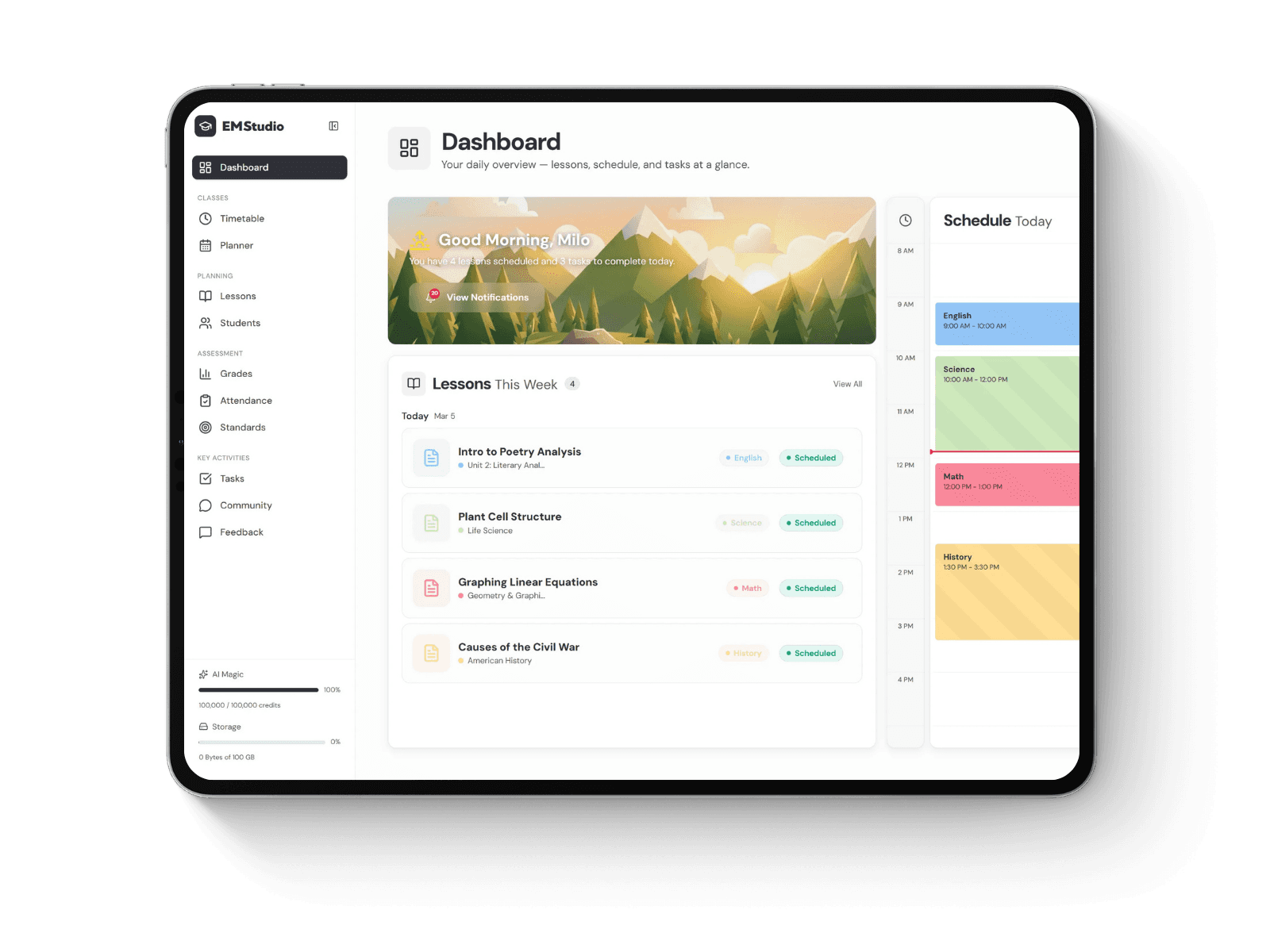
Still grading everything by hand?
EMStudio is a free teaching management app — manage your classes, students, lessons, and more!
Learn More
Table of Contents
Preparing Your Classroom for Games Based Learning
Structural preparation means furniture and devices. Pedagogical preparation means aligning your game based learning in the classroom to standards and establishing rules. You need both. Teachers who skip the alignment work often watch their initiatives devolve into chaos within weeks. Set your failure protocols now: What happens when the Wi-Fi drops or a student refuses to join the team? Decide before you plug anything in.
Understanding the Types of Game Based Learning
Not all digital play is equal. You need distinct types of game based learning for different targets. COTS games like Minecraft: Education Edition run $12 per user annually and suit grades 3-8 best for project-based learning. Budget 30 minutes for world setup. Serious Games like DragonBox Numbers cost $7.99 per app and target grades K-2 for numeracy foundations with 10-minute setup. Gamified assessment platforms like Gimkit offer a free tier with 5 kits for grades 5-12, perfect for retrieval practice and formative assessment.
Choose based on your target. Teaching abstract concepts like algebra or physics? Use Serious Games. Building fluency in vocabulary or math facts? Deploy gamified assessment tools. Developing systems thinking with 4th graders? COTS sandbox games win. Match the specific mechanic to the mental work you need.
Essential Technology and Materials Checklist
6-8 game stations for 30 students, grouping 4-5 students per station.
15+ Chromebooks or a charging cart for 1:1 digital play.
200 card sleeves for reusable flash cards, costing roughly $12.
Sand timers set with 1-minute, 3-minute, and 5-minute limits for turns.
Whiteboard dice for quiet rolling during kinesthetic learning activities.
3-drawer rolling cart labeled by subject for organized storage.
Backup paper packets for immediate tech failure contingencies.
Initial budget of $50-100 for analog materials and supplies.
Verify infrastructure. Cloud-based games need 3 Mbps per device. Download offline-capable apps for low-connectivity environments. Station rotation requires a 1:4 device ratio minimum to support collaborative learning. proven gamification methods to boost student interest require functional tech.
Aligning Games Based Learning with Your Teaching Context
Map your format to your schedule. For classes of 25-34 students with 45-minute periods, run station rotation with 4 games cycling every 11 minutes. For 90-minute blocks, schedule 2 extended 35-minute game sessions with 10-minute debriefs. This structure prevents the common failure mode of fun without actual learning.
Check prerequisites first. Students need 80% accuracy on baseline skills before playing "level-up" games. This prevents cognitive overload and frustration behaviors. Intrinsic motivation collapses when kids fail publicly at mechanics they lack the foundation to perform.
Align to the verb. Map games to specific standard codes like CCSS.MATH.CONTENT.4.NBT.B.4 rather than broad "math topics." Ensure the game mechanic directly practices the standard's required action—whether it is analyze, compare, or compute. Specificity creates games based learning that actually moves the needle on assessment data.

Step 1 — Audit Your Curriculum and Define Learning Objectives
Start with triage. Pick three to five power standards per unit that eat up your time but still leave kids confused. These are your games based learning candidates—concepts where traditional lectures fall flat. Look for standards that demand high-leverage skills but resist worksheet mastery.
Match the cognitive load using the Depth of Knowledge (DOK) framework. Simple recall objectives collapse under heavy simulation; complex synthesis drowns in flashcard drills. Research on instructional alignment indicates that when game mechanics match learning objectives at the cognitive level (DOK), transfer of learning increases significantly compared to mismatched activities. Alignment matters more than graphics.
Use aligning standards with your curriculum tools to map these targets before you shop for games. This game based learning method prevents buying fancy software that teaches what students already know.
Mapping Standards to Game Mechanics
Map DOK levels to specific game structures. DOK 1 (Recall) pairs with flash card races like Quizlet Live—keep these under ten minutes for quick collaborative learning. DOK 2 (Skill/Concept) fits strategy board games; use Prime Climb for factors and multiples with twenty-minute sessions. DOK 3 (Strategic Thinking) needs sandbox simulations like PhET or Minecraft for volume exploration, running thirty minutes or more.
Check the verb in your standard. NGSS MS-PS1-2 asks students to analyze and interpret data on substance properties. Map this to a "CSI: Chemistry" board game where kids analyze fake evidence and justify claims using density calculations. The game action mirrors the "analyze" verb in your target objective.
Verify alignment with a Bloom's Taxonomy wheel. If the standard needs evaluating, but the game only requires sorting cards into piles, you have a mismatch. The wheel exposes gaps between what you need taught and what the game actually delivers before you print the rules.
Distinguishing Practice Games from Concept Introduction Games
Practice games build fluency through spaced repetition algorithms like Anki or Gimkit. Run these for ten to fifteen minutes on Day Three or later of a unit. They target automaticity only, offering built-in formative assessment through instant feedback. Swap your "Mad Minutes" worksheets for Multiplication War card games to add retrieval practice and light collaborative learning without the anxiety.
Concept introduction games work differently than gamification overlays. They are exploratory and failure-positive—no penalties for wrong answers. Use them on Day One for twenty to five minutes. DragonBox introduces algebraic thinking through puzzle discovery; PhET simulations let students construct physics principles themselves. This game based approach leverages intrinsic motivation and kinesthetic learning.
Run a five-question pre-test to decide. If the class scores below fifty percent mastery, deploy concept introduction games. Above fifty percent, use practice games. Never use practice games for initial concept exposure; drilling unknown material wastes time and kills curiosity.
Step 2 — Select the Right Game Format for Your Students
Start with one question: Do you need granular data tracking? If yes, choose digital. If no, ask whether your students need tactile manipulation. Yes means analog. This decision tree saves you from buying a game teaching method that sits in the closet.
Setup Time: Digital 5 minutes vs Analog 15 minutes
Cost per Student: Digital $0-15/year vs Analog $3-5 one-time
Data Granularity: Item analysis vs Observation only
Social Skill Development: Low vs High
Best Content Type: Fluency vs Spatial reasoning
Check your IEPs first. Students with dysgraphia often require digital input. Students with ADHD frequently benefit from kinesthetic analog games that channel fidgeting into games based learning.
Digital Platforms vs. Analog Games
Digital tools offer automatic differentiation. IXL and Prodigy adjust difficulty in real-time. You get instant data export for gradebooks. Setup takes five minutes—just share a URL. Use these for large classes over thirty students, standards requiring immediate feedback, or remote environments.
Analog options rely on physical manipulation. Sum Swamp or Rush Hour cost $20-50 once. They work without Wi-Fi. They build social skills and serve as your power-outage backup plan. The tactile nature reinforces fine motor skills and supports kinesthetic learning.
Compare Blooket—free, max sixty students, high engagement—with the physical Fraction Pizza game from Lakeshore Learning at $24.99 for four players. The digital scales. The analog focuses.
Flash Card Games and Low-Prep Options
Flash card games maximize retrieval practice. Run Speed Drill: Partner A quizzes B for three minutes using a twenty-card deck. Switch roles. Track personal best accuracy percentages. For Concentration, use fifteen pairs maximum in a ten-minute window. Students must say terms aloud when flipping. Chain Reaction uses exactly twenty-eight cards for a class of twenty-eight. Each student solves one step in the "I Have/Who Has" sequence.
Use colored card stock. Blue for vocabulary, yellow for math, green for science. Laminate for three-plus year lifespans. Store in zippered pencil pouches.
Adapt by grade. Kindergarten and first grade use picture-symbols only. Middle school uses algebraic expression cards. High school uses AP terminology with examples. You can also explore digital flashcard apps that utilize spaced repetition for older students.
Collaborative Challenges vs. Individual Quests
Collaborative learning structures work best with four to six students per group. Use heterogeneous ability grouping—mix high, medium, and low performers. Set a shared goal like an Escape Room or Breakout EDU kit ($125). Require accountability: each member signs off on one solution step before the group proceeds.
Individual quests use self-paced mastery gating. Students cannot proceed until hitting eighty percent accuracy. Examples include Duolingo for language, Khan Academy exercises, or single-player card games like Solitaire Math. This format supports formative assessment of individual growth.
Choose collaborative when your standards contain verbs like "discuss," "negotiate," or "peer review." Choose individual for IEP accommodations, focused remediation, or when you must track precise growth metrics. This choice drives intrinsic motivation better than any gamification badge.
Step 3 — How Do You Integrate Games Based Learning Without Losing Instructional Time?
Integrate games based learning without losing instructional time by using the replacement strategy—swap worksheets for equivalent game-based practice—or micro-gaming with 5-minute retrieval sessions during transitions. Station rotations allow simultaneous small-group gaming while others receive direct instruction, preserving core instructional minutes while increasing engagement.
You don't need extra minutes. You need better minutes. Swap the dead time for active retrieval without touching your pacing guide.
Think time neutral. Your games based learning should replace existing activities of equal duration, not supplement your packed pacing guide. Trade your Tuesday vocabulary worksheet for a vocabulary relay covering the exact same word list. Same standard, same time block, better engagement. Only add games if you trim other content first, or if your district runs a mastery-based grading system that allows flexible timing.
Beware the switch cost. Moving between traditional worksheets and game modalities burns 5-7 minutes per transition as students recalibrate. Without clear protocols, you lose the very time you tried to save. That chaos creates resistance, and suddenly you're abandoning game based teaching for "just getting through the material."
The Replacement Strategy vs. Supplement Approach
Identify 15-20 minutes of weekly instruction currently spent on repetitive practice. Swap that worksheet or silent drill for a game delivering identical standard coverage. Replace "Weekly Vocabulary Worksheet" with "Vocabulary Scattergories" using the same word list. Same learning target, different delivery.
Never double-dip. Avoid having students complete both the worksheet AND the game on identical skills. That redundancy breeds student resistance and burns goodwill fast. Only supplement if you cut something else first.
If you're behind the district pacing guide, use replacement only. If you're on track, reserve Friday enrichment games. If you're ahead, deploy games for extension. Protect your core instructional minutes first.
Micro-Gaming: 5-Minute Integration Windows
Run three micro-gaming formats: "Ticket to Leave" turns your exit ticket into a beat-the-timer challenge with three questions. "Do Now Dice" has students roll to determine which review question to answer as a bell-ringer. "Vocabulary Speed Dating" runs two-minute rounds where students pair-share definitions then rotate.
Cap it at three micro-games per day. More creates cognitive whiplash. Drop them during transitions between subjects as a mental palette cleanser, or use them as "Do Now" warm-ups. Check out these time-saving classroom hacks for more transition tricks.
Reserve micro-gaming for retrieval practice only. Never introduce new concepts in a five-minute window; that requires sustained attention you can't cram into a bell-ringer.
Transition Rituals Between Traditional and Game Teaching Methods
Establish a consistent sensory signal for game mode. Play a specific 15-second song like "Eye of the Tiger" or dim half the lights. Students shift cognitive states within seconds. It takes two or three uses to condition the response.
Run a two-minute "Brain Dump" immediately post-game. Students write one thing learned and one question remaining before returning to traditional seating. This prevents energy spillover that derails your next segment.
For every 20 minutes of gameplay, budget 3 minutes setup and 2 minutes debrief. Never skip the debrief to "save time"—that nullifies your formative assessment gains and wastes the game entirely.

Step 4 — Facilitate Gameplay While Maintaining Academic Rigor
Setting Learning-First Rules and Expectations
Keep the Academic Talk Ratio at 2:1. Content discussion must double the game mechanics chatter. I audio sample every five minutes—thirty seconds of listening—to check this balance. If kids debate dice rolls instead of fractions, I intervene immediately. This prevents games based learning from becoming mere play.
Your rule hierarchy matters. Content accuracy comes before speed. Answers must be correct before points hit the board. Speed without accuracy reinforces misconceptions. Enforce "Ask three before me" so peers coach first. Teach the Pause and Respect hand signal. When raised, all action freezes within five seconds. These classroom management games that maintain order only work with clear consequences.
Consequences escalate fast so students know you mean business. First off-topic infraction earns a two-minute observation timeout where they watch others play. Second strike means switching to a parallel worksheet covering identical content. Third offense kills game privileges for forty-eight hours with parent notification. No appeals.
In Science Jeopardy, answers require "because..." followed by evidence. Guessing gets half points. This ensures retrieval practice with justification, not lucky clicks.
Managing Competition to Prevent Anxiety
Research shows unmanaged competition triggers performance anxiety in twenty to thirty percent of students according to major educational studies. That stress shuts down working memory and kills the benefits of game based learning. You must design anxiety out from the start.
Offer Pass tokens—three per student per game—for skips without penalty. Allow "Phone a Friend" in individual rounds. Use a Team Bank where points pool instead of ranking individuals. Structure sixty percent of games as "beat your previous score" rather than beating other teams. This focuses growth mindset. Try inter-class competition—third period versus fourth period—instead of intra-class battles for sensitive groups.
Provide an opt-out. Students with documented test anxiety serve as Game Master. They read questions, track scores, verify answers using answer keys. They learn through observation and formative assessment of peers without performance pressure. This gamification strategy protects intrinsic motivation while maintaining the collaborative learning environment.
Scaffolding Games Based Learning in the Classroom for Diverse Learners
Games based learning in the classroom fails if it only engages high achievers. It becomes a reward for the already successful. Use these supporting differentiated instruction strategies to make it an equity tool for everyone.
For IEP students, grant time-and-a-half for turns. Provide visual rule cards with picture cues. Reduce answer choices from four to three. Require Think-Pair-Share before answering to cut processing pressure. These accommodations ensure kinesthetic learning remains accessible.
ELL students need bilingual glossary cards during play. Pre-teach game vocabulary twenty-four hours prior so they know terms like "bank" or "trade." Offer sentence starter cards: "I think the answer is... because..." This scaffolds language without diluting content.
For gifted learners, deploy Challenge Cards. After winning the base game, they must teach the concept to an imaginary third grader or create a new rule increasing complexity. This extends kinesthetic learning into synthesis and creation.

Step 5 — Assess Outcomes and Scale Your Implementation
You need to know if the game actually taught anything, or if kids just had fun. Formative assessment happens while they play—watching, listening, catching misconceptions as cards hit the table. Summative transfer tasks come later—a worksheet, a quiz, a conversation two days removed from the game context to see if knowledge stuck.
Watch for the Stop and Re-teach moment. When digital data or your clipboard shows less than 60% accuracy on a specific question type, hit pause. Spend three minutes on a micro-lesson right then, then release them back to play. Don't wait until tomorrow.
Your data drives scaling decisions. If post-game assessments tank, your games based learning approach needs tweaking before you expand it to the next unit.
Embedded Assessment Techniques During Play
Digital tools make this easy. Export your Kahoot or Gimkit reports and look at item analysis by standard. Find the questions where fewer than 60% of your class got it right. Those are your reteaching targets for tomorrow's warm-up, not next week's review. Check out these formative assessment examples for immediate use if you need starters.
Keep a clipboard roster for analog tracking. Make tally marks for who participates and who hides. Note error patterns in real time—"confuses area with perimeter" or "skips multi-step problems." Spend three-minute windows scanning the room while they play. You'll see more authentic work than during traditional worksheets.
When half your teams miss a question, stop the music. Display the correct answer. Give teams 90 seconds to discuss why it works, then resume. This builds retrieval practice into the flow without killing momentum.
Student-Led Debriefing Protocols
Don't lecture the answers. Use the Connect-Extend-Challenge protocol instead. Students write: (1) How this connects to last week's lesson; (2) A real-world use for this skill; (3) One question they still have. This forces intrinsic motivation through curiosity, not points.
Rotate a Discussion Director role. This student poses one higher-order question using Bloom's verbs—"Analyze why this strategy failed" or "Evaluate which approach was fastest." It shifts collaborative learning ownership to them.
Require a Game Log entry. Date, game name, standard with code, one mistake corrected, one strategy to reuse. Five sentences minimum. These entries become evidence for parent conferences and show growth better than any test score.
Iterating Your Game Based Learning Method
Run a PDSA cycle on every game you deploy. Plan which standard you're targeting. Do it for one week. Study the pre-test versus post-test data. Act: if you hit 75% proficiency, expand to the next unit. If you're between 50-75%, try a different game format. Below 50%? Return to direct instruction for that concept. No shame in pivoting.
Use a scaling matrix. Post-game assessment showing 80%+ proficiency means expand your game based learning method. 60-80% means maintain current levels. Below 60%? Reduce or modify before you damage trust in the approach. This differs from pure gamification—points without learning targets.
Build student Game Portfolios. Photos of board game states, digital badge screenshots, reflection logs. Show these at conferences to demonstrate kinesthetic learning growth trajectories to skeptical parents or administrators.

Avoid These Pitfalls When Teaching Through Games
Treating teaching through games as entertainment rather than methodology guarantees failure. The pitfalls below represent honest failure modes I have witnessed or committed myself. Collaborative learning dies when the game mechanics overshadow the standards. Burnout hits when teachers attempt overnight transformation. Pace yourself. This is a multi-year evolution.
Mistake: Prioritizing Entertainment Over Standards
Games based learning collapses when the game becomes the point. You know you've lost the plot when students can describe every mechanic—I moved the dragon to level five and collected the gems—but draw blanks on the standard. Ask them what photosynthesis means. Watch the silence. That disconnect signals entertainment has defeated education.
Run a Friday Follow-up quiz that strips away all context. No dragons. No gems. Just the content. This formative assessment reveals true understanding. If they cannot transfer the knowledge, you were running an arcade, not a classroom. Track time spent customizing avatars versus reading text. When decorative chrome eats more than twenty percent of your block, switch to the stripped-down version until mastery appears.
If entertainment hijacks learning, go cold turkey. Switch to text-only mode for one week. Then reintroduce one engagement layer at a time while monitoring the academic talk ratio. When student conversation centers on strategy rather than skins, you've restored balance.
Mistake: Skipping the Debrief and Reflection Phase
Active learning without consolidation evaporates. Research indicates that reflection immediately following kinesthetic learning activities significantly boosts retention compared to passive transitions. Skip the debrief and you nullify the gains. The game becomes busy work. That loss stings worse than never playing at all.
Even when the bell looms, protect ninety seconds. Use a one-minute turn and talk or a single-sentence exit ticket: What is one thing you learned today that you did not know yesterday? This minimum viable reflection forces retrieval practice while the neural pathways are still warm and pliable.
When administrators observe and mutter that it looks like play, direct them to the debrief. This is where explicit standard alignment lives. This is where students generate academic language to justify their moves. The structured reflection proves game based teaching is methodology, not recess.
Building Your Long-Term Games Based Learning Strategy
Transforming your practice takes three years, not three weekends. Year one: pilot one game per quarter in a single subject. Master the flow. Year two: expand to one game per month across subjects. Year three: students design their own using templates like Guts and Bolts, building intrinsic motivation through creation. This is sustainable gamification.
Request your budget in April. Ask for two hundred to five hundred dollars covering five to ten quality board games from Lakeshore Learning or Amazon, or premium subscriptions like Kahoot Premium at eighty-four dollars yearly. Early requests signal intentional teaching through games, not impulse buying.
Build a support structure. Identify one Game Coach per grade level to mentor peers. Shared resource banks and observation feedback cut individual prep time by forty percent. Check our list of classroom games that actually improve learning outcomes to stock your initial library.
Quick-Start Guide for Games Based Learning
You do not need to overhaul your entire curriculum by Friday. Pick one standard that flops every year—maybe those fractions lessons in March—and swap in a single game-based activity. Watch how intrinsic motivation shifts when students chase points they actually care about. Formative assessment lives naturally inside good gameplay. You will see who understands the concept and who is just clicking buttons within the first ten minutes. That real-time data beats a worksheet hand-graded three days later.
Ready to try it? Start with this plan:
Pick your pain-point lesson—the one that always bombs.
Match it to a kinesthetic learning game format that fits your space.
Run it for twenty minutes tomorrow. Take notes on engagement, not scores.
Adjust and repeat. Gamification is a dial, not a switch.

Preparing Your Classroom for Games Based Learning
Structural preparation means furniture and devices. Pedagogical preparation means aligning your game based learning in the classroom to standards and establishing rules. You need both. Teachers who skip the alignment work often watch their initiatives devolve into chaos within weeks. Set your failure protocols now: What happens when the Wi-Fi drops or a student refuses to join the team? Decide before you plug anything in.
Understanding the Types of Game Based Learning
Not all digital play is equal. You need distinct types of game based learning for different targets. COTS games like Minecraft: Education Edition run $12 per user annually and suit grades 3-8 best for project-based learning. Budget 30 minutes for world setup. Serious Games like DragonBox Numbers cost $7.99 per app and target grades K-2 for numeracy foundations with 10-minute setup. Gamified assessment platforms like Gimkit offer a free tier with 5 kits for grades 5-12, perfect for retrieval practice and formative assessment.
Choose based on your target. Teaching abstract concepts like algebra or physics? Use Serious Games. Building fluency in vocabulary or math facts? Deploy gamified assessment tools. Developing systems thinking with 4th graders? COTS sandbox games win. Match the specific mechanic to the mental work you need.
Essential Technology and Materials Checklist
6-8 game stations for 30 students, grouping 4-5 students per station.
15+ Chromebooks or a charging cart for 1:1 digital play.
200 card sleeves for reusable flash cards, costing roughly $12.
Sand timers set with 1-minute, 3-minute, and 5-minute limits for turns.
Whiteboard dice for quiet rolling during kinesthetic learning activities.
3-drawer rolling cart labeled by subject for organized storage.
Backup paper packets for immediate tech failure contingencies.
Initial budget of $50-100 for analog materials and supplies.
Verify infrastructure. Cloud-based games need 3 Mbps per device. Download offline-capable apps for low-connectivity environments. Station rotation requires a 1:4 device ratio minimum to support collaborative learning. proven gamification methods to boost student interest require functional tech.
Aligning Games Based Learning with Your Teaching Context
Map your format to your schedule. For classes of 25-34 students with 45-minute periods, run station rotation with 4 games cycling every 11 minutes. For 90-minute blocks, schedule 2 extended 35-minute game sessions with 10-minute debriefs. This structure prevents the common failure mode of fun without actual learning.
Check prerequisites first. Students need 80% accuracy on baseline skills before playing "level-up" games. This prevents cognitive overload and frustration behaviors. Intrinsic motivation collapses when kids fail publicly at mechanics they lack the foundation to perform.
Align to the verb. Map games to specific standard codes like CCSS.MATH.CONTENT.4.NBT.B.4 rather than broad "math topics." Ensure the game mechanic directly practices the standard's required action—whether it is analyze, compare, or compute. Specificity creates games based learning that actually moves the needle on assessment data.
Step 1 — Audit Your Curriculum and Define Learning Objectives
Start with triage. Pick three to five power standards per unit that eat up your time but still leave kids confused. These are your games based learning candidates—concepts where traditional lectures fall flat. Look for standards that demand high-leverage skills but resist worksheet mastery.
Match the cognitive load using the Depth of Knowledge (DOK) framework. Simple recall objectives collapse under heavy simulation; complex synthesis drowns in flashcard drills. Research on instructional alignment indicates that when game mechanics match learning objectives at the cognitive level (DOK), transfer of learning increases significantly compared to mismatched activities. Alignment matters more than graphics.
Use aligning standards with your curriculum tools to map these targets before you shop for games. This game based learning method prevents buying fancy software that teaches what students already know.
Mapping Standards to Game Mechanics
Map DOK levels to specific game structures. DOK 1 (Recall) pairs with flash card races like Quizlet Live—keep these under ten minutes for quick collaborative learning. DOK 2 (Skill/Concept) fits strategy board games; use Prime Climb for factors and multiples with twenty-minute sessions. DOK 3 (Strategic Thinking) needs sandbox simulations like PhET or Minecraft for volume exploration, running thirty minutes or more.
Check the verb in your standard. NGSS MS-PS1-2 asks students to analyze and interpret data on substance properties. Map this to a "CSI: Chemistry" board game where kids analyze fake evidence and justify claims using density calculations. The game action mirrors the "analyze" verb in your target objective.
Verify alignment with a Bloom's Taxonomy wheel. If the standard needs evaluating, but the game only requires sorting cards into piles, you have a mismatch. The wheel exposes gaps between what you need taught and what the game actually delivers before you print the rules.
Distinguishing Practice Games from Concept Introduction Games
Practice games build fluency through spaced repetition algorithms like Anki or Gimkit. Run these for ten to fifteen minutes on Day Three or later of a unit. They target automaticity only, offering built-in formative assessment through instant feedback. Swap your "Mad Minutes" worksheets for Multiplication War card games to add retrieval practice and light collaborative learning without the anxiety.
Concept introduction games work differently than gamification overlays. They are exploratory and failure-positive—no penalties for wrong answers. Use them on Day One for twenty to five minutes. DragonBox introduces algebraic thinking through puzzle discovery; PhET simulations let students construct physics principles themselves. This game based approach leverages intrinsic motivation and kinesthetic learning.
Run a five-question pre-test to decide. If the class scores below fifty percent mastery, deploy concept introduction games. Above fifty percent, use practice games. Never use practice games for initial concept exposure; drilling unknown material wastes time and kills curiosity.
Step 2 — Select the Right Game Format for Your Students
Start with one question: Do you need granular data tracking? If yes, choose digital. If no, ask whether your students need tactile manipulation. Yes means analog. This decision tree saves you from buying a game teaching method that sits in the closet.
Setup Time: Digital 5 minutes vs Analog 15 minutes
Cost per Student: Digital $0-15/year vs Analog $3-5 one-time
Data Granularity: Item analysis vs Observation only
Social Skill Development: Low vs High
Best Content Type: Fluency vs Spatial reasoning
Check your IEPs first. Students with dysgraphia often require digital input. Students with ADHD frequently benefit from kinesthetic analog games that channel fidgeting into games based learning.
Digital Platforms vs. Analog Games
Digital tools offer automatic differentiation. IXL and Prodigy adjust difficulty in real-time. You get instant data export for gradebooks. Setup takes five minutes—just share a URL. Use these for large classes over thirty students, standards requiring immediate feedback, or remote environments.
Analog options rely on physical manipulation. Sum Swamp or Rush Hour cost $20-50 once. They work without Wi-Fi. They build social skills and serve as your power-outage backup plan. The tactile nature reinforces fine motor skills and supports kinesthetic learning.
Compare Blooket—free, max sixty students, high engagement—with the physical Fraction Pizza game from Lakeshore Learning at $24.99 for four players. The digital scales. The analog focuses.
Flash Card Games and Low-Prep Options
Flash card games maximize retrieval practice. Run Speed Drill: Partner A quizzes B for three minutes using a twenty-card deck. Switch roles. Track personal best accuracy percentages. For Concentration, use fifteen pairs maximum in a ten-minute window. Students must say terms aloud when flipping. Chain Reaction uses exactly twenty-eight cards for a class of twenty-eight. Each student solves one step in the "I Have/Who Has" sequence.
Use colored card stock. Blue for vocabulary, yellow for math, green for science. Laminate for three-plus year lifespans. Store in zippered pencil pouches.
Adapt by grade. Kindergarten and first grade use picture-symbols only. Middle school uses algebraic expression cards. High school uses AP terminology with examples. You can also explore digital flashcard apps that utilize spaced repetition for older students.
Collaborative Challenges vs. Individual Quests
Collaborative learning structures work best with four to six students per group. Use heterogeneous ability grouping—mix high, medium, and low performers. Set a shared goal like an Escape Room or Breakout EDU kit ($125). Require accountability: each member signs off on one solution step before the group proceeds.
Individual quests use self-paced mastery gating. Students cannot proceed until hitting eighty percent accuracy. Examples include Duolingo for language, Khan Academy exercises, or single-player card games like Solitaire Math. This format supports formative assessment of individual growth.
Choose collaborative when your standards contain verbs like "discuss," "negotiate," or "peer review." Choose individual for IEP accommodations, focused remediation, or when you must track precise growth metrics. This choice drives intrinsic motivation better than any gamification badge.
Step 3 — How Do You Integrate Games Based Learning Without Losing Instructional Time?
Integrate games based learning without losing instructional time by using the replacement strategy—swap worksheets for equivalent game-based practice—or micro-gaming with 5-minute retrieval sessions during transitions. Station rotations allow simultaneous small-group gaming while others receive direct instruction, preserving core instructional minutes while increasing engagement.
You don't need extra minutes. You need better minutes. Swap the dead time for active retrieval without touching your pacing guide.
Think time neutral. Your games based learning should replace existing activities of equal duration, not supplement your packed pacing guide. Trade your Tuesday vocabulary worksheet for a vocabulary relay covering the exact same word list. Same standard, same time block, better engagement. Only add games if you trim other content first, or if your district runs a mastery-based grading system that allows flexible timing.
Beware the switch cost. Moving between traditional worksheets and game modalities burns 5-7 minutes per transition as students recalibrate. Without clear protocols, you lose the very time you tried to save. That chaos creates resistance, and suddenly you're abandoning game based teaching for "just getting through the material."
The Replacement Strategy vs. Supplement Approach
Identify 15-20 minutes of weekly instruction currently spent on repetitive practice. Swap that worksheet or silent drill for a game delivering identical standard coverage. Replace "Weekly Vocabulary Worksheet" with "Vocabulary Scattergories" using the same word list. Same learning target, different delivery.
Never double-dip. Avoid having students complete both the worksheet AND the game on identical skills. That redundancy breeds student resistance and burns goodwill fast. Only supplement if you cut something else first.
If you're behind the district pacing guide, use replacement only. If you're on track, reserve Friday enrichment games. If you're ahead, deploy games for extension. Protect your core instructional minutes first.
Micro-Gaming: 5-Minute Integration Windows
Run three micro-gaming formats: "Ticket to Leave" turns your exit ticket into a beat-the-timer challenge with three questions. "Do Now Dice" has students roll to determine which review question to answer as a bell-ringer. "Vocabulary Speed Dating" runs two-minute rounds where students pair-share definitions then rotate.
Cap it at three micro-games per day. More creates cognitive whiplash. Drop them during transitions between subjects as a mental palette cleanser, or use them as "Do Now" warm-ups. Check out these time-saving classroom hacks for more transition tricks.
Reserve micro-gaming for retrieval practice only. Never introduce new concepts in a five-minute window; that requires sustained attention you can't cram into a bell-ringer.
Transition Rituals Between Traditional and Game Teaching Methods
Establish a consistent sensory signal for game mode. Play a specific 15-second song like "Eye of the Tiger" or dim half the lights. Students shift cognitive states within seconds. It takes two or three uses to condition the response.
Run a two-minute "Brain Dump" immediately post-game. Students write one thing learned and one question remaining before returning to traditional seating. This prevents energy spillover that derails your next segment.
For every 20 minutes of gameplay, budget 3 minutes setup and 2 minutes debrief. Never skip the debrief to "save time"—that nullifies your formative assessment gains and wastes the game entirely.
Step 4 — Facilitate Gameplay While Maintaining Academic Rigor
Setting Learning-First Rules and Expectations
Keep the Academic Talk Ratio at 2:1. Content discussion must double the game mechanics chatter. I audio sample every five minutes—thirty seconds of listening—to check this balance. If kids debate dice rolls instead of fractions, I intervene immediately. This prevents games based learning from becoming mere play.
Your rule hierarchy matters. Content accuracy comes before speed. Answers must be correct before points hit the board. Speed without accuracy reinforces misconceptions. Enforce "Ask three before me" so peers coach first. Teach the Pause and Respect hand signal. When raised, all action freezes within five seconds. These classroom management games that maintain order only work with clear consequences.
Consequences escalate fast so students know you mean business. First off-topic infraction earns a two-minute observation timeout where they watch others play. Second strike means switching to a parallel worksheet covering identical content. Third offense kills game privileges for forty-eight hours with parent notification. No appeals.
In Science Jeopardy, answers require "because..." followed by evidence. Guessing gets half points. This ensures retrieval practice with justification, not lucky clicks.
Managing Competition to Prevent Anxiety
Research shows unmanaged competition triggers performance anxiety in twenty to thirty percent of students according to major educational studies. That stress shuts down working memory and kills the benefits of game based learning. You must design anxiety out from the start.
Offer Pass tokens—three per student per game—for skips without penalty. Allow "Phone a Friend" in individual rounds. Use a Team Bank where points pool instead of ranking individuals. Structure sixty percent of games as "beat your previous score" rather than beating other teams. This focuses growth mindset. Try inter-class competition—third period versus fourth period—instead of intra-class battles for sensitive groups.
Provide an opt-out. Students with documented test anxiety serve as Game Master. They read questions, track scores, verify answers using answer keys. They learn through observation and formative assessment of peers without performance pressure. This gamification strategy protects intrinsic motivation while maintaining the collaborative learning environment.
Scaffolding Games Based Learning in the Classroom for Diverse Learners
Games based learning in the classroom fails if it only engages high achievers. It becomes a reward for the already successful. Use these supporting differentiated instruction strategies to make it an equity tool for everyone.
For IEP students, grant time-and-a-half for turns. Provide visual rule cards with picture cues. Reduce answer choices from four to three. Require Think-Pair-Share before answering to cut processing pressure. These accommodations ensure kinesthetic learning remains accessible.
ELL students need bilingual glossary cards during play. Pre-teach game vocabulary twenty-four hours prior so they know terms like "bank" or "trade." Offer sentence starter cards: "I think the answer is... because..." This scaffolds language without diluting content.
For gifted learners, deploy Challenge Cards. After winning the base game, they must teach the concept to an imaginary third grader or create a new rule increasing complexity. This extends kinesthetic learning into synthesis and creation.
Step 5 — Assess Outcomes and Scale Your Implementation
You need to know if the game actually taught anything, or if kids just had fun. Formative assessment happens while they play—watching, listening, catching misconceptions as cards hit the table. Summative transfer tasks come later—a worksheet, a quiz, a conversation two days removed from the game context to see if knowledge stuck.
Watch for the Stop and Re-teach moment. When digital data or your clipboard shows less than 60% accuracy on a specific question type, hit pause. Spend three minutes on a micro-lesson right then, then release them back to play. Don't wait until tomorrow.
Your data drives scaling decisions. If post-game assessments tank, your games based learning approach needs tweaking before you expand it to the next unit.
Embedded Assessment Techniques During Play
Digital tools make this easy. Export your Kahoot or Gimkit reports and look at item analysis by standard. Find the questions where fewer than 60% of your class got it right. Those are your reteaching targets for tomorrow's warm-up, not next week's review. Check out these formative assessment examples for immediate use if you need starters.
Keep a clipboard roster for analog tracking. Make tally marks for who participates and who hides. Note error patterns in real time—"confuses area with perimeter" or "skips multi-step problems." Spend three-minute windows scanning the room while they play. You'll see more authentic work than during traditional worksheets.
When half your teams miss a question, stop the music. Display the correct answer. Give teams 90 seconds to discuss why it works, then resume. This builds retrieval practice into the flow without killing momentum.
Student-Led Debriefing Protocols
Don't lecture the answers. Use the Connect-Extend-Challenge protocol instead. Students write: (1) How this connects to last week's lesson; (2) A real-world use for this skill; (3) One question they still have. This forces intrinsic motivation through curiosity, not points.
Rotate a Discussion Director role. This student poses one higher-order question using Bloom's verbs—"Analyze why this strategy failed" or "Evaluate which approach was fastest." It shifts collaborative learning ownership to them.
Require a Game Log entry. Date, game name, standard with code, one mistake corrected, one strategy to reuse. Five sentences minimum. These entries become evidence for parent conferences and show growth better than any test score.
Iterating Your Game Based Learning Method
Run a PDSA cycle on every game you deploy. Plan which standard you're targeting. Do it for one week. Study the pre-test versus post-test data. Act: if you hit 75% proficiency, expand to the next unit. If you're between 50-75%, try a different game format. Below 50%? Return to direct instruction for that concept. No shame in pivoting.
Use a scaling matrix. Post-game assessment showing 80%+ proficiency means expand your game based learning method. 60-80% means maintain current levels. Below 60%? Reduce or modify before you damage trust in the approach. This differs from pure gamification—points without learning targets.
Build student Game Portfolios. Photos of board game states, digital badge screenshots, reflection logs. Show these at conferences to demonstrate kinesthetic learning growth trajectories to skeptical parents or administrators.
Avoid These Pitfalls When Teaching Through Games
Treating teaching through games as entertainment rather than methodology guarantees failure. The pitfalls below represent honest failure modes I have witnessed or committed myself. Collaborative learning dies when the game mechanics overshadow the standards. Burnout hits when teachers attempt overnight transformation. Pace yourself. This is a multi-year evolution.
Mistake: Prioritizing Entertainment Over Standards
Games based learning collapses when the game becomes the point. You know you've lost the plot when students can describe every mechanic—I moved the dragon to level five and collected the gems—but draw blanks on the standard. Ask them what photosynthesis means. Watch the silence. That disconnect signals entertainment has defeated education.
Run a Friday Follow-up quiz that strips away all context. No dragons. No gems. Just the content. This formative assessment reveals true understanding. If they cannot transfer the knowledge, you were running an arcade, not a classroom. Track time spent customizing avatars versus reading text. When decorative chrome eats more than twenty percent of your block, switch to the stripped-down version until mastery appears.
If entertainment hijacks learning, go cold turkey. Switch to text-only mode for one week. Then reintroduce one engagement layer at a time while monitoring the academic talk ratio. When student conversation centers on strategy rather than skins, you've restored balance.
Mistake: Skipping the Debrief and Reflection Phase
Active learning without consolidation evaporates. Research indicates that reflection immediately following kinesthetic learning activities significantly boosts retention compared to passive transitions. Skip the debrief and you nullify the gains. The game becomes busy work. That loss stings worse than never playing at all.
Even when the bell looms, protect ninety seconds. Use a one-minute turn and talk or a single-sentence exit ticket: What is one thing you learned today that you did not know yesterday? This minimum viable reflection forces retrieval practice while the neural pathways are still warm and pliable.
When administrators observe and mutter that it looks like play, direct them to the debrief. This is where explicit standard alignment lives. This is where students generate academic language to justify their moves. The structured reflection proves game based teaching is methodology, not recess.
Building Your Long-Term Games Based Learning Strategy
Transforming your practice takes three years, not three weekends. Year one: pilot one game per quarter in a single subject. Master the flow. Year two: expand to one game per month across subjects. Year three: students design their own using templates like Guts and Bolts, building intrinsic motivation through creation. This is sustainable gamification.
Request your budget in April. Ask for two hundred to five hundred dollars covering five to ten quality board games from Lakeshore Learning or Amazon, or premium subscriptions like Kahoot Premium at eighty-four dollars yearly. Early requests signal intentional teaching through games, not impulse buying.
Build a support structure. Identify one Game Coach per grade level to mentor peers. Shared resource banks and observation feedback cut individual prep time by forty percent. Check our list of classroom games that actually improve learning outcomes to stock your initial library.
Quick-Start Guide for Games Based Learning
You do not need to overhaul your entire curriculum by Friday. Pick one standard that flops every year—maybe those fractions lessons in March—and swap in a single game-based activity. Watch how intrinsic motivation shifts when students chase points they actually care about. Formative assessment lives naturally inside good gameplay. You will see who understands the concept and who is just clicking buttons within the first ten minutes. That real-time data beats a worksheet hand-graded three days later.
Ready to try it? Start with this plan:
Pick your pain-point lesson—the one that always bombs.
Match it to a kinesthetic learning game format that fits your space.
Run it for twenty minutes tomorrow. Take notes on engagement, not scores.
Adjust and repeat. Gamification is a dial, not a switch.
Still grading everything by hand?
EMStudio is a free teaching management app — manage your classes, students, lessons, and more!
Learn More
Still grading everything by hand?
EMStudio is a free teaching management app — manage your classes, students, lessons, and more!
Learn More




Notion4Teachers
Notion templates to simplify administrative tasks and enhance your teaching experience.



2026 Notion4Teachers. All Rights Reserved.
Notion4Teachers
Notion templates to simplify administrative tasks and enhance your teaching experience.
2026 Notion4Teachers. All Rights Reserved.
Notion4Teachers
Notion templates to simplify administrative tasks and enhance your teaching experience.
2026 Notion4Teachers. All Rights Reserved.