
9 Education Software Solutions for K-12
9 Education Software Solutions for K-12

Article by
Milo
ESL Content Coordinator & Educator
ESL Content Coordinator & Educator
All Posts
Google Classroom, Canvas, and Schoology dominate K-12 LMS adoption. Google suits rapid deployment and tight Workspace integration. Canvas excels in secondary differentiation and LTI flexibility, while Schoology optimizes for elementary folder-based workflows and parent engagement.
Picking the wrong education software costs you weekends. Small districts need free tools that work next week. Large districts need platforms that won't crash when twenty thousand kids log in at once. Read our comprehensive guide to learning management systems for the full breakdown.
Districts under 2,000 students should prioritize cost-free solutions. Larger districts need enterprise scalability. Here's how the three major ed tech companies transforming K-12 classrooms compare:
Still grading everything by hand?
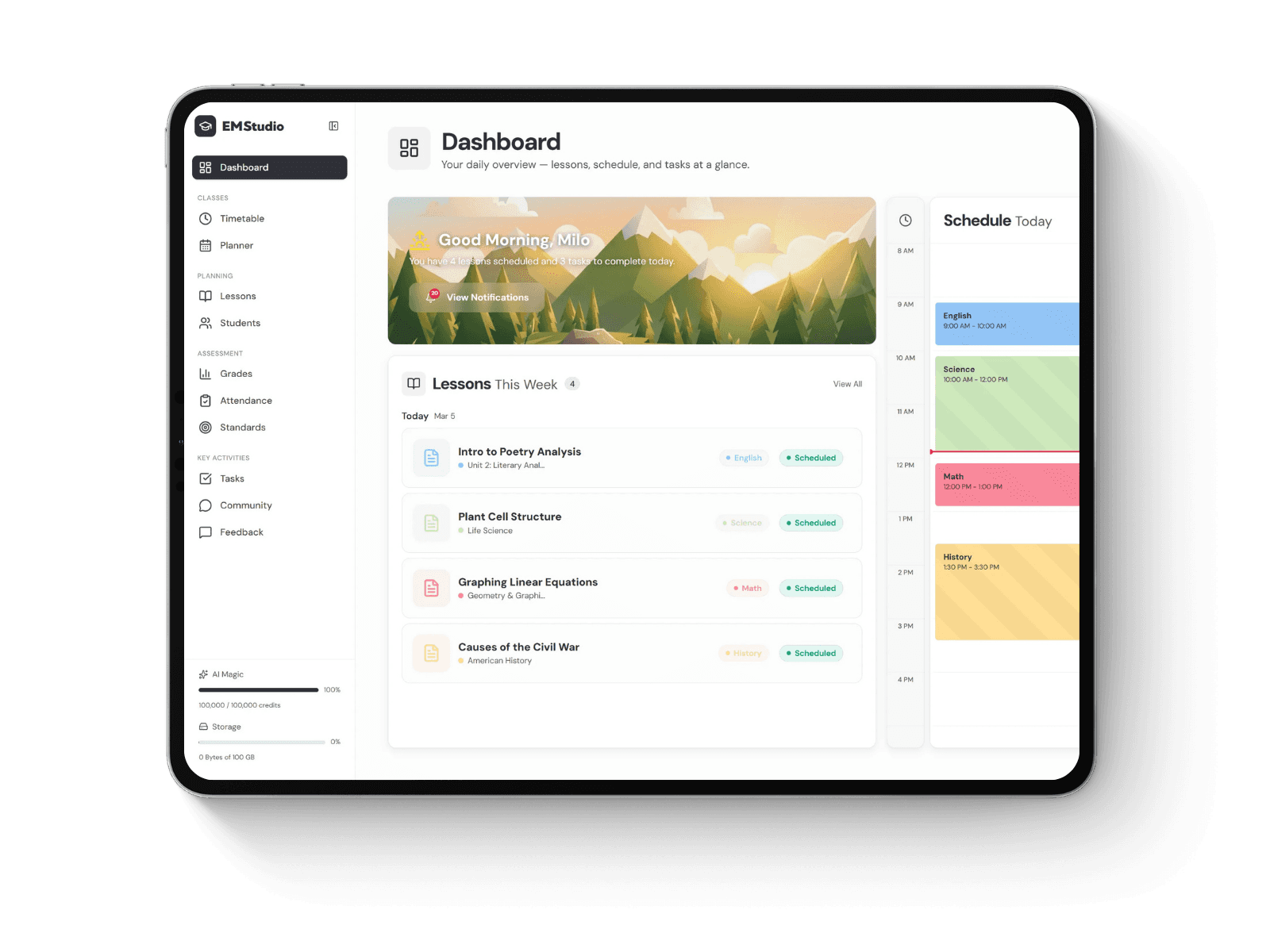
EMStudio is a free teaching management app — manage your classes, students, lessons, and more!
Learn More
Still grading everything by hand?
EMStudio is a free teaching management app — manage your classes, students, lessons, and more!
Learn More
Table of Contents
What Are the Best Learning Management Systems for K-12?
Platform | Deployment | Cost/Student | Best For | SIS Integration |
|---|---|---|---|---|
Google Classroom | 1-4 weeks | Free-$3 | K-12 | Clever, CSV |
Canvas | 6-12 months | $5-10 | 6-12 | LTI 1.3, OneRoster |
Schoology | 2-6 months | Free-$10+ | K-5 | API required |
The biggest mistake? Buying an LMS without checking if it talks to your SIS. You end up hand-entering grades into PowerSchool or Skyward every Friday night. Data stays trapped in silos. Nobody wins.
Each system has gatekeepers. Google needs Google Workspace for Education. Canvas needs LTI 1.3 compliance for external formative assessment tools. Schoology requires API access for automated roster synchronization. Check these boxes before you sign.
Google Classroom for District-Wide Deployment
Rosters sync through Clever or bulk CSV uploads with near-instant results. You get 2TB of pooled storage for the entire domain, not per user, and a hard cap of 500 students per individual class. The free Fundamentals tier covers essential classroom communication apps and basic assignment workflows. Upgrading to Plus costs $3 per student annually and unlocks advanced analytics, enhanced student data privacy controls, and premium educational technology integration has like originality reports.
This fits 1:1 Chromebook environments and districts already standardized on Google Workspace. You can deploy district-wide in under 30 days with minimal IT support, which is why small districts with stretched tech departments gravitate here for rapid software implementation.
Canvas by Instructure for Secondary Flexibility
Canvas shines in secondary settings where students juggle eight different courses. Mastery Paths automatically differentiate assignments based on prior quiz scores, pushing remediation or enrichment without manual sorting. SpeedGrader lets you record 3-minute audio or video feedback while you swipe through submissions on your tablet. The mobile app handles offline sync, which high schoolers actually use during bus rides.
LTI 1.3 Advantage certification means your favorite formative assessment tools and science simulations plug in seamlessly. But plan for a 6-12 month rollout with a dedicated implementation manager from Instructure. Budget $5-10 per student annually for the full K-12 institutional package that includes robust SIS bidirectional sync and advanced analytics.
Schoology for Elementary-Friendly Workflows
Schoology mirrors a physical classroom. Teachers drag and drop folders just like filing cabinets in a desk, organizing units by week or theme without nested menus. Students curate digital portfolios for spring parent conferences, showing growth with photos and voice recordings that parents access with one login. The interface strips away clutter, reducing cognitive load for K-2 kids who still hunt for the shift key and need large, colorful touch targets.
Basic works for individual teachers but lacks district backbone and API access for SIS sync. Enterprise unlocks mass messaging to families, granular usage analytics, and district-wide resource sharing libraries. Most elementary-focused districts pay for Enterprise licenses to get automated roster synchronization and centralized parent communication that finally replaces the Friday take-home folder.
Edmingle for STEM Enrichment and Coding Programs
Districts running after-school coding clubs, summer STEM camps, or fee-based enrichment tracks need a different toolkit than the core LMS. Edmingle's built-in compiler lets students write, run, and get graded on C, C++, Java, and Python submissions directly in the browser, while proctored exams handle year-end coding certifications without a third-party testing vendor. Live Zoom cohorts and drip-released modules keep an eight-week robotics or app-dev elective on schedule even when it only meets once a week.
Setup takes days rather than months since there's no SIS integration to negotiate: the district or PTA-run enrichment program launches its own branded site and app, with payment collection built in for paid electives. Plans start around $89 a month with a 7-day trial, and there's no per-seat revenue cut on fees families pay for the program.

Which Assessment Tools Provide Real-Time Student Insights?
Kahoot!, Formative, and MasteryConnect give you immediate visibility into student thinking through different educational technology integration approaches. Kahoot! turns assessment into a game show. Formative lets you watch kids work live. MasteryConnect tracks which standards your students actually mastered.
Each tool handles real-time data differently:
Kahoot! emphasizes gamification with 2000-player capacity for school-wide review events.
Formative specializes in live work monitoring with draw and annotate responses visible as students work.
MasteryConnect focuses on standards-based reporting with bubble sheet scanning via device cameras.
Tool | Cost | Notes |
|---|---|---|
Kahoot! | $7-17/month | Teacher plan; free tier limited to 50 players |
Formative | $12.50+/month | Silver plan starting price |
MasteryConnect | District pricing | Usually bundled with Canvas LMS |
Student data privacy varies by platform. Kahoot! requires email addresses for accounts unless you use the young learners version, which matters for COPPA compliance with under-13 users. Formative retains student work samples indefinitely unless your district negotiates deletion. MasteryConnect maintains FERPA compliance with seven-year data retention for longitudinal tracking.
Kahoot! for Gamified Formative Assessment
Kahoot! runs like a game show. Students race to answer on their devices while a leaderboard tracks the fastest correct responses. Classic mode pits individuals head-to-head, Team mode groups kids around shared devices, and Ghost mode lets students compete against their previous scores.
You can build quizzes up to 100 questions with timers from 2 to 240 seconds each. It integrates with Microsoft Teams and Zoom for hybrid classrooms. The free tier caps at 50 players, and you will need paid plans to see which specific questions tripped up individual students. Assessment depth stays shallow—mostly multiple choice with limited open response space.
Check out these formative assessment examples for immediate classroom use when you need deeper questioning strategies.
Formative for Live Response Visualization
Formative shows you live work visualization. Watch students draw math problems, type essays, or annotate uploaded PDFs while they think. You tag feedback instantly and lock questions to control pacing so faster students don't rush ahead.
It runs browser-based on any device—Chromebooks, iPads, phones all work without installing student software. You get 50+ question types including graphing and audio response. Transform existing PDF worksheets into interactive digital activities without retyping content.
This beats re-scanning paper when you need digital tools for practice tests tomorrow. No downloads required for your k12 education technology stack.
MasteryConnect for Standards-Based Tracking
MasteryConnect tracks standards mastery across your district. It offers pre-built item banks aligned to Common Core and state standards, plus bubble sheet scanning via device camera for paper tests. Scores pass back directly to Canvas gradebooks.
This education software targets district-level benchmark assessments and common formative assessments across multiple schools. It stores longitudinal data for accreditation reporting, tracking student progress over years rather than days.
Districts typically bundle MasteryConnect with Canvas, so pricing varies. For software implementation, verify your data retention policies—MasteryConnect stores assessment records for seven years to support longitudinal tracking.

What Communication and Engagement Platforms Work Best?
ClassDojo, Remind, and Flip address distinct communication needs. ClassDojo manages elementary behavior and parent sharing, Remind provides secure secondary messaging without personal number exposure, and Flip enables asynchronous video discussions for diverse learner participation.
Pick your education software based on student age. ClassDojo fits PK-5 for behavior tracking and family updates. Remind works best for grades 6-12 where secure texting matters more than points. Flip spans 4-12 for video discussions that give quiet kids time to think before speaking.
Don't use ClassDojo for middle school behavior management. Adolescents hate public scoreboards. Extrinsic motivation tanks around age 11, and displaying negative points publicly damages trust with tweens who crave autonomy. Keep behavior tracking private or skip it entirely for grades 6-8.
Compare translation and messaging architecture before you commit. ClassDojo translates family posts into 35 languages but functions mostly as broadcast one-way communication. Remind offers 90 language options with true two-way relay messaging. Check content storage policies too—some platforms delete data after 12 months while others keep portfolios indefinitely.
ClassDojo for Behavior Management and Family Updates
ClassDojo runs on customizable point categories. You award positive points for teamwork or subtract them for off-task behavior. Families see updates in real time through the app, which translates your posts into over 35 languages automatically. Students build digital portfolios with photos and videos of their work that stay archived for the entire school year.
Avoid public leaderboards entirely if you teach students older than ten. Adolescents feel micromanaged when their behavior scores hang on the wall. Intrinsic motivation crashes when you display negative points publicly for the whole class to see. Use private feedback only for middle schoolers, or switch to effective parent communication strategies that don't involve public shaming.
Remind for Secure Two-Way Messaging
Remind masks your personal phone number through a relay system that protects student data privacy. You text parents and students without sharing your digits, and they reply without exposing theirs. The platform supports 90 languages and offers voice calling while keeping both numbers hidden. Read receipts show you who saw the message about tomorrow's field trip.
Free tier limits file attachments to 25MB, while Remind Hub caps at 100MB.
Character limits force concise messages that can frustrate detailed explanations.
These constraints force clarity but frustrate when you need to share large video files or lengthy documents.
Flip for Asynchronous Video Discussions
Flip lets students record video responses from one to ten minutes long. They answer your prompt on their own schedule, not during live class time. You review submissions in a moderation queue before they go live, filtering out inappropriate content. The grid layout organizes responses by topic or period, making measuring and improving student engagement visible through participation patterns.
Embeds directly into Microsoft Teams and Google Classroom.
Auto-generates closed captions for accessibility and English learner support.
Allows video replies to peers without real-time scheduling constraints.
It works well for any grade four and up.

How Do You Evaluate Total Cost and Implementation Time?
Total cost evaluation requires analyzing per-student licensing, SIS integration fees, and professional development hours. Implementation timelines range from 2 weeks for simple apps to 12 months for enterprise LMS deployments, with hidden costs often exceeding initial quotes by 40% when training and integration are included.
You're probably underestimating k12 ed tech expenses by focusing only on subscription stickers. Real costs surface during year two renewals, emergency data migrations, and the Tuesday afternoon you spend manually uploading CSV files because the API's broken.
Run a five-step audit before signing any education software contract:
Calculate three-year TCO including renewal hikes—vendors often discount year one then bump rates 15%.
Audit SIS integration requirements; OneRoster 1.2 support beats manual CSV uploads.
Map professional development costs realistically, identifying hidden fees like storage overages.
Identify stealth charges such as API overages and premium support tier upgrades.
Assess parallel run requirements; running dual systems for a semester doubles immediate costs but prevents disaster.
Size determines strategy. If district enrollment sits under 1,000 with annual software budget under $5,000, prioritize Google Workspace integrations that play nice with existing classroom communication apps. When enrollment exceeds 10,000 with dedicated IT staff, evaluate enterprise Canvas or Schoology bundles with dedicated support tiers that include SLA guarantees.
Ignoring licensing structure wrecks budgets. Per-student fees versus site licenses create massive variance at scale. SSO authentication adds $2-4 per student annually for ClassLink or Clever. Mandatory implementation consulting runs $2,000-5,000 per day, often required for three days minimum.
Watch for integration dealbreakers:
Lack of LTI 1.3 Advantage compliance limits future tool connections.
Manual CSV upload requirements for rosters exceeding 500 students consume administrator lives.
Inability to perform bidirectional sync with PowerSchool, Infinite Campus, or Skyward creates data islands.
Consider the planning for digital tool costs before committing.
Calculating Hidden Licensing and Per-Student Fees
Google Classroom looks free until you need Workspace for Education Plus features; then it runs $3 per student annually. Canvas typically quotes $5-10 per student depending on FTE count and module selections, with volume discounts rarely appearing until year three. Kahoot! shifts from $7 per teacher monthly to site licenses that cap costs but restrict features. Certain formative assessment tools charge per-transaction fees after monthly limits, turning high-usage months into budget nightmares.
Stealth costs kill spreadsheets. API call overages trigger after your SIS hits monthly limits, adding pennies per call that accumulate fast during enrollment. Storage pools fill quickly when teachers upload video; additional terabytes run $100-300 monthly. Premium support tiers requiring annual commitments separate you from the help desk during crises. Required professional development packages often total $10,000-25,000 for district-wide rollout, rarely included in initial quotes.
Per-student models scale linearly while site licenses offer predictability. A 2,000 student district pays roughly the same for either structure until enrollment shifts. Audit your importance of data security in education platforms and student data privacy requirements; enhanced encryption often sits behind premium tiers inflating base costs by 30%. Factor in parent portal fees important for modern family engagement.
Assessing Integration with Existing SIS and Gradebooks
OneRoster 1.1 or 1.2 compliance enables automated rostering that updates within 24 hours of schedule changes. Grade passback capabilities to PowerSchool, Infinite Campus, or Skyward eliminate dual-entry headaches. SSO via SAML or OAuth protocols ensures students access platforms without separate passwords, critical for educational technology integration success.
Implementation complexity varies wildly. Google Classroom deploys in two weeks via Clever sync, assuming clean SIS data. Canvas requires three to six months with custom SIS mapping for gradebook alignment. Legacy student software requiring manual CSV exports consumes two to four hours weekly per administrator, unacceptable for buildings serving 500+ students.
Check for LTI 1.3 Advantage compliance specifically, not just basic LTI. This standard determines whether future tools connect seamlessly. Bidirectional sync failures manifest when assignments created in the LMS fail to appear in the SIS gradebook, forcing teachers to maintain parallel records. Test the API during pilot phases with real student data spanning multiple grading periods, not sandbox demos, to expose latency issues that disrupt classroom workflows during Monday morning traffic.
Estimating Professional Development Requirements
Vendor-led onsite training runs $2,000-5,000 per day plus travel expenses, often requiring three days for initial certification. Train-the-trainer models demand 40 hours initial certification for your tech coach, plus substitute costs. Minimum learning management systems proficiency requires four hours per teacher for basic navigation; advanced has like mastery pathways need eight additional hours.
Budget 20% of your software cost for year-one training and support. Identify internal champions—early adopters who model workflows during department meetings—before purchase to ensure peer support exists. Require vendors to provide asynchronous certification options; forcing 80 teachers into simultaneous after-school sessions destroys goodwill and attendance and violates contract hours.
Factor ongoing needs. New teacher onboarding requires the same four-hour baseline every August. Feature updates twice yearly demand 90-minute refresher sessions. When software implementation stalls, it's usually because training stopped after day one. Plan for just-in-time support resources like video libraries and chat channels that answer questions without waiting for vendor business hours.
Calculate the hidden cost of teacher frustration. Every hour spent troubleshooting platform issues is lost instructional time or personal planning periods that drive burnout and resentment toward new initiatives. Skip quarterly workshops and budget for microlearning opportunities—15-minute video updates accessible on phones. Successful educational technology integration requires sustained attention to adult learning curves, not just student interface design, preventing your investment from becoming expensive digital dust.

How Can You Pilot New Software Without Disrupting Instruction?
Effective pilots select 2-3 early adopter teachers across different grade levels, establish measurable success metrics including usage frequency and student outcome data, and run 6-12 week trials before district-wide commitment. Abort criteria should be established before launch to prevent forcing ineffective solutions.
Don't roll out new education software district-wide on day one. That's how you end up with expensive shelfware and angry teachers.
Run a disciplined 12-week trial instead. Weeks 1-2: Recruit 3-5 early adopters across elementary, middle, and high school grades. Weeks 3-8: Implement with weekly 15-minute check-ins to catch issues early. Weeks 9-10: Pull usage logs and assessment data to measure actual impact. Weeks 11-12: Make the go/no-go call based on hard metrics, not vendor promises or sunk costs.
Track four specific data points daily. Monitor active usage rates and aim for at least 60% of enrolled students engaging meaningfully. Compare assignment completion rates against your pre-pilot baseline to catch productivity drops. Survey teacher self-efficacy using a 5-point Likert scale to measure confidence growth or frustration. Log technical downtime and set a hard threshold below 2% of instructional time. guide to painless software updates
Establish abort criteria before you launch and stick to them ruthlessly.
Teacher adoption drops below 40% sustained usage.
Technical issues exceed 5% of total instructional time.
Student outcomes trend negative compared to control groups.
Sunk-cost fallacy kills more instructional minutes than bad software ever could.
Plan a three-phase rollout that protects learning. Phase 1 limits the tool to pilot schools only. Phase 2 expands to 50% of schools while running parallel with legacy systems for one full semester. Phase 3 completes district-wide adoption only after state testing windows close. Never switch platforms during March through May. integrate edtech seamlessly into your lesson plans
Selecting Early Adopter Teachers and Grade Levels
Recruit teachers with at least two years in the classroom. They should already navigate basic k12 education technology without panicking when the Wi-Fi hiccups. You need representation across elementary, middle, and high school. What engages a 7-year-old often bores a 17-year-old. Avoid the teacher who prints every email. Also skip the IT hobbyist who troubleshoots network switches for fun. You want pragmatists who give honest feedback. They should demonstrate comfort with educational technology integration but not evangelize it.
Require simple weekly reflection logs. These shouldn't be doctoral dissertations. Five bullet points work fine. Note what worked, what crashed, and what students actually said. Teachers who document in real time catch issues you'd miss in monthly surveys. One pilot teacher I worked with noted that her 3rd graders couldn't reach the submit button on tablets. That observation saved us from buying incompatible hardware district-wide.
Compensate the work properly. Offer stipends between $500 and $1,000 for the 12-week pilot. Cover substitute teachers during training days. Don't make teachers lose planning time to learn the system. Most importantly, guarantee them actual influence on the final purchasing decision. When teachers know their feedback determines the outcome, they pay attention. They speak the truth you need to hear.
Screen applicants with a brief questionnaire about their current classroom practices. Ask specifically how they use learning management systems or formative assessment tools during instruction. Look for teachers who experiment with new methods but also value consistency for their students. Select one teacher per grade band to start. Keep two alternates ready in case someone drops out due to maternity leave or schedule changes. This prevents restarting your pilot mid-semester.
Building Data Collection Frameworks for Effectiveness
Quantitative metrics reveal whether teachers actually use the tool. They might just log in and minimize the window. Track daily active usage with a hard target. At least 60% of enrolled students must engage meaningfully. Distinguish shallow use from deep use. Logging in differs from completing assignments. Compare completion rates against your pre-pilot baseline. Measure time-on-task against traditional methods. Ensure the digital transition isn't slowing instruction.
Qualitative protocols catch what numbers miss. Conduct structured interviews at week 4 and week 8. Use identical questions each time. Ask about student engagement and workflow efficiency. Run student focus groups with 5-7 participants per grade level. Ask whether new classroom communication apps help them stay organized. Or do they just create digital noise? Survey parents about whether they feel more informed than before. Record these sessions with permission. Review transcripts for patterns you didn't expect.
Protect student data privacy aggressively. Verify FERPA compliance before collecting any information. Check exactly where data lives. Find out who accesses it. Ask how long vendors retain it. If the company can't explain encryption standards, halt the pilot. If they hesitate to sign a privacy agreement, stop immediately. Document every breach risk you discover. Share these findings with your district technology director before expanding to Phase 2.
Monitor technical issues with zero tolerance. Set a downtime threshold below 2% of instructional time. If the platform crashes more than once weekly, log it as a failure. Track support ticket resolution times. When teachers spend more time troubleshooting than teaching, the software implementation has failed. The feature list doesn't matter if the tool doesn't work during class.
Planning District-Wide Rollout Timelines
Phase your rollout to protect instructional continuity. Start with Phase 1: pilot schools only. Run the new system alongside existing tools. Don't force dependency yet. Move to Phase 2: expand to 50% of schools. Maintain parallel systems for one full semester. This prevents panic when something breaks. Complete Phase 3: full district adoption only after state testing ends. Sunset the legacy platform properly. Never switch systems during March through May testing windows.
Use summer strategically for infrastructure work. Teachers need familiarity before students arrive. Don't drop a login link during pre-planning week. Teachers are setting up classrooms then. Schedule optional drop-in sessions during July and August. Record these for teachers who can't attend. Require completion before the first day of school. This ensures everyone starts with basic competency.
Maintain parallel systems during Phase 2 to prevent disaster. Keep old learning management systems running while teachers learn the new platform. Yes, this creates duplicate work for a semester. But it ensures that when the new tool crashes during a crucial lesson, teachers can pivot instantly. They won't lose student work. This safety net encourages risk-taking during the pilot rather than defensive teaching.
Communicate transparently with all stakeholders. Provide monthly superintendent updates with raw pilot data. Don't just share vendor highlights. Present to the school board at 90-day marks. Give honest assessments, including failures. Share results with all teachers before requesting budget allocation. If metrics don't support expansion, say so. Trust buys more goodwill than false optimism.

Where Education Software Is Heading
The tools will keep changing. Yesterday's learning management systems become tomorrow's legacy platforms. What's sticking around is your ability to spot what actually helps kids learn versus what just looks shiny in a demo. Focus on software that talks to your other tools. If your formative assessment tools can't push grades to your gradebook automatically, that's friction you don't need.
Districts will keep buying big suites. You can still win by piloting small. Test one classroom communication app with your hardest-to-reach families before rolling it out school-wide. The best educational technology integration happens when teachers lead the charge, not when IT departments drop another login on your desk.
Stay ahead by staying skeptical. Ask vendors how long setup really takes, not how long it should take. Demand trials that span a full unit, not just a week. Your classroom moves fast. Your software needs to keep up without eating your Sunday evenings.

What Are the Best Learning Management Systems for K-12?
Platform | Deployment | Cost/Student | Best For | SIS Integration |
|---|---|---|---|---|
Google Classroom | 1-4 weeks | Free-$3 | K-12 | Clever, CSV |
Canvas | 6-12 months | $5-10 | 6-12 | LTI 1.3, OneRoster |
Schoology | 2-6 months | Free-$10+ | K-5 | API required |
The biggest mistake? Buying an LMS without checking if it talks to your SIS. You end up hand-entering grades into PowerSchool or Skyward every Friday night. Data stays trapped in silos. Nobody wins.
Each system has gatekeepers. Google needs Google Workspace for Education. Canvas needs LTI 1.3 compliance for external formative assessment tools. Schoology requires API access for automated roster synchronization. Check these boxes before you sign.
Google Classroom for District-Wide Deployment
Rosters sync through Clever or bulk CSV uploads with near-instant results. You get 2TB of pooled storage for the entire domain, not per user, and a hard cap of 500 students per individual class. The free Fundamentals tier covers essential classroom communication apps and basic assignment workflows. Upgrading to Plus costs $3 per student annually and unlocks advanced analytics, enhanced student data privacy controls, and premium educational technology integration has like originality reports.
This fits 1:1 Chromebook environments and districts already standardized on Google Workspace. You can deploy district-wide in under 30 days with minimal IT support, which is why small districts with stretched tech departments gravitate here for rapid software implementation.
Canvas by Instructure for Secondary Flexibility
Canvas shines in secondary settings where students juggle eight different courses. Mastery Paths automatically differentiate assignments based on prior quiz scores, pushing remediation or enrichment without manual sorting. SpeedGrader lets you record 3-minute audio or video feedback while you swipe through submissions on your tablet. The mobile app handles offline sync, which high schoolers actually use during bus rides.
LTI 1.3 Advantage certification means your favorite formative assessment tools and science simulations plug in seamlessly. But plan for a 6-12 month rollout with a dedicated implementation manager from Instructure. Budget $5-10 per student annually for the full K-12 institutional package that includes robust SIS bidirectional sync and advanced analytics.
Schoology for Elementary-Friendly Workflows
Schoology mirrors a physical classroom. Teachers drag and drop folders just like filing cabinets in a desk, organizing units by week or theme without nested menus. Students curate digital portfolios for spring parent conferences, showing growth with photos and voice recordings that parents access with one login. The interface strips away clutter, reducing cognitive load for K-2 kids who still hunt for the shift key and need large, colorful touch targets.
Basic works for individual teachers but lacks district backbone and API access for SIS sync. Enterprise unlocks mass messaging to families, granular usage analytics, and district-wide resource sharing libraries. Most elementary-focused districts pay for Enterprise licenses to get automated roster synchronization and centralized parent communication that finally replaces the Friday take-home folder.
Edmingle for STEM Enrichment and Coding Programs
Districts running after-school coding clubs, summer STEM camps, or fee-based enrichment tracks need a different toolkit than the core LMS. Edmingle's built-in compiler lets students write, run, and get graded on C, C++, Java, and Python submissions directly in the browser, while proctored exams handle year-end coding certifications without a third-party testing vendor. Live Zoom cohorts and drip-released modules keep an eight-week robotics or app-dev elective on schedule even when it only meets once a week.
Setup takes days rather than months since there's no SIS integration to negotiate: the district or PTA-run enrichment program launches its own branded site and app, with payment collection built in for paid electives. Plans start around $89 a month with a 7-day trial, and there's no per-seat revenue cut on fees families pay for the program.
Which Assessment Tools Provide Real-Time Student Insights?
Kahoot!, Formative, and MasteryConnect give you immediate visibility into student thinking through different educational technology integration approaches. Kahoot! turns assessment into a game show. Formative lets you watch kids work live. MasteryConnect tracks which standards your students actually mastered.
Each tool handles real-time data differently:
Kahoot! emphasizes gamification with 2000-player capacity for school-wide review events.
Formative specializes in live work monitoring with draw and annotate responses visible as students work.
MasteryConnect focuses on standards-based reporting with bubble sheet scanning via device cameras.
Tool | Cost | Notes |
|---|---|---|
Kahoot! | $7-17/month | Teacher plan; free tier limited to 50 players |
Formative | $12.50+/month | Silver plan starting price |
MasteryConnect | District pricing | Usually bundled with Canvas LMS |
Student data privacy varies by platform. Kahoot! requires email addresses for accounts unless you use the young learners version, which matters for COPPA compliance with under-13 users. Formative retains student work samples indefinitely unless your district negotiates deletion. MasteryConnect maintains FERPA compliance with seven-year data retention for longitudinal tracking.
Kahoot! for Gamified Formative Assessment
Kahoot! runs like a game show. Students race to answer on their devices while a leaderboard tracks the fastest correct responses. Classic mode pits individuals head-to-head, Team mode groups kids around shared devices, and Ghost mode lets students compete against their previous scores.
You can build quizzes up to 100 questions with timers from 2 to 240 seconds each. It integrates with Microsoft Teams and Zoom for hybrid classrooms. The free tier caps at 50 players, and you will need paid plans to see which specific questions tripped up individual students. Assessment depth stays shallow—mostly multiple choice with limited open response space.
Check out these formative assessment examples for immediate classroom use when you need deeper questioning strategies.
Formative for Live Response Visualization
Formative shows you live work visualization. Watch students draw math problems, type essays, or annotate uploaded PDFs while they think. You tag feedback instantly and lock questions to control pacing so faster students don't rush ahead.
It runs browser-based on any device—Chromebooks, iPads, phones all work without installing student software. You get 50+ question types including graphing and audio response. Transform existing PDF worksheets into interactive digital activities without retyping content.
This beats re-scanning paper when you need digital tools for practice tests tomorrow. No downloads required for your k12 education technology stack.
MasteryConnect for Standards-Based Tracking
MasteryConnect tracks standards mastery across your district. It offers pre-built item banks aligned to Common Core and state standards, plus bubble sheet scanning via device camera for paper tests. Scores pass back directly to Canvas gradebooks.
This education software targets district-level benchmark assessments and common formative assessments across multiple schools. It stores longitudinal data for accreditation reporting, tracking student progress over years rather than days.
Districts typically bundle MasteryConnect with Canvas, so pricing varies. For software implementation, verify your data retention policies—MasteryConnect stores assessment records for seven years to support longitudinal tracking.
What Communication and Engagement Platforms Work Best?
ClassDojo, Remind, and Flip address distinct communication needs. ClassDojo manages elementary behavior and parent sharing, Remind provides secure secondary messaging without personal number exposure, and Flip enables asynchronous video discussions for diverse learner participation.
Pick your education software based on student age. ClassDojo fits PK-5 for behavior tracking and family updates. Remind works best for grades 6-12 where secure texting matters more than points. Flip spans 4-12 for video discussions that give quiet kids time to think before speaking.
Don't use ClassDojo for middle school behavior management. Adolescents hate public scoreboards. Extrinsic motivation tanks around age 11, and displaying negative points publicly damages trust with tweens who crave autonomy. Keep behavior tracking private or skip it entirely for grades 6-8.
Compare translation and messaging architecture before you commit. ClassDojo translates family posts into 35 languages but functions mostly as broadcast one-way communication. Remind offers 90 language options with true two-way relay messaging. Check content storage policies too—some platforms delete data after 12 months while others keep portfolios indefinitely.
ClassDojo for Behavior Management and Family Updates
ClassDojo runs on customizable point categories. You award positive points for teamwork or subtract them for off-task behavior. Families see updates in real time through the app, which translates your posts into over 35 languages automatically. Students build digital portfolios with photos and videos of their work that stay archived for the entire school year.
Avoid public leaderboards entirely if you teach students older than ten. Adolescents feel micromanaged when their behavior scores hang on the wall. Intrinsic motivation crashes when you display negative points publicly for the whole class to see. Use private feedback only for middle schoolers, or switch to effective parent communication strategies that don't involve public shaming.
Remind for Secure Two-Way Messaging
Remind masks your personal phone number through a relay system that protects student data privacy. You text parents and students without sharing your digits, and they reply without exposing theirs. The platform supports 90 languages and offers voice calling while keeping both numbers hidden. Read receipts show you who saw the message about tomorrow's field trip.
Free tier limits file attachments to 25MB, while Remind Hub caps at 100MB.
Character limits force concise messages that can frustrate detailed explanations.
These constraints force clarity but frustrate when you need to share large video files or lengthy documents.
Flip for Asynchronous Video Discussions
Flip lets students record video responses from one to ten minutes long. They answer your prompt on their own schedule, not during live class time. You review submissions in a moderation queue before they go live, filtering out inappropriate content. The grid layout organizes responses by topic or period, making measuring and improving student engagement visible through participation patterns.
Embeds directly into Microsoft Teams and Google Classroom.
Auto-generates closed captions for accessibility and English learner support.
Allows video replies to peers without real-time scheduling constraints.
It works well for any grade four and up.
How Do You Evaluate Total Cost and Implementation Time?
Total cost evaluation requires analyzing per-student licensing, SIS integration fees, and professional development hours. Implementation timelines range from 2 weeks for simple apps to 12 months for enterprise LMS deployments, with hidden costs often exceeding initial quotes by 40% when training and integration are included.
You're probably underestimating k12 ed tech expenses by focusing only on subscription stickers. Real costs surface during year two renewals, emergency data migrations, and the Tuesday afternoon you spend manually uploading CSV files because the API's broken.
Run a five-step audit before signing any education software contract:
Calculate three-year TCO including renewal hikes—vendors often discount year one then bump rates 15%.
Audit SIS integration requirements; OneRoster 1.2 support beats manual CSV uploads.
Map professional development costs realistically, identifying hidden fees like storage overages.
Identify stealth charges such as API overages and premium support tier upgrades.
Assess parallel run requirements; running dual systems for a semester doubles immediate costs but prevents disaster.
Size determines strategy. If district enrollment sits under 1,000 with annual software budget under $5,000, prioritize Google Workspace integrations that play nice with existing classroom communication apps. When enrollment exceeds 10,000 with dedicated IT staff, evaluate enterprise Canvas or Schoology bundles with dedicated support tiers that include SLA guarantees.
Ignoring licensing structure wrecks budgets. Per-student fees versus site licenses create massive variance at scale. SSO authentication adds $2-4 per student annually for ClassLink or Clever. Mandatory implementation consulting runs $2,000-5,000 per day, often required for three days minimum.
Watch for integration dealbreakers:
Lack of LTI 1.3 Advantage compliance limits future tool connections.
Manual CSV upload requirements for rosters exceeding 500 students consume administrator lives.
Inability to perform bidirectional sync with PowerSchool, Infinite Campus, or Skyward creates data islands.
Consider the planning for digital tool costs before committing.
Calculating Hidden Licensing and Per-Student Fees
Google Classroom looks free until you need Workspace for Education Plus features; then it runs $3 per student annually. Canvas typically quotes $5-10 per student depending on FTE count and module selections, with volume discounts rarely appearing until year three. Kahoot! shifts from $7 per teacher monthly to site licenses that cap costs but restrict features. Certain formative assessment tools charge per-transaction fees after monthly limits, turning high-usage months into budget nightmares.
Stealth costs kill spreadsheets. API call overages trigger after your SIS hits monthly limits, adding pennies per call that accumulate fast during enrollment. Storage pools fill quickly when teachers upload video; additional terabytes run $100-300 monthly. Premium support tiers requiring annual commitments separate you from the help desk during crises. Required professional development packages often total $10,000-25,000 for district-wide rollout, rarely included in initial quotes.
Per-student models scale linearly while site licenses offer predictability. A 2,000 student district pays roughly the same for either structure until enrollment shifts. Audit your importance of data security in education platforms and student data privacy requirements; enhanced encryption often sits behind premium tiers inflating base costs by 30%. Factor in parent portal fees important for modern family engagement.
Assessing Integration with Existing SIS and Gradebooks
OneRoster 1.1 or 1.2 compliance enables automated rostering that updates within 24 hours of schedule changes. Grade passback capabilities to PowerSchool, Infinite Campus, or Skyward eliminate dual-entry headaches. SSO via SAML or OAuth protocols ensures students access platforms without separate passwords, critical for educational technology integration success.
Implementation complexity varies wildly. Google Classroom deploys in two weeks via Clever sync, assuming clean SIS data. Canvas requires three to six months with custom SIS mapping for gradebook alignment. Legacy student software requiring manual CSV exports consumes two to four hours weekly per administrator, unacceptable for buildings serving 500+ students.
Check for LTI 1.3 Advantage compliance specifically, not just basic LTI. This standard determines whether future tools connect seamlessly. Bidirectional sync failures manifest when assignments created in the LMS fail to appear in the SIS gradebook, forcing teachers to maintain parallel records. Test the API during pilot phases with real student data spanning multiple grading periods, not sandbox demos, to expose latency issues that disrupt classroom workflows during Monday morning traffic.
Estimating Professional Development Requirements
Vendor-led onsite training runs $2,000-5,000 per day plus travel expenses, often requiring three days for initial certification. Train-the-trainer models demand 40 hours initial certification for your tech coach, plus substitute costs. Minimum learning management systems proficiency requires four hours per teacher for basic navigation; advanced has like mastery pathways need eight additional hours.
Budget 20% of your software cost for year-one training and support. Identify internal champions—early adopters who model workflows during department meetings—before purchase to ensure peer support exists. Require vendors to provide asynchronous certification options; forcing 80 teachers into simultaneous after-school sessions destroys goodwill and attendance and violates contract hours.
Factor ongoing needs. New teacher onboarding requires the same four-hour baseline every August. Feature updates twice yearly demand 90-minute refresher sessions. When software implementation stalls, it's usually because training stopped after day one. Plan for just-in-time support resources like video libraries and chat channels that answer questions without waiting for vendor business hours.
Calculate the hidden cost of teacher frustration. Every hour spent troubleshooting platform issues is lost instructional time or personal planning periods that drive burnout and resentment toward new initiatives. Skip quarterly workshops and budget for microlearning opportunities—15-minute video updates accessible on phones. Successful educational technology integration requires sustained attention to adult learning curves, not just student interface design, preventing your investment from becoming expensive digital dust.
How Can You Pilot New Software Without Disrupting Instruction?
Effective pilots select 2-3 early adopter teachers across different grade levels, establish measurable success metrics including usage frequency and student outcome data, and run 6-12 week trials before district-wide commitment. Abort criteria should be established before launch to prevent forcing ineffective solutions.
Don't roll out new education software district-wide on day one. That's how you end up with expensive shelfware and angry teachers.
Run a disciplined 12-week trial instead. Weeks 1-2: Recruit 3-5 early adopters across elementary, middle, and high school grades. Weeks 3-8: Implement with weekly 15-minute check-ins to catch issues early. Weeks 9-10: Pull usage logs and assessment data to measure actual impact. Weeks 11-12: Make the go/no-go call based on hard metrics, not vendor promises or sunk costs.
Track four specific data points daily. Monitor active usage rates and aim for at least 60% of enrolled students engaging meaningfully. Compare assignment completion rates against your pre-pilot baseline to catch productivity drops. Survey teacher self-efficacy using a 5-point Likert scale to measure confidence growth or frustration. Log technical downtime and set a hard threshold below 2% of instructional time. guide to painless software updates
Establish abort criteria before you launch and stick to them ruthlessly.
Teacher adoption drops below 40% sustained usage.
Technical issues exceed 5% of total instructional time.
Student outcomes trend negative compared to control groups.
Sunk-cost fallacy kills more instructional minutes than bad software ever could.
Plan a three-phase rollout that protects learning. Phase 1 limits the tool to pilot schools only. Phase 2 expands to 50% of schools while running parallel with legacy systems for one full semester. Phase 3 completes district-wide adoption only after state testing windows close. Never switch platforms during March through May. integrate edtech seamlessly into your lesson plans
Selecting Early Adopter Teachers and Grade Levels
Recruit teachers with at least two years in the classroom. They should already navigate basic k12 education technology without panicking when the Wi-Fi hiccups. You need representation across elementary, middle, and high school. What engages a 7-year-old often bores a 17-year-old. Avoid the teacher who prints every email. Also skip the IT hobbyist who troubleshoots network switches for fun. You want pragmatists who give honest feedback. They should demonstrate comfort with educational technology integration but not evangelize it.
Require simple weekly reflection logs. These shouldn't be doctoral dissertations. Five bullet points work fine. Note what worked, what crashed, and what students actually said. Teachers who document in real time catch issues you'd miss in monthly surveys. One pilot teacher I worked with noted that her 3rd graders couldn't reach the submit button on tablets. That observation saved us from buying incompatible hardware district-wide.
Compensate the work properly. Offer stipends between $500 and $1,000 for the 12-week pilot. Cover substitute teachers during training days. Don't make teachers lose planning time to learn the system. Most importantly, guarantee them actual influence on the final purchasing decision. When teachers know their feedback determines the outcome, they pay attention. They speak the truth you need to hear.
Screen applicants with a brief questionnaire about their current classroom practices. Ask specifically how they use learning management systems or formative assessment tools during instruction. Look for teachers who experiment with new methods but also value consistency for their students. Select one teacher per grade band to start. Keep two alternates ready in case someone drops out due to maternity leave or schedule changes. This prevents restarting your pilot mid-semester.
Building Data Collection Frameworks for Effectiveness
Quantitative metrics reveal whether teachers actually use the tool. They might just log in and minimize the window. Track daily active usage with a hard target. At least 60% of enrolled students must engage meaningfully. Distinguish shallow use from deep use. Logging in differs from completing assignments. Compare completion rates against your pre-pilot baseline. Measure time-on-task against traditional methods. Ensure the digital transition isn't slowing instruction.
Qualitative protocols catch what numbers miss. Conduct structured interviews at week 4 and week 8. Use identical questions each time. Ask about student engagement and workflow efficiency. Run student focus groups with 5-7 participants per grade level. Ask whether new classroom communication apps help them stay organized. Or do they just create digital noise? Survey parents about whether they feel more informed than before. Record these sessions with permission. Review transcripts for patterns you didn't expect.
Protect student data privacy aggressively. Verify FERPA compliance before collecting any information. Check exactly where data lives. Find out who accesses it. Ask how long vendors retain it. If the company can't explain encryption standards, halt the pilot. If they hesitate to sign a privacy agreement, stop immediately. Document every breach risk you discover. Share these findings with your district technology director before expanding to Phase 2.
Monitor technical issues with zero tolerance. Set a downtime threshold below 2% of instructional time. If the platform crashes more than once weekly, log it as a failure. Track support ticket resolution times. When teachers spend more time troubleshooting than teaching, the software implementation has failed. The feature list doesn't matter if the tool doesn't work during class.
Planning District-Wide Rollout Timelines
Phase your rollout to protect instructional continuity. Start with Phase 1: pilot schools only. Run the new system alongside existing tools. Don't force dependency yet. Move to Phase 2: expand to 50% of schools. Maintain parallel systems for one full semester. This prevents panic when something breaks. Complete Phase 3: full district adoption only after state testing ends. Sunset the legacy platform properly. Never switch systems during March through May testing windows.
Use summer strategically for infrastructure work. Teachers need familiarity before students arrive. Don't drop a login link during pre-planning week. Teachers are setting up classrooms then. Schedule optional drop-in sessions during July and August. Record these for teachers who can't attend. Require completion before the first day of school. This ensures everyone starts with basic competency.
Maintain parallel systems during Phase 2 to prevent disaster. Keep old learning management systems running while teachers learn the new platform. Yes, this creates duplicate work for a semester. But it ensures that when the new tool crashes during a crucial lesson, teachers can pivot instantly. They won't lose student work. This safety net encourages risk-taking during the pilot rather than defensive teaching.
Communicate transparently with all stakeholders. Provide monthly superintendent updates with raw pilot data. Don't just share vendor highlights. Present to the school board at 90-day marks. Give honest assessments, including failures. Share results with all teachers before requesting budget allocation. If metrics don't support expansion, say so. Trust buys more goodwill than false optimism.
Where Education Software Is Heading
The tools will keep changing. Yesterday's learning management systems become tomorrow's legacy platforms. What's sticking around is your ability to spot what actually helps kids learn versus what just looks shiny in a demo. Focus on software that talks to your other tools. If your formative assessment tools can't push grades to your gradebook automatically, that's friction you don't need.
Districts will keep buying big suites. You can still win by piloting small. Test one classroom communication app with your hardest-to-reach families before rolling it out school-wide. The best educational technology integration happens when teachers lead the charge, not when IT departments drop another login on your desk.
Stay ahead by staying skeptical. Ask vendors how long setup really takes, not how long it should take. Demand trials that span a full unit, not just a week. Your classroom moves fast. Your software needs to keep up without eating your Sunday evenings.
Still grading everything by hand?
EMStudio is a free teaching management app — manage your classes, students, lessons, and more!
Learn More
Still grading everything by hand?
EMStudio is a free teaching management app — manage your classes, students, lessons, and more!
Learn More




Notion4Teachers
Notion templates to simplify administrative tasks and enhance your teaching experience.



2026 Notion4Teachers. All Rights Reserved.
Notion4Teachers
Notion templates to simplify administrative tasks and enhance your teaching experience.
2026 Notion4Teachers. All Rights Reserved.
Notion4Teachers
Notion templates to simplify administrative tasks and enhance your teaching experience.
2026 Notion4Teachers. All Rights Reserved.