
12 Ed Tech Companies Transforming K-12 Classrooms
12 Ed Tech Companies Transforming K-12 Classrooms

Article by
Milo
ESL Content Coordinator & Educator
ESL Content Coordinator & Educator
All Posts
It's mid-October. Your 7th graders are supposed to be logging into their math platform, but three kids forgot passwords, two apps won't sync with your gradebook, and you're still copying data by hand between systems while the clock ticks toward lunch. You've been there. Every teacher has. That's why evaluating ed tech companies matters more than ever. This isn't about chasing shiny tools or adding screen time for the sake of it—it's about finding platforms that actually talk to each other, protect student data privacy, and save you from administrative busywork that steals your planning period.
Over the next sections, I'll break down twelve companies worth your time. We'll look at learning management systems that don't require a computer science degree to set up, formative assessment tools that give you feedback while the lesson is still fresh instead of after the unit ends, and adaptive learning technology that meets kids where they are—not where the textbook says they should be. Whether you need digital curriculum resources for literacy intervention, STEM platforms that actually teach coding concepts, or behavior management apps that work with real middle schoolers, these are the tools I've tested in actual classrooms. Plus, I'll show you exactly how to evaluate vendors before your principal drops a purchase order on your desk, so you don't get stuck with educational software integration headaches that follow you all year long.
Still grading everything by hand?
EMStudio is a free teaching management app — manage your classes, students, lessons, and more!
Learn More
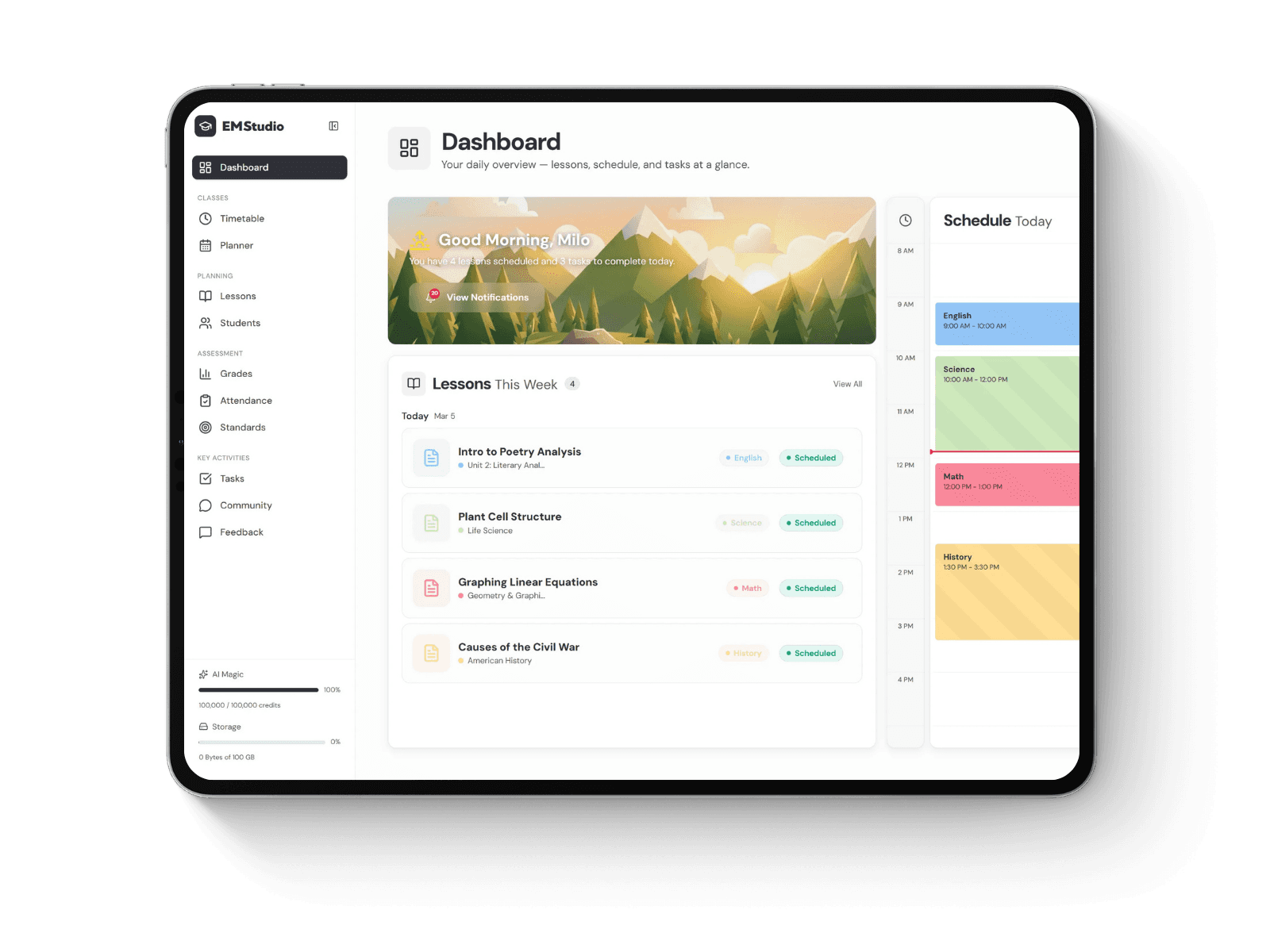
Still grading everything by hand?
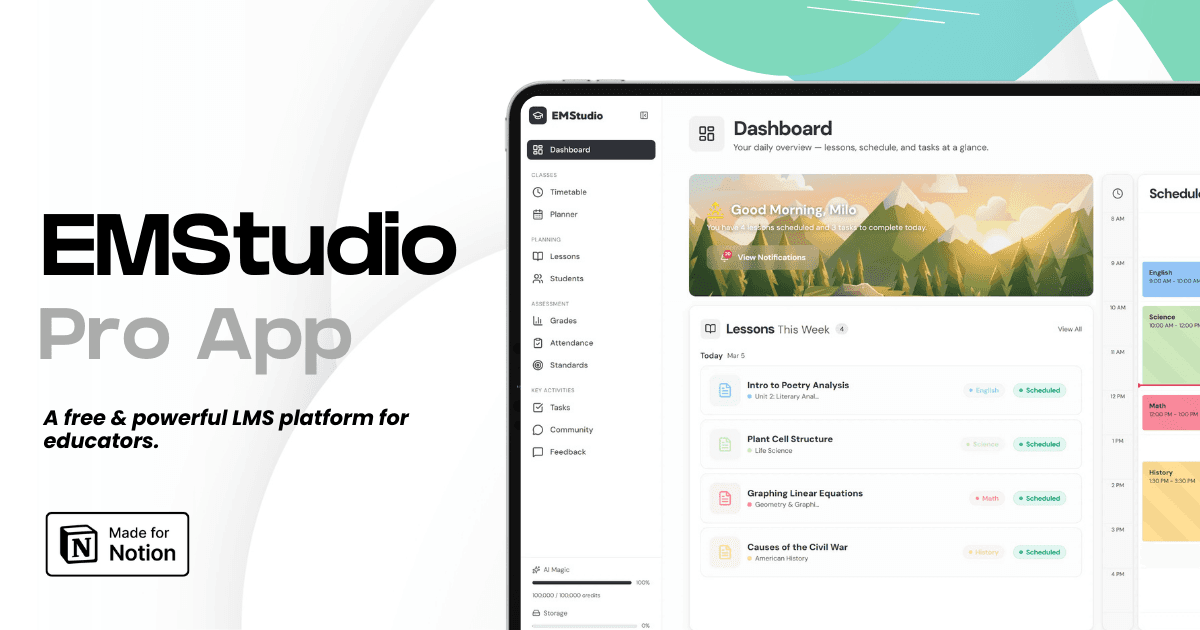
EMStudio is a free teaching management app — manage your classes, students, lessons, and more!
Learn More
Table of Contents
What Are the Best Classroom Management and LMS Providers?
The best classroom management and LMS providers include Google for Education (free Workspace integration, 60-student class limits), Instructure Canvas (advanced rubrics and mobile grading), and PowerSchool Unified Classroom (SIS and assessment integration). These three ed tech companies collectively serve approximately 80% of U.S. K-12 public school students. Selection criteria include setup complexity, per-student licensing costs averaging $6-12, and state reporting requirements.
Setup timelines vary dramatically. Google takes 1-2 days, while Canvas requires 2-4 weeks. PowerSchool demands 6-8 weeks minimum.
Costs range from free to $14 annually. Google Fundamentals costs nothing, while Plus runs $4 per student. Canvas lands at $6-10, and PowerSchool ranges $7-14.
Know when to walk away. Skip PowerSchool without SIS needs or SQL administration. Avoid Google for standards-based grading.
Steer clear of Canvas for districts under 500 students. Google requires a Workspace domain, while Canvas needs LTI 1.3 compatible SIS. PowerSchool requires a dedicated database administrator for 90 days.
Google for Education: Workspace and Classroom Tools
Google offers two distinct tiers. Workspace for Education Fundamentals remains free with 100TB pooled storage and a hard cap of 60 students per class. Workspace Plus costs $4 per student annually and adds Meet recordings, advanced Classroom features, and increases course limits to 1,000 students.
Technical constraints bite unexpectedly. Teachers face a 20-class maximum regardless of tier. LTI integrations number 200+ including Pear Deck and Kami, but the platform lacks a built-in standards-based gradebook. You cannot track mastery scales natively.
Implementation moves fast. Domain setup requires 2-3 hours for your IT admin. Teacher onboarding takes 45 minutes. Roster sync happens via Clever or manual CSV upload. Check our comprehensive guide to learning management systems for detailed migration steps.
Instructure Canvas
Canvas structures contracts around institutional size. Direct licenses require 500+ students; smaller districts pay inflated reseller pricing. Implementation stretches 8-12 weeks for full SIS integration via OneRoster API. Educational software integration here proves robust but slow.
Mobile capabilities separate Canvas from competitors. The SpeedGrader app allows offline grading with automatic sync when reconnecting. The Canvas Parent app provides view-only access, unlike student submission portals. Push notifications alert families to assignment deadlines without email clutter.
Training demands rigor. Admins need 16 hours of certification before go-live. Teachers require 6 hours to master advanced features like Outcomes and Mastery Paths. These best ed tech companies demand upfront investment in human capital.
PowerSchool Unified Classroom
The Unified Classroom bundles Performance Matters assessments, Schoology Learning LMS, and deep SIS integration. Contracts lock you in for three years with $5,000-15,000 implementation fees for districts under 5,000 students. Student data privacy compliance costs extra.
State reporting justifies the price for many registrars. Pre-built extracts handle 50+ states including Texas PEIMS and California CALPADS. This automation reduces manual entry by 15-20 hours monthly. For adaptive learning technology deployment at scale, the integration proves unmatched.
Technical specs require commitment. You need a dedicated SQL database instance. Real-time grade passback works beautifully, but only with proper configuration. The parent portal allows district branding customization. Review strategies for classroom management and support before rolling out to families.

Top Assessment and Data Analytics Platforms
Not all assessments serve the same purpose in your classroom. Kahoot! captures what your students know in the final five minutes of class through rapid questioning. IXL tracks daily skill growth through sustained practice. Renaissance screens for intervention needs each quarter with standardized benchmarks. Knowing which edtech platforms fit which gap prevents the data overload that makes analyzing student assessment data feel like drinking from a fire hose.
Use this framework when deciding where to spend your limited budget:
If you need RTI progress monitoring and universal screening → Renaissance.
If you need differentiated skill practice that fills specific gaps → IXL.
If you need engagement and quick checks → Kahoot.
John Hattie's Visible Learning research puts formative evaluation at a 0.48 effect size. Choose tools that return actionable feedback within 24-48 hours, not weeks later when the teaching moment has passed. All three education tech companies maintain iKeepSafe certification and sign NDPA student data privacy agreements. Before you sign, ask these specific questions:
How long do you retain student responses after we delete accounts?
Do you share data with third-party AI trainers for model development?
Can we export raw data if we switch platforms next year?
Renaissance Learning Assessment Suite
Star Assessments run 20-30 minutes for Early Literacy, Reading, and Math. The computer-adaptive testing adjusts question difficulty within the first ten items based on student responses. You receive scaled scores linked directly to your state performance levels, making RTI tier placement decisions straightforward during data team meetings.
Freckle handles differentiation across your classroom with 70,000+ questions spanning subjects from math to social studies. The adaptive practice engine assigns content ranging from 0.5 grade levels below to 2.0 above the student's initial diagnostic placement. Your advanced 5th graders can work on pre-algebra concepts while struggling readers get foundational comprehension support within the same platform.
Contracts typically run three years and include unlimited benchmark assessments plus tiered intervention reports. Pricing ranges from $3,000 to $8,000 per site depending on enrollment tiers and whether you bundle Star with Freckle. Negotiate for early literacy licenses even if you teach upper grades; the foundational data proves invaluable when older students struggle.
IXL Personalized Learning Platform
The Real-Time Diagnostic places students on a 0-1300 scale across math and ELA strands. Unlike static assessments, it updates after every 10-15 questions. Plan 30-45 minutes for initial setup during your first week of school; after that, students can jump in for 15-minute sessions during centers.
SmartScore measures mastery through adaptive learning technology that weighs question difficulty, accuracy, and consistency. Students hit proficiency at 80 points and mastered status at 100. I've found 30-45 minutes of weekly usage per subject creates optimal growth without burnout. The benefits of digital practice tests appear here through instant error correction and targeted explanations.
Site licenses average $300-500 per classroom or $10-15 per student annually when purchased at district scale. Family subscriptions at $12.95 per month offer parallel curriculum access for homework support. I send home the family signup link before winter break to prevent summer slide without creating new packet copies.
Kahoot! for Schools
The free version restricts you to 100 players per game and multiple-choice questions only. Kahoot! for Schools unlocks 2,000 players, polls, word clouds, and full slide decks for direct instruction. I use the word clouds for morning community circles and the polls to gauge confidence before handing out unit tests.
These formative assessment tools provide analytics beyond simple correct or incorrect markings. Reports show individual accuracy percentages, time-per-question analytics, and difficulty discrimination indices that reveal which questions confused half your class. Export these directly into Google Classroom and Microsoft Teams gradebooks without manual retyping. I review the data within 24 hours while the lesson context remains fresh.
The Pro version runs $7-10 per teacher monthly when billed annually. The Max version at $20 per month supports 10,000 participants for district-wide competitions and school assemblies. Pay for Max only if your principal plans schoolwide math bowls or literacy nights; otherwise, Pro covers most departmental needs.
Which Companies Specialize in STEM and Coding Education?
Discovery Education Experience, Sphero Edu, and Vernier Science Education dominate this space among k 12 education technology companies. You will spend $2-4 per student for Discovery's digital library, around $150 per unit for Sphero robots, and $500 or more for individual Vernier probes. These three cover the spectrum from elementary coding games to AP Physics labs.
Match your choice to your budget reality and physical storage capacity. Discovery Ed works K-12 with pure software subscriptions. Sphero targets K-8 robotics with some high school physics crossover. Vernier serves grades 6-12 exclusively, focusing on AP and IB science courses. Do not buy hardware without dedicated storage space—figure five square feet per class set—and identify a technology coordinator to manage troubleshooting. If breakage exceeds 15% in your first semester, abandon the pilot immediately. The hidden costs add up fast: budget to replace 8-10% of your robotics fleet annually, calibrate Vernier probes at $50-100 per year, and purchase charging cradles at $200 per six-unit set.
Discovery Education Experience
The platform hosts over 200,000 resources including virtual labs, STEM career videos, and coding lessons through DE Coding. Their Techbook digital textbooks include physical lab kits mailed directly to schools for grades 6-8, bridging the gap between screen and hands-on investigation. You will find kindergarten animal adaptations through high school chemistry simulations.
The SOS (Spotlight on Strategies) feature gives you 100+ research-backed activities for integrating video content. These align to NGSS and state standards, saving you from rebuilding curriculum maps. I used the "Z Chart" strategy last October with 7th graders before a cellular respiration lab, and it cut prep time while improving their reports.
Site licenses run $4,000-7,000 per school depending on enrollment. Per-student pricing drops to $4-6 when bundled with professional development. For pure digital curriculum resources without hardware headaches or student data privacy complications, Discovery Ed remains the safest bet among ed tech companies specializing in STEM content.
Sphero Edu STEM Solutions
The product line starts with indi at $75 per unit for screen-free K-2 coding, moves to BOLT at $150 with programmable sensors, and tops out with RVR at $250 for hackable robotics in grades 6+. Plan for one robot per two to three students; full class sets get expensive fast, but the collaboration improves coding outcomes.
Technical specs matter when managing 30 devices. Each unit runs two hours continuous on a charge, connects via Bluetooth up to 30 meters, and drops into inductive charging cradles. The Sphero Edu app supports block coding, JavaScript, and draw-based programming, letting you scaffold from kindergarten through middle school.
Curriculum aligns to CSTA K-12 Computer Science Standards with 150+ hours covering loops, conditionals, and variables. See our guide to digital tools for teaching coding for complementary activities. If you are building an integrative STEM education framework, Sphero provides the physical computing component that makes abstract algorithms concrete while providing formative assessment tools through immediate feedback.
Vernier Science Education
The Go Direct sensor catalog includes 60+ probe types ranging from $89 pH meters to $549 spectrophotometers. These connect via Bluetooth or USB to Chromebooks, iPads, and computers, eliminating tangled wires. I have watched AP Biology students collect real-time photosynthesis data on Chromebooks while standing at their lab tables.
Graphical Analysis 4 software is free, and the experiment library contains 1,000+ labs aligned to AP Physics, AP Chemistry, and IB Biology. Sensors carry a five-year warranty with 24-hour technical support, which matters when your titration lab is Friday and the probe dies Thursday afternoon. The educational software integration works with most learning management systems.
Each full lab station requires $2,000-5,000 initial investment for biology or chemistry sets. For a class of 24, you need two to three stations, pushing startup costs toward $10,000. This places Vernier firmly in serious laboratory equipment territory, with precision that justifies the price for advanced courses requiring adaptive learning technology adjustments based on real data.

Leading Literacy and Language Learning Platforms
Not all literacy tools serve the same purpose. These ed tech companies serve different intervention intensities:
Lexia: Tier II/III intensive intervention, $12-18 per student
Newsela: Tier I content differentiation, $5-8 per student
CommonLit: Tier I supplemental, free
All three qualify for ESSER funds targeting learning loss. Lexia specifically tracks COVID recovery metrics in admin dashboards. That data helps when the state auditor asks for proof of growth. Newsela and CommonLit accept ESSER dollars too, though you'll need to frame the purchase around "accelerating learning" in your grant narrative.
Watch your usage numbers. Lexia Core5 needs 20-30 minutes weekly; PowerUp requires 25-35 minutes. Fall below 60% usage and expect minimal gains. That's your stop/go metric. If kids aren't logging minutes, the license is burning money. Track this biweekly, not at semester's end.
Accessibility varies by need. Newsela offers five reading levels per article. CommonLit provides 13 language translations and dyslexic fonts. Lexia includes audio support and auto-placement. Match the feature to your ELL population percentage. A district with 40% newcomers needs different tools than one with 5%.
Newsela Content Platform
Newsela adjusts every article to five reading levels automatically using Lexile measures. Your 6th graders can read the same Supreme Court decision as your honors students, but with sentences that actually make sense to them. The library holds 10,000+ texts including primary sources and current events updated weekly. The content stays fresh, which matters when you're trying to convince teenagers that reading isn't just dead white guys from 200 years ago.
Content collections target specific needs. Newsela ELA includes novel studies with chapter-by-chapter assessments. Newsela SEL aligns with CASEL competencies. Social Studies pairs current events with historical context. These pair well with vocabulary strategies for language teachers when building background knowledge. The assessments are decent—not perfect, but better than creating your own multiple choice questions for every chapter of The Giver.
Integration is smooth. SSO works through Clever or Google. Grades sync automatically with Canvas and Schoology. Administrator dashboards show school-wide reading time averages and standards mastery by grade. Teachers can see which students read the article three times versus who clicked through in 30 seconds. That transparency changes conversations about homework completion.
Lexia Core5 and PowerUp Literacy
Lexia Core5 serves K-5 with foundational skills. PowerUp handles grades 6-12 with word study, grammar, and comprehension. The auto-placement assessment takes 15-20 minutes. Don't skip it. Teachers who manually override placement usually regret it by October. That's when they realize Johnny is drowning in multisyllabic words he can't decode.
Success hinges on time-on-task. Students meeting 60+ minutes weekly show significantly higher rates of reaching grade-level benchmarks. Reports flag exactly which students need face-to-face intervention and what specific skill gaps to target. Below that 60% usage threshold? You're paying for software that's just taking up Chromebook memory. I watch the weekly usage report like a hawk. If a student drops below 40 minutes for two weeks running, I call home before the achievement gap widens.
Plan for training. Lexia Academy includes an 8-hour certification course in the subscription. Onsite coaching runs $2,000 per day. Certify two teachers per grade level so you're not scrambling when someone takes maternity leave. The best implementations I've seen have a "Lexia Lead" in each building who troubleshoots logins and celebrates usage milestones. Without that human layer, the software becomes digital worksheets.
CommonLit Digital Library
The digital library is 100% free with 2,000+ lessons. The 360 Curriculum costs $1,000-3,000 per teacher and provides full-year ELA units including handouts and assessments. Start with the free tier; upgrade only if you need the pacing guides and pre-built slide decks. I've used the free version for three years and only considered paying when I got three new preps in one semester.
Accessibility features shine here. Built-in text-to-speech, translation to 13 languages, dyslexic font options, and Guided Reading Mode chunk text with embedded comprehension questions. Your newcomers can read in Spanish while listening in English. The dyslexic font isn't just a nicety. I've watched struggling readers double their stamina when the letters stop swimming. These supports work better than the accessibility features built into most learning management systems.
Know the limits. CommonLit lacks adaptive leveling like Lexia. You must manually assign text levels based on your own assessments. The data dashboard shows class averages but lacks individual learning path visualization. If you need detailed progress monitoring for IEP meetings, this isn't your tool. You won't get a report saying "Maria improved from 400L to 600L" automatically. But for free, high-quality texts with decent supports? It beats photocopying short stories from 1998 and praying the copier doesn't jam.
Brighterly Tutoring Platform
Brighterly provides math and reading tutoring for grades K-12, not self-paced software. Before anything gets scheduled, the platform runs a diagnostic that maps both weak spots and strong areas. That placement determines which tutor gets assigned and what the curriculum looks like — built around the specific student, not a grade-level template.
The curriculum follows US educational standards throughout, which matters when parents ask whether any of this connects to what the school actually expects. Tutors work through foundational gaps before moving into more advanced material, so students aren't introduced to complex topics before the groundwork is laid. That same structure works whether you're dealing with a student who's behind or one working toward more ambitious academic goals.
Parents get monthly summaries showing how the student is performing, which topics they've mastered, and which still need improvement. The platform requires a reliable internet connection to function, and there are no group options, so you're not stretching a single license across a classroom. Pricing starts at $17.70 per class and shifts depending on session frequency and duration. It makes the most sense for individual students who haven't moved on to other tools.

How Do You Evaluate Ed Tech Vendors Before Purchasing?
Evaluate ed tech vendors by verifying FERPA compliance and iKeepSafe certification, conducting a 30-90 day pilot with 10-15 teachers, checking LTI 1.3 interoperability, calculating three-year total cost including PD, and contacting reference districts. Avoid vendors requiring multi-year upfront payment or lacking sandbox testing environments. The best sales presentations mean nothing if the tool breaks your budget or leaks student data.
Most b2b edtech companies will promise you the moon in their sales deck. Your job is to separate the marketing from the mechanics before the contract lands on your superintendent's desk.
Verify data privacy first. Ask for their signed NDPA (National Data Privacy Agreement) and iKeepSafe certification. If they hesitate or send you a generic "we take privacy seriously" PDF instead of specific FERPA documentation, walk away. Check their student data privacy track record on industry databases. You can learn more about protecting student privacy in the age of edtech before you sign anything.
Check technical interoperability. Confirm they support LTI 1.3 Advantage, OneRoster, and Clever rostering. Test their API with your existing learning management systems. If it doesn't plug in within 10 minutes, your IT director will hate you by October when rostering breaks.
Structure a real pilot. Run 30-90 days with 10-15 volunteer teachers across different grade levels and tech comfort zones. Don't let the vendor hand-pick the participants. You need skeptics in that room who will actually try the adaptive learning technology with real kids.
Calculate true TCO. Look at three years, not one. Include the hidden killer: professional development at $150-300 per hour. That "free" onboarding suddenly costs $5,000 when you realize you need three full days of training to use their digital curriculum resources properly.
Call references. Demand three districts similar to yours in size and demographics. Ask specifically about their educational software integration headaches and data export processes, not just the success stories they share on Twitter.
Red Flags That Disqualify Vendors
Some ed tech companies show warning signs immediately during the demo phase. Watch for these deal-breakers before you waste months on procurement:
Requires 3+ year upfront payment or offers "discounts" for paying everything in advance.
No sandbox environment for you to test the platform before purchase.
Missing VPAT accessibility documentation. If they can't prove Section 508 compliance, you're risking lawsuits.
Refuses to sign state-specific data privacy addendums.
No FERPA-compliant data deletion protocol. When you leave, your data should vanish completely.
When NOT to Buy
Timing matters more than most administrators admit. Don't purchase during high-stakes testing windows (March-May) when teachers cannot focus on onboarding new tools.
Wait if your infrastructure audit shows insufficient bandwidth—you need minimum 25 Mbps per 100 students for most digital curriculum resources to function without lag.
Also pause if you lack teacher champions willing to pilot for 6+ weeks. Top-down mandates fail spectacularly in classrooms. You can read about evaluating user-centered app design to understand why teacher buy-in matters more than any feature list.
Decision Matrix by District Size
Your procurement strategy should match your scale.
Under 500 students: Prioritize ease of setup over features. You don't have an IT army. Choose ed tech companies that configure themselves and offer direct phone support to your one tech coordinator.
500-5,000 students: Balance cost against educational software integration. This is the sweet spot where formative assessment tools need clean SIS integration but you still watch every dollar in the general fund.
Over 10,000 students: Prioritize SIS interoperability and state reporting capabilities above all else. A global edtech company might dazzle you with features, but if their API breaks your state reporting submission, you're facing audit penalties. Check edtechimpact reviews from similar large districts before your RFP goes out.

Implementation Roadmap: From Pilot to District-Wide Rollout
Form a selection committee with three teachers, one IT director, and one administrator. Audit infrastructure to verify 1:1 devices and bandwidth. Select a pilot school with five to ten volunteers representing diverse grade levels and tech comfort.
Launch aiming for 80% teacher participation. Collect weekly usage analytics and compare interim assessment data between pilot and control classrooms. At week eight, abort if adoption falls below 60% or tickets exceed five per 100 students.
Implement a train-the-trainer model, certifying two tech leads per school. Require 80% teacher proficiency before district expansion. Establish parent communication via multilingual portals covering platform usage and student data privacy.
Pause rollout if substitute coverage drops below 95% during training, budget cuts exceed 15%, or end-of-year data shows no gains over controls. Use this educational technology integration roadmap to avoid joining the list of failed ed tech companies implementations.

Your Next Move with Ed Tech Companies
You have the names. You know which ed tech companies actually deliver on their promises and which ones just have great sales decks. The real work starts when you stop browsing and start testing. Pick one platform from the list—maybe the adaptive learning technology that caught your eye or the learning management systems your department keeps mentioning—and run a two-week pilot with one class. Not a committee. Not a district vote. Just you, your students, and the software.
Watch how it handles real traffic. Does the student data privacy dashboard actually make sense? Do the digital curriculum resources load on Chromebooks that are three years old? If it passes that test, you have evidence to bring to your admin. If it fails, you saved your district thousands and kept your sanity. Either way, you move from shopper to expert.
Open your email. Find the vendor that looked most useful from this list. Request a single teacher pilot account. Set a reminder to review the data in fourteen days. That's it. No implementation roadmap needed yet—just proof that the tool works in your room before you ask anyone else to care.

What Are the Best Classroom Management and LMS Providers?
The best classroom management and LMS providers include Google for Education (free Workspace integration, 60-student class limits), Instructure Canvas (advanced rubrics and mobile grading), and PowerSchool Unified Classroom (SIS and assessment integration). These three ed tech companies collectively serve approximately 80% of U.S. K-12 public school students. Selection criteria include setup complexity, per-student licensing costs averaging $6-12, and state reporting requirements.
Setup timelines vary dramatically. Google takes 1-2 days, while Canvas requires 2-4 weeks. PowerSchool demands 6-8 weeks minimum.
Costs range from free to $14 annually. Google Fundamentals costs nothing, while Plus runs $4 per student. Canvas lands at $6-10, and PowerSchool ranges $7-14.
Know when to walk away. Skip PowerSchool without SIS needs or SQL administration. Avoid Google for standards-based grading.
Steer clear of Canvas for districts under 500 students. Google requires a Workspace domain, while Canvas needs LTI 1.3 compatible SIS. PowerSchool requires a dedicated database administrator for 90 days.
Google for Education: Workspace and Classroom Tools
Google offers two distinct tiers. Workspace for Education Fundamentals remains free with 100TB pooled storage and a hard cap of 60 students per class. Workspace Plus costs $4 per student annually and adds Meet recordings, advanced Classroom features, and increases course limits to 1,000 students.
Technical constraints bite unexpectedly. Teachers face a 20-class maximum regardless of tier. LTI integrations number 200+ including Pear Deck and Kami, but the platform lacks a built-in standards-based gradebook. You cannot track mastery scales natively.
Implementation moves fast. Domain setup requires 2-3 hours for your IT admin. Teacher onboarding takes 45 minutes. Roster sync happens via Clever or manual CSV upload. Check our comprehensive guide to learning management systems for detailed migration steps.
Instructure Canvas
Canvas structures contracts around institutional size. Direct licenses require 500+ students; smaller districts pay inflated reseller pricing. Implementation stretches 8-12 weeks for full SIS integration via OneRoster API. Educational software integration here proves robust but slow.
Mobile capabilities separate Canvas from competitors. The SpeedGrader app allows offline grading with automatic sync when reconnecting. The Canvas Parent app provides view-only access, unlike student submission portals. Push notifications alert families to assignment deadlines without email clutter.
Training demands rigor. Admins need 16 hours of certification before go-live. Teachers require 6 hours to master advanced features like Outcomes and Mastery Paths. These best ed tech companies demand upfront investment in human capital.
PowerSchool Unified Classroom
The Unified Classroom bundles Performance Matters assessments, Schoology Learning LMS, and deep SIS integration. Contracts lock you in for three years with $5,000-15,000 implementation fees for districts under 5,000 students. Student data privacy compliance costs extra.
State reporting justifies the price for many registrars. Pre-built extracts handle 50+ states including Texas PEIMS and California CALPADS. This automation reduces manual entry by 15-20 hours monthly. For adaptive learning technology deployment at scale, the integration proves unmatched.
Technical specs require commitment. You need a dedicated SQL database instance. Real-time grade passback works beautifully, but only with proper configuration. The parent portal allows district branding customization. Review strategies for classroom management and support before rolling out to families.
Top Assessment and Data Analytics Platforms
Not all assessments serve the same purpose in your classroom. Kahoot! captures what your students know in the final five minutes of class through rapid questioning. IXL tracks daily skill growth through sustained practice. Renaissance screens for intervention needs each quarter with standardized benchmarks. Knowing which edtech platforms fit which gap prevents the data overload that makes analyzing student assessment data feel like drinking from a fire hose.
Use this framework when deciding where to spend your limited budget:
If you need RTI progress monitoring and universal screening → Renaissance.
If you need differentiated skill practice that fills specific gaps → IXL.
If you need engagement and quick checks → Kahoot.
John Hattie's Visible Learning research puts formative evaluation at a 0.48 effect size. Choose tools that return actionable feedback within 24-48 hours, not weeks later when the teaching moment has passed. All three education tech companies maintain iKeepSafe certification and sign NDPA student data privacy agreements. Before you sign, ask these specific questions:
How long do you retain student responses after we delete accounts?
Do you share data with third-party AI trainers for model development?
Can we export raw data if we switch platforms next year?
Renaissance Learning Assessment Suite
Star Assessments run 20-30 minutes for Early Literacy, Reading, and Math. The computer-adaptive testing adjusts question difficulty within the first ten items based on student responses. You receive scaled scores linked directly to your state performance levels, making RTI tier placement decisions straightforward during data team meetings.
Freckle handles differentiation across your classroom with 70,000+ questions spanning subjects from math to social studies. The adaptive practice engine assigns content ranging from 0.5 grade levels below to 2.0 above the student's initial diagnostic placement. Your advanced 5th graders can work on pre-algebra concepts while struggling readers get foundational comprehension support within the same platform.
Contracts typically run three years and include unlimited benchmark assessments plus tiered intervention reports. Pricing ranges from $3,000 to $8,000 per site depending on enrollment tiers and whether you bundle Star with Freckle. Negotiate for early literacy licenses even if you teach upper grades; the foundational data proves invaluable when older students struggle.
IXL Personalized Learning Platform
The Real-Time Diagnostic places students on a 0-1300 scale across math and ELA strands. Unlike static assessments, it updates after every 10-15 questions. Plan 30-45 minutes for initial setup during your first week of school; after that, students can jump in for 15-minute sessions during centers.
SmartScore measures mastery through adaptive learning technology that weighs question difficulty, accuracy, and consistency. Students hit proficiency at 80 points and mastered status at 100. I've found 30-45 minutes of weekly usage per subject creates optimal growth without burnout. The benefits of digital practice tests appear here through instant error correction and targeted explanations.
Site licenses average $300-500 per classroom or $10-15 per student annually when purchased at district scale. Family subscriptions at $12.95 per month offer parallel curriculum access for homework support. I send home the family signup link before winter break to prevent summer slide without creating new packet copies.
Kahoot! for Schools
The free version restricts you to 100 players per game and multiple-choice questions only. Kahoot! for Schools unlocks 2,000 players, polls, word clouds, and full slide decks for direct instruction. I use the word clouds for morning community circles and the polls to gauge confidence before handing out unit tests.
These formative assessment tools provide analytics beyond simple correct or incorrect markings. Reports show individual accuracy percentages, time-per-question analytics, and difficulty discrimination indices that reveal which questions confused half your class. Export these directly into Google Classroom and Microsoft Teams gradebooks without manual retyping. I review the data within 24 hours while the lesson context remains fresh.
The Pro version runs $7-10 per teacher monthly when billed annually. The Max version at $20 per month supports 10,000 participants for district-wide competitions and school assemblies. Pay for Max only if your principal plans schoolwide math bowls or literacy nights; otherwise, Pro covers most departmental needs.
Which Companies Specialize in STEM and Coding Education?
Discovery Education Experience, Sphero Edu, and Vernier Science Education dominate this space among k 12 education technology companies. You will spend $2-4 per student for Discovery's digital library, around $150 per unit for Sphero robots, and $500 or more for individual Vernier probes. These three cover the spectrum from elementary coding games to AP Physics labs.
Match your choice to your budget reality and physical storage capacity. Discovery Ed works K-12 with pure software subscriptions. Sphero targets K-8 robotics with some high school physics crossover. Vernier serves grades 6-12 exclusively, focusing on AP and IB science courses. Do not buy hardware without dedicated storage space—figure five square feet per class set—and identify a technology coordinator to manage troubleshooting. If breakage exceeds 15% in your first semester, abandon the pilot immediately. The hidden costs add up fast: budget to replace 8-10% of your robotics fleet annually, calibrate Vernier probes at $50-100 per year, and purchase charging cradles at $200 per six-unit set.
Discovery Education Experience
The platform hosts over 200,000 resources including virtual labs, STEM career videos, and coding lessons through DE Coding. Their Techbook digital textbooks include physical lab kits mailed directly to schools for grades 6-8, bridging the gap between screen and hands-on investigation. You will find kindergarten animal adaptations through high school chemistry simulations.
The SOS (Spotlight on Strategies) feature gives you 100+ research-backed activities for integrating video content. These align to NGSS and state standards, saving you from rebuilding curriculum maps. I used the "Z Chart" strategy last October with 7th graders before a cellular respiration lab, and it cut prep time while improving their reports.
Site licenses run $4,000-7,000 per school depending on enrollment. Per-student pricing drops to $4-6 when bundled with professional development. For pure digital curriculum resources without hardware headaches or student data privacy complications, Discovery Ed remains the safest bet among ed tech companies specializing in STEM content.
Sphero Edu STEM Solutions
The product line starts with indi at $75 per unit for screen-free K-2 coding, moves to BOLT at $150 with programmable sensors, and tops out with RVR at $250 for hackable robotics in grades 6+. Plan for one robot per two to three students; full class sets get expensive fast, but the collaboration improves coding outcomes.
Technical specs matter when managing 30 devices. Each unit runs two hours continuous on a charge, connects via Bluetooth up to 30 meters, and drops into inductive charging cradles. The Sphero Edu app supports block coding, JavaScript, and draw-based programming, letting you scaffold from kindergarten through middle school.
Curriculum aligns to CSTA K-12 Computer Science Standards with 150+ hours covering loops, conditionals, and variables. See our guide to digital tools for teaching coding for complementary activities. If you are building an integrative STEM education framework, Sphero provides the physical computing component that makes abstract algorithms concrete while providing formative assessment tools through immediate feedback.
Vernier Science Education
The Go Direct sensor catalog includes 60+ probe types ranging from $89 pH meters to $549 spectrophotometers. These connect via Bluetooth or USB to Chromebooks, iPads, and computers, eliminating tangled wires. I have watched AP Biology students collect real-time photosynthesis data on Chromebooks while standing at their lab tables.
Graphical Analysis 4 software is free, and the experiment library contains 1,000+ labs aligned to AP Physics, AP Chemistry, and IB Biology. Sensors carry a five-year warranty with 24-hour technical support, which matters when your titration lab is Friday and the probe dies Thursday afternoon. The educational software integration works with most learning management systems.
Each full lab station requires $2,000-5,000 initial investment for biology or chemistry sets. For a class of 24, you need two to three stations, pushing startup costs toward $10,000. This places Vernier firmly in serious laboratory equipment territory, with precision that justifies the price for advanced courses requiring adaptive learning technology adjustments based on real data.
Leading Literacy and Language Learning Platforms
Not all literacy tools serve the same purpose. These ed tech companies serve different intervention intensities:
Lexia: Tier II/III intensive intervention, $12-18 per student
Newsela: Tier I content differentiation, $5-8 per student
CommonLit: Tier I supplemental, free
All three qualify for ESSER funds targeting learning loss. Lexia specifically tracks COVID recovery metrics in admin dashboards. That data helps when the state auditor asks for proof of growth. Newsela and CommonLit accept ESSER dollars too, though you'll need to frame the purchase around "accelerating learning" in your grant narrative.
Watch your usage numbers. Lexia Core5 needs 20-30 minutes weekly; PowerUp requires 25-35 minutes. Fall below 60% usage and expect minimal gains. That's your stop/go metric. If kids aren't logging minutes, the license is burning money. Track this biweekly, not at semester's end.
Accessibility varies by need. Newsela offers five reading levels per article. CommonLit provides 13 language translations and dyslexic fonts. Lexia includes audio support and auto-placement. Match the feature to your ELL population percentage. A district with 40% newcomers needs different tools than one with 5%.
Newsela Content Platform
Newsela adjusts every article to five reading levels automatically using Lexile measures. Your 6th graders can read the same Supreme Court decision as your honors students, but with sentences that actually make sense to them. The library holds 10,000+ texts including primary sources and current events updated weekly. The content stays fresh, which matters when you're trying to convince teenagers that reading isn't just dead white guys from 200 years ago.
Content collections target specific needs. Newsela ELA includes novel studies with chapter-by-chapter assessments. Newsela SEL aligns with CASEL competencies. Social Studies pairs current events with historical context. These pair well with vocabulary strategies for language teachers when building background knowledge. The assessments are decent—not perfect, but better than creating your own multiple choice questions for every chapter of The Giver.
Integration is smooth. SSO works through Clever or Google. Grades sync automatically with Canvas and Schoology. Administrator dashboards show school-wide reading time averages and standards mastery by grade. Teachers can see which students read the article three times versus who clicked through in 30 seconds. That transparency changes conversations about homework completion.
Lexia Core5 and PowerUp Literacy
Lexia Core5 serves K-5 with foundational skills. PowerUp handles grades 6-12 with word study, grammar, and comprehension. The auto-placement assessment takes 15-20 minutes. Don't skip it. Teachers who manually override placement usually regret it by October. That's when they realize Johnny is drowning in multisyllabic words he can't decode.
Success hinges on time-on-task. Students meeting 60+ minutes weekly show significantly higher rates of reaching grade-level benchmarks. Reports flag exactly which students need face-to-face intervention and what specific skill gaps to target. Below that 60% usage threshold? You're paying for software that's just taking up Chromebook memory. I watch the weekly usage report like a hawk. If a student drops below 40 minutes for two weeks running, I call home before the achievement gap widens.
Plan for training. Lexia Academy includes an 8-hour certification course in the subscription. Onsite coaching runs $2,000 per day. Certify two teachers per grade level so you're not scrambling when someone takes maternity leave. The best implementations I've seen have a "Lexia Lead" in each building who troubleshoots logins and celebrates usage milestones. Without that human layer, the software becomes digital worksheets.
CommonLit Digital Library
The digital library is 100% free with 2,000+ lessons. The 360 Curriculum costs $1,000-3,000 per teacher and provides full-year ELA units including handouts and assessments. Start with the free tier; upgrade only if you need the pacing guides and pre-built slide decks. I've used the free version for three years and only considered paying when I got three new preps in one semester.
Accessibility features shine here. Built-in text-to-speech, translation to 13 languages, dyslexic font options, and Guided Reading Mode chunk text with embedded comprehension questions. Your newcomers can read in Spanish while listening in English. The dyslexic font isn't just a nicety. I've watched struggling readers double their stamina when the letters stop swimming. These supports work better than the accessibility features built into most learning management systems.
Know the limits. CommonLit lacks adaptive leveling like Lexia. You must manually assign text levels based on your own assessments. The data dashboard shows class averages but lacks individual learning path visualization. If you need detailed progress monitoring for IEP meetings, this isn't your tool. You won't get a report saying "Maria improved from 400L to 600L" automatically. But for free, high-quality texts with decent supports? It beats photocopying short stories from 1998 and praying the copier doesn't jam.
Brighterly Tutoring Platform
Brighterly provides math and reading tutoring for grades K-12, not self-paced software. Before anything gets scheduled, the platform runs a diagnostic that maps both weak spots and strong areas. That placement determines which tutor gets assigned and what the curriculum looks like — built around the specific student, not a grade-level template.
The curriculum follows US educational standards throughout, which matters when parents ask whether any of this connects to what the school actually expects. Tutors work through foundational gaps before moving into more advanced material, so students aren't introduced to complex topics before the groundwork is laid. That same structure works whether you're dealing with a student who's behind or one working toward more ambitious academic goals.
Parents get monthly summaries showing how the student is performing, which topics they've mastered, and which still need improvement. The platform requires a reliable internet connection to function, and there are no group options, so you're not stretching a single license across a classroom. Pricing starts at $17.70 per class and shifts depending on session frequency and duration. It makes the most sense for individual students who haven't moved on to other tools.
How Do You Evaluate Ed Tech Vendors Before Purchasing?
Evaluate ed tech vendors by verifying FERPA compliance and iKeepSafe certification, conducting a 30-90 day pilot with 10-15 teachers, checking LTI 1.3 interoperability, calculating three-year total cost including PD, and contacting reference districts. Avoid vendors requiring multi-year upfront payment or lacking sandbox testing environments. The best sales presentations mean nothing if the tool breaks your budget or leaks student data.
Most b2b edtech companies will promise you the moon in their sales deck. Your job is to separate the marketing from the mechanics before the contract lands on your superintendent's desk.
Verify data privacy first. Ask for their signed NDPA (National Data Privacy Agreement) and iKeepSafe certification. If they hesitate or send you a generic "we take privacy seriously" PDF instead of specific FERPA documentation, walk away. Check their student data privacy track record on industry databases. You can learn more about protecting student privacy in the age of edtech before you sign anything.
Check technical interoperability. Confirm they support LTI 1.3 Advantage, OneRoster, and Clever rostering. Test their API with your existing learning management systems. If it doesn't plug in within 10 minutes, your IT director will hate you by October when rostering breaks.
Structure a real pilot. Run 30-90 days with 10-15 volunteer teachers across different grade levels and tech comfort zones. Don't let the vendor hand-pick the participants. You need skeptics in that room who will actually try the adaptive learning technology with real kids.
Calculate true TCO. Look at three years, not one. Include the hidden killer: professional development at $150-300 per hour. That "free" onboarding suddenly costs $5,000 when you realize you need three full days of training to use their digital curriculum resources properly.
Call references. Demand three districts similar to yours in size and demographics. Ask specifically about their educational software integration headaches and data export processes, not just the success stories they share on Twitter.
Red Flags That Disqualify Vendors
Some ed tech companies show warning signs immediately during the demo phase. Watch for these deal-breakers before you waste months on procurement:
Requires 3+ year upfront payment or offers "discounts" for paying everything in advance.
No sandbox environment for you to test the platform before purchase.
Missing VPAT accessibility documentation. If they can't prove Section 508 compliance, you're risking lawsuits.
Refuses to sign state-specific data privacy addendums.
No FERPA-compliant data deletion protocol. When you leave, your data should vanish completely.
When NOT to Buy
Timing matters more than most administrators admit. Don't purchase during high-stakes testing windows (March-May) when teachers cannot focus on onboarding new tools.
Wait if your infrastructure audit shows insufficient bandwidth—you need minimum 25 Mbps per 100 students for most digital curriculum resources to function without lag.
Also pause if you lack teacher champions willing to pilot for 6+ weeks. Top-down mandates fail spectacularly in classrooms. You can read about evaluating user-centered app design to understand why teacher buy-in matters more than any feature list.
Decision Matrix by District Size
Your procurement strategy should match your scale.
Under 500 students: Prioritize ease of setup over features. You don't have an IT army. Choose ed tech companies that configure themselves and offer direct phone support to your one tech coordinator.
500-5,000 students: Balance cost against educational software integration. This is the sweet spot where formative assessment tools need clean SIS integration but you still watch every dollar in the general fund.
Over 10,000 students: Prioritize SIS interoperability and state reporting capabilities above all else. A global edtech company might dazzle you with features, but if their API breaks your state reporting submission, you're facing audit penalties. Check edtechimpact reviews from similar large districts before your RFP goes out.
Implementation Roadmap: From Pilot to District-Wide Rollout
Form a selection committee with three teachers, one IT director, and one administrator. Audit infrastructure to verify 1:1 devices and bandwidth. Select a pilot school with five to ten volunteers representing diverse grade levels and tech comfort.
Launch aiming for 80% teacher participation. Collect weekly usage analytics and compare interim assessment data between pilot and control classrooms. At week eight, abort if adoption falls below 60% or tickets exceed five per 100 students.
Implement a train-the-trainer model, certifying two tech leads per school. Require 80% teacher proficiency before district expansion. Establish parent communication via multilingual portals covering platform usage and student data privacy.
Pause rollout if substitute coverage drops below 95% during training, budget cuts exceed 15%, or end-of-year data shows no gains over controls. Use this educational technology integration roadmap to avoid joining the list of failed ed tech companies implementations.
Your Next Move with Ed Tech Companies
You have the names. You know which ed tech companies actually deliver on their promises and which ones just have great sales decks. The real work starts when you stop browsing and start testing. Pick one platform from the list—maybe the adaptive learning technology that caught your eye or the learning management systems your department keeps mentioning—and run a two-week pilot with one class. Not a committee. Not a district vote. Just you, your students, and the software.
Watch how it handles real traffic. Does the student data privacy dashboard actually make sense? Do the digital curriculum resources load on Chromebooks that are three years old? If it passes that test, you have evidence to bring to your admin. If it fails, you saved your district thousands and kept your sanity. Either way, you move from shopper to expert.
Open your email. Find the vendor that looked most useful from this list. Request a single teacher pilot account. Set a reminder to review the data in fourteen days. That's it. No implementation roadmap needed yet—just proof that the tool works in your room before you ask anyone else to care.
Still grading everything by hand?
EMStudio is a free teaching management app — manage your classes, students, lessons, and more!
Learn More
Still grading everything by hand?
EMStudio is a free teaching management app — manage your classes, students, lessons, and more!
Learn More


Notion4Teachers
Notion templates to simplify administrative tasks and enhance your teaching experience.



2026 Notion4Teachers. All Rights Reserved.
Notion4Teachers
Notion templates to simplify administrative tasks and enhance your teaching experience.
2026 Notion4Teachers. All Rights Reserved.
Notion4Teachers
Notion templates to simplify administrative tasks and enhance your teaching experience.
2026 Notion4Teachers. All Rights Reserved.