
Class Work Management: 5 Steps to Quiet Noisy Classrooms
Class Work Management: 5 Steps to Quiet Noisy Classrooms

Article by
Milo
ESL Content Coordinator & Educator
ESL Content Coordinator & Educator
All Posts
You've asked them to start their class work three times. The first reminder worked. The second one worked less. Now half the class is whispering about weekend plans, someone's wandering with a broken pencil, and that group in the back is full-volume debating whether penguins have knees. You're not teaching anymore. You're doing crowd control, and your lesson plan is slipping away.
This isn't about being the "fun" teacher versus the "strict" one. Noisy classrooms during independent tasks usually mean your systems need tightening, not your personality. When student engagement drops during quiet work, it's rarely because the assignment is bad. More often, the classroom routines surrounding that work are leaking noise and off-task behavior into every minute.
Over the next five steps, we'll fix that. You'll get explicit strategies for resetting expectations, handling classroom transitions without the chaos spiral, and building behavior management into the structure of the work itself. No gimmicks. Just practical adjustments that protect your instructional time and keep on-task behavior high without you hovering.
Still grading everything by hand?
EMStudio is a free teaching management app — manage your classes, students, lessons, and more!
Learn More
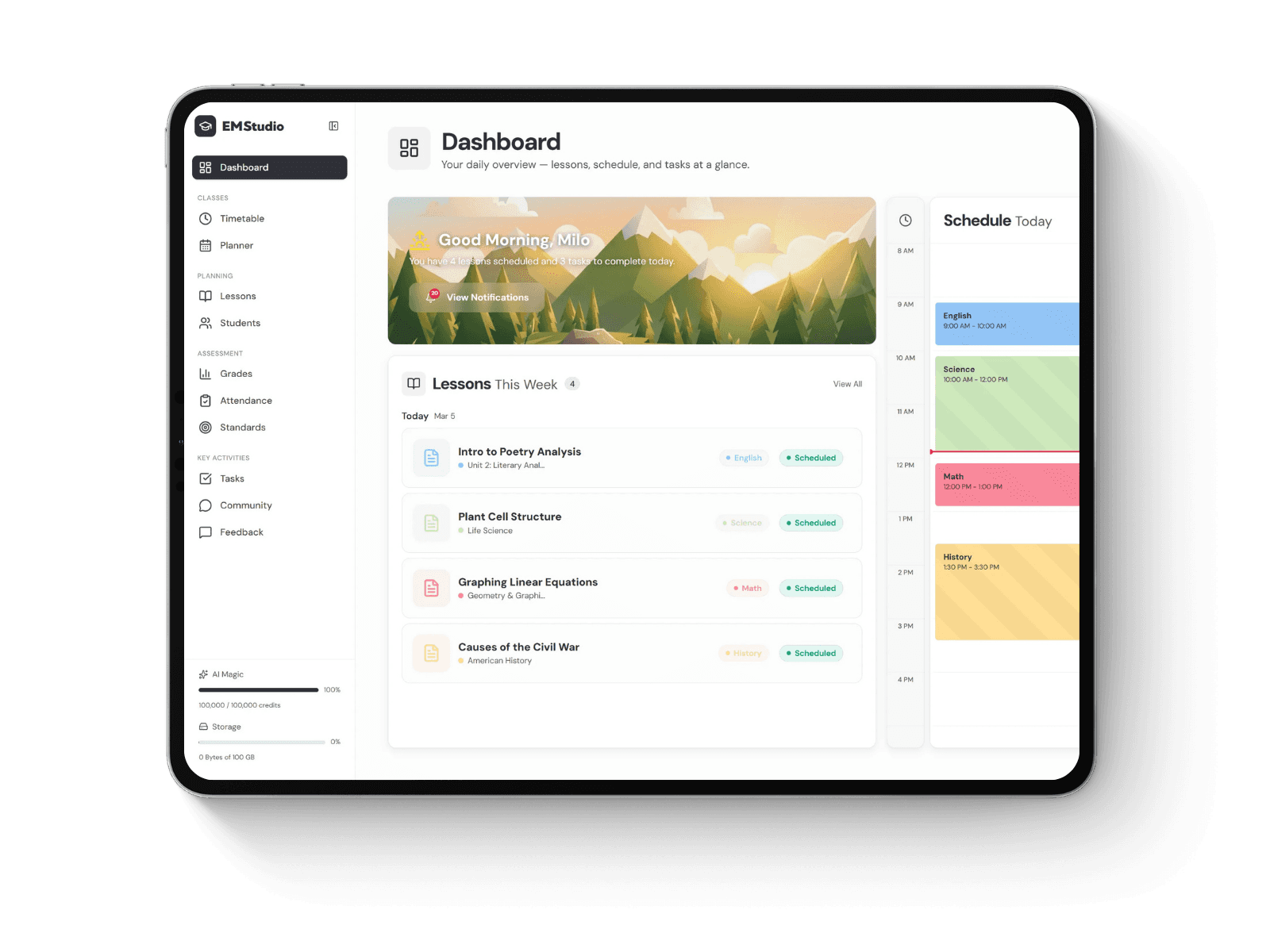
Still grading everything by hand?
EMStudio is a free teaching management app — manage your classes, students, lessons, and more!
Learn More
Table of Contents
Setting the Foundation for Productive Class Work
Rosenshine's Principles of Instruction carry an effect size of 0.59 in Hattie's Visible Learning meta-analysis. That makes them a smart research base for your first weeks. Students can't settle into serious class work if they don't know how to enter the room, get materials, or ask for help. You have to build the machine before you can run it. The principles work because they reduce cognitive load—kids aren't guessing at expectations, they're executing them.
Start with the physical environment. Rows work best for independent silent reading in grades 3-12; they cut visual distractions and keep eyes on text. I use them when I want zero conversation—just books and pencils moving. Clusters belong only during group projects, and even then, limit them to 12-15 minutes. After that, student engagement drops and side conversations multiply. You can always shift desks back while students are at recess or specials. The two minutes of shuffling saves twenty minutes of redirected behavior management later.
Follow the First 20 Days timeline from Wong & Wong to sequence your classroom routines:
Days 1-5: Attention signals. Teach one clear cue—hand raised, lights flicked, or a short chant—and practice it until it hits automaticity.
Days 6-10: Materials distribution. Map exactly how papers travel and where supplies live. Classroom transitions eat instructional time when kids wander.
Days 11-15: Help protocols. Define when to raise a hand, when to ask a neighbor, and when to just circle the question and move on.
Days 16-20: Independent work stamina. Start with ten minutes of silent practice and add five minutes every two days until you hit your target.
To measure noisy class behaviour management, download a decibel meter app like Decibel X. Record your current baseline during work periods—most untrained classrooms hover around 75dB, roughly the volume of a vacuum cleaner. Set a quantifiable target of 60dB, equivalent to normal conversation. Display the live reading on your board so students see the connection between their volume and on-task behavior. When the needle drops, the learning starts.

Step 1 — Reset Expectations Using Explicit Instruction Models
Most behavior management issues start with fuzzy instructions. You say "get to work," and half the class starts sharpening pencils while the other half chats about lunch. The Explicit Instruction Model—similar to explicit direct instruction models—fixes this by chaining dependency so students can't fail. You lock in the routine before you release them to independent class work.
Use the I Do, We Do, You Do Together, You Do Alone sequence. I Do runs ten minutes: you model the exact thinking, writing, and materials handling while students watch silent. No participation. Just observation. Narrate your mistakes and fixes aloud so they see the repair process. We Do takes another ten minutes: you guide the class through one identical example, calling on students to fill in steps but catching errors immediately. You Do Together gives eight minutes for table partners to attempt a parallel task while you circulate and spot-check. Listen for the specific vocabulary you used during the model.
Only then comes You Do Alone. Here's the catch: you don't release them until they hit 80% accuracy during the guided phase. If half the partnerships missed step three, you stop. Model it again. Check a few more pairs. Once eight out of ten kids show mastery, you drop the fifteen-minute independent practice. This prevents the chaos of kids practicing errors for twenty minutes while you scramble to reteach.
Directions matter. Write them as commands, not prohibitions. Instead of "don't talk" or "don't get up," list exactly what to do:
Open notebook to page 47.
Write heading and date in top right corner.
Read passage silently until you reach the star.
Circle unknown words in pencil.
Begin cloze activity.
Post this on the board. Point to it. Make it visible from every seat.
You also need a kill-switch for noise. If you want to take control of the noisy classroom during shifts between activities, you need a signal that works. Pick an attention cue—hand raise, chime, or light switch—and teach it like content. Explain the expectation: when you see the signal, voices stop and eyes find you within three seconds. Then practice it. Five times daily during the first week. Time it with your phone stopwatch. If the class takes four seconds, they do it again. They'll groan. Do it anyway. By day three, you'll see on-task behavior snap back faster when you need to correct mid-activity, and your classroom transitions will stop eating your period. Before the lesson runs, check your setup. This saves your instructional time later:
Materials copied and sorted 24 hours prior—no standing at the copier during lunch.
Exemplar work sample created showing exactly what finished looks like.
Early finisher menu posted with three silent options (library book, extension puzzle, previous review sheet).
Seating chart optimized for proximity management—your troublemakers sit where you can reach them in two steps without zig-zagging rows.
This structure eats up front time but pays back in student engagement. Once these classroom routines become automatic, you stop losing minutes to redirection. That's when you can finally teach.
Step 2 — How Do You Take Control of the Noisy Classroom During Transitions?
Take control of the noisy classroom during transitions by using the CHAMPs framework with a visual countdown timer. When students know exactly what Conversation, Help, Activity, Movement, and Participation look like for a two-minute shift between subjects, you stop losing instructional time to chaos. Practice specific movement paths daily until your group transitions within 60 seconds without teacher direction, using student leaders as Transition Captains to model expectations.
CHAMPs kills the ambiguity that breeds noise during shifts between activities. I post the protocol on the board before every transition:
Conversation: Level 0 (silent). No exceptions.
Help: Raise hand, stay put. Do not wander to ask me where the glue sticks are.
Activity: Moving to next station or retrieving specific materials listed on the slide.
Movement: Direct path only. I use blue painter's tape arrows on the floor for the first month so 3rd graders know exactly how to circle the rug without cutting corners.
Participation: Materials ready in 60 seconds. Pencil, notebook, binder on desk, body facing front.
The visual timer method makes time visible and urgent. I project a Google Timer or set a Time Timer on the document camera. Sixty seconds appears massive on the whiteboard. If the class beats the clock by 10 seconds, we bank two minutes of free choice on Friday. If they exceed 60 seconds, the overrun comes out of their class work period. I track this publicly on the board. Students police each other fast when their talk time is literally ticking away.
Transition Captains provide the muscle memory for smooth classroom transitions. Each morning I pick two students—one high flyer who needs a job and one quiet rule-follower—to serve as models. They walk the marked path while the class watches from their seats. They demonstrate retrieving the science notebooks from the cubby row using the "one-way street" taped on the carpet. Then the class copies them exactly. This prevents the traffic jams at the pencil sharpener and the side conversations that kill student engagement before the next lesson starts.
When noise leaks anyway, I use the Freeze and Reset. If the volume crests above a whisper during movement, I call "Freeze." Everyone returns to their starting seats immediately. We rehearse the transition silently three times. No talking. No exceptions. We lose four minutes now to save ten minutes later. After two resets in October, my 5th graders now self-correct when someone starts chatting. They know the drill.
This connects directly to establishing clear classroom rules and procedures. Transitions are where your behavior management gets stress-tested every single day. Every second spent shuffling aimlessly or waiting for stragglers is stolen instructional time. When you tighten these classroom routines, you protect on-task behavior for the actual learning that follows.

Step 3 — Structure Class Work Tasks to Minimize Off-Task Behavior
Cognitive load theory changes how you plan class work. Break assignments into micro-tasks lasting 8-12 minutes for grades 3-5, 12-15 minutes for grades 6-8, and 15-20 minutes for grades 9-12. Add visible checkboxes so kids see progress. Run a task difficulty audit: if 30% of your class finishes early or stares blankly past the two-minute mark, recalibrate using Lexile or DOK levels. Finally, build your Must Do/May Do board with three required tasks differentiated by reading level and two choice activities like educational games or art integration. This kills the "I'm done" interruptions that destroy your instructional time.
Breaking Down Complex Assignments into Micro-Tasks
Don't hand out a five-paragraph essay rubric and expect focus for forty minutes. Chunk it into five micro-tasks with specific timestamps and checkpoint approval required between each:
Task 1: Write thesis (8 minutes)
Task 2: Gather evidence (10 minutes)
Task 3: Draft paragraph 1 (10 minutes)
Task 4: Draft paragraphs 2-3 (15 minutes)
Task 5: Write conclusion (7 minutes)
Each segment requires your initials before they continue. This keeps on-task behavior high because the finish line is always visible.
Match the chunk length to age. Third graders lose steam after eight minutes. Sixth graders handle twelve to fifteen. High schoolers top out at twenty. Respect those limits and your behavior management headaches drop by half.
Using Cloze Procedure for 5th Class Literacy Activities
For cloze procedure 5th class activities, specificity saves sanity. Select a 250-word passage at Lexile 800-950. Delete every seventh word, or target your current content vocabulary. Create exactly ten blanks. Give them a word bank of twelve options—two distractors keep them thinking. Set the timer for eight minutes. This reduces cognitive overload while building context clue skills.
Watch your data. If half the class finishes in four minutes, the text is too easy. If they can't complete it, drop the Lexile. These literacy activities like the cloze procedure work best when calibrated tight. Eight minutes of focused work beats twenty minutes of staring at the page.
Embedding Movement Breaks Between Focus Periods
Long blocks of seated work invite fidgeting and side conversations. Use the 20-10-20 rule. After twenty minutes of class work, call for ten minutes of standing activity. Run Brain Gym exercises, shoulder stretches, or five jumping jacks at desks. Then return to twenty minutes of focus. This rhythm protects student engagement without destroying your schedule.
Use a visual timer and enforce strict two-minute limits for transitions between these blocks. Kids will test you. If you allow five minutes to settle back down, you lose ten hours of instructional time by June. For more on structuring focus periods and movement breaks, track your actual minutes for a week. You'll be shocked how much time leaks during classroom transitions.

Step 4 — What Are the Most Effective Strategies to Quiet a Noisy Classroom?
The most effective strategies to quiet a noisy classroom combine non-verbal signals like chime bars or light switches with proximity praise targeting on-task students near disruptive peers. Add self-monitoring checklists where students rate their noise levels every 10 minutes, paired with positive peer pressure through group contingency systems like marble jars or point charts. These behavior management tools work together to protect instructional time without turning you into a traffic cop.
Non-Verbal Attention Signals and Visual Cues
I keep four signals in rotation depending on the activity. A wireless doorbell chime cuts through the chaos for whole-class resets without yelling—you simply press the button and wait. The red/yellow/green light system hangs by the whiteboard—red means silent class work time, yellow allows partner voice, green permits group discussion. "Give Me Five" requires every student to mirror the hand signal within five seconds; if they don't, we stop and practice once until it's reflexive. On days with devices out, the ClassDojo noise meter projects on the screen and flashes red at 70dB, though you should reserve it for 3rd grade and up.
Signal | Cost | Type | Best For | Watch Out For |
Chime bars | $15-30 | Auditory | Middle and high school | Younger kids imitate the sound repeatedly |
Light switch flicker | Free | Visual | K-5 | Can trigger headaches; requires standing near switch |
Raised hand | Free | Kinesthetic | All ages | Takes 3-5 days of drilling to become automatic |
ClassDojo noise meter | Free-$50 | Digital | Grades 3-8 | Distracting for K-2; requires projector |
Proximity Praise and Environmental Adjustments
Proximity praise works because direct confrontation usually escalates noise rather than stopping it. You move within five feet of the off-task student. Then you praise the neighbor's specific behavior: "I like how Marcus is highlighting his text." You pause three seconds. Let the compliment hang there. The disruptive student usually adjusts without you addressing them directly, saving face while getting back to work.
Environmental tweaks buy you minutes of instructional time. You can dim the lights during independent reading—it drops stimulation fast, especially for ADHD learners. Move yourself to the geographic center of the room instead of anchoring the front; noise pools in corners where you can't see. White noise machines ($25-40) mask the trigger sounds of peer conversations, making it easier for students to focus on their own on-task behavior.
Dim the lights during independent work to reduce stimulation for ADHD learners
Move your teaching position to the geographic center of noise rather than the front of the room
Use white noise machines ($25-40) to mask peer conversation triggers
Positive Peer Pressure and Self-Monitoring Systems
Self-monitoring beats constant teacher nagging and builds metacognition. Post the Noise Level Rubric where everyone sees it: 0 is silence, 1 is whisper, 2 is partner voice, 3 is group voice, 4 is outdoor voice. Every ten minutes during extended work periods, students mark their personal chart honestly. You stamp valid assessments. They learn to hear their own volume instead of waiting for you to shout, which improves on-task behavior across the room.
Group contingencies build positive peer pressure that preserves your voice. The Marble Jar fills when the class completes ten-minute silent work blocks; twenty marbles earns ten minutes of classroom management games to quiet a noisy room. Table groups compete for Team Points—the winning table gets line leader privileges or a homework pass. Classroom routines like these make behavior management a shared responsibility, smoothing classroom transitions and boosting student engagement without draining you.

Step 5 — Maintain Momentum During Extended Class Work Periods
Long stretches of independent work separate calm classrooms from chaos. When 3rd graders—or 10th graders—face 45 minutes of silent writing, the talk starts around minute twelve. You need structures that break the time into digestible chunks while keeping everyone moving forward without constant chatter.
The Classroom Pomodoro works better than "work until the bell." Set a visible countdown timer for twenty minutes of focused class work. Project it large so students can see time slipping away without asking you. When it hits zero, call a three-minute brain break. Students stand and stretch, refill water bottles, or read silently at their desks. No talking, no phones, no line at the pencil sharpener. Reset the timer and repeat. These science-backed methods to improve student focus prevent the cognitive fatigue that turns a talkative class management challenge into a free-for-all. The breaks aren't rewards for finishing—they're scheduled resets to protect instructional time and maintain on-task behavior through the block. Early finishers kill momentum faster than slow workers. Post an Early Finisher Decision Flowchart on your wall where everyone can see it. The sequence keeps them busy and prevents the "I'm done, what do I do now?" interruptions that derail student engagement:
Check work against the rubric (2 minutes)
Peer edit with checklist (3 minutes)
Sponge activity menu: Blooket, anchor chart creation, or choice reading
Help neighbor only after confirming 80% accuracy
This removes decision fatigue and eliminates the dead time where side conversations bloom.
While they work, grab a clipboard and run Checkpoint Conferencing. Every eight minutes, circulate and mark codes next to names: C for Complete, P for Progressing, S for Stuck. Don't stop to talk yet—just walk, scan, write. After two rounds, you'll spot the three students who need you before they start tapping pencils or chatting. Pull that group to the kidney table for a quick re-teach while the rest continue. This proactive behavior management stops off-task behavior before it spreads across the room.
These classroom routines turn 45 minutes of potential noise into manageable sprints. The timer creates urgency. The flowchart removes decision fatigue. The clipboard keeps you ahead of the problems. Your students stay busy. You keep your sanity. And classroom transitions between activities happen without the usual drama.

Troubleshooting Persistent Talkative Class Management Issues
If your quiet signals still get ignored after two weeks, stop adding new tricks. Start auditing. Pull your Fountas & Pinnell or i-Ready data. When forty percent of your kids read two or more grade levels below the text you assigned, that chatter isn't defiance. It's avoidance. Noise masks the fact they can't do the class work. Check for social conflicts too. Sometimes the loudest table is avoiding a bully three seats over. That requires SEL intervention, not another seating chart. Behavior management starts with figuring out what problem the talking solves.
For the chronic few who derail classroom routines every day, deploy Tier 2 interventions. Set up a Check-In/Check-Out system with a trusted adult—counselor, custodian, whoever the kid actually likes—three times daily. Morning goal setting, lunch check-in, afternoon review. Use a daily behavior report card (DBRC) rated one to five on voice level. The kid carries the clipboard. You sign it. They return it. It takes ninety seconds and builds a feedback loop that actually improves on-task behavior without public shaming.
When you need immediate relief during classroom transitions or independent practice, run the 3-Strike Seating Protocol:
First disruption: proximity warning. Stand next to the desk. Say nothing.
Second: seat change to the "power zone," within three feet of your desk.
Third: isolated workspace with a task checklist broken into single-problem segments and timer intervals. One problem, two minutes, check. Next problem.
This removes the social reward of talking while protecting instructional time. Finally, audit your own habits. Set a kitchen timer. Track your wait time after you ask for quiet. If you repeat yourself before five seconds pass, you trained them to ignore the first prompt. Track your teacher talk time too. If you're talking more than forty percent of the period, you're the one killing student engagement. Record yourself on your phone during a lesson. Count the minutes. You'll be surprised how much you fill the silence they need for thinking. These proven classroom control and management strategies work only when you fix both sides of the equation. Talkative class management fails when the work is too hard, the relationships are too thin, or you're doing all the talking.

Quick-Start Guide for Class Work
Noise isn't the real enemy. Ambiguity is. When students know exactly what to do, how to get help, and what finished looks like, the volume drops naturally. The teachers who win at behavior management aren't the ones with the loudest teacher voice or the fanciest point systems. They're the ones who frontload the structure so kids never need to ask "what do I do now?"
Pick one transition or one assignment that went sideways this week. Write down the exact steps a student should take from the moment you say "begin" until they submit their work. Tomorrow, teach those steps like you're showing someone how to drive a stick shift—explicit, slow, and with zero assumptions about prior knowledge. Watch what happens when class work becomes predictable.

Setting the Foundation for Productive Class Work
Rosenshine's Principles of Instruction carry an effect size of 0.59 in Hattie's Visible Learning meta-analysis. That makes them a smart research base for your first weeks. Students can't settle into serious class work if they don't know how to enter the room, get materials, or ask for help. You have to build the machine before you can run it. The principles work because they reduce cognitive load—kids aren't guessing at expectations, they're executing them.
Start with the physical environment. Rows work best for independent silent reading in grades 3-12; they cut visual distractions and keep eyes on text. I use them when I want zero conversation—just books and pencils moving. Clusters belong only during group projects, and even then, limit them to 12-15 minutes. After that, student engagement drops and side conversations multiply. You can always shift desks back while students are at recess or specials. The two minutes of shuffling saves twenty minutes of redirected behavior management later.
Follow the First 20 Days timeline from Wong & Wong to sequence your classroom routines:
Days 1-5: Attention signals. Teach one clear cue—hand raised, lights flicked, or a short chant—and practice it until it hits automaticity.
Days 6-10: Materials distribution. Map exactly how papers travel and where supplies live. Classroom transitions eat instructional time when kids wander.
Days 11-15: Help protocols. Define when to raise a hand, when to ask a neighbor, and when to just circle the question and move on.
Days 16-20: Independent work stamina. Start with ten minutes of silent practice and add five minutes every two days until you hit your target.
To measure noisy class behaviour management, download a decibel meter app like Decibel X. Record your current baseline during work periods—most untrained classrooms hover around 75dB, roughly the volume of a vacuum cleaner. Set a quantifiable target of 60dB, equivalent to normal conversation. Display the live reading on your board so students see the connection between their volume and on-task behavior. When the needle drops, the learning starts.
Step 1 — Reset Expectations Using Explicit Instruction Models
Most behavior management issues start with fuzzy instructions. You say "get to work," and half the class starts sharpening pencils while the other half chats about lunch. The Explicit Instruction Model—similar to explicit direct instruction models—fixes this by chaining dependency so students can't fail. You lock in the routine before you release them to independent class work.
Use the I Do, We Do, You Do Together, You Do Alone sequence. I Do runs ten minutes: you model the exact thinking, writing, and materials handling while students watch silent. No participation. Just observation. Narrate your mistakes and fixes aloud so they see the repair process. We Do takes another ten minutes: you guide the class through one identical example, calling on students to fill in steps but catching errors immediately. You Do Together gives eight minutes for table partners to attempt a parallel task while you circulate and spot-check. Listen for the specific vocabulary you used during the model.
Only then comes You Do Alone. Here's the catch: you don't release them until they hit 80% accuracy during the guided phase. If half the partnerships missed step three, you stop. Model it again. Check a few more pairs. Once eight out of ten kids show mastery, you drop the fifteen-minute independent practice. This prevents the chaos of kids practicing errors for twenty minutes while you scramble to reteach.
Directions matter. Write them as commands, not prohibitions. Instead of "don't talk" or "don't get up," list exactly what to do:
Open notebook to page 47.
Write heading and date in top right corner.
Read passage silently until you reach the star.
Circle unknown words in pencil.
Begin cloze activity.
Post this on the board. Point to it. Make it visible from every seat.
You also need a kill-switch for noise. If you want to take control of the noisy classroom during shifts between activities, you need a signal that works. Pick an attention cue—hand raise, chime, or light switch—and teach it like content. Explain the expectation: when you see the signal, voices stop and eyes find you within three seconds. Then practice it. Five times daily during the first week. Time it with your phone stopwatch. If the class takes four seconds, they do it again. They'll groan. Do it anyway. By day three, you'll see on-task behavior snap back faster when you need to correct mid-activity, and your classroom transitions will stop eating your period. Before the lesson runs, check your setup. This saves your instructional time later:
Materials copied and sorted 24 hours prior—no standing at the copier during lunch.
Exemplar work sample created showing exactly what finished looks like.
Early finisher menu posted with three silent options (library book, extension puzzle, previous review sheet).
Seating chart optimized for proximity management—your troublemakers sit where you can reach them in two steps without zig-zagging rows.
This structure eats up front time but pays back in student engagement. Once these classroom routines become automatic, you stop losing minutes to redirection. That's when you can finally teach.
Step 2 — How Do You Take Control of the Noisy Classroom During Transitions?
Take control of the noisy classroom during transitions by using the CHAMPs framework with a visual countdown timer. When students know exactly what Conversation, Help, Activity, Movement, and Participation look like for a two-minute shift between subjects, you stop losing instructional time to chaos. Practice specific movement paths daily until your group transitions within 60 seconds without teacher direction, using student leaders as Transition Captains to model expectations.
CHAMPs kills the ambiguity that breeds noise during shifts between activities. I post the protocol on the board before every transition:
Conversation: Level 0 (silent). No exceptions.
Help: Raise hand, stay put. Do not wander to ask me where the glue sticks are.
Activity: Moving to next station or retrieving specific materials listed on the slide.
Movement: Direct path only. I use blue painter's tape arrows on the floor for the first month so 3rd graders know exactly how to circle the rug without cutting corners.
Participation: Materials ready in 60 seconds. Pencil, notebook, binder on desk, body facing front.
The visual timer method makes time visible and urgent. I project a Google Timer or set a Time Timer on the document camera. Sixty seconds appears massive on the whiteboard. If the class beats the clock by 10 seconds, we bank two minutes of free choice on Friday. If they exceed 60 seconds, the overrun comes out of their class work period. I track this publicly on the board. Students police each other fast when their talk time is literally ticking away.
Transition Captains provide the muscle memory for smooth classroom transitions. Each morning I pick two students—one high flyer who needs a job and one quiet rule-follower—to serve as models. They walk the marked path while the class watches from their seats. They demonstrate retrieving the science notebooks from the cubby row using the "one-way street" taped on the carpet. Then the class copies them exactly. This prevents the traffic jams at the pencil sharpener and the side conversations that kill student engagement before the next lesson starts.
When noise leaks anyway, I use the Freeze and Reset. If the volume crests above a whisper during movement, I call "Freeze." Everyone returns to their starting seats immediately. We rehearse the transition silently three times. No talking. No exceptions. We lose four minutes now to save ten minutes later. After two resets in October, my 5th graders now self-correct when someone starts chatting. They know the drill.
This connects directly to establishing clear classroom rules and procedures. Transitions are where your behavior management gets stress-tested every single day. Every second spent shuffling aimlessly or waiting for stragglers is stolen instructional time. When you tighten these classroom routines, you protect on-task behavior for the actual learning that follows.
Step 3 — Structure Class Work Tasks to Minimize Off-Task Behavior
Cognitive load theory changes how you plan class work. Break assignments into micro-tasks lasting 8-12 minutes for grades 3-5, 12-15 minutes for grades 6-8, and 15-20 minutes for grades 9-12. Add visible checkboxes so kids see progress. Run a task difficulty audit: if 30% of your class finishes early or stares blankly past the two-minute mark, recalibrate using Lexile or DOK levels. Finally, build your Must Do/May Do board with three required tasks differentiated by reading level and two choice activities like educational games or art integration. This kills the "I'm done" interruptions that destroy your instructional time.
Breaking Down Complex Assignments into Micro-Tasks
Don't hand out a five-paragraph essay rubric and expect focus for forty minutes. Chunk it into five micro-tasks with specific timestamps and checkpoint approval required between each:
Task 1: Write thesis (8 minutes)
Task 2: Gather evidence (10 minutes)
Task 3: Draft paragraph 1 (10 minutes)
Task 4: Draft paragraphs 2-3 (15 minutes)
Task 5: Write conclusion (7 minutes)
Each segment requires your initials before they continue. This keeps on-task behavior high because the finish line is always visible.
Match the chunk length to age. Third graders lose steam after eight minutes. Sixth graders handle twelve to fifteen. High schoolers top out at twenty. Respect those limits and your behavior management headaches drop by half.
Using Cloze Procedure for 5th Class Literacy Activities
For cloze procedure 5th class activities, specificity saves sanity. Select a 250-word passage at Lexile 800-950. Delete every seventh word, or target your current content vocabulary. Create exactly ten blanks. Give them a word bank of twelve options—two distractors keep them thinking. Set the timer for eight minutes. This reduces cognitive overload while building context clue skills.
Watch your data. If half the class finishes in four minutes, the text is too easy. If they can't complete it, drop the Lexile. These literacy activities like the cloze procedure work best when calibrated tight. Eight minutes of focused work beats twenty minutes of staring at the page.
Embedding Movement Breaks Between Focus Periods
Long blocks of seated work invite fidgeting and side conversations. Use the 20-10-20 rule. After twenty minutes of class work, call for ten minutes of standing activity. Run Brain Gym exercises, shoulder stretches, or five jumping jacks at desks. Then return to twenty minutes of focus. This rhythm protects student engagement without destroying your schedule.
Use a visual timer and enforce strict two-minute limits for transitions between these blocks. Kids will test you. If you allow five minutes to settle back down, you lose ten hours of instructional time by June. For more on structuring focus periods and movement breaks, track your actual minutes for a week. You'll be shocked how much time leaks during classroom transitions.
Step 4 — What Are the Most Effective Strategies to Quiet a Noisy Classroom?
The most effective strategies to quiet a noisy classroom combine non-verbal signals like chime bars or light switches with proximity praise targeting on-task students near disruptive peers. Add self-monitoring checklists where students rate their noise levels every 10 minutes, paired with positive peer pressure through group contingency systems like marble jars or point charts. These behavior management tools work together to protect instructional time without turning you into a traffic cop.
Non-Verbal Attention Signals and Visual Cues
I keep four signals in rotation depending on the activity. A wireless doorbell chime cuts through the chaos for whole-class resets without yelling—you simply press the button and wait. The red/yellow/green light system hangs by the whiteboard—red means silent class work time, yellow allows partner voice, green permits group discussion. "Give Me Five" requires every student to mirror the hand signal within five seconds; if they don't, we stop and practice once until it's reflexive. On days with devices out, the ClassDojo noise meter projects on the screen and flashes red at 70dB, though you should reserve it for 3rd grade and up.
Signal | Cost | Type | Best For | Watch Out For |
Chime bars | $15-30 | Auditory | Middle and high school | Younger kids imitate the sound repeatedly |
Light switch flicker | Free | Visual | K-5 | Can trigger headaches; requires standing near switch |
Raised hand | Free | Kinesthetic | All ages | Takes 3-5 days of drilling to become automatic |
ClassDojo noise meter | Free-$50 | Digital | Grades 3-8 | Distracting for K-2; requires projector |
Proximity Praise and Environmental Adjustments
Proximity praise works because direct confrontation usually escalates noise rather than stopping it. You move within five feet of the off-task student. Then you praise the neighbor's specific behavior: "I like how Marcus is highlighting his text." You pause three seconds. Let the compliment hang there. The disruptive student usually adjusts without you addressing them directly, saving face while getting back to work.
Environmental tweaks buy you minutes of instructional time. You can dim the lights during independent reading—it drops stimulation fast, especially for ADHD learners. Move yourself to the geographic center of the room instead of anchoring the front; noise pools in corners where you can't see. White noise machines ($25-40) mask the trigger sounds of peer conversations, making it easier for students to focus on their own on-task behavior.
Dim the lights during independent work to reduce stimulation for ADHD learners
Move your teaching position to the geographic center of noise rather than the front of the room
Use white noise machines ($25-40) to mask peer conversation triggers
Positive Peer Pressure and Self-Monitoring Systems
Self-monitoring beats constant teacher nagging and builds metacognition. Post the Noise Level Rubric where everyone sees it: 0 is silence, 1 is whisper, 2 is partner voice, 3 is group voice, 4 is outdoor voice. Every ten minutes during extended work periods, students mark their personal chart honestly. You stamp valid assessments. They learn to hear their own volume instead of waiting for you to shout, which improves on-task behavior across the room.
Group contingencies build positive peer pressure that preserves your voice. The Marble Jar fills when the class completes ten-minute silent work blocks; twenty marbles earns ten minutes of classroom management games to quiet a noisy room. Table groups compete for Team Points—the winning table gets line leader privileges or a homework pass. Classroom routines like these make behavior management a shared responsibility, smoothing classroom transitions and boosting student engagement without draining you.
Step 5 — Maintain Momentum During Extended Class Work Periods
Long stretches of independent work separate calm classrooms from chaos. When 3rd graders—or 10th graders—face 45 minutes of silent writing, the talk starts around minute twelve. You need structures that break the time into digestible chunks while keeping everyone moving forward without constant chatter.
The Classroom Pomodoro works better than "work until the bell." Set a visible countdown timer for twenty minutes of focused class work. Project it large so students can see time slipping away without asking you. When it hits zero, call a three-minute brain break. Students stand and stretch, refill water bottles, or read silently at their desks. No talking, no phones, no line at the pencil sharpener. Reset the timer and repeat. These science-backed methods to improve student focus prevent the cognitive fatigue that turns a talkative class management challenge into a free-for-all. The breaks aren't rewards for finishing—they're scheduled resets to protect instructional time and maintain on-task behavior through the block. Early finishers kill momentum faster than slow workers. Post an Early Finisher Decision Flowchart on your wall where everyone can see it. The sequence keeps them busy and prevents the "I'm done, what do I do now?" interruptions that derail student engagement:
Check work against the rubric (2 minutes)
Peer edit with checklist (3 minutes)
Sponge activity menu: Blooket, anchor chart creation, or choice reading
Help neighbor only after confirming 80% accuracy
This removes decision fatigue and eliminates the dead time where side conversations bloom.
While they work, grab a clipboard and run Checkpoint Conferencing. Every eight minutes, circulate and mark codes next to names: C for Complete, P for Progressing, S for Stuck. Don't stop to talk yet—just walk, scan, write. After two rounds, you'll spot the three students who need you before they start tapping pencils or chatting. Pull that group to the kidney table for a quick re-teach while the rest continue. This proactive behavior management stops off-task behavior before it spreads across the room.
These classroom routines turn 45 minutes of potential noise into manageable sprints. The timer creates urgency. The flowchart removes decision fatigue. The clipboard keeps you ahead of the problems. Your students stay busy. You keep your sanity. And classroom transitions between activities happen without the usual drama.
Troubleshooting Persistent Talkative Class Management Issues
If your quiet signals still get ignored after two weeks, stop adding new tricks. Start auditing. Pull your Fountas & Pinnell or i-Ready data. When forty percent of your kids read two or more grade levels below the text you assigned, that chatter isn't defiance. It's avoidance. Noise masks the fact they can't do the class work. Check for social conflicts too. Sometimes the loudest table is avoiding a bully three seats over. That requires SEL intervention, not another seating chart. Behavior management starts with figuring out what problem the talking solves.
For the chronic few who derail classroom routines every day, deploy Tier 2 interventions. Set up a Check-In/Check-Out system with a trusted adult—counselor, custodian, whoever the kid actually likes—three times daily. Morning goal setting, lunch check-in, afternoon review. Use a daily behavior report card (DBRC) rated one to five on voice level. The kid carries the clipboard. You sign it. They return it. It takes ninety seconds and builds a feedback loop that actually improves on-task behavior without public shaming.
When you need immediate relief during classroom transitions or independent practice, run the 3-Strike Seating Protocol:
First disruption: proximity warning. Stand next to the desk. Say nothing.
Second: seat change to the "power zone," within three feet of your desk.
Third: isolated workspace with a task checklist broken into single-problem segments and timer intervals. One problem, two minutes, check. Next problem.
This removes the social reward of talking while protecting instructional time. Finally, audit your own habits. Set a kitchen timer. Track your wait time after you ask for quiet. If you repeat yourself before five seconds pass, you trained them to ignore the first prompt. Track your teacher talk time too. If you're talking more than forty percent of the period, you're the one killing student engagement. Record yourself on your phone during a lesson. Count the minutes. You'll be surprised how much you fill the silence they need for thinking. These proven classroom control and management strategies work only when you fix both sides of the equation. Talkative class management fails when the work is too hard, the relationships are too thin, or you're doing all the talking.
Quick-Start Guide for Class Work
Noise isn't the real enemy. Ambiguity is. When students know exactly what to do, how to get help, and what finished looks like, the volume drops naturally. The teachers who win at behavior management aren't the ones with the loudest teacher voice or the fanciest point systems. They're the ones who frontload the structure so kids never need to ask "what do I do now?"
Pick one transition or one assignment that went sideways this week. Write down the exact steps a student should take from the moment you say "begin" until they submit their work. Tomorrow, teach those steps like you're showing someone how to drive a stick shift—explicit, slow, and with zero assumptions about prior knowledge. Watch what happens when class work becomes predictable.
Still grading everything by hand?
EMStudio is a free teaching management app — manage your classes, students, lessons, and more!
Learn More
Still grading everything by hand?
EMStudio is a free teaching management app — manage your classes, students, lessons, and more!
Learn More





Notion4Teachers
Notion templates to simplify administrative tasks and enhance your teaching experience.



2026 Notion4Teachers. All Rights Reserved.
Notion4Teachers
Notion templates to simplify administrative tasks and enhance your teaching experience.
2026 Notion4Teachers. All Rights Reserved.
Notion4Teachers
Notion templates to simplify administrative tasks and enhance your teaching experience.
2026 Notion4Teachers. All Rights Reserved.