
Advanced Learning Academy: Essential Guide for K-12 Educators
Advanced Learning Academy: Essential Guide for K-12 Educators

Article by
Milo
ESL Content Coordinator & Educator
ESL Content Coordinator & Educator
All Posts
Advanced learning academy programs are either a lifeline for your bored high-performers or a tracking system based on one test score. I've watched districts get this right. I've watched them create elite enclaves that drain regular classrooms. The difference isn't the curriculum. It's whether the program serves kids who need it or just makes parents feel special.
Last year, a 2nd grader's reading scores flagged him for our district's academy. The psychologist showed his cognitive ability testing results. High verbal reasoning, off-the-charts spatial skills, but he bombed the math section. We enrolled him anyway. By December, he'd finished the 4th grade math book and was explaining fractions to classmates during indoor recess. That's what these programs should do. Find the kid who doesn't fit the worksheet and give him room to run.
Most academies fail when they become museums for high test scores. They stack kids with tutors into honors classes, then call it gifted education. Real acceleration means looking for the student who thinks differently, not just the one who finishes first. You know the type. They're reading under their desk during phonics. A strong advanced learning academy builds curriculum around that kid, not the other way around.
Still grading everything by hand?
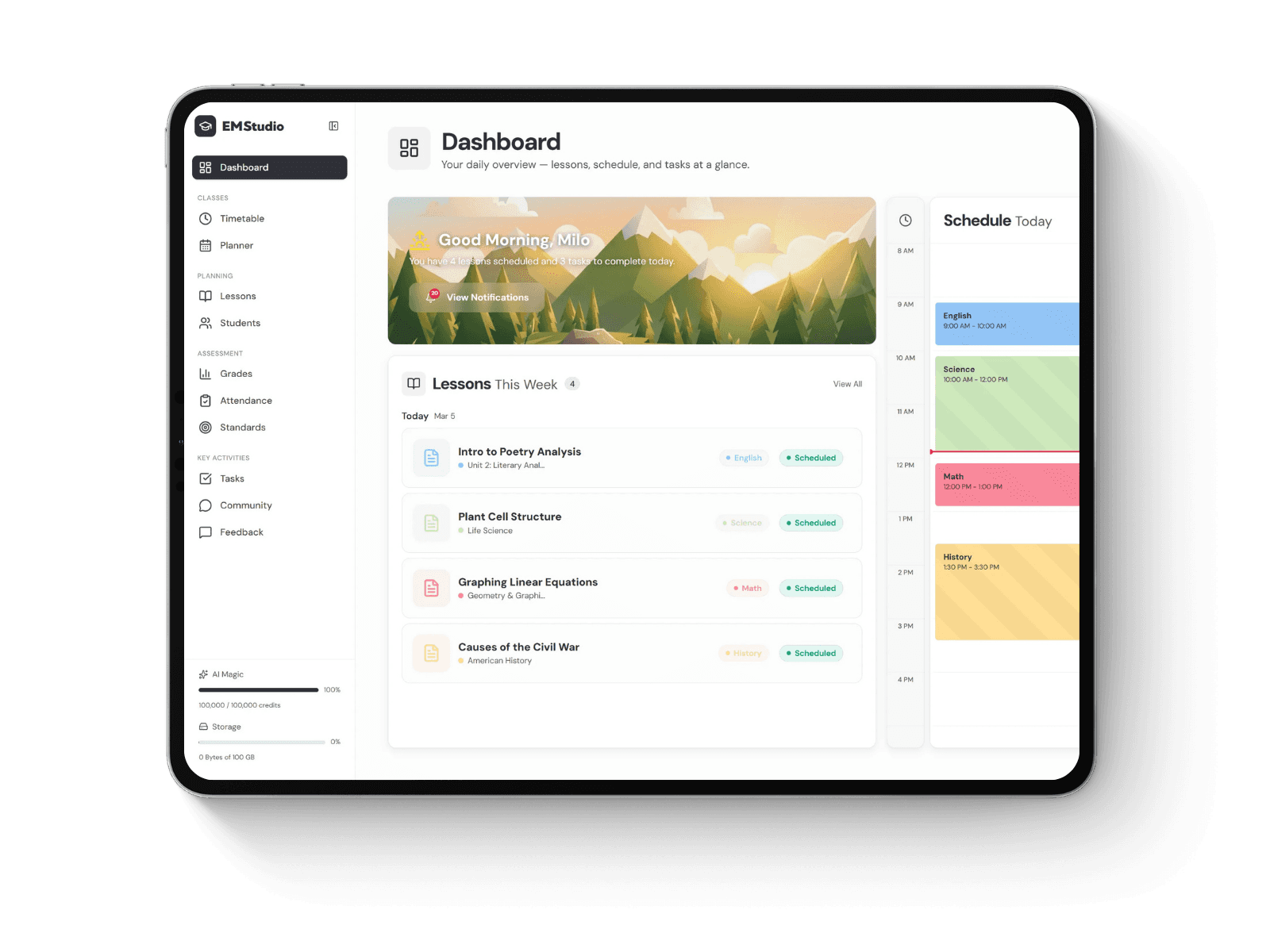
EMStudio is a free teaching management app — manage your classes, students, lessons, and more!
Learn More
Still grading everything by hand?
EMStudio is a free teaching management app — manage your classes, students, lessons, and more!
Learn More
Table of Contents
What Is an Advanced Learning Academy?
An advanced learning academy is a specialized K-12 program providing accelerated, enriched curriculum for high-ability students through full-day self-contained, magnet, or pull-out models. Unlike standard classrooms, these academies employ homogeneous grouping, curriculum compacting, and instructors with gifted education endorsements to match instruction to advanced cognitive development.
Think of it as a magnet for outliers. While your standard honors class adds extra reading logs, these programs move a 4th grader into 6th-grade math because the kid already mastered fractions last year. I watched a third-grader build a working circuit board while her peers were still labeling plant parts.
Definition and Core Program Models
Full-time self-contained academies like Hunter College Elementary serve K-8 students working 1-2 years above grade level. Part-time pull-out programs run 4-6 hours weekly for grades 3-8. Selective magnet schools such as the Illinois Mathematics and Science Academy enroll grades 9-12 for residential STEM immersion. Cohorts cap at 15-22 students, not 25-30.
University-affiliated Saturday programs like Johns Hopkins Center for Talented Youth offer another pathway. Getting in requires cognitive ability testing: CogAT scores of 126+ or WISC-V full-scale IQ of 130+, plus 95th percentile marks on Iowa Assessments or Stanford-10. Districts spend $1,200 to $4,500 extra per pupil annually for specialized instructors and dedicated labs.
Advanced Learning Academy vs. Traditional Gifted Education
Traditional gifted education pulls kids out for 2-3 hours weekly with generalist teachers. An advanced learning academy employs full-time instructors with 12-15 graduate credits in gifted education. Traditional enrichment programs add extra book reports—more work. Academies use curriculum compacting to skip mastered material and substitute abstract reasoning tasks.
The physical footprint differs too. Traditional programs use standard classrooms. Academies need dedicated maker spaces with $50,000 to $150,000 startup costs for equipment and flexible furniture. That investment allows students to build prototypes instead of posters. I watched magnet academy kids redesigning an HVAC system while my pull-out group finished logic puzzles upstairs.

Why Do Advanced Learning Academies Matter for Student Success?
Advanced learning academies prevent underachievement in high-potential students by providing challenge levels that standard classrooms lack. When high-ability learners receive targeted acceleration and enrichment as opposed to grade-level repetition, they demonstrate significantly higher academic engagement and are more likely to pursue advanced degrees and STEM careers.
Standard classrooms often fail our brightest kids. I watched a 4th grader who finished the math curriculum in October spend the next six months doodling while classmates caught up. That waste of potential is exactly what these academies eliminate.
John Hattie's Visible Learning meta-analysis makes the case with hard data. Curriculum acceleration shows an effect size of 0.68—well above the 0.40 threshold for high impact. Generic enrichment programs only hit 0.39. Simply put, moving bright kids ahead produces better results than giving them extra projects while they wait.
The excellence gap hits low-income students hardest. High-ability students from low-SES backgrounds lose one to two years of academic growth when forced into grade-level classrooms. An advanced learning academy stops this talent loss by matching instruction to their cognitive ability as opposed to their zip code.
But these programs aren't for everyone without support. Students with asynchronous development—think cognitive ability at the 98th percentile but social-emotional skills at the 50th—often crash and burn without embedded counseling. I've seen brilliant kids walk out because the academic challenge exceeded their coping capacity.
The numbers back up the model long-term. Academy alumni graduate from four-year colleges at rates 15-20% higher than equally gifted peers in traditional settings. They also take 40% more AP and IB exams, building the academic momentum that carries through university.
Addressing Diverse Learner Needs
Twice-exceptional learners need specific scaffolding to thrive in advanced settings. A student with an IQ of 130+ comorbid with ADHD or dyslexia requires extended time, fidget tools, and explicit social thinking curricula within the accelerated framework. Without these accommodations, the cluster grouping and rapid pacing that work for typical gifted students become overwhelming traps for 2e kids who can't executive-function their way through complex projects despite their cognitive strengths.
Effective identification methods matter more than you think. Top programs use local norming—identifying the top 5% per school as opposed to district-wide—to catch underrepresented talent missed by universal screening. This approach increases English learner and low-income representation by 40-60%, making sure gifted education serves the kids who need it most as opposed to just those with test prep resources and educated parents who know how to advocate.
Long-Term Academic and Social Outcomes
College persistence data tells the real story about these investments. Academy alumni complete four-year degrees at rates of 85-90%, compared to 70-75% for matched controls from traditional settings. These long-term academic and social outcomes prove that early academic challenge builds the resilience and study habits necessary for university success where previous academic ease often fails.
Social isolation kills these programs if you ignore the human element. We use nested grouping—teams of four to five students within larger cohorts—to prevent the intense loneliness that often hits bright kids when curriculum compacting and acceleration remove them from familiar peer groups. Weekly advisory periods using CASEL SEL competencies address the psychosocial gaps that cognitive ability testing simply cannot measure or predict before they become dropout risks.

How Advanced Learning Academies Structure Curriculum and Instruction
Curriculum Acceleration Methods
Curriculum acceleration follows four distinct protocols. Grade-skipping moves students 1-2 years ahead in all subjects. Subject acceleration isolates advancement to one domain—often math through Johns Hopkins CTY or Stanford Online. Curriculum compacting eliminates 40-50% of pre-tested content, while telescoping compresses two years of standards into one instructional year.
Compacting requires 90% mastery on above-grade-level pre-assessments. I had a 5th grader take the 7th grade fractions unit test last October. She scored 94%, so we documented the eliminated standards in our district tracking system and replaced that six-week block with independent research. That's the compacting protocol: test out, log it, enrich.
Project-Based Learning Integration
The Buck Institute Gold Standard distinguishes between dessert projects and main course projects. Dessert projects last two weeks and follow traditional instruction—think posters after lectures. Main course projects drive instruction for 6-8 weeks, with content built around the driving question.
Last semester, my 8th graders spent six weeks analyzing our local watershed using real EPA data sets. This wasn't an add-on. The chemistry, biology, and statistics instruction happened because students needed those tools to test water quality. We assess these through rubrics measuring intellectual challenge, authenticity, and student voice.
Effective project-based learning integration means abandoning the "fun Friday" model. When projects become the vehicle for standards rather than the reward for enduring them, engagement shifts.
Assessment and Progress Monitoring Systems
We track growth differently in an advanced learning academy. Formative assessment includes daily exit tickets and weekly Socratic seminars. Summative assessment combines above-grade-level achievement tests with cognitive ability testing—NWEA MAP Growth three times yearly, plus Talent Search SAT/ACT for 7th and 8th graders.
Progress monitoring runs on goal-line graphs expecting 1.5 years of growth per academic year. We use Pearson aimswebPlus or Renaissance Star 360 configured with above-grade-level ceilings to prevent top-out effects. When a 6th grader maxes out the 8th grade math test, we know it's time to accelerate.
Systematic assessment and progress monitoring systems prevent plateauing in gifted education. The data tells us exactly when to adjust cluster grouping configurations or move to full subject acceleration.
Key Components of Effective Advanced Learning Academy Programs
Specialized Instructor Training and Certification
Teachers in an advanced learning academy need specific credentials beyond standard licensure. The NAGC endorsement requires 12-15 graduate credit hours in gifted education, running $3,000-$6,000 per teacher. Standard certification covers classroom management, not curriculum compacting or acceleration strategies.
Pathways vary by state. Gifted Education National Board certification needs a 4-component portfolio. Florida's plan requires 5 competency courses. Some pursue micro-credentials through University of Connecticut or Northwestern Center for Talent Development.
I watched a district hire a PhD mathematician who assigned triple homework. The students never saw conceptually complex work. Content expertise means nothing without training in cognitive ability testing and gifted pedagogy. Kids got worksheets, not wonder.
Resource Allocation and Budget Considerations
Districts choose between two distinct funding models. Magnet schools demand $500K+ startup for separate facilities plus ongoing transportation costs. School-within-school models share existing buildings with a $50K curriculum acceleration investment and no bussing.
Budget lines reveal priorities. Gifted certification stipends run $2,000-$5,000 per teacher. Advanced lab supplies cost $200-$400 per pupil versus $100 standard. Quality professional development runs $40,000-$60,000 annually for 15 staff.
Technology adds up. Programs pay $8 per student for IXL Learning math acceleration and $15 per student for Renzulli Learning enrichment profiling. That is $23 per kid annually before the 1:1 devices.
I've seen enrichment programs collapse when districts fund building renovation but skip the $300 per student materials budget. The rooms look impressive but sit empty.
Family and Community Engagement Protocols
Real family and community engagement protocols require structured commitment. Mandatory SENG parent groups meet monthly to address social-emotional needs specific to gifted learners. Parent advisory councils hold voting rights on field trips and curriculum acceleration selections, not just advisory input.
Communication systems vary by level. K-5 uses Seesaw for weekly digital portfolios. Grades 6-12 maintain Google Sites. Both replace traditional conferences with quarterly student-led events where kids present enrichment programs work.
This builds investment. When parents understand cognitive ability testing scores and curriculum compacting, they stop requesting "more homework" and start demanding intellectually complex tasks that stretch their children appropriately.

Who Qualifies for Advanced Learning Academy Enrollment?
Enrollment typically requires scores at the 95th percentile or above on cognitive ability tests like CogAT or WISC-V, combined with achievement testing. Programs increasingly use local norms and portfolio assessments to identify underrepresented gifted learners, following APA Learning guidelines for culturally responsive and equitable assessment practices.
Most districts screen every second grader in October. Last year, I watched a quiet ELL student qualify because the Naglieri NVCC removed the language barrier. You do not need a teacher referral anymore.
The identification matrix weighs CogAT Form 7, WISC-V, or Naglieri NVCC scores at 75%, with Renzulli Scales or portfolios at 25%. Students need an IQ of 130+ or 95th percentile on Stanford-10 or Iowa Assessments. Local norming identifies the top 5% per school, not district-wide, capturing underrepresented minorities who might otherwise be overlooked.
Assessments run October through November. Appeals close in January. You receive placement notifications by March for fall entry into the advanced learning academy.
Identification and Assessment Criteria
The process moves through three distinct phases:
Phase 1: Universal screening of all 2nd graders.
Phase 2: Individual IQ testing for the top 20%.
Phase 3: Holistic review by a committee including the school psychologist, ELL specialist, and gifted coordinator.
For twice-exceptional learners, the district provides untimed testing, separate quiet rooms, and accepts discrepancy models. I once had a dyslexic student score 140 on the WISC-V but fail the reading achievement test; the gap qualified him for gifted education services immediately.
APA Learning Framework Considerations
Following APA Learning Guidelines for Psychological Evaluations, districts must use culturally competent assessors who consider bilingual development when interpreting scores. Test administrators work to eliminate stereotype threat during cognitive ability testing sessions.
Documentation standards require psychological reports dated within 24 months that include confidence intervals and address test-taking behavior. This ensures valid interpretation of scores for curriculum acceleration or curriculum compacting decisions.

Practical Applications: Bringing Advanced Strategies to Standard Classrooms
Differentiation Strategies for Mixed-Ability Classrooms
I use Tomlinson's tiered instruction for 5th grade literary analysis, which you can read more about in these differentiation strategies for mixed-ability classrooms. Tier 1 reads the grade-level text at Lexile 850 while Tier 2 tackles 8th-grade complexity at Lexile 1050. Tier 3 wrestles with 11th-grade text at Lexile 1300. All three groups analyze theme and character motivation with the same conceptual complexity; only the text density changes.
For cluster grouping, I place the top four or five advanced learners together in my heterogeneous class of 28. Though cognitive ability testing identifies many of these students, I also include anyone demonstrating readiness through class performance. While the rest of the class engages in guided inquiry, my cluster conducts independent research using JSTOR or Google Scholar with full citation requirements.
During 20-minute station rotations, my advanced group uses curriculum compacting to skip procedural practice. Last month, while peers reviewed arithmetic on IXL, my 7th graders used Desmos for algebraic modeling of real-world population data. If students score above 85% on unit pre-tests, I compact 50% of the content, replace it with independent study, and document the adjustment in our district LMS.
Digital Tools and Notion Templates for Advanced Learning
I built a Notion system for curriculum compacting with three linked databases. The Student Standards Tracker connects to an Enrichment Resource Library tagged by subject and a Parent Communication Log. I use the free personal plan, though my district pays $8 to $10 per user monthly for the team plan to share templates across the gifted education department.
My template uses specific database views. The Compacting Status column uses a dropdown with options: Pre-tested, Mastered, or In Progress. Replacement Activities link directly to enrichment programs and resources, and a Parent Notification checkbox confirms I sent the learning pdf home. You can download similar Notion templates for advanced learning from our resource library.
If Notion isn't available, try Google Classroom automation using Apps Script to auto-assign enrichment when formative scores exceed 90%. Schoology users can set completion rules to unlock advanced modules only after students demonstrate mastery. These digital supports make curriculum acceleration feasible without waiting for official cognitive ability testing results to update.

Essential Resources: APA Learning Standards and Digital Learning PDFs
Understanding APA Learning Guidelines for Advanced Curriculum
The apa learning standards outlined in the Top 20 Principles from Psychology for PreK-12 Teaching and Learning ground our advanced learning academy decisions in evidence. Principle 2 states that cognitive development precedes learning. This justifies curriculum acceleration for students ready for above-grade-level content, like placing a 5th grader in 7th grade math. We use this principle when curriculum compacting lessons for students who already mastered the standards.
Principle 7 emphasizes that learning is fundamentally social. This supports cluster grouping and collaborative structures within enrichment programs. Students need peers who challenge their thinking.
Ethical guidelines for cognitive ability testing require written parental consent and strict confidentiality of IQ scores. We use this data only for instructional planning, never for labels that limit opportunity.
Creating Accessible Learning PDFs for Stakeholders
Every learning pdf we distribute meets WCAG 2.1 AA standards. That means searchable text, not scanned images. We tag headings for screen readers and maintain 4.5:1 color contrast ratios. File sizes stay under 5MB so they won't bounce back from district email servers.
We use 12pt sans-serif fonts minimum and translate documents into our top three home languages, usually Spanish, Mandarin, and Arabic in our district. When I started creating accessible learning PDFs, I realized families needed digital formats that work on phones, not just desktops.
Store these in a password-protected parent portal with clear version dates. Parents need to know if they're reading the October or February edition of the gifted education handbook.
Citation and Research Skill Development
Learning apa citation follows a clear progression through the grades. Sixth graders master basic attribution: naming the author and source. By eighth grade, they format in-text citations properly with author and year. Tenth graders build complete reference lists with hanging indents. Seniors write full APA 7th edition research papers with proper DOI formatting for journal articles.
We teach students to check Purdue OWL or the APA Style Blog when they get stuck. For curriculum compacting research projects, we require drafts through Turnitin or Grammarly EDU before submission. This catches accidental plagiarism early.
Access matters. Our students use EBSCO and JSTOR databases appropriate for secondary researchers. They learn to evaluate sources while mastering the mechanics of citation. The tool should match the cognitive demand of the task.

Getting Started: Implementation Steps for Educators and Administrators
Initial Planning and Needs Assessment
Start with the Renzulli Schoolwide Enrichment Model readiness survey to gauge whether your school culture can sustain an advanced learning academy. Budget five to fifteen thousand dollars for a feasibility study. Run stakeholder focus groups with fifteen to twenty participants, and deliberately include skeptics—they surface real obstacles early.
Use a SWOT analysis template designed specifically for gifted education programming. Enrollment projection models typically show two to five percent of your population eligible based on cognitive ability testing distribution. Conduct a space audit. You need dedicated breakout rooms, sound dampening for sensitive learners, flexible furniture for project-based work, and secure storage for expensive lab equipment.
Professional Development Requirements
During months four through eight, commit to forty hours of initial training per teacher. Cover Costa and Garmston Cognitive Coaching and Kaplan Depth and Complexity icons. Recruit NAGC-endorsed staff to build expertise in curriculum acceleration.
Structure your professional development requirements across four quarters. Quarter one covers nature and needs. Quarter two focuses on differentiation and curriculum compacting. Quarter three addresses social-emotional support. Quarter four trains assessment protocols.
Establish external partnerships early. Collaborate with universities for dual enrollment. Arrange STEM shadows with industry professionals. Secure museum access for enrichment programs beyond your walls.
Evaluation Metrics and Success Indicators
Launch your pilot in months nine through twelve with one grade level and maximum sixty students. Use cluster grouping to optimize peer interaction. Build a dashboard tracking 1.5 years MAP growth, Gallup satisfaction above eighty-five percent, and ninety percent teacher retention.
Monitor ninety-fifth percentile growth rates and AP passing rates alongside student agency surveys and parent Net Promoter Scores. At month six, check pre-assessment compliance. Below eighty percent means you pause expansion.
Budget Year one at $150,000 to $300,000 for a school-within-school or $1 million-plus for a standalone magnet. Track effect size above 1.0 and equity ratios. Establish exit criteria for inappropriate placement with a clear return-path to general education.

The Bigger Picture on Advanced Learning Academy
An advanced learning academy isn't a special building down the hall. It's a mindset. Last year, I had a 4th grader who finished the math curriculum by February. We didn't ship him off anywhere. We used curriculum acceleration and enrichment programs right in our regular classroom. That's the real takeaway here.
You don't need perfect cognitive ability testing scores or a district magnet program to begin. Pick one strategy from this guide. Maybe it's pre-assessing before units, or using those APA Learning Standards to differentiate reading groups. Pick one student who finishes early and looks bored. Give them the harder text. See what happens.
The goal isn't to create a separate track for "gifted" kids. It's to stop holding them back while you catch everyone else up. That's good teaching, period.
What Is an Advanced Learning Academy?
An advanced learning academy is a specialized K-12 program providing accelerated, enriched curriculum for high-ability students through full-day self-contained, magnet, or pull-out models. Unlike standard classrooms, these academies employ homogeneous grouping, curriculum compacting, and instructors with gifted education endorsements to match instruction to advanced cognitive development.
Think of it as a magnet for outliers. While your standard honors class adds extra reading logs, these programs move a 4th grader into 6th-grade math because the kid already mastered fractions last year. I watched a third-grader build a working circuit board while her peers were still labeling plant parts.
Definition and Core Program Models
Full-time self-contained academies like Hunter College Elementary serve K-8 students working 1-2 years above grade level. Part-time pull-out programs run 4-6 hours weekly for grades 3-8. Selective magnet schools such as the Illinois Mathematics and Science Academy enroll grades 9-12 for residential STEM immersion. Cohorts cap at 15-22 students, not 25-30.
University-affiliated Saturday programs like Johns Hopkins Center for Talented Youth offer another pathway. Getting in requires cognitive ability testing: CogAT scores of 126+ or WISC-V full-scale IQ of 130+, plus 95th percentile marks on Iowa Assessments or Stanford-10. Districts spend $1,200 to $4,500 extra per pupil annually for specialized instructors and dedicated labs.
Advanced Learning Academy vs. Traditional Gifted Education
Traditional gifted education pulls kids out for 2-3 hours weekly with generalist teachers. An advanced learning academy employs full-time instructors with 12-15 graduate credits in gifted education. Traditional enrichment programs add extra book reports—more work. Academies use curriculum compacting to skip mastered material and substitute abstract reasoning tasks.
The physical footprint differs too. Traditional programs use standard classrooms. Academies need dedicated maker spaces with $50,000 to $150,000 startup costs for equipment and flexible furniture. That investment allows students to build prototypes instead of posters. I watched magnet academy kids redesigning an HVAC system while my pull-out group finished logic puzzles upstairs.
Why Do Advanced Learning Academies Matter for Student Success?
Advanced learning academies prevent underachievement in high-potential students by providing challenge levels that standard classrooms lack. When high-ability learners receive targeted acceleration and enrichment as opposed to grade-level repetition, they demonstrate significantly higher academic engagement and are more likely to pursue advanced degrees and STEM careers.
Standard classrooms often fail our brightest kids. I watched a 4th grader who finished the math curriculum in October spend the next six months doodling while classmates caught up. That waste of potential is exactly what these academies eliminate.
John Hattie's Visible Learning meta-analysis makes the case with hard data. Curriculum acceleration shows an effect size of 0.68—well above the 0.40 threshold for high impact. Generic enrichment programs only hit 0.39. Simply put, moving bright kids ahead produces better results than giving them extra projects while they wait.
The excellence gap hits low-income students hardest. High-ability students from low-SES backgrounds lose one to two years of academic growth when forced into grade-level classrooms. An advanced learning academy stops this talent loss by matching instruction to their cognitive ability as opposed to their zip code.
But these programs aren't for everyone without support. Students with asynchronous development—think cognitive ability at the 98th percentile but social-emotional skills at the 50th—often crash and burn without embedded counseling. I've seen brilliant kids walk out because the academic challenge exceeded their coping capacity.
The numbers back up the model long-term. Academy alumni graduate from four-year colleges at rates 15-20% higher than equally gifted peers in traditional settings. They also take 40% more AP and IB exams, building the academic momentum that carries through university.
Addressing Diverse Learner Needs
Twice-exceptional learners need specific scaffolding to thrive in advanced settings. A student with an IQ of 130+ comorbid with ADHD or dyslexia requires extended time, fidget tools, and explicit social thinking curricula within the accelerated framework. Without these accommodations, the cluster grouping and rapid pacing that work for typical gifted students become overwhelming traps for 2e kids who can't executive-function their way through complex projects despite their cognitive strengths.
Effective identification methods matter more than you think. Top programs use local norming—identifying the top 5% per school as opposed to district-wide—to catch underrepresented talent missed by universal screening. This approach increases English learner and low-income representation by 40-60%, making sure gifted education serves the kids who need it most as opposed to just those with test prep resources and educated parents who know how to advocate.
Long-Term Academic and Social Outcomes
College persistence data tells the real story about these investments. Academy alumni complete four-year degrees at rates of 85-90%, compared to 70-75% for matched controls from traditional settings. These long-term academic and social outcomes prove that early academic challenge builds the resilience and study habits necessary for university success where previous academic ease often fails.
Social isolation kills these programs if you ignore the human element. We use nested grouping—teams of four to five students within larger cohorts—to prevent the intense loneliness that often hits bright kids when curriculum compacting and acceleration remove them from familiar peer groups. Weekly advisory periods using CASEL SEL competencies address the psychosocial gaps that cognitive ability testing simply cannot measure or predict before they become dropout risks.
How Advanced Learning Academies Structure Curriculum and Instruction
Curriculum Acceleration Methods
Curriculum acceleration follows four distinct protocols. Grade-skipping moves students 1-2 years ahead in all subjects. Subject acceleration isolates advancement to one domain—often math through Johns Hopkins CTY or Stanford Online. Curriculum compacting eliminates 40-50% of pre-tested content, while telescoping compresses two years of standards into one instructional year.
Compacting requires 90% mastery on above-grade-level pre-assessments. I had a 5th grader take the 7th grade fractions unit test last October. She scored 94%, so we documented the eliminated standards in our district tracking system and replaced that six-week block with independent research. That's the compacting protocol: test out, log it, enrich.
Project-Based Learning Integration
The Buck Institute Gold Standard distinguishes between dessert projects and main course projects. Dessert projects last two weeks and follow traditional instruction—think posters after lectures. Main course projects drive instruction for 6-8 weeks, with content built around the driving question.
Last semester, my 8th graders spent six weeks analyzing our local watershed using real EPA data sets. This wasn't an add-on. The chemistry, biology, and statistics instruction happened because students needed those tools to test water quality. We assess these through rubrics measuring intellectual challenge, authenticity, and student voice.
Effective project-based learning integration means abandoning the "fun Friday" model. When projects become the vehicle for standards rather than the reward for enduring them, engagement shifts.
Assessment and Progress Monitoring Systems
We track growth differently in an advanced learning academy. Formative assessment includes daily exit tickets and weekly Socratic seminars. Summative assessment combines above-grade-level achievement tests with cognitive ability testing—NWEA MAP Growth three times yearly, plus Talent Search SAT/ACT for 7th and 8th graders.
Progress monitoring runs on goal-line graphs expecting 1.5 years of growth per academic year. We use Pearson aimswebPlus or Renaissance Star 360 configured with above-grade-level ceilings to prevent top-out effects. When a 6th grader maxes out the 8th grade math test, we know it's time to accelerate.
Systematic assessment and progress monitoring systems prevent plateauing in gifted education. The data tells us exactly when to adjust cluster grouping configurations or move to full subject acceleration.
Key Components of Effective Advanced Learning Academy Programs
Specialized Instructor Training and Certification
Teachers in an advanced learning academy need specific credentials beyond standard licensure. The NAGC endorsement requires 12-15 graduate credit hours in gifted education, running $3,000-$6,000 per teacher. Standard certification covers classroom management, not curriculum compacting or acceleration strategies.
Pathways vary by state. Gifted Education National Board certification needs a 4-component portfolio. Florida's plan requires 5 competency courses. Some pursue micro-credentials through University of Connecticut or Northwestern Center for Talent Development.
I watched a district hire a PhD mathematician who assigned triple homework. The students never saw conceptually complex work. Content expertise means nothing without training in cognitive ability testing and gifted pedagogy. Kids got worksheets, not wonder.
Resource Allocation and Budget Considerations
Districts choose between two distinct funding models. Magnet schools demand $500K+ startup for separate facilities plus ongoing transportation costs. School-within-school models share existing buildings with a $50K curriculum acceleration investment and no bussing.
Budget lines reveal priorities. Gifted certification stipends run $2,000-$5,000 per teacher. Advanced lab supplies cost $200-$400 per pupil versus $100 standard. Quality professional development runs $40,000-$60,000 annually for 15 staff.
Technology adds up. Programs pay $8 per student for IXL Learning math acceleration and $15 per student for Renzulli Learning enrichment profiling. That is $23 per kid annually before the 1:1 devices.
I've seen enrichment programs collapse when districts fund building renovation but skip the $300 per student materials budget. The rooms look impressive but sit empty.
Family and Community Engagement Protocols
Real family and community engagement protocols require structured commitment. Mandatory SENG parent groups meet monthly to address social-emotional needs specific to gifted learners. Parent advisory councils hold voting rights on field trips and curriculum acceleration selections, not just advisory input.
Communication systems vary by level. K-5 uses Seesaw for weekly digital portfolios. Grades 6-12 maintain Google Sites. Both replace traditional conferences with quarterly student-led events where kids present enrichment programs work.
This builds investment. When parents understand cognitive ability testing scores and curriculum compacting, they stop requesting "more homework" and start demanding intellectually complex tasks that stretch their children appropriately.
Who Qualifies for Advanced Learning Academy Enrollment?
Enrollment typically requires scores at the 95th percentile or above on cognitive ability tests like CogAT or WISC-V, combined with achievement testing. Programs increasingly use local norms and portfolio assessments to identify underrepresented gifted learners, following APA Learning guidelines for culturally responsive and equitable assessment practices.
Most districts screen every second grader in October. Last year, I watched a quiet ELL student qualify because the Naglieri NVCC removed the language barrier. You do not need a teacher referral anymore.
The identification matrix weighs CogAT Form 7, WISC-V, or Naglieri NVCC scores at 75%, with Renzulli Scales or portfolios at 25%. Students need an IQ of 130+ or 95th percentile on Stanford-10 or Iowa Assessments. Local norming identifies the top 5% per school, not district-wide, capturing underrepresented minorities who might otherwise be overlooked.
Assessments run October through November. Appeals close in January. You receive placement notifications by March for fall entry into the advanced learning academy.
Identification and Assessment Criteria
The process moves through three distinct phases:
Phase 1: Universal screening of all 2nd graders.
Phase 2: Individual IQ testing for the top 20%.
Phase 3: Holistic review by a committee including the school psychologist, ELL specialist, and gifted coordinator.
For twice-exceptional learners, the district provides untimed testing, separate quiet rooms, and accepts discrepancy models. I once had a dyslexic student score 140 on the WISC-V but fail the reading achievement test; the gap qualified him for gifted education services immediately.
APA Learning Framework Considerations
Following APA Learning Guidelines for Psychological Evaluations, districts must use culturally competent assessors who consider bilingual development when interpreting scores. Test administrators work to eliminate stereotype threat during cognitive ability testing sessions.
Documentation standards require psychological reports dated within 24 months that include confidence intervals and address test-taking behavior. This ensures valid interpretation of scores for curriculum acceleration or curriculum compacting decisions.
Practical Applications: Bringing Advanced Strategies to Standard Classrooms
Differentiation Strategies for Mixed-Ability Classrooms
I use Tomlinson's tiered instruction for 5th grade literary analysis, which you can read more about in these differentiation strategies for mixed-ability classrooms. Tier 1 reads the grade-level text at Lexile 850 while Tier 2 tackles 8th-grade complexity at Lexile 1050. Tier 3 wrestles with 11th-grade text at Lexile 1300. All three groups analyze theme and character motivation with the same conceptual complexity; only the text density changes.
For cluster grouping, I place the top four or five advanced learners together in my heterogeneous class of 28. Though cognitive ability testing identifies many of these students, I also include anyone demonstrating readiness through class performance. While the rest of the class engages in guided inquiry, my cluster conducts independent research using JSTOR or Google Scholar with full citation requirements.
During 20-minute station rotations, my advanced group uses curriculum compacting to skip procedural practice. Last month, while peers reviewed arithmetic on IXL, my 7th graders used Desmos for algebraic modeling of real-world population data. If students score above 85% on unit pre-tests, I compact 50% of the content, replace it with independent study, and document the adjustment in our district LMS.
Digital Tools and Notion Templates for Advanced Learning
I built a Notion system for curriculum compacting with three linked databases. The Student Standards Tracker connects to an Enrichment Resource Library tagged by subject and a Parent Communication Log. I use the free personal plan, though my district pays $8 to $10 per user monthly for the team plan to share templates across the gifted education department.
My template uses specific database views. The Compacting Status column uses a dropdown with options: Pre-tested, Mastered, or In Progress. Replacement Activities link directly to enrichment programs and resources, and a Parent Notification checkbox confirms I sent the learning pdf home. You can download similar Notion templates for advanced learning from our resource library.
If Notion isn't available, try Google Classroom automation using Apps Script to auto-assign enrichment when formative scores exceed 90%. Schoology users can set completion rules to unlock advanced modules only after students demonstrate mastery. These digital supports make curriculum acceleration feasible without waiting for official cognitive ability testing results to update.
Essential Resources: APA Learning Standards and Digital Learning PDFs
Understanding APA Learning Guidelines for Advanced Curriculum
The apa learning standards outlined in the Top 20 Principles from Psychology for PreK-12 Teaching and Learning ground our advanced learning academy decisions in evidence. Principle 2 states that cognitive development precedes learning. This justifies curriculum acceleration for students ready for above-grade-level content, like placing a 5th grader in 7th grade math. We use this principle when curriculum compacting lessons for students who already mastered the standards.
Principle 7 emphasizes that learning is fundamentally social. This supports cluster grouping and collaborative structures within enrichment programs. Students need peers who challenge their thinking.
Ethical guidelines for cognitive ability testing require written parental consent and strict confidentiality of IQ scores. We use this data only for instructional planning, never for labels that limit opportunity.
Creating Accessible Learning PDFs for Stakeholders
Every learning pdf we distribute meets WCAG 2.1 AA standards. That means searchable text, not scanned images. We tag headings for screen readers and maintain 4.5:1 color contrast ratios. File sizes stay under 5MB so they won't bounce back from district email servers.
We use 12pt sans-serif fonts minimum and translate documents into our top three home languages, usually Spanish, Mandarin, and Arabic in our district. When I started creating accessible learning PDFs, I realized families needed digital formats that work on phones, not just desktops.
Store these in a password-protected parent portal with clear version dates. Parents need to know if they're reading the October or February edition of the gifted education handbook.
Citation and Research Skill Development
Learning apa citation follows a clear progression through the grades. Sixth graders master basic attribution: naming the author and source. By eighth grade, they format in-text citations properly with author and year. Tenth graders build complete reference lists with hanging indents. Seniors write full APA 7th edition research papers with proper DOI formatting for journal articles.
We teach students to check Purdue OWL or the APA Style Blog when they get stuck. For curriculum compacting research projects, we require drafts through Turnitin or Grammarly EDU before submission. This catches accidental plagiarism early.
Access matters. Our students use EBSCO and JSTOR databases appropriate for secondary researchers. They learn to evaluate sources while mastering the mechanics of citation. The tool should match the cognitive demand of the task.
Getting Started: Implementation Steps for Educators and Administrators
Initial Planning and Needs Assessment
Start with the Renzulli Schoolwide Enrichment Model readiness survey to gauge whether your school culture can sustain an advanced learning academy. Budget five to fifteen thousand dollars for a feasibility study. Run stakeholder focus groups with fifteen to twenty participants, and deliberately include skeptics—they surface real obstacles early.
Use a SWOT analysis template designed specifically for gifted education programming. Enrollment projection models typically show two to five percent of your population eligible based on cognitive ability testing distribution. Conduct a space audit. You need dedicated breakout rooms, sound dampening for sensitive learners, flexible furniture for project-based work, and secure storage for expensive lab equipment.
Professional Development Requirements
During months four through eight, commit to forty hours of initial training per teacher. Cover Costa and Garmston Cognitive Coaching and Kaplan Depth and Complexity icons. Recruit NAGC-endorsed staff to build expertise in curriculum acceleration.
Structure your professional development requirements across four quarters. Quarter one covers nature and needs. Quarter two focuses on differentiation and curriculum compacting. Quarter three addresses social-emotional support. Quarter four trains assessment protocols.
Establish external partnerships early. Collaborate with universities for dual enrollment. Arrange STEM shadows with industry professionals. Secure museum access for enrichment programs beyond your walls.
Evaluation Metrics and Success Indicators
Launch your pilot in months nine through twelve with one grade level and maximum sixty students. Use cluster grouping to optimize peer interaction. Build a dashboard tracking 1.5 years MAP growth, Gallup satisfaction above eighty-five percent, and ninety percent teacher retention.
Monitor ninety-fifth percentile growth rates and AP passing rates alongside student agency surveys and parent Net Promoter Scores. At month six, check pre-assessment compliance. Below eighty percent means you pause expansion.
Budget Year one at $150,000 to $300,000 for a school-within-school or $1 million-plus for a standalone magnet. Track effect size above 1.0 and equity ratios. Establish exit criteria for inappropriate placement with a clear return-path to general education.
The Bigger Picture on Advanced Learning Academy
An advanced learning academy isn't a special building down the hall. It's a mindset. Last year, I had a 4th grader who finished the math curriculum by February. We didn't ship him off anywhere. We used curriculum acceleration and enrichment programs right in our regular classroom. That's the real takeaway here.
You don't need perfect cognitive ability testing scores or a district magnet program to begin. Pick one strategy from this guide. Maybe it's pre-assessing before units, or using those APA Learning Standards to differentiate reading groups. Pick one student who finishes early and looks bored. Give them the harder text. See what happens.
The goal isn't to create a separate track for "gifted" kids. It's to stop holding them back while you catch everyone else up. That's good teaching, period.
Still grading everything by hand?
EMStudio is a free teaching management app — manage your classes, students, lessons, and more!
Learn More
Still grading everything by hand?
EMStudio is a free teaching management app — manage your classes, students, lessons, and more!
Learn More




Notion4Teachers
Notion templates to simplify administrative tasks and enhance your teaching experience.



2026 Notion4Teachers. All Rights Reserved.
Notion4Teachers
Notion templates to simplify administrative tasks and enhance your teaching experience.
2026 Notion4Teachers. All Rights Reserved.
Notion4Teachers
Notion templates to simplify administrative tasks and enhance your teaching experience.
2026 Notion4Teachers. All Rights Reserved.