
15 Classroom Resources for Your Teacher Toolkit
15 Classroom Resources for Your Teacher Toolkit

Article by
Milo
ESL Content Coordinator & Educator
ESL Content Coordinator & Educator
All Posts
You’ve spent another Sunday evening scrolling through Pinterest boards and Amazon reviews, adding items to your cart and then deleting them. Your desk is already buried under papers. Your district’s budget covers exactly none of the classroom resources you actually need, and you’re tired of buying stuff that breaks by October. I’ve been there—staring at Monday’s lesson plan and wondering if that $40 subscription is worth half a tank of gas. The right tools shouldn’t require a side hustle to afford.
This list cuts through the noise. I’m sharing fifteen tools that survived real use in my room. These digital apps boost student engagement. The physical items survive 3rd graders. The organization systems gave me back my planning periods. No affiliate links to junk I wouldn’t use myself. Just instructional materials and strategies that work for differentiated instruction without draining your paycheck. I’ve tested these during fire drills, indoor recess days, and that week before winter break when focus disappears.
You’ll find hands-on learning materials for STEM stations, literacy tools that simplify lesson planning, and classroom management shortcuts. Some cost nothing. Others are worth every penny. All of them earned their spot in my teacher toolkit the hard way. They worked when the wifi failed, the copier jammed, and twenty fourth-graders walked in ready to learn. Grab what fits your teaching style. Leave the rest.
Still grading everything by hand?
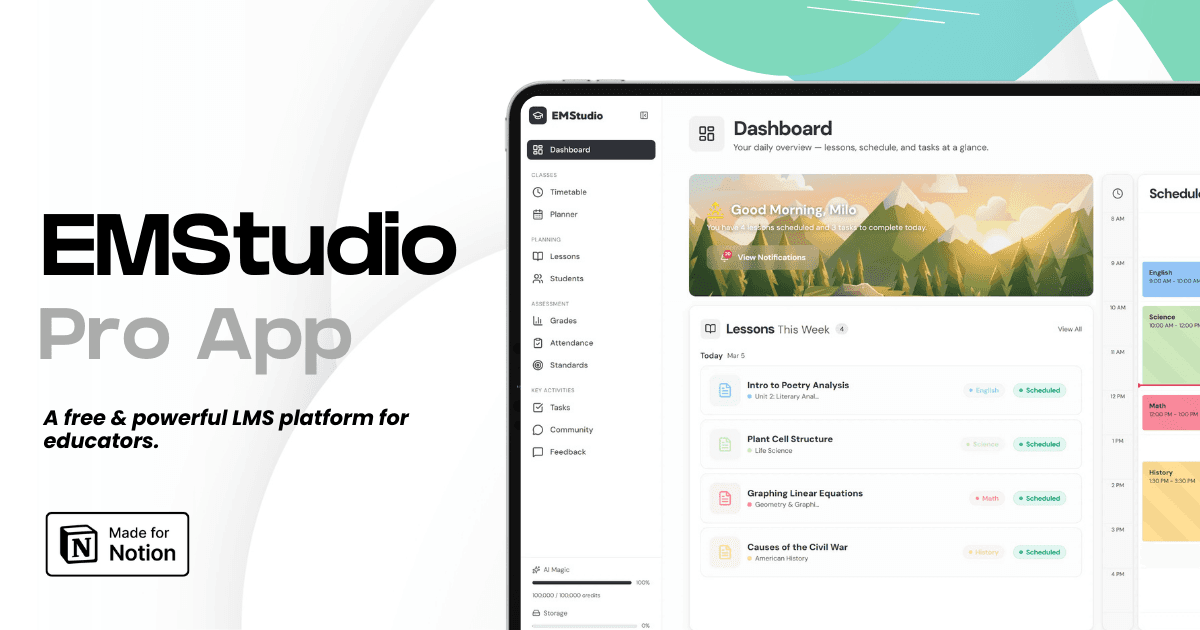
EMStudio is a free teaching management app — manage your classes, students, lessons, and more!
Learn More
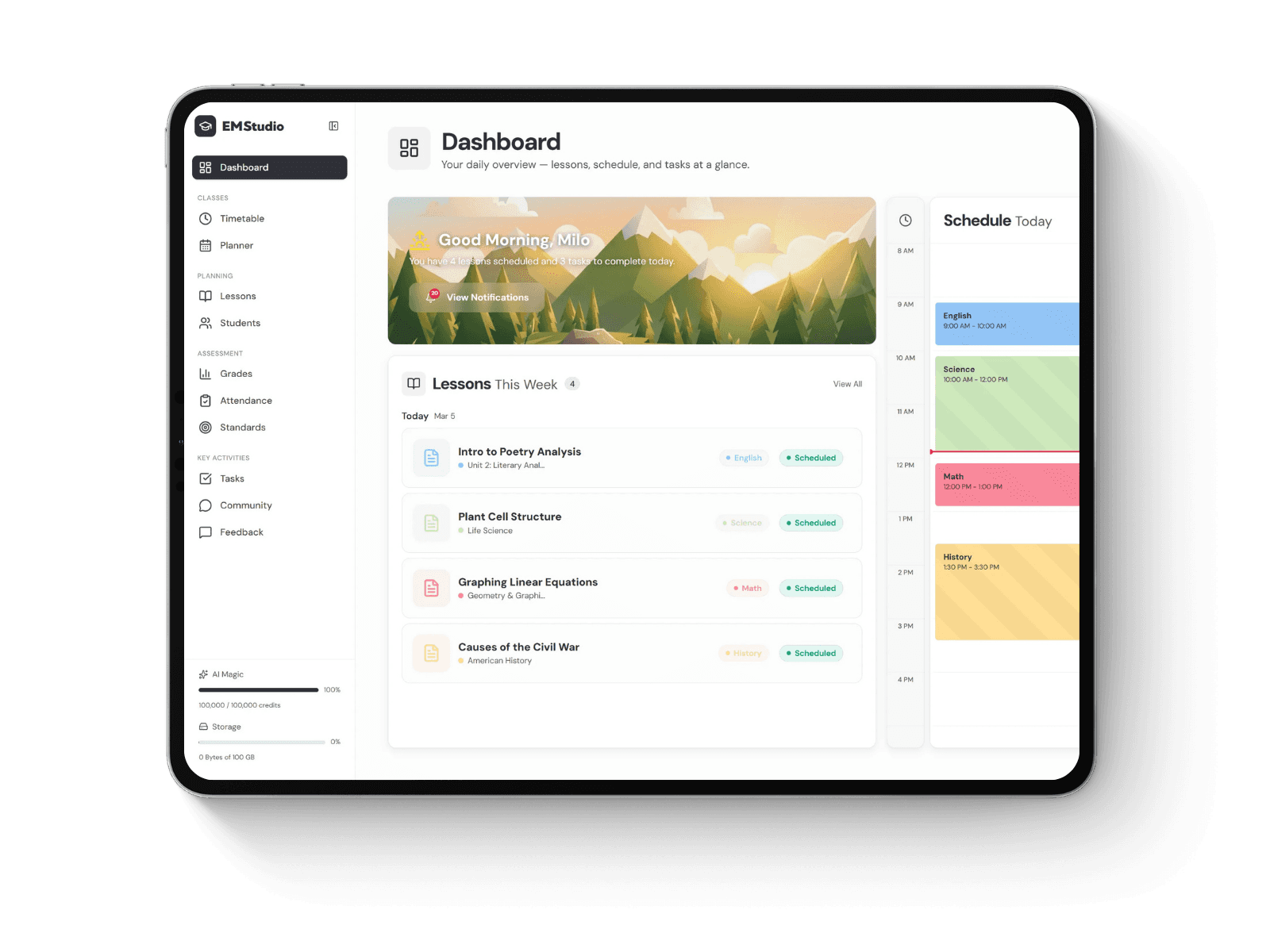
Still grading everything by hand?
EMStudio is a free teaching management app — manage your classes, students, lessons, and more!
Learn More
Table of Contents
What Are the Best Digital Classroom Resources for Engagement?
The best digital classroom resources include interactive whiteboard software like Nearpod and Lumio, student response systems such as Kahoot! and Pear Deck, and digital portfolio platforms like Seesaw. These classroom tools increase student participation through real-time feedback and multimodal learning when implemented with consistent lesson planning routines.
You need instructional materials that work on Chromebooks and don't crash when the Wi-Fi sputters. I've tested these with 3rd graders and 11th graders alike. The winners support differentiated instruction and get out of the way so you can focus on classroom management.
Category | Cost | Setup Time | Grade Range | Bandwidth |
|---|---|---|---|---|
Interactive Whiteboards | Free-$15/student | 5-10 minutes | K-12 | 2 Mbps/device |
Response Systems | Free-$150/year | 2-5 minutes | K-12 | 1 Mbps/device |
Portfolio Platforms | Free-$120/year | 20 minutes | K-12 | 0.5 Mbps |
Interactive Whiteboard Software
Nearpod offers freemium access with a hard limit of 40 students maximum on free accounts. I use Draw It for 3rd grade fraction models and Collaborate Board for hands-on learning brainstorming sessions. Setup takes ten minutes: create account, upload your PDF, add an interactive slide, then launch Live Lesson. Each device needs 2 Mbps bandwidth. Learn more about best practices for interactive whiteboards.
Lumio by SMART runs on district licenses around $15 per student and requires training days. It needs modern tablets or touchscreens. Whiteboard.chat is completely free, requires no student login, and launches in five minutes on any device with a browser—including six-year-old Chromebooks.
Student Response Systems
Kahoot! supports 100 players on free accounts and drives student engagement through game-based review in large middle school classes. Pear Deck embeds in Google Slides for $150 per teacher yearly—ideal for high school English argumentative essays where you need text responses. Mentimeter allows ten questions monthly free; I use the word clouds for pre-reading anticipation guides.
Plickers uses printed cards and only your teacher device. This saves my day when the Chromebook cart is charging or in math classes where I want eyes on paper, not screens. One phone scans the whole room. No student devices required.
Digital Portfolio Platforms
Seesaw targets K-5 with automatic family translation and Skills tracking for standards. It costs $120 yearly per teacher and maintains FERPA compliance. Critical setting: enable "Families can only see their child's work" before inviting parents. Google Sites fits grades 6-12, offering free unlimited storage with Workspace but no built-in parent messaging system.
Google Sites portfolios last forever—students take them to college admissions. Seesaw archives when they graduate. Check privacy settings twice before open house. Both work for creating effective student portfolios with different age groups.
Which Physical Tools Belong in Every Teacher's Toolkit?
Every teacher's toolkit needs magnetic whiteboard organizers ($15-30), portable document cameras like the IPEVO V4K ($69) or HUE HD Pro ($80), and flexible seating options including wobble cushions ($20) and standing desk converters ($45). These physical classroom resources increase instructional efficiency and accommodate diverse learning needs when selected for specific grade levels.
Physical tools anchor your digital workflow. They bridge hands-on learning and screen time without draining your budget.
Magnetic Whiteboard Organizers
Magnetic pockets display daily learning objectives and streamline lesson planning. Strips build word walls—limit twenty visible words. Bins corral instructional materials for differentiated instruction.
Learning Resources magnetic pockets cost $24 for six, fit 8.5x11 paper, and hold two pounds. DIY magnetic spice tins run $15 for twelve, handle small manipulatives, max out at half a pound. Standard pocket charts cost $12 but need wall space and rip easily. See our classroom supplies and organizers guide for updates.
Portable Document Cameras
Document cameras boost student engagement by projecting manipulatives for the whole room. The IPEVO V4K ($69) offers 8MP resolution via USB-A but needs software installation. The HUE HD Pro ($80) brings a built-in LED light and flexible neck—plug-and-play on Windows, Mac, and Chromebook.
The district-standard ELMO MX-1 ($400) delivers wireless 4K with onboard buttons, no drivers needed. All three work with Zoom and Teams. Run a six-foot USB cable minimum to reach your teacher station.
Flexible Seating Options
Flexible seating demands solid classroom management first. You need established hand signals and volume zero cues before introducing movement. Skip wobble cushions for students with sensory processing needs without OT consultation. Avoid standing desks in K-2; their bodies need floors. Ball chairs eat space in small rooms.
Wobble cushions work grades three and up. Floor desks with lap pads suit K-5. Standing desk toppers fit grades six and up. Budget $20-50 per seat versus $0 for traditional chairs. Run a 30-day trial with three options before purchasing class sets. Check our flexible seating implementation guide for safety protocols.
What Organization Systems Save Teachers the Most Time?
Color-coded storage bins with consistent labeling systems save teachers 30-60 minutes weekly. Effective organization combines physical binder systems—Arc notebooks for daily plans or standard 3-ring for archives—with digital tools like Google Drive using strict naming conventions (YYYY-MM-DD_Topic) for cloud backup and instant searchability.
I cut my transition time by 90% last year using research-based classroom organization strategies. Sterilite 16-quart bins cost $4 each and hold an entire unit's hands-on learning materials. Clear walls beat black garbage bags every time.
Color-Coded Storage Bins
Assign Red=Math, Blue=ELA, Green=Science, Yellow=Social Studies, Purple=Intervention. Elementary teachers need five bins per subject for 25 total; secondary teachers need three per prep. Label everything with Brother P-touch TZe-231 12mm black on white tape. That specific tape resists smudging when bins get handled by sticky fingers.
The Friday reset routine saves Monday morning panic. Students return bins to color-coded shelves while you restock consumables from central supply. Clear bins reduce search time by 40% compared to opaque containers, turning five-minute scavenger hunts into instant retrieval. You will see exactly which classroom resources need replenishing before you lock up for the weekend. I learned this after hunting through black garbage bags for my October supplies.
Binder Systems for Lesson Plans
Arc discbound notebooks run $25 for a starter kit but pages lay flat at 8.5x11. Standard 3-ring binders cost $8 and work everywhere, though they bulk up fast. Digital-only planning risks total loss when the WiFi drops during a principal walkthrough. I keep a backup paper teacher toolkit for this exact reason.
Use Arc systems for daily lesson planning with grid paper for math and lined pages for literacy. Archive IEP documentation in heavy-duty 3-ring binders for legal compliance. Refill paper costs $8 per 100 sheets compared to free copier paper, but the lay-flat feature saves sanity during differentiated instruction groups. The discs let you rearrange instructional materials without tearing holes. Three-ring binders win for long-term storage since they never jam.
Digital File Management Tools
Create a three-folder backup system: Active for current units, Archive for past years, and Templates for reusable forms. Follow the hierarchy Academic Year 2024-25 > Unit_03_Ecosystems > Week_2_Nov_4. Name files YYYY-MM-DD_Class_Period_Topic for instant sorting across any device you grab.
Google Drive offers 15GB free with decent search, while Notion provides free educator upgrades for better database views. Schedule monthly digital declutter sessions to prevent file bloat. Organized systems reduce material retrieval time from 5 minutes to 30 seconds per transition, keeping student engagement high and classroom management smooth. I do my declutter on the last Friday of each month. Check digital classroom materials inventory systems for tracking physical stock too.

Essential Free Resources for Budget-Conscious Classrooms
Teachers spend $500 to $750 annually on classroom resources. Strategic use of free databases and community funding drops that by 60% to 80%. These classroom tools put instructional materials in student hands without draining your checking account.
Open Educational Resource Libraries
Start with OER Commons. Register, search, then filter by Grade 6, Math, and CCSS.MATH.6.NS. Download what works. Check the license tab first. Look for "No Strings Attached" for unrestricted use. Avoid "NC" (Non-Commercial) tags if you run a tutoring side business; that content can't go behind a paywall.
Creative Commons licenses vary. CC BY requires attribution in your lesson planning docs. Public domain carries no restrictions. Know the difference before you distribute worksheets.
Khan Academy offers more than videos. Their Mastery Learning tracking shows exactly which students need remediation on specific standards. The coach dashboard updates in real time.
For hands-on learning, PhET Interactive Simulations from the University of Colorado runs entirely in HTML5. No installation, no Flash, no subscription. These open educational resources for K-12 work on Chromebooks and iPads alike. I found a complete 7th grade chemistry unit on OER Commons last fall. Saved me twelve hours of lesson planning.
Grant-Funded Science Kits
DonorsChoose works for public and charter schools only. Keep requests under $400 for the 70%+ funding rate. Match offers appear every September; stack them for science kits or classroom libraries. I funded a $380 microscope bundle last October using a September match offer. The project posted Monday morning and fully funded by Wednesday lunch.
AdoptAClassroom accepts all school types. They pass 95% of donations directly to you. No thank-you photos required.
Walmart Community Grants run $250 to $5,000 with rolling deadlines. You need a 501c3 or district tax ID.
Use this formula: Specific item + Student impact (30 students × 3 years) + Cost per student ($150 ÷ 90 = $1.67 each). DonorsChoose requires student thank-you photos and impact letters. That means staging photos, printing releases, and mailing packets. AdoptAClassroom lets you skip the photography homework and focus on student engagement instead.
Community Donation Platforms
Amazon Wish Lists ship directly to your school. The list stays public, so use your school address, never home. Teacher Funder sends cash transfers, but that's taxable income; Amazon gifts are not.
Only accept sealed consumables from unknown donors. Markers, paper, glue sticks in original packaging. Last year a donor sent opened packs of colored pencils through Amazon. I tossed them. Only sealed boxes touch my shelves now. Never accept used electronics; you can't verify safety or functionality for classroom management.
DonorsChoose handles donor tax receipts automatically. For Amazon Wish List, donors must save their own receipts for tax purposes. Remember: donors cannot specify religious curriculum requirements under public school gift policies. You retain full control of your differentiated instruction.
Subject-Specific Classroom Tools for STEM and Literacy
These are the heavy hitters in your teacher toolkit. Math manipulatives, lab equipment, and leveled libraries are the classroom resources that require serious budget dollars. Buy wrong, and you've got expensive paperweights gathering dust. Buy right, and your instructional materials do the differentiated instruction for you while supporting solid classroom management.
Math Manipulative Kits
Match your kits to your grade band. K-1 needs ETA hand2mind Rekenreks ($45) and counting bears ($20). 2-3 uses base ten blocks ($30) and fraction circles ($18). 4-5 shifts to fraction tower cubes ($15) and decimal tiles ($12). 6-8 requires algebra tile kits ($25) and geometric solids ($35). Each kit for 30 students needs one cubic foot of storage. That's four milk crates per grade level.
Skip the plastic pie pieces for fractions. Use the sherry jar method instead—transparent cylinders that pour to show equivalence. This hits 3.NF.A.1 harder than circular models because kids see the liquid levels match. I learned this the hard way when my third graders could slice pies but couldn't compare 1/2 and 2/4 on a number line. The jars fix that confusion in one lesson.
Here's the trap: buying manipulatives without training on the Concrete-Representational-Abstract (CRA) progression. Without it, kids just play with the bears. With it, they're solving story problems and explaining their thinking. Budget $200 for the manipulatives, then spend an hour learning the sequence. Otherwise you've bought toys, not classroom tools.
Hands-On Science Lab Equipment
Safety comes before microscopes. You need a class set of safety goggles meeting ANSI Z87.1 ($3 each), an ABC fire extinguisher ($25), and non-slip mats ($10). Then add the fun stuff: Vernier Go Direct sensors ($99 each, Bluetooth), digital scales with 0.01g precision ($25), and borosilicate beakers ($8) that won't crack under heat shock.
Run the 5-step safety protocol before every lab: check goggles, review chemical handling, locate the eyewash, assign the fire watcher, and confirm the cleanup station. I do this even for vinegar and baking soda. It takes 90 seconds and saves your career. Post the sequence by the sink. Make a student read it aloud.
Build your lab in tiers for scalable hands-on learning. Tier 1 ($50) is demonstration only—you do the pouring while they watch. Tier 2 ($200) gives you eight stations for rotations with shared equipment. Tier 3 ($500+) outfits full class sets for simultaneous experiments. Vernier sensors require tablets or Chromebooks with Bluetooth 4.0 or higher. Check your STEM teacher resources and curriculum platforms for compatibility before you buy.
Leveled Reading Libraries
Choose your leveling system early. Fountas & Pinnell uses an A-Z gradient and requires formal benchmark assessments to place kids accurately. DRA uses numbered levels and takes less time to administer but still gives you precise growth data. Both work. Pick one and stick with it. Switching mid-year confuses everyone.
Build your library with this formula: 20 to 30 books per level times six guided reading levels equals 120 to 180 books total. That's your baseline for student engagement during independent reading. Store them in Really Useful Boxes 4-liter size ($6 each)—they hold exactly 20 picture books and stack without cracking when the fourth graders lean on them.
Use the Scholastic Book Wizard app to verify levels, then color-code with tape. Red means A-B, orange means C-D, yellow means E-F. This color system supports classroom management during book shopping. Maintain a 50/50 fiction and nonfiction split at every level for balanced literacy. Check out these books to transform your classroom library for high-interest titles that fit the baskets and match your lesson planning themes.

How Do You Choose Resources That Match Your Teaching Style?
Match resources to your teaching style by identifying your approach—direct instruction needs pacing tools while inquiry-based learning requires exploration materials. Audit your teacher's toolkit quarterly using a 3-question test (prep time, student engagement, management fit), pilot new tools for 2 weeks with one unit, and purge anything failing the 80% threshold.
I used to buy every shiny tool I saw. Now I run everything through a style check before it touches my lesson planning. Your classroom resources should feel like extensions of your hands, not extra appendages.
If you run direct instruction with heavy "I do, we do, you do" pacing, grab Nearpod, timers, and leveled worksheets for differentiated instruction. For inquiry rooms, you need whiteboard tables and open-ended instructional materials supporting hands-on learning. Blended teachers should prioritize LMS-compatible tools like Google Classroom that handle workflow automatically.
Every quarter, audit your toolkit with three questions. Does this cut prep time by ten minutes? Does it boost student engagement through more talk or writing? Does it fit your classroom management style—authoritative or permissive? Two "no" answers means it goes in the donation pile.
Pilot new materials with one class for two weeks. Check for 80% student usage and fifteen minutes of weekly time savings. If it fails either metric, delete it immediately.
Identify your style: direct, inquiry, or blended.
Select tools from the categories above.
Audit items using the 3-question test.
Pilot for two weeks with one group.
Purge if usage drops below 80%.
How Can You Implement New Classroom Resources Without Student Resistance?
Implement new resources by introducing them as 'expert tools' rather than toys, using think-alouds to model usage explicitly, and allowing 5 minutes of exploration before academic application. Establish non-negotiable usage protocols immediately, limit introductions to one per week, and maintain consistency for 3-4 weeks to form habits and minimize student resistance.
Frame every new item as a professional instrument. When I unbox algebra tiles, I tell my 7th graders, "Mathematicians use these to model equations." Never say "toys." That single word shift changes everything. Students stop fidgeting and start working.
Map your rollout across three days. Day one: I demonstrate with a think-aloud, taking ten minutes to show exactly how I handle the instructional materials. Day two: pairs practice with a checklist for fifteen minutes. Day three: independent use with spot-checks. By week two, these classroom tools become invisible infrastructure that supports real differentiated instruction.
Resist the urge to pile on classroom resources. I learned this the hard way last fall when I introduced whiteboard desks and new apps during the same unit. Maximum adoption rate: one major tool per seven days. If chaos erupts, call a "tool timeout" for twenty-four hours, then reteach protocols. When integrating new technology into your lesson plans, patience beats speed.
Research shows that habits form through consistent use over three to four weeks. The first five days make or break your routine. I mark my calendar with "Protocol Check" reminders during that critical window. This disciplined approach to classroom management builds the automaticity needed for true hands-on learning and lasting student engagement.

Your Next Move with Classroom Resources
You've got the list now. Digital tools for student engagement. Physical gear that actually holds up. Organization systems that stick, plus free instructional materials that won't drain your budget. We covered how to match these classroom resources to your actual teaching style and how to roll them out without a classroom revolt. That's a lot to sort through.
Don't try to adopt it all. I learned that the hard way after cramming five new apps into one lesson planning week and watching my third graders melt down. Pick one thing. Just one. Maybe it's that magnetic timer for your whiteboard or the differentiated instruction strategy you bookmarked.
Open your plan book right now. Find tomorrow's lesson. Replace one activity with one new resource from this list. That's it. Close the laptop and go home.
What Are the Best Digital Classroom Resources for Engagement?
The best digital classroom resources include interactive whiteboard software like Nearpod and Lumio, student response systems such as Kahoot! and Pear Deck, and digital portfolio platforms like Seesaw. These classroom tools increase student participation through real-time feedback and multimodal learning when implemented with consistent lesson planning routines.
You need instructional materials that work on Chromebooks and don't crash when the Wi-Fi sputters. I've tested these with 3rd graders and 11th graders alike. The winners support differentiated instruction and get out of the way so you can focus on classroom management.
Category | Cost | Setup Time | Grade Range | Bandwidth |
|---|---|---|---|---|
Interactive Whiteboards | Free-$15/student | 5-10 minutes | K-12 | 2 Mbps/device |
Response Systems | Free-$150/year | 2-5 minutes | K-12 | 1 Mbps/device |
Portfolio Platforms | Free-$120/year | 20 minutes | K-12 | 0.5 Mbps |
Interactive Whiteboard Software
Nearpod offers freemium access with a hard limit of 40 students maximum on free accounts. I use Draw It for 3rd grade fraction models and Collaborate Board for hands-on learning brainstorming sessions. Setup takes ten minutes: create account, upload your PDF, add an interactive slide, then launch Live Lesson. Each device needs 2 Mbps bandwidth. Learn more about best practices for interactive whiteboards.
Lumio by SMART runs on district licenses around $15 per student and requires training days. It needs modern tablets or touchscreens. Whiteboard.chat is completely free, requires no student login, and launches in five minutes on any device with a browser—including six-year-old Chromebooks.
Student Response Systems
Kahoot! supports 100 players on free accounts and drives student engagement through game-based review in large middle school classes. Pear Deck embeds in Google Slides for $150 per teacher yearly—ideal for high school English argumentative essays where you need text responses. Mentimeter allows ten questions monthly free; I use the word clouds for pre-reading anticipation guides.
Plickers uses printed cards and only your teacher device. This saves my day when the Chromebook cart is charging or in math classes where I want eyes on paper, not screens. One phone scans the whole room. No student devices required.
Digital Portfolio Platforms
Seesaw targets K-5 with automatic family translation and Skills tracking for standards. It costs $120 yearly per teacher and maintains FERPA compliance. Critical setting: enable "Families can only see their child's work" before inviting parents. Google Sites fits grades 6-12, offering free unlimited storage with Workspace but no built-in parent messaging system.
Google Sites portfolios last forever—students take them to college admissions. Seesaw archives when they graduate. Check privacy settings twice before open house. Both work for creating effective student portfolios with different age groups.
Which Physical Tools Belong in Every Teacher's Toolkit?
Every teacher's toolkit needs magnetic whiteboard organizers ($15-30), portable document cameras like the IPEVO V4K ($69) or HUE HD Pro ($80), and flexible seating options including wobble cushions ($20) and standing desk converters ($45). These physical classroom resources increase instructional efficiency and accommodate diverse learning needs when selected for specific grade levels.
Physical tools anchor your digital workflow. They bridge hands-on learning and screen time without draining your budget.
Magnetic Whiteboard Organizers
Magnetic pockets display daily learning objectives and streamline lesson planning. Strips build word walls—limit twenty visible words. Bins corral instructional materials for differentiated instruction.
Learning Resources magnetic pockets cost $24 for six, fit 8.5x11 paper, and hold two pounds. DIY magnetic spice tins run $15 for twelve, handle small manipulatives, max out at half a pound. Standard pocket charts cost $12 but need wall space and rip easily. See our classroom supplies and organizers guide for updates.
Portable Document Cameras
Document cameras boost student engagement by projecting manipulatives for the whole room. The IPEVO V4K ($69) offers 8MP resolution via USB-A but needs software installation. The HUE HD Pro ($80) brings a built-in LED light and flexible neck—plug-and-play on Windows, Mac, and Chromebook.
The district-standard ELMO MX-1 ($400) delivers wireless 4K with onboard buttons, no drivers needed. All three work with Zoom and Teams. Run a six-foot USB cable minimum to reach your teacher station.
Flexible Seating Options
Flexible seating demands solid classroom management first. You need established hand signals and volume zero cues before introducing movement. Skip wobble cushions for students with sensory processing needs without OT consultation. Avoid standing desks in K-2; their bodies need floors. Ball chairs eat space in small rooms.
Wobble cushions work grades three and up. Floor desks with lap pads suit K-5. Standing desk toppers fit grades six and up. Budget $20-50 per seat versus $0 for traditional chairs. Run a 30-day trial with three options before purchasing class sets. Check our flexible seating implementation guide for safety protocols.
What Organization Systems Save Teachers the Most Time?
Color-coded storage bins with consistent labeling systems save teachers 30-60 minutes weekly. Effective organization combines physical binder systems—Arc notebooks for daily plans or standard 3-ring for archives—with digital tools like Google Drive using strict naming conventions (YYYY-MM-DD_Topic) for cloud backup and instant searchability.
I cut my transition time by 90% last year using research-based classroom organization strategies. Sterilite 16-quart bins cost $4 each and hold an entire unit's hands-on learning materials. Clear walls beat black garbage bags every time.
Color-Coded Storage Bins
Assign Red=Math, Blue=ELA, Green=Science, Yellow=Social Studies, Purple=Intervention. Elementary teachers need five bins per subject for 25 total; secondary teachers need three per prep. Label everything with Brother P-touch TZe-231 12mm black on white tape. That specific tape resists smudging when bins get handled by sticky fingers.
The Friday reset routine saves Monday morning panic. Students return bins to color-coded shelves while you restock consumables from central supply. Clear bins reduce search time by 40% compared to opaque containers, turning five-minute scavenger hunts into instant retrieval. You will see exactly which classroom resources need replenishing before you lock up for the weekend. I learned this after hunting through black garbage bags for my October supplies.
Binder Systems for Lesson Plans
Arc discbound notebooks run $25 for a starter kit but pages lay flat at 8.5x11. Standard 3-ring binders cost $8 and work everywhere, though they bulk up fast. Digital-only planning risks total loss when the WiFi drops during a principal walkthrough. I keep a backup paper teacher toolkit for this exact reason.
Use Arc systems for daily lesson planning with grid paper for math and lined pages for literacy. Archive IEP documentation in heavy-duty 3-ring binders for legal compliance. Refill paper costs $8 per 100 sheets compared to free copier paper, but the lay-flat feature saves sanity during differentiated instruction groups. The discs let you rearrange instructional materials without tearing holes. Three-ring binders win for long-term storage since they never jam.
Digital File Management Tools
Create a three-folder backup system: Active for current units, Archive for past years, and Templates for reusable forms. Follow the hierarchy Academic Year 2024-25 > Unit_03_Ecosystems > Week_2_Nov_4. Name files YYYY-MM-DD_Class_Period_Topic for instant sorting across any device you grab.
Google Drive offers 15GB free with decent search, while Notion provides free educator upgrades for better database views. Schedule monthly digital declutter sessions to prevent file bloat. Organized systems reduce material retrieval time from 5 minutes to 30 seconds per transition, keeping student engagement high and classroom management smooth. I do my declutter on the last Friday of each month. Check digital classroom materials inventory systems for tracking physical stock too.
Essential Free Resources for Budget-Conscious Classrooms
Teachers spend $500 to $750 annually on classroom resources. Strategic use of free databases and community funding drops that by 60% to 80%. These classroom tools put instructional materials in student hands without draining your checking account.
Open Educational Resource Libraries
Start with OER Commons. Register, search, then filter by Grade 6, Math, and CCSS.MATH.6.NS. Download what works. Check the license tab first. Look for "No Strings Attached" for unrestricted use. Avoid "NC" (Non-Commercial) tags if you run a tutoring side business; that content can't go behind a paywall.
Creative Commons licenses vary. CC BY requires attribution in your lesson planning docs. Public domain carries no restrictions. Know the difference before you distribute worksheets.
Khan Academy offers more than videos. Their Mastery Learning tracking shows exactly which students need remediation on specific standards. The coach dashboard updates in real time.
For hands-on learning, PhET Interactive Simulations from the University of Colorado runs entirely in HTML5. No installation, no Flash, no subscription. These open educational resources for K-12 work on Chromebooks and iPads alike. I found a complete 7th grade chemistry unit on OER Commons last fall. Saved me twelve hours of lesson planning.
Grant-Funded Science Kits
DonorsChoose works for public and charter schools only. Keep requests under $400 for the 70%+ funding rate. Match offers appear every September; stack them for science kits or classroom libraries. I funded a $380 microscope bundle last October using a September match offer. The project posted Monday morning and fully funded by Wednesday lunch.
AdoptAClassroom accepts all school types. They pass 95% of donations directly to you. No thank-you photos required.
Walmart Community Grants run $250 to $5,000 with rolling deadlines. You need a 501c3 or district tax ID.
Use this formula: Specific item + Student impact (30 students × 3 years) + Cost per student ($150 ÷ 90 = $1.67 each). DonorsChoose requires student thank-you photos and impact letters. That means staging photos, printing releases, and mailing packets. AdoptAClassroom lets you skip the photography homework and focus on student engagement instead.
Community Donation Platforms
Amazon Wish Lists ship directly to your school. The list stays public, so use your school address, never home. Teacher Funder sends cash transfers, but that's taxable income; Amazon gifts are not.
Only accept sealed consumables from unknown donors. Markers, paper, glue sticks in original packaging. Last year a donor sent opened packs of colored pencils through Amazon. I tossed them. Only sealed boxes touch my shelves now. Never accept used electronics; you can't verify safety or functionality for classroom management.
DonorsChoose handles donor tax receipts automatically. For Amazon Wish List, donors must save their own receipts for tax purposes. Remember: donors cannot specify religious curriculum requirements under public school gift policies. You retain full control of your differentiated instruction.
Subject-Specific Classroom Tools for STEM and Literacy
These are the heavy hitters in your teacher toolkit. Math manipulatives, lab equipment, and leveled libraries are the classroom resources that require serious budget dollars. Buy wrong, and you've got expensive paperweights gathering dust. Buy right, and your instructional materials do the differentiated instruction for you while supporting solid classroom management.
Math Manipulative Kits
Match your kits to your grade band. K-1 needs ETA hand2mind Rekenreks ($45) and counting bears ($20). 2-3 uses base ten blocks ($30) and fraction circles ($18). 4-5 shifts to fraction tower cubes ($15) and decimal tiles ($12). 6-8 requires algebra tile kits ($25) and geometric solids ($35). Each kit for 30 students needs one cubic foot of storage. That's four milk crates per grade level.
Skip the plastic pie pieces for fractions. Use the sherry jar method instead—transparent cylinders that pour to show equivalence. This hits 3.NF.A.1 harder than circular models because kids see the liquid levels match. I learned this the hard way when my third graders could slice pies but couldn't compare 1/2 and 2/4 on a number line. The jars fix that confusion in one lesson.
Here's the trap: buying manipulatives without training on the Concrete-Representational-Abstract (CRA) progression. Without it, kids just play with the bears. With it, they're solving story problems and explaining their thinking. Budget $200 for the manipulatives, then spend an hour learning the sequence. Otherwise you've bought toys, not classroom tools.
Hands-On Science Lab Equipment
Safety comes before microscopes. You need a class set of safety goggles meeting ANSI Z87.1 ($3 each), an ABC fire extinguisher ($25), and non-slip mats ($10). Then add the fun stuff: Vernier Go Direct sensors ($99 each, Bluetooth), digital scales with 0.01g precision ($25), and borosilicate beakers ($8) that won't crack under heat shock.
Run the 5-step safety protocol before every lab: check goggles, review chemical handling, locate the eyewash, assign the fire watcher, and confirm the cleanup station. I do this even for vinegar and baking soda. It takes 90 seconds and saves your career. Post the sequence by the sink. Make a student read it aloud.
Build your lab in tiers for scalable hands-on learning. Tier 1 ($50) is demonstration only—you do the pouring while they watch. Tier 2 ($200) gives you eight stations for rotations with shared equipment. Tier 3 ($500+) outfits full class sets for simultaneous experiments. Vernier sensors require tablets or Chromebooks with Bluetooth 4.0 or higher. Check your STEM teacher resources and curriculum platforms for compatibility before you buy.
Leveled Reading Libraries
Choose your leveling system early. Fountas & Pinnell uses an A-Z gradient and requires formal benchmark assessments to place kids accurately. DRA uses numbered levels and takes less time to administer but still gives you precise growth data. Both work. Pick one and stick with it. Switching mid-year confuses everyone.
Build your library with this formula: 20 to 30 books per level times six guided reading levels equals 120 to 180 books total. That's your baseline for student engagement during independent reading. Store them in Really Useful Boxes 4-liter size ($6 each)—they hold exactly 20 picture books and stack without cracking when the fourth graders lean on them.
Use the Scholastic Book Wizard app to verify levels, then color-code with tape. Red means A-B, orange means C-D, yellow means E-F. This color system supports classroom management during book shopping. Maintain a 50/50 fiction and nonfiction split at every level for balanced literacy. Check out these books to transform your classroom library for high-interest titles that fit the baskets and match your lesson planning themes.
How Do You Choose Resources That Match Your Teaching Style?
Match resources to your teaching style by identifying your approach—direct instruction needs pacing tools while inquiry-based learning requires exploration materials. Audit your teacher's toolkit quarterly using a 3-question test (prep time, student engagement, management fit), pilot new tools for 2 weeks with one unit, and purge anything failing the 80% threshold.
I used to buy every shiny tool I saw. Now I run everything through a style check before it touches my lesson planning. Your classroom resources should feel like extensions of your hands, not extra appendages.
If you run direct instruction with heavy "I do, we do, you do" pacing, grab Nearpod, timers, and leveled worksheets for differentiated instruction. For inquiry rooms, you need whiteboard tables and open-ended instructional materials supporting hands-on learning. Blended teachers should prioritize LMS-compatible tools like Google Classroom that handle workflow automatically.
Every quarter, audit your toolkit with three questions. Does this cut prep time by ten minutes? Does it boost student engagement through more talk or writing? Does it fit your classroom management style—authoritative or permissive? Two "no" answers means it goes in the donation pile.
Pilot new materials with one class for two weeks. Check for 80% student usage and fifteen minutes of weekly time savings. If it fails either metric, delete it immediately.
Identify your style: direct, inquiry, or blended.
Select tools from the categories above.
Audit items using the 3-question test.
Pilot for two weeks with one group.
Purge if usage drops below 80%.
How Can You Implement New Classroom Resources Without Student Resistance?
Implement new resources by introducing them as 'expert tools' rather than toys, using think-alouds to model usage explicitly, and allowing 5 minutes of exploration before academic application. Establish non-negotiable usage protocols immediately, limit introductions to one per week, and maintain consistency for 3-4 weeks to form habits and minimize student resistance.
Frame every new item as a professional instrument. When I unbox algebra tiles, I tell my 7th graders, "Mathematicians use these to model equations." Never say "toys." That single word shift changes everything. Students stop fidgeting and start working.
Map your rollout across three days. Day one: I demonstrate with a think-aloud, taking ten minutes to show exactly how I handle the instructional materials. Day two: pairs practice with a checklist for fifteen minutes. Day three: independent use with spot-checks. By week two, these classroom tools become invisible infrastructure that supports real differentiated instruction.
Resist the urge to pile on classroom resources. I learned this the hard way last fall when I introduced whiteboard desks and new apps during the same unit. Maximum adoption rate: one major tool per seven days. If chaos erupts, call a "tool timeout" for twenty-four hours, then reteach protocols. When integrating new technology into your lesson plans, patience beats speed.
Research shows that habits form through consistent use over three to four weeks. The first five days make or break your routine. I mark my calendar with "Protocol Check" reminders during that critical window. This disciplined approach to classroom management builds the automaticity needed for true hands-on learning and lasting student engagement.
Your Next Move with Classroom Resources
You've got the list now. Digital tools for student engagement. Physical gear that actually holds up. Organization systems that stick, plus free instructional materials that won't drain your budget. We covered how to match these classroom resources to your actual teaching style and how to roll them out without a classroom revolt. That's a lot to sort through.
Don't try to adopt it all. I learned that the hard way after cramming five new apps into one lesson planning week and watching my third graders melt down. Pick one thing. Just one. Maybe it's that magnetic timer for your whiteboard or the differentiated instruction strategy you bookmarked.
Open your plan book right now. Find tomorrow's lesson. Replace one activity with one new resource from this list. That's it. Close the laptop and go home.
Still grading everything by hand?
EMStudio is a free teaching management app — manage your classes, students, lessons, and more!
Learn More
Still grading everything by hand?
EMStudio is a free teaching management app — manage your classes, students, lessons, and more!
Learn More



Notion4Teachers
Notion templates to simplify administrative tasks and enhance your teaching experience.



2026 Notion4Teachers. All Rights Reserved.
Notion4Teachers
Notion templates to simplify administrative tasks and enhance your teaching experience.
2026 Notion4Teachers. All Rights Reserved.
Notion4Teachers
Notion templates to simplify administrative tasks and enhance your teaching experience.
2026 Notion4Teachers. All Rights Reserved.