
12 Teacher Plans That Cut Your Prep Time in Half
12 Teacher Plans That Cut Your Prep Time in Half

Article by
Milo
ESL Content Coordinator & Educator
ESL Content Coordinator & Educator
All Posts
How do some teachers walk out at contract time with tomorrow's copies made and grades entered while you're still hunting for that one worksheet? They aren't working harder. They've stopped treating every lesson like a custom art project and started using teacher plans that run on rails.
I've watched too many Sundays disappear into lesson planning that should have taken twenty minutes. The difference isn't talent or time management. It's having the right framework before you sit down. These twelve planning systems aren't decorative binders or fancy apps. They're specific workflows for daily lessons, weekly spreads, and full units that remove the decision fatigue draining your evenings.
This guide covers daily templates that actually get used, weekly systems that prevent the Sunday scaries, unit frameworks connecting standards to assessments, and subject-specific layouts for math and ELA. Pick the one that fits your schedule. Stop reinventing the wheel every Tuesday night.
Still grading everything by hand?
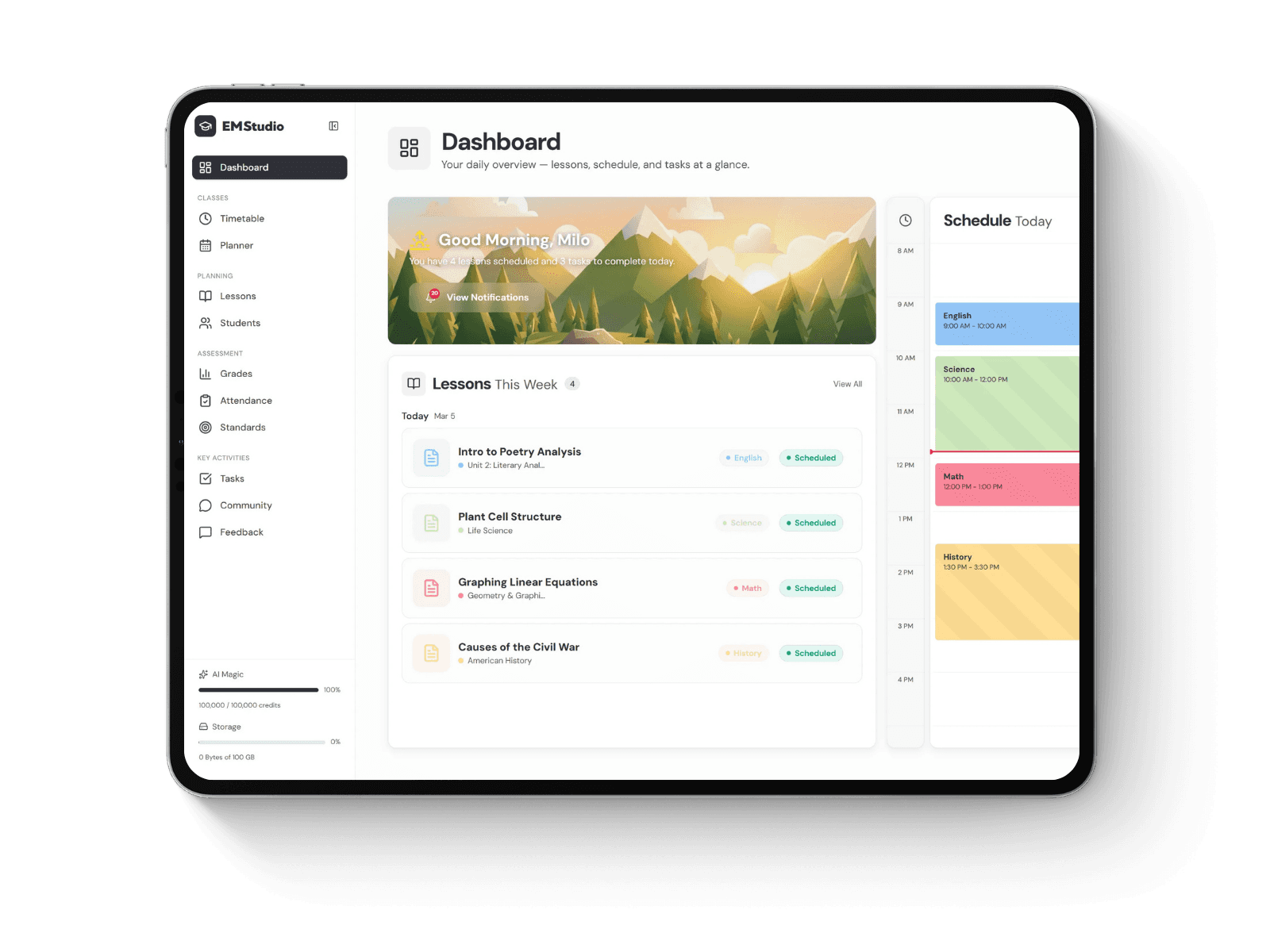
EMStudio is a free teaching management app — manage your classes, students, lessons, and more!
Learn More
Still grading everything by hand?
EMStudio is a free teaching management app — manage your classes, students, lessons, and more!
Learn More
Table of Contents
What Are the Best Daily Teacher Plans for Minimal Prep?
The best daily teacher plans for minimal prep include time-block templates for 45-minute periods, workshop models with 10-minute mini-lessons, and station rotations with 12-minute intervals. These systems use repeatable structures and reusable materials, reducing daily prep to 5-15 minutes while maintaining instructional rigor across subjects.
You don't need to reinvent the wheel every morning. I've used the same skeleton for three years—swap the content, keep the bones. Predictable teacher plans let your brain focus on teaching, not logistics.
Pick your format:
Time-Block templates work for traditional 45-minute periods and need only a whiteboard and 5 minutes of morning setup.
Workshop Model runs 10-minute mini-lessons followed by 20 minutes of independent work and 10 minutes of sharing; budget 10 minutes to review printed packets the night before.
Station Rotation requires the most front-loaded instructional design—four stations at 12 minutes each need digital slides ready and take about 15 minutes to verify.
Three tools to start tomorrow:
Erin Condren Teacher Lesson Planner ($55-65, coil-bound, best for elementary). Setup takes 30 minutes to customize your first week.
Planboard by Chalk (free, digital, standards alignment). Setup takes five minutes if you import your curriculum mapping first.
Google Slides Daily 5 Template (free, cloud-based). Travels across devices with automatic saving.
Skip minimal-prep on complex skill days. Differentiating for four or more IEP students breaks scripted templates. If you need more than three support levels, prep jumps to 20-plus minutes.
John Hattie's research supports structured simplicity. Teacher clarity shows an effect size of 0.59; inquiry-based learning sits at 0.44. Scripted plans outperform open-ended ones when covering learning objectives efficiently.
Smart pacing guides make these systems work. Learn from the planning habits of highly effective educators who front-load semester structure.
Simple Block Schedule Templates
Block schedules come in two flavors. A/B blocks run 90 minutes every other day; traditional blocks stick to 45 minutes daily. Schedule 2 minutes between blocks for transitions or you'll bleed instructional time.
Build templates in Microsoft Word using 'Secondary Block Schedule' layout, or Canva's education templates in 8.5x11 portrait. These include time stamps down the margin and objective boxes across the top.
Use the Buffer Block strategy. Reserve the final 5 minutes for cleanup and tomorrow's objective preview. When students walk in knowing the target, you eliminate warm-up creation and cut morning prep by half.
Activity-Centered Daily Outlines
Structure every period the same way: Hook (5 minutes), Input (10 minutes), Practice (15 minutes), Output (10 minutes), Exit ticket (5 minutes). The framework works for any subject because the verbs stay constant while the content changes.
Stock your toolbox with three zero-prep activities:
Two Corners has students move left or right to indicate agreement—no materials needed.
Gallery Walks require only sticky notes and existing anchor charts.
Think-Pair-Share with sentence stems on the board runs itself once you establish the routine.
Adapt hooks to grade level. Kindergarteners need picture-based hooks; 3rd-5th graders respond to 3-4 minute video clips; 6th-8th graders need controversial questions; 9th-12th graders analyze primary source documents for 2 minutes before discussion.
Standards-Aligned Day Plans
Focus on one standard per day. Build an alignment box in the top corner: write the standard code (like 7.RL.1), the "I can" statement in student language, the formative assessment method (3-question exit ticket), and the homework connection.
Filter through Power Standards. Identify three priority standards per quarter using your district's scope and sequence. Design your teacher planning so students encounter these twelve standards repeatedly across nine weeks rather than touching forty standards once each. Depth beats coverage.
Digital systems track this alignment. Organize your daily lesson plan with linked pages that connect standards to assessment data, creating feedback loops without extra paperwork.

Which Weekly Planning Systems Prevent Burnout?
Weekly planning systems that prevent burnout utilize vertical week-at-a-glance formats for secondary schedules and batch planning workflows that process five weeks of content in 90 minutes. These approaches consolidate decision-making, eliminate daily material scrambling, and build in 20% flexibility for interruptions.
Burnout isn't about working hard. It's about deciding what to teach at 6:00 AM on a Tuesday. I've been there. Weekly systems remove those morning decisions.
Vertical Week-at-a-Glance Formats
Secondary teachers juggling 4-6 preps need vertical grids. Six rows (periods or subjects) by five columns (Monday-Friday) fit on standard 8.5x11 paper. Elementary self-contained teachers prefer horizontal layouts—five rows by six columns on 11x17 ledger—but secondary teachers lose visibility when flipping oversized pages between classes while monitoring hallways. The vertical format keeps all preps visible simultaneously.
Use red dry-erase markers for summative assessments, blue for formative checks, green for lab or activity days. I laminate my template every August and use wet-erase markers. You reuse the same sheet all year so you don't print 36 copies. Add a dedicated bottom row for IEP and 504 due dates so required accommodations never sneak up on you during instruction. This row is your legal compliance checkpoint.
Color-code ruthlessly. Red means stop and assess. Yellow signals reteach days. Green shows on-pace progress. One glance Thursday evening tells you if Wednesday is overloaded with heavy cognitive lifts. This visual system prevents the Sunday anxiety that comes from unstructured teacher plans. weekly planning templates for teachers work best when they mirror your actual bell schedule rather than forcing you to translate time blocks mentally. The physical constraint of a single page forces you to focus on essential learning objectives.
Batch Planning Workflows
The Batch Method processes five weeks of ELA or Math content in 90 minutes total. That breaks down to 18 minutes per week. Here is the five-day sprint:
Monday: Map all standards for the five-week span from your district scope.
Tuesday: Create every assessment including summative tests and formative checkpoints.
Wednesday: Design three anchor activities like centers, journals, or discussion protocols.
Thursday: Build differentiation materials for IEP and 504 accommodations.
Friday: Schedule reflection slots and buffer time.
Teachers who batch report reduced Sunday anxiety and reclaim 2-3 hours weekly. You spend 90 minutes batching versus 30 minutes daily—that equals 150 minutes weekly. Studies indicate this approach cuts planning time by 40% while improving instructional design coherence. You eliminate decision fatigue by front-loading all choices into one focused session not facing blank curriculum mapping documents every morning.
Use Planbook.com's 'Bump' feature to shift entire weeks forward when snow days occur. This saves 30 minutes of manual rewriting versus paper systems. Digital batching allows you to maintain pacing guides without starting from scratch when interruptions happen. evidence-based strategies for teacher work-life balance consistently show that batching administrative tasks preserves mental energy for actual differentiated instruction during class time.
Flexible Block Scheduling Templates
Rigid teacher plans break when snow days hit. Build templates with movable blocks using sticky notes or Google Sheets with drag-and-drop cells. Reserve 20% buffer time—one full day or two half-days—marked in yellow on every five-week batch. Friday afternoon flex periods or Wednesday advisory slots absorb the shock of pop quizzes and assemblies without destroying your pacing or forcing you to compress three days of instruction into one.
The over-planning trap kills more teacher planning resources than bad software. You pack five days with dense content, then lose Tuesday to a fire drill and Wednesday to MAP testing. Your carefully sequenced lessons collapse like dominoes. Solution: insert 'light' activity placeholders. Educational videos with guided notes or independent reading with logs fill assembly days without disrupting your scope or forcing you to skip essential content.
Google Sheets lets you drag entire columns when schedules shift. Sticky notes on a whiteboard work for analog fans. Both methods honor the reality that learning objectives rarely align perfectly with bell schedules. Build in that 20% flex time and you stop rewriting formative assessment dates every time the principal adds a pep rally. This margin prevents the resentment that builds when you spend Sunday night revising plans that will change by Tuesday morning.
Unit Plan Frameworks That Align Standards to Assessments
Backward Design Unit Maps
Start with the end in mind. Backward design, from Wiggins & McTighe's Understanding by Design, flips the script: you build the assessment before the activities. I learned this the hard way after spending three weeks on a Civil War unit only to realize my test didn't match the standard.
Stage 1 means unpacking standards into learning objectives. For 7.RL.1, you pull out "cite several pieces of text evidence." Your essential question becomes: "How do authors support their claims?" For math, take 3.NBT.2—fluently add and subtract within 1000. Ask: "How do place value patterns help us calculate?"
Stage 2 requires designing formative assessment evidence. Build a text-dependent analysis rubric for ELA. Create a five-question pre-assessment, daily exit tickets, and a word problem performance task for math. These tools prove mastery before you move on.
Stage 3 sequences experiences using the WHERETO framework—Hook them with a mystery, let them Explore primary sources, then Reflect on evidence quality. The ASCD Understanding by Design Template 2.0 runs $29 for the digital suite. Budget four hours for your first unit. Next year? Just thirty minutes to tweak dates.
The template includes sections for misconceptions and essential vocabulary. Fill this out during summer planning when your brain isn't fried. That upfront investment saves you from mid-unit panic when you realize half your teacher plans don't actually assess the standard you thought they did. Grab our step-by-step unit planning guide to map this without the headache.
Pacing Guide Integrated Templates
Your district probably handed you a curriculum mapping document with 180 boxes. Ignore it. You have roughly 160 actual instructional days once you subtract interruptions. Map your units to reality, not the fantasy calendar.
Ten professional development days scattered across semesters.
Five state testing windows where instruction stops.
Five snow days, assemblies, or field trips.
Place Common Formative Assessments at weeks 6, 12, 18, 24, 30, and 36. Schedule a five-day "Buffer Week" before each CFA. This buffer isn't vacation—it's strategic.
That week 6 CFA lands right before fall break for most districts. Perfect timing—either celebrate mastery heading into vacation or know exactly which standards need reteaching when you return.
Use those five days for differentiated instruction groups based on exit ticket data. Kids who mastered the skill get extension projects. Kids who struggled get small-group reteach with alternative manipulatives or texts.
Use color-coding in your digital pacing guides: green means on pace, yellow signals slow down and consolidate, red needs immediate intervention. This instructional design strategy keeps your PLC meetings focused on student data rather than calendar complaints. Most districts provide these templates free. If not, build one in Google Sheets. That visual tracker beats guessing why you're three weeks behind in March.
Project-Based Learning Unit Planners
Project-Based Learning needs a different architecture than traditional lesson planning resources. The Buck Institute's Gold Standard PBL requires a Driving Question like "How can we improve our school's recycling system?" and 40+ hours of sustained inquiry. Kick it off with an Entry Event—a guest speaker from waste management or a shocking video of landfill overflow.
Sustained inquiry means students ask questions, find resources, and apply information over six weeks. Not six separate one-day activities. One coherent investigation that builds complexity.
Map milestone checkpoints at weeks 2, 4, and 6. Week 2 means research completed and sources cited. Week 4 shows a rough prototype or draft.
Week 6 delivers the Public Product presentation to the principal or local experts. Build in Student Voice & Choice at each checkpoint—let them pick research methods or presentation formats between podcasts, posters, or essays.
Ditch the 100-point percentage scale where a 79% means nothing specific. Use a 4-point mastery rubric measuring collaboration, content knowledge, and presentation quality.
PBLWorks offers these rubrics free with registration. You'll need that weekly 45-minute PLC block to coordinate logistics with colleagues. Store student portfolios in Google Sites or Padlet for easy access. For the full blueprint, see our guide on designing an effective PBL curriculum.

Subject-Specific Templates for Math and ELA
Guided Math Rotation Plans
The M.A.T.H. rotation system breaks your math block into four distinct stations. Students rotate every 15 minutes in grades 3-5, or every 10 minutes for K-2. M means Meet with the teacher for targeted reteach or enrichment. A is At your seat for independent practice. T puts them on Technology like IXL or Prodigy. H stands for Hands-on work with ETA Hand2Mind manipulatives or homemade items.
Keep your groups tight for effective differentiated instruction. Tier 3 intervention groups get four students max. Tier 2 groups can handle five. Tier 1 groups top out at six. I use beginning-of-year NWEA MAP scores or unit pre-assessments to form these groups. Refresh them every three weeks based on formative assessment data. At my teacher table, I keep whiteboards, place value blocks, and fraction tiles ready.
Your class size determines your instructional design. If you have more than 25 students, use Station Rotation to manage behavior and volume. Under 20 students allows for the Workshop Model with deeper personalization. Co-teaching with a special education teacher? Split the class evenly for Parallel Teaching, with clearly designated lead and support roles. These math teacher resources to transform your classroom include printable rotation boards that match these group sizes.
Literacy Center Planning Sheets
The Daily 5 framework structures your literacy block into five distinct rotations that build independent reading stamina:
Read to Self gives students 15 minutes of sustained silent reading with self-selected texts.
Read to Someone pairs them for partner reading with comprehension checkmarks.
Listen to Reading uses Epic! Books or Raz-Kids for modeled fluency.
Word Work targets spelling through Spelling City or multisensory sand writing.
Work on Writing moves students through journals or authentic blog posts.
Your management system depends on developmental readiness. K-2 students need a pocket chart with their photos or names for visual rotation tracking. Third through fifth graders can handle a Google Slides rotation tracker that builds digital literacy skills. For accountability, younger students post finished work to Seesaw portfolios. Older students maintain traditional reading logs or digital versions to track genre exposure.
Must-Do/May-Do lists keep everyone on track without constant teacher monitoring. The Must-Do column lists non-negotiable daily learning objectives like completing one rotation or finishing a specific text. The May-Do column offers choices for early finishers. This system cuts your lesson prep time while maintaining rigorous pacing guides. Find more templates in this comprehensive guide for ELA instruction.
Cross-Curricular Integration Maps
Curriculum mapping across subjects reclaims precious instructional minutes. Last year, I integrated a 4th-grade fraction unit with informational text about planetary distances and solar system scale models. Students calculated ratios while reading about astronomical units, then built scale models in science class. This natural connection meant one 45-minute integrated block replaced three separate 30-minute periods. We saved 45 minutes daily while hitting all learning objectives.
Show the standards overlap in a simple Venn diagram of three subjects. Math focuses on fraction operations and scale factors. ELA targets technical vocabulary and main idea identification in informational text. Science covers planetary motion and relative measurement. When objectives align this cleanly, you achieve a 30% reduction in total instructional minutes needed compared to siloed teaching. Your teacher plans become more efficient without sacrificing rigor or depth.
Forced integration increases cognitive load and frustrates students. Only combine subjects when the learning objectives genuinely support each other naturally. If the connection feels like a stretch or requires excessive explanation to make sense, teach the subjects separately. Students retain more when skills are contextualized authentically rather than artificially linked for the sake of covering multiple standards at once.

How to Choose the Right Planning System for Your Schedule?
Conduct a one-week time audit using Toggl Track to identify actual prep hours, then match templates to your instructional style. Direct instruction requires detailed scripting while inquiry-based needs facilitation protocols. Combine weekly batching with minimal daily templates for sustainability.
Evaluate Your Current Prep Time
Use Toggl Track (free) or a paper log. Track five consecutive school days in fifteen-minute blocks. Categorize tasks:
Instructional Design: Creating slides, worksheets, and activities.
Grading/Feedback: Entering scores and writing comments.
Administrative: Email, meetings, and paperwork.
Analyze your data against benchmarks. Material creation should stay under thirty percent; Grading around forty percent; Administrative near thirty percent. If you're building lessons from scratch beyond these ratios, adopt pre-made curricula. Experienced teachers should complete daily teacher plans in forty-five to sixty minutes; first-year teachers need ninety to one hundred twenty minutes. Adjust your pacing guides accordingly.
Match Templates to Your Teaching Style
Match templates to your dominant instructional method:
Direct Instruction (over seventy percent of time): Use Madeline Hunter-style plans with detailed scripting for anticipatory sets, modeling, and guided practice.
Collaborative Learning (over fifty percent): Use station rotation plans with role assignments and timing cues.
Project-Based Learning: Use milestone checklists that front-load preparation but minimize daily maintenance.
Inquiry-based teachers should use the 5E model with facilitation questions rather than detailed scripts. Co-teaching pairs need "One Teach, One Assist" templates with designated roles and fifteen minutes of coordination time.
Build a Hybrid System
Implement a Sunday Batch Protocol:
Review standards for the week and check curriculum mapping.
Copy "Do Now" and "Exit Ticket" templates.
Insert video links or activity directions.
Print materials for Monday through Wednesday only—leave Thursday/Friday flexible for formative assessment adjustments.
Organize digitally with folders by unit using naming conventions like "Q2W3_Math_Fractions." Use a five-drawer filing cabinet labeled Monday through Friday for physical copies. Learn more about how to choose the right teacher planner and time management techniques for educators.
Follow this timeline: Weeks one and two, set up templates. Weeks three and four, troubleshoot timing. Week five onward, maintain with twenty-minute weekly adjustments. If daily prep exceeds sixty minutes after week five, simplify your template. Keep an emergency sub folder with three days of standalone activities.

Should You Try Teacher Plans?
If Sunday nights feel like panic attacks, yes. The right teacher plans replace Sunday scrambling with pacing guides you can actually use. You don't need another binder collecting dust in your trunk or complex instructional design theory that ignores your 45-minute reality. You need something that works Monday morning.
Don't obsess over perfect curriculum mapping yet. Pick one template from this list—daily or weekly—and test it for ten days. I spent a year color-coding units I never taught before realizing done always beats pretty. Differentiated instruction only happens when you aren't drowning in basic prep. Your students need you present, not perfect. Start messy.
Stop polishing documents you'll never print. Open your calendar right now. Block twenty minutes to adapt one template from this article for next week. Your future self will thank you when Friday arrives and you're already ready. Which planning headache wakes you up at 3 a.m.—tomorrow's lesson or next month's assessments?

What Are the Best Daily Teacher Plans for Minimal Prep?
The best daily teacher plans for minimal prep include time-block templates for 45-minute periods, workshop models with 10-minute mini-lessons, and station rotations with 12-minute intervals. These systems use repeatable structures and reusable materials, reducing daily prep to 5-15 minutes while maintaining instructional rigor across subjects.
You don't need to reinvent the wheel every morning. I've used the same skeleton for three years—swap the content, keep the bones. Predictable teacher plans let your brain focus on teaching, not logistics.
Pick your format:
Time-Block templates work for traditional 45-minute periods and need only a whiteboard and 5 minutes of morning setup.
Workshop Model runs 10-minute mini-lessons followed by 20 minutes of independent work and 10 minutes of sharing; budget 10 minutes to review printed packets the night before.
Station Rotation requires the most front-loaded instructional design—four stations at 12 minutes each need digital slides ready and take about 15 minutes to verify.
Three tools to start tomorrow:
Erin Condren Teacher Lesson Planner ($55-65, coil-bound, best for elementary). Setup takes 30 minutes to customize your first week.
Planboard by Chalk (free, digital, standards alignment). Setup takes five minutes if you import your curriculum mapping first.
Google Slides Daily 5 Template (free, cloud-based). Travels across devices with automatic saving.
Skip minimal-prep on complex skill days. Differentiating for four or more IEP students breaks scripted templates. If you need more than three support levels, prep jumps to 20-plus minutes.
John Hattie's research supports structured simplicity. Teacher clarity shows an effect size of 0.59; inquiry-based learning sits at 0.44. Scripted plans outperform open-ended ones when covering learning objectives efficiently.
Smart pacing guides make these systems work. Learn from the planning habits of highly effective educators who front-load semester structure.
Simple Block Schedule Templates
Block schedules come in two flavors. A/B blocks run 90 minutes every other day; traditional blocks stick to 45 minutes daily. Schedule 2 minutes between blocks for transitions or you'll bleed instructional time.
Build templates in Microsoft Word using 'Secondary Block Schedule' layout, or Canva's education templates in 8.5x11 portrait. These include time stamps down the margin and objective boxes across the top.
Use the Buffer Block strategy. Reserve the final 5 minutes for cleanup and tomorrow's objective preview. When students walk in knowing the target, you eliminate warm-up creation and cut morning prep by half.
Activity-Centered Daily Outlines
Structure every period the same way: Hook (5 minutes), Input (10 minutes), Practice (15 minutes), Output (10 minutes), Exit ticket (5 minutes). The framework works for any subject because the verbs stay constant while the content changes.
Stock your toolbox with three zero-prep activities:
Two Corners has students move left or right to indicate agreement—no materials needed.
Gallery Walks require only sticky notes and existing anchor charts.
Think-Pair-Share with sentence stems on the board runs itself once you establish the routine.
Adapt hooks to grade level. Kindergarteners need picture-based hooks; 3rd-5th graders respond to 3-4 minute video clips; 6th-8th graders need controversial questions; 9th-12th graders analyze primary source documents for 2 minutes before discussion.
Standards-Aligned Day Plans
Focus on one standard per day. Build an alignment box in the top corner: write the standard code (like 7.RL.1), the "I can" statement in student language, the formative assessment method (3-question exit ticket), and the homework connection.
Filter through Power Standards. Identify three priority standards per quarter using your district's scope and sequence. Design your teacher planning so students encounter these twelve standards repeatedly across nine weeks rather than touching forty standards once each. Depth beats coverage.
Digital systems track this alignment. Organize your daily lesson plan with linked pages that connect standards to assessment data, creating feedback loops without extra paperwork.
Which Weekly Planning Systems Prevent Burnout?
Weekly planning systems that prevent burnout utilize vertical week-at-a-glance formats for secondary schedules and batch planning workflows that process five weeks of content in 90 minutes. These approaches consolidate decision-making, eliminate daily material scrambling, and build in 20% flexibility for interruptions.
Burnout isn't about working hard. It's about deciding what to teach at 6:00 AM on a Tuesday. I've been there. Weekly systems remove those morning decisions.
Vertical Week-at-a-Glance Formats
Secondary teachers juggling 4-6 preps need vertical grids. Six rows (periods or subjects) by five columns (Monday-Friday) fit on standard 8.5x11 paper. Elementary self-contained teachers prefer horizontal layouts—five rows by six columns on 11x17 ledger—but secondary teachers lose visibility when flipping oversized pages between classes while monitoring hallways. The vertical format keeps all preps visible simultaneously.
Use red dry-erase markers for summative assessments, blue for formative checks, green for lab or activity days. I laminate my template every August and use wet-erase markers. You reuse the same sheet all year so you don't print 36 copies. Add a dedicated bottom row for IEP and 504 due dates so required accommodations never sneak up on you during instruction. This row is your legal compliance checkpoint.
Color-code ruthlessly. Red means stop and assess. Yellow signals reteach days. Green shows on-pace progress. One glance Thursday evening tells you if Wednesday is overloaded with heavy cognitive lifts. This visual system prevents the Sunday anxiety that comes from unstructured teacher plans. weekly planning templates for teachers work best when they mirror your actual bell schedule rather than forcing you to translate time blocks mentally. The physical constraint of a single page forces you to focus on essential learning objectives.
Batch Planning Workflows
The Batch Method processes five weeks of ELA or Math content in 90 minutes total. That breaks down to 18 minutes per week. Here is the five-day sprint:
Monday: Map all standards for the five-week span from your district scope.
Tuesday: Create every assessment including summative tests and formative checkpoints.
Wednesday: Design three anchor activities like centers, journals, or discussion protocols.
Thursday: Build differentiation materials for IEP and 504 accommodations.
Friday: Schedule reflection slots and buffer time.
Teachers who batch report reduced Sunday anxiety and reclaim 2-3 hours weekly. You spend 90 minutes batching versus 30 minutes daily—that equals 150 minutes weekly. Studies indicate this approach cuts planning time by 40% while improving instructional design coherence. You eliminate decision fatigue by front-loading all choices into one focused session not facing blank curriculum mapping documents every morning.
Use Planbook.com's 'Bump' feature to shift entire weeks forward when snow days occur. This saves 30 minutes of manual rewriting versus paper systems. Digital batching allows you to maintain pacing guides without starting from scratch when interruptions happen. evidence-based strategies for teacher work-life balance consistently show that batching administrative tasks preserves mental energy for actual differentiated instruction during class time.
Flexible Block Scheduling Templates
Rigid teacher plans break when snow days hit. Build templates with movable blocks using sticky notes or Google Sheets with drag-and-drop cells. Reserve 20% buffer time—one full day or two half-days—marked in yellow on every five-week batch. Friday afternoon flex periods or Wednesday advisory slots absorb the shock of pop quizzes and assemblies without destroying your pacing or forcing you to compress three days of instruction into one.
The over-planning trap kills more teacher planning resources than bad software. You pack five days with dense content, then lose Tuesday to a fire drill and Wednesday to MAP testing. Your carefully sequenced lessons collapse like dominoes. Solution: insert 'light' activity placeholders. Educational videos with guided notes or independent reading with logs fill assembly days without disrupting your scope or forcing you to skip essential content.
Google Sheets lets you drag entire columns when schedules shift. Sticky notes on a whiteboard work for analog fans. Both methods honor the reality that learning objectives rarely align perfectly with bell schedules. Build in that 20% flex time and you stop rewriting formative assessment dates every time the principal adds a pep rally. This margin prevents the resentment that builds when you spend Sunday night revising plans that will change by Tuesday morning.
Unit Plan Frameworks That Align Standards to Assessments
Backward Design Unit Maps
Start with the end in mind. Backward design, from Wiggins & McTighe's Understanding by Design, flips the script: you build the assessment before the activities. I learned this the hard way after spending three weeks on a Civil War unit only to realize my test didn't match the standard.
Stage 1 means unpacking standards into learning objectives. For 7.RL.1, you pull out "cite several pieces of text evidence." Your essential question becomes: "How do authors support their claims?" For math, take 3.NBT.2—fluently add and subtract within 1000. Ask: "How do place value patterns help us calculate?"
Stage 2 requires designing formative assessment evidence. Build a text-dependent analysis rubric for ELA. Create a five-question pre-assessment, daily exit tickets, and a word problem performance task for math. These tools prove mastery before you move on.
Stage 3 sequences experiences using the WHERETO framework—Hook them with a mystery, let them Explore primary sources, then Reflect on evidence quality. The ASCD Understanding by Design Template 2.0 runs $29 for the digital suite. Budget four hours for your first unit. Next year? Just thirty minutes to tweak dates.
The template includes sections for misconceptions and essential vocabulary. Fill this out during summer planning when your brain isn't fried. That upfront investment saves you from mid-unit panic when you realize half your teacher plans don't actually assess the standard you thought they did. Grab our step-by-step unit planning guide to map this without the headache.
Pacing Guide Integrated Templates
Your district probably handed you a curriculum mapping document with 180 boxes. Ignore it. You have roughly 160 actual instructional days once you subtract interruptions. Map your units to reality, not the fantasy calendar.
Ten professional development days scattered across semesters.
Five state testing windows where instruction stops.
Five snow days, assemblies, or field trips.
Place Common Formative Assessments at weeks 6, 12, 18, 24, 30, and 36. Schedule a five-day "Buffer Week" before each CFA. This buffer isn't vacation—it's strategic.
That week 6 CFA lands right before fall break for most districts. Perfect timing—either celebrate mastery heading into vacation or know exactly which standards need reteaching when you return.
Use those five days for differentiated instruction groups based on exit ticket data. Kids who mastered the skill get extension projects. Kids who struggled get small-group reteach with alternative manipulatives or texts.
Use color-coding in your digital pacing guides: green means on pace, yellow signals slow down and consolidate, red needs immediate intervention. This instructional design strategy keeps your PLC meetings focused on student data rather than calendar complaints. Most districts provide these templates free. If not, build one in Google Sheets. That visual tracker beats guessing why you're three weeks behind in March.
Project-Based Learning Unit Planners
Project-Based Learning needs a different architecture than traditional lesson planning resources. The Buck Institute's Gold Standard PBL requires a Driving Question like "How can we improve our school's recycling system?" and 40+ hours of sustained inquiry. Kick it off with an Entry Event—a guest speaker from waste management or a shocking video of landfill overflow.
Sustained inquiry means students ask questions, find resources, and apply information over six weeks. Not six separate one-day activities. One coherent investigation that builds complexity.
Map milestone checkpoints at weeks 2, 4, and 6. Week 2 means research completed and sources cited. Week 4 shows a rough prototype or draft.
Week 6 delivers the Public Product presentation to the principal or local experts. Build in Student Voice & Choice at each checkpoint—let them pick research methods or presentation formats between podcasts, posters, or essays.
Ditch the 100-point percentage scale where a 79% means nothing specific. Use a 4-point mastery rubric measuring collaboration, content knowledge, and presentation quality.
PBLWorks offers these rubrics free with registration. You'll need that weekly 45-minute PLC block to coordinate logistics with colleagues. Store student portfolios in Google Sites or Padlet for easy access. For the full blueprint, see our guide on designing an effective PBL curriculum.
Subject-Specific Templates for Math and ELA
Guided Math Rotation Plans
The M.A.T.H. rotation system breaks your math block into four distinct stations. Students rotate every 15 minutes in grades 3-5, or every 10 minutes for K-2. M means Meet with the teacher for targeted reteach or enrichment. A is At your seat for independent practice. T puts them on Technology like IXL or Prodigy. H stands for Hands-on work with ETA Hand2Mind manipulatives or homemade items.
Keep your groups tight for effective differentiated instruction. Tier 3 intervention groups get four students max. Tier 2 groups can handle five. Tier 1 groups top out at six. I use beginning-of-year NWEA MAP scores or unit pre-assessments to form these groups. Refresh them every three weeks based on formative assessment data. At my teacher table, I keep whiteboards, place value blocks, and fraction tiles ready.
Your class size determines your instructional design. If you have more than 25 students, use Station Rotation to manage behavior and volume. Under 20 students allows for the Workshop Model with deeper personalization. Co-teaching with a special education teacher? Split the class evenly for Parallel Teaching, with clearly designated lead and support roles. These math teacher resources to transform your classroom include printable rotation boards that match these group sizes.
Literacy Center Planning Sheets
The Daily 5 framework structures your literacy block into five distinct rotations that build independent reading stamina:
Read to Self gives students 15 minutes of sustained silent reading with self-selected texts.
Read to Someone pairs them for partner reading with comprehension checkmarks.
Listen to Reading uses Epic! Books or Raz-Kids for modeled fluency.
Word Work targets spelling through Spelling City or multisensory sand writing.
Work on Writing moves students through journals or authentic blog posts.
Your management system depends on developmental readiness. K-2 students need a pocket chart with their photos or names for visual rotation tracking. Third through fifth graders can handle a Google Slides rotation tracker that builds digital literacy skills. For accountability, younger students post finished work to Seesaw portfolios. Older students maintain traditional reading logs or digital versions to track genre exposure.
Must-Do/May-Do lists keep everyone on track without constant teacher monitoring. The Must-Do column lists non-negotiable daily learning objectives like completing one rotation or finishing a specific text. The May-Do column offers choices for early finishers. This system cuts your lesson prep time while maintaining rigorous pacing guides. Find more templates in this comprehensive guide for ELA instruction.
Cross-Curricular Integration Maps
Curriculum mapping across subjects reclaims precious instructional minutes. Last year, I integrated a 4th-grade fraction unit with informational text about planetary distances and solar system scale models. Students calculated ratios while reading about astronomical units, then built scale models in science class. This natural connection meant one 45-minute integrated block replaced three separate 30-minute periods. We saved 45 minutes daily while hitting all learning objectives.
Show the standards overlap in a simple Venn diagram of three subjects. Math focuses on fraction operations and scale factors. ELA targets technical vocabulary and main idea identification in informational text. Science covers planetary motion and relative measurement. When objectives align this cleanly, you achieve a 30% reduction in total instructional minutes needed compared to siloed teaching. Your teacher plans become more efficient without sacrificing rigor or depth.
Forced integration increases cognitive load and frustrates students. Only combine subjects when the learning objectives genuinely support each other naturally. If the connection feels like a stretch or requires excessive explanation to make sense, teach the subjects separately. Students retain more when skills are contextualized authentically rather than artificially linked for the sake of covering multiple standards at once.
How to Choose the Right Planning System for Your Schedule?
Conduct a one-week time audit using Toggl Track to identify actual prep hours, then match templates to your instructional style. Direct instruction requires detailed scripting while inquiry-based needs facilitation protocols. Combine weekly batching with minimal daily templates for sustainability.
Evaluate Your Current Prep Time
Use Toggl Track (free) or a paper log. Track five consecutive school days in fifteen-minute blocks. Categorize tasks:
Instructional Design: Creating slides, worksheets, and activities.
Grading/Feedback: Entering scores and writing comments.
Administrative: Email, meetings, and paperwork.
Analyze your data against benchmarks. Material creation should stay under thirty percent; Grading around forty percent; Administrative near thirty percent. If you're building lessons from scratch beyond these ratios, adopt pre-made curricula. Experienced teachers should complete daily teacher plans in forty-five to sixty minutes; first-year teachers need ninety to one hundred twenty minutes. Adjust your pacing guides accordingly.
Match Templates to Your Teaching Style
Match templates to your dominant instructional method:
Direct Instruction (over seventy percent of time): Use Madeline Hunter-style plans with detailed scripting for anticipatory sets, modeling, and guided practice.
Collaborative Learning (over fifty percent): Use station rotation plans with role assignments and timing cues.
Project-Based Learning: Use milestone checklists that front-load preparation but minimize daily maintenance.
Inquiry-based teachers should use the 5E model with facilitation questions rather than detailed scripts. Co-teaching pairs need "One Teach, One Assist" templates with designated roles and fifteen minutes of coordination time.
Build a Hybrid System
Implement a Sunday Batch Protocol:
Review standards for the week and check curriculum mapping.
Copy "Do Now" and "Exit Ticket" templates.
Insert video links or activity directions.
Print materials for Monday through Wednesday only—leave Thursday/Friday flexible for formative assessment adjustments.
Organize digitally with folders by unit using naming conventions like "Q2W3_Math_Fractions." Use a five-drawer filing cabinet labeled Monday through Friday for physical copies. Learn more about how to choose the right teacher planner and time management techniques for educators.
Follow this timeline: Weeks one and two, set up templates. Weeks three and four, troubleshoot timing. Week five onward, maintain with twenty-minute weekly adjustments. If daily prep exceeds sixty minutes after week five, simplify your template. Keep an emergency sub folder with three days of standalone activities.
Should You Try Teacher Plans?
If Sunday nights feel like panic attacks, yes. The right teacher plans replace Sunday scrambling with pacing guides you can actually use. You don't need another binder collecting dust in your trunk or complex instructional design theory that ignores your 45-minute reality. You need something that works Monday morning.
Don't obsess over perfect curriculum mapping yet. Pick one template from this list—daily or weekly—and test it for ten days. I spent a year color-coding units I never taught before realizing done always beats pretty. Differentiated instruction only happens when you aren't drowning in basic prep. Your students need you present, not perfect. Start messy.
Stop polishing documents you'll never print. Open your calendar right now. Block twenty minutes to adapt one template from this article for next week. Your future self will thank you when Friday arrives and you're already ready. Which planning headache wakes you up at 3 a.m.—tomorrow's lesson or next month's assessments?
Still grading everything by hand?
EMStudio is a free teaching management app — manage your classes, students, lessons, and more!
Learn More
Still grading everything by hand?
EMStudio is a free teaching management app — manage your classes, students, lessons, and more!
Learn More




Notion4Teachers
Notion templates to simplify administrative tasks and enhance your teaching experience.



2026 Notion4Teachers. All Rights Reserved.
Notion4Teachers
Notion templates to simplify administrative tasks and enhance your teaching experience.
2026 Notion4Teachers. All Rights Reserved.
Notion4Teachers
Notion templates to simplify administrative tasks and enhance your teaching experience.
2026 Notion4Teachers. All Rights Reserved.