
10 Teacher Plans That Cut Lesson Prep Time in Half
10 Teacher Plans That Cut Lesson Prep Time in Half

Article by
Milo
ESL Content Coordinator & Educator
ESL Content Coordinator & Educator
All Posts
You are staring at a blank slide deck at 10 PM on Sunday. Again. You know what standards you need to hit this week. You have the textbook pages. But bridging that gap between "what the district says to teach" and "what actually happens at 8:15 AM Monday" feels like building a bridge while crossing it.
This is where solid teacher plans stop the bleeding. Not the kind that sit in a binder collecting dust—living documents that map your week, track your pacing, and leave room for when half the class bombs the exit ticket. The right system turns chaos into a Tuesday morning that runs itself.
I have tested dozens of planning systems over fifteen years. Some crashed and burned by October because they looked pretty but ignored reality. Others became the backbone of my instructional design, handling everything from standards alignment to differentiated instruction without eating my entire weekend. The ten teacher plans below cut my prep time in half by automating the repetitive stuff—curriculum mapping, formative assessment tracking, daily pacing guides—so I could focus on actually teaching. They work for digital die-hards and printable loyalists alike. Pick one that fits your brain, not your principal's aesthetic.
Still grading everything by hand?
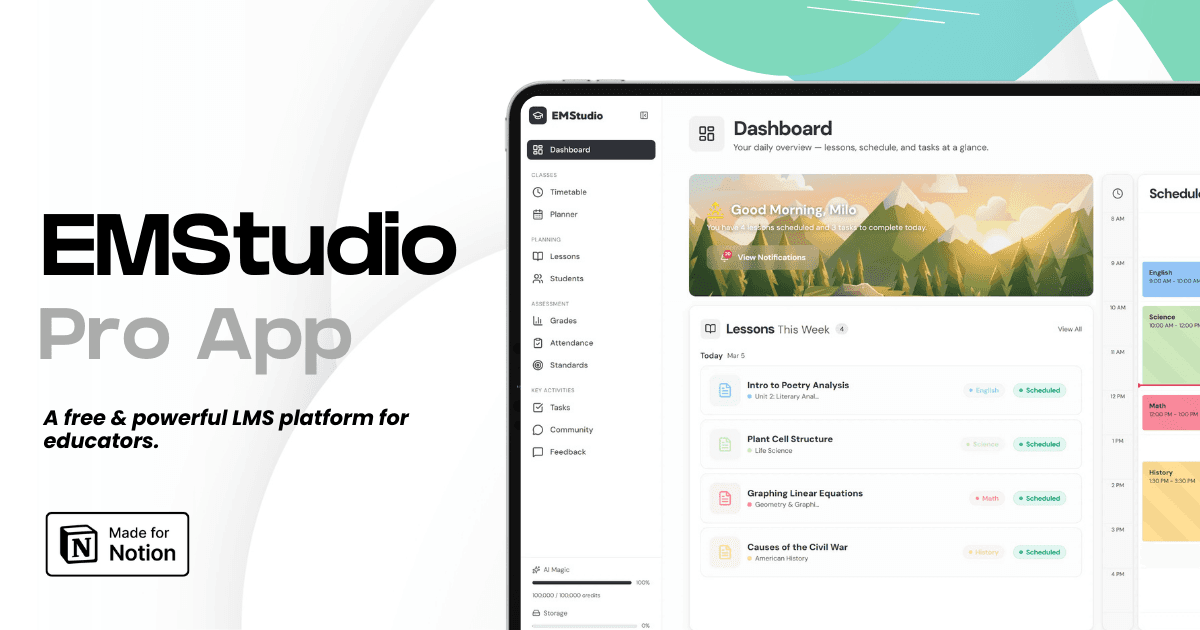
EMStudio is a free teaching management app — manage your classes, students, lessons, and more!
Learn More
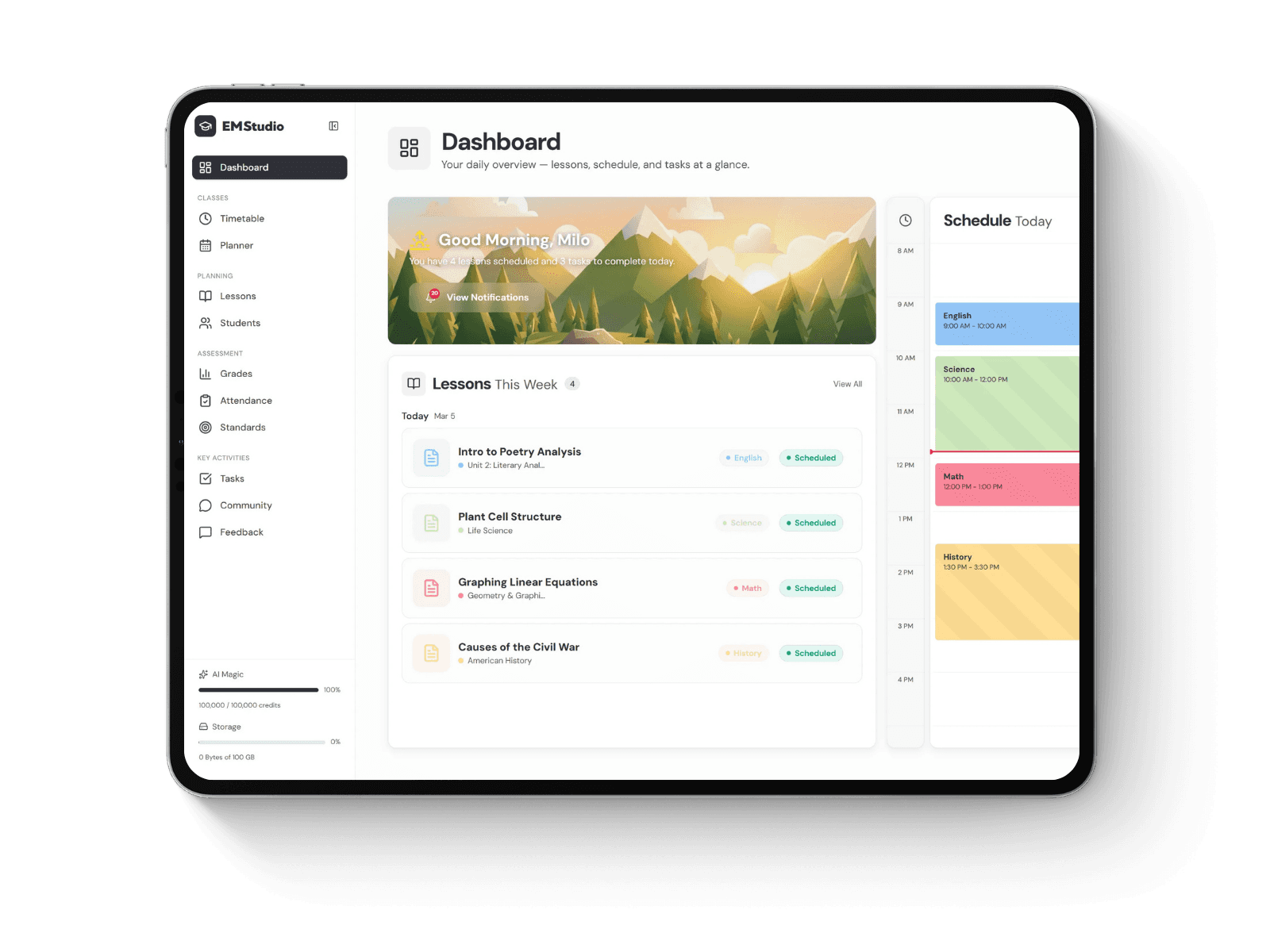
Still grading everything by hand?
EMStudio is a free teaching management app — manage your classes, students, lessons, and more!
Learn More
Table of Contents
What Are the Best All-in-One Teacher Planning Systems?
The best all-in-one systems combine year-long curriculum maps, weekly lesson bundles, and unit templates with built-in assessments. Top options include Planbook.com for digital scheduling, Fishtank Learning for free standards-aligned curriculum maps, and Teachers Pay Teachers comprehensive bundles for subject-specific content with differentiated activities.
You need systems that actually talk to each other. A scheduler that links to your standards. A curriculum map that feeds weekly lessons. Three tools dominate this space, and each serves a different type of teacher planning need.
Planbook.com costs $12 yearly and lives in the cloud. You get a digital schedule that connects to standards banks. Setup takes two hours if you know your rotation. It works best for elementary through high school, but you need reliable internet.
Fishtank Learning gives you free K-12 curriculum maps aligned to Common Core. No subscription, just open-source curriculum mapping and pacing guides. Setup needs ten-plus hours. A 3rd-grade teacher finds cross-subject integration; a 9th-grade biology teacher gets discipline-specific lab sequencing.
Teachers Pay Teachers offers comprehensive teacher planning resources in their Year Long MEGA Bundles, running $25 to $75 per subject. These include complete resources—worksheets, PowerPoints, assessments—for 36 weeks. Elementary bundles cover five subjects. Secondary bundles drill deep into one discipline with assessment banks.
John Hattie's Visible Learning research shows teacher clarity carries an effect size of 0.75. That clarity jumps when you use pre-structured teacher plans with explicit learning objectives embedded in daily templates. You stop guessing what students should learn and start knowing.
Year-Long Curriculum Maps and Pacing Guides
Fishtank Learning offers free, open-source 180-day maps. Atlas Rubicon charges $1,500 or more for school licenses. Both show you how to pace, but only one requires a budget line item.
A 7th-grade math pacing guide breaks the year into chunks: six weeks for proportional relationships, four for expressions, five for geometry. Built-in buffer days—ten percent of the calendar—cover remediation. You see exactly where you stand week by week.
Each unit block contains these elements:
Four to six units per year with week-by-week breakdowns.
Essential questions like "How do we measure change?"
Suggested assessments: performance tasks versus traditional tests.
Standards codes such as CCSS.MATH.7.RP.A.1.
Weekly Lesson Plan Bundles with Standards Alignment
Teachers Pay Teachers bundles typically span 36 weeks. You get daily PowerPoints, printable worksheets, and exit tickets. Price tags hover between $45 and $95 depending on subject complexity.
A 4th-grade ELA bundle might theme the weeks: Mythology in week one, Native American stories in week two. Each day includes pre-vocabulary and comprehension questions. You print and go.
Look for CCSS codes in lesson headers. "I Can" statements appear at 4th-grade reading level. This aligning standards with your curriculum saves fifteen to twenty minutes daily. Using structured teacher plans reclaims hours for teaching.
Unit Plan Templates with Assessment Rubrics
Understanding by Design templates structure your thinking into three stages. Stage one covers Desired Results. Stage two outlines Assessment Evidence using GRASPS tasks. Stage three builds the Learning Plan using the WHERETO acronym for instructional design.
Picture a high school argumentative writing unit. Stage one defines the thesis skill. Stage two plans the peer review protocol. Stage three schedules the workshop sequence.
Assessment rubrics use four-point analytic scales. Each trait—Claim, Evidence, Reasoning—gets its own four-point descriptor. Include student self-assessment checklists and space for your anecdotal notes. This supports differentiated instruction and formative assessment.

Which Subject-Specific Teacher Plans Save the Most Time?
Math plans featuring differentiated small-group rotations like EngageNY and ELA guided reading systems such as Fountas & Pinnell Classroom typically save five to seven hours weekly. Science sequences using the 5E model with pre-written safety protocols cut prep time significantly.
Subject-specific teacher plans work because someone else already built the ladder. You just climb it.
Math centers offer concrete differentiation with tiered activities ready to print. ELA rotations provide structured guided reading blocks with built-in formative assessment checkpoints. Science labs include safety-prepped sequences and material lists. Research shows structured subject plans with tight standards alignment and clear pacing guides reduce weekly lesson prep from ten-plus hours to under four for experienced users.
Skip these plans if your IEP population exceeds forty percent requiring heavy modification. Don't force them if your district mandates scripted curriculum that clashes with inquiry-based approaches. Also avoid them when the technology requirements—like one-to-one devices—outpace your school's actual resources.
Quality plans embed weekly and monthly review cycles, aligning with Rosenshine's Principles of Instruction. Curriculum coherence—meaning tight standards alignment and clear curriculum mapping across the scope and sequence—shows measurable impact on student retention, according to instructional design research.
Math Teacher Plans with Differentiated Small Group Activities
EngageNY offers free complete K-12 sequences while Bridges in Mathematics runs twenty-five to forty dollars per student workbook. See math teacher resources for differentiated instruction for rotation templates. Both use a four-station rotation: fifteen minutes each at Teacher Table, Technology, Independent Practice, and Manipulatives. Third-grade multiplication units come tiered—below-level uses counters, on-level uses array grids, and above-level tackles area model decomposition. Check lesson margins for tags marked Intervention, On Track, or Extension with specific materials listed to prevent last-minute searches.
ELA Teacher Plans Featuring Guided Reading Rotations
The four-day rotation covers book introduction, strategy mini-lessons, independent reading with sticky notes, and written response. Fifth-grade historical fiction circles using Sign of the Beaver assign roles like Discussion Director and Vocabulary Enricher. Fountas & Pinnell Classroom provides one hundred fifty-plus leveled books per grade, twenty-minute explicit phonics lessons, word study notebooks, and digital assessment tools for running records. See ELA planning for literacy instruction for scheduling templates.
Science Teacher Plans with Hands-On Lab Sequences
The 5E model structures inquiry with specific time blocks:
Engage: Fifteen minutes using discrepant events to spark curiosity.
Explore: Thirty minutes of hands-on investigation.
Explain: Twenty minutes introducing academic vocabulary.
Elaborate: Twenty-five minutes applying concepts to new contexts.
Evaluate: Fifteen minutes using exit tickets to check understanding.
Eighth-grade density labs use eggs floating in salt and fresh water with calculation extensions. Plans include Material Safety Data Sheets, three-step cleanup protocols, and budget alternatives like household vinegar in place of reagent-grade acetic acid.

Digital vs. Printable Teacher Plans: Top Format Picks
Choosing between formats means weighing five criteria. Cloud-Based systems cost $0-$25 yearly with high internet dependency. Printable options run $30-$50 plus accessories, working offline with rigid structure. Hybrid systems demand 3-4 hours setup for maximum flexibility. App-Based tools run $6-$15 one-time, working offline without district integration.
Digital teacher plans fail during statewide testing when devices get confiscated for secure browsers, or in rural districts with packet loss exceeding 5%. Printable binders collapse during sudden snow days requiring digital submission, or when administrators demand real-time standards tracking.
Free Google accounts offer 15GB storage; paid tiers hit $6 monthly. Printables require yearly replacement. One-time app purchases save money but isolate data from district curriculum systems. Digital teacher planner options suit tech-heavy schools, while printable teacher planner templates work where wifi remains unstable.
Cloud-Based Digital Teacher Planners for Real-Time Collaboration
Google Workspace dominates for teaching teams of three or more sharing curriculum mapping. Shared drives track every change through version history when co-teachers adjust pacing guides. Comment has allow asynchronous feedback on formative assessment strategies. You will know exactly who modified the differentiated instruction groups last Tuesday. The limitation hits at 15GB free storage; Education Plus runs $6 monthly.
PlanbookEdu offers a middle path at $12 yearly. Their standards bank covers all 50 states, while the 'copy forward' function saves hours on recurring lessons. Print-friendly PDF views generate substitute materials instantly. Direct Google Classroom integration posts assignments without duplicate entry. Both platforms allow PLC sharing, though privacy settings require careful management to protect student data.
Printable Teacher Plan Binders for Tactile Organization
Erin Condren's planner delivers a 40-week calendar with seven-period daily layouts. Coil binding lies flat at 180 degrees for easy writing during faculty meetings. Heavyweight paper prevents bleed-through from flair pens. Blue Sky offers a $25 alternative with simpler layouts, skipping the $12 accessories. Both lack search functionality but never require charging. Replacement costs hit annually, yet the physical artifact is legal documentation during contract disputes.
Tactile processing aids instructional design. Color-coding with highlighters creates visual memory encoding that screens cannot replicate. Post-it notes handle sudden schedule changes when assemblies disrupt pacing guides. After ten-hour planning sessions, eliminating screen fatigue becomes essential. The physical presence on your desk signals "do not disturb" to chatty colleagues more effectively than a laptop screen.
Hybrid Teacher Planning Systems for Flexibility
Notion templates revolutionize teacher planning resources through database views sortable by subject and unit. Calendar views track daily lessons while embedded PDFs store differentiated instruction materials. The learning curve needs 3-4 hours initially, but infinite nesting organizes everything from semester pacing guides to individual accommodation lists. Individual educators access premium has free with .edu addresses. The system adapts when switching from hybrid to in-person mid-year without purchasing new materials.
OneNote Class Notebook functions as a digital binder with dedicated sections for each subject area. Ink-to-text conversion preserves handwritten annotations from professional development sessions. Microsoft Teams integration distributes assignments directly to students. It works offline during internet outages, syncing when connections restore. This dual nature prevents panic during observations or dead batteries. Your handwritten notes from curriculum mapping remain searchable through OCR technology.
App-Based Teacher Plans with Automated Standards Tracking
iDoceo excels for iPad users needing robust offline functionality. Seating charts display student photos for quick name-learning in August. The gradebook tracks formative assessment scores while color-coded mastery levels—red, yellow, green—visualize standards alignment instantly. At $11.99 one-time with Dropbox backup, you own the data permanently regardless of district contract changes. Generate progress reports during parent conferences without internet access.
TeacherKit offers a cheaper alternative at $6.99 but carries significant limitations. The app handles attendance and basic grades without standards database integration. Free versions display intrusive advertisements. For districts requiring documented standards-based grading, TeacherKit cannot support your evaluation requirements. Stick with iDoceo if tracking mastery levels matters for your teacher evaluation system.

How Do You Implement New Teacher Plans Without Losing Control?
Audit your current workflow to identify time drains using a 5-day time log, then pilot test new plans in one low-stakes subject for four weeks before full implementation. Train students explicitly on new routines, establish three non-negotiables for consistency, and maintain backup paper activities for technology failures.
Most teachers abandon new systems by week three because they try to change everything at once. You wouldn't teach six new standards in one day, so don't overhaul your entire workflow overnight. Small, measured steps keep you sane while you test what actually works for your specific kids.
Audit Your Current Planning Workflow Before Switching
Start with a cold, hard look at your actual hours. Use Toggl or a simple spreadsheet to log every minute of lesson prep for five consecutive days. Sort tasks into four buckets: Material Creation, Grading, Administrative paperwork, and Resource Searching. Track the 20-minute Pinterest rabbit holes and the Sunday night PowerPoint builds. If Resource Searching eats more than two hours weekly or Material Creation swallows five-plus hours, structured plans will deliver ROI within three weeks.
Check three boxes before you commit. First, confirm your current weekly prep exceeds ten hours. Second, verify your curriculum mapping has visible gaps—standards alignment that wobbles month to month. Third, determine if co-teaching requires real-time collaboration your current system can't support. Research on instructional design consistently shows gradual implementation reduces teacher burnout compared to sudden overhauls.
Make the decision binary. Either your workflow is bleeding time or it isn't. Collect the data, then choose.
Pilot Test One Subject Before Full Implementation
Pick your pilot subject wisely. Choose 7th grade science, not AP Calculus. Avoid March through May when testing pressure fries everyone's nerves. You need a low-stakes environment where you can absorb small failures without catastrophic fallout. This mirrors the planning habits of effective educators who test changes in isolation.
Run this strict protocol:
Week 1: Learn the system yourself—no students yet.
Week 2: Implement Monday and Wednesday only; your first go/no-go decision point. If daily prep still exceeds 30 minutes or your stress spikes, abort.
Week 3: Daily implementation tracking metrics.
Week 4: Final assessment—your second go/no-go point. Target prep time reduction from 12 hours to 4 hours weekly, 80% on-task behavior via 3-minute interval checks, and self-reported stress below 4 out of 10.
Watch for red flags. If off-task behavior jumps 25%, if you save less than two hours weekly by week 3, or if you catch yourself robotically script-reading instead of teaching, revert immediately.
Train Students on New Routines Embedded in the Plans
New lesson planning resources fail when kids don't know the dance steps. Use explicit "I do, We do, You do" modeling for every new routine. Teaching 6th graders the Math Workshop rotation? Day 1: You model walking to stations in 30 seconds, voice level 1, and the cleanup chime. Day 2: Class practices with your guidance. Day 3: They run it solo while you observe. Skip this training and you'll hemorrhage five minutes per transition times six transitions daily—that's 30 minutes of lost instruction.
Build your backup systems now. Technology fails during observations. Wifi dies during standardized testing windows. Batteries deplete at 10:15 AM. Maintain a physical "Plan B" folder for every digital lesson containing printed articles, pencil-paper assessments, and standalone worksheets. This isn't defeatist; it's professional readiness.
Connect your routines to establishing classroom procedures and routines that stick. Your pacing guides only work if students move efficiently between activities. If they can't hear your transition signal over the chaos, your differentiated instruction and formative assessment plans collapse regardless of how perfect your teacher plans look on screen.

Should You Try Teacher Plans?
You do not need another system that creates work instead of saving it. The right teacher plans eliminate the Sunday night scramble without turning you into a robot following a script. Pick one that matches how you actually teach — whether that means detailed curriculum mapping with built-in assessments or just a skeleton outline with space for your sticky notes.
Start small. Swap out one unit this month rather than overhauling your entire year. Watch how the pacing guides affect your Sunday evenings and your students' retention. If the plan adds friction, dump it. If it gives you back time to actually teach, keep it and expand from there next quarter.
The best plans are ones you modify, not ones that modify you. They handle the standards alignment busywork so you can focus on the kid who needs differentiated instruction today, not tomorrow. Which lesson this week could you stop building from scratch — and what would you do with that extra hour instead?
What Are the Best All-in-One Teacher Planning Systems?
The best all-in-one systems combine year-long curriculum maps, weekly lesson bundles, and unit templates with built-in assessments. Top options include Planbook.com for digital scheduling, Fishtank Learning for free standards-aligned curriculum maps, and Teachers Pay Teachers comprehensive bundles for subject-specific content with differentiated activities.
You need systems that actually talk to each other. A scheduler that links to your standards. A curriculum map that feeds weekly lessons. Three tools dominate this space, and each serves a different type of teacher planning need.
Planbook.com costs $12 yearly and lives in the cloud. You get a digital schedule that connects to standards banks. Setup takes two hours if you know your rotation. It works best for elementary through high school, but you need reliable internet.
Fishtank Learning gives you free K-12 curriculum maps aligned to Common Core. No subscription, just open-source curriculum mapping and pacing guides. Setup needs ten-plus hours. A 3rd-grade teacher finds cross-subject integration; a 9th-grade biology teacher gets discipline-specific lab sequencing.
Teachers Pay Teachers offers comprehensive teacher planning resources in their Year Long MEGA Bundles, running $25 to $75 per subject. These include complete resources—worksheets, PowerPoints, assessments—for 36 weeks. Elementary bundles cover five subjects. Secondary bundles drill deep into one discipline with assessment banks.
John Hattie's Visible Learning research shows teacher clarity carries an effect size of 0.75. That clarity jumps when you use pre-structured teacher plans with explicit learning objectives embedded in daily templates. You stop guessing what students should learn and start knowing.
Year-Long Curriculum Maps and Pacing Guides
Fishtank Learning offers free, open-source 180-day maps. Atlas Rubicon charges $1,500 or more for school licenses. Both show you how to pace, but only one requires a budget line item.
A 7th-grade math pacing guide breaks the year into chunks: six weeks for proportional relationships, four for expressions, five for geometry. Built-in buffer days—ten percent of the calendar—cover remediation. You see exactly where you stand week by week.
Each unit block contains these elements:
Four to six units per year with week-by-week breakdowns.
Essential questions like "How do we measure change?"
Suggested assessments: performance tasks versus traditional tests.
Standards codes such as CCSS.MATH.7.RP.A.1.
Weekly Lesson Plan Bundles with Standards Alignment
Teachers Pay Teachers bundles typically span 36 weeks. You get daily PowerPoints, printable worksheets, and exit tickets. Price tags hover between $45 and $95 depending on subject complexity.
A 4th-grade ELA bundle might theme the weeks: Mythology in week one, Native American stories in week two. Each day includes pre-vocabulary and comprehension questions. You print and go.
Look for CCSS codes in lesson headers. "I Can" statements appear at 4th-grade reading level. This aligning standards with your curriculum saves fifteen to twenty minutes daily. Using structured teacher plans reclaims hours for teaching.
Unit Plan Templates with Assessment Rubrics
Understanding by Design templates structure your thinking into three stages. Stage one covers Desired Results. Stage two outlines Assessment Evidence using GRASPS tasks. Stage three builds the Learning Plan using the WHERETO acronym for instructional design.
Picture a high school argumentative writing unit. Stage one defines the thesis skill. Stage two plans the peer review protocol. Stage three schedules the workshop sequence.
Assessment rubrics use four-point analytic scales. Each trait—Claim, Evidence, Reasoning—gets its own four-point descriptor. Include student self-assessment checklists and space for your anecdotal notes. This supports differentiated instruction and formative assessment.
Which Subject-Specific Teacher Plans Save the Most Time?
Math plans featuring differentiated small-group rotations like EngageNY and ELA guided reading systems such as Fountas & Pinnell Classroom typically save five to seven hours weekly. Science sequences using the 5E model with pre-written safety protocols cut prep time significantly.
Subject-specific teacher plans work because someone else already built the ladder. You just climb it.
Math centers offer concrete differentiation with tiered activities ready to print. ELA rotations provide structured guided reading blocks with built-in formative assessment checkpoints. Science labs include safety-prepped sequences and material lists. Research shows structured subject plans with tight standards alignment and clear pacing guides reduce weekly lesson prep from ten-plus hours to under four for experienced users.
Skip these plans if your IEP population exceeds forty percent requiring heavy modification. Don't force them if your district mandates scripted curriculum that clashes with inquiry-based approaches. Also avoid them when the technology requirements—like one-to-one devices—outpace your school's actual resources.
Quality plans embed weekly and monthly review cycles, aligning with Rosenshine's Principles of Instruction. Curriculum coherence—meaning tight standards alignment and clear curriculum mapping across the scope and sequence—shows measurable impact on student retention, according to instructional design research.
Math Teacher Plans with Differentiated Small Group Activities
EngageNY offers free complete K-12 sequences while Bridges in Mathematics runs twenty-five to forty dollars per student workbook. See math teacher resources for differentiated instruction for rotation templates. Both use a four-station rotation: fifteen minutes each at Teacher Table, Technology, Independent Practice, and Manipulatives. Third-grade multiplication units come tiered—below-level uses counters, on-level uses array grids, and above-level tackles area model decomposition. Check lesson margins for tags marked Intervention, On Track, or Extension with specific materials listed to prevent last-minute searches.
ELA Teacher Plans Featuring Guided Reading Rotations
The four-day rotation covers book introduction, strategy mini-lessons, independent reading with sticky notes, and written response. Fifth-grade historical fiction circles using Sign of the Beaver assign roles like Discussion Director and Vocabulary Enricher. Fountas & Pinnell Classroom provides one hundred fifty-plus leveled books per grade, twenty-minute explicit phonics lessons, word study notebooks, and digital assessment tools for running records. See ELA planning for literacy instruction for scheduling templates.
Science Teacher Plans with Hands-On Lab Sequences
The 5E model structures inquiry with specific time blocks:
Engage: Fifteen minutes using discrepant events to spark curiosity.
Explore: Thirty minutes of hands-on investigation.
Explain: Twenty minutes introducing academic vocabulary.
Elaborate: Twenty-five minutes applying concepts to new contexts.
Evaluate: Fifteen minutes using exit tickets to check understanding.
Eighth-grade density labs use eggs floating in salt and fresh water with calculation extensions. Plans include Material Safety Data Sheets, three-step cleanup protocols, and budget alternatives like household vinegar in place of reagent-grade acetic acid.
Digital vs. Printable Teacher Plans: Top Format Picks
Choosing between formats means weighing five criteria. Cloud-Based systems cost $0-$25 yearly with high internet dependency. Printable options run $30-$50 plus accessories, working offline with rigid structure. Hybrid systems demand 3-4 hours setup for maximum flexibility. App-Based tools run $6-$15 one-time, working offline without district integration.
Digital teacher plans fail during statewide testing when devices get confiscated for secure browsers, or in rural districts with packet loss exceeding 5%. Printable binders collapse during sudden snow days requiring digital submission, or when administrators demand real-time standards tracking.
Free Google accounts offer 15GB storage; paid tiers hit $6 monthly. Printables require yearly replacement. One-time app purchases save money but isolate data from district curriculum systems. Digital teacher planner options suit tech-heavy schools, while printable teacher planner templates work where wifi remains unstable.
Cloud-Based Digital Teacher Planners for Real-Time Collaboration
Google Workspace dominates for teaching teams of three or more sharing curriculum mapping. Shared drives track every change through version history when co-teachers adjust pacing guides. Comment has allow asynchronous feedback on formative assessment strategies. You will know exactly who modified the differentiated instruction groups last Tuesday. The limitation hits at 15GB free storage; Education Plus runs $6 monthly.
PlanbookEdu offers a middle path at $12 yearly. Their standards bank covers all 50 states, while the 'copy forward' function saves hours on recurring lessons. Print-friendly PDF views generate substitute materials instantly. Direct Google Classroom integration posts assignments without duplicate entry. Both platforms allow PLC sharing, though privacy settings require careful management to protect student data.
Printable Teacher Plan Binders for Tactile Organization
Erin Condren's planner delivers a 40-week calendar with seven-period daily layouts. Coil binding lies flat at 180 degrees for easy writing during faculty meetings. Heavyweight paper prevents bleed-through from flair pens. Blue Sky offers a $25 alternative with simpler layouts, skipping the $12 accessories. Both lack search functionality but never require charging. Replacement costs hit annually, yet the physical artifact is legal documentation during contract disputes.
Tactile processing aids instructional design. Color-coding with highlighters creates visual memory encoding that screens cannot replicate. Post-it notes handle sudden schedule changes when assemblies disrupt pacing guides. After ten-hour planning sessions, eliminating screen fatigue becomes essential. The physical presence on your desk signals "do not disturb" to chatty colleagues more effectively than a laptop screen.
Hybrid Teacher Planning Systems for Flexibility
Notion templates revolutionize teacher planning resources through database views sortable by subject and unit. Calendar views track daily lessons while embedded PDFs store differentiated instruction materials. The learning curve needs 3-4 hours initially, but infinite nesting organizes everything from semester pacing guides to individual accommodation lists. Individual educators access premium has free with .edu addresses. The system adapts when switching from hybrid to in-person mid-year without purchasing new materials.
OneNote Class Notebook functions as a digital binder with dedicated sections for each subject area. Ink-to-text conversion preserves handwritten annotations from professional development sessions. Microsoft Teams integration distributes assignments directly to students. It works offline during internet outages, syncing when connections restore. This dual nature prevents panic during observations or dead batteries. Your handwritten notes from curriculum mapping remain searchable through OCR technology.
App-Based Teacher Plans with Automated Standards Tracking
iDoceo excels for iPad users needing robust offline functionality. Seating charts display student photos for quick name-learning in August. The gradebook tracks formative assessment scores while color-coded mastery levels—red, yellow, green—visualize standards alignment instantly. At $11.99 one-time with Dropbox backup, you own the data permanently regardless of district contract changes. Generate progress reports during parent conferences without internet access.
TeacherKit offers a cheaper alternative at $6.99 but carries significant limitations. The app handles attendance and basic grades without standards database integration. Free versions display intrusive advertisements. For districts requiring documented standards-based grading, TeacherKit cannot support your evaluation requirements. Stick with iDoceo if tracking mastery levels matters for your teacher evaluation system.
How Do You Implement New Teacher Plans Without Losing Control?
Audit your current workflow to identify time drains using a 5-day time log, then pilot test new plans in one low-stakes subject for four weeks before full implementation. Train students explicitly on new routines, establish three non-negotiables for consistency, and maintain backup paper activities for technology failures.
Most teachers abandon new systems by week three because they try to change everything at once. You wouldn't teach six new standards in one day, so don't overhaul your entire workflow overnight. Small, measured steps keep you sane while you test what actually works for your specific kids.
Audit Your Current Planning Workflow Before Switching
Start with a cold, hard look at your actual hours. Use Toggl or a simple spreadsheet to log every minute of lesson prep for five consecutive days. Sort tasks into four buckets: Material Creation, Grading, Administrative paperwork, and Resource Searching. Track the 20-minute Pinterest rabbit holes and the Sunday night PowerPoint builds. If Resource Searching eats more than two hours weekly or Material Creation swallows five-plus hours, structured plans will deliver ROI within three weeks.
Check three boxes before you commit. First, confirm your current weekly prep exceeds ten hours. Second, verify your curriculum mapping has visible gaps—standards alignment that wobbles month to month. Third, determine if co-teaching requires real-time collaboration your current system can't support. Research on instructional design consistently shows gradual implementation reduces teacher burnout compared to sudden overhauls.
Make the decision binary. Either your workflow is bleeding time or it isn't. Collect the data, then choose.
Pilot Test One Subject Before Full Implementation
Pick your pilot subject wisely. Choose 7th grade science, not AP Calculus. Avoid March through May when testing pressure fries everyone's nerves. You need a low-stakes environment where you can absorb small failures without catastrophic fallout. This mirrors the planning habits of effective educators who test changes in isolation.
Run this strict protocol:
Week 1: Learn the system yourself—no students yet.
Week 2: Implement Monday and Wednesday only; your first go/no-go decision point. If daily prep still exceeds 30 minutes or your stress spikes, abort.
Week 3: Daily implementation tracking metrics.
Week 4: Final assessment—your second go/no-go point. Target prep time reduction from 12 hours to 4 hours weekly, 80% on-task behavior via 3-minute interval checks, and self-reported stress below 4 out of 10.
Watch for red flags. If off-task behavior jumps 25%, if you save less than two hours weekly by week 3, or if you catch yourself robotically script-reading instead of teaching, revert immediately.
Train Students on New Routines Embedded in the Plans
New lesson planning resources fail when kids don't know the dance steps. Use explicit "I do, We do, You do" modeling for every new routine. Teaching 6th graders the Math Workshop rotation? Day 1: You model walking to stations in 30 seconds, voice level 1, and the cleanup chime. Day 2: Class practices with your guidance. Day 3: They run it solo while you observe. Skip this training and you'll hemorrhage five minutes per transition times six transitions daily—that's 30 minutes of lost instruction.
Build your backup systems now. Technology fails during observations. Wifi dies during standardized testing windows. Batteries deplete at 10:15 AM. Maintain a physical "Plan B" folder for every digital lesson containing printed articles, pencil-paper assessments, and standalone worksheets. This isn't defeatist; it's professional readiness.
Connect your routines to establishing classroom procedures and routines that stick. Your pacing guides only work if students move efficiently between activities. If they can't hear your transition signal over the chaos, your differentiated instruction and formative assessment plans collapse regardless of how perfect your teacher plans look on screen.
Should You Try Teacher Plans?
You do not need another system that creates work instead of saving it. The right teacher plans eliminate the Sunday night scramble without turning you into a robot following a script. Pick one that matches how you actually teach — whether that means detailed curriculum mapping with built-in assessments or just a skeleton outline with space for your sticky notes.
Start small. Swap out one unit this month rather than overhauling your entire year. Watch how the pacing guides affect your Sunday evenings and your students' retention. If the plan adds friction, dump it. If it gives you back time to actually teach, keep it and expand from there next quarter.
The best plans are ones you modify, not ones that modify you. They handle the standards alignment busywork so you can focus on the kid who needs differentiated instruction today, not tomorrow. Which lesson this week could you stop building from scratch — and what would you do with that extra hour instead?
Still grading everything by hand?
EMStudio is a free teaching management app — manage your classes, students, lessons, and more!
Learn More
Still grading everything by hand?
EMStudio is a free teaching management app — manage your classes, students, lessons, and more!
Learn More




Notion4Teachers
Notion templates to simplify administrative tasks and enhance your teaching experience.



2026 Notion4Teachers. All Rights Reserved.
Notion4Teachers
Notion templates to simplify administrative tasks and enhance your teaching experience.
2026 Notion4Teachers. All Rights Reserved.
Notion4Teachers
Notion templates to simplify administrative tasks and enhance your teaching experience.
2026 Notion4Teachers. All Rights Reserved.