
Teacher Planner Template: Complete Setup Guide
Teacher Planner Template: Complete Setup Guide

Article by
Milo
ESL Content Coordinator & Educator
ESL Content Coordinator & Educator
All Posts
Most teacher planners sold online are lifestyle accessories, not tools. They're designed for Instagram aesthetics, not for a Tuesday afternoon when your lesson on fractions imploded and you need to track which kids need reteaching before Friday's assessment. I've spent too much money on beautiful binders that couldn't handle the reality of differentiated instruction or curriculum mapping across three preps.
The best teacher planner isn't the one with the prettiest stickers. It's the one that actually stays open on your desk past October. You need a system that connects your long-term curriculum mapping to tomorrow's specific activities, with room for student data tracking that informs your next move. Paper or digital doesn't matter—what matters is whether it reduces your cognitive load or adds to it.
This setup guide walks through a template that handles classroom organization without the fluff. We'll cover the core components that matter, how to customize it for your actual teaching context, and how to build the daily habit so you're not scrambling during your planning period.
Still grading everything by hand?
EMStudio is a free teaching management app — manage your classes, students, lessons, and more!
Learn More
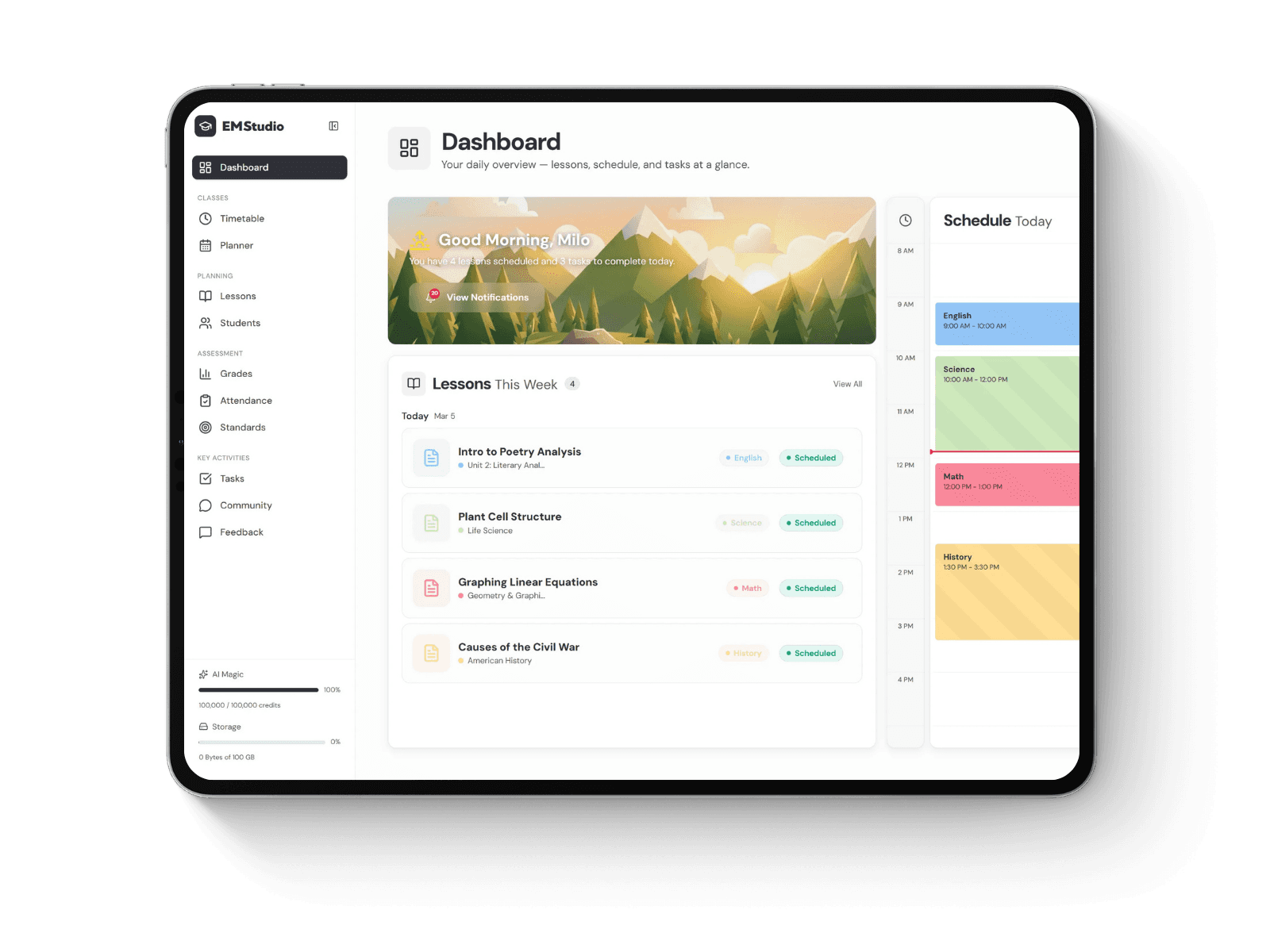
Still grading everything by hand?
EMStudio is a free teaching management app — manage your classes, students, lessons, and more!
Learn More
Table of Contents
What Does This Teacher Planner Template Include?
This teacher planner template includes a dual-format system with editable Google Slides and printable PDF versions. It contains an academic year-at-a-glance, 40-week lesson planning spreads, student data dashboards for 30 students per class, IEP accommodation trackers, assessment gradebooks, CPD hours logs aligned with Teaching Council requirements, and parent communication records. The template supports both A4 and US Letter formats with hyperlinked navigation and automatic date propagation in digital versions.
You get two versions. The Google Slides file uses automatic shape linking to jump between months and weeks. The PDF comes print-ready with fillable form fields that work in Adobe Acrobat Reader. Both files stay under 5MB, so you can email them without hitting district attachment limits.
The template breaks down into eight core modules. You get an Academic Year-at-a-Glance running August through July, 40-week lesson planning spreads with space for differentiated instruction notes, and a Student Data Dashboard that tracks up to 30 pupils per class. The IEP/ASN Accommodation Tracker keeps individual strategies visible during lesson planning, while the Assessment Gradebook exports cleanly to VSware and Aladdin formats. There's a GDPR-compliant Parent Communication Log, a CPD Hours Tracker aligned with Teaching Council requirements, and a Substitute Teacher Emergency Folder for those mornings when you wake up with a fever.
Technical specs matter when you're using this daily. The files work with GoodNotes 5, Notability, and OneNote for iPad annotation. Print layouts adjust automatically for A4 or US Letter, with margins set to prevent punch holes from eating your text. Spiral-binding optimization means double-sided printing won't bleed through cheap copier paper.
Setup takes 45 minutes. Import your class lists, link your curriculum mapping dates, and customize the assessment logs to match your grading scheme. Building equivalent layouts from blank documents eats three hours of your Sunday afternoon that you could spend on actual classroom organization. Among the best digital teacher planner options I've tested, this one saves time rather than creating digital busywork.
Generic planners offer blank boxes. This one offers hyperlinked navigation between monthly and weekly views, automatic date propagation when you shift term dates, and layout constraints that prevent the formatting disasters you get when merging cells in basic templates.
Template Structure and Core Components
Choosing between digital and printable comes down to how your brain works. Digital offers searchability and cloud backup—lose your device, and your plans survive. Paper gives tactile memory and zero screen time, plus no loading delays when inspiration strikes. Cost matters too. The digital version runs free with your Google account, while printing and binding the printable runs €15-25 annually. Device dependency is the real divider: tablets and laptops versus paper and pen only. This customizable teacher planner template combines both worlds, organized around five core components that handle everything from curriculum mapping to student data tracking.
Weekly and Monthly Overview Pages
Weekly spreads use horizontal Monday-start grids with six-period columns blocked in 45-minute increments. Prefer block scheduling? Flip to the vertical layout designed for 90-minute sessions. Primary teachers get yard duty roster slots; post-primary staff see supervision schedules.
The monthly view spans August through July with Irish bank holidays pre-marked and term breaks shaded—October mid-term, Christmas, February mid-term, Easter. A dedicated sidebar lets you map curriculum objectives against monthly themes, keeping your classroom organization visible at a glance.
Detailed Lesson Planning Sections
The lesson planning pages follow the 5E model with checkboxes for Engage, Explore, Explain, Elaborate, and Evaluate. Each field caps at 200 characters to force concise planning. Differentiation strategies appear as checkboxes covering visual, auditory, and kinesthetic modalities, plus EAL scaffolds like vocabulary banks. You can list three specific student names per strategy.
The digital version allows embedded hyperlinks to Google Drive folders, specific textbook pages like Busy at Maths page 45, or assessment tools such as Kahoot and Quizlet. Space for three learning objectives aligned with Bloom's Taxonomy levels keeps your instruction targeted.
Student Assessment and Grade Tracking Logs
The gradebook accommodates 25 students across 15 assignment columns, supporting both percentage and standards-based 1-4 grading scales. Digital versions include automatic averaging formulas. RTI intervention tracking uses a three-column system for Tier 1 classroom strategies, Tier 2 small groups, and Tier 3 individual support, with start dates, end dates, and bi-weekly progress monitoring checkboxes.
For Irish post-primary teachers, Junior Cycle CBA tracking grids include descriptor bands from Exceptional to Yet to Meet Expectations. This functions as a digital gradebook for tracking student marks or a printable assessment log.
Professional Development and Meeting Records
CPD tracking uses Teaching Council category codes—Category 1, 2, 3, or 4—with columns for date, provider, title, hours, and reflection notes. This meets your 14-hour annual requirement for full registration without digging through emails later.
The meeting notes template lists attendees, five agenda bullet points, and action items with assignee names and hard deadlines. It works for staff meetings, parent-teacher conferences, and NCSE team meetings, with follow-up date fields that prevent commitments from disappearing into the week. The format respects both digital tags and handwritten annotations.
Parent Communication Documentation
The communication log includes timestamp fields, method checkboxes for phone, email, or face-to-face meetings, and reason categories covering academic, behavioral, attendance, or welfare concerns. Summary notes use GDPR-compliant anonymized identifiers instead of full names for sensitive discussions. Follow-up required checkboxes keep you accountable.
Half-page home-school notebook templates fit on sticky notes or directly into your planner for daily behavior reports or homework updates. Pair this with parent communication strategies for modern teachers to handle tough conversations with documentation to back you up.

Step-by-Step Setup Guide
Start by choosing your platform. If you're using an iPad or tablet, import the file into GoodNotes or Notability. Working from a laptop? Open the Google Slides version. Printing? Send the PDF to a local print shop for coil binding. This setup takes 30 to 45 minutes total. Building a customizable teacher planner from scratch would eat five hours or more.
Step 1 — Import and Configure Your Digital or Printable Base
Download the ZIP file containing the PowerPoint source file, Google Slides link, and flattened PDF. For digital setup, duplicate the master file immediately and rename it before touching anything. Edit the original directly and you corrupt your template permanently. You lose it for next year.
Upload your working copy to Google Drive and enable offline access. Test the hyperlink navigation between monthly and weekly views before you start lesson planning. Broken links waste time later.
For the printable version, export only specific pages to avoid wasting paper on blank templates. Send the file to Staples or PrintWorks for double-sided printing on 100gsm paper. Request coil binding with a poly cover. Expect to pay €8 to €12. The poly cover survives backpack abuse better than standard binding.
Step 2 — Input Your Teaching Schedule and Class Rotations
Input your bell times exactly as they appear on your official schedule. Primary schools run 9:00 AM to 2:40 PM with lunch at 12:30. Post-primary runs 9:00 AM to 4:00 PM with lunch at 1:00. Skip this step and you will manually rewrite every weekly page later. That is forty weeks of corrections.
Configure your rotary schedule now. Label Week A and Week B if your school uses six-day cycles or alternating fortnights. Get this wrong and your curriculum mapping falls apart by October.
Apply color codes using specific hex values for visual recognition. Use #FF6B6B for Maths, #4ECDC4 for English, and #95E1D3 for Gaeilge. These consistent markers speed up your classroom organization during live lessons. You glance and know what comes next.
Step 3 — Populate Student Rosters and Accommodation Notes
Import student names directly from your school MIS. Export the CSV from Aladdin or VSware and paste names into your roster fields. Manual entry invites spelling errors.
Add safeguarding markers immediately. Use icons for medical alerts—an epipen symbol for severe allergies, an inhaler for asthma. Note EAL status levels: Newcomer, Developing, or Competent. Schedule IEP review dates every four weeks to maintain NCSE compliance for differentiated instruction.
Store this data securely. Back it up to your school drive immediately. Failing to protect student information risks a GDPR privacy breach and professional disciplinary action.
Step 4 — Establish Recurring Templates for Weekly Efficiency
Create your Week 1 Master with all recurring elements locked in. Insert hyperlinks to Dropbox folders for worksheets and textbook ISBN references for quick ordering. This template drives your entire year's lesson planning.
Duplicate it forty times for the full academic year. Insert term break divider pages automatically dated for mid-term breaks in October and February, plus two weeks each for Christmas and Easter.
Apply time management techniques for educators by pre-filling recurring appointments. Copy staff meetings every Tuesday at 3:30 PM and yard duty Friday at 11:00 AM across all weeks using these weekly planning templates for teachers. Never type the same meeting twice.
How Do You Customize This Teacher Planner?
You customize this teacher planner through editable master slides in Google Slides or PowerPoint, allowing you to resize time blocks for 35-minute primary periods or 60-minute secondary classes, add Irish curriculum codes like NCCA specification references, and insert subject-specific elements such as lab safety checkboxes for Science or Aistear frameworks for primary. The modular design lets you duplicate or delete sections based on single-subject or multi-class teaching assignments. But start simple. I have seen colleagues abandon perfectly good planners after three weeks because they added too many fields upfront. Pick eighty percent of what you actually need, then layer in extras once the habit sticks.
Adapting Layouts for Primary versus Secondary Levels
Primary teachers need vertical daily strips with seven distinct activity zones. Think Aistear, phonics, Gaeilge, English, maths, SESE, and SPHE. Junior Infants through Second Class require larger handwriting spaces and yard duty roster integration right there on the page.
Post-primary works better with horizontal period blocks. You are looking at 40 to 60 minute classes, exam paper tracking grids for Leaving Cert and Junior Cycle, and CAO deadline reminders for senior cycle Guidance work. If you are in a small rural school teaching split classes like Third/Fourth or Fifth/Sixth together, use the two-column layout to keep both grades visible without flipping pages.
Configuring Sections for Irish Curriculum Requirements
This is where aligning instruction with curriculum standards actually happens in your daily work. The template comes pre-loaded with NCCA specification short codes, so you can drop 'JC-WAT-1' for Junior Cycle Wellbeing directly into your lesson planning fields without cross-referencing a PDF every morning.
For Cuntas Míosúil compliance, you will find monthly reflection templates that match DES requirements for both probationary teachers and permanent staff. There are also dedicated fields for Gaeilge proficiency tracking across T1, T2, and T3 bands, plus Teanga ó Bhéal assessment checkboxes that keep you audit-ready.
Adding Subject-Specific Workflow Elements
Science teachers should add lab safety checkboxes, chemical inventory logs, and risk assessment approval signatures right into their weekly spread. English teachers need essay drafting stages visible—planning, drafting, editing, publishing—alongside comparative study tracking grids for the Leaving Cert.
Maths teachers benefit from concrete materials checklists for Cuisenaire rods and base ten blocks, plus problem-solving strategy reminders like RUDE or ROSE. When you are working within the secondary education structure and implementation framework, these subject-specific workflows prevent the Friday afternoon scramble to find that equipment order form you misplaced.

Best Practices for Daily Implementation
Daily rituals prevent your teacher planner from becoming another abandoned resolution. Treat it like classroom management: consistency beats intensity. The teachers who stick with their systems don't have better planners; they have better boundaries.
Morning Setup Routines for Maximum Efficiency
At 8:15 AM, spend ten minutes with your teacher planner before the bell rings. Check your emergency sub folder location first—substitutes shouldn't have to hunt for it while you're in A&E. Verify your technology next: whiteboard markers charged, iPad synced with the cloud, clicker batteries fresh. Review your ASN accommodation alerts for specific students, like noting that John needs preferential seating today or that your dyslexia scaffolds must be ready for period 2. Highlight three priority tasks using your color-coding system so you know what cannot slip. Skip this routine, and by period 3 you'll be scrambling for materials and forgetting legally required accommodations. That failure mode ruins the flow for everyone.
Implement the Two-Minute Rule during this block: if a task takes less than two minutes—returning a parent email or recording a single grade—complete it immediately. Scheduling these micro-tasks creates a Sunday evening backlog that drives mid-term abandonment and burnout. During the first five minutes of each class, check your planner for differentiation strategies specific to that group before you start talking. This keeps your lesson planning grounded in reality, not just theory.
End-of-Day Review and Preparation Habits
At 3:00 PM, take fifteen minutes to shut down properly. Document any child protection incidents immediately while the details are fresh; your incident report logs are legal documents, not memory exercises to be reconstructed later. File signed permission slips in your physical folder or scan them to your digital archive now before they disappear into bag crumples. Photograph today's whiteboard notes and paste them into your digital planner for absent students who will ask tomorrow. Prep materials for next day's first period immediately—photocopying or lab setup—so you aren't racing the clock at 8:40 AM when the copier inevitably jams.
Fridays extend this to thirty minutes. Complete your Cuntas Míosúil monthly reflection and log CPD hours for the week. Review next week's planner for clashes or missing resources. If you're carrying work home, use a slim version containing only next week's pages rather than the full binder. This prevents the abandonment triggers that kill most teacher planner template systems: over-ambitious decoration that wastes two hours on stickers, rigid adherence to unused sections, and the back-strain of hauling everything home. These planning habits of highly effective educators protect your evenings and support maintaining a healthy teacher work-life balance.

Teacher Planner: The 3-Step Kickoff
You have the template open. You know where the curriculum mapping lives and how the student data tracking connects to your daily lesson planning. The setup work is finished. Now comes the part that matters—using this teacher planner daily so it actually lowers your stress instead of becoming another digital graveyard you ignore by October. I’ve watched colleagues build elaborate systems they abandon after three weeks. Don’t let that be you.
Start smaller than you think. Pick one component—maybe just the weekly lesson planning view—and run it for two weeks straight. Get the muscle memory down before you layer in the attendance tracker or unit maps. Your classroom organization should feel like a support, not a side hustle you resent.
Duplicate the template and delete the sample data from every database.
Add your first quarter’s curriculum mapping with real unit dates and standards.
Schedule 10 minutes every Friday to review student data tracking and adjust next week’s lessons.
What Does This Teacher Planner Template Include?
This teacher planner template includes a dual-format system with editable Google Slides and printable PDF versions. It contains an academic year-at-a-glance, 40-week lesson planning spreads, student data dashboards for 30 students per class, IEP accommodation trackers, assessment gradebooks, CPD hours logs aligned with Teaching Council requirements, and parent communication records. The template supports both A4 and US Letter formats with hyperlinked navigation and automatic date propagation in digital versions.
You get two versions. The Google Slides file uses automatic shape linking to jump between months and weeks. The PDF comes print-ready with fillable form fields that work in Adobe Acrobat Reader. Both files stay under 5MB, so you can email them without hitting district attachment limits.
The template breaks down into eight core modules. You get an Academic Year-at-a-Glance running August through July, 40-week lesson planning spreads with space for differentiated instruction notes, and a Student Data Dashboard that tracks up to 30 pupils per class. The IEP/ASN Accommodation Tracker keeps individual strategies visible during lesson planning, while the Assessment Gradebook exports cleanly to VSware and Aladdin formats. There's a GDPR-compliant Parent Communication Log, a CPD Hours Tracker aligned with Teaching Council requirements, and a Substitute Teacher Emergency Folder for those mornings when you wake up with a fever.
Technical specs matter when you're using this daily. The files work with GoodNotes 5, Notability, and OneNote for iPad annotation. Print layouts adjust automatically for A4 or US Letter, with margins set to prevent punch holes from eating your text. Spiral-binding optimization means double-sided printing won't bleed through cheap copier paper.
Setup takes 45 minutes. Import your class lists, link your curriculum mapping dates, and customize the assessment logs to match your grading scheme. Building equivalent layouts from blank documents eats three hours of your Sunday afternoon that you could spend on actual classroom organization. Among the best digital teacher planner options I've tested, this one saves time rather than creating digital busywork.
Generic planners offer blank boxes. This one offers hyperlinked navigation between monthly and weekly views, automatic date propagation when you shift term dates, and layout constraints that prevent the formatting disasters you get when merging cells in basic templates.
Template Structure and Core Components
Choosing between digital and printable comes down to how your brain works. Digital offers searchability and cloud backup—lose your device, and your plans survive. Paper gives tactile memory and zero screen time, plus no loading delays when inspiration strikes. Cost matters too. The digital version runs free with your Google account, while printing and binding the printable runs €15-25 annually. Device dependency is the real divider: tablets and laptops versus paper and pen only. This customizable teacher planner template combines both worlds, organized around five core components that handle everything from curriculum mapping to student data tracking.
Weekly and Monthly Overview Pages
Weekly spreads use horizontal Monday-start grids with six-period columns blocked in 45-minute increments. Prefer block scheduling? Flip to the vertical layout designed for 90-minute sessions. Primary teachers get yard duty roster slots; post-primary staff see supervision schedules.
The monthly view spans August through July with Irish bank holidays pre-marked and term breaks shaded—October mid-term, Christmas, February mid-term, Easter. A dedicated sidebar lets you map curriculum objectives against monthly themes, keeping your classroom organization visible at a glance.
Detailed Lesson Planning Sections
The lesson planning pages follow the 5E model with checkboxes for Engage, Explore, Explain, Elaborate, and Evaluate. Each field caps at 200 characters to force concise planning. Differentiation strategies appear as checkboxes covering visual, auditory, and kinesthetic modalities, plus EAL scaffolds like vocabulary banks. You can list three specific student names per strategy.
The digital version allows embedded hyperlinks to Google Drive folders, specific textbook pages like Busy at Maths page 45, or assessment tools such as Kahoot and Quizlet. Space for three learning objectives aligned with Bloom's Taxonomy levels keeps your instruction targeted.
Student Assessment and Grade Tracking Logs
The gradebook accommodates 25 students across 15 assignment columns, supporting both percentage and standards-based 1-4 grading scales. Digital versions include automatic averaging formulas. RTI intervention tracking uses a three-column system for Tier 1 classroom strategies, Tier 2 small groups, and Tier 3 individual support, with start dates, end dates, and bi-weekly progress monitoring checkboxes.
For Irish post-primary teachers, Junior Cycle CBA tracking grids include descriptor bands from Exceptional to Yet to Meet Expectations. This functions as a digital gradebook for tracking student marks or a printable assessment log.
Professional Development and Meeting Records
CPD tracking uses Teaching Council category codes—Category 1, 2, 3, or 4—with columns for date, provider, title, hours, and reflection notes. This meets your 14-hour annual requirement for full registration without digging through emails later.
The meeting notes template lists attendees, five agenda bullet points, and action items with assignee names and hard deadlines. It works for staff meetings, parent-teacher conferences, and NCSE team meetings, with follow-up date fields that prevent commitments from disappearing into the week. The format respects both digital tags and handwritten annotations.
Parent Communication Documentation
The communication log includes timestamp fields, method checkboxes for phone, email, or face-to-face meetings, and reason categories covering academic, behavioral, attendance, or welfare concerns. Summary notes use GDPR-compliant anonymized identifiers instead of full names for sensitive discussions. Follow-up required checkboxes keep you accountable.
Half-page home-school notebook templates fit on sticky notes or directly into your planner for daily behavior reports or homework updates. Pair this with parent communication strategies for modern teachers to handle tough conversations with documentation to back you up.
Step-by-Step Setup Guide
Start by choosing your platform. If you're using an iPad or tablet, import the file into GoodNotes or Notability. Working from a laptop? Open the Google Slides version. Printing? Send the PDF to a local print shop for coil binding. This setup takes 30 to 45 minutes total. Building a customizable teacher planner from scratch would eat five hours or more.
Step 1 — Import and Configure Your Digital or Printable Base
Download the ZIP file containing the PowerPoint source file, Google Slides link, and flattened PDF. For digital setup, duplicate the master file immediately and rename it before touching anything. Edit the original directly and you corrupt your template permanently. You lose it for next year.
Upload your working copy to Google Drive and enable offline access. Test the hyperlink navigation between monthly and weekly views before you start lesson planning. Broken links waste time later.
For the printable version, export only specific pages to avoid wasting paper on blank templates. Send the file to Staples or PrintWorks for double-sided printing on 100gsm paper. Request coil binding with a poly cover. Expect to pay €8 to €12. The poly cover survives backpack abuse better than standard binding.
Step 2 — Input Your Teaching Schedule and Class Rotations
Input your bell times exactly as they appear on your official schedule. Primary schools run 9:00 AM to 2:40 PM with lunch at 12:30. Post-primary runs 9:00 AM to 4:00 PM with lunch at 1:00. Skip this step and you will manually rewrite every weekly page later. That is forty weeks of corrections.
Configure your rotary schedule now. Label Week A and Week B if your school uses six-day cycles or alternating fortnights. Get this wrong and your curriculum mapping falls apart by October.
Apply color codes using specific hex values for visual recognition. Use #FF6B6B for Maths, #4ECDC4 for English, and #95E1D3 for Gaeilge. These consistent markers speed up your classroom organization during live lessons. You glance and know what comes next.
Step 3 — Populate Student Rosters and Accommodation Notes
Import student names directly from your school MIS. Export the CSV from Aladdin or VSware and paste names into your roster fields. Manual entry invites spelling errors.
Add safeguarding markers immediately. Use icons for medical alerts—an epipen symbol for severe allergies, an inhaler for asthma. Note EAL status levels: Newcomer, Developing, or Competent. Schedule IEP review dates every four weeks to maintain NCSE compliance for differentiated instruction.
Store this data securely. Back it up to your school drive immediately. Failing to protect student information risks a GDPR privacy breach and professional disciplinary action.
Step 4 — Establish Recurring Templates for Weekly Efficiency
Create your Week 1 Master with all recurring elements locked in. Insert hyperlinks to Dropbox folders for worksheets and textbook ISBN references for quick ordering. This template drives your entire year's lesson planning.
Duplicate it forty times for the full academic year. Insert term break divider pages automatically dated for mid-term breaks in October and February, plus two weeks each for Christmas and Easter.
Apply time management techniques for educators by pre-filling recurring appointments. Copy staff meetings every Tuesday at 3:30 PM and yard duty Friday at 11:00 AM across all weeks using these weekly planning templates for teachers. Never type the same meeting twice.
How Do You Customize This Teacher Planner?
You customize this teacher planner through editable master slides in Google Slides or PowerPoint, allowing you to resize time blocks for 35-minute primary periods or 60-minute secondary classes, add Irish curriculum codes like NCCA specification references, and insert subject-specific elements such as lab safety checkboxes for Science or Aistear frameworks for primary. The modular design lets you duplicate or delete sections based on single-subject or multi-class teaching assignments. But start simple. I have seen colleagues abandon perfectly good planners after three weeks because they added too many fields upfront. Pick eighty percent of what you actually need, then layer in extras once the habit sticks.
Adapting Layouts for Primary versus Secondary Levels
Primary teachers need vertical daily strips with seven distinct activity zones. Think Aistear, phonics, Gaeilge, English, maths, SESE, and SPHE. Junior Infants through Second Class require larger handwriting spaces and yard duty roster integration right there on the page.
Post-primary works better with horizontal period blocks. You are looking at 40 to 60 minute classes, exam paper tracking grids for Leaving Cert and Junior Cycle, and CAO deadline reminders for senior cycle Guidance work. If you are in a small rural school teaching split classes like Third/Fourth or Fifth/Sixth together, use the two-column layout to keep both grades visible without flipping pages.
Configuring Sections for Irish Curriculum Requirements
This is where aligning instruction with curriculum standards actually happens in your daily work. The template comes pre-loaded with NCCA specification short codes, so you can drop 'JC-WAT-1' for Junior Cycle Wellbeing directly into your lesson planning fields without cross-referencing a PDF every morning.
For Cuntas Míosúil compliance, you will find monthly reflection templates that match DES requirements for both probationary teachers and permanent staff. There are also dedicated fields for Gaeilge proficiency tracking across T1, T2, and T3 bands, plus Teanga ó Bhéal assessment checkboxes that keep you audit-ready.
Adding Subject-Specific Workflow Elements
Science teachers should add lab safety checkboxes, chemical inventory logs, and risk assessment approval signatures right into their weekly spread. English teachers need essay drafting stages visible—planning, drafting, editing, publishing—alongside comparative study tracking grids for the Leaving Cert.
Maths teachers benefit from concrete materials checklists for Cuisenaire rods and base ten blocks, plus problem-solving strategy reminders like RUDE or ROSE. When you are working within the secondary education structure and implementation framework, these subject-specific workflows prevent the Friday afternoon scramble to find that equipment order form you misplaced.
Best Practices for Daily Implementation
Daily rituals prevent your teacher planner from becoming another abandoned resolution. Treat it like classroom management: consistency beats intensity. The teachers who stick with their systems don't have better planners; they have better boundaries.
Morning Setup Routines for Maximum Efficiency
At 8:15 AM, spend ten minutes with your teacher planner before the bell rings. Check your emergency sub folder location first—substitutes shouldn't have to hunt for it while you're in A&E. Verify your technology next: whiteboard markers charged, iPad synced with the cloud, clicker batteries fresh. Review your ASN accommodation alerts for specific students, like noting that John needs preferential seating today or that your dyslexia scaffolds must be ready for period 2. Highlight three priority tasks using your color-coding system so you know what cannot slip. Skip this routine, and by period 3 you'll be scrambling for materials and forgetting legally required accommodations. That failure mode ruins the flow for everyone.
Implement the Two-Minute Rule during this block: if a task takes less than two minutes—returning a parent email or recording a single grade—complete it immediately. Scheduling these micro-tasks creates a Sunday evening backlog that drives mid-term abandonment and burnout. During the first five minutes of each class, check your planner for differentiation strategies specific to that group before you start talking. This keeps your lesson planning grounded in reality, not just theory.
End-of-Day Review and Preparation Habits
At 3:00 PM, take fifteen minutes to shut down properly. Document any child protection incidents immediately while the details are fresh; your incident report logs are legal documents, not memory exercises to be reconstructed later. File signed permission slips in your physical folder or scan them to your digital archive now before they disappear into bag crumples. Photograph today's whiteboard notes and paste them into your digital planner for absent students who will ask tomorrow. Prep materials for next day's first period immediately—photocopying or lab setup—so you aren't racing the clock at 8:40 AM when the copier inevitably jams.
Fridays extend this to thirty minutes. Complete your Cuntas Míosúil monthly reflection and log CPD hours for the week. Review next week's planner for clashes or missing resources. If you're carrying work home, use a slim version containing only next week's pages rather than the full binder. This prevents the abandonment triggers that kill most teacher planner template systems: over-ambitious decoration that wastes two hours on stickers, rigid adherence to unused sections, and the back-strain of hauling everything home. These planning habits of highly effective educators protect your evenings and support maintaining a healthy teacher work-life balance.
Teacher Planner: The 3-Step Kickoff
You have the template open. You know where the curriculum mapping lives and how the student data tracking connects to your daily lesson planning. The setup work is finished. Now comes the part that matters—using this teacher planner daily so it actually lowers your stress instead of becoming another digital graveyard you ignore by October. I’ve watched colleagues build elaborate systems they abandon after three weeks. Don’t let that be you.
Start smaller than you think. Pick one component—maybe just the weekly lesson planning view—and run it for two weeks straight. Get the muscle memory down before you layer in the attendance tracker or unit maps. Your classroom organization should feel like a support, not a side hustle you resent.
Duplicate the template and delete the sample data from every database.
Add your first quarter’s curriculum mapping with real unit dates and standards.
Schedule 10 minutes every Friday to review student data tracking and adjust next week’s lessons.
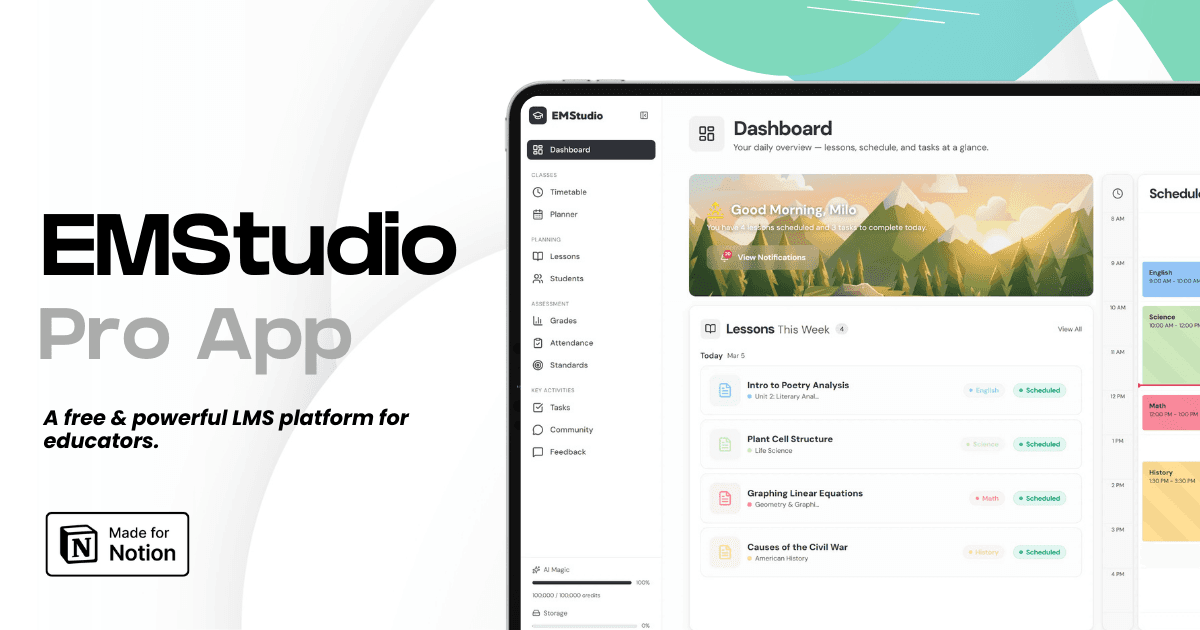
Still grading everything by hand?
EMStudio is a free teaching management app — manage your classes, students, lessons, and more!
Learn More
Still grading everything by hand?
EMStudio is a free teaching management app — manage your classes, students, lessons, and more!
Learn More




Notion4Teachers
Notion templates to simplify administrative tasks and enhance your teaching experience.



2026 Notion4Teachers. All Rights Reserved.
Notion4Teachers
Notion templates to simplify administrative tasks and enhance your teaching experience.
2026 Notion4Teachers. All Rights Reserved.
Notion4Teachers
Notion templates to simplify administrative tasks and enhance your teaching experience.
2026 Notion4Teachers. All Rights Reserved.