
Responsibilities of a Teacher: A Complete Guide
Responsibilities of a Teacher: A Complete Guide

Article by
Milo
ESL Content Coordinator & Educator
ESL Content Coordinator & Educator
All Posts
The fundamental responsibilities of a teacher encompass four domains: instructional delivery using evidence-based pedagogy, administrative compliance with legal documentation, social-emotional support for whole-child development, and continuous professional growth through collaboration. These duties extend beyond classroom instruction to include grading, IEP management, parent communication, and peer mentoring, typically requiring 50+ hours weekly during the school year.
You are not just an instructor. You are a data analyst, a compliance officer, a counselor, and a project manager. The role of a teacher needs 50 to 55 hours weekly with only 35 to 40 spent in front of students. The rest is invisible labor that drives every outcome you see.
You plan units backward using Understanding by Design. Start with the enduring understanding you want students to carry for years. Then design the performance task that proves they got it. Finally, build the learning experiences. When I taught 11th-grade U.S. History, I spent three weeks on Civil Rights using documentary analysis and Socratic seminars. Students didn't just memorize dates; they analyzed primary sources to evaluate historical causation. That backward planning ensured every activity served the final assessment.
Still grading everything by hand?
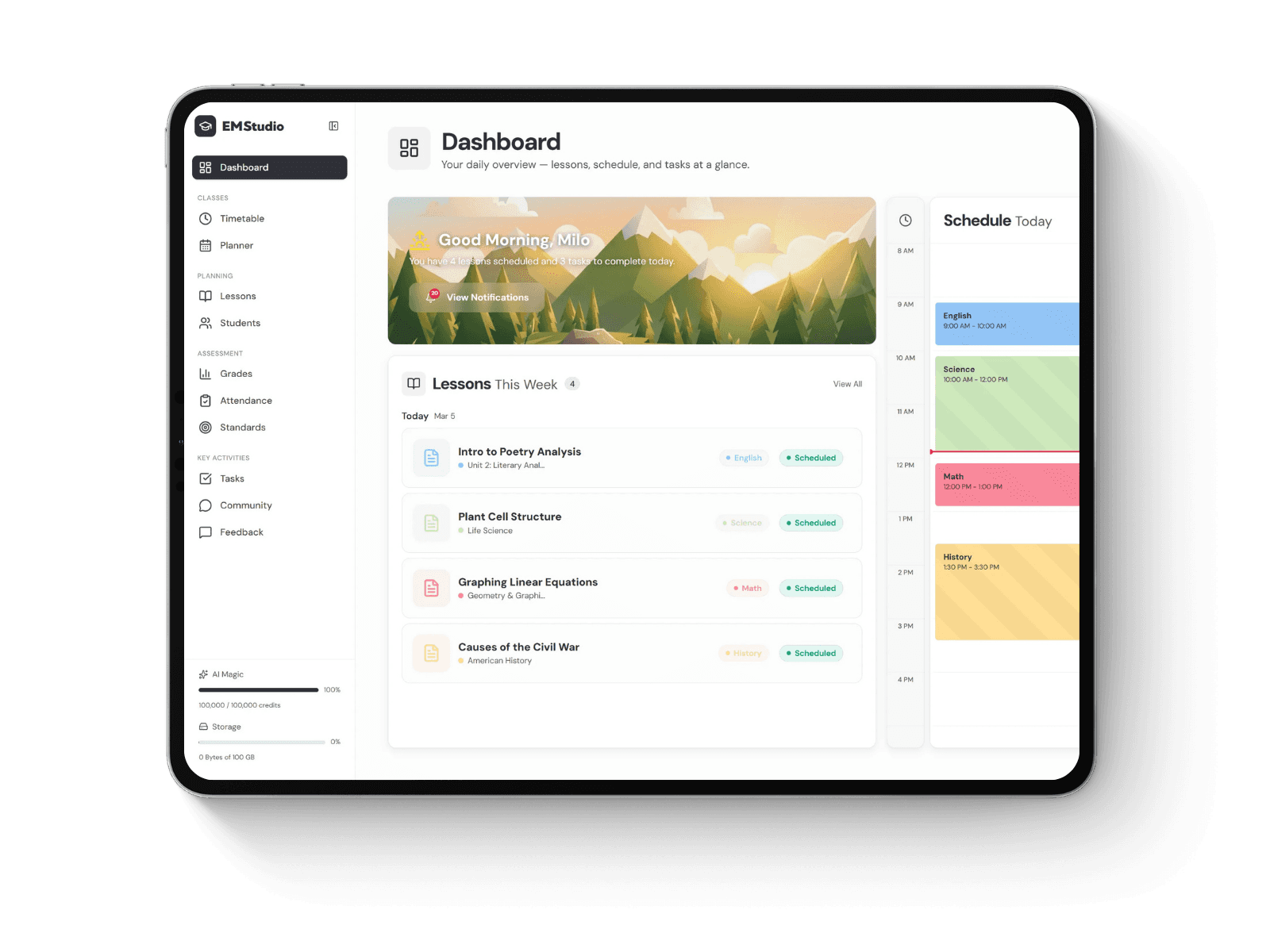
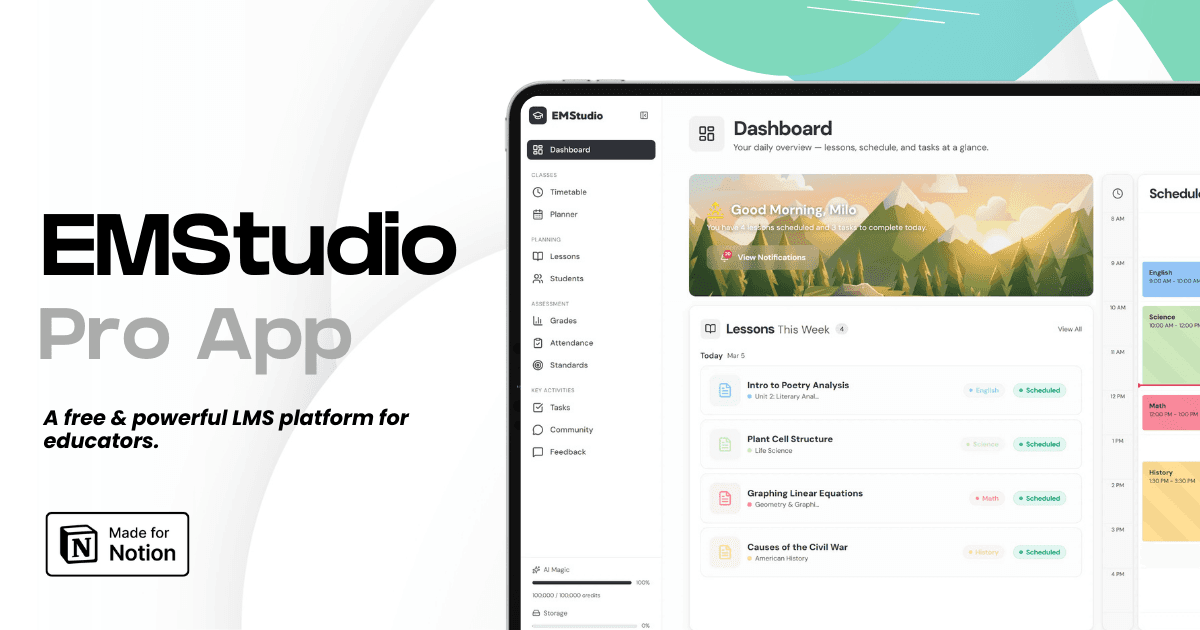
EMStudio is a free teaching management app — manage your classes, students, lessons, and more!
Learn More
Still grading everything by hand?
EMStudio is a free teaching management app — manage your classes, students, lessons, and more!
Learn More
Table of Contents
What Are the Fundamental Responsibilities of a Teacher?
Instructional Core: Curriculum Delivery and Pedagogy
You follow pedagogical frameworks and curriculum delivery like Rosenshine's Principles. You begin with five to eight minutes of daily review. You present new material in small steps. You ask frequent questions to check for understanding.
You ensure students hit an 80% success rate during guided practice before they work independently. You differentiate using Bloom's Taxonomy, making sure each unit has activities at apply, analyze, and evaluate levels. You model everything using "I do, We do, You do." This gradual release prevents the panic of throwing students into independent work before they are ready. This is understanding teaching at its core.
Administrative Duties: Documentation and Compliance
You manage IEP deadlines with military precision.
Annual reviews every 365 days.
Three-year reevaluations.
Thirty-day response timelines for parent requests.
You use PowerSchool or Infinite Campus dashboards with automated alerts to stay ahead. Missing these deadlines violates IDEA federal law and exposes your district to due process litigation. One missed date can invalidate an entire year's progress for a student who needs every service documented and legally protected.
You document attendance within 48 hours per state law. You maintain FERPA-compliant records for 504 plans, medical alerts, and guardianship papers in locked files or encrypted folders. Managing teacher records and administrative compliance means understanding that missing mandatory reporting triggers truancy interventions and potential educational neglect investigations. One missed signature can derail a child's services for months.
Educational compliance is not optional paperwork. It is legal protection for vulnerable students. You also handle daily logistics like field trip permissions, medication schedules, and emergency contact updates that consume hours before you ever teach a lesson. Parents see the gradebook; they rarely see the compliance infrastructure keeping their children safe.
Developmental Roles: Social-Emotional Support and Mentoring
You implement CASEL's five SEL competencies in your classroom management.
Self-awareness through mood meters.
Self-management through calm-down spaces.
Social awareness through perspective-taking.
Relationship skills through peer mediation.
Responsible decision-making through problem-solving protocols.
When I taught 5th grade, I started every day with a 20-minute morning meeting: greeting, sharing, a cooperative activity, and a morning message. It built the community that made academic risk-taking possible. Without this foundation, content knowledge sits unused.
You serve as a mandated reporter. You identify and document signs of abuse or neglect within 24 hours to Child Protective Services. You maintain detailed written records of observable indicators. This role requires you to balance empathy for families with legal obligations to protect children. You cannot opt out. You carry the weight of knowing that your documentation might be the evidence that saves a child.
You counsel students through friendship drama, anxiety, and family crises. You are not a licensed therapist, but you are the adult they see daily. Your developmental role fills gaps that counselors cannot reach due to caseloads.
Professional Obligations: Growth and Collaboration
You complete 15 to 30 clock hours of professional development annually depending on your state. You might pursue National Board Certification, which requires a four-component portfolio and 400-plus hours of work. Or you earn subject-specific micro-credentials through platforms like BloomBoard. This isn't box-checking; it's staying current on pedagogical strategies that actually work. Your growth directly impacts student outcomes.
You participate in professional learning communities weekly for 45 to 60 minutes. You analyze common formative assessment data using protocols. You adjust instruction every six weeks based on results. You mentor novice teachers using the Charlotte Danielson Framework, conducting peer observations two to three times yearly with pre- and post-conferences. This collaboration ensures that effective classroom management and differentiated instruction spread beyond your four walls.
You draft curriculum maps with colleagues. You align formative assessments to standards. You share resources in shared drives. This collective work reduces isolation and prevents rookie mistakes from becoming bad habits. Professional obligations ensure the entire system improves, not just your individual classroom.
Why Do Teacher Responsibilities Matter for Student Success?
Teacher responsibilities directly impact student success through high-effect instructional strategies like formative assessment and explicit teaching, which research shows can produce effect sizes above 0.70. Beyond academics, teachers who prioritize classroom culture and SEL competencies create psychological safety that enables risk-taking, resulting in higher engagement, reduced behavioral incidents, and improved long-term college and career readiness.
John Hattie's research confirms what veteran teachers know. These numbers represent months of growth:
Teacher credibility carries an effect size of 0.90, meaning students learn better when they trust you.
Formative evaluation hits 0.90, making it one of the most powerful tools you have.
Classroom management sits at 0.52, still ranking among the top influences on learning.
The teachers role in education remains the single strongest in-school factor determining student growth. Class size matters less than your grouping strategies. Funding helps only if you deploy it toward high-leverage interventions. Facilities are nice, but they don't teach reading. Your daily pedagogical strategies outperform every other variable within school control when you implement them with consistency and focus.
Maslow comes before Bloom. Students require psychological safety and belonging before they can engage with rigorous academic content. A child experiencing chronic stress cannot access working memory for math facts or reading comprehension. You must build the emotional foundation that makes academic learning possible. Without it, your best lesson plans fail.
High-leverage strategies separate effective classrooms from chaotic ones. You don't need more time. You need better moves. Focus on what actually moves the needle.
Academic Achievement and Critical Skill Development
Deploy high-effect strategies daily. Direct instruction yields a 0.59 effect size. Reciprocal teaching hits 0.74. Spaced practice sits at 0.65. These aren't buzzwords. They are specific pedagogical strategies that accelerate learning when you implement them with fidelity. You don't need to guess what works. The research tells you exactly which moves produce the biggest gains.
I taught 7th-grade math for six years. Every afternoon, I gave exit tickets with five questions. Three minutes max. Students handed them to me as they walked out. That data drove my heterogeneous grouping for the next morning. Students who demonstrated mastery became peer tutors. Students who struggled received Tier 2 interventions in small groups of three to four for twenty minutes using Do The Math protocols. We targeted 1.5 years of academic growth for students below the 25th percentile. The daily check took effort, but it paid off in June when benchmark scores jumped.
Post clear learning intentions and success criteria every day. This practice carries a 0.75 effect size. Write your objective on the board. Reference it three to five times during the lesson. Link it to rubrics so students self-monitor progress. When kids know exactly where they're headed, they get there faster. This is differentiated instruction that actually works because it gives students a destination and a map.
Social-Emotional Safety and Inclusive Classroom Culture
You cannot teach a brain in defense mode. Social-emotional learning in modern classrooms isn't an add-on. It is the on-ramp to academics. Implement Yale's RULER approach to build emotional vocabulary. Use the Mood Meter daily so students recognize, understand, label, express, and regulate their emotions. This builds self-regulation capacity that transfers to every subject area. When students can name their feelings, they can manage their behavior.
Establish classroom norms through community circles. Spend fifteen minutes weekly repairing harm and preventing bullying. Sit in a circle. Use a talking piece. Address conflicts before they explode. Measure your success by tracking office discipline referrals. Effective implementation reduces referrals by thirty to fifty percent over one semester. This is classroom management that actually works because it prevents problems rather than punishing symptoms.
Ignore SEL needs and you lose instructional time. Behavioral interruptions steal ten to fifteen minutes daily. Chronic stress impairs working memory and attention. Students cannot focus on your lesson if they are emotionally dysregulated. The responsibilities of a teacher include building psychological safety before expecting academic output. When you skip this step, you work twice as hard for half the results.
Long-term College and Career Readiness Foundations
Your work extends beyond the current academic year. Teach the 4 Cs: Critical thinking, Communication, Collaboration, and Creativity. Align with ASCD Whole Child tenets making sure students are healthy, safe, engaged, supported, and challenged. These competencies determine post-secondary success more than any standardized test score. Colleges and employers want students who can think, not just memorize.
Partner with local businesses for senior capstones. I watched 12th-grade students complete forty-hour internships with local manufacturers and marketing firms. They built presentation portfolios demonstrating professional communication and project management. This is preparing students for college and long-term success in action. Real work beats a worksheet every time. Students learn accountability when actual deadlines matter.
The Conference Board research indicates that eighty-seven percent of employers prioritize soft skills over technical knowledge. Ensure students practice email etiquette, deadline management, and conflict resolution before graduation. Professional learning communities can share rubrics for these competencies. You meet educational compliance not by checking boxes, but by making sure students are ready for real workplaces and adult responsibilities. That is the true measure of your impact.
Start early. Fifth graders can manage group projects. Ninth graders can send professional emails. Build these skills incrementally so seniors are ready for the transition.

How Do Teaching Responsibilities Vary by Grade Level and Context?
Teaching responsibilities vary significantly by context. Elementary generalists manage 25-32 students across 6-7 subjects with 20+ daily transitions, while secondary specialists teach 120-180 students in content-specific 45-minute periods. Special education teachers manage IEP compliance for 15-25 students with extensive documentation, and online educators provide 24-48 hour digital feedback while troubleshooting technical issues remotely.
Context changes everything. The pedagogical strategies that work in a kindergarten classroom will fail in a high school physics lab. Understanding teaching means recognizing that your daily workflow depends entirely on where you stand.
Elementary generalists juggle 25-32 students across 6-7 subjects with 20+ daily transitions; secondary specialists teach 120-180 students in single 45-minute periods.
Elementary teachers make 1,500+ academic decisions daily; secondary teachers make around 500+.
Special education teachers spend 10-15 hours weekly on IEP documentation versus 3-4 hours on lesson plans for general educators.
Online educators provide 24-48 hour digital feedback while troubleshooting technical issues for 15-20% of students lacking home access.
Student contact hours range from 6.5 hours daily for elementary to 5-6 hours for secondary, with online teachers clocking 10-15 additional hours of asynchronous facilitation.
Elementary Generalists: Managing Multiple Subjects and Transitions
You stand in front of 25-32 students all day. You teach math, ELA, science, social studies, art, PE, and SEL. That's seven preps, seven sets of standards, seven ways to reteach when kids get stuck. No other level requires this breadth.
I taught 3rd grade for eight years. October was when I mastered transitions. We moved 22 times daily—line up, rotate centers, switch subjects. Each transition ate 2-3 minutes. You lose an hour of instruction if you waste two minutes twenty times. The pacing never slows.
The literacy block consumes 90 minutes. You pull guided reading groups of 4-5 kids for 15 minutes each while others rotate through Daily 5 centers. You track handwriting grip, reading fluency, and recess conflicts simultaneously.
The responsibilities of elementary generalists demand constant formative assessment across developmental domains. You make over 1,500 academic decisions daily. That's one every 15 seconds. Your classroom management and pedagogical strategies create stability between the 20+ daily transitions.
Preparation time per lesson averages 15-20 minutes because you're adapting materials across subjects constantly. Documentation includes running records, behavior logs, and developmental checklists.
Secondary Specialists: Content Expertise and Exam Preparation
You see 120-180 students daily across five or six periods. Each group stays 45-55 minutes. You teach one subject—Chemistry, World History, Algebra II—deeply, not broadly. That depth requires ongoing professional learning communities to maintain currency in your field and meet certification requirements.
AP Biology teachers spend 2 hours setting up labs that last 90 minutes. You need 8-10 labs annually to meet College Board requirements. Preparation time per lesson runs 30-45 minutes because you're aligning to strict frameworks. Breakdown takes another hour. Grading 180 essays extends your workday deep into the evening hours.
Differentiation looks different here. In one English class, you scaffold texts from 800 Lexile to 1400 Lexile simultaneously for diverse readers. You tier assignments so Algebra readiness kids practice basics while Pre-Calculus-bound students tackle extensions. The specialized roles in secondary education focus on content expertise and exam preparation rather than developmental monitoring.
You make around 500 academic decisions daily, concentrated in content-specific moments. Student contact hours hover around 5-6 hours daily, but the grading load is relentless. Your documentation centers on detailed lesson plans and assessment data rather than IEP compliance.
Special Education: IEP Management and Individualization
You manage 15-25 students with IEPs or 504 plans under strict IDEA federal mandates. Each requires measurable annual goals with baseline data. You write progress reports every 9 weeks using SMART criteria. The educational compliance documentation alone consumes 10-15 hours weekly. One error can trigger due process complaints.
You rely on specialized tools daily to support differentiated instruction. Goalbook Toolkit helps write standards-based goals. Unique Learning System provides alternate curriculum for students with significant disabilities. You track progress with AIMsweb or DIBELS. Boardmaker creates the visual schedules that keep students oriented and on task.
You coordinate with SLPs, OTs, and PTs to fit 30-60 minute therapy sessions into the master schedule. You can't pull students from core instruction, so you negotiate with general education teachers constantly. The IEP management and special education collaboration requires diplomatic skills alongside specific pedagogical strategies and strict adherence to timelines.
Your responsibilities of a teacher center on legal compliance and individualization. Every accommodation must be tracked and implemented with fidelity. Preparation time includes adapting grade-level content to meet diverse needs. Student contact hours vary, but the paperwork extends far beyond the school day.
Online and Hybrid: Digital Facilitation and Technical Support
You facilitate through Canvas, Google Classroom, or Schoology. Students expect feedback within 24-48 hours. Parents email at midnight expecting responses. Your classroom management happens through mute buttons and chat moderation, not proximity. The asynchronous nature means you're always on call.
You troubleshoot constantly. Someone forgot their password. Another needs a hotspot because 15-20% of your kids lack reliable internet. You proctor exams using LockDown Browser while monitoring for academic integrity. Technical issues consume 20% of your planning time.
You record 5-7 minute videos with Screencastify or Loom. You moderate discussion boards requiring three substantive posts weekly from each student. That adds 10-15 hours of digital facilitation weekly. You type more words than you speak. Understanding teaching in this context means accepting that your workday never really closes.
Your responsibilities of a teacher shift from live performance to digital curation. You build modules instead of bulletin boards. Student contact hours look different—less face time, more typing, more video creation.
Preparation involves creating asynchronous content that stands alone. You can't clarify in the moment, so your instructions must be perfect. The 24-48 hour feedback window becomes your new rhythm.

How Can Educators Manage Competing Responsibilities Without Burnout?
Educators manage competing responsibilities by implementing the Eisenhower Matrix to prioritize urgent tasks, automating repetitive workflows using templates and batch processing, and establishing strict boundaries like no email after 7 PM. These strategies can reduce weekly workload by 5-10 hours while maintaining instructional quality and preventing compassion fatigue.
The responsibilities of a teacher expand far beyond the classroom. You grade papers, attend IEP meetings, and manage parent communication while designing differentiated instruction. Without systems, you work sixty-hour weeks and burn out fast.
Audit and Prioritize Using the Eisenhower Matrix
Gallup research from 2022 shows that 44% of K-12 teachers report frequent burnout. You cannot pour from an empty cup. The Eisenhower Matrix divides your tasks into four quadrants.
Quadrant 1 (Urgent/Important): IEP deadlines, safety incidents, and medical emergencies require immediate attention.
Quadrant 2 (Not Urgent/Important): Lesson planning, relationship building, and formative assessment design prevent future crises.
Quadrant 3 (Urgent/Unimportant): Most emails, unexpected phone calls, and paperwork that paras could handle.
Quadrant 4 (Neither): Perfecting bulletin boards, reorganizing supplies repeatedly, or excessive scrolling.
Conduct a one-week time audit. Log every activity in thirty-minute blocks. You will discover five to seven hours weekly spent in Quadrants 3 and 4. Eliminate these entirely. Delegate to paras when possible. Automate what remains. I learned this during my third year teaching 7th grade ELA. I spent my mornings responding to emails and my afternoons planning lessons when my brain felt fried. When I flipped this—planning at 7:00 AM before students arrived—I created better assessments and left school by 4:00 PM.
Protect your peak cognitive hours for Quadrant 2 work. Schedule these activities during your first two hours at school. Your willpower depletes throughout the day. Batch your email responses into two specific blocks. Avoid checking continuously throughout the day. This preserves mental energy for the pedagogical strategies that actually impact student learning. When you prioritize this way, you stop living in crisis mode.
Automate Repetitive Tasks with Templates and Systems
Repetitive tasks consume the role of a teacher. You grade the same essay errors one hundred times. You write similar emails to parents weekly. You design new worksheets from scratch. Stop this madness. Build reusable systems.
Comment banks for common feedback reduce grading from four hours to ninety minutes per class set.
Google Forms manage hall passes and bathroom logs without paper shuffling.
AutoCrat or Mail Merge generate personalized parent emails from simple spreadsheets.
Batch process similar tasks. Grade all Period 1 assessments together before touching Period 2. Answer emails in two scheduled blocks—lunch and 3:30 PM. Context switching kills productivity. Use time management systems for educators to track these batches. Leverage technology strategically. Flipgrid manages video discussions without live facilitation. Google Classroom rubrics auto-calculate scores. Canva templates produce weekly newsletters in ten minutes, not forty-five.
These systems require front-loaded setup—usually two to three hours—but save five to ten hours weekly once running. Your classroom management improves when you are not drowning in administrative minutiae. You regain energy for actual teaching. Professional learning communities can share these templates, multiplying the time savings across your entire department.
Establish Non-Negotiable Boundaries for Work-Life Balance
Working sixty-plus hours weekly leads to compassion fatigue and an 8% annual attrition rate within the first three years. You cannot sustain this pace. Students suffer when their teachers cycle through burnout and leave mid-year. Consistency matters for achievement.
No email checking after 7:00 PM or before 6:00 AM.
Use Gmail Schedule Send to respect others' boundaries while working late.
Set phones to Do Not Disturb during dinner and family time.
Protect one full weekend day completely free of school work. Take sick days for mental health without guilt. Maintain a three-day emergency sub plan template for these occasions. Your educational compliance paperwork will wait. Your IEP meetings will wait. Your students need you healthy more than they need you martyred. These evidence-based strategies for work-life balance protect your sanity.
Teachers who lack boundaries experience secondary traumatic stress and leave the profession within five years. Research shows that healthy boundaries actually improve longevity and the quality of student relationships over time. Implementing these systems reduces your weekly workload by five to ten hours while maintaining instructional quality. You gain bandwidth for differentiated instruction and meaningful formative assessment. Try teacher stress management and burnout prevention techniques starting tomorrow. Audit your time this week. Create one template. Set one boundary. Your future self will thank you.

Should You Try Responsibilities Of A Teacher?
You should only take on these responsibilities if you care more about impact than income. Teaching needs that you manage behavior while differentiating lessons and assessing growth daily. It is messy, exhausting work that will consume your evenings and challenge your patience. But if you can find joy in a student's breakthrough moment after weeks of struggle, the weight of these duties becomes manageable.
The responsibilities of a teacher shape you. You will become someone who notices details others miss—who sees a child stop making eye contact and knows to check in. You will carry your students home in your head each night. This is not a job you leave at the door; it becomes part of your identity.
So here is the question: Are you willing to let thirty young people rearrange your priorities, your sleep schedule, and your heart—for ten months a year?
What Are the Fundamental Responsibilities of a Teacher?
Instructional Core: Curriculum Delivery and Pedagogy
You follow pedagogical frameworks and curriculum delivery like Rosenshine's Principles. You begin with five to eight minutes of daily review. You present new material in small steps. You ask frequent questions to check for understanding.
You ensure students hit an 80% success rate during guided practice before they work independently. You differentiate using Bloom's Taxonomy, making sure each unit has activities at apply, analyze, and evaluate levels. You model everything using "I do, We do, You do." This gradual release prevents the panic of throwing students into independent work before they are ready. This is understanding teaching at its core.
Administrative Duties: Documentation and Compliance
You manage IEP deadlines with military precision.
Annual reviews every 365 days.
Three-year reevaluations.
Thirty-day response timelines for parent requests.
You use PowerSchool or Infinite Campus dashboards with automated alerts to stay ahead. Missing these deadlines violates IDEA federal law and exposes your district to due process litigation. One missed date can invalidate an entire year's progress for a student who needs every service documented and legally protected.
You document attendance within 48 hours per state law. You maintain FERPA-compliant records for 504 plans, medical alerts, and guardianship papers in locked files or encrypted folders. Managing teacher records and administrative compliance means understanding that missing mandatory reporting triggers truancy interventions and potential educational neglect investigations. One missed signature can derail a child's services for months.
Educational compliance is not optional paperwork. It is legal protection for vulnerable students. You also handle daily logistics like field trip permissions, medication schedules, and emergency contact updates that consume hours before you ever teach a lesson. Parents see the gradebook; they rarely see the compliance infrastructure keeping their children safe.
Developmental Roles: Social-Emotional Support and Mentoring
You implement CASEL's five SEL competencies in your classroom management.
Self-awareness through mood meters.
Self-management through calm-down spaces.
Social awareness through perspective-taking.
Relationship skills through peer mediation.
Responsible decision-making through problem-solving protocols.
When I taught 5th grade, I started every day with a 20-minute morning meeting: greeting, sharing, a cooperative activity, and a morning message. It built the community that made academic risk-taking possible. Without this foundation, content knowledge sits unused.
You serve as a mandated reporter. You identify and document signs of abuse or neglect within 24 hours to Child Protective Services. You maintain detailed written records of observable indicators. This role requires you to balance empathy for families with legal obligations to protect children. You cannot opt out. You carry the weight of knowing that your documentation might be the evidence that saves a child.
You counsel students through friendship drama, anxiety, and family crises. You are not a licensed therapist, but you are the adult they see daily. Your developmental role fills gaps that counselors cannot reach due to caseloads.
Professional Obligations: Growth and Collaboration
You complete 15 to 30 clock hours of professional development annually depending on your state. You might pursue National Board Certification, which requires a four-component portfolio and 400-plus hours of work. Or you earn subject-specific micro-credentials through platforms like BloomBoard. This isn't box-checking; it's staying current on pedagogical strategies that actually work. Your growth directly impacts student outcomes.
You participate in professional learning communities weekly for 45 to 60 minutes. You analyze common formative assessment data using protocols. You adjust instruction every six weeks based on results. You mentor novice teachers using the Charlotte Danielson Framework, conducting peer observations two to three times yearly with pre- and post-conferences. This collaboration ensures that effective classroom management and differentiated instruction spread beyond your four walls.
You draft curriculum maps with colleagues. You align formative assessments to standards. You share resources in shared drives. This collective work reduces isolation and prevents rookie mistakes from becoming bad habits. Professional obligations ensure the entire system improves, not just your individual classroom.
Why Do Teacher Responsibilities Matter for Student Success?
Teacher responsibilities directly impact student success through high-effect instructional strategies like formative assessment and explicit teaching, which research shows can produce effect sizes above 0.70. Beyond academics, teachers who prioritize classroom culture and SEL competencies create psychological safety that enables risk-taking, resulting in higher engagement, reduced behavioral incidents, and improved long-term college and career readiness.
John Hattie's research confirms what veteran teachers know. These numbers represent months of growth:
Teacher credibility carries an effect size of 0.90, meaning students learn better when they trust you.
Formative evaluation hits 0.90, making it one of the most powerful tools you have.
Classroom management sits at 0.52, still ranking among the top influences on learning.
The teachers role in education remains the single strongest in-school factor determining student growth. Class size matters less than your grouping strategies. Funding helps only if you deploy it toward high-leverage interventions. Facilities are nice, but they don't teach reading. Your daily pedagogical strategies outperform every other variable within school control when you implement them with consistency and focus.
Maslow comes before Bloom. Students require psychological safety and belonging before they can engage with rigorous academic content. A child experiencing chronic stress cannot access working memory for math facts or reading comprehension. You must build the emotional foundation that makes academic learning possible. Without it, your best lesson plans fail.
High-leverage strategies separate effective classrooms from chaotic ones. You don't need more time. You need better moves. Focus on what actually moves the needle.
Academic Achievement and Critical Skill Development
Deploy high-effect strategies daily. Direct instruction yields a 0.59 effect size. Reciprocal teaching hits 0.74. Spaced practice sits at 0.65. These aren't buzzwords. They are specific pedagogical strategies that accelerate learning when you implement them with fidelity. You don't need to guess what works. The research tells you exactly which moves produce the biggest gains.
I taught 7th-grade math for six years. Every afternoon, I gave exit tickets with five questions. Three minutes max. Students handed them to me as they walked out. That data drove my heterogeneous grouping for the next morning. Students who demonstrated mastery became peer tutors. Students who struggled received Tier 2 interventions in small groups of three to four for twenty minutes using Do The Math protocols. We targeted 1.5 years of academic growth for students below the 25th percentile. The daily check took effort, but it paid off in June when benchmark scores jumped.
Post clear learning intentions and success criteria every day. This practice carries a 0.75 effect size. Write your objective on the board. Reference it three to five times during the lesson. Link it to rubrics so students self-monitor progress. When kids know exactly where they're headed, they get there faster. This is differentiated instruction that actually works because it gives students a destination and a map.
Social-Emotional Safety and Inclusive Classroom Culture
You cannot teach a brain in defense mode. Social-emotional learning in modern classrooms isn't an add-on. It is the on-ramp to academics. Implement Yale's RULER approach to build emotional vocabulary. Use the Mood Meter daily so students recognize, understand, label, express, and regulate their emotions. This builds self-regulation capacity that transfers to every subject area. When students can name their feelings, they can manage their behavior.
Establish classroom norms through community circles. Spend fifteen minutes weekly repairing harm and preventing bullying. Sit in a circle. Use a talking piece. Address conflicts before they explode. Measure your success by tracking office discipline referrals. Effective implementation reduces referrals by thirty to fifty percent over one semester. This is classroom management that actually works because it prevents problems rather than punishing symptoms.
Ignore SEL needs and you lose instructional time. Behavioral interruptions steal ten to fifteen minutes daily. Chronic stress impairs working memory and attention. Students cannot focus on your lesson if they are emotionally dysregulated. The responsibilities of a teacher include building psychological safety before expecting academic output. When you skip this step, you work twice as hard for half the results.
Long-term College and Career Readiness Foundations
Your work extends beyond the current academic year. Teach the 4 Cs: Critical thinking, Communication, Collaboration, and Creativity. Align with ASCD Whole Child tenets making sure students are healthy, safe, engaged, supported, and challenged. These competencies determine post-secondary success more than any standardized test score. Colleges and employers want students who can think, not just memorize.
Partner with local businesses for senior capstones. I watched 12th-grade students complete forty-hour internships with local manufacturers and marketing firms. They built presentation portfolios demonstrating professional communication and project management. This is preparing students for college and long-term success in action. Real work beats a worksheet every time. Students learn accountability when actual deadlines matter.
The Conference Board research indicates that eighty-seven percent of employers prioritize soft skills over technical knowledge. Ensure students practice email etiquette, deadline management, and conflict resolution before graduation. Professional learning communities can share rubrics for these competencies. You meet educational compliance not by checking boxes, but by making sure students are ready for real workplaces and adult responsibilities. That is the true measure of your impact.
Start early. Fifth graders can manage group projects. Ninth graders can send professional emails. Build these skills incrementally so seniors are ready for the transition.
How Do Teaching Responsibilities Vary by Grade Level and Context?
Teaching responsibilities vary significantly by context. Elementary generalists manage 25-32 students across 6-7 subjects with 20+ daily transitions, while secondary specialists teach 120-180 students in content-specific 45-minute periods. Special education teachers manage IEP compliance for 15-25 students with extensive documentation, and online educators provide 24-48 hour digital feedback while troubleshooting technical issues remotely.
Context changes everything. The pedagogical strategies that work in a kindergarten classroom will fail in a high school physics lab. Understanding teaching means recognizing that your daily workflow depends entirely on where you stand.
Elementary generalists juggle 25-32 students across 6-7 subjects with 20+ daily transitions; secondary specialists teach 120-180 students in single 45-minute periods.
Elementary teachers make 1,500+ academic decisions daily; secondary teachers make around 500+.
Special education teachers spend 10-15 hours weekly on IEP documentation versus 3-4 hours on lesson plans for general educators.
Online educators provide 24-48 hour digital feedback while troubleshooting technical issues for 15-20% of students lacking home access.
Student contact hours range from 6.5 hours daily for elementary to 5-6 hours for secondary, with online teachers clocking 10-15 additional hours of asynchronous facilitation.
Elementary Generalists: Managing Multiple Subjects and Transitions
You stand in front of 25-32 students all day. You teach math, ELA, science, social studies, art, PE, and SEL. That's seven preps, seven sets of standards, seven ways to reteach when kids get stuck. No other level requires this breadth.
I taught 3rd grade for eight years. October was when I mastered transitions. We moved 22 times daily—line up, rotate centers, switch subjects. Each transition ate 2-3 minutes. You lose an hour of instruction if you waste two minutes twenty times. The pacing never slows.
The literacy block consumes 90 minutes. You pull guided reading groups of 4-5 kids for 15 minutes each while others rotate through Daily 5 centers. You track handwriting grip, reading fluency, and recess conflicts simultaneously.
The responsibilities of elementary generalists demand constant formative assessment across developmental domains. You make over 1,500 academic decisions daily. That's one every 15 seconds. Your classroom management and pedagogical strategies create stability between the 20+ daily transitions.
Preparation time per lesson averages 15-20 minutes because you're adapting materials across subjects constantly. Documentation includes running records, behavior logs, and developmental checklists.
Secondary Specialists: Content Expertise and Exam Preparation
You see 120-180 students daily across five or six periods. Each group stays 45-55 minutes. You teach one subject—Chemistry, World History, Algebra II—deeply, not broadly. That depth requires ongoing professional learning communities to maintain currency in your field and meet certification requirements.
AP Biology teachers spend 2 hours setting up labs that last 90 minutes. You need 8-10 labs annually to meet College Board requirements. Preparation time per lesson runs 30-45 minutes because you're aligning to strict frameworks. Breakdown takes another hour. Grading 180 essays extends your workday deep into the evening hours.
Differentiation looks different here. In one English class, you scaffold texts from 800 Lexile to 1400 Lexile simultaneously for diverse readers. You tier assignments so Algebra readiness kids practice basics while Pre-Calculus-bound students tackle extensions. The specialized roles in secondary education focus on content expertise and exam preparation rather than developmental monitoring.
You make around 500 academic decisions daily, concentrated in content-specific moments. Student contact hours hover around 5-6 hours daily, but the grading load is relentless. Your documentation centers on detailed lesson plans and assessment data rather than IEP compliance.
Special Education: IEP Management and Individualization
You manage 15-25 students with IEPs or 504 plans under strict IDEA federal mandates. Each requires measurable annual goals with baseline data. You write progress reports every 9 weeks using SMART criteria. The educational compliance documentation alone consumes 10-15 hours weekly. One error can trigger due process complaints.
You rely on specialized tools daily to support differentiated instruction. Goalbook Toolkit helps write standards-based goals. Unique Learning System provides alternate curriculum for students with significant disabilities. You track progress with AIMsweb or DIBELS. Boardmaker creates the visual schedules that keep students oriented and on task.
You coordinate with SLPs, OTs, and PTs to fit 30-60 minute therapy sessions into the master schedule. You can't pull students from core instruction, so you negotiate with general education teachers constantly. The IEP management and special education collaboration requires diplomatic skills alongside specific pedagogical strategies and strict adherence to timelines.
Your responsibilities of a teacher center on legal compliance and individualization. Every accommodation must be tracked and implemented with fidelity. Preparation time includes adapting grade-level content to meet diverse needs. Student contact hours vary, but the paperwork extends far beyond the school day.
Online and Hybrid: Digital Facilitation and Technical Support
You facilitate through Canvas, Google Classroom, or Schoology. Students expect feedback within 24-48 hours. Parents email at midnight expecting responses. Your classroom management happens through mute buttons and chat moderation, not proximity. The asynchronous nature means you're always on call.
You troubleshoot constantly. Someone forgot their password. Another needs a hotspot because 15-20% of your kids lack reliable internet. You proctor exams using LockDown Browser while monitoring for academic integrity. Technical issues consume 20% of your planning time.
You record 5-7 minute videos with Screencastify or Loom. You moderate discussion boards requiring three substantive posts weekly from each student. That adds 10-15 hours of digital facilitation weekly. You type more words than you speak. Understanding teaching in this context means accepting that your workday never really closes.
Your responsibilities of a teacher shift from live performance to digital curation. You build modules instead of bulletin boards. Student contact hours look different—less face time, more typing, more video creation.
Preparation involves creating asynchronous content that stands alone. You can't clarify in the moment, so your instructions must be perfect. The 24-48 hour feedback window becomes your new rhythm.
How Can Educators Manage Competing Responsibilities Without Burnout?
Educators manage competing responsibilities by implementing the Eisenhower Matrix to prioritize urgent tasks, automating repetitive workflows using templates and batch processing, and establishing strict boundaries like no email after 7 PM. These strategies can reduce weekly workload by 5-10 hours while maintaining instructional quality and preventing compassion fatigue.
The responsibilities of a teacher expand far beyond the classroom. You grade papers, attend IEP meetings, and manage parent communication while designing differentiated instruction. Without systems, you work sixty-hour weeks and burn out fast.
Audit and Prioritize Using the Eisenhower Matrix
Gallup research from 2022 shows that 44% of K-12 teachers report frequent burnout. You cannot pour from an empty cup. The Eisenhower Matrix divides your tasks into four quadrants.
Quadrant 1 (Urgent/Important): IEP deadlines, safety incidents, and medical emergencies require immediate attention.
Quadrant 2 (Not Urgent/Important): Lesson planning, relationship building, and formative assessment design prevent future crises.
Quadrant 3 (Urgent/Unimportant): Most emails, unexpected phone calls, and paperwork that paras could handle.
Quadrant 4 (Neither): Perfecting bulletin boards, reorganizing supplies repeatedly, or excessive scrolling.
Conduct a one-week time audit. Log every activity in thirty-minute blocks. You will discover five to seven hours weekly spent in Quadrants 3 and 4. Eliminate these entirely. Delegate to paras when possible. Automate what remains. I learned this during my third year teaching 7th grade ELA. I spent my mornings responding to emails and my afternoons planning lessons when my brain felt fried. When I flipped this—planning at 7:00 AM before students arrived—I created better assessments and left school by 4:00 PM.
Protect your peak cognitive hours for Quadrant 2 work. Schedule these activities during your first two hours at school. Your willpower depletes throughout the day. Batch your email responses into two specific blocks. Avoid checking continuously throughout the day. This preserves mental energy for the pedagogical strategies that actually impact student learning. When you prioritize this way, you stop living in crisis mode.
Automate Repetitive Tasks with Templates and Systems
Repetitive tasks consume the role of a teacher. You grade the same essay errors one hundred times. You write similar emails to parents weekly. You design new worksheets from scratch. Stop this madness. Build reusable systems.
Comment banks for common feedback reduce grading from four hours to ninety minutes per class set.
Google Forms manage hall passes and bathroom logs without paper shuffling.
AutoCrat or Mail Merge generate personalized parent emails from simple spreadsheets.
Batch process similar tasks. Grade all Period 1 assessments together before touching Period 2. Answer emails in two scheduled blocks—lunch and 3:30 PM. Context switching kills productivity. Use time management systems for educators to track these batches. Leverage technology strategically. Flipgrid manages video discussions without live facilitation. Google Classroom rubrics auto-calculate scores. Canva templates produce weekly newsletters in ten minutes, not forty-five.
These systems require front-loaded setup—usually two to three hours—but save five to ten hours weekly once running. Your classroom management improves when you are not drowning in administrative minutiae. You regain energy for actual teaching. Professional learning communities can share these templates, multiplying the time savings across your entire department.
Establish Non-Negotiable Boundaries for Work-Life Balance
Working sixty-plus hours weekly leads to compassion fatigue and an 8% annual attrition rate within the first three years. You cannot sustain this pace. Students suffer when their teachers cycle through burnout and leave mid-year. Consistency matters for achievement.
No email checking after 7:00 PM or before 6:00 AM.
Use Gmail Schedule Send to respect others' boundaries while working late.
Set phones to Do Not Disturb during dinner and family time.
Protect one full weekend day completely free of school work. Take sick days for mental health without guilt. Maintain a three-day emergency sub plan template for these occasions. Your educational compliance paperwork will wait. Your IEP meetings will wait. Your students need you healthy more than they need you martyred. These evidence-based strategies for work-life balance protect your sanity.
Teachers who lack boundaries experience secondary traumatic stress and leave the profession within five years. Research shows that healthy boundaries actually improve longevity and the quality of student relationships over time. Implementing these systems reduces your weekly workload by five to ten hours while maintaining instructional quality. You gain bandwidth for differentiated instruction and meaningful formative assessment. Try teacher stress management and burnout prevention techniques starting tomorrow. Audit your time this week. Create one template. Set one boundary. Your future self will thank you.
Should You Try Responsibilities Of A Teacher?
You should only take on these responsibilities if you care more about impact than income. Teaching needs that you manage behavior while differentiating lessons and assessing growth daily. It is messy, exhausting work that will consume your evenings and challenge your patience. But if you can find joy in a student's breakthrough moment after weeks of struggle, the weight of these duties becomes manageable.
The responsibilities of a teacher shape you. You will become someone who notices details others miss—who sees a child stop making eye contact and knows to check in. You will carry your students home in your head each night. This is not a job you leave at the door; it becomes part of your identity.
So here is the question: Are you willing to let thirty young people rearrange your priorities, your sleep schedule, and your heart—for ten months a year?
Still grading everything by hand?
EMStudio is a free teaching management app — manage your classes, students, lessons, and more!
Learn More
Still grading everything by hand?
EMStudio is a free teaching management app — manage your classes, students, lessons, and more!
Learn More



Notion4Teachers
Notion templates to simplify administrative tasks and enhance your teaching experience.



2026 Notion4Teachers. All Rights Reserved.
Notion4Teachers
Notion templates to simplify administrative tasks and enhance your teaching experience.
2026 Notion4Teachers. All Rights Reserved.
Notion4Teachers
Notion templates to simplify administrative tasks and enhance your teaching experience.
2026 Notion4Teachers. All Rights Reserved.