
One to One Tutoring: 5 Steps to Transform Student Learning
One to One Tutoring: 5 Steps to Transform Student Learning

Article by
Milo
ESL Content Coordinator & Educator
ESL Content Coordinator & Educator
All Posts
Last Tuesday, Maria stared at her division worksheet for twenty minutes without writing a word. I pulled her to the kidney table for some one to one tutoring, worked through one problem together, and watched her face shift from panic to recognition. That's the moment that matters — when individualized instruction cuts through the noise and reaches the one kid who got lost in the whole-group lesson.
But ad-hoc help at the kidney table isn't a system. Without diagnostic precision, measurable goals, and evidence-based academic intervention, those moments stay accidental, never transformational. The following five steps turn your one to one tutoring sessions from emergency triage into engineered growth — starting with figuring out exactly where the cognitive breakdown happens, not just what the gradebook says. No fancy tools required. Just better sequencing.
Still grading everything by hand?
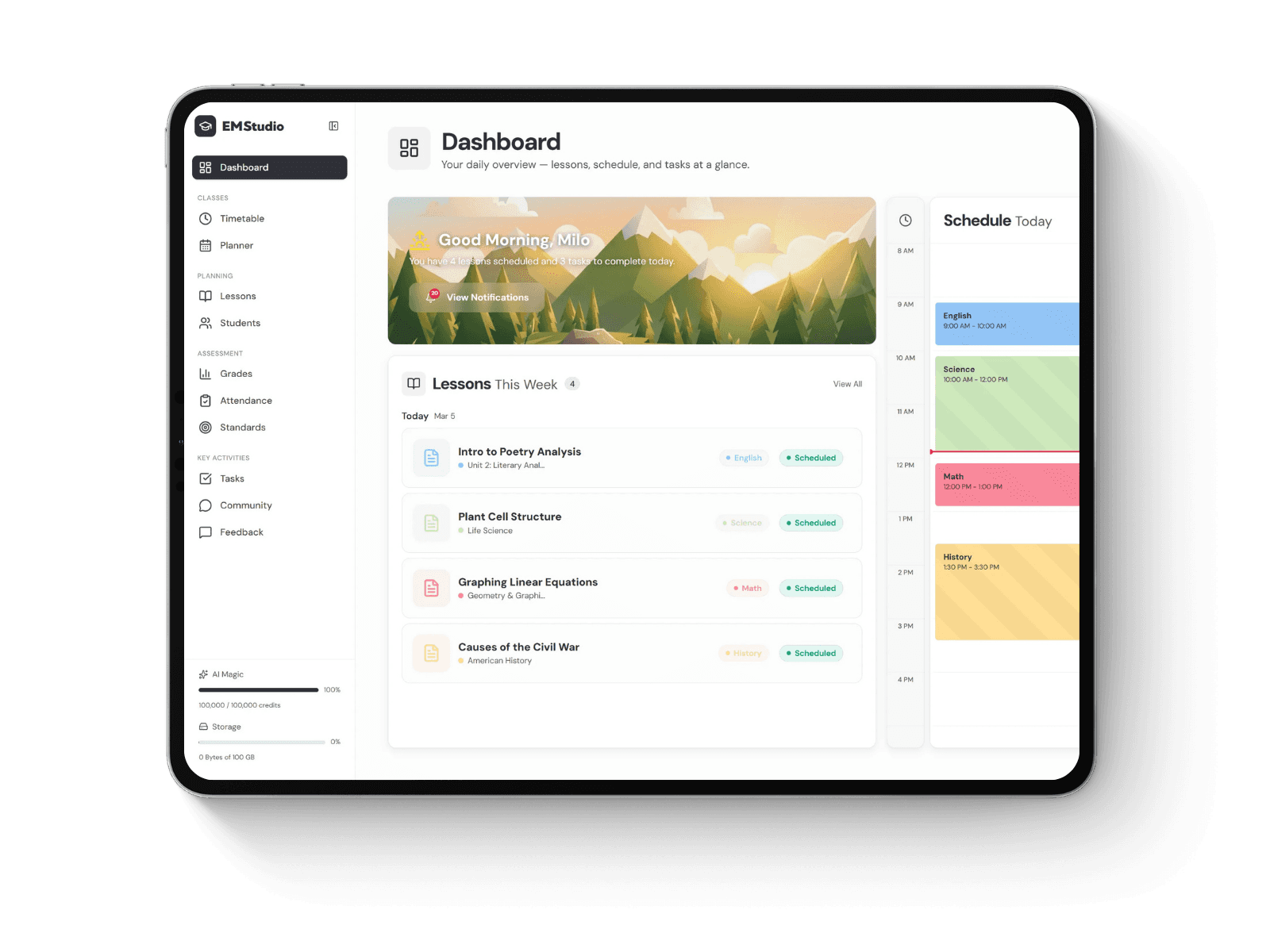
EMStudio is a free teaching management app — manage your classes, students, lessons, and more!
Learn More
Still grading everything by hand?
EMStudio is a free teaching management app — manage your classes, students, lessons, and more!
Learn More
Table of Contents
Setting the Foundation for Effective One to One Tutoring
One to one tutoring fails when tutors skip the setup. I've watched 30-minute sessions lose 12 minutes to bathroom breaks and shutdowns. That's 40% of your instructional time gone. Steps 1 through 5 won't work without these foundational strategies to improve student learning.
Essential Pre-Session Assessments
You can't build individualized instruction on guesswork. Run the QRI-5 to pinpoint independent, instructional, and frustration levels. Calculate accuracy and fluency. This reveals exactly where instructional scaffolding must begin.
For math, apply Newman's 5-step error analysis to three recent assignments. Categorize mistakes as reading failures, comprehension gaps, transformation errors, process breakdowns, or encoding slips.
Pair this with NWEA MAP Growth percentiles to find the true baseline, not just the grade-level placement on paper.
In session one, run a 5-minute cognitive sorter. Test phonological awareness with rapid naming. Check processing speed with a 2-minute coding task.
Run reverse digit span for working memory. Expect four digits for eight-year-olds, five for ten-year-olds. These prevent mismatching tasks to cognitive load.
Establishing Rapport and Trust Protocols
Academic intervention stalls when the relationship cracks. Use the 2x10 Strategy: two minutes of non-academic conversation for ten consecutive sessions. Ask about Fortnite builds or soccer practice. Track it on a checklist so you don't skip day six when you're rushed.
For grades five and up, have students complete the VIA Character Strengths Survey. Reference their top strength before tough tasks. Administer Bandura's 8-item Academic Self-Efficacy Scale in session one. If they score below five out of ten, delay content for two sessions.
Co-write ground rules. Include "the right to pass" on one question per session and a non-verbal reset signal—a thumbs-down or code word like "pineapple"—for when frustration hits. This creates metacognition safety nets.
Structuring Your Physical or Digital Environment
Your environment determines attention span. For digital setups, require a second monitor so you can screen-share without losing video contact. Use Krisp.ai or $40 noise-canceling headphones to kill household noise. Add 5000K LED lighting to reduce eye strain.
Physical setups demand a semicircular desk or 90-degree seating. Never sit across like an interrogation. Keep base-10 blocks, highlighters, and sticky notes within an 18-inch reach. Use a visible Time Timer 8-inch for spaced repetition drills.
Create a distraction inventory together. List the top three environmental triggers—noise, temperature, seating—and have the student rate comfort 1-10 at session start. Adjust if it's below seven. Consider organizing your tutoring sessions with digital tools to track these factors.

Step 1 — Diagnose Specific Learning Gaps and Cognitive Patterns
Teaching blind wastes your time and theirs. Hattie's Visible Learning data shows tutoring without diagnostic alignment drops effect sizes by 0.3 compared to targeted intervention. Before your first one to one tutoring session, you need to know exactly where the breakdown happens—not just the grade level.
Use Error Pattern Analysis. Collect 5-10 recent work samples. Sort every missed item into three buckets: procedural (calculation slip), conceptual (misunderstanding regrouping), or careless (rushing). If procedural errors cluster on long division but conceptual errors dominate fractions, you know where to start. This formative assessment takes 20 minutes and saves weeks of reteaching.
Skip cognitive processing assessment and you risk mismatching strategies to improve learning. I once used graphic organizers for a student with weak visual-spatial processing. He crashed. We switched to auditory rehearsal and instructional scaffolding through verbal chains. He soared. identifying specific learning disabilities and cognitive barriers prevents these collisions.
Academic Diagnostic Tools Beyond Grade-Level Tests
Grade-level tests hide the fracture points. Pinpoint them with these tools:
Fountas & Pinnell Running Records map cueing systems: graphophonic (sound-symbol), syntactic (grammar), and semantic (meaning). Calculate the self-correction ratio. If the student ignores semantic cues, comprehension crumbles even with perfect phonics.
AIMSweb probes in math reveal the frustration level—the grade band where accuracy drops below 75%. That's your starting line for academic intervention.
Curriculum-based measurement (CBM) for writing: 3-minute story, count total words, words spelled correctly, and correct writing sequences. This separates mechanical barriers from generative ones.
Identifying Cognitive Processing Strengths
Working memory determines your pacing. Test reverse digit span: average is 4 digits for 7-year-olds, 6 for 12-year-olds. If the student hits 2, chunk everything. One direction at a time. External memory aids become non-negotiable metacognition tools.
Processing speed matters too. Run a 2-minute symbol-copying task simulating WISC Coding. If they fall below the 25th percentile, allow 25% extra time and cut output volume. Quality over quantity. Test the phonological loop with rapid automatized naming (RAN) of colors. Slow naming (>3 seconds per item) means you should prioritize multisensory strategies and individualized instruction over phonics drill.
Uncovering Motivation and Mindset Barriers
Give the Growth Mindset Scale and Attribution Style Questionnaire. If the student says "I'm just bad at math," start with Schwartz's Brainology curriculum—neuroplasticity lessons that show brains change. Conduct an interest inventory: "Ten books on one topic—what is it?" Use that context for word problems. Situational interest fuels spaced repetition drills.
Identify math anxiety using the Mathematics Anxiety Rating Scale (MARS) short form. Scores above 30/50 mean the brain's threat response is blocking working memory. Teach box breathing or 5-4-3-2-1 grounding before cognitive work. You cannot differentiate instructional scaffolding if the student is panicking.

Step 2 — Co-Create Targeted, Measurable Learning Objectives
The SMART Goal Framework for Individual Learners
Add a Generalization Criterion to every goal: the student must demonstrate the skill independently on a classroom quiz within two weeks, not just during your sessions. Otherwise, you are building a dependency, not a transfer. That is how one to one tutoring actually moves the needle.
Traditional Classroom IEP Goal | Tutoring-Optimized SMART Goal |
|---|---|
Broad, annual, activity-based | Specific, mastery-based with fluency component |
"Improve reading comprehension" | "Read 90 WCPM with 85% accuracy on grade-level probes, verified by classroom quiz" |
Define mastery as three consecutive sessions at 85% accuracy plus a transfer task. Set fluency benchmarks: 90 words correct per minute for fourth-grade reading, 40 correct digits per minute for math facts. Speed matters as much as accuracy.
Use this format: "Student will [skill] with [materials] achieving [criteria] measured by [assessment type] by [date], verified by [classroom teacher/generalization probe]." Have students track their own progress on a visible graph—standard celeration chart or simple bar graph taped to the desk. Watching the line climb builds metacognition and ownership better than any sticker chart.
Aligning Tutoring Goals with Classroom Curriculum
Stop guessing what matters. Email the classroom teacher for the scope and sequence using a simple request template. Identify the power standards—the 20% of content that delivers 80% of the academic impact. Focus your individualized instruction there. Time is scarce in academic intervention; spend it on high-leverage targets.
Map backwards from classroom summative dates. Schedule your tutoring objectives to hit mastery 10 to 14 days before the class test. This creates space for spaced repetition and cements retention.
Build a Curriculum Crosswalk chart. List these alignments:
Tutoring objective (e.g., "solve linear equations")
Textbook chapter and page numbers
Khan Academy module or similar resource
State standard code
When you are managing individual learning plans, this document prevents you from teaching island skills that never connect to the classroom. Use formative assessment data from the teacher to verify the student can generalize.
Building Student Agency Through Collaborative Planning
Goals created without student input fail half the time. Research shows 50% lower commitment when you write the target alone. Use the Goal-Setting Conference protocol.
Run this 10-minute meeting:
Student lists two strengths.
Student identifies one challenge.
Student proposes two possible goals.
You provide curriculum constraint guidance.
Mutual selection and signing of the learning contract.
This is instructional scaffolding for executive function. The contract lives in their folder, not yours.
Apply Choice Architecture. Offer Goal A or Goal B, not an open-ended question. Decision paralysis kills momentum. Then hold weekly 5-minute Goal Check-ins. Student rates effort 1-10. You give specific feedback on strategy use. If effort is above 8 but progress is below 50%, the goal is too hard. Adjust immediately. This develops the 5 learning strategies for students they need to self-regulate and transfer skills beyond the tutoring table.

Step 3 — Deploy Evidence-Based Strategies to Improve Student Learning
You can have the perfect objective, but without the right moves, your one to one tutoring stalls. John Hattie's research gives us guardrails: Feedback (0.72), Metacognitive Strategies (0.69), and Direct Instruction (0.59) all sit in the "zone of desired effects." But watch the trap. Instructional scaffolding fails when you over-do it. Feeding answers, hovering, hinting too fast creates learned helplessness. The kid freezes when you're not there. Stay in the productive struggle zone: aim for 80% success. Drop below that, you intervene with a question. Above it, you're not challenging enough. These four techniques keep you in that sweet spot.
Scaffolded Questioning and Socratic Dialogue
Stop asking "Does that make sense?" You know they'll nod. This formative assessment technique reveals thinking, not nods. Run one problem through Bloom's ladder. Remember: "Define numerator." Apply: "Use it in a sentence." Evaluate: "Which method works faster?"
My student Maria stared blankly until I counted to four. Then she explained the ratio herself. Wait Time 1 means three to five seconds of dead silence after your question. Wait Time 2 means three seconds after they stop talking.
Use this Socratic methods of teaching script for math: "How did you get that?" Pause. "What would happen if we changed this number?" Pause. "Can you prove that works for all cases?" Never accept yes or no. Force the reasoning.
Metacognitive Strategy Instruction
Hattie puts metacognitive strategies at 0.69. These are high-impact ways to improve student learning. But students don't monitor thinking naturally. Install the software.
Teach the Stop and Think protocol. Laminate a card with three questions: What is being asked? What strategy fits? Did that work? Make them touch each box before writing. That's metacognition. My 4th graders now tap the card without me asking.
Model your brain. For five minutes, narrate expert cognition: "I see 'except,' so this is compare-contrast." Hand them the checklist. Reading: Who? What? Where? Why? So what? Math: Known? Unknown? Operation? This individualized instruction builds self-regulated learners.
Multisensory Encoding Techniques
Don't stare at worksheets. Multisensory encoding burns memories into multiple pathways. Grab a shallow tray and blue sand for Orton-Gillingham spelling. Write the word, trace it, tap syllables on the non-writing arm, then sky-write it large.
For math, run the Concrete-Representational-Abstract sequence. Algebra tiles first—actual plastic pieces. Then drawings. Then symbols. Spend forty percent of time in concrete for new concepts. One 7th grader grasped negative integers by removing zero pairs from the desk.
Add color-coding for executive function. Green marks "go" or start. Yellow means "slow down." Red signals "stop and check." Apply it to word problems and directions.
Spaced Retrieval and Interleaving Practice
Cramming fails. Spaced repetition builds long-term memory. Review new material at one day, three days, seven days, and twenty-one days. Use Anki, Quizlet, or physical Leitner boxes with five compartments. This is implementing spaced repetition strategies that actually stick.
Interleave your practice. Don't block one topic. Mix three related skills—addition, subtraction, multiplication word problems—in a 3-2-1 ratio. Three of type A, two of B, one of type C, then repeat. My students retained 50% more when I mixed geometry with algebra instead of blocking them.
Research by Cepeda et al. shows distributed practice improves retention by fifty to one hundred percent compared to massed cramming. This academic intervention prevents the forgetting curve from winning.

Step 4 — How Do You Monitor Progress Without Disrupting Flow?
Use embedded formative checks like hinge questions every 8-10 minutes, visual thumbs-up/down signals, and mini-whiteboard responses that take under 30 seconds. Track errors silently with a tally chart while the student works, and review digital portfolios asynchronously. Adjust difficulty only between activities, never during deep concentration, to maintain cognitive flow while capturing real-time data.
In one to one tutoring, data collection should feel like breathing: unnoticed, constant, invisible. The moment a student feels tested, the flow breaks. Your checks must live inside the activity itself.
Real-Time Formative Assessment Techniques
Deploy Hinge Questions at minute 8 and minute 25 of a 45-minute block. Write multiple-choice items with distractors targeting specific misconceptions you saw last week. Students flash ABCD cards or hold up fingers (1=A, 2=B) for a visual sweep. You see every answer in 3 seconds without breaking rhythm.
For math, use mini-whiteboards with the "3-2-1-Show" protocol. Students solve while you count down. On "Show," everyone holds boards up simultaneously. Scan all work in 5 seconds. Note errors by student ID on a running record sheet. No verbal feedback yet. Just watch.
Try these real-time formative assessment examples for hinge question templates. Track silently using an Error Tally: mark a plus for correct, minus for error on a clipboard checklist. Review the pattern after 5 items to spot misconceptions early.
Learning Portfolio Documentation Methods
Set up digital portfolios using Seesaw for K-5 or Google Sites for 6-12. Require weekly uploads: one photo of work plus a 30-second voice reflection. Prompt students with "I struggled with... I used the strategy..." This captures metacognition without interrupting flow.
Create physical "Proud Folders" for tactile learners. Each week, the student selects their best example, writes a dated sticky note explaining why it shows growth, and files it. You review these monthly to spot trends in self-perception versus actual progress.
Use Exit Tickets in the final 3 minutes. One thing learned, one question still confusing, one strategy used today. For math, use Google Forms with auto-grading. For open response, try Padlet. Review asynchronously after the session ends.
Micro-Adjustment Protocols During Sessions
Follow the 20% Rule. If error rate exceeds 20%, immediately reteach the prerequisite skill using "I Do, We Do" for 10 minutes. If error rate falls between 5-20%, offer guided practice with hints but continue. If below 5%, accelerate to the next level. Never adjust difficulty during deep concentration—only between activities.
Use Micro-Acceleration for the sub-5% scenario. When a student completes 5 items with 100% accuracy and high fluency—under 30 seconds per problem—skip the remaining 10 practice items. Introduce the next complexity level immediately. Individualized instruction means moving faster when the data needs it, not just slower.
Document every pivot on a session log. Note the time, the trigger (error rate tier), the strategy change (visual to kinesthetic), and the student response. Review these logs weekly. Patterns emerge that help you predict when helping students learn requires academic intervention before they fail.

Step 5 — Iterate Instruction Based on Data and Student Response
Iteration separates mediocre check-ins from transformational one to one tutoring. Rosenshine's Principle of 'Review and Check for Understanding' isn't a suggestion—it's the engine. You aren't collecting data to file reports. You're hunting for exactly where thinking broke down so your strategies to improve student learning hit the mark every time.
Treat error analysis like detective work. In math, use Newman's 5 levels to pinpoint whether the breakdown happened during reading, comprehension, transformation, process, or encoding. For reading, run a Running Record miscue analysis—did the student substitute "house" for "home" because the meaning held, or did they ignore syntax entirely? These tools reveal whether you're fixing a concept or just a careless slip.
Watch for the Tutoring Trap. Drilling mastered skills to "build confidence" bores kids and tanks your effect size. When accuracy hits 90% and explanations flow automatically, you exit. Immediately. Anything less wastes your half-hour.
Analyzing Error Patterns for Conceptual Misunderstandings
Systematic errors repeat. Random errors scatter. When a 4th grader "carries" the 1 to the wrong column three times in ten minutes, that's not carelessness. That's a place value gap. Map every systematic error to its conceptual foundation.
Run an Error Analysis Interview. Ask the student to walk you through three consecutive wrong answers. Don't correct them. Just listen and take notes. Code their explanation using Clement's algebra misconceptions taxonomy or a reading-specific framework. You might hear that the equals sign means "the answer is coming" rather than "both sides balance." That's a fixable target, not a mystery.
Maintain a Misconception Target List. Common math traps include "multiplication always makes bigger" or "you can't subtract a larger number from a smaller one." Match observed errors to these known categories. Your analyzing student assessment data becomes surgical when you know exactly which foundation is cracked.
Pivoting Strategies When Progress Stalls
Apply the 3-Strike Rule. If a student misses three similar problems despite your instructional scaffolding, stop. Continuing breeds frustration and learned helplessness. Switch modalities immediately—move from visual diagrams to auditory explanation or kinesthetic manipulation. Alternatively, break the task into micro-steps using task analysis.
Deploy the Concrete-Rescue Protocol. When abstract symbols fail, drop to base-10 blocks, fraction strips, or algebra tiles for fifteen minutes. Let the student touch the math. Then fade to drawings before returning to symbols. This progression rebuilds understanding from the ground up without embarrassment.
Keep a Strategy Switch Log. Record:
Date and specific concept.
Failed strategy and replacement approach.
Outcome and student response.
Share this with the classroom teacher. It prevents parallel failure in whole-group instruction and documents your academic intervention adjustments for administrators who want to see responsive teaching.
Accelerating Challenge When Mastery Emerges
Recognize mastery signals. Look for 90% accuracy plus automaticity plus the Protégé Effect—can the student teach the skill to you or a peer? When you see all three, accelerate. Yesterday. Staying put kills motivation faster than difficulty does.
Implement Curriculum Compacting. Pre-test upcoming unit content. Skip fifty to one hundred percent of instruction on mastered objectives. Replace that time with enrichment—complex problem-solving or real-world applications. This keeps formative assessment driving your individualized instruction forward, not sideways into repetition.
Use Telescoping for rapid growth. Cover two grade levels in one year by eliminating redundant practice. Focus only on new concepts and spaced repetition review cycles. Monitor stress indicators weekly. Metacognition and challenge should rise together, but anxiety signals you to pump the brakes before you burn out your learner.

Sustaining Success: Building Independence Through One to One Tutoring
The endgame of one to one tutoring is simple: you want to fire yourself. Academic intervention works best when it’s temporary. When a student no longer needs you, they’ve won. This happens through skill internalization and self-regulated learning—not dependency.
Fisher and Frey’s Gradual Release of Responsibility gives you the roadmap. Move from “I Do” (you model everything) to “We Do” (shared work) to “You Do Together” (peer collaboration) to “You Do Alone” (full independence) across 6-8 weeks. It is not a race. Rush the fade and you build a facade of competence that crumbles during tests.
Before you fade entirely, check three boxes: 90% accuracy on independent probes, completion of self-monitoring checklists without your prompts, and confirmation from the classroom teacher that skills generalize to daily work. This is your exit ticket.
Fading Scaffolds to Promote Autonomy
You are managing instructional scaffolding, not giving answers. Map your Prompt Hierarchy fade carefully. Reduce one level every 2-3 successful sessions:
Physical prompt: Hand-over-hand guidance when concepts are brand new.
Gestural prompt: Pointing to the work area without touching.
Verbal prompt: Reminding of the strategy or next step.
Visual prompt: Anchor charts or written cues only.
Independent: Student works with no external support.
If they stumble at any level, stay put for another week. Never drop two levels at once.
Use Delayed Support to build tolerance. When they raise a hand or say “I don’t know,” count to ten before responding. Stretch that to thirty seconds over time. Watch them attempt something before you swoop in. Frustration breeds initiation. You are teaching them to sit with the problem.
In the final ten minutes of each session, try Shadow Scaffolding. Move your chair behind the student. Stay silent unless thirty seconds of visible struggle pass or they explicitly ask. You become a safety net, not a crutch. I’ve seen kids solve entire problems they “couldn’t do” simply because I moved three feet away.
Transferring Skills to Independent Learning Contexts
This is the art of helping students learn to operate without you. Teach Self-Advocacy Scripts explicitly. Practice saying, “I need help with regrouping,” not “I don’t get it.” Have the student play teacher while you act confused. They learn to name the strategy they used. This connects to self-regulated strategy development. Specific language unlocks specific help.
Run Generalization Probes weekly. Bring problems in a different font, from a different curriculum, or with new vocabulary. If they can hit 80% on the first try in this alien format, the skill has transferred. If not, you’re still teaching to the worksheet. Last year, my 4th grader could divide using our tutoring manipulatives but froze on the district assessment. The font change broke him. We practiced with novel formats until he stabilized.
Create a Homework Independence Checklist: materials ready, strategy named, timer set, self-check complete. The student rates their independence 1-4. You validate, not grade. Metacognition starts with honest self-assessment. When they circle “4” and you saw them ask a peer, you have data. When they circle “2” and nailed it, you have confidence issues to address. The checklist stays in their folder as a reminder that they own the learning now.
Scheduling Review Cycles for Long-Term Retention
Spiral Review prevents decay using spaced repetition. Schedule five-problem mini-assessments: weekly for last week’s content, monthly for last month’s, quarterly for the semester’s big ideas. Space matters more than mass. Cramming creates illusions of mastery that fade fast.
Use Distributed Practice Calendars. The student marks green for new learning, yellow for review days, red for assessments. They own the schedule. You check bi-weekly to ensure they’re not cramming. A 7th grader I worked with color-coded his entire semester. He started planning his own review before tests without my prompting. That’s the goal.
Define your Exit Protocol clearly. When the classroom teacher confirms three consecutive weeks of independent success and the student hits 90% accuracy without your scaffolding, shift to Booster Sessions. Meet monthly, not weekly. You’re on standby, not on duty. The student knows you’re there, but they’re flying solo. These check-ins serve as formative assessment touchpoints. If scores drop, you resume weekly support immediately. If they hold steady for two months, you graduate them entirely. Send a letter. Make it official. They should leave tutoring with a certificate, not a sigh of relief.

Should You Try One To One Tutoring?
Yes—if you're tired of watching capable kids fall through the cracks because your whole-group lesson moved too fast. One to one tutoring isn't magic. It's one student, one teacher, and a clear plan built from the five steps above. You diagnose the gap, build the ladder with instructional scaffolding, and let them climb. I've seen 4th graders who couldn't decode multisyllabic words in September reading fluently by December. That happens when individualized instruction matches the specific wiring of a kid's brain.
It takes twenty minutes and real energy. You can't phone it in. But the return beats another worksheet packet every time. Start with one student this week. Pick the kid who raises their hand but gets the answer wrong. Run through the steps. Watch them develop metacognition as they finally understand their own thinking. That's the goal of any solid academic intervention: not just better grades, but a kid who knows how they learn.
Which student in your room right now is waiting for you to sit down beside them?

Setting the Foundation for Effective One to One Tutoring
One to one tutoring fails when tutors skip the setup. I've watched 30-minute sessions lose 12 minutes to bathroom breaks and shutdowns. That's 40% of your instructional time gone. Steps 1 through 5 won't work without these foundational strategies to improve student learning.
Essential Pre-Session Assessments
You can't build individualized instruction on guesswork. Run the QRI-5 to pinpoint independent, instructional, and frustration levels. Calculate accuracy and fluency. This reveals exactly where instructional scaffolding must begin.
For math, apply Newman's 5-step error analysis to three recent assignments. Categorize mistakes as reading failures, comprehension gaps, transformation errors, process breakdowns, or encoding slips.
Pair this with NWEA MAP Growth percentiles to find the true baseline, not just the grade-level placement on paper.
In session one, run a 5-minute cognitive sorter. Test phonological awareness with rapid naming. Check processing speed with a 2-minute coding task.
Run reverse digit span for working memory. Expect four digits for eight-year-olds, five for ten-year-olds. These prevent mismatching tasks to cognitive load.
Establishing Rapport and Trust Protocols
Academic intervention stalls when the relationship cracks. Use the 2x10 Strategy: two minutes of non-academic conversation for ten consecutive sessions. Ask about Fortnite builds or soccer practice. Track it on a checklist so you don't skip day six when you're rushed.
For grades five and up, have students complete the VIA Character Strengths Survey. Reference their top strength before tough tasks. Administer Bandura's 8-item Academic Self-Efficacy Scale in session one. If they score below five out of ten, delay content for two sessions.
Co-write ground rules. Include "the right to pass" on one question per session and a non-verbal reset signal—a thumbs-down or code word like "pineapple"—for when frustration hits. This creates metacognition safety nets.
Structuring Your Physical or Digital Environment
Your environment determines attention span. For digital setups, require a second monitor so you can screen-share without losing video contact. Use Krisp.ai or $40 noise-canceling headphones to kill household noise. Add 5000K LED lighting to reduce eye strain.
Physical setups demand a semicircular desk or 90-degree seating. Never sit across like an interrogation. Keep base-10 blocks, highlighters, and sticky notes within an 18-inch reach. Use a visible Time Timer 8-inch for spaced repetition drills.
Create a distraction inventory together. List the top three environmental triggers—noise, temperature, seating—and have the student rate comfort 1-10 at session start. Adjust if it's below seven. Consider organizing your tutoring sessions with digital tools to track these factors.
Step 1 — Diagnose Specific Learning Gaps and Cognitive Patterns
Teaching blind wastes your time and theirs. Hattie's Visible Learning data shows tutoring without diagnostic alignment drops effect sizes by 0.3 compared to targeted intervention. Before your first one to one tutoring session, you need to know exactly where the breakdown happens—not just the grade level.
Use Error Pattern Analysis. Collect 5-10 recent work samples. Sort every missed item into three buckets: procedural (calculation slip), conceptual (misunderstanding regrouping), or careless (rushing). If procedural errors cluster on long division but conceptual errors dominate fractions, you know where to start. This formative assessment takes 20 minutes and saves weeks of reteaching.
Skip cognitive processing assessment and you risk mismatching strategies to improve learning. I once used graphic organizers for a student with weak visual-spatial processing. He crashed. We switched to auditory rehearsal and instructional scaffolding through verbal chains. He soared. identifying specific learning disabilities and cognitive barriers prevents these collisions.
Academic Diagnostic Tools Beyond Grade-Level Tests
Grade-level tests hide the fracture points. Pinpoint them with these tools:
Fountas & Pinnell Running Records map cueing systems: graphophonic (sound-symbol), syntactic (grammar), and semantic (meaning). Calculate the self-correction ratio. If the student ignores semantic cues, comprehension crumbles even with perfect phonics.
AIMSweb probes in math reveal the frustration level—the grade band where accuracy drops below 75%. That's your starting line for academic intervention.
Curriculum-based measurement (CBM) for writing: 3-minute story, count total words, words spelled correctly, and correct writing sequences. This separates mechanical barriers from generative ones.
Identifying Cognitive Processing Strengths
Working memory determines your pacing. Test reverse digit span: average is 4 digits for 7-year-olds, 6 for 12-year-olds. If the student hits 2, chunk everything. One direction at a time. External memory aids become non-negotiable metacognition tools.
Processing speed matters too. Run a 2-minute symbol-copying task simulating WISC Coding. If they fall below the 25th percentile, allow 25% extra time and cut output volume. Quality over quantity. Test the phonological loop with rapid automatized naming (RAN) of colors. Slow naming (>3 seconds per item) means you should prioritize multisensory strategies and individualized instruction over phonics drill.
Uncovering Motivation and Mindset Barriers
Give the Growth Mindset Scale and Attribution Style Questionnaire. If the student says "I'm just bad at math," start with Schwartz's Brainology curriculum—neuroplasticity lessons that show brains change. Conduct an interest inventory: "Ten books on one topic—what is it?" Use that context for word problems. Situational interest fuels spaced repetition drills.
Identify math anxiety using the Mathematics Anxiety Rating Scale (MARS) short form. Scores above 30/50 mean the brain's threat response is blocking working memory. Teach box breathing or 5-4-3-2-1 grounding before cognitive work. You cannot differentiate instructional scaffolding if the student is panicking.
Step 2 — Co-Create Targeted, Measurable Learning Objectives
The SMART Goal Framework for Individual Learners
Add a Generalization Criterion to every goal: the student must demonstrate the skill independently on a classroom quiz within two weeks, not just during your sessions. Otherwise, you are building a dependency, not a transfer. That is how one to one tutoring actually moves the needle.
Traditional Classroom IEP Goal | Tutoring-Optimized SMART Goal |
|---|---|
Broad, annual, activity-based | Specific, mastery-based with fluency component |
"Improve reading comprehension" | "Read 90 WCPM with 85% accuracy on grade-level probes, verified by classroom quiz" |
Define mastery as three consecutive sessions at 85% accuracy plus a transfer task. Set fluency benchmarks: 90 words correct per minute for fourth-grade reading, 40 correct digits per minute for math facts. Speed matters as much as accuracy.
Use this format: "Student will [skill] with [materials] achieving [criteria] measured by [assessment type] by [date], verified by [classroom teacher/generalization probe]." Have students track their own progress on a visible graph—standard celeration chart or simple bar graph taped to the desk. Watching the line climb builds metacognition and ownership better than any sticker chart.
Aligning Tutoring Goals with Classroom Curriculum
Stop guessing what matters. Email the classroom teacher for the scope and sequence using a simple request template. Identify the power standards—the 20% of content that delivers 80% of the academic impact. Focus your individualized instruction there. Time is scarce in academic intervention; spend it on high-leverage targets.
Map backwards from classroom summative dates. Schedule your tutoring objectives to hit mastery 10 to 14 days before the class test. This creates space for spaced repetition and cements retention.
Build a Curriculum Crosswalk chart. List these alignments:
Tutoring objective (e.g., "solve linear equations")
Textbook chapter and page numbers
Khan Academy module or similar resource
State standard code
When you are managing individual learning plans, this document prevents you from teaching island skills that never connect to the classroom. Use formative assessment data from the teacher to verify the student can generalize.
Building Student Agency Through Collaborative Planning
Goals created without student input fail half the time. Research shows 50% lower commitment when you write the target alone. Use the Goal-Setting Conference protocol.
Run this 10-minute meeting:
Student lists two strengths.
Student identifies one challenge.
Student proposes two possible goals.
You provide curriculum constraint guidance.
Mutual selection and signing of the learning contract.
This is instructional scaffolding for executive function. The contract lives in their folder, not yours.
Apply Choice Architecture. Offer Goal A or Goal B, not an open-ended question. Decision paralysis kills momentum. Then hold weekly 5-minute Goal Check-ins. Student rates effort 1-10. You give specific feedback on strategy use. If effort is above 8 but progress is below 50%, the goal is too hard. Adjust immediately. This develops the 5 learning strategies for students they need to self-regulate and transfer skills beyond the tutoring table.
Step 3 — Deploy Evidence-Based Strategies to Improve Student Learning
You can have the perfect objective, but without the right moves, your one to one tutoring stalls. John Hattie's research gives us guardrails: Feedback (0.72), Metacognitive Strategies (0.69), and Direct Instruction (0.59) all sit in the "zone of desired effects." But watch the trap. Instructional scaffolding fails when you over-do it. Feeding answers, hovering, hinting too fast creates learned helplessness. The kid freezes when you're not there. Stay in the productive struggle zone: aim for 80% success. Drop below that, you intervene with a question. Above it, you're not challenging enough. These four techniques keep you in that sweet spot.
Scaffolded Questioning and Socratic Dialogue
Stop asking "Does that make sense?" You know they'll nod. This formative assessment technique reveals thinking, not nods. Run one problem through Bloom's ladder. Remember: "Define numerator." Apply: "Use it in a sentence." Evaluate: "Which method works faster?"
My student Maria stared blankly until I counted to four. Then she explained the ratio herself. Wait Time 1 means three to five seconds of dead silence after your question. Wait Time 2 means three seconds after they stop talking.
Use this Socratic methods of teaching script for math: "How did you get that?" Pause. "What would happen if we changed this number?" Pause. "Can you prove that works for all cases?" Never accept yes or no. Force the reasoning.
Metacognitive Strategy Instruction
Hattie puts metacognitive strategies at 0.69. These are high-impact ways to improve student learning. But students don't monitor thinking naturally. Install the software.
Teach the Stop and Think protocol. Laminate a card with three questions: What is being asked? What strategy fits? Did that work? Make them touch each box before writing. That's metacognition. My 4th graders now tap the card without me asking.
Model your brain. For five minutes, narrate expert cognition: "I see 'except,' so this is compare-contrast." Hand them the checklist. Reading: Who? What? Where? Why? So what? Math: Known? Unknown? Operation? This individualized instruction builds self-regulated learners.
Multisensory Encoding Techniques
Don't stare at worksheets. Multisensory encoding burns memories into multiple pathways. Grab a shallow tray and blue sand for Orton-Gillingham spelling. Write the word, trace it, tap syllables on the non-writing arm, then sky-write it large.
For math, run the Concrete-Representational-Abstract sequence. Algebra tiles first—actual plastic pieces. Then drawings. Then symbols. Spend forty percent of time in concrete for new concepts. One 7th grader grasped negative integers by removing zero pairs from the desk.
Add color-coding for executive function. Green marks "go" or start. Yellow means "slow down." Red signals "stop and check." Apply it to word problems and directions.
Spaced Retrieval and Interleaving Practice
Cramming fails. Spaced repetition builds long-term memory. Review new material at one day, three days, seven days, and twenty-one days. Use Anki, Quizlet, or physical Leitner boxes with five compartments. This is implementing spaced repetition strategies that actually stick.
Interleave your practice. Don't block one topic. Mix three related skills—addition, subtraction, multiplication word problems—in a 3-2-1 ratio. Three of type A, two of B, one of type C, then repeat. My students retained 50% more when I mixed geometry with algebra instead of blocking them.
Research by Cepeda et al. shows distributed practice improves retention by fifty to one hundred percent compared to massed cramming. This academic intervention prevents the forgetting curve from winning.
Step 4 — How Do You Monitor Progress Without Disrupting Flow?
Use embedded formative checks like hinge questions every 8-10 minutes, visual thumbs-up/down signals, and mini-whiteboard responses that take under 30 seconds. Track errors silently with a tally chart while the student works, and review digital portfolios asynchronously. Adjust difficulty only between activities, never during deep concentration, to maintain cognitive flow while capturing real-time data.
In one to one tutoring, data collection should feel like breathing: unnoticed, constant, invisible. The moment a student feels tested, the flow breaks. Your checks must live inside the activity itself.
Real-Time Formative Assessment Techniques
Deploy Hinge Questions at minute 8 and minute 25 of a 45-minute block. Write multiple-choice items with distractors targeting specific misconceptions you saw last week. Students flash ABCD cards or hold up fingers (1=A, 2=B) for a visual sweep. You see every answer in 3 seconds without breaking rhythm.
For math, use mini-whiteboards with the "3-2-1-Show" protocol. Students solve while you count down. On "Show," everyone holds boards up simultaneously. Scan all work in 5 seconds. Note errors by student ID on a running record sheet. No verbal feedback yet. Just watch.
Try these real-time formative assessment examples for hinge question templates. Track silently using an Error Tally: mark a plus for correct, minus for error on a clipboard checklist. Review the pattern after 5 items to spot misconceptions early.
Learning Portfolio Documentation Methods
Set up digital portfolios using Seesaw for K-5 or Google Sites for 6-12. Require weekly uploads: one photo of work plus a 30-second voice reflection. Prompt students with "I struggled with... I used the strategy..." This captures metacognition without interrupting flow.
Create physical "Proud Folders" for tactile learners. Each week, the student selects their best example, writes a dated sticky note explaining why it shows growth, and files it. You review these monthly to spot trends in self-perception versus actual progress.
Use Exit Tickets in the final 3 minutes. One thing learned, one question still confusing, one strategy used today. For math, use Google Forms with auto-grading. For open response, try Padlet. Review asynchronously after the session ends.
Micro-Adjustment Protocols During Sessions
Follow the 20% Rule. If error rate exceeds 20%, immediately reteach the prerequisite skill using "I Do, We Do" for 10 minutes. If error rate falls between 5-20%, offer guided practice with hints but continue. If below 5%, accelerate to the next level. Never adjust difficulty during deep concentration—only between activities.
Use Micro-Acceleration for the sub-5% scenario. When a student completes 5 items with 100% accuracy and high fluency—under 30 seconds per problem—skip the remaining 10 practice items. Introduce the next complexity level immediately. Individualized instruction means moving faster when the data needs it, not just slower.
Document every pivot on a session log. Note the time, the trigger (error rate tier), the strategy change (visual to kinesthetic), and the student response. Review these logs weekly. Patterns emerge that help you predict when helping students learn requires academic intervention before they fail.
Step 5 — Iterate Instruction Based on Data and Student Response
Iteration separates mediocre check-ins from transformational one to one tutoring. Rosenshine's Principle of 'Review and Check for Understanding' isn't a suggestion—it's the engine. You aren't collecting data to file reports. You're hunting for exactly where thinking broke down so your strategies to improve student learning hit the mark every time.
Treat error analysis like detective work. In math, use Newman's 5 levels to pinpoint whether the breakdown happened during reading, comprehension, transformation, process, or encoding. For reading, run a Running Record miscue analysis—did the student substitute "house" for "home" because the meaning held, or did they ignore syntax entirely? These tools reveal whether you're fixing a concept or just a careless slip.
Watch for the Tutoring Trap. Drilling mastered skills to "build confidence" bores kids and tanks your effect size. When accuracy hits 90% and explanations flow automatically, you exit. Immediately. Anything less wastes your half-hour.
Analyzing Error Patterns for Conceptual Misunderstandings
Systematic errors repeat. Random errors scatter. When a 4th grader "carries" the 1 to the wrong column three times in ten minutes, that's not carelessness. That's a place value gap. Map every systematic error to its conceptual foundation.
Run an Error Analysis Interview. Ask the student to walk you through three consecutive wrong answers. Don't correct them. Just listen and take notes. Code their explanation using Clement's algebra misconceptions taxonomy or a reading-specific framework. You might hear that the equals sign means "the answer is coming" rather than "both sides balance." That's a fixable target, not a mystery.
Maintain a Misconception Target List. Common math traps include "multiplication always makes bigger" or "you can't subtract a larger number from a smaller one." Match observed errors to these known categories. Your analyzing student assessment data becomes surgical when you know exactly which foundation is cracked.
Pivoting Strategies When Progress Stalls
Apply the 3-Strike Rule. If a student misses three similar problems despite your instructional scaffolding, stop. Continuing breeds frustration and learned helplessness. Switch modalities immediately—move from visual diagrams to auditory explanation or kinesthetic manipulation. Alternatively, break the task into micro-steps using task analysis.
Deploy the Concrete-Rescue Protocol. When abstract symbols fail, drop to base-10 blocks, fraction strips, or algebra tiles for fifteen minutes. Let the student touch the math. Then fade to drawings before returning to symbols. This progression rebuilds understanding from the ground up without embarrassment.
Keep a Strategy Switch Log. Record:
Date and specific concept.
Failed strategy and replacement approach.
Outcome and student response.
Share this with the classroom teacher. It prevents parallel failure in whole-group instruction and documents your academic intervention adjustments for administrators who want to see responsive teaching.
Accelerating Challenge When Mastery Emerges
Recognize mastery signals. Look for 90% accuracy plus automaticity plus the Protégé Effect—can the student teach the skill to you or a peer? When you see all three, accelerate. Yesterday. Staying put kills motivation faster than difficulty does.
Implement Curriculum Compacting. Pre-test upcoming unit content. Skip fifty to one hundred percent of instruction on mastered objectives. Replace that time with enrichment—complex problem-solving or real-world applications. This keeps formative assessment driving your individualized instruction forward, not sideways into repetition.
Use Telescoping for rapid growth. Cover two grade levels in one year by eliminating redundant practice. Focus only on new concepts and spaced repetition review cycles. Monitor stress indicators weekly. Metacognition and challenge should rise together, but anxiety signals you to pump the brakes before you burn out your learner.
Sustaining Success: Building Independence Through One to One Tutoring
The endgame of one to one tutoring is simple: you want to fire yourself. Academic intervention works best when it’s temporary. When a student no longer needs you, they’ve won. This happens through skill internalization and self-regulated learning—not dependency.
Fisher and Frey’s Gradual Release of Responsibility gives you the roadmap. Move from “I Do” (you model everything) to “We Do” (shared work) to “You Do Together” (peer collaboration) to “You Do Alone” (full independence) across 6-8 weeks. It is not a race. Rush the fade and you build a facade of competence that crumbles during tests.
Before you fade entirely, check three boxes: 90% accuracy on independent probes, completion of self-monitoring checklists without your prompts, and confirmation from the classroom teacher that skills generalize to daily work. This is your exit ticket.
Fading Scaffolds to Promote Autonomy
You are managing instructional scaffolding, not giving answers. Map your Prompt Hierarchy fade carefully. Reduce one level every 2-3 successful sessions:
Physical prompt: Hand-over-hand guidance when concepts are brand new.
Gestural prompt: Pointing to the work area without touching.
Verbal prompt: Reminding of the strategy or next step.
Visual prompt: Anchor charts or written cues only.
Independent: Student works with no external support.
If they stumble at any level, stay put for another week. Never drop two levels at once.
Use Delayed Support to build tolerance. When they raise a hand or say “I don’t know,” count to ten before responding. Stretch that to thirty seconds over time. Watch them attempt something before you swoop in. Frustration breeds initiation. You are teaching them to sit with the problem.
In the final ten minutes of each session, try Shadow Scaffolding. Move your chair behind the student. Stay silent unless thirty seconds of visible struggle pass or they explicitly ask. You become a safety net, not a crutch. I’ve seen kids solve entire problems they “couldn’t do” simply because I moved three feet away.
Transferring Skills to Independent Learning Contexts
This is the art of helping students learn to operate without you. Teach Self-Advocacy Scripts explicitly. Practice saying, “I need help with regrouping,” not “I don’t get it.” Have the student play teacher while you act confused. They learn to name the strategy they used. This connects to self-regulated strategy development. Specific language unlocks specific help.
Run Generalization Probes weekly. Bring problems in a different font, from a different curriculum, or with new vocabulary. If they can hit 80% on the first try in this alien format, the skill has transferred. If not, you’re still teaching to the worksheet. Last year, my 4th grader could divide using our tutoring manipulatives but froze on the district assessment. The font change broke him. We practiced with novel formats until he stabilized.
Create a Homework Independence Checklist: materials ready, strategy named, timer set, self-check complete. The student rates their independence 1-4. You validate, not grade. Metacognition starts with honest self-assessment. When they circle “4” and you saw them ask a peer, you have data. When they circle “2” and nailed it, you have confidence issues to address. The checklist stays in their folder as a reminder that they own the learning now.
Scheduling Review Cycles for Long-Term Retention
Spiral Review prevents decay using spaced repetition. Schedule five-problem mini-assessments: weekly for last week’s content, monthly for last month’s, quarterly for the semester’s big ideas. Space matters more than mass. Cramming creates illusions of mastery that fade fast.
Use Distributed Practice Calendars. The student marks green for new learning, yellow for review days, red for assessments. They own the schedule. You check bi-weekly to ensure they’re not cramming. A 7th grader I worked with color-coded his entire semester. He started planning his own review before tests without my prompting. That’s the goal.
Define your Exit Protocol clearly. When the classroom teacher confirms three consecutive weeks of independent success and the student hits 90% accuracy without your scaffolding, shift to Booster Sessions. Meet monthly, not weekly. You’re on standby, not on duty. The student knows you’re there, but they’re flying solo. These check-ins serve as formative assessment touchpoints. If scores drop, you resume weekly support immediately. If they hold steady for two months, you graduate them entirely. Send a letter. Make it official. They should leave tutoring with a certificate, not a sigh of relief.
Should You Try One To One Tutoring?
Yes—if you're tired of watching capable kids fall through the cracks because your whole-group lesson moved too fast. One to one tutoring isn't magic. It's one student, one teacher, and a clear plan built from the five steps above. You diagnose the gap, build the ladder with instructional scaffolding, and let them climb. I've seen 4th graders who couldn't decode multisyllabic words in September reading fluently by December. That happens when individualized instruction matches the specific wiring of a kid's brain.
It takes twenty minutes and real energy. You can't phone it in. But the return beats another worksheet packet every time. Start with one student this week. Pick the kid who raises their hand but gets the answer wrong. Run through the steps. Watch them develop metacognition as they finally understand their own thinking. That's the goal of any solid academic intervention: not just better grades, but a kid who knows how they learn.
Which student in your room right now is waiting for you to sit down beside them?
Still grading everything by hand?
EMStudio is a free teaching management app — manage your classes, students, lessons, and more!
Learn More
Still grading everything by hand?
EMStudio is a free teaching management app — manage your classes, students, lessons, and more!
Learn More



Notion4Teachers
Notion templates to simplify administrative tasks and enhance your teaching experience.



2026 Notion4Teachers. All Rights Reserved.
Notion4Teachers
Notion templates to simplify administrative tasks and enhance your teaching experience.
2026 Notion4Teachers. All Rights Reserved.
Notion4Teachers
Notion templates to simplify administrative tasks and enhance your teaching experience.
2026 Notion4Teachers. All Rights Reserved.