
Learning Style Assessment Template for K-12 Educators
Learning Style Assessment Template for K-12 Educators

Article by
Milo
ESL Content Coordinator & Educator
ESL Content Coordinator & Educator
All Posts
I watched a 4th grader trace spelling words in the air with her finger while the rest of the class copied from the board. She wasn't distracted. She was trying to make the words stick through motion. That was the moment I realized I needed a concrete way to capture how my kids actually process information.
A learning style assessment built on the VARK model gives you that data without the fluff. It cuts through the guesswork about who needs to move, who needs to hear instructions twice, and who learns best from diagrams or text. You stop teaching to the middle.
This template maps visual, auditory, reading, and kinesthetic preferences using criteria Neil Fleming would recognize. You’ll get the setup steps, grade-level adjustments, and a clear path from collecting those learner profiles to actually differentiating your next lesson.
Still grading everything by hand?
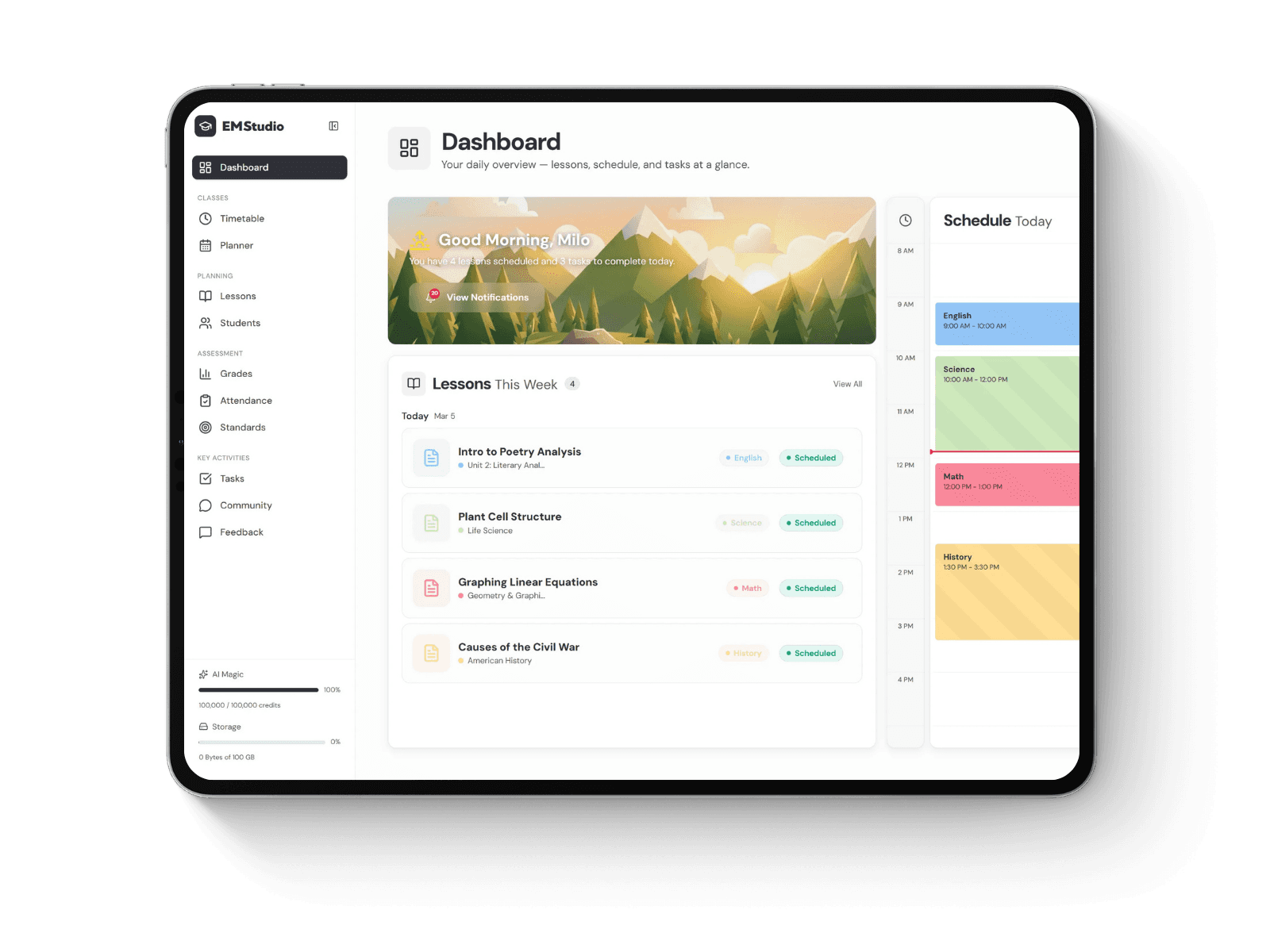
EMStudio is a free teaching management app — manage your classes, students, lessons, and more!
Learn More
Still grading everything by hand?
EMStudio is a free teaching management app — manage your classes, students, lessons, and more!
Learn More
Table of Contents
What This Personal Learning Style Assessment Template Includes
You get a complete 12-page system. It includes printable PDF inventories, editable Google Forms with auto-scoring built in, an Excel dashboard that handles up to 35 students, and ready-to-send parent communication letters. Everything you need to help kids identify my learning style preferences without turning them into caricatures or limiting their potential.
The personal learning style assessment centers on the VARK model developed by Neil Fleming. It recognizes that most learners aren't just "visual" or "just kinesthetic." Real students use multimodal learning strategies every day. This template tracks those mixed modality preference patterns so you can see who needs text-to-speech versus who needs to build a physical model.
I used the paper version with my 3rd graders last September. Eight minutes during morning work. They circled pictures of headphones for auditory or hands for kinesthetic. By lunch, I knew who learned best through movement. I adjusted my math stations that afternoon to include more manipulatives. The picture options meant my emergent readers could participate fully without frustration or help from a neighbor.
Here is exactly what sits in the download folder:
A 20-item VARK inventory with picture-based options for emergent readers. The icons help 2nd graders who can't decode "I prefer diagrams" yet still show you how they process information.
Individual 5x7 learner profile cards formatted for student binders. Laminate them. When a kid gets stuck on fractions, check their card. If they scored high kinesthetic, pull out the fraction tiles before you reteach.
A class summary dashboard showing the visual distribution of preferences across your room. You'll see immediately if your 4th period is 80% visual while your 5th period leans auditory. Plan your anchor charts accordingly.
A bilingual parent guide explaining results in English and Spanish for items 1-10. Send it home before conferences so families understand their child's cognitive flexibility. It explains results without boxing students into rigid categories.
Technical requirements are straightforward. The Google Forms version requires Google Workspace for Education to capture auto-scored responses directly into your Drive. The paper version prints on standard 8.5x11 and takes eight minutes to administer during morning work. The Excel tracker auto-generates pie charts for data visualization without you touching a formula. I keep the spreadsheet open on my laptop during planning. It updates the charts as I enter new data from Friday's assessments. You can export the graphs for RTI meetings or parent emails.
The base template is free under Creative Commons. Download it, modify it, share it with your team. The $12 premium add-on includes Gregorc Style Delineator comparison charts and advanced filtering tools. Those extras help you sort by multiple different categories of learning styles if your admin requires that level of documentation for intervention teams or gifted program referrals. The comparison charts are particularly useful for secondary teachers.
Use these learning style tools to help students know your learning style tendencies. Emphasize that preferences shift based on task difficulty and subject matter. A kid might be kinesthetic for science but reading/writing for social studies. That's normal. That's multimodal learning in action. Avoid rigid labeling. The goal is insight, not limitation. Teach them to ask for what they need based on the task at hand.

Template Structure: Visual, Auditory, Reading, and Kinesthetic Components
Neil Fleming developed the VARK model in 1987 after watching students struggle with mismatched instruction. This framework still drives effective learning style analysis today. You're looking for patterns that reveal how each child processes information best under current conditions.
Visual (spatial) | Auditory (aural) | Reading/Writing | Kinesthetic |
|---|---|---|---|
Definition: These learners think in pictures and spatial arrays. They process diagrams, charts, and visual hierarchies faster than spoken explanations. Give them a blank page and they'll fill it with mind maps. Observable behaviors: They draw diagrams to explain concepts to peers. They prefer seats in front near demonstrations. They stare into space when concentrating—not zoning out, but constructing mental images. Strategies: Deploy visual learning strategies like concept maps and graphic organizers. Color-coded notes let them track themes instantly. Sketch notes work better than outlines. | Definition: Sound patterns anchor their memory. They encode information through listening, speaking, and rhythmic repetition. Silence actually hinders their processing. Observable behaviors: They read aloud when studying alone. They hum or talk to themselves during independent work. They follow oral directions better than written instructions on the board. Strategies: Use auditory learning components like think-pair-share and podcast creation. Let them record summaries on their phones. Verbal processing time is non-negotiable. | Definition: Text is their native language. They prefer reading over watching and writing over speaking. Words on a page carry more weight than words in the air. Observable behaviors: They take extensive notes even when you provide handouts. They choose textbooks over video tutorials. They rewrite information repeatedly to memorize it. Strategies: Assign journal reflections with specific prompts. Design text-based research projects requiring annotated bibliographies. Let them teach through written instructions. | Definition: Movement drives their cognition. They learn by doing, building, and physically manipulating objects. Sitting still actually reduces their comprehension. Observable behaviors: They gesture emphatically while speaking. They fidget during lectures—not from distraction, but from physical need. They excel at lab work and building models. Strategies: Install standing desks for optional use. Use manipulative-based math with physical counters or algebra tiles. Build in movement breaks every fifteen minutes. |
You need to know what your dominant learning style is for each student before you can group them effectively. This template gives you that data.
Convert raw scores to percentages immediately to build a complete learner profile. A student scoring 4 out of 5 in Visual hits 80%. That's clear dominance. But 3 out of 5 only hits 60%, right at the threshold requiring additional confirmation through observation.
Watch the spread. When Auditory hits 45% and Kinesthetic hits 42%, you've identified multimodal learning. These students comprise roughly 60% of K-12 populations.
Last spring, I watched Maria ace a science lab while standing. She gestured through the whole explanation. Then she bombed the written test. Her scores showed Visual at 35%, Kinesthetic at 40%, and Reading/Writing at 15%. No single dominance. She needed hands-on practice combined with visual aids, not silent reading time.
Single-modality learners are rare. When you find one, celebrate the clarity. But prepare for the majority who need multiple entry points.
These multimodal learners demand cognitive flexibility from your lesson design. Don't force them to choose one modality preference. Let them access the VARK assessment framework materials in multiple formats simultaneously. This learning style assessment isn't a label. It's a starting point for flexible grouping.

Step-by-Step Setup Guide to Identify Your Students' Learning Styles
Pick your delivery mode based on what is actually plugged in. If your school runs Google Workspace and every kid has a Chromebook, build the learning style survey inside Google Forms. Set it to auto-grade and push responses into a Sheet. You will save an hour of hand-tallying. Create a separate section for each VARK category so the form logic flows cleanly. If you are working with a single computer cart or zero tech, print the PDF. It works for classes of 30 or more. You will score it manually with a highlighter and a calculator during your prep period.
Customize the inventory language before you hit copy. For kindergarten through 2nd grade, strip out every text-heavy question. Replace them with picture icons. Ask: "Do you like to look at pictures or touch blocks?" Pair the words with images of a book and a Lego tower. They circle the one that looks like fun. For 9th through 12th graders, binary yes-or-no choices insult their intelligence. Convert the learning style assessment to a 5-point Likert scale ranging from "Strongly Disagree" to "Strongly Agree." This captures the nuance in their modality preference and produces cleaner data for your spreadsheet.
Lock the date: Week 1, Day 1. Block 15 minutes including instructions. Pass out the survey and say: "This helps me determine learning style preferences for engagement. It does not measure how smart you are." You must say that last part out loud. I watched a 7th grader shut down last September because he thought picking "kinesthetic" meant he was bad at reading. Protect that kid immediately. Give one example for each category so they know what "visual" actually means in your room.
Process the data fast. Input raw scores into the provided Excel template within 48 hours. The template auto-calculates percentages and generates pie charts showing multimodal learning spreads. You need this visual before you sketch out your first differentiated unit plan. Waiting a week means you fly blind during the lessons that matter most. Target completion by Wednesday evening if you administered on Monday. The formulas are already baked in; you just type the numbers.
Run the debrief using the learningstylequiz reflection protocol. Each student writes one specific action they will take using their dominant preference for an upcoming unit project. The visual learner might propose creating a digital poster instead of a written essay. The auditory learner commits to recording a two-minute voice memo summary. The kinesthetic builder sketches a physical model plan. Lock in that commitment on paper before they leave the room. Tape it to their folder.
Watch for data skews. If more than 40% of your class identifies as Kinesthetic, do not immediately rewrite every lesson. Review your physical classroom space first. Add standing zones near the back. Stock fidget tools. Clear a floor area for pacing. Sometimes the VARK model scores reflect your room's lack of movement opportunities, not a true learner profile skew. Fix the environment, then retest in six weeks if the numbers still look odd.
For older students seeking additional online learning style assessment options for homework, direct them to www how to study learning style assessment and https www how to study com learning style assessment. These external inventories reinforce cognitive flexibility and remind students that Neil Fleming designed this framework as a starting point, not a permanent box.
You might also review our guide on designing self-assessment tools for students to extend this work beyond the initial inventory.
How Do You Customize This Learning Type Assessment for Different Grades?
Customize by format and time. Use picture cards for K-2, simple Likert scales for grades 3-5, reflection journals for middle school, and the Gregorc Style Delineator for high school. Administration ranges from 5-minute interviews to 30-minute self-directed modules depending on cognitive development by grade level.
One size never fits all in education. A learning style assessment that works for AP seniors will overwhelm second graders. Match the tool to the child's ability to self-report, or you'll collect garbage data.
For kindergarteners, turn the learning type assessment into a card game. Lay out eight picture cards showing activities like reading, drawing, listening, and building. Sit with each child for five minutes. Ask "how do you like to learn?" without forcing labels. Watch where their finger lands first. Record their choice on a simple checklist. Don't mention modality preference yet. At this age, you're gathering observation data, not building permanent learner profiles. Keep the interview conversational. If they choose the block tower, ask why. Their explanation reveals more than the choice itself.
Third graders can handle a written learning style survey, but keep it concrete. Twelve items with smiley-face Likert scales work best. Use basic vocabulary: "When you want to remember something, do you write it down or say it aloud?" Set a timer for ten minutes. Any longer and they start guessing. Introduce the VARK model gently. Don't expect them to memorize categories. Just note if they favor books or headphones. I laminate the survey cards so students can circle with dry-erase markers. Reusable tools save paper and feel less permanent to anxious kids.
Sixth graders need cognitive flexibility practice, not boxes. Add metacognitive reflection: "Last time you studied for a test, what did you do first?" Have them track their actual behavior for one week before they determine your learning style preferences. Real data beats wishful thinking. Middle schoolers often claim they're visual learners because it sounds sophisticated. Force the evidence. Ask them to bring in their actual study notes. If the page is blank, they haven't found their modality preference yet.
High schoolers can handle complexity. Offer the Gregorc Style Delineator with its concrete random and abstract sequential categories. Let them complete a learning style self assessment independently. Then require digital portfolios showing evidence—screenshots of notes, recordings of explanations. They identify your learning style through proof, not claims. Mention Neil Fleming's research if they ask for sources. Older students appreciate knowing the VARK model has scientific backing, even if the field debates its validity. The goal is self-awareness, not permanent labeling.
Differentiate for special populations. English Language Learners receive native language support for the first five items. Students with dyslexia may skip the reading/writing column initially. Reducing anxiety matters more than completing every question. A partial learner profile still gives you enough to plan multimodal learning stations. For students with processing delays, break the learning style assessment into three short sessions. Fatigue invalidates the results. You want their fresh preferences, not their frustrated ones. Offer choice boards instead of linear questionnaires for students with attention differences.
Adjust your scoring rubric accordingly. Kindergarteners get sticky notes on a chart. Seniors get spreadsheet analysis. The assessment serves the student, not the other way around.

Implementation Strategies: From Data Collection to Differentiated Instruction
Do not turn your learning style assessment into a tracking system. Research consistently shows that matching instruction strictly to single modalities does not improve achievement compared to solid multisensory teaching. Students have preferences, not processing deficits. Use your data to boost engagement by offering choices, not to limit kids to specific "styles" or label them as incapable of learning through other methods. The VARK model describes preferences, not potential.
I learned this the hard way with a 7th grade class two years ago. I grouped students strictly by their VARK results and kept them there for three weeks. The "kinesthetic" kids grew bored with constant manipulatives, and my "reading" group missed out on rich discussions. Preferences shift based on content difficulty, fatigue, and context. Rigid sorting creates artificial ceilings.
Instead, focus on building cognitive flexibility. Your goal is helping students identify learning style strategies they can deploy when stuck, not boxing them into permanent categories. Think of modality preferences as a toolbox. When a student hits a wall with text, they should reach for a visual organizer or verbal explanation instinctively. That adaptive skill matters more than their dominant modality preference.
Run weekly 20-minute station rotations for review days. Set up four corners: Visual uses mind maps and color-coding; Auditory uses structured discussion protocols like Think-Pair-Share; Reading uses article annotation and Cornell notes; Kinesthetic uses physical manipulatives or gallery walks. Let students choose their preferred station for that day's review, but require them to visit non-dominant stations twice monthly. This builds adaptability while honoring comfort.
Design choice boards for major unit assessments. Let students select presentation formats aligned to their strengths—video for visual learners, podcasts for auditory, traditional essays for reading/writing preferences, live demonstrations for kinesthetic. Just ensure every student cycles through all formats across the semester. Multimodal learning happens when kids practice outside their comfort zones, not just within them. I track this on a simple checklist in my planbook.
Lock down your data. Store assessment of learning styles and strategies results in password-protected files or secure gradebook notes. Never post public charts labeling someone as "the kinesthetic kid" or "the visual learner." Use learner profile data for internal grouping only when implementing differentiated instruction. Privacy protects dignity. If you must display grouping, use numbers or colors, not learning style labels.
Skip the learning style evaluation entirely for some students. Kids with specific learning disabilities in reading need accommodation-based assessment grounded in IEP goals, not preference-based sorting. Students on the autism spectrum often show atypical sensory profiles that standard inventories misinterpret or distress. Always consult your SPED team before administering any learning style self assessment to these populations. The assessment should never override documented accommodation needs.
Track metacognitive growth, not preference shifts. Reassess mid-year and end-of-year using the same rubric. Look for students articulating which strategies they used to study for last week's science test, not whether they switched from Visual to Kinesthetic on the survey. Growth sounds like "I drew a diagram because the reading wasn't sticking"—evidence they're analyzing student assessment data about their own cognition. That's the win.
Review your learning style evaluation data during PLC meetings quarterly. Identify which modalities students avoid and intentionally design "stretch" activities targeting those gaps. Document what works for specific content areas. When using digital tools for differentiation, remember that Neil Fleming's framework offers insight into how students prefer to receive information, but effective teaching requires us to help them process it multiple ways. Flexibility beats fidelity to any single learner profile.
Getting Started with Learning Style Assessment
You now have a tool that cuts through the guesswork. I keep my completed assessments taped to my clipboard for the first six weeks of every year. When a kid zones out during read-alouds but lights up during labs, I check the sheet. It usually confirms what I suspected, but having the data stops me from labeling kids as "unfocused" when they're actually just visual processors working against their strengths.
Remember that these preferences shift over time. A 3rd grader who needed constant movement breaks in October might prefer quiet reading by March. Cognitive flexibility develops as students grow, so run the learning style assessment again mid-year. The goal isn't to box students into rigid categories—it's to give them the vocabulary to describe how they learn best and advocate for themselves.
Print the template this afternoon and fill it out yourself first. You'll spot confusing questions before students do.
Run it with one class tomorrow. Don't wait for the perfect moment.
Pick one lesson next week to differentiate using the data. Start small.
File the results where you'll actually look at them—inside your plan book, not a digital folder you'll forget.

What This Personal Learning Style Assessment Template Includes
You get a complete 12-page system. It includes printable PDF inventories, editable Google Forms with auto-scoring built in, an Excel dashboard that handles up to 35 students, and ready-to-send parent communication letters. Everything you need to help kids identify my learning style preferences without turning them into caricatures or limiting their potential.
The personal learning style assessment centers on the VARK model developed by Neil Fleming. It recognizes that most learners aren't just "visual" or "just kinesthetic." Real students use multimodal learning strategies every day. This template tracks those mixed modality preference patterns so you can see who needs text-to-speech versus who needs to build a physical model.
I used the paper version with my 3rd graders last September. Eight minutes during morning work. They circled pictures of headphones for auditory or hands for kinesthetic. By lunch, I knew who learned best through movement. I adjusted my math stations that afternoon to include more manipulatives. The picture options meant my emergent readers could participate fully without frustration or help from a neighbor.
Here is exactly what sits in the download folder:
A 20-item VARK inventory with picture-based options for emergent readers. The icons help 2nd graders who can't decode "I prefer diagrams" yet still show you how they process information.
Individual 5x7 learner profile cards formatted for student binders. Laminate them. When a kid gets stuck on fractions, check their card. If they scored high kinesthetic, pull out the fraction tiles before you reteach.
A class summary dashboard showing the visual distribution of preferences across your room. You'll see immediately if your 4th period is 80% visual while your 5th period leans auditory. Plan your anchor charts accordingly.
A bilingual parent guide explaining results in English and Spanish for items 1-10. Send it home before conferences so families understand their child's cognitive flexibility. It explains results without boxing students into rigid categories.
Technical requirements are straightforward. The Google Forms version requires Google Workspace for Education to capture auto-scored responses directly into your Drive. The paper version prints on standard 8.5x11 and takes eight minutes to administer during morning work. The Excel tracker auto-generates pie charts for data visualization without you touching a formula. I keep the spreadsheet open on my laptop during planning. It updates the charts as I enter new data from Friday's assessments. You can export the graphs for RTI meetings or parent emails.
The base template is free under Creative Commons. Download it, modify it, share it with your team. The $12 premium add-on includes Gregorc Style Delineator comparison charts and advanced filtering tools. Those extras help you sort by multiple different categories of learning styles if your admin requires that level of documentation for intervention teams or gifted program referrals. The comparison charts are particularly useful for secondary teachers.
Use these learning style tools to help students know your learning style tendencies. Emphasize that preferences shift based on task difficulty and subject matter. A kid might be kinesthetic for science but reading/writing for social studies. That's normal. That's multimodal learning in action. Avoid rigid labeling. The goal is insight, not limitation. Teach them to ask for what they need based on the task at hand.
Template Structure: Visual, Auditory, Reading, and Kinesthetic Components
Neil Fleming developed the VARK model in 1987 after watching students struggle with mismatched instruction. This framework still drives effective learning style analysis today. You're looking for patterns that reveal how each child processes information best under current conditions.
Visual (spatial) | Auditory (aural) | Reading/Writing | Kinesthetic |
|---|---|---|---|
Definition: These learners think in pictures and spatial arrays. They process diagrams, charts, and visual hierarchies faster than spoken explanations. Give them a blank page and they'll fill it with mind maps. Observable behaviors: They draw diagrams to explain concepts to peers. They prefer seats in front near demonstrations. They stare into space when concentrating—not zoning out, but constructing mental images. Strategies: Deploy visual learning strategies like concept maps and graphic organizers. Color-coded notes let them track themes instantly. Sketch notes work better than outlines. | Definition: Sound patterns anchor their memory. They encode information through listening, speaking, and rhythmic repetition. Silence actually hinders their processing. Observable behaviors: They read aloud when studying alone. They hum or talk to themselves during independent work. They follow oral directions better than written instructions on the board. Strategies: Use auditory learning components like think-pair-share and podcast creation. Let them record summaries on their phones. Verbal processing time is non-negotiable. | Definition: Text is their native language. They prefer reading over watching and writing over speaking. Words on a page carry more weight than words in the air. Observable behaviors: They take extensive notes even when you provide handouts. They choose textbooks over video tutorials. They rewrite information repeatedly to memorize it. Strategies: Assign journal reflections with specific prompts. Design text-based research projects requiring annotated bibliographies. Let them teach through written instructions. | Definition: Movement drives their cognition. They learn by doing, building, and physically manipulating objects. Sitting still actually reduces their comprehension. Observable behaviors: They gesture emphatically while speaking. They fidget during lectures—not from distraction, but from physical need. They excel at lab work and building models. Strategies: Install standing desks for optional use. Use manipulative-based math with physical counters or algebra tiles. Build in movement breaks every fifteen minutes. |
You need to know what your dominant learning style is for each student before you can group them effectively. This template gives you that data.
Convert raw scores to percentages immediately to build a complete learner profile. A student scoring 4 out of 5 in Visual hits 80%. That's clear dominance. But 3 out of 5 only hits 60%, right at the threshold requiring additional confirmation through observation.
Watch the spread. When Auditory hits 45% and Kinesthetic hits 42%, you've identified multimodal learning. These students comprise roughly 60% of K-12 populations.
Last spring, I watched Maria ace a science lab while standing. She gestured through the whole explanation. Then she bombed the written test. Her scores showed Visual at 35%, Kinesthetic at 40%, and Reading/Writing at 15%. No single dominance. She needed hands-on practice combined with visual aids, not silent reading time.
Single-modality learners are rare. When you find one, celebrate the clarity. But prepare for the majority who need multiple entry points.
These multimodal learners demand cognitive flexibility from your lesson design. Don't force them to choose one modality preference. Let them access the VARK assessment framework materials in multiple formats simultaneously. This learning style assessment isn't a label. It's a starting point for flexible grouping.
Step-by-Step Setup Guide to Identify Your Students' Learning Styles
Pick your delivery mode based on what is actually plugged in. If your school runs Google Workspace and every kid has a Chromebook, build the learning style survey inside Google Forms. Set it to auto-grade and push responses into a Sheet. You will save an hour of hand-tallying. Create a separate section for each VARK category so the form logic flows cleanly. If you are working with a single computer cart or zero tech, print the PDF. It works for classes of 30 or more. You will score it manually with a highlighter and a calculator during your prep period.
Customize the inventory language before you hit copy. For kindergarten through 2nd grade, strip out every text-heavy question. Replace them with picture icons. Ask: "Do you like to look at pictures or touch blocks?" Pair the words with images of a book and a Lego tower. They circle the one that looks like fun. For 9th through 12th graders, binary yes-or-no choices insult their intelligence. Convert the learning style assessment to a 5-point Likert scale ranging from "Strongly Disagree" to "Strongly Agree." This captures the nuance in their modality preference and produces cleaner data for your spreadsheet.
Lock the date: Week 1, Day 1. Block 15 minutes including instructions. Pass out the survey and say: "This helps me determine learning style preferences for engagement. It does not measure how smart you are." You must say that last part out loud. I watched a 7th grader shut down last September because he thought picking "kinesthetic" meant he was bad at reading. Protect that kid immediately. Give one example for each category so they know what "visual" actually means in your room.
Process the data fast. Input raw scores into the provided Excel template within 48 hours. The template auto-calculates percentages and generates pie charts showing multimodal learning spreads. You need this visual before you sketch out your first differentiated unit plan. Waiting a week means you fly blind during the lessons that matter most. Target completion by Wednesday evening if you administered on Monday. The formulas are already baked in; you just type the numbers.
Run the debrief using the learningstylequiz reflection protocol. Each student writes one specific action they will take using their dominant preference for an upcoming unit project. The visual learner might propose creating a digital poster instead of a written essay. The auditory learner commits to recording a two-minute voice memo summary. The kinesthetic builder sketches a physical model plan. Lock in that commitment on paper before they leave the room. Tape it to their folder.
Watch for data skews. If more than 40% of your class identifies as Kinesthetic, do not immediately rewrite every lesson. Review your physical classroom space first. Add standing zones near the back. Stock fidget tools. Clear a floor area for pacing. Sometimes the VARK model scores reflect your room's lack of movement opportunities, not a true learner profile skew. Fix the environment, then retest in six weeks if the numbers still look odd.
For older students seeking additional online learning style assessment options for homework, direct them to www how to study learning style assessment and https www how to study com learning style assessment. These external inventories reinforce cognitive flexibility and remind students that Neil Fleming designed this framework as a starting point, not a permanent box.
You might also review our guide on designing self-assessment tools for students to extend this work beyond the initial inventory.
How Do You Customize This Learning Type Assessment for Different Grades?
Customize by format and time. Use picture cards for K-2, simple Likert scales for grades 3-5, reflection journals for middle school, and the Gregorc Style Delineator for high school. Administration ranges from 5-minute interviews to 30-minute self-directed modules depending on cognitive development by grade level.
One size never fits all in education. A learning style assessment that works for AP seniors will overwhelm second graders. Match the tool to the child's ability to self-report, or you'll collect garbage data.
For kindergarteners, turn the learning type assessment into a card game. Lay out eight picture cards showing activities like reading, drawing, listening, and building. Sit with each child for five minutes. Ask "how do you like to learn?" without forcing labels. Watch where their finger lands first. Record their choice on a simple checklist. Don't mention modality preference yet. At this age, you're gathering observation data, not building permanent learner profiles. Keep the interview conversational. If they choose the block tower, ask why. Their explanation reveals more than the choice itself.
Third graders can handle a written learning style survey, but keep it concrete. Twelve items with smiley-face Likert scales work best. Use basic vocabulary: "When you want to remember something, do you write it down or say it aloud?" Set a timer for ten minutes. Any longer and they start guessing. Introduce the VARK model gently. Don't expect them to memorize categories. Just note if they favor books or headphones. I laminate the survey cards so students can circle with dry-erase markers. Reusable tools save paper and feel less permanent to anxious kids.
Sixth graders need cognitive flexibility practice, not boxes. Add metacognitive reflection: "Last time you studied for a test, what did you do first?" Have them track their actual behavior for one week before they determine your learning style preferences. Real data beats wishful thinking. Middle schoolers often claim they're visual learners because it sounds sophisticated. Force the evidence. Ask them to bring in their actual study notes. If the page is blank, they haven't found their modality preference yet.
High schoolers can handle complexity. Offer the Gregorc Style Delineator with its concrete random and abstract sequential categories. Let them complete a learning style self assessment independently. Then require digital portfolios showing evidence—screenshots of notes, recordings of explanations. They identify your learning style through proof, not claims. Mention Neil Fleming's research if they ask for sources. Older students appreciate knowing the VARK model has scientific backing, even if the field debates its validity. The goal is self-awareness, not permanent labeling.
Differentiate for special populations. English Language Learners receive native language support for the first five items. Students with dyslexia may skip the reading/writing column initially. Reducing anxiety matters more than completing every question. A partial learner profile still gives you enough to plan multimodal learning stations. For students with processing delays, break the learning style assessment into three short sessions. Fatigue invalidates the results. You want their fresh preferences, not their frustrated ones. Offer choice boards instead of linear questionnaires for students with attention differences.
Adjust your scoring rubric accordingly. Kindergarteners get sticky notes on a chart. Seniors get spreadsheet analysis. The assessment serves the student, not the other way around.
Implementation Strategies: From Data Collection to Differentiated Instruction
Do not turn your learning style assessment into a tracking system. Research consistently shows that matching instruction strictly to single modalities does not improve achievement compared to solid multisensory teaching. Students have preferences, not processing deficits. Use your data to boost engagement by offering choices, not to limit kids to specific "styles" or label them as incapable of learning through other methods. The VARK model describes preferences, not potential.
I learned this the hard way with a 7th grade class two years ago. I grouped students strictly by their VARK results and kept them there for three weeks. The "kinesthetic" kids grew bored with constant manipulatives, and my "reading" group missed out on rich discussions. Preferences shift based on content difficulty, fatigue, and context. Rigid sorting creates artificial ceilings.
Instead, focus on building cognitive flexibility. Your goal is helping students identify learning style strategies they can deploy when stuck, not boxing them into permanent categories. Think of modality preferences as a toolbox. When a student hits a wall with text, they should reach for a visual organizer or verbal explanation instinctively. That adaptive skill matters more than their dominant modality preference.
Run weekly 20-minute station rotations for review days. Set up four corners: Visual uses mind maps and color-coding; Auditory uses structured discussion protocols like Think-Pair-Share; Reading uses article annotation and Cornell notes; Kinesthetic uses physical manipulatives or gallery walks. Let students choose their preferred station for that day's review, but require them to visit non-dominant stations twice monthly. This builds adaptability while honoring comfort.
Design choice boards for major unit assessments. Let students select presentation formats aligned to their strengths—video for visual learners, podcasts for auditory, traditional essays for reading/writing preferences, live demonstrations for kinesthetic. Just ensure every student cycles through all formats across the semester. Multimodal learning happens when kids practice outside their comfort zones, not just within them. I track this on a simple checklist in my planbook.
Lock down your data. Store assessment of learning styles and strategies results in password-protected files or secure gradebook notes. Never post public charts labeling someone as "the kinesthetic kid" or "the visual learner." Use learner profile data for internal grouping only when implementing differentiated instruction. Privacy protects dignity. If you must display grouping, use numbers or colors, not learning style labels.
Skip the learning style evaluation entirely for some students. Kids with specific learning disabilities in reading need accommodation-based assessment grounded in IEP goals, not preference-based sorting. Students on the autism spectrum often show atypical sensory profiles that standard inventories misinterpret or distress. Always consult your SPED team before administering any learning style self assessment to these populations. The assessment should never override documented accommodation needs.
Track metacognitive growth, not preference shifts. Reassess mid-year and end-of-year using the same rubric. Look for students articulating which strategies they used to study for last week's science test, not whether they switched from Visual to Kinesthetic on the survey. Growth sounds like "I drew a diagram because the reading wasn't sticking"—evidence they're analyzing student assessment data about their own cognition. That's the win.
Review your learning style evaluation data during PLC meetings quarterly. Identify which modalities students avoid and intentionally design "stretch" activities targeting those gaps. Document what works for specific content areas. When using digital tools for differentiation, remember that Neil Fleming's framework offers insight into how students prefer to receive information, but effective teaching requires us to help them process it multiple ways. Flexibility beats fidelity to any single learner profile.
Getting Started with Learning Style Assessment
You now have a tool that cuts through the guesswork. I keep my completed assessments taped to my clipboard for the first six weeks of every year. When a kid zones out during read-alouds but lights up during labs, I check the sheet. It usually confirms what I suspected, but having the data stops me from labeling kids as "unfocused" when they're actually just visual processors working against their strengths.
Remember that these preferences shift over time. A 3rd grader who needed constant movement breaks in October might prefer quiet reading by March. Cognitive flexibility develops as students grow, so run the learning style assessment again mid-year. The goal isn't to box students into rigid categories—it's to give them the vocabulary to describe how they learn best and advocate for themselves.
Print the template this afternoon and fill it out yourself first. You'll spot confusing questions before students do.
Run it with one class tomorrow. Don't wait for the perfect moment.
Pick one lesson next week to differentiate using the data. Start small.
File the results where you'll actually look at them—inside your plan book, not a digital folder you'll forget.
Still grading everything by hand?
EMStudio is a free teaching management app — manage your classes, students, lessons, and more!
Learn More
Still grading everything by hand?
EMStudio is a free teaching management app — manage your classes, students, lessons, and more!
Learn More




Notion4Teachers
Notion templates to simplify administrative tasks and enhance your teaching experience.



2026 Notion4Teachers. All Rights Reserved.
Notion4Teachers
Notion templates to simplify administrative tasks and enhance your teaching experience.
2026 Notion4Teachers. All Rights Reserved.
Notion4Teachers
Notion templates to simplify administrative tasks and enhance your teaching experience.
2026 Notion4Teachers. All Rights Reserved.