
How to Build a Student Placement Tracking System in Notion (For Educators and Program Coordinators)
How to Build a Student Placement Tracking System in Notion (For Educators and Program Coordinators)

Article by
Milo
ESL Content Coordinator & Educator
ESL Content Coordinator & Educator
All Posts
You track grades. You track attendance. But if you’re coordinating student field placements, practicums, or clinical rotations, chances are you’re also managing everything across a patchwork of spreadsheets, email threads, and shared documents — or not tracking it well at all.
Placement coordination is one of teaching’s most invisible administrative burdens. Unlike grading, there’s no standard tool built for it. Unlike attendance, there’s no easy default workflow. Yet for cooperating teachers, department coordinators, practicum supervisors, and program administrators, getting placements right directly shapes whether students actually complete their programs on time. Educators already spend over 12 hours per week on administrative tasks, according to data referenced by Notion for Teachers — and placement logistics are a significant slice of that load.
The good news: Notion’s relational databases and flexible views make it genuinely useful for building a placement tracking system without enterprise-level software costs. This guide walks through exactly how to set one up, what it needs to include, and — honestly — when a more specialized tool becomes the right call.
Student Placement Tracking Database Interface
Still grading everything by hand?
EMStudio is a free teaching management app — manage your classes, students, lessons, and more!
Learn More
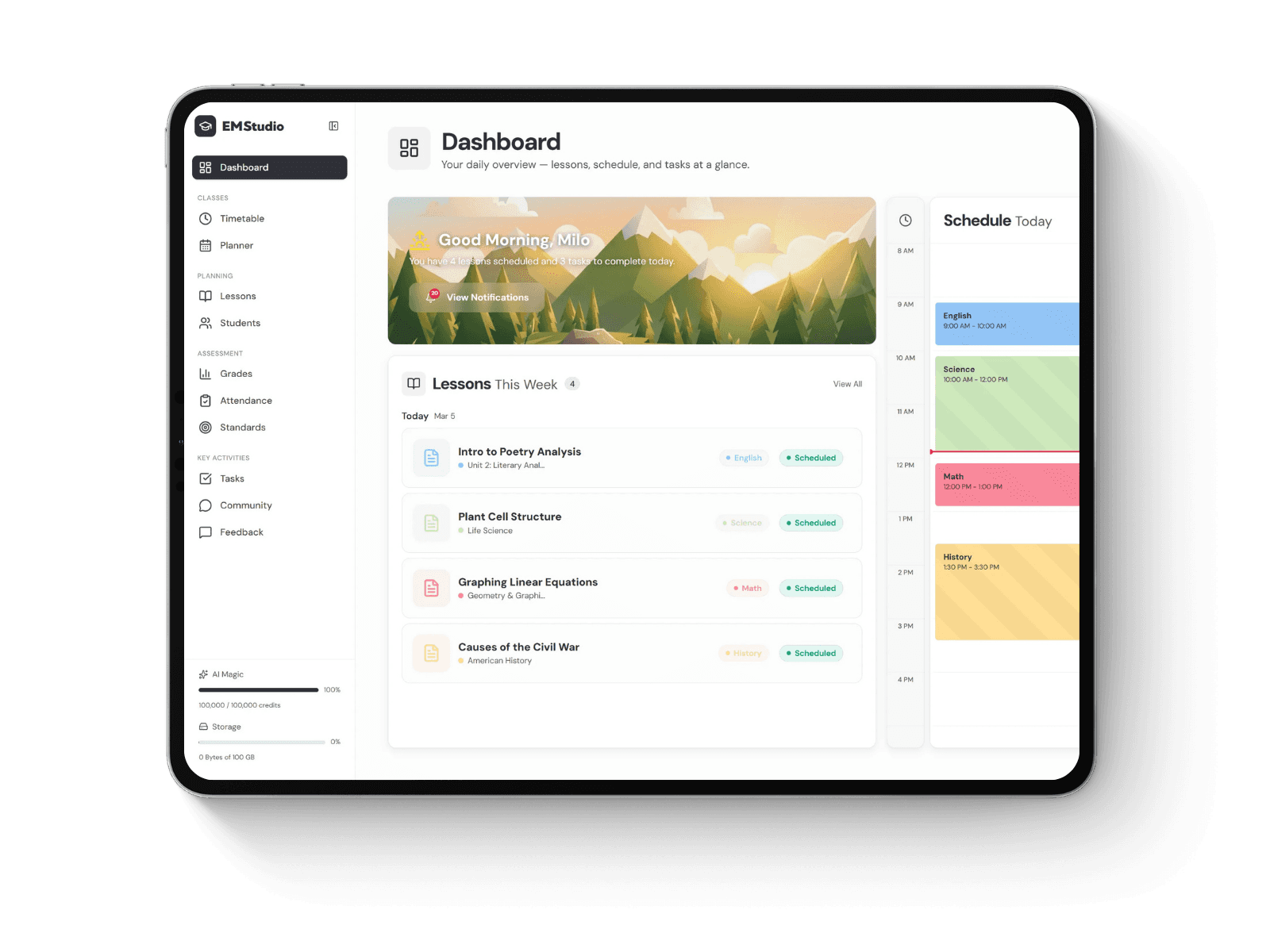
Still grading everything by hand?
EMStudio is a free teaching management app — manage your classes, students, lessons, and more!
Learn More
Table of Contents
What a Student Placement Tracking System Actually Needs to Do
A placement tracking system is not just a roster. It has to answer a specific set of questions at any point during the semester: Who is placed where? Who still needs a site? Has every student completed the required compliance documents before their start date? Which supervisors are currently at capacity?
According to Lumivero’s breakdown of must-haves for placement programs, a functional placement system needs to cover time tracking, supervisor qualification tracking, automated workflows, collaborative evaluations, and robust reporting. That’s a significant scope — and most educators try to handle it with tools that were never designed for it.
Research from InPlace Software found that some placement coordination teams juggle as many as eight platforms, databases, documents, and spreadsheets to manage a single student’s placement journey. That fragmentation drives errors, delays, and real student impact.
The five categories any placement tracking system must cover are:
Students — who they are, what program they’re in, and where they’re assigned
Sites — facility or school details, capacity, and affiliation status
Supervisors — contact information, qualifications, and current caseload
Compliance — documents, clearances, and deadlines each student must meet before starting
Timeline — placement start dates, end dates, evaluation milestones, and hour logs
These five categories map directly onto a Notion structure that’s more powerful than a spreadsheet and far cheaper than enterprise software. Programs that specialize in healthcare education sometimes turn to purpose-built tools for clinical student placement management, but for many coordinators and educators, a well-structured Notion workspace is a practical and flexible starting point.
Building Your Placement Database in Notion: Step-by-Step Setup
Start With Three Core Databases
The most important structural decision is to build three separate, linked databases rather than one flat table.
Students database — One row per student. Properties include: Program, Cohort Year, Assigned Site (linked to Sites DB), Supervisor (linked to Supervisors DB), Status (Unplaced / Matching / Placed / Active / Complete), Hours Logged, and Notes.
Sites database — One row per placement site. Properties include: Facility Name, Address, Subject Area or Specialty, Student Capacity, Primary Contact, Affiliation Agreement Status, and an Active Students rollup (auto-calculated from the Students relation).
Supervisors database — One row per supervisor. Properties include: Full Name, Role, Site (linked to Sites DB), Qualifications, and a Current Students rollup that auto-calculates how many students are assigned to them.
The Notion official blog has a helpful overview of how teachers use Notion for flexible organization if you’re new to Notion’s database structure and want a general orientation before building out the placement system.
Use Relations and Rollups to Connect Everything
Once the three databases exist, use Notion’s relation property to link them. Connect each student to their assigned site and supervisor. Then use rollup properties on the Sites and Supervisors databases to automatically calculate how many students are currently active at each location, or how many hours a student has logged.
This relational structure is what separates Notion from a spreadsheet. Instead of manually updating counts in multiple places, the rollups do it automatically. A coordinator can open the Sites database and immediately see which sites are at capacity and which have room — without running a formula.
Add Views for Different Use Cases
A single database with three views does the work of three separate tools.
Board view (Kanban) — Visualize your entire cohort by placement status. Cards move from Unplaced to Matching to Placed to Active to Complete. This view makes the pipeline visible at a glance.
Calendar view — See start dates, end dates, and evaluation deadlines across the full cohort. Useful for anticipating crunch weeks.
Filtered table view — Filter by site, supervisor, or cohort to answer real-time questions like “who is placed at Riverside Elementary right now?”
Educators who already use Notion for individual learning plans will find the database structure familiar — the same relational logic that connects learning objectives to student records applies equally well to connecting students to placement sites.
Kanban Board and Table Views for Placement Pipeline
Tracking Compliance and Documentation Without Losing Your Mind
Compliance is where placement coordination gets genuinely stressful. Every student typically needs to complete a checklist of requirements — background checks, health clearances, orientation modules, signed affiliation agreements, insurance verification — before they’re cleared to begin. Missing one document can delay a student’s start date by weeks.
Build a Compliance Checklist Property Set
Add checkbox properties directly to each student’s record in the Students database. A basic compliance set might include:
Background Check Complete
Health Clearance Received
Affiliation Agreement Signed
Orientation Module Complete
Insurance Verified
Then add a formula property that calculates a compliance percentage or assigns a plain-English status label: “Not Ready,” “Pending,” or “Cleared.” This turns a scattered checklist into a filterable data field.
Set Up Filtered Views for At-Risk Students
Create a saved filter called “Needs Attention” that surfaces any student who has a start date within 14 days but has not reached “Cleared” status. Pair this with Notion’s date reminder feature on the Start Date property to receive a notification when a student is approaching their placement without completing the required steps.
The NCTQ Clinical Practice Action Guide outlines what compliance typically requires for student teacher placements — it’s a useful external reference for establishing your own checklist requirements, particularly for programs that involve cooperating schools or district partnerships.
Scaling Up: When to Move Beyond Notion
Notion is genuinely well-suited for: individual teachers managing small cohorts (under 30-40 students), programs with straightforward compliance requirements, and educators who need flexibility without software licensing costs. If you’re coordinating a practicum for a single cohort and the main challenge is keeping track of who is where, Notion handles it well.
But Notion has meaningful limits. It is not built for multi-institution coordination, automated compliance renewal tracking, credentialing verification workflows, or shift-based scheduling. It has no native integration with background check vendors or clinical hour logging systems. And maintaining it well requires someone with enough Notion fluency to build and update the structure as the program evolves. For programs that lack the internal bandwidth to manage these complex workflows, utilizing virtual assistant support services can help bridge the gap and keep these manual tracking systems updated.
The scale of this problem is significant for larger programs. According to the Cisive 2026 Clinical Placement Benchmark Report, over 90% of health science program administrators report that difficulty securing enough clinical placements has at least some operational impact — and 85% of students want a single unified platform for all placement-related tasks. Meanwhile, 60% of placement administrators cite turnaround time delays as their biggest frustration. These aren’t problems a Notion database alone can solve at an institutional scale.
The practical spectrum looks like this: Notion (DIY, flexible, low cost, great for small programs) sits at one end; enterprise workforce integration platforms sit at the other. In the middle — and the right fit for many growing programs, particularly in healthcare and nursing education — are purpose-built tools designed specifically for clinical student placement management that automate compliance tracking, centralize shift scheduling, and give coordinators real-time visibility across multiple sites and cohorts. If your program involves healthcare students navigating hospital rotations or multi-site clinical schedules, that middle layer is worth knowing about.
Conclusion: One Workspace to Coordinate It All
Placement coordination has always been a real administrative burden — it just hasn’t had a name or a standard solution. Building a three-database Notion system with relational connections, compliance checkboxes, and filtered views gives educators a concrete starting point that’s far more reliable than a pile of spreadsheets.
Start simple: create the Students, Sites, and Supervisors databases, link them with relations, and build one Kanban view. That alone will change how clearly you can see the state of your placement program at any moment. From there, add compliance properties and reminder filters as the semester’s needs become clear.
The goal of any placement system — Notion-based or otherwise — is to reduce coordinator friction so students spend less time waiting for approvals and more time learning in the field. If you’re new to Notion as an educator’s organizational tool, the organizing your class workflow guide is a good place to build your foundational skills before tackling the more advanced database structure outlined here.
Placement logistics may never be effortless, but they can absolutely be organized.
What a Student Placement Tracking System Actually Needs to Do
A placement tracking system is not just a roster. It has to answer a specific set of questions at any point during the semester: Who is placed where? Who still needs a site? Has every student completed the required compliance documents before their start date? Which supervisors are currently at capacity?
According to Lumivero’s breakdown of must-haves for placement programs, a functional placement system needs to cover time tracking, supervisor qualification tracking, automated workflows, collaborative evaluations, and robust reporting. That’s a significant scope — and most educators try to handle it with tools that were never designed for it.
Research from InPlace Software found that some placement coordination teams juggle as many as eight platforms, databases, documents, and spreadsheets to manage a single student’s placement journey. That fragmentation drives errors, delays, and real student impact.
The five categories any placement tracking system must cover are:
Students — who they are, what program they’re in, and where they’re assigned
Sites — facility or school details, capacity, and affiliation status
Supervisors — contact information, qualifications, and current caseload
Compliance — documents, clearances, and deadlines each student must meet before starting
Timeline — placement start dates, end dates, evaluation milestones, and hour logs
These five categories map directly onto a Notion structure that’s more powerful than a spreadsheet and far cheaper than enterprise software. Programs that specialize in healthcare education sometimes turn to purpose-built tools for clinical student placement management, but for many coordinators and educators, a well-structured Notion workspace is a practical and flexible starting point.
Building Your Placement Database in Notion: Step-by-Step Setup
Start With Three Core Databases
The most important structural decision is to build three separate, linked databases rather than one flat table.
Students database — One row per student. Properties include: Program, Cohort Year, Assigned Site (linked to Sites DB), Supervisor (linked to Supervisors DB), Status (Unplaced / Matching / Placed / Active / Complete), Hours Logged, and Notes.
Sites database — One row per placement site. Properties include: Facility Name, Address, Subject Area or Specialty, Student Capacity, Primary Contact, Affiliation Agreement Status, and an Active Students rollup (auto-calculated from the Students relation).
Supervisors database — One row per supervisor. Properties include: Full Name, Role, Site (linked to Sites DB), Qualifications, and a Current Students rollup that auto-calculates how many students are assigned to them.
The Notion official blog has a helpful overview of how teachers use Notion for flexible organization if you’re new to Notion’s database structure and want a general orientation before building out the placement system.
Use Relations and Rollups to Connect Everything
Once the three databases exist, use Notion’s relation property to link them. Connect each student to their assigned site and supervisor. Then use rollup properties on the Sites and Supervisors databases to automatically calculate how many students are currently active at each location, or how many hours a student has logged.
This relational structure is what separates Notion from a spreadsheet. Instead of manually updating counts in multiple places, the rollups do it automatically. A coordinator can open the Sites database and immediately see which sites are at capacity and which have room — without running a formula.
Add Views for Different Use Cases
A single database with three views does the work of three separate tools.
Board view (Kanban) — Visualize your entire cohort by placement status. Cards move from Unplaced to Matching to Placed to Active to Complete. This view makes the pipeline visible at a glance.
Calendar view — See start dates, end dates, and evaluation deadlines across the full cohort. Useful for anticipating crunch weeks.
Filtered table view — Filter by site, supervisor, or cohort to answer real-time questions like “who is placed at Riverside Elementary right now?”
Educators who already use Notion for individual learning plans will find the database structure familiar — the same relational logic that connects learning objectives to student records applies equally well to connecting students to placement sites.
Kanban Board and Table Views for Placement Pipeline
Tracking Compliance and Documentation Without Losing Your Mind
Compliance is where placement coordination gets genuinely stressful. Every student typically needs to complete a checklist of requirements — background checks, health clearances, orientation modules, signed affiliation agreements, insurance verification — before they’re cleared to begin. Missing one document can delay a student’s start date by weeks.
Build a Compliance Checklist Property Set
Add checkbox properties directly to each student’s record in the Students database. A basic compliance set might include:
Background Check Complete
Health Clearance Received
Affiliation Agreement Signed
Orientation Module Complete
Insurance Verified
Then add a formula property that calculates a compliance percentage or assigns a plain-English status label: “Not Ready,” “Pending,” or “Cleared.” This turns a scattered checklist into a filterable data field.
Set Up Filtered Views for At-Risk Students
Create a saved filter called “Needs Attention” that surfaces any student who has a start date within 14 days but has not reached “Cleared” status. Pair this with Notion’s date reminder feature on the Start Date property to receive a notification when a student is approaching their placement without completing the required steps.
The NCTQ Clinical Practice Action Guide outlines what compliance typically requires for student teacher placements — it’s a useful external reference for establishing your own checklist requirements, particularly for programs that involve cooperating schools or district partnerships.
Scaling Up: When to Move Beyond Notion
Notion is genuinely well-suited for: individual teachers managing small cohorts (under 30-40 students), programs with straightforward compliance requirements, and educators who need flexibility without software licensing costs. If you’re coordinating a practicum for a single cohort and the main challenge is keeping track of who is where, Notion handles it well.
But Notion has meaningful limits. It is not built for multi-institution coordination, automated compliance renewal tracking, credentialing verification workflows, or shift-based scheduling. It has no native integration with background check vendors or clinical hour logging systems. And maintaining it well requires someone with enough Notion fluency to build and update the structure as the program evolves. For programs that lack the internal bandwidth to manage these complex workflows, utilizing virtual assistant support services can help bridge the gap and keep these manual tracking systems updated.
The scale of this problem is significant for larger programs. According to the Cisive 2026 Clinical Placement Benchmark Report, over 90% of health science program administrators report that difficulty securing enough clinical placements has at least some operational impact — and 85% of students want a single unified platform for all placement-related tasks. Meanwhile, 60% of placement administrators cite turnaround time delays as their biggest frustration. These aren’t problems a Notion database alone can solve at an institutional scale.
The practical spectrum looks like this: Notion (DIY, flexible, low cost, great for small programs) sits at one end; enterprise workforce integration platforms sit at the other. In the middle — and the right fit for many growing programs, particularly in healthcare and nursing education — are purpose-built tools designed specifically for clinical student placement management that automate compliance tracking, centralize shift scheduling, and give coordinators real-time visibility across multiple sites and cohorts. If your program involves healthcare students navigating hospital rotations or multi-site clinical schedules, that middle layer is worth knowing about.
Conclusion: One Workspace to Coordinate It All
Placement coordination has always been a real administrative burden — it just hasn’t had a name or a standard solution. Building a three-database Notion system with relational connections, compliance checkboxes, and filtered views gives educators a concrete starting point that’s far more reliable than a pile of spreadsheets.
Start simple: create the Students, Sites, and Supervisors databases, link them with relations, and build one Kanban view. That alone will change how clearly you can see the state of your placement program at any moment. From there, add compliance properties and reminder filters as the semester’s needs become clear.
The goal of any placement system — Notion-based or otherwise — is to reduce coordinator friction so students spend less time waiting for approvals and more time learning in the field. If you’re new to Notion as an educator’s organizational tool, the organizing your class workflow guide is a good place to build your foundational skills before tackling the more advanced database structure outlined here.
Placement logistics may never be effortless, but they can absolutely be organized.
Still grading everything by hand?
EMStudio is a free teaching management app — manage your classes, students, lessons, and more!
Learn More
Still grading everything by hand?
EMStudio is a free teaching management app — manage your classes, students, lessons, and more!
Learn More


Notion4Teachers
Notion templates to simplify administrative tasks and enhance your teaching experience.



2026 Notion4Teachers. All Rights Reserved.
Notion4Teachers
Notion templates to simplify administrative tasks and enhance your teaching experience.
2026 Notion4Teachers. All Rights Reserved.
Notion4Teachers
Notion templates to simplify administrative tasks and enhance your teaching experience.
2026 Notion4Teachers. All Rights Reserved.