
Why Better Classroom Systems Are the Key to Improving Student Outcomes
Why Better Classroom Systems Are the Key to Improving Student Outcomes

Article by
Milo
ESL Content Coordinator & Educator
ESL Content Coordinator & Educator
All Posts
Student outcomes are not driven by effort alone. They depend on how well a classroom is organized, how clearly progress is tracked and how quickly teachers can respond when learning starts to slip.
Student performance in the United States is no longer a question of effort. It is a question of structure. The most recent results from the National Assessment of Educational Progress (NAEP) show that fourth-grade reading scores in 2024 remain five points below 2019 levels, while math performance has yet to fully recover. These are not marginal shifts. They reflect systemic strain across classrooms that are being asked to do more with less consistency.
At the same time, absenteeism continues to disrupt learning at scale. RAND estimates that around 22 percent of K–12 students, roughly 10.8 million children, were chronically absent during the 2024–25 school year. When students are not consistently present, even the strongest teaching plans begin to fragment. The issue is no longer whether teachers are working hard enough; it is whether the systems around them allow that effort to translate into sustained progress.
Still grading everything by hand?
EMStudio is a free teaching management app — manage your classes, students, lessons, and more!
Learn More
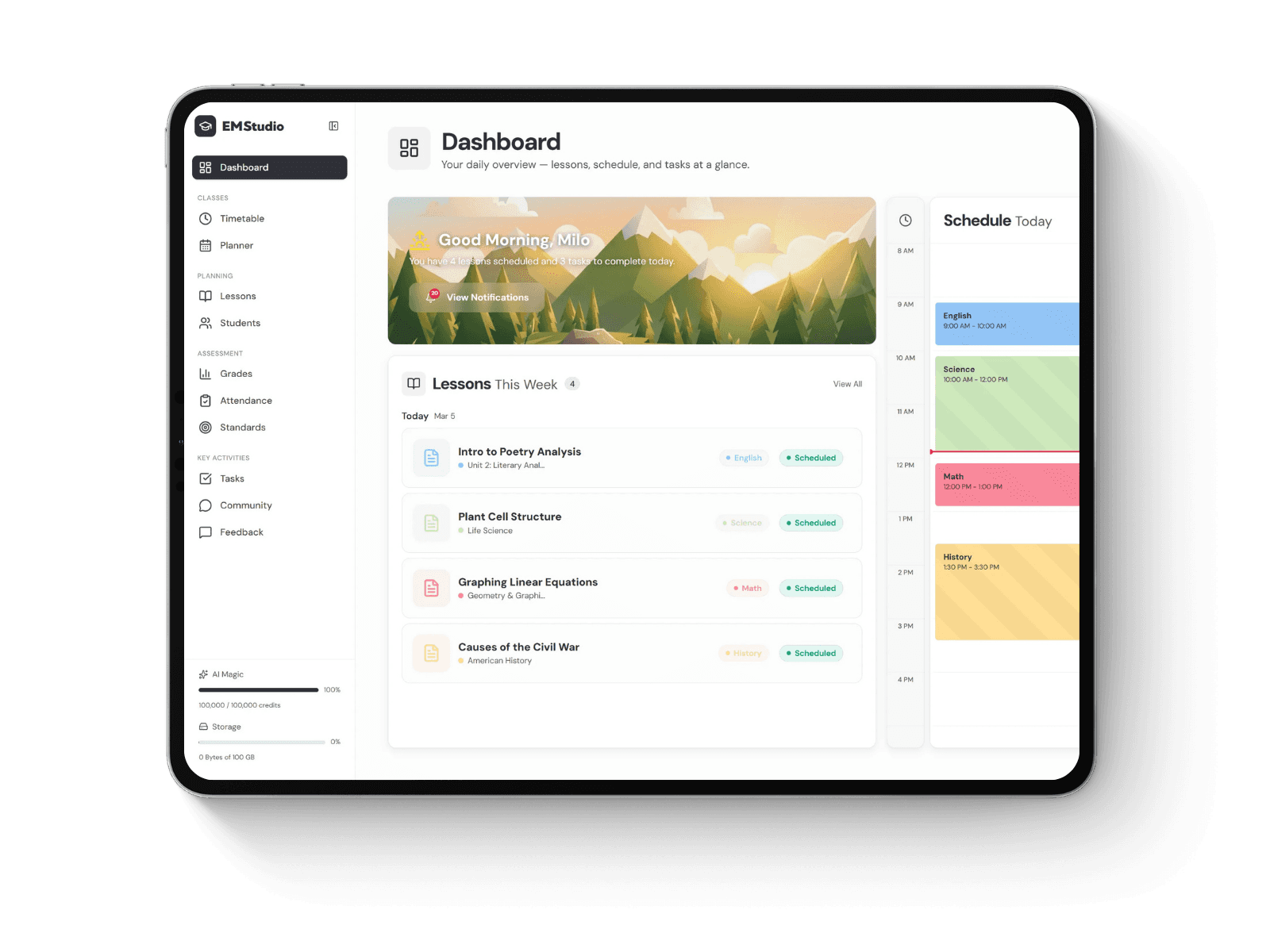
Still grading everything by hand?
EMStudio is a free teaching management app — manage your classes, students, lessons, and more!
Learn More
Table of Contents
Outcomes Are Now a Systems Problem, Not Just a Teaching Problem
The gap between high- and low-performing students has widened in recent years, according to NAEP data, with top-performing students holding steady while those at the lower end continue to fall behind. That divergence is not driven by curriculum alone. It reflects how effectively schools identify gaps, respond to them and maintain continuity in learning.
The impact on student progress is immediate. When teachers are managing excessive workloads, planning becomes compressed, feedback loops slow and intervention becomes reactive. Over time, this reduces the reliability that effective learning depends on.
Attendance Data Has Become a Classroom Planning Issue
Attendance is often discussed at district level, but its real impact is felt day to day. When students miss lessons, gaps form quickly, particularly in subjects that build sequentially. Without a system to track and respond to those gaps, they become harder to close.
In high-functioning classrooms, attendance data is integrated into planning. Teachers do not treat it as a separate administrative metric. They connect it to performance, identify patterns and adjust instruction accordingly. This approach allows for earlier intervention and reduces the risk of long-term decline.
The difference is not technology alone. It is the way information is structured and used. When attendance, assessment and feedback are aligned, teachers gain a clearer picture of where each student stands.
Teachers Need Fewer Loose Ends, Not More Initiatives
One of the defining challenges in modern education is initiative overload. Schools are introducing new programs at a steady pace, often with the goal of improving results. The problem is that these initiatives are not always integrated into existing workflows.
Teachers are left managing multiple systems, each with its own expectations and processes. This creates friction. Time is spent navigating systems rather than applying them, and reliability suffers as a result.
A more effective approach focuses on consolidation. Instead of adding new layers, successful classrooms refine existing processes. Progress tracking becomes simpler, communication becomes more direct and routines become easier to maintain. This reduces cognitive load and allows teachers to focus on instruction.
Where Leadership Thinking Enters the Classroom
These pressures are not isolated to individual classrooms. They reflect how systems are designed and managed, which is where leadership thinking becomes relevant.
Improving outcomes is often framed as a leadership challenge, but the same principles apply at classroom level. Leadership, in this context, is about creating clarity. It is about ensuring that information flows efficiently and that decisions are based on accurate, up-to-date insight.
Many of the most effective classroom frameworks are built around leadership principles, where the ability to improve student outcomes depends on how well teachers collaborate, contribute to decision-making and identify support needs early. In practice, this often means structured peer learning, more transparent feedback systems and a coordinated approach to student support instead of isolated interventions. These approaches are reflected in structured leadership strategies that align collaboration, planning and support systems to deliver more consistent progress.
When those systems are in place, classrooms become more reliable. Teachers are not relying on instinct alone. They are working within a framework that allows them to identify gaps quickly, share insight and respond with greater precision.
What Effective Classrooms Do Differently
High-performing classrooms share a set of common characteristics. They are not necessarily more complex, but they are more organized. Teachers have better visibility over student progress, and they use that information to guide instruction.
Collaboration is one of the most important factors. Structured professional interaction allows teachers to learn from one another and refine their approach over time, reducing isolation and creating a more adaptive learning environment.
Another defining feature is the use of data as a practical tool. When assessment results are organized and accessible, they support decision-making rather than adding to workload. Teachers can identify trends, measure progress and adjust their approach with greater confidence.
Student Support Works Best When It Is Visible Early
Academic performance does not exist in isolation. Mental health, attendance and external pressures all influence how students engage with learning. According to the National Alliance on Mental Illness, more than 15 percent of children aged six to seventeen experience a mental health condition each year.
When support systems are not integrated into daily practice, these challenges can go unnoticed until they begin to affect performance. In contrast, classrooms that embed support into their structure are better positioned to respond early.
This might involve tracking engagement alongside academic progress or creating clear pathways for intervention when concerns arise. The key is early awareness. When issues are recognized early, they are easier to address.
Better Organization Gives Teachers Room to Teach
At its core, improving outcomes is about creating the conditions for effective teaching. Organization is not a secondary concern. It is central to how learning is delivered.
In practice, this often involves using structured planning systems where lesson plans, attendance data and assessment results are kept in one place. When information is centralized and easy to update, teachers spend less time searching and more time responding.
Recent reporting on teacher workload and burnout highlights that pressures are reaching unsustainable levels, with teachers describing their responsibilities as continuous and difficult to manage. Reporting from the BBC reflects this reality, with educators describing how never-ending task lists begin to affect both planning time and the quality of classroom delivery.
When systems are disjointed or fragmented, even experienced teachers can struggle to maintain reliability. Planning becomes reactive, feedback is delayed and opportunities for early intervention are missed.
Stronger systems change that dynamic. They provide a framework where information is accessible, processes are aligned and decisions can be made with confidence. This allows teachers to focus on what they do best: delivering high-quality instruction.
The challenges facing education today are significant, but they are not insurmountable. By focusing on structure rather than volume, schools can create environments where effort leads to measurable progress. That is where meaningful improvement begins.
Outcomes Are Now a Systems Problem, Not Just a Teaching Problem
The gap between high- and low-performing students has widened in recent years, according to NAEP data, with top-performing students holding steady while those at the lower end continue to fall behind. That divergence is not driven by curriculum alone. It reflects how effectively schools identify gaps, respond to them and maintain continuity in learning.
The impact on student progress is immediate. When teachers are managing excessive workloads, planning becomes compressed, feedback loops slow and intervention becomes reactive. Over time, this reduces the reliability that effective learning depends on.
Attendance Data Has Become a Classroom Planning Issue
Attendance is often discussed at district level, but its real impact is felt day to day. When students miss lessons, gaps form quickly, particularly in subjects that build sequentially. Without a system to track and respond to those gaps, they become harder to close.
In high-functioning classrooms, attendance data is integrated into planning. Teachers do not treat it as a separate administrative metric. They connect it to performance, identify patterns and adjust instruction accordingly. This approach allows for earlier intervention and reduces the risk of long-term decline.
The difference is not technology alone. It is the way information is structured and used. When attendance, assessment and feedback are aligned, teachers gain a clearer picture of where each student stands.
Teachers Need Fewer Loose Ends, Not More Initiatives
One of the defining challenges in modern education is initiative overload. Schools are introducing new programs at a steady pace, often with the goal of improving results. The problem is that these initiatives are not always integrated into existing workflows.
Teachers are left managing multiple systems, each with its own expectations and processes. This creates friction. Time is spent navigating systems rather than applying them, and reliability suffers as a result.
A more effective approach focuses on consolidation. Instead of adding new layers, successful classrooms refine existing processes. Progress tracking becomes simpler, communication becomes more direct and routines become easier to maintain. This reduces cognitive load and allows teachers to focus on instruction.
Where Leadership Thinking Enters the Classroom
These pressures are not isolated to individual classrooms. They reflect how systems are designed and managed, which is where leadership thinking becomes relevant.
Improving outcomes is often framed as a leadership challenge, but the same principles apply at classroom level. Leadership, in this context, is about creating clarity. It is about ensuring that information flows efficiently and that decisions are based on accurate, up-to-date insight.
Many of the most effective classroom frameworks are built around leadership principles, where the ability to improve student outcomes depends on how well teachers collaborate, contribute to decision-making and identify support needs early. In practice, this often means structured peer learning, more transparent feedback systems and a coordinated approach to student support instead of isolated interventions. These approaches are reflected in structured leadership strategies that align collaboration, planning and support systems to deliver more consistent progress.
When those systems are in place, classrooms become more reliable. Teachers are not relying on instinct alone. They are working within a framework that allows them to identify gaps quickly, share insight and respond with greater precision.
What Effective Classrooms Do Differently
High-performing classrooms share a set of common characteristics. They are not necessarily more complex, but they are more organized. Teachers have better visibility over student progress, and they use that information to guide instruction.
Collaboration is one of the most important factors. Structured professional interaction allows teachers to learn from one another and refine their approach over time, reducing isolation and creating a more adaptive learning environment.
Another defining feature is the use of data as a practical tool. When assessment results are organized and accessible, they support decision-making rather than adding to workload. Teachers can identify trends, measure progress and adjust their approach with greater confidence.
Student Support Works Best When It Is Visible Early
Academic performance does not exist in isolation. Mental health, attendance and external pressures all influence how students engage with learning. According to the National Alliance on Mental Illness, more than 15 percent of children aged six to seventeen experience a mental health condition each year.
When support systems are not integrated into daily practice, these challenges can go unnoticed until they begin to affect performance. In contrast, classrooms that embed support into their structure are better positioned to respond early.
This might involve tracking engagement alongside academic progress or creating clear pathways for intervention when concerns arise. The key is early awareness. When issues are recognized early, they are easier to address.
Better Organization Gives Teachers Room to Teach
At its core, improving outcomes is about creating the conditions for effective teaching. Organization is not a secondary concern. It is central to how learning is delivered.
In practice, this often involves using structured planning systems where lesson plans, attendance data and assessment results are kept in one place. When information is centralized and easy to update, teachers spend less time searching and more time responding.
Recent reporting on teacher workload and burnout highlights that pressures are reaching unsustainable levels, with teachers describing their responsibilities as continuous and difficult to manage. Reporting from the BBC reflects this reality, with educators describing how never-ending task lists begin to affect both planning time and the quality of classroom delivery.
When systems are disjointed or fragmented, even experienced teachers can struggle to maintain reliability. Planning becomes reactive, feedback is delayed and opportunities for early intervention are missed.
Stronger systems change that dynamic. They provide a framework where information is accessible, processes are aligned and decisions can be made with confidence. This allows teachers to focus on what they do best: delivering high-quality instruction.
The challenges facing education today are significant, but they are not insurmountable. By focusing on structure rather than volume, schools can create environments where effort leads to measurable progress. That is where meaningful improvement begins.
Still grading everything by hand?
EMStudio is a free teaching management app — manage your classes, students, lessons, and more!
Learn More
Still grading everything by hand?
EMStudio is a free teaching management app — manage your classes, students, lessons, and more!
Learn More
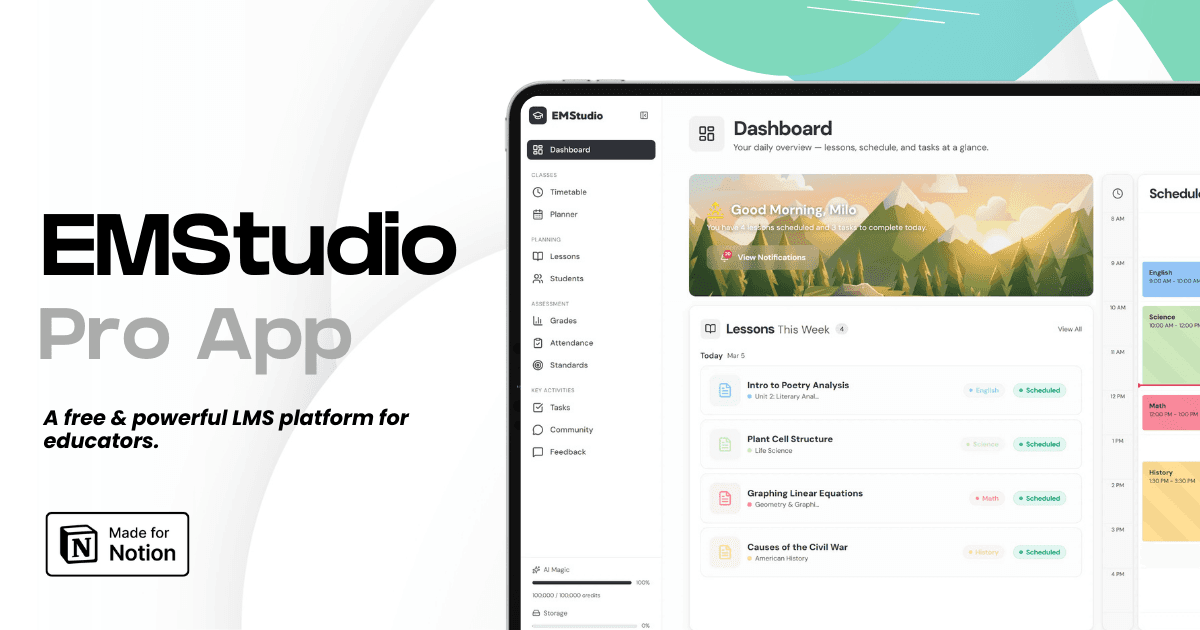



Notion4Teachers
Notion templates to simplify administrative tasks and enhance your teaching experience.



2026 Notion4Teachers. All Rights Reserved.
Notion4Teachers
Notion templates to simplify administrative tasks and enhance your teaching experience.
2026 Notion4Teachers. All Rights Reserved.
Notion4Teachers
Notion templates to simplify administrative tasks and enhance your teaching experience.
2026 Notion4Teachers. All Rights Reserved.