
How to Become a Flight Instructor: A Practical Roadmap
How to Become a Flight Instructor: A Practical Roadmap

Article by
Milo
ESL Content Coordinator & Educator
ESL Content Coordinator & Educator
All Posts
Table of Contents
A newly issued commercial certificate creates a strange pause. The pilot can fly for compensation, holds hard-won privileges, and still doesn't have a clear job waiting on the ramp. Instructor work often fills that gap, but it isn't the next box to check. Learning how to become a flight instructor means learning a second profession that sits on top of piloting. The right preparation treats teaching, risk management, and record keeping as skills that need training in their own right.
What the Flight Instructor Path Actually Looks Like
The scene repeats in flight school lobbies everywhere. A commercial pilot stands near the dispatch desk, certificate in hand, watching instructors brief students and head out to the flight line. The pilot knows how to fly the maneuvers. The open question is whether instructing is a genuine career step or just a way to log hours until something better appears.
That distinction matters because instructor certification is built as an advanced qualification, not an entry-level license. In the United States, an applicant must be at least 18 years old and able to read, speak, write, and understand English, and the applicant must already hold the appropriate pilot certificate for the rating sought, as set out in the Federal Aviation Regulations for pilot certification in 14 CFR Part 61. Candidates arrive as pilots first. Instructor training then tests whether that experience can be turned into safe, structured teaching.
A Professional Program, Not an Add-On
The work changes in character once a candidate moves to the right seat. Flying a steep turn correctly is one task. Demonstrating it, narrating it, spotting the student's error mid-maneuver, and correcting without grabbing the controls unnecessarily is a different task entirely. Candidates who expect instructor training to feel like more of the same flying usually struggle, while candidates who expect a teaching course adapt faster.
The visual roadmap below maps the full sequence from readiness through the first paid lessons.

Why the Jurisdiction Choice Comes First
Regulators don't structure this qualification the same way. The U.S. system is built around knowledge tests and a demanding practical test, while the European system front-loads a much larger block of structured theoretical instruction. Both routes lead to teaching privileges, but they shape the candidate's calendar, budget, and study load very differently. Picking a jurisdiction late, or drifting between systems, wastes money on training that may not credit cleanly toward the final goal.
The certificate rewards the pilot who can make a student competent, not the pilot who simply performs well alone.
Prerequisites, the two major regulatory pathways, training structure, honest costs, and post-certification recency rules all connect. A candidate who understands that chain early can plan logbook evidence, choose a school deliberately, and avoid treating the checkride as the finish line. Instructing, done properly, is a career with its own compliance rhythm. The path rewards planners.
Prerequisites You Need Before Instructor Training
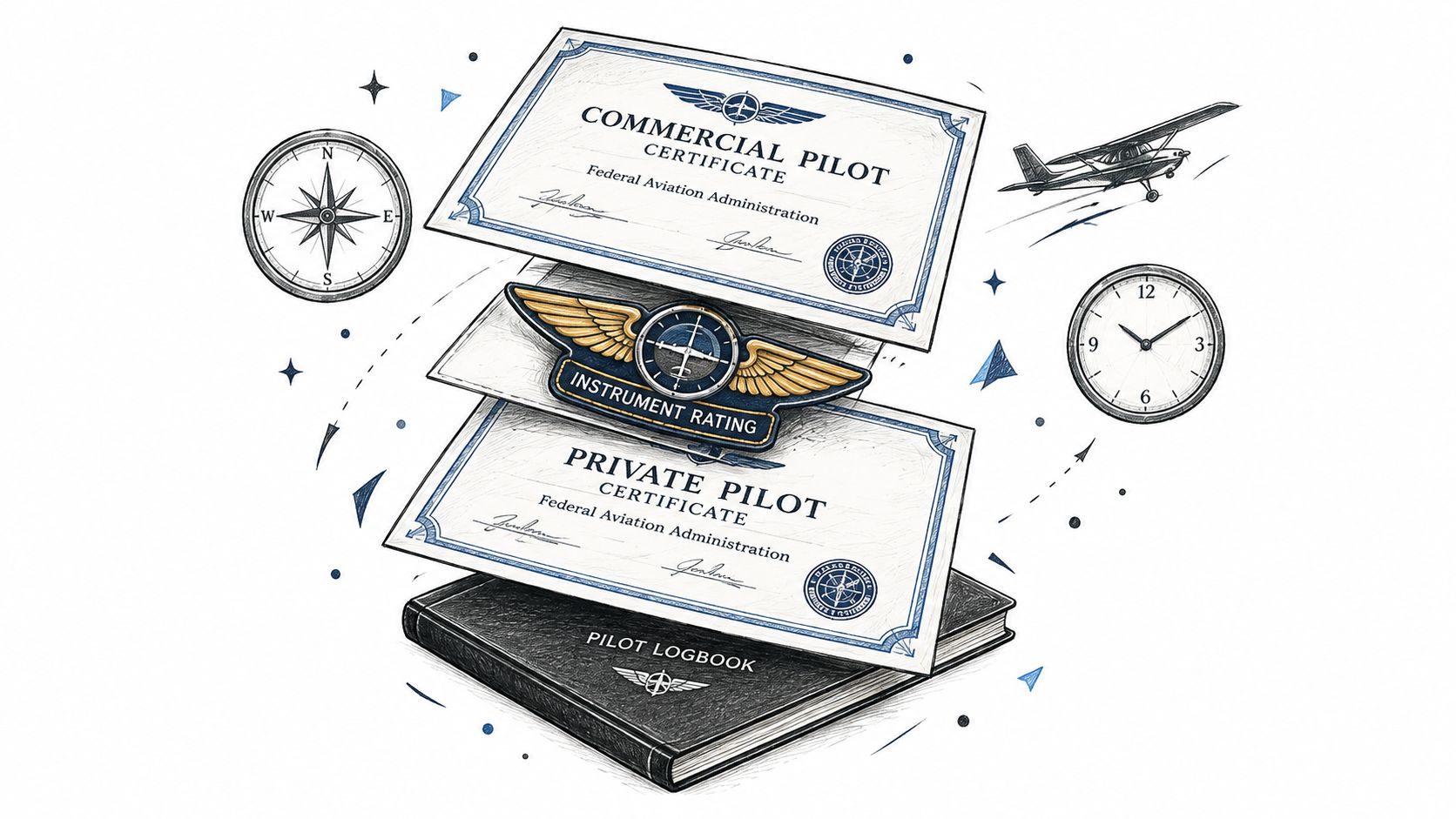
Instructor training sits on a layered foundation, and each layer exists for a practical reason. The private pilot certificate proves basic airmanship and solo judgment. The instrument rating adds the ability to fly and think in the system, on gauges, under rules that future students will eventually need explained clearly. Commercial training then raises maneuver precision to a professional standard, because a teacher can't credibly demonstrate sloppy work.
Skipping steps doesn't work, and rushing them leaves visible gaps. An examiner can hear the difference between a candidate who barely passed commercial ground school and one who can explain the underlying aerodynamics without notes. The reliable U.S. progression runs private certificate, instrument rating, commercial certificate, instructor ground training, the flight instructor knowledge examination, and finally the practical test under the applicable standards described in the FAA Airman Certification Standards for flight instructor airplane.
The Details Candidates Underestimate
Several requirements catch candidates by surprise because they sit outside total time:
Category and class PIC time: For the relevant aircraft category and class, U.S. regulations require at least 15 hours of pilot-in-command time in that category and class, a requirement defined in the same Part 61 framework cited earlier.
Language proficiency: The English requirement covers reading, speaking, writing, and understanding, subject only to limited medical accommodations.
Medical status: The appropriate medical certificate needs to be current for the privileges being exercised, and lapses stall training at awkward moments.
Logbook evidence: Examiners look for specific entries, endorsements, and experience categories, not a single impressive total.
The logbook point deserves emphasis. Total flight time alone proves very little to an examiner reviewing eligibility. Candidates should track logbook totals, aircraft class, PIC status, and ground instruction separately, because an hour logged in the wrong class doesn't satisfy a class-specific requirement no matter how well it was flown.
The illustration below shows the core documents that form this foundation.
Auditing Readiness Honestly
A practical pre-enrollment audit takes an afternoon. The candidate lists every certificate and rating held, totals PIC time by category and class, confirms medical validity, and flags any endorsement gaps. Weak instrument skills or rusty commercial maneuvers should be fixed before instructor training starts, not during it, because instructor course fees are an expensive place to relearn fundamentals. Candidates who arrive current and organized spend their training budget on teaching skill, which is the entire point of the course.
Comparing the FAA and EASA Pathways
Two regulatory philosophies dominate global instructor training. The FAA model is checkride-driven, giving candidates flexibility in how they prepare as long as they pass the knowledge test and then demonstrate teaching ability on the practical test. The EASA model is coursework-driven, prescribing a structured syllabus with a heavy theory component before privileges are granted. Neither approach is automatically easier. They distribute the difficulty differently.
Under the European framework, the initial aeroplane flight instructor course includes at least 125 hours of theoretical instruction and at least 30 hours of flight instruction, with 25 hours of that flight time as dual instruction, according to the EASA Easy Access Rules for aircrew regulation. That theory block covers learning processes, lesson planning, and instructional methods alongside aviation knowledge. A candidate in Europe should expect a classroom commitment that a U.S. candidate largely self-directs.
Requirement | FAA (U.S.) | EASA (Europe) |
|---|---|---|
Entry certificates | Appropriate pilot certificate plus rating sought | Commercial Pilot Licence, or Private Pilot Licence with commercial theory completed |
Prior experience | 15 hours PIC in category and class | Commonly 200 hours total time and 150 hours PIC |
Theory training | Ground training toward knowledge test | 125 hours of theoretical instruction |
Flight training | Proficiency based, checked on practical test | 30 hours flight instruction, 25 dual |
Entry screening | Knowledge test before practical test | Pre-entry flight test within preceding six months |
Final assessment | Practical test under Airman Certification Standards | Competence assessment under Part-FCL |
Where the Systems Converge
Despite the structural differences, the two systems agree on fundamentals. Both require the instructor to hold privileges appropriate to the training provided. EASA likewise expects at least 15 hours of flight time as pilot of the relevant aircraft class or type for relevant instruction, mirroring the U.S. category and class logic noted earlier. Both systems also separate flying competence from teaching competence and examine each one deliberately.
What the Choice Means Day to Day
An FAA candidate's schedule bends around self-study, mentor availability, and examiner scheduling. Progress can be fast, but weak self-discipline shows up immediately because nobody imposes a classroom timetable. An EASA candidate trades that flexibility for structure, attending a defined course with progress built into the syllabus. Candidates who learn best independently often prefer the American route. Candidates who want a cohort, a curriculum, and fixed milestones often thrive in the European one.
Geography, license recognition, and the intended job market should drive the decision more than perceived difficulty. Training under the system where the instructor plans to work avoids conversion headaches later. For internationally mobile pilots, the FAA framework remains influential because many commercial training organizations use it as a reference point, but privileges still have to be valid where the teaching happens.
How CFII Can Help
For candidates training in the United States, the school choice determines whether the instructor phase feels organized or improvised. CFII is a Southern California flight training organization offering an accelerated, fixed-price pathway from zero experience through flight instructor instrument privileges. Pilots who want the full sequence under one roof can review the CFII Career Track, which sequences private, instrument, commercial single and multi-engine, CFI, and CFII training as one continuous program.
The screenshot below shows how the school presents its training operation.

The Career Track is priced at a fixed $89,000 tuition over about nine months, with 282 total hours logged across single-engine, multi-engine, and simulator time. An optional add-on provides a 25-hour instructor bootcamp plus guaranteed paid instructing hours, which addresses the most anxious moment for new instructors, finding that first teaching job. Fixed pricing won't suit every pilot, but it converts an open-ended hourly bill into a plannable number, and that predictability has real value when financing training.
Operational details matter as much as price. Instruction is delivered one-on-one, checkride scheduling is coordinated with examiners rather than left to the student, and training runs from Southern California bases including Long Beach, Corona, and Riverside, where weather rarely cancels a training week. The fleet uses factory-new aircraft with Garmin glass cockpits, and a training portal handles lessons, quizzes, stage checks, and written test preparation.
Practical rule: A school that coordinates examiners, standardizes aircraft, and tracks progress digitally removes three of the most common causes of instructor training delays.
This kind of integrated program fits candidates starting from zero or restarting after fragmented training elsewhere. Pilots who already hold a commercial certificate and need a focused CFI course may spend less at a local school. The honest test is total cost to a working instructor job, including delays, not the headline rate per hour.
How CFI Training Is Structured
Instructor training feels unfamiliar from the first lesson because the candidate stops being the student in the usual sense. Ground sessions focus on how people learn, how to build a lesson, and how to evaluate performance fairly. Flight lessons move the candidate to the right seat, where every maneuver must be flown, explained, and monitored at the same time. The infographic below outlines the five stages that structure the work.

The Lesson Portfolio Method
The most effective preparation tool is a lesson portfolio built for each task in the certification standards. Each entry contains a learning objective, regulatory references, a demonstration sequence, common student errors, risk controls, and an oral-question checklist. Building the portfolio forces the candidate to organize knowledge the way an examiner will probe it, out loud and under mild pressure. Candidates who borrow generic lesson plans without rewriting them usually can't defend the material when the questioning goes one layer deeper.
Mock oral exams expose that weakness early, which is their purpose. A good mentor plays the curious student and the skeptical examiner in the same session, asking why a maneuver works, not just how it's flown. Approaches drawn from structured coaching practice, such as those in this guide to coaching techniques for educators, translate surprisingly well to the briefing room, because both settings reward clear objectives and specific feedback over vague encouragement.
What a Strong Practice Lesson Looks Like
Consider a candidate teaching slow flight. The briefing covers the objective, the aerodynamic cause of each common error, and the point at which the lesson stops for safety. In the air, the candidate demonstrates once while narrating, lets the mock student fly it imperfectly, diagnoses the error out loud, and intervenes verbally before touching the controls. That sequence, demonstration, supervised imperfection, diagnosis, correction, is the skill the practical test measures.
The video below gives a sense of how demonstration and explanation combine in instructor training.
The readiness gate is unforgiving but clear. A candidate is ready when every major maneuver can be taught without notes, the aerodynamic cause of each error can be explained plainly, and the decision to discontinue a lesson for weather, aircraft status, or student workload comes without hesitation. Passing the knowledge test isn't that gate. Memorized answers collapse in an oral exam, while genuine understanding survives follow-up questions. European training makes the same point structurally, since the EASA FI(A) course dedicates at least 25 hours to teaching-and-learning instruction and 100 hours to theoretical knowledge instruction including progress tests, as detailed in the EASA FCL.930.FI training course requirements.
Realistic Costs and Timelines to Plan For
Honest budgeting starts by separating fixed regulatory costs from variable training hours. Fixed items, the medical examination, knowledge test fees, and the practical test, don't shrink with talent. Variable items, aircraft rental, instructor fees, and extra proficiency flights, shrink or grow with the candidate's preparation and currency. Mixing the two categories into one vague guess is how candidates run out of money two weeks before a checkride.
The budget worksheet below reflects the phase-based planning approach that keeps costs visible.

Mapping Costs to Phases
A phase-based budget assigns money to the work it buys:
Foundation phase: Any catch-up flying needed to restore commercial and instrument proficiency before instructor training begins.
Ground phase: Instructor ground training, study materials, and knowledge test fees, which in Europe expand significantly because of the prescribed theory block.
Flight phase: Aircraft rental and instructor fees for right-seat proficiency and demonstration practice.
Assessment phase: Practical test or competence assessment fees, plus a reserve for a retest that nobody plans for and some candidates need.
European candidates should also budget for national authority charges and examiner fees, which vary by country even under a shared EASA framework. The heavier European theory requirement doesn't just cost money, it costs calendar time that a candidate might otherwise spend working. Opportunity cost belongs in the budget next to the invoices.
Two Timelines, Two Totals
A working commercial pilot training part-time spreads expenses across many months, which protects cash flow but usually increases total flight hours because skills fade between lessons. A full-time integrated student pays faster and often finishes with fewer redundant hours, yet faces a concentrated bill and no income during training. Neither route is cheaper in every case, and any school quoting a single guaranteed total without reviewing the candidate's logbook deserves skepticism.
The defensible planning method is a range tied to phases, reviewed monthly against actual spending. Candidates who track cost per completed syllabus item spot overruns while corrections are still cheap. A contingency reserve for weather delays, maintenance downtime, and examiner rescheduling turns surprises into inconveniences rather than crises.
Staying Current After You Are Certified
Most new instructors ask how renewal works, and in the United States that question is now outdated. The FAA final rule removed the expiration date from flight instructor certificates and replaced renewal with 24-month recent-experience requirements, effective December 1, 2024, a change the FAA estimated would save $5.6 million over five years, as reported in the EAA summary of the FAA rule removing CFI certificate expiration dates. The certificate stays valid. The privilege to exercise it depends on documented recent activity.
That distinction between certificate validity and instructional recency is the core of the modern system. An instructor can hold a perfectly valid certificate and still be unable to teach legally because qualifying recent experience hasn't been documented within the window. Treating certification as a one-time event, the way many older guides framed it, now actively misleads new instructors.
Building a 24-Month Planning Dashboard
A working instructor should maintain a simple rolling dashboard with four elements:
Recency deadline: The exact date current privileges lapse without further qualifying activity.
Qualifying activity log: Instruction given and other qualifying activities, recorded as they happen rather than reconstructed later.
Documentation file: Applications and supporting records stored where an employer or inspector can review them quickly.
Recovery awareness: Knowledge that recency lapsed by no more than three months can be recovered through an approved flight instructor refresher course instead of a practical test.
Freelance instructors carry the full administrative burden personally, since no school tracks their deadlines. School employees often benefit from internal tracking systems, but relying on an employer entirely is risky when jobs change. Internationally trained pilots entering the U.S. system face the steepest learning curve, because the recency model doesn't map neatly onto revalidation systems elsewhere.
An instructor career is now a continuous documentation habit, not a biennial paperwork sprint.
The professional growth side matters alongside compliance. Instructors who keep developing as educators, along the lines explored in this resource on continuing to grow as a teacher, tend to generate the steady instructional activity that keeps recency current almost automatically. Schools notice that difference. Students do too.
Career Outlook and Your First 30 Days
Instructor work pays modestly at the start, and honesty about that serves new CFIs better than optimism. What the job returns is flight time, professional judgment, and a logbook that strengthens every future application, whether the goal is an airline seat or a long career in training. Schools hire where student demand exists, and instructors who communicate clearly generate repeat bookings, which is why deliberate work on communication skills training for educators pays off in a briefing room as much as in a classroom.
A Concrete First Month
The first thirty days set the pattern for everything after:
Days 1 to 7: Complete a full logbook audit, confirm recency baseline dates, and organize certificate and medical documents.
Days 8 to 15: Apply to schools with a prepared mock lesson, since most hiring processes include a teaching demonstration.
Days 16 to 30: Start the recency dashboard from day one of employment and observe experienced instructors briefing real students.
The trade-offs are real. Weather cancels income, schedules bend around students, and watching a learner struggle without intervening too early is emotionally harder than it sounds. Against that stands genuine mentorship, rapidly deepening systems knowledge, and the professional respect instructing carries across aviation. Few roles teach judgment faster than being responsible for someone else's learning in a moving aircraft.
Ready to turn this roadmap into an organized training plan? Notion4Teachers offers planning templates and practical teaching resources that adapt well to tracking logbook audits, lesson portfolios, study schedules, and recency deadlines in one workspace. Visit Notion4Teachers, set up a personal instructor dashboard, and start the certification journey with every prerequisite, cost phase, and deadline visible from day one.
A newly issued commercial certificate creates a strange pause. The pilot can fly for compensation, holds hard-won privileges, and still doesn't have a clear job waiting on the ramp. Instructor work often fills that gap, but it isn't the next box to check. Learning how to become a flight instructor means learning a second profession that sits on top of piloting. The right preparation treats teaching, risk management, and record keeping as skills that need training in their own right.
What the Flight Instructor Path Actually Looks Like
The scene repeats in flight school lobbies everywhere. A commercial pilot stands near the dispatch desk, certificate in hand, watching instructors brief students and head out to the flight line. The pilot knows how to fly the maneuvers. The open question is whether instructing is a genuine career step or just a way to log hours until something better appears.
That distinction matters because instructor certification is built as an advanced qualification, not an entry-level license. In the United States, an applicant must be at least 18 years old and able to read, speak, write, and understand English, and the applicant must already hold the appropriate pilot certificate for the rating sought, as set out in the Federal Aviation Regulations for pilot certification in 14 CFR Part 61. Candidates arrive as pilots first. Instructor training then tests whether that experience can be turned into safe, structured teaching.
A Professional Program, Not an Add-On
The work changes in character once a candidate moves to the right seat. Flying a steep turn correctly is one task. Demonstrating it, narrating it, spotting the student's error mid-maneuver, and correcting without grabbing the controls unnecessarily is a different task entirely. Candidates who expect instructor training to feel like more of the same flying usually struggle, while candidates who expect a teaching course adapt faster.
The visual roadmap below maps the full sequence from readiness through the first paid lessons.
Why the Jurisdiction Choice Comes First
Regulators don't structure this qualification the same way. The U.S. system is built around knowledge tests and a demanding practical test, while the European system front-loads a much larger block of structured theoretical instruction. Both routes lead to teaching privileges, but they shape the candidate's calendar, budget, and study load very differently. Picking a jurisdiction late, or drifting between systems, wastes money on training that may not credit cleanly toward the final goal.
The certificate rewards the pilot who can make a student competent, not the pilot who simply performs well alone.
Prerequisites, the two major regulatory pathways, training structure, honest costs, and post-certification recency rules all connect. A candidate who understands that chain early can plan logbook evidence, choose a school deliberately, and avoid treating the checkride as the finish line. Instructing, done properly, is a career with its own compliance rhythm. The path rewards planners.
Prerequisites You Need Before Instructor Training
Instructor training sits on a layered foundation, and each layer exists for a practical reason. The private pilot certificate proves basic airmanship and solo judgment. The instrument rating adds the ability to fly and think in the system, on gauges, under rules that future students will eventually need explained clearly. Commercial training then raises maneuver precision to a professional standard, because a teacher can't credibly demonstrate sloppy work.
Skipping steps doesn't work, and rushing them leaves visible gaps. An examiner can hear the difference between a candidate who barely passed commercial ground school and one who can explain the underlying aerodynamics without notes. The reliable U.S. progression runs private certificate, instrument rating, commercial certificate, instructor ground training, the flight instructor knowledge examination, and finally the practical test under the applicable standards described in the FAA Airman Certification Standards for flight instructor airplane.
The Details Candidates Underestimate
Several requirements catch candidates by surprise because they sit outside total time:
Category and class PIC time: For the relevant aircraft category and class, U.S. regulations require at least 15 hours of pilot-in-command time in that category and class, a requirement defined in the same Part 61 framework cited earlier.
Language proficiency: The English requirement covers reading, speaking, writing, and understanding, subject only to limited medical accommodations.
Medical status: The appropriate medical certificate needs to be current for the privileges being exercised, and lapses stall training at awkward moments.
Logbook evidence: Examiners look for specific entries, endorsements, and experience categories, not a single impressive total.
The logbook point deserves emphasis. Total flight time alone proves very little to an examiner reviewing eligibility. Candidates should track logbook totals, aircraft class, PIC status, and ground instruction separately, because an hour logged in the wrong class doesn't satisfy a class-specific requirement no matter how well it was flown.
The illustration below shows the core documents that form this foundation.
Auditing Readiness Honestly
A practical pre-enrollment audit takes an afternoon. The candidate lists every certificate and rating held, totals PIC time by category and class, confirms medical validity, and flags any endorsement gaps. Weak instrument skills or rusty commercial maneuvers should be fixed before instructor training starts, not during it, because instructor course fees are an expensive place to relearn fundamentals. Candidates who arrive current and organized spend their training budget on teaching skill, which is the entire point of the course.
Comparing the FAA and EASA Pathways
Two regulatory philosophies dominate global instructor training. The FAA model is checkride-driven, giving candidates flexibility in how they prepare as long as they pass the knowledge test and then demonstrate teaching ability on the practical test. The EASA model is coursework-driven, prescribing a structured syllabus with a heavy theory component before privileges are granted. Neither approach is automatically easier. They distribute the difficulty differently.
Under the European framework, the initial aeroplane flight instructor course includes at least 125 hours of theoretical instruction and at least 30 hours of flight instruction, with 25 hours of that flight time as dual instruction, according to the EASA Easy Access Rules for aircrew regulation. That theory block covers learning processes, lesson planning, and instructional methods alongside aviation knowledge. A candidate in Europe should expect a classroom commitment that a U.S. candidate largely self-directs.
Requirement | FAA (U.S.) | EASA (Europe) |
|---|---|---|
Entry certificates | Appropriate pilot certificate plus rating sought | Commercial Pilot Licence, or Private Pilot Licence with commercial theory completed |
Prior experience | 15 hours PIC in category and class | Commonly 200 hours total time and 150 hours PIC |
Theory training | Ground training toward knowledge test | 125 hours of theoretical instruction |
Flight training | Proficiency based, checked on practical test | 30 hours flight instruction, 25 dual |
Entry screening | Knowledge test before practical test | Pre-entry flight test within preceding six months |
Final assessment | Practical test under Airman Certification Standards | Competence assessment under Part-FCL |
Where the Systems Converge
Despite the structural differences, the two systems agree on fundamentals. Both require the instructor to hold privileges appropriate to the training provided. EASA likewise expects at least 15 hours of flight time as pilot of the relevant aircraft class or type for relevant instruction, mirroring the U.S. category and class logic noted earlier. Both systems also separate flying competence from teaching competence and examine each one deliberately.
What the Choice Means Day to Day
An FAA candidate's schedule bends around self-study, mentor availability, and examiner scheduling. Progress can be fast, but weak self-discipline shows up immediately because nobody imposes a classroom timetable. An EASA candidate trades that flexibility for structure, attending a defined course with progress built into the syllabus. Candidates who learn best independently often prefer the American route. Candidates who want a cohort, a curriculum, and fixed milestones often thrive in the European one.
Geography, license recognition, and the intended job market should drive the decision more than perceived difficulty. Training under the system where the instructor plans to work avoids conversion headaches later. For internationally mobile pilots, the FAA framework remains influential because many commercial training organizations use it as a reference point, but privileges still have to be valid where the teaching happens.
How CFII Can Help
For candidates training in the United States, the school choice determines whether the instructor phase feels organized or improvised. CFII is a Southern California flight training organization offering an accelerated, fixed-price pathway from zero experience through flight instructor instrument privileges. Pilots who want the full sequence under one roof can review the CFII Career Track, which sequences private, instrument, commercial single and multi-engine, CFI, and CFII training as one continuous program.
The screenshot below shows how the school presents its training operation.
The Career Track is priced at a fixed $89,000 tuition over about nine months, with 282 total hours logged across single-engine, multi-engine, and simulator time. An optional add-on provides a 25-hour instructor bootcamp plus guaranteed paid instructing hours, which addresses the most anxious moment for new instructors, finding that first teaching job. Fixed pricing won't suit every pilot, but it converts an open-ended hourly bill into a plannable number, and that predictability has real value when financing training.
Operational details matter as much as price. Instruction is delivered one-on-one, checkride scheduling is coordinated with examiners rather than left to the student, and training runs from Southern California bases including Long Beach, Corona, and Riverside, where weather rarely cancels a training week. The fleet uses factory-new aircraft with Garmin glass cockpits, and a training portal handles lessons, quizzes, stage checks, and written test preparation.
Practical rule: A school that coordinates examiners, standardizes aircraft, and tracks progress digitally removes three of the most common causes of instructor training delays.
This kind of integrated program fits candidates starting from zero or restarting after fragmented training elsewhere. Pilots who already hold a commercial certificate and need a focused CFI course may spend less at a local school. The honest test is total cost to a working instructor job, including delays, not the headline rate per hour.
How CFI Training Is Structured
Instructor training feels unfamiliar from the first lesson because the candidate stops being the student in the usual sense. Ground sessions focus on how people learn, how to build a lesson, and how to evaluate performance fairly. Flight lessons move the candidate to the right seat, where every maneuver must be flown, explained, and monitored at the same time. The infographic below outlines the five stages that structure the work.
The Lesson Portfolio Method
The most effective preparation tool is a lesson portfolio built for each task in the certification standards. Each entry contains a learning objective, regulatory references, a demonstration sequence, common student errors, risk controls, and an oral-question checklist. Building the portfolio forces the candidate to organize knowledge the way an examiner will probe it, out loud and under mild pressure. Candidates who borrow generic lesson plans without rewriting them usually can't defend the material when the questioning goes one layer deeper.
Mock oral exams expose that weakness early, which is their purpose. A good mentor plays the curious student and the skeptical examiner in the same session, asking why a maneuver works, not just how it's flown. Approaches drawn from structured coaching practice, such as those in this guide to coaching techniques for educators, translate surprisingly well to the briefing room, because both settings reward clear objectives and specific feedback over vague encouragement.
What a Strong Practice Lesson Looks Like
Consider a candidate teaching slow flight. The briefing covers the objective, the aerodynamic cause of each common error, and the point at which the lesson stops for safety. In the air, the candidate demonstrates once while narrating, lets the mock student fly it imperfectly, diagnoses the error out loud, and intervenes verbally before touching the controls. That sequence, demonstration, supervised imperfection, diagnosis, correction, is the skill the practical test measures.
The video below gives a sense of how demonstration and explanation combine in instructor training.
The readiness gate is unforgiving but clear. A candidate is ready when every major maneuver can be taught without notes, the aerodynamic cause of each error can be explained plainly, and the decision to discontinue a lesson for weather, aircraft status, or student workload comes without hesitation. Passing the knowledge test isn't that gate. Memorized answers collapse in an oral exam, while genuine understanding survives follow-up questions. European training makes the same point structurally, since the EASA FI(A) course dedicates at least 25 hours to teaching-and-learning instruction and 100 hours to theoretical knowledge instruction including progress tests, as detailed in the EASA FCL.930.FI training course requirements.
Realistic Costs and Timelines to Plan For
Honest budgeting starts by separating fixed regulatory costs from variable training hours. Fixed items, the medical examination, knowledge test fees, and the practical test, don't shrink with talent. Variable items, aircraft rental, instructor fees, and extra proficiency flights, shrink or grow with the candidate's preparation and currency. Mixing the two categories into one vague guess is how candidates run out of money two weeks before a checkride.
The budget worksheet below reflects the phase-based planning approach that keeps costs visible.
Mapping Costs to Phases
A phase-based budget assigns money to the work it buys:
Foundation phase: Any catch-up flying needed to restore commercial and instrument proficiency before instructor training begins.
Ground phase: Instructor ground training, study materials, and knowledge test fees, which in Europe expand significantly because of the prescribed theory block.
Flight phase: Aircraft rental and instructor fees for right-seat proficiency and demonstration practice.
Assessment phase: Practical test or competence assessment fees, plus a reserve for a retest that nobody plans for and some candidates need.
European candidates should also budget for national authority charges and examiner fees, which vary by country even under a shared EASA framework. The heavier European theory requirement doesn't just cost money, it costs calendar time that a candidate might otherwise spend working. Opportunity cost belongs in the budget next to the invoices.
Two Timelines, Two Totals
A working commercial pilot training part-time spreads expenses across many months, which protects cash flow but usually increases total flight hours because skills fade between lessons. A full-time integrated student pays faster and often finishes with fewer redundant hours, yet faces a concentrated bill and no income during training. Neither route is cheaper in every case, and any school quoting a single guaranteed total without reviewing the candidate's logbook deserves skepticism.
The defensible planning method is a range tied to phases, reviewed monthly against actual spending. Candidates who track cost per completed syllabus item spot overruns while corrections are still cheap. A contingency reserve for weather delays, maintenance downtime, and examiner rescheduling turns surprises into inconveniences rather than crises.
Staying Current After You Are Certified
Most new instructors ask how renewal works, and in the United States that question is now outdated. The FAA final rule removed the expiration date from flight instructor certificates and replaced renewal with 24-month recent-experience requirements, effective December 1, 2024, a change the FAA estimated would save $5.6 million over five years, as reported in the EAA summary of the FAA rule removing CFI certificate expiration dates. The certificate stays valid. The privilege to exercise it depends on documented recent activity.
That distinction between certificate validity and instructional recency is the core of the modern system. An instructor can hold a perfectly valid certificate and still be unable to teach legally because qualifying recent experience hasn't been documented within the window. Treating certification as a one-time event, the way many older guides framed it, now actively misleads new instructors.
Building a 24-Month Planning Dashboard
A working instructor should maintain a simple rolling dashboard with four elements:
Recency deadline: The exact date current privileges lapse without further qualifying activity.
Qualifying activity log: Instruction given and other qualifying activities, recorded as they happen rather than reconstructed later.
Documentation file: Applications and supporting records stored where an employer or inspector can review them quickly.
Recovery awareness: Knowledge that recency lapsed by no more than three months can be recovered through an approved flight instructor refresher course instead of a practical test.
Freelance instructors carry the full administrative burden personally, since no school tracks their deadlines. School employees often benefit from internal tracking systems, but relying on an employer entirely is risky when jobs change. Internationally trained pilots entering the U.S. system face the steepest learning curve, because the recency model doesn't map neatly onto revalidation systems elsewhere.
An instructor career is now a continuous documentation habit, not a biennial paperwork sprint.
The professional growth side matters alongside compliance. Instructors who keep developing as educators, along the lines explored in this resource on continuing to grow as a teacher, tend to generate the steady instructional activity that keeps recency current almost automatically. Schools notice that difference. Students do too.
Career Outlook and Your First 30 Days
Instructor work pays modestly at the start, and honesty about that serves new CFIs better than optimism. What the job returns is flight time, professional judgment, and a logbook that strengthens every future application, whether the goal is an airline seat or a long career in training. Schools hire where student demand exists, and instructors who communicate clearly generate repeat bookings, which is why deliberate work on communication skills training for educators pays off in a briefing room as much as in a classroom.
A Concrete First Month
The first thirty days set the pattern for everything after:
Days 1 to 7: Complete a full logbook audit, confirm recency baseline dates, and organize certificate and medical documents.
Days 8 to 15: Apply to schools with a prepared mock lesson, since most hiring processes include a teaching demonstration.
Days 16 to 30: Start the recency dashboard from day one of employment and observe experienced instructors briefing real students.
The trade-offs are real. Weather cancels income, schedules bend around students, and watching a learner struggle without intervening too early is emotionally harder than it sounds. Against that stands genuine mentorship, rapidly deepening systems knowledge, and the professional respect instructing carries across aviation. Few roles teach judgment faster than being responsible for someone else's learning in a moving aircraft.
Ready to turn this roadmap into an organized training plan? Notion4Teachers offers planning templates and practical teaching resources that adapt well to tracking logbook audits, lesson portfolios, study schedules, and recency deadlines in one workspace. Visit Notion4Teachers, set up a personal instructor dashboard, and start the certification journey with every prerequisite, cost phase, and deadline visible from day one.
Table of Contents



Notion4Teachers
Notion templates to simplify administrative tasks and enhance your teaching experience.



2026 Notion4Teachers. All Rights Reserved.
Notion4Teachers
Notion templates to simplify administrative tasks and enhance your teaching experience.
2026 Notion4Teachers. All Rights Reserved.
Notion4Teachers
Notion templates to simplify administrative tasks and enhance your teaching experience.
2026 Notion4Teachers. All Rights Reserved.