
How Teachers Can Check Student Essays for AI
How Teachers Can Check Student Essays for AI

Article by
Milo
ESL Content Coordinator & Educator
ESL Content Coordinator & Educator
All Posts
A student submits an essay that sounds unlike anything they have written all semester. The vocabulary is sharper, the argument tighter, and you wonder whether ChatGPT helped. The harder question is how to tell if an essay was written by AI without mistaking genuine improvement for misconduct. A fair review starts with the work and its drafting history, uses detection tools cautiously, and ends with a conversation, not an automatic verdict.
Still grading everything by hand?
EMStudio is a free teaching management app — manage your classes, students, lessons, and more!
Learn More
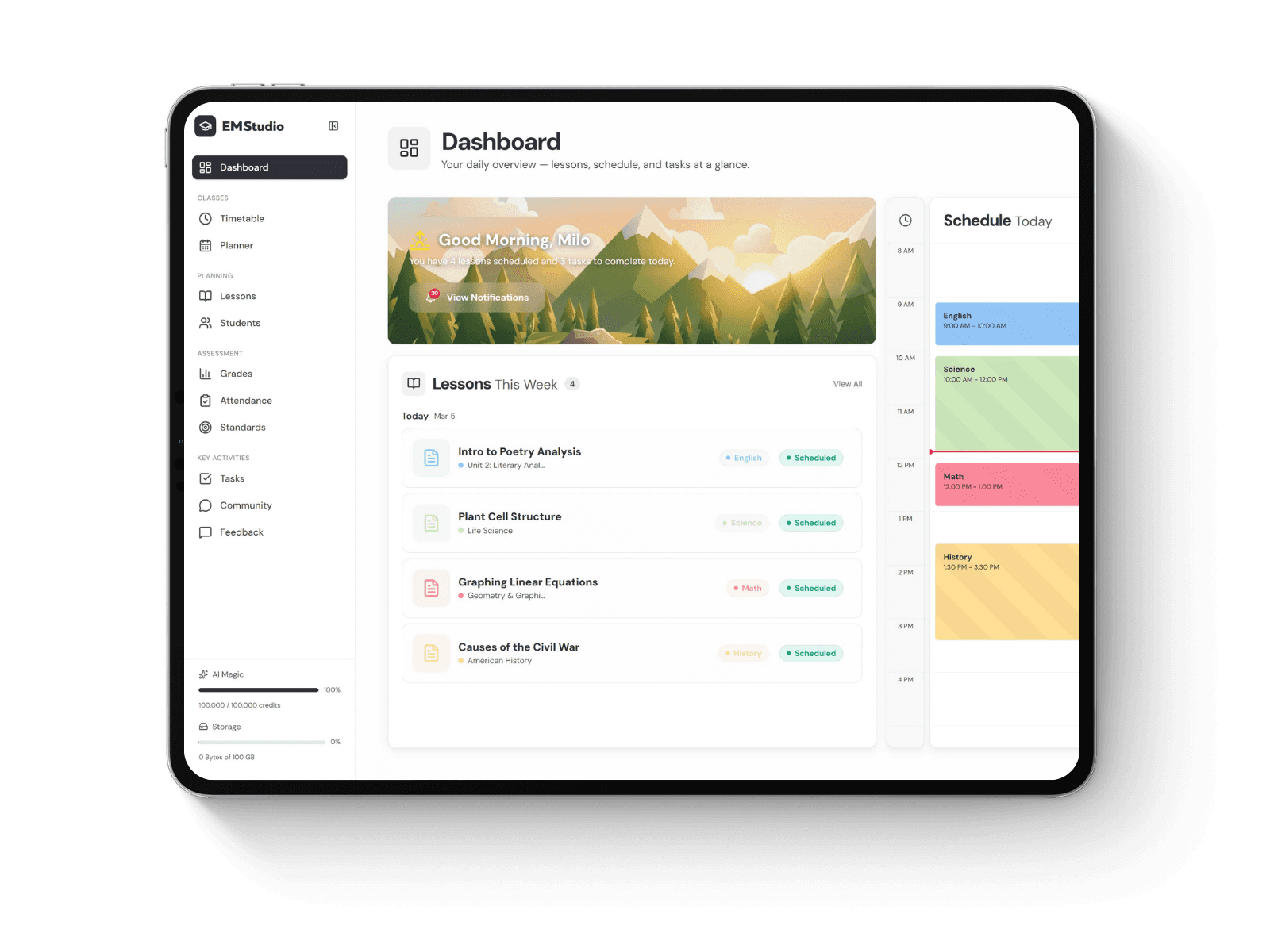
Still grading everything by hand?
EMStudio is a free teaching management app — manage your classes, students, lessons, and more!
Learn More
Table of Contents
Before You Check an Essay, Set the Rules
Useful evidence starts before the assignment. Collect short writing samples in class, using each student's normal accommodations. Keep conditions comparable to later assignments. Several samples give a better reference point than one.
Next, explain what AI assistance the assignment allows. Brainstorming a topic, checking grammar, and asking a chatbot to generate whole paragraphs are different activities. State which are allowed. Specify whether students must disclose AI-assisted edits to a draft they wrote themselves.
A one-line disclosure can help: “I used [tool] to [specific task], and I reviewed or wrote the final wording myself.” Students who used no AI can write “No AI tools used.” Ask everyone, not only students you suspect.
How Teachers Check for AI Writing: Six Practical Checks
No single test establishes authorship. A fair AI check looks at the student’s writing, sources, drafting process, and understanding rather than relying on one signal. These six checks show how to detect AI writing in student essays without treating a suspicion as a verdict. Start with evidence available through normal teaching. Use further checks only when a specific concern warrants them.
Step 1. Compare the Essay With the Student's Previous Writing
Read the essay beside two or three earlier pieces, preferably including work completed in class. Look beyond spelling and vocabulary. Compare how the student makes claims, links ideas, and handles evidence, even when the prose is more polished.
A student who usually struggles to explain quotations might now provide detailed analysis. Ask what helped them make that change before drawing conclusions. Look for continuity in the underlying ideas, not just the surface style.
Note: students improve. Tutoring, feedback, disability accommodations, and extra practice can all change a writing style. Previous work is not a ceiling on achievement. This is how teachers detect AI-written essays without confusing growth with misconduct.
Step 2. Verify Sources, Quotes, and Classroom References
Check two or three claims against the original sources. Does the quotation appear there? Does it support the interpretation? If class materials were required, were they used accurately?
Chatbots can invent convincing references. Students also miscopy passages or confuse editions. Ask where a questionable quotation came from. If a journal citation looks plausible but cannot be located, check the publisher’s website rather than trusting the formatted bibliography.
Genuine citations can show that the sources are reliable, but they do not prove who actually wrote the paragraphs around them.
Step 3. Review the Document's Version History
For a Google Doc you can edit, click File, Version history, and open See version history. Select earlier versions to review changes. See Google's instructions.

In Microsoft Word, select the document title, then Version History, where supported. Microsoft explains that this generally requires OneDrive or SharePoint storage, not just a local file.
As you review the history, look for outlines, revisions, and feedback incorporated over time. If a large section of text appears all at once, you can ask where the original was written and whether the student can share that earlier file. Keep in mind, however, that students may write offline or paste in their own drafts. A large paste or missing version history does not, on its own, prove AI use.
Step 4. Look for Patterns
Look for repeated patterns: broad claims, examples without analysis, or tidy summaries that avoid the assigned question.
Consider a line such as “Throughout history, literature has played a crucial role in shaping society.” It sounds formal, but tells you almost nothing about the assigned novel. A stronger paragraph connects a claim to a scene or passage. You might see the same empty transitions repeated throughout the essay: “Furthermore,” “Moreover,” and “In conclusion,” without any real development of the argument.
There is no reliable list of forbidden “AI words.” Templates, academic conventions, and multilingual writing can produce many of the same patterns. For that reason, evaluate the quality of the argument separately from questions about authorship.
Step 5. Use an AI Checker for Teachers as a Secondary Check
AI detection for student writing works best as a secondary check. If your school approves external services, you can check for AI with a tool such as Clever AI Detector. Its website currently describes free checks without sign-up, an overall AI probability score, and sentence-level signals that highlight passages for review. Treat those signals as prompts to reread particular sentences, not a percentage of the essay proved to be machine-written.

In a 2023 Patterns study, seven detectors wrongly flagged an average of 61.3% of 91 human-written TOEFL essays. That figure describes those tools and that sample, not a universal error rate. For more on what detector results mean, read this teacher’s guide to AI detector scores.
Note: do not upload identifiable student work to an unapproved service. The US Department of Education advises teachers to check with their school or district before using third-party classroom applications. Removing a name may not make an essay anonymous. If approval is unclear, rely on classroom evidence.
Step 6. Ask the Student to Explain Their Essay
A private conversation may clarify more than another scan. Ask questions tied to the student's actual choices: “How did you develop the argument in paragraph three?” “Why did you choose this source?” “What would you change if you revised the conclusion?”
Invite notes, an offline draft, or an explanation of permitted help. You could also ask for a short revision under normal classroom conditions. Keep questions separate from any formal finding.
But nervousness, language barriers, and difficulty explaining ideas aloud do not establish dishonesty, so consider how the student normally communicates when evaluating their answers. Offer accommodations or another response format when appropriate.
What If AI Rewrote a Student's Original Essay?
An essay may be partly student-written and partly AI-rewritten. A student could develop an argument and then have a chatbot replace most sentences; another might only use a grammar checker. Your assignment rules may treat these cases differently. A writing assignment may permit spelling corrections but not a rewrite that replaces the student’s sentence construction.
Tools marketed as an essay humanizer can adjust wording, sentence structure, and tone in AI-assisted drafts. That makes surface-level language signals harder to interpret. A low score cannot reconstruct earlier assistance.
Compare notes, drafts, disclosures, and the final text. Did the student choose the ideas? Did AI merely edit wording or do writing the assignment required? Apply the rules given before the deadline.
How to Review Thirty Essays Without Checking Every Sentence
Checking every sentence for AI wastes grading time. Apply the same criteria to every essay: answer to the question, evidence, and any required AI disclosure.
Flag specific issues, such as an untraceable quotation, and verify them first. Continue normal grading while you clarify concerns. If an authorship concern persists, use the relevant steps rather than sending every essay to a detector.
Be consistent. Improved English, formal style, or a student's background are not grounds for investigation. Comparable concerns deserve the same process and chance to explain.
For future assignments, request an outline or a short revision note. These help with feedback, regardless of AI concerns. A two-minute reflection on the most important revision can reveal more about learning than an extra detector score.
Keep Your Review Notes Organized in Notion
A Notion assignment tracker can organize outstanding follow-ups. Keep fields such as assignment, review status, next action, and follow-up date. You might use views for “To review,” “Waiting for clarification,” and “Complete.”
Do not use a general Notion workspace as a misconduct database. If your school has not approved it for student information, keep names, essays, allegations, and interview notes in your authorized school system instead. Keep only non-identifying tasks there.
Good notes should distinguish what you observed from what you inferred. In an authorized system, note the date, question asked, evidence reviewed, and any follow-up agreed. “Citation missing from named article” is an observation; “student used ChatGPT” is a conclusion that needs separate support.
Frequently Asked Questions
Can teachers tell if an essay was written by AI from one paragraph?
Not reliably. Short, formal passages can be flagged even when a student wrote them. If a paragraph seems out of place, compare it with the rest of the essay and ask the student about the ideas and drafting process. Do not treat a short detector result as a finding.
Is an AI detector the same as a plagiarism checker?
No. A plagiarism checker looks for similarities between submitted text and other material in its searchable sources. An AI detector looks for statistical patterns associated with generated writing. A text may be AI-generated without plagiarism, or plagiarized without AI. Neither tool replaces source verification or a fair review.
Can a teacher prove that a student used ChatGPT?
Sometimes there is direct evidence, such as the student's own disclosure or documented material from the writing process. But a detector score, polished prose, or a large paste in version history cannot establish ChatGPT use by itself. A misconduct decision needs credible evidence and the school's procedure.
The Bottom Line
To check student essays for AI fairly, begin with writing samples, sources, and draft history. Use language patterns and approved detection tools only as supporting information. When a concern remains, ask the student to explain their process and document what you learned. The aim is not to catch unusual writing; it is to assess the work against clear, consistent expectations.
Before You Check an Essay, Set the Rules
Useful evidence starts before the assignment. Collect short writing samples in class, using each student's normal accommodations. Keep conditions comparable to later assignments. Several samples give a better reference point than one.
Next, explain what AI assistance the assignment allows. Brainstorming a topic, checking grammar, and asking a chatbot to generate whole paragraphs are different activities. State which are allowed. Specify whether students must disclose AI-assisted edits to a draft they wrote themselves.
A one-line disclosure can help: “I used [tool] to [specific task], and I reviewed or wrote the final wording myself.” Students who used no AI can write “No AI tools used.” Ask everyone, not only students you suspect.
How Teachers Check for AI Writing: Six Practical Checks
No single test establishes authorship. A fair AI check looks at the student’s writing, sources, drafting process, and understanding rather than relying on one signal. These six checks show how to detect AI writing in student essays without treating a suspicion as a verdict. Start with evidence available through normal teaching. Use further checks only when a specific concern warrants them.
Step 1. Compare the Essay With the Student's Previous Writing
Read the essay beside two or three earlier pieces, preferably including work completed in class. Look beyond spelling and vocabulary. Compare how the student makes claims, links ideas, and handles evidence, even when the prose is more polished.
A student who usually struggles to explain quotations might now provide detailed analysis. Ask what helped them make that change before drawing conclusions. Look for continuity in the underlying ideas, not just the surface style.
Note: students improve. Tutoring, feedback, disability accommodations, and extra practice can all change a writing style. Previous work is not a ceiling on achievement. This is how teachers detect AI-written essays without confusing growth with misconduct.
Step 2. Verify Sources, Quotes, and Classroom References
Check two or three claims against the original sources. Does the quotation appear there? Does it support the interpretation? If class materials were required, were they used accurately?
Chatbots can invent convincing references. Students also miscopy passages or confuse editions. Ask where a questionable quotation came from. If a journal citation looks plausible but cannot be located, check the publisher’s website rather than trusting the formatted bibliography.
Genuine citations can show that the sources are reliable, but they do not prove who actually wrote the paragraphs around them.
Step 3. Review the Document's Version History
For a Google Doc you can edit, click File, Version history, and open See version history. Select earlier versions to review changes. See Google's instructions.
In Microsoft Word, select the document title, then Version History, where supported. Microsoft explains that this generally requires OneDrive or SharePoint storage, not just a local file.
As you review the history, look for outlines, revisions, and feedback incorporated over time. If a large section of text appears all at once, you can ask where the original was written and whether the student can share that earlier file. Keep in mind, however, that students may write offline or paste in their own drafts. A large paste or missing version history does not, on its own, prove AI use.
Step 4. Look for Patterns
Look for repeated patterns: broad claims, examples without analysis, or tidy summaries that avoid the assigned question.
Consider a line such as “Throughout history, literature has played a crucial role in shaping society.” It sounds formal, but tells you almost nothing about the assigned novel. A stronger paragraph connects a claim to a scene or passage. You might see the same empty transitions repeated throughout the essay: “Furthermore,” “Moreover,” and “In conclusion,” without any real development of the argument.
There is no reliable list of forbidden “AI words.” Templates, academic conventions, and multilingual writing can produce many of the same patterns. For that reason, evaluate the quality of the argument separately from questions about authorship.
Step 5. Use an AI Checker for Teachers as a Secondary Check
AI detection for student writing works best as a secondary check. If your school approves external services, you can check for AI with a tool such as Clever AI Detector. Its website currently describes free checks without sign-up, an overall AI probability score, and sentence-level signals that highlight passages for review. Treat those signals as prompts to reread particular sentences, not a percentage of the essay proved to be machine-written.
In a 2023 Patterns study, seven detectors wrongly flagged an average of 61.3% of 91 human-written TOEFL essays. That figure describes those tools and that sample, not a universal error rate. For more on what detector results mean, read this teacher’s guide to AI detector scores.
Note: do not upload identifiable student work to an unapproved service. The US Department of Education advises teachers to check with their school or district before using third-party classroom applications. Removing a name may not make an essay anonymous. If approval is unclear, rely on classroom evidence.
Step 6. Ask the Student to Explain Their Essay
A private conversation may clarify more than another scan. Ask questions tied to the student's actual choices: “How did you develop the argument in paragraph three?” “Why did you choose this source?” “What would you change if you revised the conclusion?”
Invite notes, an offline draft, or an explanation of permitted help. You could also ask for a short revision under normal classroom conditions. Keep questions separate from any formal finding.
But nervousness, language barriers, and difficulty explaining ideas aloud do not establish dishonesty, so consider how the student normally communicates when evaluating their answers. Offer accommodations or another response format when appropriate.
What If AI Rewrote a Student's Original Essay?
An essay may be partly student-written and partly AI-rewritten. A student could develop an argument and then have a chatbot replace most sentences; another might only use a grammar checker. Your assignment rules may treat these cases differently. A writing assignment may permit spelling corrections but not a rewrite that replaces the student’s sentence construction.
Tools marketed as an essay humanizer can adjust wording, sentence structure, and tone in AI-assisted drafts. That makes surface-level language signals harder to interpret. A low score cannot reconstruct earlier assistance.
Compare notes, drafts, disclosures, and the final text. Did the student choose the ideas? Did AI merely edit wording or do writing the assignment required? Apply the rules given before the deadline.
How to Review Thirty Essays Without Checking Every Sentence
Checking every sentence for AI wastes grading time. Apply the same criteria to every essay: answer to the question, evidence, and any required AI disclosure.
Flag specific issues, such as an untraceable quotation, and verify them first. Continue normal grading while you clarify concerns. If an authorship concern persists, use the relevant steps rather than sending every essay to a detector.
Be consistent. Improved English, formal style, or a student's background are not grounds for investigation. Comparable concerns deserve the same process and chance to explain.
For future assignments, request an outline or a short revision note. These help with feedback, regardless of AI concerns. A two-minute reflection on the most important revision can reveal more about learning than an extra detector score.
Keep Your Review Notes Organized in Notion
A Notion assignment tracker can organize outstanding follow-ups. Keep fields such as assignment, review status, next action, and follow-up date. You might use views for “To review,” “Waiting for clarification,” and “Complete.”
Do not use a general Notion workspace as a misconduct database. If your school has not approved it for student information, keep names, essays, allegations, and interview notes in your authorized school system instead. Keep only non-identifying tasks there.
Good notes should distinguish what you observed from what you inferred. In an authorized system, note the date, question asked, evidence reviewed, and any follow-up agreed. “Citation missing from named article” is an observation; “student used ChatGPT” is a conclusion that needs separate support.
Frequently Asked Questions
Can teachers tell if an essay was written by AI from one paragraph?
Not reliably. Short, formal passages can be flagged even when a student wrote them. If a paragraph seems out of place, compare it with the rest of the essay and ask the student about the ideas and drafting process. Do not treat a short detector result as a finding.
Is an AI detector the same as a plagiarism checker?
No. A plagiarism checker looks for similarities between submitted text and other material in its searchable sources. An AI detector looks for statistical patterns associated with generated writing. A text may be AI-generated without plagiarism, or plagiarized without AI. Neither tool replaces source verification or a fair review.
Can a teacher prove that a student used ChatGPT?
Sometimes there is direct evidence, such as the student's own disclosure or documented material from the writing process. But a detector score, polished prose, or a large paste in version history cannot establish ChatGPT use by itself. A misconduct decision needs credible evidence and the school's procedure.
The Bottom Line
To check student essays for AI fairly, begin with writing samples, sources, and draft history. Use language patterns and approved detection tools only as supporting information. When a concern remains, ask the student to explain their process and document what you learned. The aim is not to catch unusual writing; it is to assess the work against clear, consistent expectations.
Still grading everything by hand?
EMStudio is a free teaching management app — manage your classes, students, lessons, and more!
Learn More
Still grading everything by hand?
EMStudio is a free teaching management app — manage your classes, students, lessons, and more!
Learn More
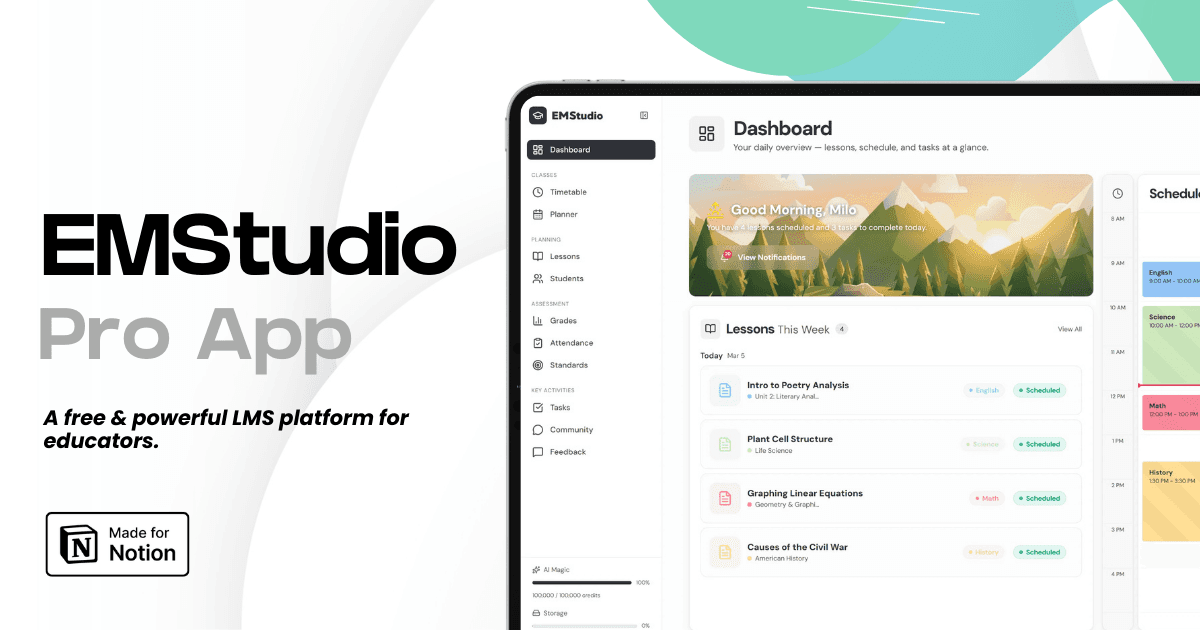


Notion4Teachers
Notion templates to simplify administrative tasks and enhance your teaching experience.


2026 Notion4Teachers. All Rights Reserved.
Notion4Teachers
Notion templates to simplify administrative tasks and enhance your teaching experience.
2026 Notion4Teachers. All Rights Reserved.
Notion4Teachers
Notion templates to simplify administrative tasks and enhance your teaching experience.
2026 Notion4Teachers. All Rights Reserved.