
A Teacher’s Guide to AI Detector Results: When the Essay Sounds Too Polished
A Teacher’s Guide to AI Detector Results: When the Essay Sounds Too Polished

Article by
Milo
ESL Content Coordinator & Educator
ESL Content Coordinator & Educator
All Posts
Most teachers now know the feeling. A student who writes in fragments all term hands in a reflection that flows like an editorial: balanced sentences, careful qualifications, a neat “on the other hand” in every second paragraph. Nothing is wrong with it — and that is exactly what feels wrong.
The temptation is to paste it into an AI detector and let the tool decide. This guide is about what that tool can actually tell you, what it can’t, and how to build a routine that is fair to students and defensible if a parent or an administrator asks how you reached a conclusion.
Still grading everything by hand?
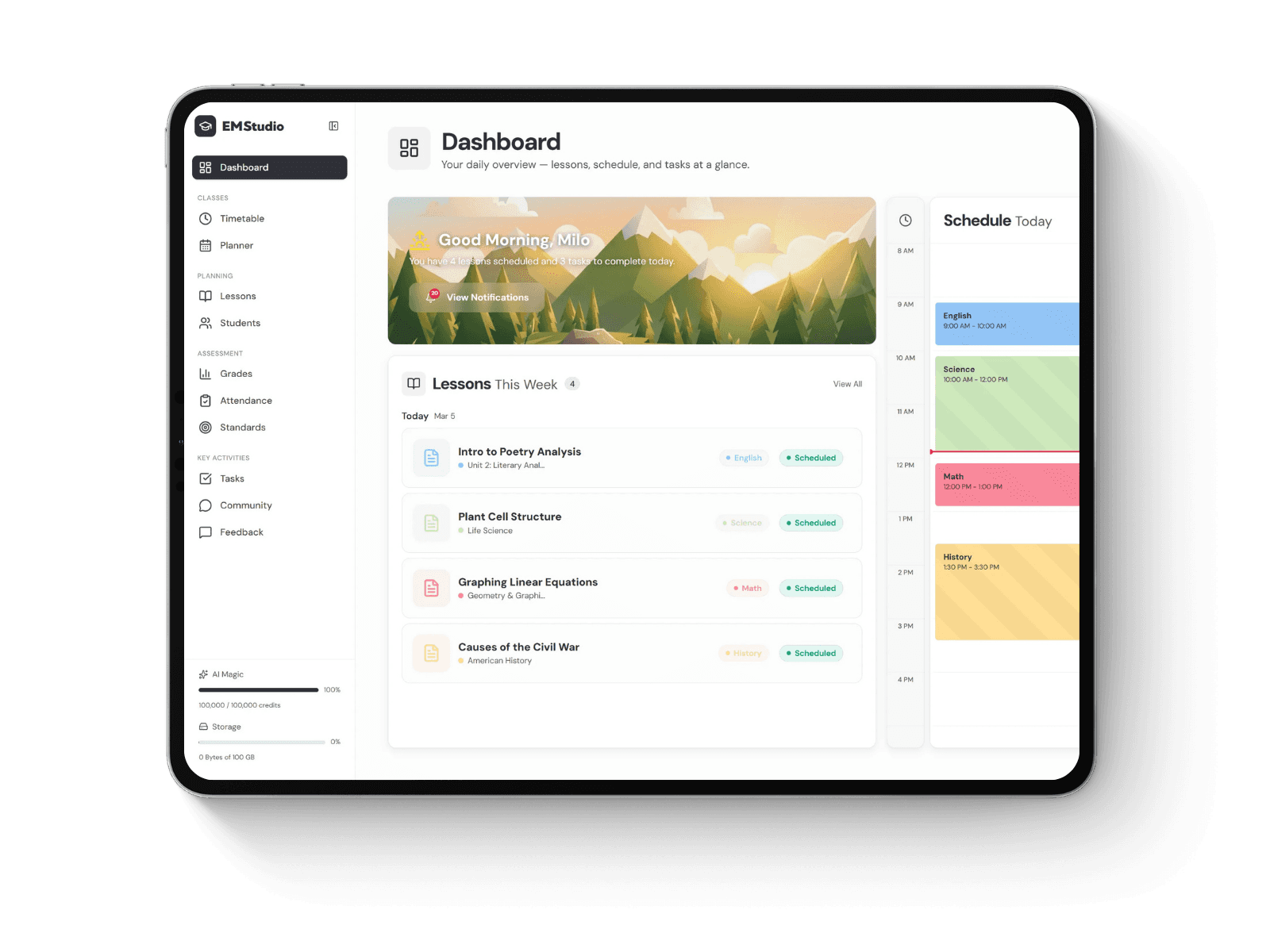
EMStudio is a free teaching management app — manage your classes, students, lessons, and more!
Learn More
Still grading everything by hand?
EMStudio is a free teaching management app — manage your classes, students, lessons, and more!
Learn More
Table of Contents
What the number is
An AI detector does not know who wrote a text. It compares the writing with large samples of human and machine-generated prose and reports how strongly the passage matches the machine side. The result is usually a score on a 0–100 scale plus a band such as “Likely human-written”, “Uncertain” or “Likely AI-written”.
Read that number as a signal strength, not a probability. A 90 does not mean there is a 90% chance a student used AI, and it does not mean 90% of the essay was generated. It means the writing sits high on the tool’s scale of AI-like patterns: unusually uniform sentence lengths, stock transition phrases, generic vocabulary, an absence of specific detail.
Those same patterns show up in perfectly honest student writing, which brings us to the first rule.
Rule one: know who gets flagged wrongly
Three kinds of students produce text that detectors flag more often than others.
Students writing in a second language tend to choose safe words and standard structures, which reads as “low surprise” to a statistical model. Students who follow a rigid template — the five-paragraph essay, the lab-report scaffold, the sentence starters you gave them — produce formulaic prose by design. And students who write short answers give the tool very little to work with: a 120-word response can be flagged for reasons that would disappear in a 400-word one.
A responsible tool publishes how often this happens. One example: the team behind AI Detector Checker ran a single sealed test on their current engine and published the results, including the targets they missed. On human texts of 150 words or more, about 2 in every 1,000 received a wrong AI signal; on texts of 100 to 149 words it was about 2.4 in 100. Their Claude AI detector page is worth reading precisely because it explains what a strong signal does not establish — and why carefully qualified, well-structured prose (the kind Claude tends to produce, and the kind good students are taught to produce) is hard for any detector to separate from careful human writing.
Rule two: check whole pieces, then read them yourself
Paste complete work, not a paragraph. Most tools require at least 100 words and are far more reliable above 150. Note the length band the tool reports alongside the score, because the false-flag rate changes with it.
Then read the essay yourself for the patterns the tool describes. This is the step most people skip, and it is the one that actually builds a case. Do the sentences all land between 18 and 25 words? Are there numbers, names, places, a first-person moment, a mistake that a model would not make? Is there anything the student could only know from being in your classroom? Human writing has fingerprints; generic prose does not.
Rule three: the tool is not the evidence
If the signal is strong, the evidence you need lives outside the detector.
Drafts and revision history come first. Google Docs, Notion pages and most learning platforms keep version history, and a genuine writing process leaves a trail: false starts, reordered paragraphs, a title that changed three times. A pasted-in essay arrives fully formed.
A conversation comes second, and it is often decisive. Ask the student to explain their second paragraph, to expand a claim, or to say what they would change with another hour. Someone who wrote the piece can answer immediately; someone who didn’t will describe the essay rather than the thinking behind it.
Notes, outlines and earlier assignments come third. Compare the flagged piece with work the student produced in class, under conditions you controlled.
What to do with each result
Strong signal. Do not accuse. Gather drafts, compare with in-class work, and talk to the student. If your school has a policy, follow it; if it doesn’t, this is the moment to propose one that treats detector output as a reason to investigate, never as a finding.
Uncertain. Treat it as “no useful answer”. Mixed or edited text often lands here, and so does ordinary careful writing. It is not a weak accusation.
No strong signal. This is not clearance. Detectors miss a large share of AI-written text, especially after light editing. Grade the work on its merits and keep the same standards of evidence you would apply to anything else.
If a student’s work is flagged and they insist it is theirs, this guide to what a flagged writer should do next is a fair thing to share with them: it explains what a flag means and what kinds of evidence resolve it.
A classroom routine that holds up
Set expectations before the first assignment: which AI uses are allowed, which are not, and that you will ask for drafts. Design tasks that leave a trail — in-class writing, outlines submitted before the essay, reflections tied to specific classroom moments. Keep a simple record of what you looked at when you did investigate: score, length band, the patterns you saw, the drafts you reviewed, what the student said. And never let a single number stand alone in a conversation with a parent or a principal.
Detectors can earn a place in that routine. They are useful for deciding where to spend your attention. They are not useful for deciding what happened — and a teacher who knows the difference is far harder to argue with than one who trusts the score.
What the number is
An AI detector does not know who wrote a text. It compares the writing with large samples of human and machine-generated prose and reports how strongly the passage matches the machine side. The result is usually a score on a 0–100 scale plus a band such as “Likely human-written”, “Uncertain” or “Likely AI-written”.
Read that number as a signal strength, not a probability. A 90 does not mean there is a 90% chance a student used AI, and it does not mean 90% of the essay was generated. It means the writing sits high on the tool’s scale of AI-like patterns: unusually uniform sentence lengths, stock transition phrases, generic vocabulary, an absence of specific detail.
Those same patterns show up in perfectly honest student writing, which brings us to the first rule.
Rule one: know who gets flagged wrongly
Three kinds of students produce text that detectors flag more often than others.
Students writing in a second language tend to choose safe words and standard structures, which reads as “low surprise” to a statistical model. Students who follow a rigid template — the five-paragraph essay, the lab-report scaffold, the sentence starters you gave them — produce formulaic prose by design. And students who write short answers give the tool very little to work with: a 120-word response can be flagged for reasons that would disappear in a 400-word one.
A responsible tool publishes how often this happens. One example: the team behind AI Detector Checker ran a single sealed test on their current engine and published the results, including the targets they missed. On human texts of 150 words or more, about 2 in every 1,000 received a wrong AI signal; on texts of 100 to 149 words it was about 2.4 in 100. Their Claude AI detector page is worth reading precisely because it explains what a strong signal does not establish — and why carefully qualified, well-structured prose (the kind Claude tends to produce, and the kind good students are taught to produce) is hard for any detector to separate from careful human writing.
Rule two: check whole pieces, then read them yourself
Paste complete work, not a paragraph. Most tools require at least 100 words and are far more reliable above 150. Note the length band the tool reports alongside the score, because the false-flag rate changes with it.
Then read the essay yourself for the patterns the tool describes. This is the step most people skip, and it is the one that actually builds a case. Do the sentences all land between 18 and 25 words? Are there numbers, names, places, a first-person moment, a mistake that a model would not make? Is there anything the student could only know from being in your classroom? Human writing has fingerprints; generic prose does not.
Rule three: the tool is not the evidence
If the signal is strong, the evidence you need lives outside the detector.
Drafts and revision history come first. Google Docs, Notion pages and most learning platforms keep version history, and a genuine writing process leaves a trail: false starts, reordered paragraphs, a title that changed three times. A pasted-in essay arrives fully formed.
A conversation comes second, and it is often decisive. Ask the student to explain their second paragraph, to expand a claim, or to say what they would change with another hour. Someone who wrote the piece can answer immediately; someone who didn’t will describe the essay rather than the thinking behind it.
Notes, outlines and earlier assignments come third. Compare the flagged piece with work the student produced in class, under conditions you controlled.
What to do with each result
Strong signal. Do not accuse. Gather drafts, compare with in-class work, and talk to the student. If your school has a policy, follow it; if it doesn’t, this is the moment to propose one that treats detector output as a reason to investigate, never as a finding.
Uncertain. Treat it as “no useful answer”. Mixed or edited text often lands here, and so does ordinary careful writing. It is not a weak accusation.
No strong signal. This is not clearance. Detectors miss a large share of AI-written text, especially after light editing. Grade the work on its merits and keep the same standards of evidence you would apply to anything else.
If a student’s work is flagged and they insist it is theirs, this guide to what a flagged writer should do next is a fair thing to share with them: it explains what a flag means and what kinds of evidence resolve it.
A classroom routine that holds up
Set expectations before the first assignment: which AI uses are allowed, which are not, and that you will ask for drafts. Design tasks that leave a trail — in-class writing, outlines submitted before the essay, reflections tied to specific classroom moments. Keep a simple record of what you looked at when you did investigate: score, length band, the patterns you saw, the drafts you reviewed, what the student said. And never let a single number stand alone in a conversation with a parent or a principal.
Detectors can earn a place in that routine. They are useful for deciding where to spend your attention. They are not useful for deciding what happened — and a teacher who knows the difference is far harder to argue with than one who trusts the score.
Still grading everything by hand?
EMStudio is a free teaching management app — manage your classes, students, lessons, and more!
Learn More
Still grading everything by hand?
EMStudio is a free teaching management app — manage your classes, students, lessons, and more!
Learn More




Notion4Teachers
Notion templates to simplify administrative tasks and enhance your teaching experience.



2026 Notion4Teachers. All Rights Reserved.
Notion4Teachers
Notion templates to simplify administrative tasks and enhance your teaching experience.
2026 Notion4Teachers. All Rights Reserved.
Notion4Teachers
Notion templates to simplify administrative tasks and enhance your teaching experience.
2026 Notion4Teachers. All Rights Reserved.