
15 Generation Teach Resources for Effective Classroom Implementation
15 Generation Teach Resources for Effective Classroom Implementation

Article by
Milo
ESL Content Coordinator & Educator
ESL Content Coordinator & Educator
All Posts
You keep hearing about generation teach strategies in PD sessions, but nobody shows you what that looks like during third period on a Tuesday. I spent my first year with these pedagogical frameworks drowning in vision statements while my students drowned in worksheets. Theory doesn't grade papers. You need specific tools that fit into your existing workflow without requiring a complete teardown of your room every weekend.
This post covers fifteen resources I've actually used with real kids. We'll look at differentiated instruction for elementary readers who can't sit still, student-centered learning activities that keep middle schoolers from destroying each other during group work, and high school methods that actually build independence—not just the label. I also share the digital platforms worth your time.
You'll learn how to track progress without inventing new assessment categories. I've sat through enough instructional coaching sessions that confused "engagement" with "keeping kids busy." These tools work because they prioritize formative feedback over flashy tech. Some require prep. Others you can launch tomorrow.
All of them respect the reality that you have 32 kids, limited copies, and maybe one working marker. No classroom management systems overhaul required. Just practical moves that make the philosophy actually function in a real building.
Still grading everything by hand?
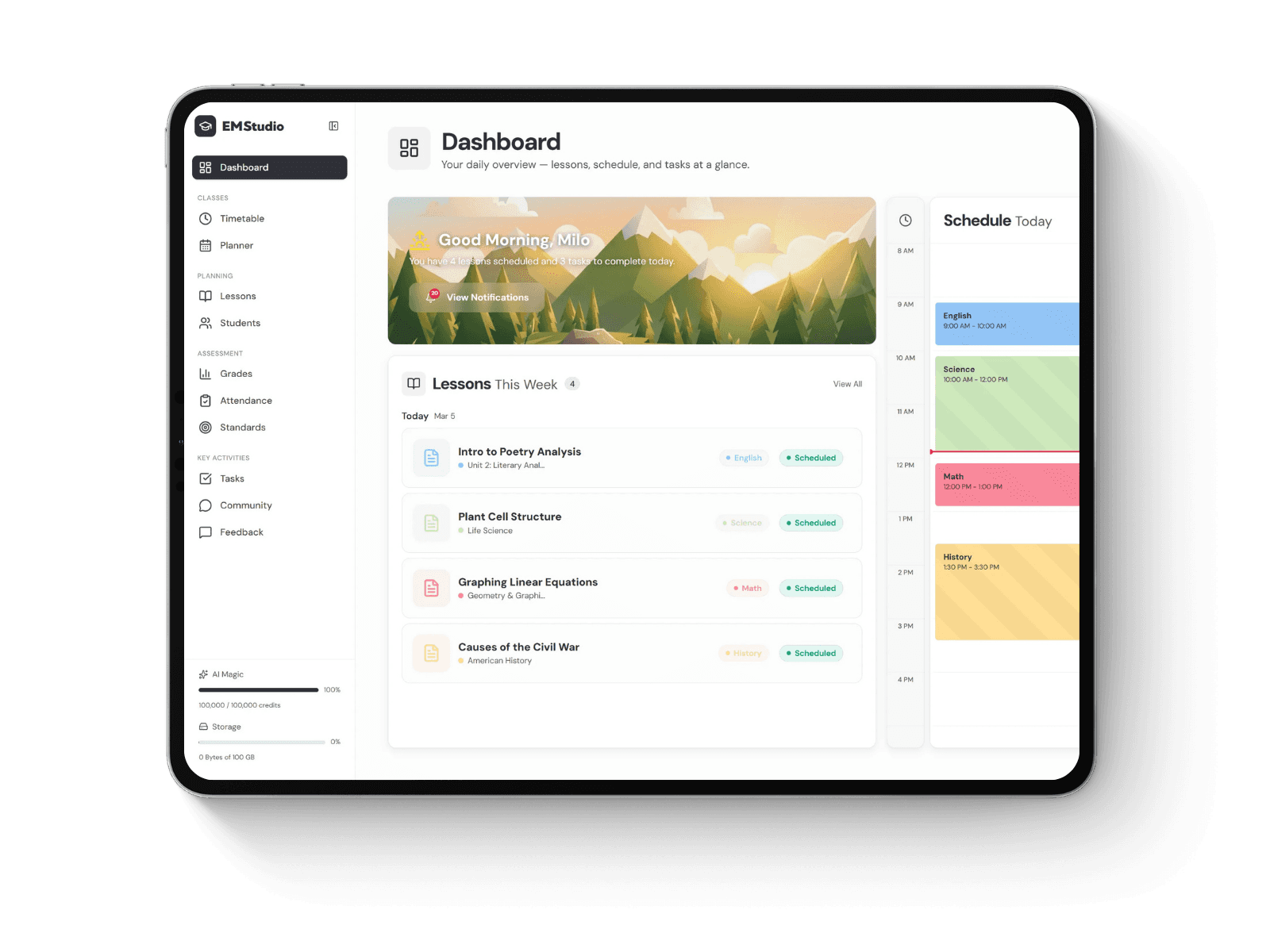
EMStudio is a free teaching management app — manage your classes, students, lessons, and more!
Learn More
Still grading everything by hand?
EMStudio is a free teaching management app — manage your classes, students, lessons, and more!
Learn More
Table of Contents
What Are the Best Generation Teach Strategies for Elementary Classrooms?
The best Generation Teach strategies for elementary classrooms include phonics-based learning centers using Wilson FUNdations or UFLI curricula, hands-on math manipulative stations following the Concrete-Representational-Abstract progression, and Morning Meeting protocols built on Responsive Classroom principles. These methods emphasize student-centered inquiry, typically requiring 12-15 minute rotation blocks and specific material investments of $200-$400 per classroom.
Generation Teach elementary strategies center on inquiry-based stations and social-emotional morning routines for grades K-5. Unlike direct instruction models with 45-minute whole-group lessons, these approaches split your class into fluid groups rotating through stations. The model assumes young learners construct knowledge through peer interaction and tactile exploration, not passive listening.
This is a developmental progression. You build literacy foundations in grades K-2 through phonics centers. Grades 2-4 use concrete mathematical reasoning with manipulatives. All grades need community building protocols. Each layer supports the next.
The hard truth: Generation Teach centers require 15-20 minutes of independent work. Students below the 30th percentile in self-regulation will fail in standard centers. You must start them on differentiated "micro-center" protocols with 5-minute stations to build stamina. Ignore this and you will spend your entire block managing behavior, not teaching.
Research shows students need 4-6 weeks of practice before hitting the 85% engagement threshold typical of mature Generation Teach classrooms. Those first weeks feel messy. Students test boundaries. Materials scatter. Stick with the protocols anyway. Week five brings a shift when students begin self-correcting and peer-coaching without intervention.
Phonics-Based Learning Centers for Early Readers
Your K-2 learning centers for early readers need three rotation types. Run Wilson FUNdations Alphabet Magnetic Board Station for grades K-1 where students build words phonetically. Add UFLI Foundation Skills Decodable Reader Partner Check for grades 1-2 for practice. Include Heggerty Phonemic Awareness Listening Center spanning K-2 where students follow oral blending routines.
Materials cost money. Magnetic letter trays run $25 per set. Decodable text libraries cost $180 per level. Wireless headphones cost $40 per pair. Budget $200-$400 per classroom. Cheap headphones cause audio bleed and breakage all year.
Run stations on a 12-15 minute schedule with three centers daily. Use a Must Do/May Do accountability sheet. Students complete tasks before moving to extensions. This prevents wandering.
Hands-On Math Manipulative Stations
Concrete manipulatives vary by grade band.
Kindergarteners and first graders need Unifix cubes and ten frames for number sense and composing numbers.
Second and third graders work with base-ten blocks and fraction tiles for place value and part-whole relationships.
Fourth and fifth graders transition to algebra tiles and geoboards for abstract concept visualization and area models.
Follow Concrete-Representational-Abstract (CRA) protocol strictly. Students demonstrate mastery at the concrete tier for three consecutive days before advancing to representational work. They repeat this at the representational level before advancing to abstract. Skip a tier and you create gaps later.
Manipulatives become toys without explicit objectives. I learned this in my second year when students built towers instead of comparing fractions. Use the Mathematical Practice Look-Fors checklist. This tool keeps academic focus sharp by showing which behaviors indicate mathematical reasoning versus play.
Morning Meeting Social-Emotional Protocols
Responsive Classroom Morning Meeting adapts perfectly. Spend two minutes on Greeting, three on Share, five on Activity, and three on Message. This 13-minute investment pays off later. Your social-emotional learning activities here set the tone for the day.
Match your SEL sequence to developmental stages.
Grades K-2 use Emotion Thermometer Check-In with a 1-5 scale visual. Students point to current energy level and name one strategy to get to "green."
Grades 3-5 use Rose, Thorn, Bud reflection. They share one highlight, one challenge, and one emerging opportunity.
Track this through student recall. Within four weeks, 85% of your class should name morning meeting norms verbatim. Look for phrases like "We look at the speaker" or "We use school-appropriate voices." If fewer than eight of ten students know the norms, your routines need tightening.
Which Generation Teach Activities Work Best for Middle School?
Middle school Generation Teach activities center on three distinct approaches. Use Project-Based Science Investigation Kits like SEPUP or FOSS for month-long inquiry units. Run Structured Academic Controversy protocols for humanities discourse. Deploy modular Digital Citizenship curricula from Common Sense Education. You will need 45-55 minute block periods and 1:1 device access to run these properly.
This is the pivot point. Grades 6-8 abandon elementary centers for structured inquiry and academic discourse. Forty-two minute periods suffocate these activities; you need block scheduling to make them breathe.
Match your method to your subject. Project-based science investigation works for labs requiring hands-on inquiry. Structured Academic Controversy fits humanities classes building academic discourse. Digital Citizenship modules slot into advisory periods for targeted skill building.
You cannot run these without proper tech. You need 1:1 device access or a 2:1 ratio minimum, plus 15 Mbps bandwidth per classroom. Anything less and the digital components freeze during peak usage, killing the momentum of a good lab or debate.
Project-Based Science Investigation Kits
The kits follow the 5E instructional model. Start with an Engage phenomenon video. Move to Explore through hands-on labs. Explain via jigsaw reading activities. Elaborate with engineering challenges. Evaluate through scientific argumentation presentations. Plan for four units annually.
Each unit consumes 3-4 weeks. Budget $12 to $18 per student per unit for physical materials. Last spring my 7th graders spent three weeks on chemical reactions, redesigning protocols after failed attempts. That iteration loop requires time.
Structured Academic Controversy Protocols
Structured Academic Controversy organizes four students into pro and con pairs. You run four rounds: teams present positions, seek perspectives from opponents, build consensus, and reflect. Try "Was the New Deal effective?" for history, or "Should schools ban smartphones?" for advisory.
SAC collapses when you pick binary topics. If the answer is obviously yes or no, the discussion dies. Apply the Goldilocks Complexity Test: look for 3-4 viable positions, evidence-rich sources, and emotional distance. "Should we have homework?" fails; "Which homework model supports retention best?" passes.
Digital Literacy and Citizenship Modules
The curriculum includes Common Sense Education (free), Google's Be Internet Awesome (game-based), or iKeepSafe Generation Safe. These cover six competency areas: Internet Safety, Privacy & Security, Relationships & Communication, Cyberbullying, Digital Footprint & Reputation, and Creative Credit & Copyright.
Students complete one module monthly, taking 30 to 40 minutes. I map Cyberbullying units to October and Copyright to March before research papers. Effective programs show 20%+ knowledge gains on pre/post assessments. Check your digital literacy and citizenship guide for pacing templates.

High School Generation Teach Methods That Build Independence
High school generation teach methods prepare students for the moment when no one is watching. By grades 9-12, the goal shifts from content coverage to metacognition and professional skill development. I watched too many graduates struggle with freshman seminar courses because they had never managed an open-ended research project.
Structure the progression deliberately toward student-centered learning. Ninth and tenth graders build Career Readiness Portfolios with quarterly reviews. Eleventh graders enter Socratic Seminars with complex texts. Twelfth graders conduct fully autonomous research using academic databases. This pipeline creates self-directed learners.
Instruction Model | Annual Cost per Classroom | Engagement Outcome |
|---|---|---|
Generation Teach | $2,400 | High (student-driven inquiry, autonomous research) |
Traditional Textbook-Dependent | $1,800 | Lower (passive content consumption) |
Career Readiness Portfolio Frameworks
Start with the platform that fits your tech ecosystem. Naviance dominates—it's already embedded in 40% of US high schools with built-in career inventories. If your district cut licensing fees, Google Sites works fine for creating effective student portfolios without spending a dime. For schools focused specifically on the higher ed transition, Portfolium connects directly to university admissions offices.
The portfolio needs substance beyond screenshots. I require six specific artifacts:
A resume updated every quarter.
Complete documentation from one capstone project.
Two sealed letters of recommendation.
Digital badges earned through Credly or Badgr.
RIASEC career inventory results.
One failure narrative analyzing what went wrong.
Every nine weeks, students complete a self-assessment using the NACE Career Readiness Competencies rubric. They rate themselves on critical thinking, communication, and professionalism. I schedule 15-minute conferences during independent work days. Students bring their portfolio evidence; I listen. By junior year, they run the meeting while I take notes. That's the independence we're building.
Socratic Seminar Discussion Guides
The Inner Circle/Outer Circle protocol ensures 100% participation. Place 8-12 students in the center discussing complex texts while the outer circle completes Socratic Tracker observation sheets. They note specific evidence usage, question quality, and speaking patterns. At the 15-minute mark, circles switch roles. The outer group enters the discussion with prepared counterarguments. No one zones out checking their phone.
Eleventh graders need texts that genuinely stretch their reading ability. Select readings with Lexile measures 100-200 points above grade level—target 1185L to 1285L for standard junior English. This discomfort aligns with Socratic methods of teaching that prioritize grappling with ambiguity over simple comprehension checks.
Choose your seminar catalyst based on your pedagogical frameworks. Paideia seminars follow a formal three-part structure with specific speaking rules. Shared Inquiry from the Great Books Foundation emphasizes interpretive questions with no single right answer. The Spider Web discussion method, drawn from Daring Greatly, maps conversation flow visually on the board so students see who dominates the airtime and who needs explicit invitations to speak.
Research and Argumentation Skill Builders
By senior year, students must drive the inquiry without daily scaffolding. I implement the Argument-Driven Inquiry (ADI) framework:
Identify a phenomenon or research question.
Design the investigation method.
Collect and analyze raw data.
Develop a claim supported by evidence.
Submit to peer review and formative feedback.
Revise the final report based on critique.
Give them access to real academic databases. JSTOR works for AP and IB classes with institutional logins. ProQuest SIRS Issues Researcher and Gale In Context offer secondary-appropriate peer-reviewed sources without paywall frustration. Teach citation management early—Zotero or even a shared Google Doc works.
Set rigorous benchmarks. Juniors and seniors write four argumentative essays annually, each 1,200 to 1,500 words, citing at least eight peer-reviewed sources. When my 12th graders hit their first college library database, they already know how to navigate abstracts and methodology sections. That autonomous research capability is the endgame of high school generation teach.

What Digital Platforms Support Generation Teach Implementation?
Digital platforms supporting Generation Teach include Learning Management Systems like Canvas or Google Classroom for content delivery, interactive video tools such as Edpuzzle or PlayPosit for asynchronous instruction, and collaborative workspaces like Padlet or Miro for project-based learning. Successful implementation requires 25+ Mbps internet, single sign-on capability, and limiting the tool stack to 3-4 core platforms to avoid fatigue.
Digital tools amplify generation teach methods, but only if your infrastructure can handle the load. I learned this when six laptops buffering crashed our school's 10 Mbps connection during a documentary project.
Verify three non-negotiables before adding platforms: minimum 25 Mbps internet per classroom, single sign-on (SSO) capability, and IT support responding within four hours. I've seen innovative lessons die because teachers waited days for password resets while units marched on. Your classroom management systems need this backbone.
Platform Type | Primary Function | Generation Teach Application |
|---|---|---|
LMS (Canvas, Google Classroom) | Content delivery | Houses units, distributes differentiated materials |
Interactive Video (Edpuzzle, PlayPosit) | Asynchronous instruction | Enables self-paced learning with embedded checks |
Collaborative Workspaces (Padlet, Miro) | Project synthesis | Supports visible thinking and shared construction |
The fastest way to kill instructional coaching momentum is platform fatigue. Cap your stack at three or four core platforms district-wide. This constraint forces intentionality and prevents cognitive overload that derails student-centered learning.
Learning Management System Integration Templates
Choosing an LMS shapes your daily workflow:
Google Classroom: Free with twenty-minute setup, but limited gradebook for standards-based reporting.
Canvas: $3-5 per student annually with robust mastery paths, though expect a six-week learning curve.
Schoology: Moderate cost with superior parent portals that keep guardians informed without inbox flooding.
Effective templates require consistency. Build unit folders using "Week X: Topic" naming so students know where to look. Embed generation teach rubrics directly into assignment instructions. In Canvas, set up automated mastery paths unlocking extensions only after 80% proficiency.
Budget eight to twelve hours for initial template builds. This upfront investment pays dividends. Weekly maintenance drops to thirty minutes once the skeleton exists—mostly updating dates. See our learning management systems guide.
Interactive Video Lesson Creation Tools
Video tools vary in differentiated instruction utility. Edpuzzle offers twenty free videos; unlimited runs $12.50 monthly. PlayPosit costs $249 yearly with branching scenarios. Nearpod functions as a full lesson platform at $150 annually, replacing slide decks entirely.
Three video types drive my practice:
Inquiry hooks: Three to five minute phenomenon videos without explanation, sparking curiosity before direct instruction.
Skill demonstrations: Teacher models annotation or problem-solving while students pause and mirror the work.
Expert interviews: Local professionals explaining career connections to classroom content.
Embed two to three questions per five minutes of video to maintain engagement. These checkpoints provide formative feedback and prevent passive viewing. Data reveals exactly where understanding breaks down before class begins.
Collaborative Digital Workspace Setups
Selecting tools requires honesty about devices. Padlet works on tablets with three free boards; unlimited costs $8 monthly. Miro offers three free education boards but needs laptops for full functionality. Notion remains free for educators though young students need scaffolding.
Structure prevents chaos. Use the Digital Collaboration Protocol with visible role cards:
Facilitator: Keeps discussion moving and ensures all voices participate.
Recorder: Captures consensus and saves work to the shared space.
Timekeeper: Watches the clock and alerts the group at ten, twenty, and thirty-minute check-ins.
Skeptic: Challenges weak reasoning and pushes for evidence.
Plan hardware accordingly. If your 1:1 issued tablets, use Padlet rather than Miro. Nothing derails pedagogical frameworks faster than watching eighth graders struggle to right-click on a touchscreen. Test workflows on actual student devices before launching.

How Do You Assess Progress in Generation Teach Classrooms?
Assessment in Generation Teach classrooms relies on daily formative hinge questions using Plickers or whiteboards. Weekly self-evaluations track growth mindset through effort and strategy use. Quarterly conferences feature students presenting SMART goal portfolios, with formal testing capped at 20% of class time to reduce anxiety.
Stop grading everything. That is the first shift.
Traditional classrooms drown students in high-stakes tests. Assessment as learning flips this. You check understanding every fifteen minutes, not every two weeks. Students learn to regulate their own progress through constant, low-stakes feedback loops not judgment days.
Your tiered system runs on three gears. Hinge questions check daily mastery. Weekly self-evaluation tracks mindset growth. Quarterly conferences put students in the driver's seat. You create a feedback loop, not a courtroom.
Here is the failure mode. Over-assessment triggers anxiety and kills curiosity. Cap formal, graded assessments at 20% of your weekly instructional time. Guard the other 80% for actual learning activities and formative feedback. When tests dominate, student-centered learning dies.
Formative Assessment Checklists for Daily Use
Plan hinge questions at 15-minute intervals during direct instruction. Each planned question offers four response options (ABCD). Students reply using Plickers—printed cards you scan with your phone camera, completely free, no student devices needed—or mini whiteboards costing roughly $15 per class set. Students hold boards facing you. You see instantly who masters the concept and who needs a reteach before you move forward.
Use the Mastery Check template for rigorous skill verification. Each standard gets three problems representing easy, medium, and hard difficulty levels. Students self-assess using traffic light colors. Green means move on. Yellow signals check-in needed. Red stops the line for immediate help. You expect 90% mastery before proceeding. This protocol aligns with instructional coaching models that prioritize quick checks over lengthy exams.
Track results in a simple Google Sheet with conditional formatting rules. Cells turn red below 70%, yellow between 70-85%, and green above 85%. This visual classroom management system shows mastery patterns in seconds without manual calculation. You will spot differentiated instruction needs before the bell rings. Adjust your small groups for tomorrow based on yesterday's color-coded data.
Student-Led Conference Preparation Guides
Structure conferences in three distinct parts:
Portfolio Review: Students lead for ten minutes.
SMART Goal Presentation: Five minutes using the specific framework.
Questions and Feedback: Five minutes of dialogue. You speak last, if at all.
The student owns the narrative about their growth and challenges. You facilitate.
Preparation prevents disaster. Students complete a Conference Prep Checklist three days prior, organizing work samples and showing on specific struggles. Parents receive a Question Prompts sheet so they ask "how did you improve?" not "why did you get a B?" You fill out the Celebration and Next Steps form during the meeting itself while listening actively to the dialogue between family members.
Set ambitious but achievable targets. Require 90% parent attendance with virtual options for those who cannot travel. Students must lead 80% of the conversation time. If you find yourself lecturing the parent about missing assignments, you have stolen the conference from the child. Guard their voice. Flexibility ensures equity.
Growth Mindset Self-Evaluation Rubrics
Adapt Dweck's mindset taxonomy for daily use in your classroom culture. Fixed mindset shows as avoiding challenges or quitting quickly when work gets hard. Mixed mindset means sometimes persisting through difficulty. Growth mindset embraces challenges and learns from criticism. Students honestly identify where they lived today during reflection time.
Apply the Process Over Product rubric consistently each week:
Effort: Time on task.
Strategy Use: Referencing anchor charts.
Help-Seeking: Appropriate collaboration.
Reflection: Error analysis and revision attempts.
These self-assessment tools for students build metacognition better than any letter grade ever could.
Separate these rubrics from your gradebook immediately. When formative assessment examples become summative weapons, psychological safety evaporates fast. Students will game the system or shut down completely. Keep growth tracking separate from grades to maintain honest reflection and true pedagogical frameworks centered on development. Formative stays formative. Trust the process.

How Do You Launch Generation Teach in Your School?
Launching generation teach requires a 90-day timeline: Month 1 for curriculum audit and gap analysis using Backward Design worksheets, Month 2 for a protected pilot with 2-3 volunteer teachers per grade, and Month 3 for scaling with the 3-2-1 PD model. Budget $15,000-$30,000 for elementary implementation.
Don't try to flip every classroom at once. I watched a principal crash-and-burn attempting school-wide rollout in three weeks. Start small, protect your pioneers, and build momentum through visible wins.
Successful implementation needs 20+ hours of initial PD per teacher. You'll need 4 hours of ongoing monthly support throughout the first academic year. Costs run $15,000-$30,000 for a 500-student elementary school including materials and training. Middle and high schools typically see $8,000-$15,000 since they use mostly digital licenses. ROI becomes visible after 18 months when retention rates climb and intervention costs drop.
Curriculum Audit and Gap Analysis Worksheets
Backward Design Audit starts with identifying your power standards. Find the 20% of content delivering 80% of academic value. Map existing resources against NGSS/CCSS requirements.
Our audit relies on three specific diagnostic tools:
The Resource Alignment Matrix compares current texts to standards.
The Pedagogy Inventory counts minutes of student talk versus teacher talk.
The Equity Check ensures materials represent diverse authors and perspectives.
Plan for 12-15 hours of collaborative team time. Spread this across three half-day professional development sessions. Don't rush the inventory phase.
Pilot Program Planning Templates
Select 2-3 volunteer teachers per grade level. Run the pilot for one semester only. Track specific metrics: student engagement scores, formative assessment growth, and teacher retention rates.
The Pilot Protection Protocol is non-negotiable. Participants receive a 50% reduction in non-instructional duties. They get guaranteed planning time and monthly instructional coaching cycles. Each cycle includes 30 minutes of observation plus 30 minutes of debrief.
Establish go/no-go criteria before you start. Proceed to full implementation only if 75% of pilot teachers report increased job satisfaction. Student growth percentiles must increase by 5 points or more. If not, fix the model before scaling.
Professional Development Scheduling Frameworks
We follow the 3-2-1 PD Model. Teachers receive 3 hours of initial summer training and 2 hours monthly in PLCs. They complete 1 hour of weekly peer observation. This rhythm sustains momentum without crushing schedules.
The summer institute runs five days. Days 1-2 cover pedagogical frameworks and classroom setup. Days 3-4 dive into curriculum-specific implementation and student-centered learning strategies. Day 5 focuses on assessment systems and data protocols.
Lead teachers need serious credentials and deep classroom experience. They must have 2+ years of Generation Teach classroom experience. They also complete a 40-hour train-the-trainer certification. For additional professional development opportunities, check your regional intermediate agency.
Is Generation Teach Right for Your Students?
It depends on whether your kids need structured independence or heavy scaffolding. It works best with instructional coaching and time to build new classroom management systems. Without both, you'll just have expensive binders gathering dust on your shelf.
I've seen it transform 7th graders who couldn't sit still. They became students who run their own literature circles. I've also watched districts buy the curriculum and dump it on teachers mid-year with zero training. The difference isn't the resources. It's the preparation and the patience to let kids fail forward while you step back.
Start small. Pick one pedagogical framework from the list. Test it with your most resilient class, then adjust before you scale. If you're willing to trade some control for deeper student ownership, the tools are ready. Are you ready to trust your students more than your lesson plan?

What Are the Best Generation Teach Strategies for Elementary Classrooms?
The best Generation Teach strategies for elementary classrooms include phonics-based learning centers using Wilson FUNdations or UFLI curricula, hands-on math manipulative stations following the Concrete-Representational-Abstract progression, and Morning Meeting protocols built on Responsive Classroom principles. These methods emphasize student-centered inquiry, typically requiring 12-15 minute rotation blocks and specific material investments of $200-$400 per classroom.
Generation Teach elementary strategies center on inquiry-based stations and social-emotional morning routines for grades K-5. Unlike direct instruction models with 45-minute whole-group lessons, these approaches split your class into fluid groups rotating through stations. The model assumes young learners construct knowledge through peer interaction and tactile exploration, not passive listening.
This is a developmental progression. You build literacy foundations in grades K-2 through phonics centers. Grades 2-4 use concrete mathematical reasoning with manipulatives. All grades need community building protocols. Each layer supports the next.
The hard truth: Generation Teach centers require 15-20 minutes of independent work. Students below the 30th percentile in self-regulation will fail in standard centers. You must start them on differentiated "micro-center" protocols with 5-minute stations to build stamina. Ignore this and you will spend your entire block managing behavior, not teaching.
Research shows students need 4-6 weeks of practice before hitting the 85% engagement threshold typical of mature Generation Teach classrooms. Those first weeks feel messy. Students test boundaries. Materials scatter. Stick with the protocols anyway. Week five brings a shift when students begin self-correcting and peer-coaching without intervention.
Phonics-Based Learning Centers for Early Readers
Your K-2 learning centers for early readers need three rotation types. Run Wilson FUNdations Alphabet Magnetic Board Station for grades K-1 where students build words phonetically. Add UFLI Foundation Skills Decodable Reader Partner Check for grades 1-2 for practice. Include Heggerty Phonemic Awareness Listening Center spanning K-2 where students follow oral blending routines.
Materials cost money. Magnetic letter trays run $25 per set. Decodable text libraries cost $180 per level. Wireless headphones cost $40 per pair. Budget $200-$400 per classroom. Cheap headphones cause audio bleed and breakage all year.
Run stations on a 12-15 minute schedule with three centers daily. Use a Must Do/May Do accountability sheet. Students complete tasks before moving to extensions. This prevents wandering.
Hands-On Math Manipulative Stations
Concrete manipulatives vary by grade band.
Kindergarteners and first graders need Unifix cubes and ten frames for number sense and composing numbers.
Second and third graders work with base-ten blocks and fraction tiles for place value and part-whole relationships.
Fourth and fifth graders transition to algebra tiles and geoboards for abstract concept visualization and area models.
Follow Concrete-Representational-Abstract (CRA) protocol strictly. Students demonstrate mastery at the concrete tier for three consecutive days before advancing to representational work. They repeat this at the representational level before advancing to abstract. Skip a tier and you create gaps later.
Manipulatives become toys without explicit objectives. I learned this in my second year when students built towers instead of comparing fractions. Use the Mathematical Practice Look-Fors checklist. This tool keeps academic focus sharp by showing which behaviors indicate mathematical reasoning versus play.
Morning Meeting Social-Emotional Protocols
Responsive Classroom Morning Meeting adapts perfectly. Spend two minutes on Greeting, three on Share, five on Activity, and three on Message. This 13-minute investment pays off later. Your social-emotional learning activities here set the tone for the day.
Match your SEL sequence to developmental stages.
Grades K-2 use Emotion Thermometer Check-In with a 1-5 scale visual. Students point to current energy level and name one strategy to get to "green."
Grades 3-5 use Rose, Thorn, Bud reflection. They share one highlight, one challenge, and one emerging opportunity.
Track this through student recall. Within four weeks, 85% of your class should name morning meeting norms verbatim. Look for phrases like "We look at the speaker" or "We use school-appropriate voices." If fewer than eight of ten students know the norms, your routines need tightening.
Which Generation Teach Activities Work Best for Middle School?
Middle school Generation Teach activities center on three distinct approaches. Use Project-Based Science Investigation Kits like SEPUP or FOSS for month-long inquiry units. Run Structured Academic Controversy protocols for humanities discourse. Deploy modular Digital Citizenship curricula from Common Sense Education. You will need 45-55 minute block periods and 1:1 device access to run these properly.
This is the pivot point. Grades 6-8 abandon elementary centers for structured inquiry and academic discourse. Forty-two minute periods suffocate these activities; you need block scheduling to make them breathe.
Match your method to your subject. Project-based science investigation works for labs requiring hands-on inquiry. Structured Academic Controversy fits humanities classes building academic discourse. Digital Citizenship modules slot into advisory periods for targeted skill building.
You cannot run these without proper tech. You need 1:1 device access or a 2:1 ratio minimum, plus 15 Mbps bandwidth per classroom. Anything less and the digital components freeze during peak usage, killing the momentum of a good lab or debate.
Project-Based Science Investigation Kits
The kits follow the 5E instructional model. Start with an Engage phenomenon video. Move to Explore through hands-on labs. Explain via jigsaw reading activities. Elaborate with engineering challenges. Evaluate through scientific argumentation presentations. Plan for four units annually.
Each unit consumes 3-4 weeks. Budget $12 to $18 per student per unit for physical materials. Last spring my 7th graders spent three weeks on chemical reactions, redesigning protocols after failed attempts. That iteration loop requires time.
Structured Academic Controversy Protocols
Structured Academic Controversy organizes four students into pro and con pairs. You run four rounds: teams present positions, seek perspectives from opponents, build consensus, and reflect. Try "Was the New Deal effective?" for history, or "Should schools ban smartphones?" for advisory.
SAC collapses when you pick binary topics. If the answer is obviously yes or no, the discussion dies. Apply the Goldilocks Complexity Test: look for 3-4 viable positions, evidence-rich sources, and emotional distance. "Should we have homework?" fails; "Which homework model supports retention best?" passes.
Digital Literacy and Citizenship Modules
The curriculum includes Common Sense Education (free), Google's Be Internet Awesome (game-based), or iKeepSafe Generation Safe. These cover six competency areas: Internet Safety, Privacy & Security, Relationships & Communication, Cyberbullying, Digital Footprint & Reputation, and Creative Credit & Copyright.
Students complete one module monthly, taking 30 to 40 minutes. I map Cyberbullying units to October and Copyright to March before research papers. Effective programs show 20%+ knowledge gains on pre/post assessments. Check your digital literacy and citizenship guide for pacing templates.
High School Generation Teach Methods That Build Independence
High school generation teach methods prepare students for the moment when no one is watching. By grades 9-12, the goal shifts from content coverage to metacognition and professional skill development. I watched too many graduates struggle with freshman seminar courses because they had never managed an open-ended research project.
Structure the progression deliberately toward student-centered learning. Ninth and tenth graders build Career Readiness Portfolios with quarterly reviews. Eleventh graders enter Socratic Seminars with complex texts. Twelfth graders conduct fully autonomous research using academic databases. This pipeline creates self-directed learners.
Instruction Model | Annual Cost per Classroom | Engagement Outcome |
|---|---|---|
Generation Teach | $2,400 | High (student-driven inquiry, autonomous research) |
Traditional Textbook-Dependent | $1,800 | Lower (passive content consumption) |
Career Readiness Portfolio Frameworks
Start with the platform that fits your tech ecosystem. Naviance dominates—it's already embedded in 40% of US high schools with built-in career inventories. If your district cut licensing fees, Google Sites works fine for creating effective student portfolios without spending a dime. For schools focused specifically on the higher ed transition, Portfolium connects directly to university admissions offices.
The portfolio needs substance beyond screenshots. I require six specific artifacts:
A resume updated every quarter.
Complete documentation from one capstone project.
Two sealed letters of recommendation.
Digital badges earned through Credly or Badgr.
RIASEC career inventory results.
One failure narrative analyzing what went wrong.
Every nine weeks, students complete a self-assessment using the NACE Career Readiness Competencies rubric. They rate themselves on critical thinking, communication, and professionalism. I schedule 15-minute conferences during independent work days. Students bring their portfolio evidence; I listen. By junior year, they run the meeting while I take notes. That's the independence we're building.
Socratic Seminar Discussion Guides
The Inner Circle/Outer Circle protocol ensures 100% participation. Place 8-12 students in the center discussing complex texts while the outer circle completes Socratic Tracker observation sheets. They note specific evidence usage, question quality, and speaking patterns. At the 15-minute mark, circles switch roles. The outer group enters the discussion with prepared counterarguments. No one zones out checking their phone.
Eleventh graders need texts that genuinely stretch their reading ability. Select readings with Lexile measures 100-200 points above grade level—target 1185L to 1285L for standard junior English. This discomfort aligns with Socratic methods of teaching that prioritize grappling with ambiguity over simple comprehension checks.
Choose your seminar catalyst based on your pedagogical frameworks. Paideia seminars follow a formal three-part structure with specific speaking rules. Shared Inquiry from the Great Books Foundation emphasizes interpretive questions with no single right answer. The Spider Web discussion method, drawn from Daring Greatly, maps conversation flow visually on the board so students see who dominates the airtime and who needs explicit invitations to speak.
Research and Argumentation Skill Builders
By senior year, students must drive the inquiry without daily scaffolding. I implement the Argument-Driven Inquiry (ADI) framework:
Identify a phenomenon or research question.
Design the investigation method.
Collect and analyze raw data.
Develop a claim supported by evidence.
Submit to peer review and formative feedback.
Revise the final report based on critique.
Give them access to real academic databases. JSTOR works for AP and IB classes with institutional logins. ProQuest SIRS Issues Researcher and Gale In Context offer secondary-appropriate peer-reviewed sources without paywall frustration. Teach citation management early—Zotero or even a shared Google Doc works.
Set rigorous benchmarks. Juniors and seniors write four argumentative essays annually, each 1,200 to 1,500 words, citing at least eight peer-reviewed sources. When my 12th graders hit their first college library database, they already know how to navigate abstracts and methodology sections. That autonomous research capability is the endgame of high school generation teach.
What Digital Platforms Support Generation Teach Implementation?
Digital platforms supporting Generation Teach include Learning Management Systems like Canvas or Google Classroom for content delivery, interactive video tools such as Edpuzzle or PlayPosit for asynchronous instruction, and collaborative workspaces like Padlet or Miro for project-based learning. Successful implementation requires 25+ Mbps internet, single sign-on capability, and limiting the tool stack to 3-4 core platforms to avoid fatigue.
Digital tools amplify generation teach methods, but only if your infrastructure can handle the load. I learned this when six laptops buffering crashed our school's 10 Mbps connection during a documentary project.
Verify three non-negotiables before adding platforms: minimum 25 Mbps internet per classroom, single sign-on (SSO) capability, and IT support responding within four hours. I've seen innovative lessons die because teachers waited days for password resets while units marched on. Your classroom management systems need this backbone.
Platform Type | Primary Function | Generation Teach Application |
|---|---|---|
LMS (Canvas, Google Classroom) | Content delivery | Houses units, distributes differentiated materials |
Interactive Video (Edpuzzle, PlayPosit) | Asynchronous instruction | Enables self-paced learning with embedded checks |
Collaborative Workspaces (Padlet, Miro) | Project synthesis | Supports visible thinking and shared construction |
The fastest way to kill instructional coaching momentum is platform fatigue. Cap your stack at three or four core platforms district-wide. This constraint forces intentionality and prevents cognitive overload that derails student-centered learning.
Learning Management System Integration Templates
Choosing an LMS shapes your daily workflow:
Google Classroom: Free with twenty-minute setup, but limited gradebook for standards-based reporting.
Canvas: $3-5 per student annually with robust mastery paths, though expect a six-week learning curve.
Schoology: Moderate cost with superior parent portals that keep guardians informed without inbox flooding.
Effective templates require consistency. Build unit folders using "Week X: Topic" naming so students know where to look. Embed generation teach rubrics directly into assignment instructions. In Canvas, set up automated mastery paths unlocking extensions only after 80% proficiency.
Budget eight to twelve hours for initial template builds. This upfront investment pays dividends. Weekly maintenance drops to thirty minutes once the skeleton exists—mostly updating dates. See our learning management systems guide.
Interactive Video Lesson Creation Tools
Video tools vary in differentiated instruction utility. Edpuzzle offers twenty free videos; unlimited runs $12.50 monthly. PlayPosit costs $249 yearly with branching scenarios. Nearpod functions as a full lesson platform at $150 annually, replacing slide decks entirely.
Three video types drive my practice:
Inquiry hooks: Three to five minute phenomenon videos without explanation, sparking curiosity before direct instruction.
Skill demonstrations: Teacher models annotation or problem-solving while students pause and mirror the work.
Expert interviews: Local professionals explaining career connections to classroom content.
Embed two to three questions per five minutes of video to maintain engagement. These checkpoints provide formative feedback and prevent passive viewing. Data reveals exactly where understanding breaks down before class begins.
Collaborative Digital Workspace Setups
Selecting tools requires honesty about devices. Padlet works on tablets with three free boards; unlimited costs $8 monthly. Miro offers three free education boards but needs laptops for full functionality. Notion remains free for educators though young students need scaffolding.
Structure prevents chaos. Use the Digital Collaboration Protocol with visible role cards:
Facilitator: Keeps discussion moving and ensures all voices participate.
Recorder: Captures consensus and saves work to the shared space.
Timekeeper: Watches the clock and alerts the group at ten, twenty, and thirty-minute check-ins.
Skeptic: Challenges weak reasoning and pushes for evidence.
Plan hardware accordingly. If your 1:1 issued tablets, use Padlet rather than Miro. Nothing derails pedagogical frameworks faster than watching eighth graders struggle to right-click on a touchscreen. Test workflows on actual student devices before launching.
How Do You Assess Progress in Generation Teach Classrooms?
Assessment in Generation Teach classrooms relies on daily formative hinge questions using Plickers or whiteboards. Weekly self-evaluations track growth mindset through effort and strategy use. Quarterly conferences feature students presenting SMART goal portfolios, with formal testing capped at 20% of class time to reduce anxiety.
Stop grading everything. That is the first shift.
Traditional classrooms drown students in high-stakes tests. Assessment as learning flips this. You check understanding every fifteen minutes, not every two weeks. Students learn to regulate their own progress through constant, low-stakes feedback loops not judgment days.
Your tiered system runs on three gears. Hinge questions check daily mastery. Weekly self-evaluation tracks mindset growth. Quarterly conferences put students in the driver's seat. You create a feedback loop, not a courtroom.
Here is the failure mode. Over-assessment triggers anxiety and kills curiosity. Cap formal, graded assessments at 20% of your weekly instructional time. Guard the other 80% for actual learning activities and formative feedback. When tests dominate, student-centered learning dies.
Formative Assessment Checklists for Daily Use
Plan hinge questions at 15-minute intervals during direct instruction. Each planned question offers four response options (ABCD). Students reply using Plickers—printed cards you scan with your phone camera, completely free, no student devices needed—or mini whiteboards costing roughly $15 per class set. Students hold boards facing you. You see instantly who masters the concept and who needs a reteach before you move forward.
Use the Mastery Check template for rigorous skill verification. Each standard gets three problems representing easy, medium, and hard difficulty levels. Students self-assess using traffic light colors. Green means move on. Yellow signals check-in needed. Red stops the line for immediate help. You expect 90% mastery before proceeding. This protocol aligns with instructional coaching models that prioritize quick checks over lengthy exams.
Track results in a simple Google Sheet with conditional formatting rules. Cells turn red below 70%, yellow between 70-85%, and green above 85%. This visual classroom management system shows mastery patterns in seconds without manual calculation. You will spot differentiated instruction needs before the bell rings. Adjust your small groups for tomorrow based on yesterday's color-coded data.
Student-Led Conference Preparation Guides
Structure conferences in three distinct parts:
Portfolio Review: Students lead for ten minutes.
SMART Goal Presentation: Five minutes using the specific framework.
Questions and Feedback: Five minutes of dialogue. You speak last, if at all.
The student owns the narrative about their growth and challenges. You facilitate.
Preparation prevents disaster. Students complete a Conference Prep Checklist three days prior, organizing work samples and showing on specific struggles. Parents receive a Question Prompts sheet so they ask "how did you improve?" not "why did you get a B?" You fill out the Celebration and Next Steps form during the meeting itself while listening actively to the dialogue between family members.
Set ambitious but achievable targets. Require 90% parent attendance with virtual options for those who cannot travel. Students must lead 80% of the conversation time. If you find yourself lecturing the parent about missing assignments, you have stolen the conference from the child. Guard their voice. Flexibility ensures equity.
Growth Mindset Self-Evaluation Rubrics
Adapt Dweck's mindset taxonomy for daily use in your classroom culture. Fixed mindset shows as avoiding challenges or quitting quickly when work gets hard. Mixed mindset means sometimes persisting through difficulty. Growth mindset embraces challenges and learns from criticism. Students honestly identify where they lived today during reflection time.
Apply the Process Over Product rubric consistently each week:
Effort: Time on task.
Strategy Use: Referencing anchor charts.
Help-Seeking: Appropriate collaboration.
Reflection: Error analysis and revision attempts.
These self-assessment tools for students build metacognition better than any letter grade ever could.
Separate these rubrics from your gradebook immediately. When formative assessment examples become summative weapons, psychological safety evaporates fast. Students will game the system or shut down completely. Keep growth tracking separate from grades to maintain honest reflection and true pedagogical frameworks centered on development. Formative stays formative. Trust the process.
How Do You Launch Generation Teach in Your School?
Launching generation teach requires a 90-day timeline: Month 1 for curriculum audit and gap analysis using Backward Design worksheets, Month 2 for a protected pilot with 2-3 volunteer teachers per grade, and Month 3 for scaling with the 3-2-1 PD model. Budget $15,000-$30,000 for elementary implementation.
Don't try to flip every classroom at once. I watched a principal crash-and-burn attempting school-wide rollout in three weeks. Start small, protect your pioneers, and build momentum through visible wins.
Successful implementation needs 20+ hours of initial PD per teacher. You'll need 4 hours of ongoing monthly support throughout the first academic year. Costs run $15,000-$30,000 for a 500-student elementary school including materials and training. Middle and high schools typically see $8,000-$15,000 since they use mostly digital licenses. ROI becomes visible after 18 months when retention rates climb and intervention costs drop.
Curriculum Audit and Gap Analysis Worksheets
Backward Design Audit starts with identifying your power standards. Find the 20% of content delivering 80% of academic value. Map existing resources against NGSS/CCSS requirements.
Our audit relies on three specific diagnostic tools:
The Resource Alignment Matrix compares current texts to standards.
The Pedagogy Inventory counts minutes of student talk versus teacher talk.
The Equity Check ensures materials represent diverse authors and perspectives.
Plan for 12-15 hours of collaborative team time. Spread this across three half-day professional development sessions. Don't rush the inventory phase.
Pilot Program Planning Templates
Select 2-3 volunteer teachers per grade level. Run the pilot for one semester only. Track specific metrics: student engagement scores, formative assessment growth, and teacher retention rates.
The Pilot Protection Protocol is non-negotiable. Participants receive a 50% reduction in non-instructional duties. They get guaranteed planning time and monthly instructional coaching cycles. Each cycle includes 30 minutes of observation plus 30 minutes of debrief.
Establish go/no-go criteria before you start. Proceed to full implementation only if 75% of pilot teachers report increased job satisfaction. Student growth percentiles must increase by 5 points or more. If not, fix the model before scaling.
Professional Development Scheduling Frameworks
We follow the 3-2-1 PD Model. Teachers receive 3 hours of initial summer training and 2 hours monthly in PLCs. They complete 1 hour of weekly peer observation. This rhythm sustains momentum without crushing schedules.
The summer institute runs five days. Days 1-2 cover pedagogical frameworks and classroom setup. Days 3-4 dive into curriculum-specific implementation and student-centered learning strategies. Day 5 focuses on assessment systems and data protocols.
Lead teachers need serious credentials and deep classroom experience. They must have 2+ years of Generation Teach classroom experience. They also complete a 40-hour train-the-trainer certification. For additional professional development opportunities, check your regional intermediate agency.
Is Generation Teach Right for Your Students?
It depends on whether your kids need structured independence or heavy scaffolding. It works best with instructional coaching and time to build new classroom management systems. Without both, you'll just have expensive binders gathering dust on your shelf.
I've seen it transform 7th graders who couldn't sit still. They became students who run their own literature circles. I've also watched districts buy the curriculum and dump it on teachers mid-year with zero training. The difference isn't the resources. It's the preparation and the patience to let kids fail forward while you step back.
Start small. Pick one pedagogical framework from the list. Test it with your most resilient class, then adjust before you scale. If you're willing to trade some control for deeper student ownership, the tools are ready. Are you ready to trust your students more than your lesson plan?
Still grading everything by hand?
EMStudio is a free teaching management app — manage your classes, students, lessons, and more!
Learn More
Still grading everything by hand?
EMStudio is a free teaching management app — manage your classes, students, lessons, and more!
Learn More


Notion4Teachers
Notion templates to simplify administrative tasks and enhance your teaching experience.



2026 Notion4Teachers. All Rights Reserved.
Notion4Teachers
Notion templates to simplify administrative tasks and enhance your teaching experience.
2026 Notion4Teachers. All Rights Reserved.
Notion4Teachers
Notion templates to simplify administrative tasks and enhance your teaching experience.
2026 Notion4Teachers. All Rights Reserved.