Escape Learning Explained: How Relief Builds Habits

Think about hitting snooze on a blaring alarm. The noise is unpleasant, and that tap makes it stop, so you're more likely to reach for snooze again tomorrow.
That simple loop is the heart of escape learning: a behavior grows stronger because it ends something unpleasant that's already happening.
In this post, we'll unpack what escape learning is, how it differs from avoidance and punishment, and how it shows up in animals, people, and classrooms.
We'll close with practical ways to spot escape-driven behavior and respond inclusively to multilingual learners.
Ultimate Teacher Planner
The ultimate all-in-one education management system in Notion.

The Basic Ideas Behind Escape Learning
Before we get to classrooms, let's get the psychology straight so you can spot it later. Escape learning and avoidance both come down to timing: whether the unpleasant thing has already started or is still on its way.
What is escape in psychology?
In psychology, escape means a behavior ends something unpleasant that's already happening. That unpleasant thing is called an aversive, anything a person or animal wants to get away from, like a loud noise or a hard task.
The aversive is already present, and the behavior stops it.
This falls within the operant conditioning framework, which studies how consequences shape behavior. Escape is a form of negative reinforcement.
Skinner's negative reinforcement works this way: a behavior grows stronger because it takes something unpleasant away. Despite the word "negative," nothing bad is added. Something is removed, which makes the behavior more likely to happen again.
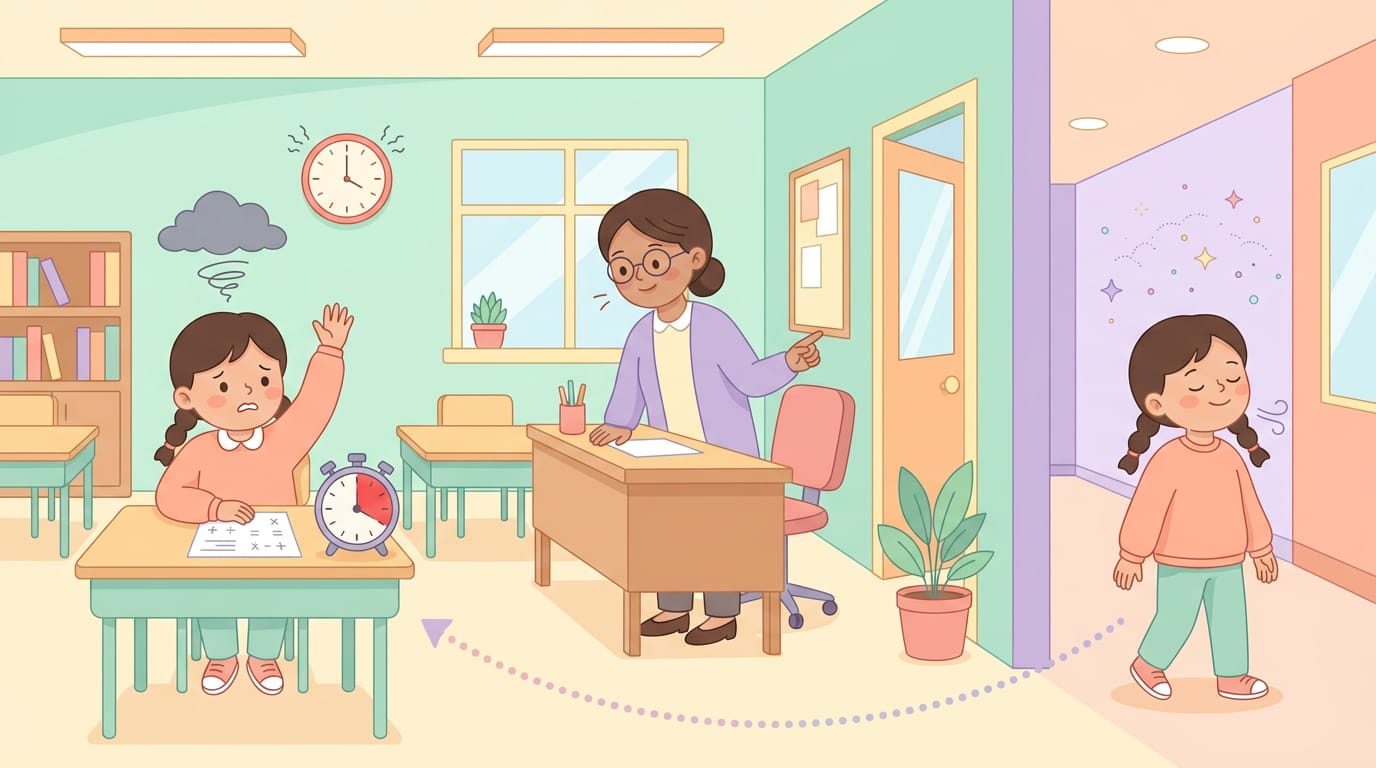
Consider a teacher whose student keeps asking to leave a timed drill. Each time the teacher lets her step out, the pressure of the drill stops. Next time, she's more likely to ask again.
Acting before an expected unpleasant event happens
Avoidance flips the timing. Escape ends a problem that's already here, but avoidance prevents one that's still coming. For this to work, the person has to predict the aversive, and a cue, or warning signal, is what tells them it's on its way.
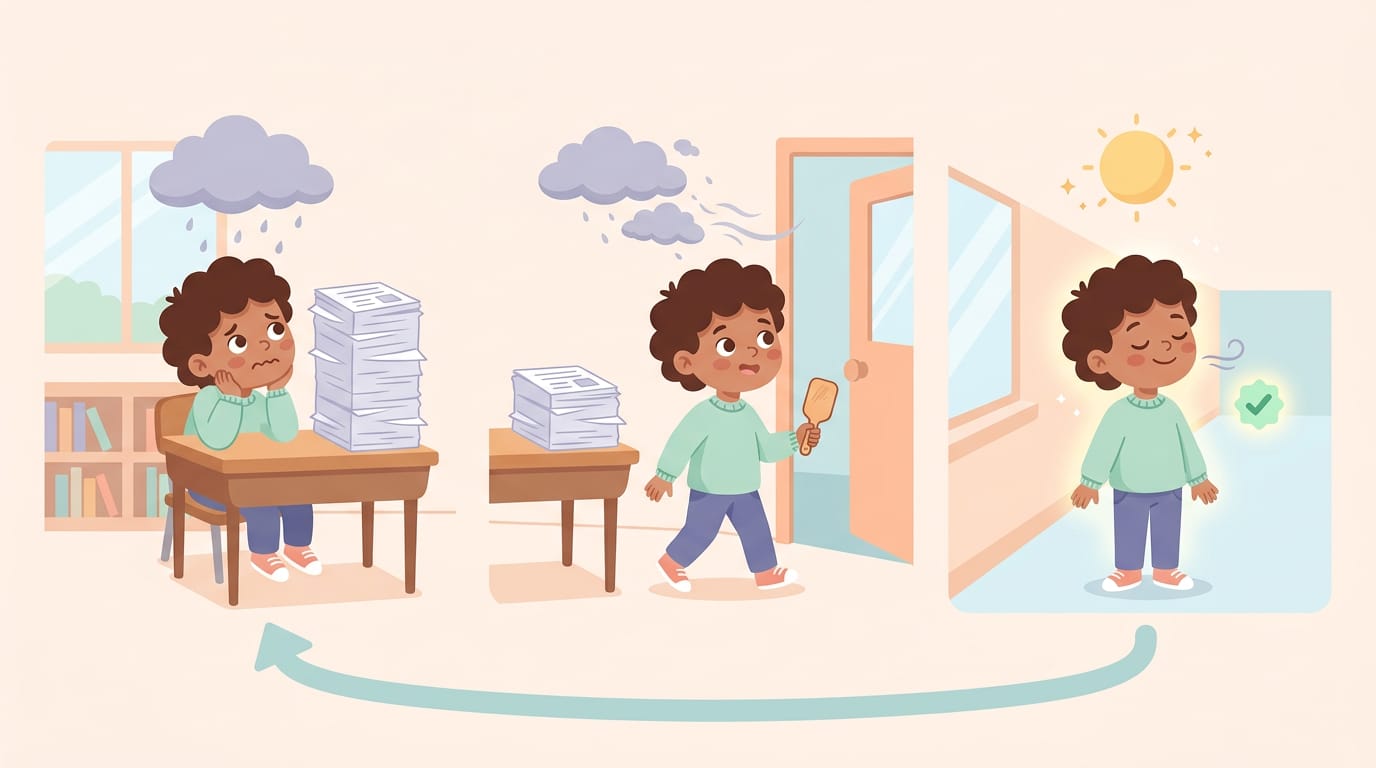
Picture a student who sees the teacher pull out a stack of pop quizzes. He asks for a bathroom pass and stays out until the quiz is handed out and collected.
He never takes the quiz, so the pass seems to work, and he's more likely to request one next time. Avoidance pays off.
How Escape and Avoidance Differ
Escape and avoidance can look identical: both get a student out of something hard. The real difference is timing, and here's how we tell them apart.
What really separates the two behaviors
The core difference is when the unpleasant event shows up. With escape, the aversive (unpleasant) event is already present, and the behavior ends it. With avoidance, the event is only anticipated, so the behavior keeps it from arriving.
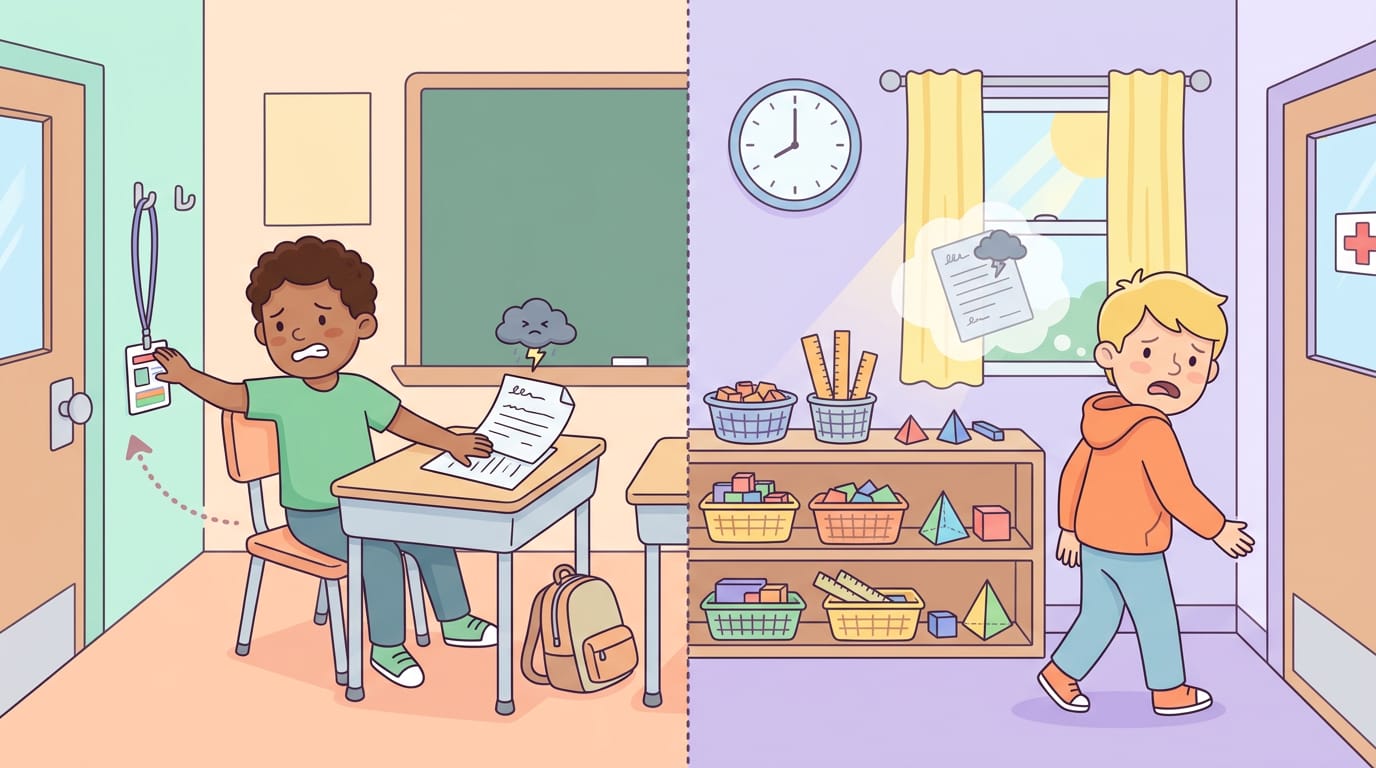
A student who pushes a word problem away once it lands on the desk, then asks for the bathroom pass, is escaping. A student who groans at the math bin each morning and finds a reason to visit the nurse before class starts is avoiding.
Both are maintained by negative reinforcement: each works by taking something unpleasant away or keeping it from arriving. Don't confuse this with punishment. Punishment reduces a behavior, while negative reinforcement strengthens one.
Try this exam-style question: 'A student leaves the room as soon as the reading is handed out. Escape or avoidance?' The answer is escape: the reading was already there.
The order these skills are usually learned
Escape is usually learned first, when a behavior ends a hard moment that's already here. Avoidance builds on that. Once escape has worked a few times, the earlier cues start to predict the task, and the behavior moves up in time.
The escape contingency (the link between a behavior and what it removes) also shapes avoidance. Picture a second grader who learns that asking for the nurse ends a spelling test. Next week, the request comes as soon as the word list appears.
That early request is your first clue: escape has become avoidance, so you can step in early.
Seeing These Behaviors in Action
Escape learning is easier to spot once you know what to look for, and it shows up in people as well as animals. Hitting snooze on a blaring alarm ends the noise, so you're likely to do it again tomorrow.
In class, a teacher might notice task refusal: a student handed a hard worksheet suddenly needs the hallway pass, and leaving the room ends the work. Errorless learning is one classroom approach that changes how a hard worksheet is introduced.
Dogs responding to leash and collar cues
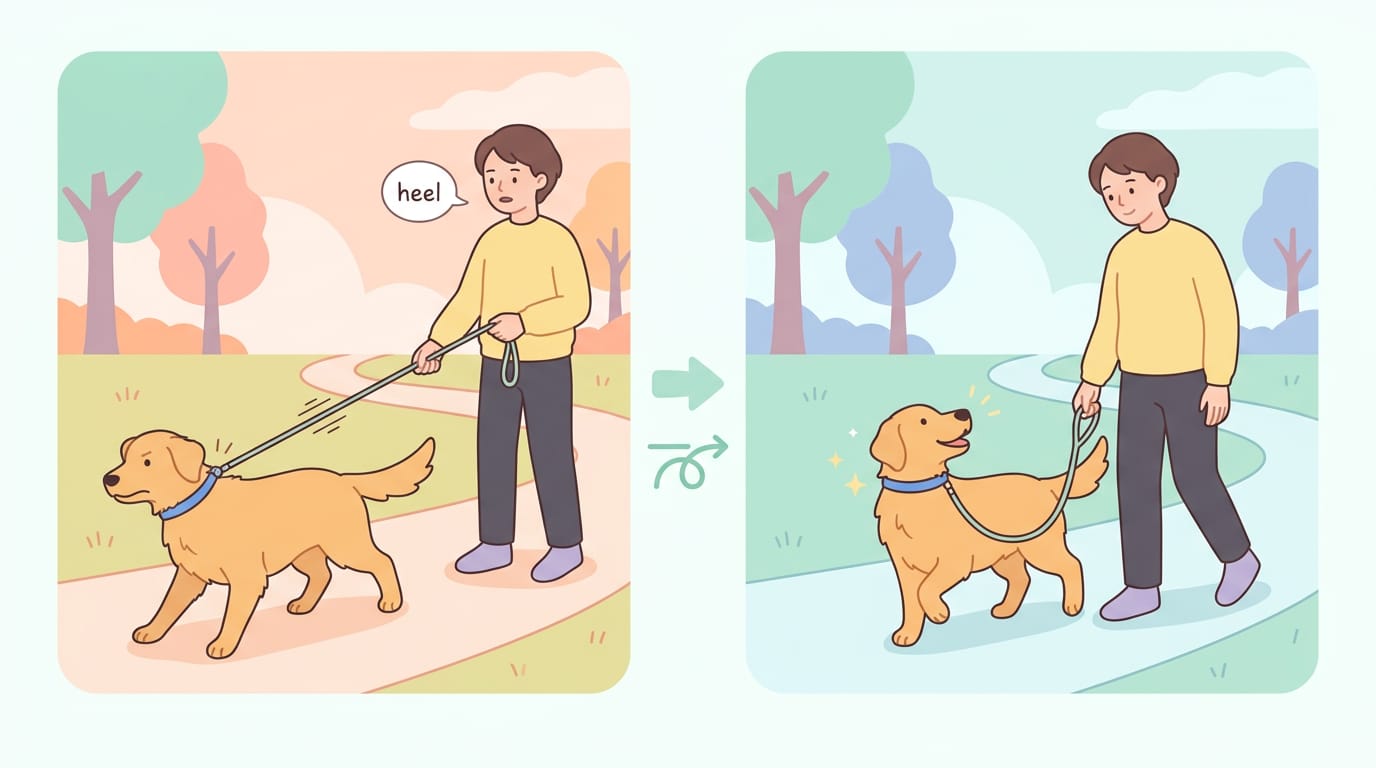
Picture a leash that tightens until the dog steps back to your side, then loosens the moment it does. The dog learns that moving ends the pressure. Add a verbal cue like “heel” and the word starts to predict when the tug will stop.
An invisible fence works on the same logic. The dog gets a correction at the boundary and retreats inside, and the correction stops once it's back in the yard.
Recall with an electronic collar follows suit, with stimulation continuing until the dog turns and comes back to its handler. Notice the pattern: the dog isn't earning a reward so much as ending something unpleasant.
Warning lights and rats in shuttle boxes
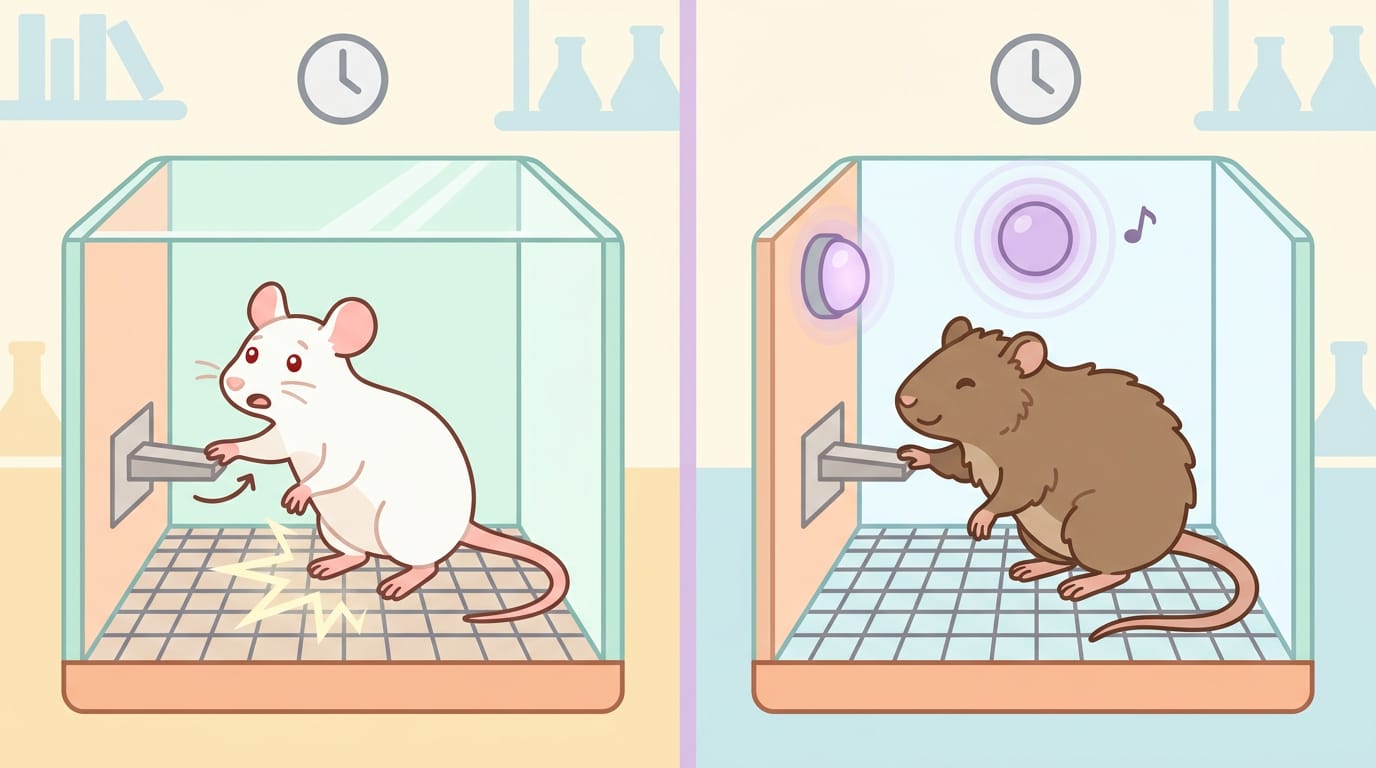
A shuttle box has two connected compartments, so an animal can cross from one side to the other. Here, a light signals an upcoming shock. Once the shock starts, running to the other side ends it, and that's escape.
Crossing while the light is on, before any shock arrives, is avoidance instead.
Watch the rats closely and you'll see running, turning, and rearing as they try different moves. Eventually one move ends the shock, and the rat keeps making it. Then it sticks.
What the Research Has Found so Far
Rat experiments and newer studies of human behavior both shed light on escape learning. Here's what they've found so far, and why it matters for you as a teacher.
What the shock experiments in rats showed
Shock has been used in rat experiments investigating escape and avoidance learning. The response an animal has to make matters, too. Ending a shock once it starts is a different task from avoiding one before it arrives.
In one comparison of wild and domesticated rats, three cotton rats and three albino rats were exposed to instrumental escape, unsignaled avoidance, and signaled avoidance, in that order. Precision matters.
Other rat experiments have looked at the simultaneous acquisition of different responses during escape or avoidance learning, meaning an animal picks up more than one response at the same time.
Other fields that connect to this work
Other fields connect here as well, including:
two-factor theory
species-specific defense reactions
self-punitive behavior
We don't yet have verified sources for those threads, so for now they remain open questions rather than findings.
Research has also examined how drugs and hormones affect escape and avoidance learning. One study of morphine and chlorpromazine looked at the acute effects of those drugs on acquiring a shuttle box avoidance response.
Does this apply to people? Researchers have considered that question too. A systematic review identified 116 studies on human avoidance learning, which is a sizable body of work.
Think of a student who always finds a reason to leave when a hard reading starts. Leaving brings quick relief, and that relief is exactly what makes the pattern stick.
Putting These Ideas to Work with Dogs
Trainers use these ideas daily, aiming to help a dog learn which response gets the outcome it wants. Here's where we see that play out.
Where trainers apply these skills
Basic obedience commands like sit, down, and come are a natural starting point. Pairing each cue with a reward helps the dog learn the pattern.
Over time, you'll notice faster response to cues. The dog answers right away instead of hesitating.
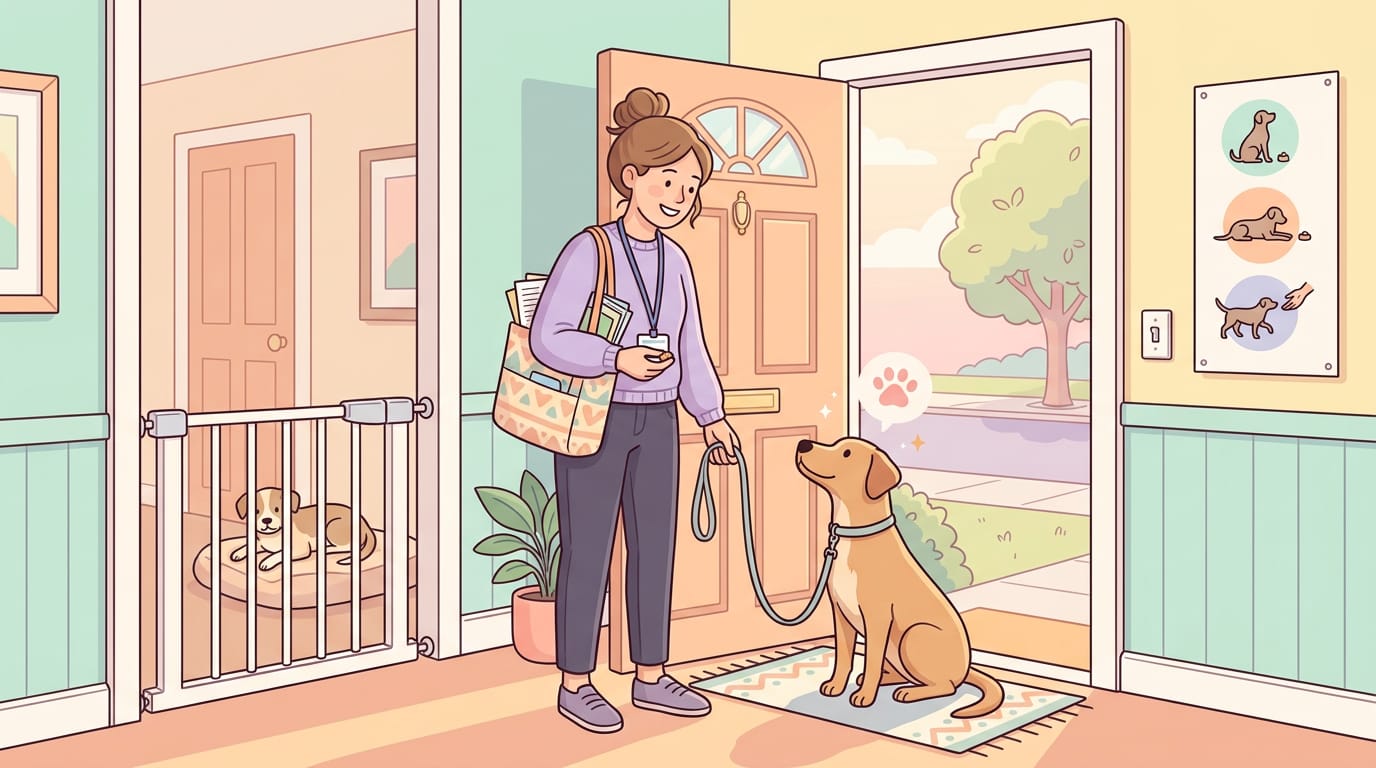
Good trainers also work on preventive, proactive behavior, teaching the right response in advance. Consider a teacher who adopts a rescue dog and practices 'wait' at the door before every walk. The payoff is a calm exit, not a tug-of-war.
Boundary training teaches a dog where it may and may not go, like staying behind a baby gate. Teaching the rule in advance sets clear expectations.
Keeping training kind, clear, and consistent
Clear communication. A study titled An Investigation into the Impact of Pre-Adolescent Training on Canine Behavior found that clear communication, where the dog is told when it solves something correctly, increases wanted behaviors and lowers frustration.
Clear cues matter for multilingual learners, too. An instruction they can't parse in a new language can push them to escape the task, just as a dog facing an unfamiliar cue may look for a way out.
Consistency. Use the same word, tone, and reward every time. If 'down' means lying down on Monday but gets ignored on Tuesday, the dog has no reliable signal. Mixed signals confuse dogs.
Respect the dog's well-being. Focus on building good habits rather than punishing mistakes. A dog that feels it can't escape any demand may stop trying, a pattern known as learned helplessness, or grow fearful of training itself.
Escape learning comes down to one idea: behavior is shaped by what it helps us get away from.
Once you can tell escape apart from avoidance and punishment, you'll start noticing it in your own classroom, and you'll know how to respond with patience instead of frustration.
When a student keeps pulling away from a task, ask what the task is helping them escape. Then make the path forward feel safer, clearer, and more supported. Ready to build that kind of classroom?
Check out our Inclusive & Multilingual Education posts for more strategies that work for every learner.
References
A systematic review of human avoidance learning: Cognition, computation, and methods — doi.org (2026)
A COMPARISON OF ESCAPE AND AVOIDANCE CONDITIONING IN WILD AND DOMESTICATED RATS1 — doi.org
Avoidance and escape learning: Simultaneous acquisition of different responses. — doi.org
Acute effects of morphine and chlorpromazine on the acquisition of shuttle box conditioned avoidance response — pubmed.ncbi.nlm.nih.gov (1976)
An Investigation into the Impact of Pre-Adolescent Training on Canine Behavior — mdpi.com (2021)
Ultimate Teacher Planner
The ultimate all-in-one education management system in Notion.