
Curriculum Examples: A Teacher's Guide to Models
Curriculum Examples: A Teacher's Guide to Models

Article by
Milo
ESL Content Coordinator & Educator
ESL Content Coordinator & Educator
All Posts
You have the standards. You have the textbook. But when you sit down to plan unit three, you’re staring at a blank screen wondering what this actually looks like day-to-day. That’s where curriculum examples come in. They’re not just binders from the district office. They’re the specific instructional roadmaps and unit plan templates that turn benchmarks into twenty actual school days.
I’ve planned enough units to know that starting from scratch wastes evenings you don’t have. A solid example maps out the vertical alignment and scope and sequence for you. You spend your time tweaking, not inventing. Whether you need a backward design model for high school biology or a simple pacing guide for 4th grade math, concrete models save your sanity. This post breaks down real examples you can steal from, tweak, or completely rethink for your specific kids.
Still grading everything by hand?
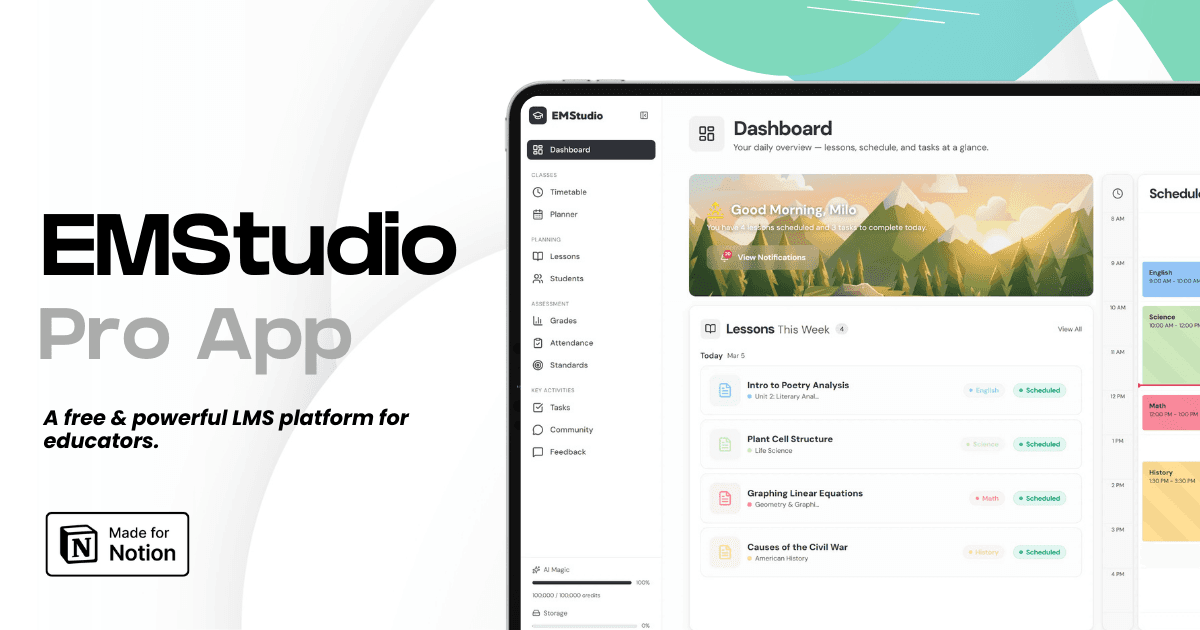
EMStudio is a free teaching management app — manage your classes, students, lessons, and more!
Learn More
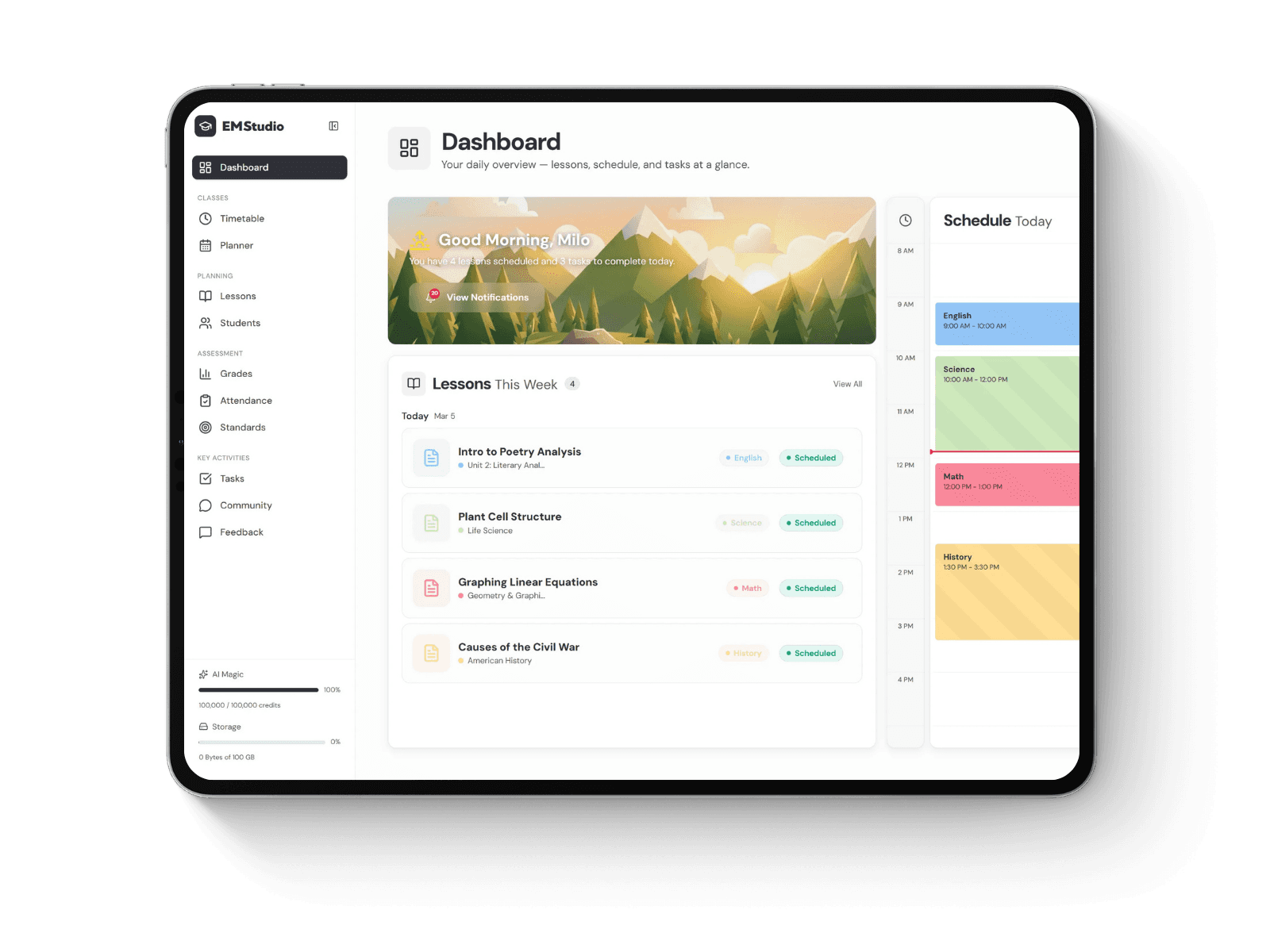
Still grading everything by hand?
EMStudio is a free teaching management app — manage your classes, students, lessons, and more!
Learn More
Table of Contents
What Are Curriculum Examples?
Curriculum examples are concrete, documented plans that translate educational standards into sequenced learning experiences. They include scope and sequence documents, unit plans, and instructional roadmaps that specify what students learn, when they learn it, and how mastery is assessed. Unlike isolated lesson plans, these examples show vertical alignment across weeks or semesters.
Think of them as the architectural blueprints for teaching. You wouldn't build a house from a photograph of a living room, and you shouldn't teach from a single activity. These documents show the load-bearing walls: which standards connect, how deep to go, and where the exits are.
Curriculum as Planned Learning Experiences
Ralph Tyler framed this back in 1949 with four questions that still haunt curriculum in education departments: What educational purposes should the school seek? What experiences achieve those purposes? How organize them effectively? How evaluate success? Curriculum examples answer these by mapping curriculum as planned learning experiences, not just lists of topics to cover.
Look at a high school English unit plan template for Romeo and Juliet. Stage 1 lists the essential questions and the CCSS RL.9-10.1 through 4 standards. Stage 2 centers on the performance task: a literary analysis essay. Stage 3 breaks down fifteen days of learning events. Enduring understandings run down the right margin. Everything connects vertically.
We need to distinguish three realities. The intended curriculum lives in your district's written guides—say, a 5th-grade fractions unit scheduled for October. The enacted curriculum is what actually happens when the fire drill eats Tuesday and half your class forgot their manipulatives. The assessed curriculum is what actually shows up on the interim test. Good curriculum examples anticipate the gaps between these three.
Tyler's legacy matters because he separated aims from activities. A standard might demand that students "analyze how complex characters develop." That's an aim. The curriculum example shows the specific planned experiences—the Socratic seminar on Tuesday, the character map on Wednesday, the timed writing on Friday—that build toward that analysis. It is the instructional roadmap, not just the destination.
These documents also reveal vertical alignment matrices alongside horizontal scope-and-sequence charts. Your 9th-grade Romeo and Juliet unit sits between 8th-grade short stories and 10th-grade research methods. The vertical matrix shows which skills spiral upward. The horizontal chart maps your 180 days. Together they form the complete framework.
The Difference Between Standards and Curriculum
Standards are the contract. Curriculum is the construction plan. Compare the Texas TEKS for 7th-grade science—roughly twelve pages of performance expectations—with your district's Year-at-a-Glance pacing guide. That document runs two hundred pages and includes assessment blueprints, suggested labs, and intervention strategies. This is the difference between standards and curriculum.
Take NGSS MS-LS1-1: "Conduct an investigation to provide evidence that living things are made of cells." That's the standard. Now look at a district's 7th-grade Cells and Systems unit. It specifies the three-day onion skin lab, the safety protocols for methylene blue, the Cell City analogy for English learners, and the alternate assignment for students who were absent during the microscope introduction. The standard says what competence looks like. The curriculum example maps how to get there.
Scope and sequence charts show this distinction clearly. The standard lists "cellular respiration" as a middle school concept. The curriculum specifies that you will spend eight days on it in February, using specific trade books and a formative assessment on day five. It allocates the resources. It plans the differentiation for your IEP students. It is the instructional journey, not just the benchmark.
When I open a unit plan template, I see more than content. I see time allocations, grouping strategies, and assessment checkpoints. The NGSS performance expectation tells me my 7th graders must model matter cycling. The curriculum example gives me the specific phenomenon—the decomposing pumpkin in the courtyard—and the backward design sequence that starts with that observation and ends with the model. One sets the bar. The other builds the ladder.
Why Do Curriculum Examples Matter for Teachers?
Curriculum examples reduce teacher planning time significantly while making sure vertical alignment across grade levels. They provide evidence-based instructional sequences, clear assessment benchmarks, and resource allocations that prevent learning gaps. Research by Hattie shows teacher clarity—which structured examples provide—has a 0.75 effect size on student achievement.
You could build your scope and sequence from scratch. Most of us have tried. It takes forever and the alignment still ends up shaky.
John Hattie's Visible Learning meta-analysis puts teacher clarity at a 0.75 effect size—one of the highest impacts on student achievement. Structured curriculum examples using backward design deliver that clarity upfront. You see exactly what standard connects to what activity. No more guessing while grading papers at midnight.
The time math is brutal. Without shared examples, teachers report spending 7 to 12 hours weekly on unit planning alone. With solid exemplars and a clear instructional roadmap, that drops to 3 or 4 hours. You get those hours back for actual teaching, or for professional planning for new teachers who need the support.
The danger comes when a pacing guide becomes "pacing guide slavery." Teachers skip necessary differentiation just to keep up with the calendar. Build in flex days from the start. When your unit plan template includes buffer time for reteaching, you don't sacrifice kids to stay on schedule.
The trade-offs are real. Consider both sides before adopting any system wholesale.
Benefit: Vertical alignment. Students arrive with prerequisites mastered because the scope and sequence connects grade levels intentionally.
Benefit: Resource equity. Every classroom gets quality materials, not just the teachers with time to hunt for resources.
Benefit: Assessment consistency. Common benchmarks mean fair grading across sections and actual data on student growth.
Risk: Creativity suppression. Rigid adherence to any teacher education curriculum can kill the spontaneous magic that hooks reluctant learners.
Risk: Local context mismatch. A suburban teacher curriculum rarely fits a rural schedule or your specific student population.

How Do Curriculum Models Shape These Examples?
Curriculum models provide the architectural framework determining how content is organized—whether by academic discipline (subject-centered), student interests (learner-centered), or real-world challenges (problem-based). Each model produces distinct curriculum examples with different pacing, assessment types, and teacher roles. The choice between Tyler Rationale, Taba Model, or Integrated approaches fundamentally changes the layout.
Your curriculum model is the blueprint. It dictates whether you lecture for forty minutes or circulate among stations. Pick the wrong architecture for your standards, and even the best activities collapse.
Subject-Centered: Best for AP/IB courses (10th-12th grade). You function as content expert. The failure mode is knowledge siloing where students cannot transfer history concepts to civics.
Learner-Centered: Optimal for heterogeneous elementary groups using choice boards. You facilitate student choice. Failure mode is uneven content coverage and equity issues if scaffolding is missing.
Problem-Based: Ideal for middle school STEM integration. You coach teams through inquiry. Watch for twenty-plus hours of initial planning and uneven group work outcomes.
Subject-Centered Curriculum Models
The Academic Disciplines model follows Bruner's structure of knowledge, organizing content by logical domains rather than student experience. In tenth-grade World History, this means a strict chronological march: Ancient civilizations in Fall, Medieval Europe in Winter, Modern eras in Spring. Your scope and sequence locks into a thirty-six-week pacing guide with benchmark exams every nine weeks. The unit plan template remains consistent—lecture, primary source analysis, assessment—repeat.
Avoid this curriculum model for interdisciplinary courses like Humanities or when your engagement data shows fewer than sixty percent of students participating in lecture-heavy formats. Some content simply requires direct transmission, but this architecture without flexibility cracks under the weight of spontaneous student questions or when you need to pause for current events connections that disrupt the timeline.
You stand as the content expert, the sage on the stage. Assessments rely on traditional exams and document analysis. The instructional roadmap is clear, vertical alignment is obvious between grade levels, and everyone knows exactly which century comes next. These curriculum examples produce standardized outcomes that college admissions counselors recognize immediately.
Learner-Centered Curriculum Approaches
Responsive Classroom and Montessori Cosmic Education represent this approach. In third-grade literacy, you run ninety-minute blocks with rotating centers: Guided Reading at the kidney table, Word Work with manipulatives, and independent Writing. Students move based on choice or assigned rotation, not by bell schedule. The room hums with multiple activities simultaneously.
I never use learner-centered curriculum approaches during standardized test preparation windows or when teaching discrete algorithms like multi-digit multiplication. Those require direct instruction and distributed practice, not discovery. The failure mode arrives when choice lacks scaffolding, creating equity issues where some students never encounter specific standards while others drill them repeatedly.
Differentiation happens through three tiered pathways within the same essential question. One group reads Frog and Toad at Level K, another tackles Charlotte's Web at Level P, all analyzing character motivation. Your pacing guide flexes daily based on formative checks rather than rigid calendar dates. This generates curriculum examples that look messy to outsiders but match individual readiness levels precisely.
Problem-Based and Integrated Models
Understanding by Design and Project Lead The Way fit here. An eighth-grade Water Quality unit runs six weeks, integrating chemistry pH testing, math statistical analysis, and civics EPA regulations. The driving question—"Is our local river safe for recreation?"—pulls students through problem-based and integrated models that resist traditional subject boundaries.
Students produce a formal lab report and a public service announcement video. The backward design requires you to identify these final products first, then plan the instructional roadmap backward through skill-building workshops. Rosenshine's Principles of Instruction support this when well-structured curriculum examples provide daily review and present new material in small steps within the larger project arc.
Mitigate failure through individual accountability quizzes alongside group projects. Without these checks, social loafing destroys the unit. Twenty hours of initial planning is normal for this curriculum model, but the engagement payoff justifies the investment when students present findings to actual city council members rather than just the teacher.

Real-World Curriculum Examples by Grade and Subject
Elementary Literacy Scope and Sequence
When I built my first elementary literacy scope and sequence, I stopped guessing which sound came next. This 36-week instructional roadmap for K-2 follows the Science of Reading progression without filler weeks. Every day has a job.
The curriculum layout breaks down into five targeted phases. Weeks 1-6 focus on Letter ID and concepts of print. Week 3 has The Snowy Day to teach directionality and one-to-one matching while building winter vocabulary. Weeks 7-12 attack CVC patterns systematically, with Bob Books Set 1 anchoring Week 8 for short vowel application. Weeks 13-20 layer blends and digraphs including trigraphs like -tch. Weeks 21-28 tackle Silent E patterns across all vowels with decodable passages about Pete and his magic cape. Weeks 29-36 spiral multisyllabic word attack with compound words, prefixes, and suffixes to close the decoding gap before third grade.
My unit plan template uses five columns to keep the pacing guide transparent. Column A shows the week number and specific dates. Column B isolates the phonemic awareness focus—segmenting three sounds by Week 8, manipulating phonemes by Week 20, deleting initial sounds by Week 28. Column C identifies the explicit phonics pattern with example words. Column D lists the exact decodable text title and level. Column E marks the assessment type and mastery threshold.
Column E assessments rotate between formatives and diagnostics. Week 3 uses a concepts of print checklist. Week 8 requires a dictated sentence assessment. Week 12 brings the nonsense word fluency probe. By Week 20, students read a grade-level passage for accuracy and rate. Week 36 combines oral reading with a comprehension retell to ensure they aren't just barking at print.
DIBELS 8th Edition checkpoints hit at Week 6 (Letter Naming Fluency), Week 12 (Nonsense Word Fluency), Week 20 (Oral Reading Fluency benchmark), and Week 36 (end-of-year comprehensive). Mastery benchmarks are non-negotiable: 90% accuracy on nonsense word fluency by Week 12, and 60 correct words per minute by Week 36 on grade-level passages. Kids who miss these markers get immediate reteaching during the 13-20 blend phase rather than waiting until third grade.
You can find curriculum pdf downloads matching this columnar structure on EngageNY and Achieve the Core. Both sites offer complete K-2 sequences with decodable text lists, assessment calendars, and vertical alignment notes showing how these skills connect to third-grade reading comprehension expectations. Print the pdf, highlight your quarters, and teach.
Middle School Science Unit Architecture
This curriculum layout for 7th-grade photosynthesis uses the 5E instructional model across eight weeks. It anchors NGSS MS-LS1-6 with concrete experiences before the textbook ever opens. Every phase builds the next.
The Engage phase lasts three days. Students observe algae jars in different light conditions and sketch what living things actually need to survive. The Explore phase spans two weeks with a controlled light/dark plant experiment using Wisconsin Fast Plants kits. These run $45 per class set and show visible root-to-shoot energy transfer in 14 days. If your budget is tight, the free PhET photosynthesis simulation works as a substitute, though kids lose the tactile observation of watching actual cotyledons emerge and green up.
Explain takes one week of direct instruction on chloroplast structure and the chemical equation. I draw the explicit connection to 5th-grade matter conservation here—those carbon atoms don't disappear during photosynthesis, they rearrange into glucose molecules. This vertical alignment matters deeply. When these same students hit 9th-grade biochemistry and encounter the Krebs cycle, they'll recognize cellular respiration as the inverse equation rather than starting from zero. The instructional roadmap makes this bridge explicit so kids don't think photosynthesis is something plants do and respiration is something animals do.
Elaborate stretches two weeks. Teams build global carbon cycle models using the cross-cutting concept of Systems and System Models. They track carbon from atmosphere to plant to herbivore to decomposer, practicing the Science Practice of Developing and Using Models. Evaluate closes with a Claim-Evidence-Reasoning paragraph arguing how changing light intensity affects glucose production based on their Fast Plants data.
Optional light sensors cost $120 if you want quantitative lux measurements, but visual growth measurement and student sketching works fine for the standard. OpenSciEd offers the full curriculum pdf download for this exact unit, complete with teacher guides, student handouts, and the vertical alignment maps showing prerequisite 5th-grade content and 9th-grade extensions. Download it, buy the plants, and start growing.
High School Social Studies Framework
Eleventh graders need to see patterns across time instead of isolated decades with no connection. This four-week curriculum layout titled "Reform & Change" braids the Progressive Era (1900-1920) with the Civil Rights Movement (1950-1970) through one analytical lens: civic action tactics. The pacing guide moves fast because the conceptual workload is heavy.
The unit opens with brutal Upton Sinclair excerpts from The Jungle and the 1912 Progressive Party Platform. Students identify the specific tools available to reformers in 1910—muckraking journalism, third-party political pressure, regulatory legislation, and public outrage campaigns.
Week two jumps sharply to 1963 with MLK's Birmingham Jail letter and the SNCC founding statement. Same essential question: what tactics work when the system resists change, and when do you work inside versus outside institutional power? The juxtaposition shocks them into seeing reform as continuous struggle rather than completed textbook chapters.
The primary source set stays deliberately tight at five documents. This prevents document overload while maintaining historical rigor. The comparative inquiry drives every lesson: How did mid-century activists adapt, reject, or improve upon Progressive Era strategies? Students track the shift from lobbying for legislation to direct action sit-ins, noting which methods produced federal response.
Assessment is a Document-Based Question using a specific rubric with four weighted categories. Contextualization requires placing both movements in their broader historical moments with specific prior events. Thesis needs a defensible claim about tactical evolution, not just listing similarities. Evidence pulls from the provided documents plus precise outside knowledge beyond the excerpts. Analysis explains how specific tactics succeeded, failed, or transformed between 1912 and 1963 based on historical context.
You can build similar curriculum examples using the backward design template on Achieve the Core. Their curriculum pdf downloads include ready-made DBQ rubrics, primary source sets for US History, and sample student responses scored against the rubric. Print the unit plan template, plug in your documents, and adjust the calendar to your block schedule.
Cross-Curricular STEM Integration Model
The cross-curricular STEM integration model that actually survives first period requires tight coordination and clear ownership. This six-week "Mission to Mars" unit for 5th grade uses an interdisciplinary matrix mapped across four subjects with specific standards identified before day one.
Math focuses on precise measurement and unit conversion—calculating metric distances for Mars trajectories, converting fractions for fuel mixture ratios, and interpreting line graphs of temperature data. Science runs the full engineering design process through three complete cycles of prototype, test, and refine. ELA produces technical procedural writing; teams draft mission manuals that could theoretically guide an alien through their lander assembly without diagrams. Social Studies examines the space race history, analyzing 1960s primary sources about Cold War competition and propaganda.
The team structure matters more than the materials. Four students per team, ninety students total across three teachers rotating through classrooms. Each teacher owns specific subjects' standards but coordinates daily through shared Google Drive folders and common planning time. The $5 per team material budget forces genuine engineering constraints and resource scarcity thinking. They get twenty plastic straws, one roll of masking tape, ten index cards, and one raw egg. No foam, no bubble wrap, no pre-made parachutes, no 3D printed parts.
The drop test happens on Friday of week six in the gymnasium. Two-meter height, concrete floor, raw egg payload. Success requires two simultaneous achievements: an intact egg after impact and a mission manual accurate enough that a rival team can rebuild the lander using only those written instructions. No pictures allowed in the manual. If the egg survives but the instructions confuse, the team fails the communication standard.
This curriculum example shows how backward design works across departments. We started with the drop test success criteria and mapped back to the specific math standards on precision and the ELA standards on technical writing. OpenSciEd and EngageNY both offer curriculum pdf downloads for integrated STEM units if you need starter templates for your own Mars mission or alternative engineering challenges.

How Can Teachers Adapt Examples for Their Classrooms?
Teachers adapt curriculum examples by first conducting a gap analysis between the example's standards and local requirements, then modifying timelines based on class period length, and finally differentiating assessments for diverse learners while maintaining core objectives. This process ensures alignment with state standards while accommodating specific classroom contexts.
Follow this five-step flowchart when adapting any curriculum examples. It keeps you from gutting the rigor while making the content actually usable for your kids.
Conduct gap analysis against state standards.
Adjust for period length (50-min vs 90-block).
Modify for demographic needs (ELL percentages, IEP accommodations).
Substitute resources based on budget.
Build in formative checkpoints.
For step one, pull up Achieve the Core Coherence Map (free) for CCSS Math or ELA. Science teachers should bookmark the NSTA NGSS Hub. Build a three-column chart: Standard | Example Coverage | Gap/Surplus Analysis. This shows exactly where the curriculum pdf download aligns and where you need to patch holes.
Step two requires math. For block schedules, multiply the original daily lesson count by 0.6 for 90-minute periods. Add ten flex days per semester to your pacing guide for assemblies and testing. This instructional roadmap stays realistic.
Watch out for over-adaptation. I have seen teachers strip complex texts from curriculum examples to accommodate struggling learners, accidentally removing the rigor entirely. Maintain the same essential questions but tier the complexity of sources. The thinking stays hard; the reading level shifts.
Check your work against Webb's alignment criteria (1997). Your adapted unit must maintain the same depth of knowledge (DOK) levels found on state assessments. If the original example hits DOK 3 and your adaptation only reaches DOK 1, you have a problem.
Mapping Examples to Your State Standards
Start by downloading your state's specific standards. Compare Texas TEKS 7.10B against California CCSS RL.7.1. Build an alignment matrix in Excel or Google Sheets to see the gaps.
Last year, I adapted an EngageNY 6th-grade ELA unit to Florida B.E.S.T. standards. I found three missing standards on argument writing. I inserted a supplemental mini-unit using CommonLit (free) to cover the gap without rewriting the entire scope and sequence.
Use your State Education Agency website for official crosswalk documents. Avoid unofficial alignment blogs that guess at connections. When you mapping examples to your state standards, trust primary sources over teacher Pinterest.
Adjusting Timeline and Resources
For 90-minute block schedules, combine Days 1-2 of the original 50-minute curriculum into Day 1. Build in ten flex days per semester for testing and assemblies. Your unit plan template needs breathing room.
Use a resource substitution matrix when budgets are tight. Original: Vernier probeware ($800). Substitution: PhET simulations (free). Original: class set of novels ($240). Substitution: Project Gutenberg tablets or printouts. This keeps backward design intact without breaking the bank.
Differentiation means keeping identical essential questions but providing three text complexity levels. Use Lexile 800, 1000, and 1200 for the same historical topic. This honors vertical alignment while meeting kids where they are. To streamline your curriculum development framework, build these tiers into your initial planning.
What to Remember About Curriculum Examples
Curriculum examples are starting points, not scripts. Whether you're staring at a district's scope and sequence or a veteran colleague's unit plan template, remember that these documents lived in someone else's classroom first. They worked there with those kids. Your job is to make them work here, with your specific group, on this specific Tuesday in October. Take what fits, cut what doesn't, and trust your judgment.
The model you choose shapes your daily life more than you think. Backward design keeps you focused on what students need to prove by Friday. Vertical alignment saves you from reteaching what last year's teacher already nailed. Pick a structure that matches how you actually think, then fill it with the texts, problems, and projects that light up your particular students.
Steal wisely. Adapt boldly. The best curriculum isn't the one that looks perfect in the binder or checks every standard box. It's the one you actually teach from.

What Are Curriculum Examples?
Curriculum examples are concrete, documented plans that translate educational standards into sequenced learning experiences. They include scope and sequence documents, unit plans, and instructional roadmaps that specify what students learn, when they learn it, and how mastery is assessed. Unlike isolated lesson plans, these examples show vertical alignment across weeks or semesters.
Think of them as the architectural blueprints for teaching. You wouldn't build a house from a photograph of a living room, and you shouldn't teach from a single activity. These documents show the load-bearing walls: which standards connect, how deep to go, and where the exits are.
Curriculum as Planned Learning Experiences
Ralph Tyler framed this back in 1949 with four questions that still haunt curriculum in education departments: What educational purposes should the school seek? What experiences achieve those purposes? How organize them effectively? How evaluate success? Curriculum examples answer these by mapping curriculum as planned learning experiences, not just lists of topics to cover.
Look at a high school English unit plan template for Romeo and Juliet. Stage 1 lists the essential questions and the CCSS RL.9-10.1 through 4 standards. Stage 2 centers on the performance task: a literary analysis essay. Stage 3 breaks down fifteen days of learning events. Enduring understandings run down the right margin. Everything connects vertically.
We need to distinguish three realities. The intended curriculum lives in your district's written guides—say, a 5th-grade fractions unit scheduled for October. The enacted curriculum is what actually happens when the fire drill eats Tuesday and half your class forgot their manipulatives. The assessed curriculum is what actually shows up on the interim test. Good curriculum examples anticipate the gaps between these three.
Tyler's legacy matters because he separated aims from activities. A standard might demand that students "analyze how complex characters develop." That's an aim. The curriculum example shows the specific planned experiences—the Socratic seminar on Tuesday, the character map on Wednesday, the timed writing on Friday—that build toward that analysis. It is the instructional roadmap, not just the destination.
These documents also reveal vertical alignment matrices alongside horizontal scope-and-sequence charts. Your 9th-grade Romeo and Juliet unit sits between 8th-grade short stories and 10th-grade research methods. The vertical matrix shows which skills spiral upward. The horizontal chart maps your 180 days. Together they form the complete framework.
The Difference Between Standards and Curriculum
Standards are the contract. Curriculum is the construction plan. Compare the Texas TEKS for 7th-grade science—roughly twelve pages of performance expectations—with your district's Year-at-a-Glance pacing guide. That document runs two hundred pages and includes assessment blueprints, suggested labs, and intervention strategies. This is the difference between standards and curriculum.
Take NGSS MS-LS1-1: "Conduct an investigation to provide evidence that living things are made of cells." That's the standard. Now look at a district's 7th-grade Cells and Systems unit. It specifies the three-day onion skin lab, the safety protocols for methylene blue, the Cell City analogy for English learners, and the alternate assignment for students who were absent during the microscope introduction. The standard says what competence looks like. The curriculum example maps how to get there.
Scope and sequence charts show this distinction clearly. The standard lists "cellular respiration" as a middle school concept. The curriculum specifies that you will spend eight days on it in February, using specific trade books and a formative assessment on day five. It allocates the resources. It plans the differentiation for your IEP students. It is the instructional journey, not just the benchmark.
When I open a unit plan template, I see more than content. I see time allocations, grouping strategies, and assessment checkpoints. The NGSS performance expectation tells me my 7th graders must model matter cycling. The curriculum example gives me the specific phenomenon—the decomposing pumpkin in the courtyard—and the backward design sequence that starts with that observation and ends with the model. One sets the bar. The other builds the ladder.
Why Do Curriculum Examples Matter for Teachers?
Curriculum examples reduce teacher planning time significantly while making sure vertical alignment across grade levels. They provide evidence-based instructional sequences, clear assessment benchmarks, and resource allocations that prevent learning gaps. Research by Hattie shows teacher clarity—which structured examples provide—has a 0.75 effect size on student achievement.
You could build your scope and sequence from scratch. Most of us have tried. It takes forever and the alignment still ends up shaky.
John Hattie's Visible Learning meta-analysis puts teacher clarity at a 0.75 effect size—one of the highest impacts on student achievement. Structured curriculum examples using backward design deliver that clarity upfront. You see exactly what standard connects to what activity. No more guessing while grading papers at midnight.
The time math is brutal. Without shared examples, teachers report spending 7 to 12 hours weekly on unit planning alone. With solid exemplars and a clear instructional roadmap, that drops to 3 or 4 hours. You get those hours back for actual teaching, or for professional planning for new teachers who need the support.
The danger comes when a pacing guide becomes "pacing guide slavery." Teachers skip necessary differentiation just to keep up with the calendar. Build in flex days from the start. When your unit plan template includes buffer time for reteaching, you don't sacrifice kids to stay on schedule.
The trade-offs are real. Consider both sides before adopting any system wholesale.
Benefit: Vertical alignment. Students arrive with prerequisites mastered because the scope and sequence connects grade levels intentionally.
Benefit: Resource equity. Every classroom gets quality materials, not just the teachers with time to hunt for resources.
Benefit: Assessment consistency. Common benchmarks mean fair grading across sections and actual data on student growth.
Risk: Creativity suppression. Rigid adherence to any teacher education curriculum can kill the spontaneous magic that hooks reluctant learners.
Risk: Local context mismatch. A suburban teacher curriculum rarely fits a rural schedule or your specific student population.
How Do Curriculum Models Shape These Examples?
Curriculum models provide the architectural framework determining how content is organized—whether by academic discipline (subject-centered), student interests (learner-centered), or real-world challenges (problem-based). Each model produces distinct curriculum examples with different pacing, assessment types, and teacher roles. The choice between Tyler Rationale, Taba Model, or Integrated approaches fundamentally changes the layout.
Your curriculum model is the blueprint. It dictates whether you lecture for forty minutes or circulate among stations. Pick the wrong architecture for your standards, and even the best activities collapse.
Subject-Centered: Best for AP/IB courses (10th-12th grade). You function as content expert. The failure mode is knowledge siloing where students cannot transfer history concepts to civics.
Learner-Centered: Optimal for heterogeneous elementary groups using choice boards. You facilitate student choice. Failure mode is uneven content coverage and equity issues if scaffolding is missing.
Problem-Based: Ideal for middle school STEM integration. You coach teams through inquiry. Watch for twenty-plus hours of initial planning and uneven group work outcomes.
Subject-Centered Curriculum Models
The Academic Disciplines model follows Bruner's structure of knowledge, organizing content by logical domains rather than student experience. In tenth-grade World History, this means a strict chronological march: Ancient civilizations in Fall, Medieval Europe in Winter, Modern eras in Spring. Your scope and sequence locks into a thirty-six-week pacing guide with benchmark exams every nine weeks. The unit plan template remains consistent—lecture, primary source analysis, assessment—repeat.
Avoid this curriculum model for interdisciplinary courses like Humanities or when your engagement data shows fewer than sixty percent of students participating in lecture-heavy formats. Some content simply requires direct transmission, but this architecture without flexibility cracks under the weight of spontaneous student questions or when you need to pause for current events connections that disrupt the timeline.
You stand as the content expert, the sage on the stage. Assessments rely on traditional exams and document analysis. The instructional roadmap is clear, vertical alignment is obvious between grade levels, and everyone knows exactly which century comes next. These curriculum examples produce standardized outcomes that college admissions counselors recognize immediately.
Learner-Centered Curriculum Approaches
Responsive Classroom and Montessori Cosmic Education represent this approach. In third-grade literacy, you run ninety-minute blocks with rotating centers: Guided Reading at the kidney table, Word Work with manipulatives, and independent Writing. Students move based on choice or assigned rotation, not by bell schedule. The room hums with multiple activities simultaneously.
I never use learner-centered curriculum approaches during standardized test preparation windows or when teaching discrete algorithms like multi-digit multiplication. Those require direct instruction and distributed practice, not discovery. The failure mode arrives when choice lacks scaffolding, creating equity issues where some students never encounter specific standards while others drill them repeatedly.
Differentiation happens through three tiered pathways within the same essential question. One group reads Frog and Toad at Level K, another tackles Charlotte's Web at Level P, all analyzing character motivation. Your pacing guide flexes daily based on formative checks rather than rigid calendar dates. This generates curriculum examples that look messy to outsiders but match individual readiness levels precisely.
Problem-Based and Integrated Models
Understanding by Design and Project Lead The Way fit here. An eighth-grade Water Quality unit runs six weeks, integrating chemistry pH testing, math statistical analysis, and civics EPA regulations. The driving question—"Is our local river safe for recreation?"—pulls students through problem-based and integrated models that resist traditional subject boundaries.
Students produce a formal lab report and a public service announcement video. The backward design requires you to identify these final products first, then plan the instructional roadmap backward through skill-building workshops. Rosenshine's Principles of Instruction support this when well-structured curriculum examples provide daily review and present new material in small steps within the larger project arc.
Mitigate failure through individual accountability quizzes alongside group projects. Without these checks, social loafing destroys the unit. Twenty hours of initial planning is normal for this curriculum model, but the engagement payoff justifies the investment when students present findings to actual city council members rather than just the teacher.
Real-World Curriculum Examples by Grade and Subject
Elementary Literacy Scope and Sequence
When I built my first elementary literacy scope and sequence, I stopped guessing which sound came next. This 36-week instructional roadmap for K-2 follows the Science of Reading progression without filler weeks. Every day has a job.
The curriculum layout breaks down into five targeted phases. Weeks 1-6 focus on Letter ID and concepts of print. Week 3 has The Snowy Day to teach directionality and one-to-one matching while building winter vocabulary. Weeks 7-12 attack CVC patterns systematically, with Bob Books Set 1 anchoring Week 8 for short vowel application. Weeks 13-20 layer blends and digraphs including trigraphs like -tch. Weeks 21-28 tackle Silent E patterns across all vowels with decodable passages about Pete and his magic cape. Weeks 29-36 spiral multisyllabic word attack with compound words, prefixes, and suffixes to close the decoding gap before third grade.
My unit plan template uses five columns to keep the pacing guide transparent. Column A shows the week number and specific dates. Column B isolates the phonemic awareness focus—segmenting three sounds by Week 8, manipulating phonemes by Week 20, deleting initial sounds by Week 28. Column C identifies the explicit phonics pattern with example words. Column D lists the exact decodable text title and level. Column E marks the assessment type and mastery threshold.
Column E assessments rotate between formatives and diagnostics. Week 3 uses a concepts of print checklist. Week 8 requires a dictated sentence assessment. Week 12 brings the nonsense word fluency probe. By Week 20, students read a grade-level passage for accuracy and rate. Week 36 combines oral reading with a comprehension retell to ensure they aren't just barking at print.
DIBELS 8th Edition checkpoints hit at Week 6 (Letter Naming Fluency), Week 12 (Nonsense Word Fluency), Week 20 (Oral Reading Fluency benchmark), and Week 36 (end-of-year comprehensive). Mastery benchmarks are non-negotiable: 90% accuracy on nonsense word fluency by Week 12, and 60 correct words per minute by Week 36 on grade-level passages. Kids who miss these markers get immediate reteaching during the 13-20 blend phase rather than waiting until third grade.
You can find curriculum pdf downloads matching this columnar structure on EngageNY and Achieve the Core. Both sites offer complete K-2 sequences with decodable text lists, assessment calendars, and vertical alignment notes showing how these skills connect to third-grade reading comprehension expectations. Print the pdf, highlight your quarters, and teach.
Middle School Science Unit Architecture
This curriculum layout for 7th-grade photosynthesis uses the 5E instructional model across eight weeks. It anchors NGSS MS-LS1-6 with concrete experiences before the textbook ever opens. Every phase builds the next.
The Engage phase lasts three days. Students observe algae jars in different light conditions and sketch what living things actually need to survive. The Explore phase spans two weeks with a controlled light/dark plant experiment using Wisconsin Fast Plants kits. These run $45 per class set and show visible root-to-shoot energy transfer in 14 days. If your budget is tight, the free PhET photosynthesis simulation works as a substitute, though kids lose the tactile observation of watching actual cotyledons emerge and green up.
Explain takes one week of direct instruction on chloroplast structure and the chemical equation. I draw the explicit connection to 5th-grade matter conservation here—those carbon atoms don't disappear during photosynthesis, they rearrange into glucose molecules. This vertical alignment matters deeply. When these same students hit 9th-grade biochemistry and encounter the Krebs cycle, they'll recognize cellular respiration as the inverse equation rather than starting from zero. The instructional roadmap makes this bridge explicit so kids don't think photosynthesis is something plants do and respiration is something animals do.
Elaborate stretches two weeks. Teams build global carbon cycle models using the cross-cutting concept of Systems and System Models. They track carbon from atmosphere to plant to herbivore to decomposer, practicing the Science Practice of Developing and Using Models. Evaluate closes with a Claim-Evidence-Reasoning paragraph arguing how changing light intensity affects glucose production based on their Fast Plants data.
Optional light sensors cost $120 if you want quantitative lux measurements, but visual growth measurement and student sketching works fine for the standard. OpenSciEd offers the full curriculum pdf download for this exact unit, complete with teacher guides, student handouts, and the vertical alignment maps showing prerequisite 5th-grade content and 9th-grade extensions. Download it, buy the plants, and start growing.
High School Social Studies Framework
Eleventh graders need to see patterns across time instead of isolated decades with no connection. This four-week curriculum layout titled "Reform & Change" braids the Progressive Era (1900-1920) with the Civil Rights Movement (1950-1970) through one analytical lens: civic action tactics. The pacing guide moves fast because the conceptual workload is heavy.
The unit opens with brutal Upton Sinclair excerpts from The Jungle and the 1912 Progressive Party Platform. Students identify the specific tools available to reformers in 1910—muckraking journalism, third-party political pressure, regulatory legislation, and public outrage campaigns.
Week two jumps sharply to 1963 with MLK's Birmingham Jail letter and the SNCC founding statement. Same essential question: what tactics work when the system resists change, and when do you work inside versus outside institutional power? The juxtaposition shocks them into seeing reform as continuous struggle rather than completed textbook chapters.
The primary source set stays deliberately tight at five documents. This prevents document overload while maintaining historical rigor. The comparative inquiry drives every lesson: How did mid-century activists adapt, reject, or improve upon Progressive Era strategies? Students track the shift from lobbying for legislation to direct action sit-ins, noting which methods produced federal response.
Assessment is a Document-Based Question using a specific rubric with four weighted categories. Contextualization requires placing both movements in their broader historical moments with specific prior events. Thesis needs a defensible claim about tactical evolution, not just listing similarities. Evidence pulls from the provided documents plus precise outside knowledge beyond the excerpts. Analysis explains how specific tactics succeeded, failed, or transformed between 1912 and 1963 based on historical context.
You can build similar curriculum examples using the backward design template on Achieve the Core. Their curriculum pdf downloads include ready-made DBQ rubrics, primary source sets for US History, and sample student responses scored against the rubric. Print the unit plan template, plug in your documents, and adjust the calendar to your block schedule.
Cross-Curricular STEM Integration Model
The cross-curricular STEM integration model that actually survives first period requires tight coordination and clear ownership. This six-week "Mission to Mars" unit for 5th grade uses an interdisciplinary matrix mapped across four subjects with specific standards identified before day one.
Math focuses on precise measurement and unit conversion—calculating metric distances for Mars trajectories, converting fractions for fuel mixture ratios, and interpreting line graphs of temperature data. Science runs the full engineering design process through three complete cycles of prototype, test, and refine. ELA produces technical procedural writing; teams draft mission manuals that could theoretically guide an alien through their lander assembly without diagrams. Social Studies examines the space race history, analyzing 1960s primary sources about Cold War competition and propaganda.
The team structure matters more than the materials. Four students per team, ninety students total across three teachers rotating through classrooms. Each teacher owns specific subjects' standards but coordinates daily through shared Google Drive folders and common planning time. The $5 per team material budget forces genuine engineering constraints and resource scarcity thinking. They get twenty plastic straws, one roll of masking tape, ten index cards, and one raw egg. No foam, no bubble wrap, no pre-made parachutes, no 3D printed parts.
The drop test happens on Friday of week six in the gymnasium. Two-meter height, concrete floor, raw egg payload. Success requires two simultaneous achievements: an intact egg after impact and a mission manual accurate enough that a rival team can rebuild the lander using only those written instructions. No pictures allowed in the manual. If the egg survives but the instructions confuse, the team fails the communication standard.
This curriculum example shows how backward design works across departments. We started with the drop test success criteria and mapped back to the specific math standards on precision and the ELA standards on technical writing. OpenSciEd and EngageNY both offer curriculum pdf downloads for integrated STEM units if you need starter templates for your own Mars mission or alternative engineering challenges.
How Can Teachers Adapt Examples for Their Classrooms?
Teachers adapt curriculum examples by first conducting a gap analysis between the example's standards and local requirements, then modifying timelines based on class period length, and finally differentiating assessments for diverse learners while maintaining core objectives. This process ensures alignment with state standards while accommodating specific classroom contexts.
Follow this five-step flowchart when adapting any curriculum examples. It keeps you from gutting the rigor while making the content actually usable for your kids.
Conduct gap analysis against state standards.
Adjust for period length (50-min vs 90-block).
Modify for demographic needs (ELL percentages, IEP accommodations).
Substitute resources based on budget.
Build in formative checkpoints.
For step one, pull up Achieve the Core Coherence Map (free) for CCSS Math or ELA. Science teachers should bookmark the NSTA NGSS Hub. Build a three-column chart: Standard | Example Coverage | Gap/Surplus Analysis. This shows exactly where the curriculum pdf download aligns and where you need to patch holes.
Step two requires math. For block schedules, multiply the original daily lesson count by 0.6 for 90-minute periods. Add ten flex days per semester to your pacing guide for assemblies and testing. This instructional roadmap stays realistic.
Watch out for over-adaptation. I have seen teachers strip complex texts from curriculum examples to accommodate struggling learners, accidentally removing the rigor entirely. Maintain the same essential questions but tier the complexity of sources. The thinking stays hard; the reading level shifts.
Check your work against Webb's alignment criteria (1997). Your adapted unit must maintain the same depth of knowledge (DOK) levels found on state assessments. If the original example hits DOK 3 and your adaptation only reaches DOK 1, you have a problem.
Mapping Examples to Your State Standards
Start by downloading your state's specific standards. Compare Texas TEKS 7.10B against California CCSS RL.7.1. Build an alignment matrix in Excel or Google Sheets to see the gaps.
Last year, I adapted an EngageNY 6th-grade ELA unit to Florida B.E.S.T. standards. I found three missing standards on argument writing. I inserted a supplemental mini-unit using CommonLit (free) to cover the gap without rewriting the entire scope and sequence.
Use your State Education Agency website for official crosswalk documents. Avoid unofficial alignment blogs that guess at connections. When you mapping examples to your state standards, trust primary sources over teacher Pinterest.
Adjusting Timeline and Resources
For 90-minute block schedules, combine Days 1-2 of the original 50-minute curriculum into Day 1. Build in ten flex days per semester for testing and assemblies. Your unit plan template needs breathing room.
Use a resource substitution matrix when budgets are tight. Original: Vernier probeware ($800). Substitution: PhET simulations (free). Original: class set of novels ($240). Substitution: Project Gutenberg tablets or printouts. This keeps backward design intact without breaking the bank.
Differentiation means keeping identical essential questions but providing three text complexity levels. Use Lexile 800, 1000, and 1200 for the same historical topic. This honors vertical alignment while meeting kids where they are. To streamline your curriculum development framework, build these tiers into your initial planning.
What to Remember About Curriculum Examples
Curriculum examples are starting points, not scripts. Whether you're staring at a district's scope and sequence or a veteran colleague's unit plan template, remember that these documents lived in someone else's classroom first. They worked there with those kids. Your job is to make them work here, with your specific group, on this specific Tuesday in October. Take what fits, cut what doesn't, and trust your judgment.
The model you choose shapes your daily life more than you think. Backward design keeps you focused on what students need to prove by Friday. Vertical alignment saves you from reteaching what last year's teacher already nailed. Pick a structure that matches how you actually think, then fill it with the texts, problems, and projects that light up your particular students.
Steal wisely. Adapt boldly. The best curriculum isn't the one that looks perfect in the binder or checks every standard box. It's the one you actually teach from.
Still grading everything by hand?
EMStudio is a free teaching management app — manage your classes, students, lessons, and more!
Learn More
Still grading everything by hand?
EMStudio is a free teaching management app — manage your classes, students, lessons, and more!
Learn More



Notion4Teachers
Notion templates to simplify administrative tasks and enhance your teaching experience.



2026 Notion4Teachers. All Rights Reserved.
Notion4Teachers
Notion templates to simplify administrative tasks and enhance your teaching experience.
2026 Notion4Teachers. All Rights Reserved.
Notion4Teachers
Notion templates to simplify administrative tasks and enhance your teaching experience.
2026 Notion4Teachers. All Rights Reserved.