
Curriculum Instruction: A Complete Guide for K-12 Educators
Curriculum Instruction: A Complete Guide for K-12 Educators

Article by
Milo
ESL Content Coordinator & Educator
ESL Content Coordinator & Educator
All Posts
Curriculum instruction is the systematic process of aligning academic standards with daily teaching practice through Understanding by Design (UbD) framework 2.0. It bridges what students should learn (standards) with how they learn it (pedagogy), ensuring horizontal and vertical alignment across classrooms and grade levels.
Think of it as the difference between cooking dinner and planning a month's meals. Curriculum and instruction work together when you map how tonight's skill feeds next week's project and next year's course.
Ralph Tyler's 1949 Rationale still drives this work. He asked four questions: What purposes should schools seek? What experiences attain them? How do we organize those experiences? How do we know if purposes are met? Schools running documented curriculum instruction frameworks score 85% or higher on district coherence audits. Those using ad-hoc lesson planning typically score 40-60%. The gap isn't about teacher quality; it's about system design.
Still grading everything by hand?
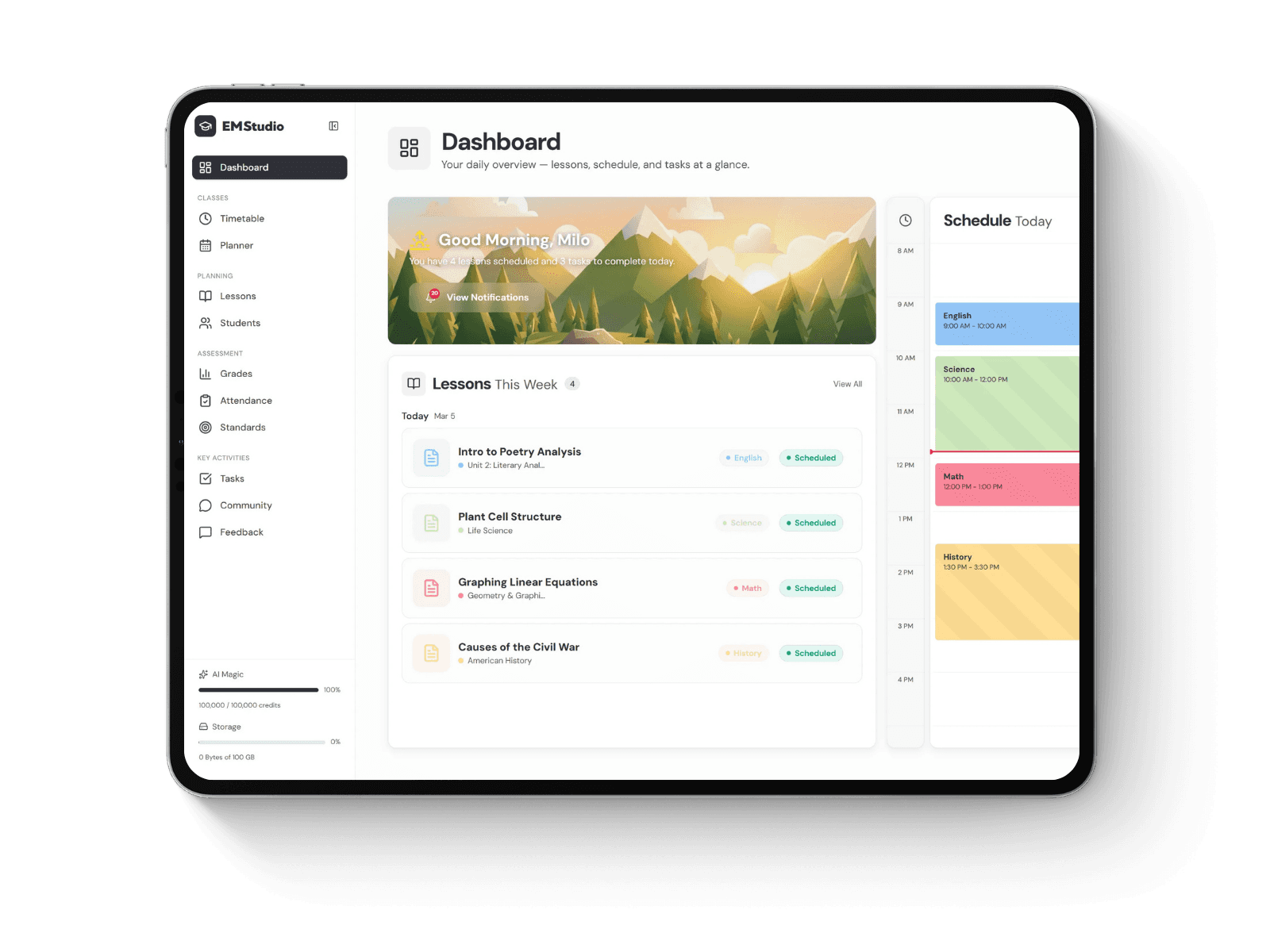
EMStudio is a free teaching management app — manage your classes, students, lessons, and more!
Learn More
Still grading everything by hand?
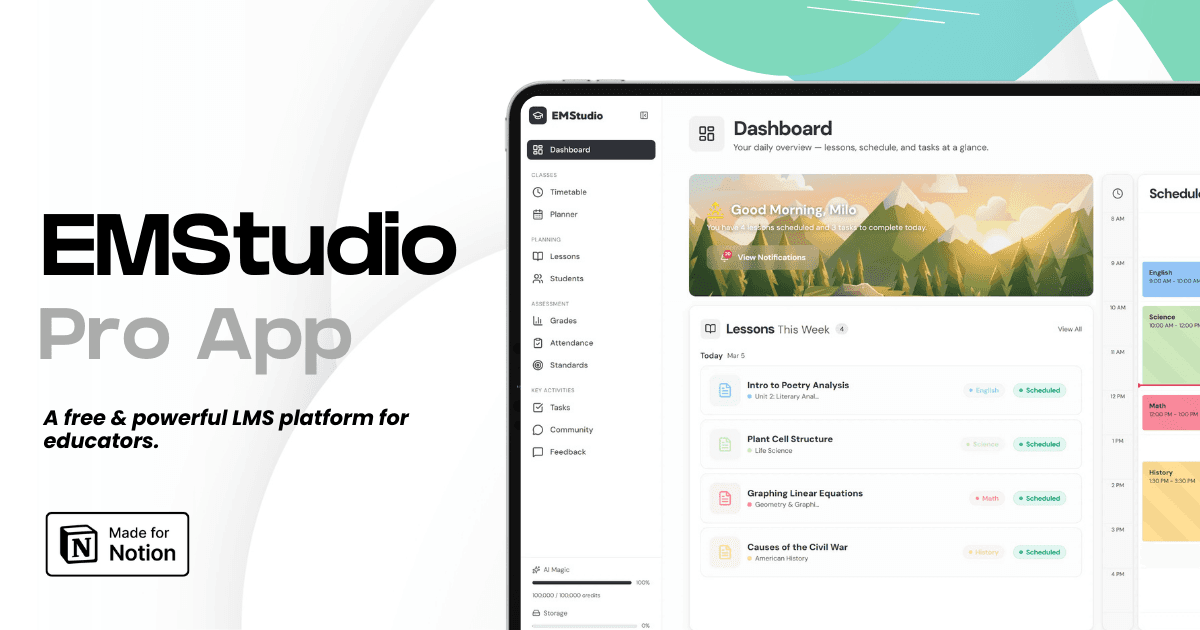
EMStudio is a free teaching management app — manage your classes, students, lessons, and more!
Learn More
Table of Contents
What Is Curriculum Instruction?
The Integration of Content Standards and Teaching Practice
You start with Common Core State Standards or Next Generation Science Standards as your baseline. Map these against Marzano's strategies or Danielson's Framework for instructional design. This integration of content standards and teaching practice turns standards into actual lessons.
District teams identify priority standards—the 20% driving 80% of assessments. They unpack these into learning targets matched with strategies like reciprocal teaching. Document this in Google Sheets showing standard code, depth of knowledge level, and assessment method.
How Curriculum Instruction Differs From Traditional Lesson Planning
Traditional planning covers Monday through Friday. Curriculum instruction spans nine-week quarters with pacing guides that leave 10% flex time for reteaching. It requires vertical alignment—knowing how your 7th-grade lesson feeds the 8th-grade capstone.
It also shifts from solo work to PLC calibration. You write common formative assessments with your team. Instead of asking "What activity will I do tomorrow?" you ask "How does tomorrow build toward Unit 3's essential question?" That's the difference between filling time and building a scope and sequence.

Why Does Curriculum Instruction Matter for Student Success?
Curriculum instruction matters because it creates consistent, high-quality learning experiences across all classrooms, directly impacting student achievement and equity. Research indicates that aligned curricula significantly improve college persistence rates and close achievement gaps by ensuring all students access rigorous, grade-level content regardless of teacher assignment.
When every 7th-grade math teacher covers the same scope and sequence using common formative assessments, students win. It sounds rigid, but it's actually what gives teachers room to exercise their pedagogical content knowledge without accidentally skipping standards.
John Hattie's Visible Learning meta-analysis puts collective teacher efficacy at the top of achievement factors with an effect size of 1.39. You hit that number when teams align their practice through shared curriculum & instruction frameworks. Everyone teaching the same unit simultaneously sounds rigid until you see students moving between classrooms without missing content because one teacher ran out of time.
Opportunity to Learn research shows that schools with rigorous alignment see higher college persistence and fewer remedial placements. One analysis suggests curriculum alignment accounts for roughly 30 percent of variance in student scores—more than individual teacher traits. That means even your best educator can't compensate for a fragmented system where Room 104 covers poetry while Room 112 does grammar all year.
Aligned curriculum instruction eliminates the lottery effect where your schedule determines your future. It ensures all students access grade-level standards regardless of which teacher they draw. In my building, we stopped the "honors track gets Shakespeare, regular track gets worksheets" divide by locking the texts and differentiating the tasks.
Closing the Achievement Gap Through Aligned Practice
Misaligned curricula often default to lower expectations for underserved populations. Without a locked scope and sequence, teachers sometimes "meet kids where they are" by dropping them two grade levels below standard. Curriculum instruction mandates access to rigorous content with scaffolds like Response to Intervention tiers, keeping the bar high while providing the ladder.
Robert Marzano's "guaranteed and viable curriculum" protects 150 to 180 days for priority standards, monitored through common formative assessments every six to eight weeks. My team assessed every Friday. It felt like overkill until we spotted gaps in week three, not June. That rhythm let us reteach immediately, avoiding the June surprise of sending kids forward with Swiss cheese knowledge.
The equity audit requires checking that 80 percent of supplemental texts reflect diverse authors and perspectives. Build this into your instructional design cycle during unit planning, not as a one-off summer project. Swap that same-old short story for something reflecting your actual students while you still have time to source materials.
Long-Term Impacts on College and Career Readiness
For college readiness, align your high school curriculum & instruction to ACT benchmarks—English 18, Math 22, Reading 22, Science 23—or SAT crosswalks. Your course content must show standards alignment covering 100 percent of assessed items in advanced pathways. Map your scope and sequence backward from those targets so junior year isn't a surprise.
Career readiness requires mapping to industry certifications like NCCER, OSHA-10, or Adobe Certified Associate. You need 80 percent content match between your coursework and the credentialing exam blueprints. This connects directly to long-term impacts on college and career readiness through clear skill articulation.
Longitudinal data shows students in schools with vertical alignment across K-12 complete postsecondary credentials at higher rates within six years. Disjointed systems produce students who hit college thinking they mastered writing because they aced a random elective, only to fail the placement test. Alignment closes that gap between perception and reality.

How Does Curriculum Instruction Work in K-12 Classrooms?
Curriculum instruction works through a three-tier system connecting district scope-and-sequence to daily learning targets using Backward Design methodology. Teachers implement 6-8 week assessment cycles with common formative assessments, analyzing data within 48 hours to adjust instruction while maintaining vertical alignment across grade levels.
Your district writes the scope and sequence—the year-long map of what gets taught when. Your building team breaks that into 6-8 week units with common formative assessments. You translate those units into daily learning targets. Data flows back up within 48 hours, letting the district spot gaps in vertical alignment while you adjust tomorrow's lesson.
This runs on Backward Design—an instructional design framework that starts with the standard, decides how students will prove mastery, then plans the learning path. No more planning activities first and hoping they hit the target. This keeps teaching learning and curriculum locked together so your daily work aligns with the goal.
You still differentiate. Using Tomlinson's framework, you adjust process and product while keeping content aligned to priority standards. That means every student hits the same priority targets, but the path and proof vary. Curriculum instruction stays flexible without becoming fragmented.
Every 6-8 weeks, your team gives common formative assessments. You review the data within 48 hours—before the next lesson. Kids who didn't master proportional relationships get small-group reteach while others extend. The cycle keeps pacing tight and standards sharp.
Backward Design and Standards-Based Planning
You unpack standards into enduring understandings, essential questions—one or two per unit—and specific knowledge and skill targets. Run your unit plan through the EQUP rubric to check quality. If the essential question doesn't spark debate in your 5th grade classroom, rewrite it before you move to activities.
Next, design the performance task using GRASPS: Goal, Role, Audience, Situation, Product, Standards. Match your assessments to cognitive complexity—DOK 1 for vocabulary recall, DOK 4 for transferring the math to unfamiliar contexts. The task proves whether students truly own the standard.
Finally, sequence the learning. Use the 5E model—Engage, Explore, Explain, Elaborate, Evaluate—or explicit instruction protocols. Cap direct instruction at 15-20 minutes for elementary. Build in time for students to grapple with the content before you rescue them.
Differentiated Instruction Within Curriculum Frameworks
Differentiation has guardrails. You may adjust process—using learning stations or tiered assignments—and product through choice boards. But content aligned to priority standards stays fixed. Every student must master the non-negotiables. This is differentiated instruction within curriculum frameworks that preserves standards alignment.
In 7th-grade math, everyone masters 7.RP.A.2—recognizing proportional relationships. Your process varies: some kids use physical manipulatives for concrete grounding, others move straight to abstract algorithms, and some work through real-world simulations like scaling recipes. The destination is identical; the route differs.
Track your choices on a Curriculum Instruction Alignment Checklist. List the standard, note your modification type—process or product—and attach evidence of mastery. This documentation proves you maintained fidelity while honoring student readiness. It also helps you refine your pedagogical content knowledge for next year.

The Four Essential Components of Curriculum and Instruction
Curriculum instruction breaks down into four interlocking parts. I call them the Curriculum and Instruction Core Four: Standards Mapping, Evidence-Based Strategies, Assessment Design, and Collaborative Structures. Miss one, and the whole machine grinds. Here is how they stack up.
Component | Primary Function | Time Investment (hours/year per teacher) | Quality Indicator | Common Pitfall |
|---|---|---|---|---|
Standards Mapping | Vertical scope and sequence alignment | 60-80 hrs/year | 100% priority standards coverage | Mapping without boundary meetings |
Evidence-Based Strategies | Learning strategies curriculum selection | 40-50 hrs/year | Effect size >0.40 implementation | Strategy shopping without fidelity checks |
Assessment Design | Common formative assessment creation | 50-60 hrs/year | Item discrimination >0.30 | Grading formative work |
Collaborative Structures | Professional learning communities and collaboration | 70-90 hrs/year | 80% inter-rater reliability | Activity instead of results focus |
Schools achieving full implementation of all four components typically require 18-24 months. Spend the first six months on component one alone—mapping—because everything else hangs on that foundation. Budget approximately $4-7 per student for curriculum mapping software, $150 per teacher per year for substitute coverage during collaborative planning time, and $2,000-5,000 for initial assessment item bank purchases.
Content Standards Mapping and Alignment
I use content standards mapping and alignment to build Curriculum Maps 2.0 in Atlas Rubicon, Curriculum Trak, or even Google Sheets if budget is tight. Each unit map needs five columns: essential questions, content, skills, assessments, and resources showing standards alignment to specific codes. Don't just list standards—show the instructional design path.
Apply the 80/20 rule ruthlessly. Identify the 20% of priority standards that yield 80% of assessment value on your state test. Map those first, ensuring 100% coverage in your scope and sequence. Supporting standards fill gaps. Then run boundary meetings between grade levels—like having your 5th and 6th grade teachers compare notes on fraction operations to ensure vertical alignment, eliminate gaps, and stop the repetition that bores kids and wastes August.
Evidence-Based Instructional Strategies
Your learning strategies curriculum should pull from high-impact moves: Rosenshine's explicit direct instruction, reciprocal teaching, problem-based learning (PBL), and formative assessment loops. Hattie's research shows these work when effect sizes sit above 0.40. Pick two strategies per quarter and master them before adding new ones.
Explicit instruction demands 15-20 minute focused segments with guided practice—we do together—before independent practice—you do alone. PBL requires 3-5 week sustained inquiry cycles, not afternoon projects. Check fidelity with an Instructional Practice Guide (IPG) or similar observation protocol. I watched a teacher think she was doing reciprocal teaching when she was just calling on kids randomly. The IPG caught the missing summarizing and clarifying steps that build true pedagogical content knowledge.
Formative and Summative Assessment Design
Design Common Formative Assessments (CFAs) every 6-8 weeks with 15-20 items aligned strictly to priority standards. Quality items show a difficulty index between 0.40-0.60 and discrimination index above 0.30. Buy an item bank for $2,000-5,000 if your team lacks time to write validated questions.
Formative assessment happens daily with descriptive feedback—no grades. Summative hits at unit end and earns the grade. Both must trace back to your curriculum maps through identical learning targets. Analyze CFA results within 48 hours using item analysis templates. Group students into Tier 1, Tier 2, or Tier 3 reteaching sets for the following week based on specific standard mastery, not overall percentages.
Professional Learning Communities and Collaboration
Structure your professional learning communities and collaboration around DuFour's four questions. What do we want students to learn? How will we know if they learned it? What will we do if they don't? What will we do if they already know it? These questions keep meetings from becoming complaint sessions.
Protect 90 minutes weekly using substitute coverage—budget $125-150 per day—or early release schedules. Follow a strict agenda: norms, data review, strategy selection, action planning. Run Assessment Moderation sessions monthly where three teachers score the same student work sample independently. You're aiming for 80% inter-rater reliability. I once saw two teachers give the same argumentative essay a 2 and a 4. Calibration fixed that discrepancy in twenty minutes and saved us from mixed messages all year.

Practical Applications: Curriculum Instruction Across Grade Levels
Smart curriculum instruction requires distinct approaches for different developmental stages. Watch three critical transitions: 2nd-3rd grade (shifting from learning to read to reading to learn), 5th-6th grade (moving from self-contained to departmentalized structures), and 8th-9th grade (adjusting to high school rigor without middle school safety nets).
Elementary: Integrating Play-Based Learning Standards
Schedule 90-120 minute daily literacy blocks using Daily 5 or Fundations with 20-minute rotation cycles through word work and comprehension stations. Success in integrating play-based learning standards means tying blocks, dramatic play, and art centers to early math and ELA benchmarks using Creative Curriculum frameworks.
Deploy running records (Fountas & Pinnell or DRA) every 6-8 weeks to track progression from pre-reader to grade-level text. Target Level D/E by end of 1st grade and Level M/N by end of 3rd.
Middle School: Balancing Content Rigor and Student Engagement
Balance your scope and sequence using AVID WICOR strategies to maintain DOK 2-3 cognitive complexity and ensure standards alignment while embedding 10-20 minute daily advisory periods for goal-setting. This pedagogical content knowledge recognizes that 6th graders need social-emotional support to take academic risks.
Create interdisciplinary units combining ELA with social studies or math with science to hit 2-3 standards simultaneously. Use frequent formative assessment to catch gaps during the 5th-6th grade transition when students face multiple teachers for the first time.
High School: Aligning Courses to College and Career Pathways
High school curriculum and instruction requires structuring instructional design around A-G requirements for UC/CSU eligibility: 2 years history, 4 years English, 3 years math, 2 years lab science, 2 years language other than English, plus 1 year arts and 1 year elective. Ensure 80% content match to approved syllabi. Map CTE sequences like Health Science across 2-3 courses with 120 minimum hours per 1.0 credit.
Senior capstones require defense exhibitions where students demonstrate mastery of 12th grade priority standards through 15-20 minute presentations with Q&A panels. Maintain strict vertical alignment checks at 8th-9th grade to prevent credential gaps.

Digital Tools That Enhance Curriculum and Instruction
Curriculum Mapping Software Solutions
Atlas Rubicon runs $4-7 per student and offers built-in standards banks with drag-and-drop unit planning. BuildYourOwnCurriculum (BYOC) hits $2-4 per student and feels more utilitarian but gets the job done. If your budget is zero, validated Google Sheets with dropdown menus for standard codes work surprisingly well for small teams with strong pedagogical content knowledge.
Demand vertical alignment views that let you trace a standard from kindergarten through 12th grade. You need unit calendar integration that syncs with your school year pacing, plus attachment capabilities for PDFs, videos, and links to external resources. Expect 40-60 hours of initial setup: import your district priority standards first, build unit templates with essential questions and assessments, then let teachers add lesson-level details.
Before uploading any student information, verify the vendor signs a Data Privacy Agreement and confirms FERPA compliance. District-wide adoption requires SOC 2 Type II certification to protect your scope and sequence data.
Learning Management Systems for Vertical Alignment
Canvas Commons lets you push district-curated modules to every course instantly, maintaining standards alignment across the building. Schoology banks learning objectives and generates alignment reports showing which standards you covered by date. Google Classroom organizes by topic, though you will hit the 20 co-teacher limit per class unless you upgrade to Workspace for Education Plus.
Your learning management systems for vertical alignment must support LTI standards for single sign-on and automatic grade passback to your SIS. Verify compatibility with PowerSchool or Infinite Campus before you commit. Canvas allows unlimited users, while Google Classroom caps courses at 1,000 students unless you pay for Plus.
Budget 20-30 hours for initial LMS configuration and integration testing. Run a pilot course with two teachers before rolling out district-wide to catch sync errors early.
Data Analytics Platforms for Instructional Decision-Making
Illuminate DnA runs $3-5 per student and shows item difficulty and discrimination indexes so you can spot bad questions. PowerSchool Analytics integrates with your SIS but locks you into their ecosystem. Google Data Studio is free if you accept manual CSV imports and building reports from scratch.
Demand longitudinal tracking across years and standards mastery dashboards comparing class vs. district performance. This validates whether your curriculum instruction actually produces mastery or just surface-level coverage. Look for item analysis that flags questions where high-performers miss the answer.
Plan 10-15 hours for platform integration with your SIS and 3-5 hours to build answer keys. Train teachers for 2-3 hours on report reading, then budget 30 minutes per formative assessment cycle for data entry using your data analytics platforms for instructional decision-making.

What Are the Most Common Challenges in Curriculum Instruction?
Common challenges include misalignment between adopted standards and classroom materials—often only 40-60% matched—severe time constraints for collaborative planning requiring substitute coverage at $150 per day, and resistance from experienced staff undergoing the Implementation Dip where student achievement temporarily drops 5-15% during transitions.
You will hit a wall. Usually around week six, when the new textbook gathers dust and you revert to last year's worksheets. That wall has a name, and it costs money.
Michael Fullan calls it the Implementation Dip. Expect student scores to drop 5-15% during the first three to six months of any major curriculum shift. Teachers learn new materials while students adjust to higher expectations. Plan intervention protocols now. Schedule extra tutoring before you see the first failing grades.
Watch for three warning signs. Curriculum Drift starts when teachers abandon the mapped sequence by week six. Assessment Misalignment occurs when your Common Formative Assessments test content you haven't taught. Collaboration Erosion turns PLCs into complaint sessions. Spot these early. They're cancerous.
Rate your curriculum instruction health on ten indicators. Check alignment percentage, CFA participation, data meeting attendance, and reteaching implementation. Score each zero to ten. Red flags appear below 60% total. If your team scores under six on vertical alignment, stop and fix the foundation.
Misalignment wastes money. Expect $2,000 to $4,000 per teacher annually in wasted materials and remediation. A full curriculum replacement runs $100 to $300 per student for new textbooks and digital licenses. When you skip the alignment audit to save time, you pay it back tenfold.
Misalignment Between Adopted Standards and Classroom Materials
Standards alignment audits separate useful textbooks from expensive paperweights. Use the Webb Depth of Knowledge protocol. Match every test item to standard codes. Reject anything below 80% alignment. I once found a math series testing multiplication in unit one while teaching it in unit three. That's chaos that leaves kids confused.
Watch for curriculum shrinkage. Teachers skip complex units when time runs short. By year-end, 30 to 40% of priority standards remain unaddressed. Protect your scope and sequence with pacing guides. Conduct quarterly audits. If third graders miss fractions in October, they fail state tests in May. No excuses.
Close the resource gap. Worksheets and online quizzes often contradict your adopted sequencing. A Grammarly subscription doesn't replace your writing curriculum. Require the Curriculum Compatibility Checklist for every supplemental resource. Teachers must verify alignment before printing. One conflicting worksheet undoes a week of careful pedagogical content knowledge building.
Time Constraints for Collaborative Planning and Calibration
You need 90 minutes weekly for effective PLC work. Most schools give you 45. Early release schedules buy one hour monthly. Or budget $600 to $800 per teacher annually for substitute coverage. Teaching learning and curriculum calibration requires protected time. Pretending otherwise guarantees shallow implementation and frustrated teams.
Recruit permanent subs at $150 per day trained in your curriculum language. They maintain continuity while you analyze formative assessment data. A warm body won't cut it. You need someone who knows your vertical alignment expectations. Train them in August alongside your staff.
When synchronous planning fails, use asynchronous templates with comment protocols. Require 48-hour turnaround on assessment item feedback. Google Docs works fine with strict deadlines. "Reply by Thursday" isn't optional. Without structure, asynchronous collaboration becomes ignored homework that wastes everyone's time.
Resistance to Instructional Shifts Among Experienced Staff
Not everyone boards the train willingly. Apply the Concerns-Based Adoption Model. Stage 0 teachers are unconcerned; Stage 3 obsess over logistics. Give Stage 3 teachers copies and schedules, not philosophy. Match support to their stage. Blanket professional development wastes money and goodwill.
Implement veteran teacher mentorship. Pair resistant 20-year veterans with early adopters. Focus on student outcome data, not debates about "how we used to do it." Philosophy meetings breed resistance to instructional shifts among experienced staff. Data meetings change practice. Keep it concrete.
Establish clear intervention protocols. After two cycles of missed CFA administration or map submission, move to administrative consultation. Create a 30-60-90 day remediation plan with specific steps. "Figure it out" isn't a strategy. Document everything. Sometimes the kindest thing for students is insisting that adults follow the instructional design agreed upon during adoption.

How Can Schools Build a Sustainable Curriculum Instruction Framework?
Schools build sustainable curriculum instruction through a PDCA (Plan-Do-Check-Act) cycle lasting 18-24 months. The process begins with thorough needs assessment, establishes vertical and horizontal alignment structures, and creates 6-8 week feedback loops with Curriculum Councils overseeing continuous refinement and resource allocation.
Sustainability fails when curriculum maps sit in binders collecting dust. You need a living system—one that breathes through regular check-ins and adjusts when data shows kids aren't getting it. Think of it as lesson planning at the systems level, with built-in accountability for every teacher.
Use the PDCA cycle: Plan your maps, Do the instruction, Check data within 48 hours, Act on revisions. Establish a Curriculum Council with one rep per grade, one admin, and one coach meeting monthly. Budget 40 hours of professional development per teacher in Year One. Focus on mapping and assessment literacy, then drop to 12 hours annually for maintenance. This isn't a one-time project; it's instructional design that evolves.
Step 1: Conducting a Comprehensive Needs Assessment
Run a TESA audit using a 20-item protocol across 10-15 classrooms. You're measuring standards alignment, cognitive complexity, and whether kids are actually engaged or just compliant. Then run a Gap Analysis: compare current coverage against 100% of state standards. Label each standard as a gap, align, or extra.
Set a 30-60-90 day timeline. Collect data for 30 days, draft priority maps by day 60, and get volunteer teachers piloting units by day 90. Speed matters here—perfectionism kills momentum before you even start.
Step 2: Developing Vertical and Horizontal Alignment Structures
Horizontal alignment means every 7th grade math teacher hits the same standard within the same two-week window. Use pacing guide calendars and common formative assessments to verify your scope and sequence stays synchronized. For vertical alignment, build skill ladders showing how argument writing progresses from opinion paragraphs in 3rd grade to research papers in high school.
Store maps using the ACE template (Alignment, Calibration, Essential Questions) with version control: Subject_Grade_Unit_Version_Date. This protects your pedagogical content knowledge from getting lost when developing vertical and horizontal alignment structures across grade levels.
Step 3: Creating Feedback Loops for Continuous Improvement
Run 6-8 week cycles. Administer common formative assessments, then run Plus-Delta protocols within 48 hours—what worked, what needs changing. Revise your learning strategies curriculum immediately while the data is hot. If proficiency drops below 70% on any priority standard, trigger immediate reteaching protocols.
Track your Curriculum Coherence Score—the percentage of teachers following the mapped sequence. When standards alignment slips, you see it before test scores tank. Sustainability lives in these quick iterations, not annual reviews that arrive too late to help this year's kids.

Getting Started with Curriculum Instruction
You don't need a doctorate to improve your curriculum instruction. Grab one unit that frustrates you. Check your scope and sequence against what actually happens in your classroom. That gap between the plan and the reality is where your real work lives.
Last year, I spent one planning period auditing standards alignment for our 7th-grade writing unit. Found three skills I was teaching that actually belong in 9th grade. Cut them. Gained back two weeks I spent on essay revision.
Build your pedagogical content knowledge one lesson at a time. Pick the strategy that failed yesterday. Test one fix during tomorrow's second period. Document what worked in a note on your phone before you forget by June.
Print your scope and sequence for next month. Highlight every standard you haven't assessed yet.
Pick one lesson that bombed. Check its standards alignment. Rewrite the objective to match the verb in the standard.
Schedule 20 minutes to observe a colleague teaching the same content. Watch their instructional design, not their classroom management.
Write one sentence describing what you learned. Put it in your lesson plan folder for next year.

What Is Curriculum Instruction?
The Integration of Content Standards and Teaching Practice
You start with Common Core State Standards or Next Generation Science Standards as your baseline. Map these against Marzano's strategies or Danielson's Framework for instructional design. This integration of content standards and teaching practice turns standards into actual lessons.
District teams identify priority standards—the 20% driving 80% of assessments. They unpack these into learning targets matched with strategies like reciprocal teaching. Document this in Google Sheets showing standard code, depth of knowledge level, and assessment method.
How Curriculum Instruction Differs From Traditional Lesson Planning
Traditional planning covers Monday through Friday. Curriculum instruction spans nine-week quarters with pacing guides that leave 10% flex time for reteaching. It requires vertical alignment—knowing how your 7th-grade lesson feeds the 8th-grade capstone.
It also shifts from solo work to PLC calibration. You write common formative assessments with your team. Instead of asking "What activity will I do tomorrow?" you ask "How does tomorrow build toward Unit 3's essential question?" That's the difference between filling time and building a scope and sequence.
Why Does Curriculum Instruction Matter for Student Success?
Curriculum instruction matters because it creates consistent, high-quality learning experiences across all classrooms, directly impacting student achievement and equity. Research indicates that aligned curricula significantly improve college persistence rates and close achievement gaps by ensuring all students access rigorous, grade-level content regardless of teacher assignment.
When every 7th-grade math teacher covers the same scope and sequence using common formative assessments, students win. It sounds rigid, but it's actually what gives teachers room to exercise their pedagogical content knowledge without accidentally skipping standards.
John Hattie's Visible Learning meta-analysis puts collective teacher efficacy at the top of achievement factors with an effect size of 1.39. You hit that number when teams align their practice through shared curriculum & instruction frameworks. Everyone teaching the same unit simultaneously sounds rigid until you see students moving between classrooms without missing content because one teacher ran out of time.
Opportunity to Learn research shows that schools with rigorous alignment see higher college persistence and fewer remedial placements. One analysis suggests curriculum alignment accounts for roughly 30 percent of variance in student scores—more than individual teacher traits. That means even your best educator can't compensate for a fragmented system where Room 104 covers poetry while Room 112 does grammar all year.
Aligned curriculum instruction eliminates the lottery effect where your schedule determines your future. It ensures all students access grade-level standards regardless of which teacher they draw. In my building, we stopped the "honors track gets Shakespeare, regular track gets worksheets" divide by locking the texts and differentiating the tasks.
Closing the Achievement Gap Through Aligned Practice
Misaligned curricula often default to lower expectations for underserved populations. Without a locked scope and sequence, teachers sometimes "meet kids where they are" by dropping them two grade levels below standard. Curriculum instruction mandates access to rigorous content with scaffolds like Response to Intervention tiers, keeping the bar high while providing the ladder.
Robert Marzano's "guaranteed and viable curriculum" protects 150 to 180 days for priority standards, monitored through common formative assessments every six to eight weeks. My team assessed every Friday. It felt like overkill until we spotted gaps in week three, not June. That rhythm let us reteach immediately, avoiding the June surprise of sending kids forward with Swiss cheese knowledge.
The equity audit requires checking that 80 percent of supplemental texts reflect diverse authors and perspectives. Build this into your instructional design cycle during unit planning, not as a one-off summer project. Swap that same-old short story for something reflecting your actual students while you still have time to source materials.
Long-Term Impacts on College and Career Readiness
For college readiness, align your high school curriculum & instruction to ACT benchmarks—English 18, Math 22, Reading 22, Science 23—or SAT crosswalks. Your course content must show standards alignment covering 100 percent of assessed items in advanced pathways. Map your scope and sequence backward from those targets so junior year isn't a surprise.
Career readiness requires mapping to industry certifications like NCCER, OSHA-10, or Adobe Certified Associate. You need 80 percent content match between your coursework and the credentialing exam blueprints. This connects directly to long-term impacts on college and career readiness through clear skill articulation.
Longitudinal data shows students in schools with vertical alignment across K-12 complete postsecondary credentials at higher rates within six years. Disjointed systems produce students who hit college thinking they mastered writing because they aced a random elective, only to fail the placement test. Alignment closes that gap between perception and reality.
How Does Curriculum Instruction Work in K-12 Classrooms?
Curriculum instruction works through a three-tier system connecting district scope-and-sequence to daily learning targets using Backward Design methodology. Teachers implement 6-8 week assessment cycles with common formative assessments, analyzing data within 48 hours to adjust instruction while maintaining vertical alignment across grade levels.
Your district writes the scope and sequence—the year-long map of what gets taught when. Your building team breaks that into 6-8 week units with common formative assessments. You translate those units into daily learning targets. Data flows back up within 48 hours, letting the district spot gaps in vertical alignment while you adjust tomorrow's lesson.
This runs on Backward Design—an instructional design framework that starts with the standard, decides how students will prove mastery, then plans the learning path. No more planning activities first and hoping they hit the target. This keeps teaching learning and curriculum locked together so your daily work aligns with the goal.
You still differentiate. Using Tomlinson's framework, you adjust process and product while keeping content aligned to priority standards. That means every student hits the same priority targets, but the path and proof vary. Curriculum instruction stays flexible without becoming fragmented.
Every 6-8 weeks, your team gives common formative assessments. You review the data within 48 hours—before the next lesson. Kids who didn't master proportional relationships get small-group reteach while others extend. The cycle keeps pacing tight and standards sharp.
Backward Design and Standards-Based Planning
You unpack standards into enduring understandings, essential questions—one or two per unit—and specific knowledge and skill targets. Run your unit plan through the EQUP rubric to check quality. If the essential question doesn't spark debate in your 5th grade classroom, rewrite it before you move to activities.
Next, design the performance task using GRASPS: Goal, Role, Audience, Situation, Product, Standards. Match your assessments to cognitive complexity—DOK 1 for vocabulary recall, DOK 4 for transferring the math to unfamiliar contexts. The task proves whether students truly own the standard.
Finally, sequence the learning. Use the 5E model—Engage, Explore, Explain, Elaborate, Evaluate—or explicit instruction protocols. Cap direct instruction at 15-20 minutes for elementary. Build in time for students to grapple with the content before you rescue them.
Differentiated Instruction Within Curriculum Frameworks
Differentiation has guardrails. You may adjust process—using learning stations or tiered assignments—and product through choice boards. But content aligned to priority standards stays fixed. Every student must master the non-negotiables. This is differentiated instruction within curriculum frameworks that preserves standards alignment.
In 7th-grade math, everyone masters 7.RP.A.2—recognizing proportional relationships. Your process varies: some kids use physical manipulatives for concrete grounding, others move straight to abstract algorithms, and some work through real-world simulations like scaling recipes. The destination is identical; the route differs.
Track your choices on a Curriculum Instruction Alignment Checklist. List the standard, note your modification type—process or product—and attach evidence of mastery. This documentation proves you maintained fidelity while honoring student readiness. It also helps you refine your pedagogical content knowledge for next year.
The Four Essential Components of Curriculum and Instruction
Curriculum instruction breaks down into four interlocking parts. I call them the Curriculum and Instruction Core Four: Standards Mapping, Evidence-Based Strategies, Assessment Design, and Collaborative Structures. Miss one, and the whole machine grinds. Here is how they stack up.
Component | Primary Function | Time Investment (hours/year per teacher) | Quality Indicator | Common Pitfall |
|---|---|---|---|---|
Standards Mapping | Vertical scope and sequence alignment | 60-80 hrs/year | 100% priority standards coverage | Mapping without boundary meetings |
Evidence-Based Strategies | Learning strategies curriculum selection | 40-50 hrs/year | Effect size >0.40 implementation | Strategy shopping without fidelity checks |
Assessment Design | Common formative assessment creation | 50-60 hrs/year | Item discrimination >0.30 | Grading formative work |
Collaborative Structures | Professional learning communities and collaboration | 70-90 hrs/year | 80% inter-rater reliability | Activity instead of results focus |
Schools achieving full implementation of all four components typically require 18-24 months. Spend the first six months on component one alone—mapping—because everything else hangs on that foundation. Budget approximately $4-7 per student for curriculum mapping software, $150 per teacher per year for substitute coverage during collaborative planning time, and $2,000-5,000 for initial assessment item bank purchases.
Content Standards Mapping and Alignment
I use content standards mapping and alignment to build Curriculum Maps 2.0 in Atlas Rubicon, Curriculum Trak, or even Google Sheets if budget is tight. Each unit map needs five columns: essential questions, content, skills, assessments, and resources showing standards alignment to specific codes. Don't just list standards—show the instructional design path.
Apply the 80/20 rule ruthlessly. Identify the 20% of priority standards that yield 80% of assessment value on your state test. Map those first, ensuring 100% coverage in your scope and sequence. Supporting standards fill gaps. Then run boundary meetings between grade levels—like having your 5th and 6th grade teachers compare notes on fraction operations to ensure vertical alignment, eliminate gaps, and stop the repetition that bores kids and wastes August.
Evidence-Based Instructional Strategies
Your learning strategies curriculum should pull from high-impact moves: Rosenshine's explicit direct instruction, reciprocal teaching, problem-based learning (PBL), and formative assessment loops. Hattie's research shows these work when effect sizes sit above 0.40. Pick two strategies per quarter and master them before adding new ones.
Explicit instruction demands 15-20 minute focused segments with guided practice—we do together—before independent practice—you do alone. PBL requires 3-5 week sustained inquiry cycles, not afternoon projects. Check fidelity with an Instructional Practice Guide (IPG) or similar observation protocol. I watched a teacher think she was doing reciprocal teaching when she was just calling on kids randomly. The IPG caught the missing summarizing and clarifying steps that build true pedagogical content knowledge.
Formative and Summative Assessment Design
Design Common Formative Assessments (CFAs) every 6-8 weeks with 15-20 items aligned strictly to priority standards. Quality items show a difficulty index between 0.40-0.60 and discrimination index above 0.30. Buy an item bank for $2,000-5,000 if your team lacks time to write validated questions.
Formative assessment happens daily with descriptive feedback—no grades. Summative hits at unit end and earns the grade. Both must trace back to your curriculum maps through identical learning targets. Analyze CFA results within 48 hours using item analysis templates. Group students into Tier 1, Tier 2, or Tier 3 reteaching sets for the following week based on specific standard mastery, not overall percentages.
Professional Learning Communities and Collaboration
Structure your professional learning communities and collaboration around DuFour's four questions. What do we want students to learn? How will we know if they learned it? What will we do if they don't? What will we do if they already know it? These questions keep meetings from becoming complaint sessions.
Protect 90 minutes weekly using substitute coverage—budget $125-150 per day—or early release schedules. Follow a strict agenda: norms, data review, strategy selection, action planning. Run Assessment Moderation sessions monthly where three teachers score the same student work sample independently. You're aiming for 80% inter-rater reliability. I once saw two teachers give the same argumentative essay a 2 and a 4. Calibration fixed that discrepancy in twenty minutes and saved us from mixed messages all year.
Practical Applications: Curriculum Instruction Across Grade Levels
Smart curriculum instruction requires distinct approaches for different developmental stages. Watch three critical transitions: 2nd-3rd grade (shifting from learning to read to reading to learn), 5th-6th grade (moving from self-contained to departmentalized structures), and 8th-9th grade (adjusting to high school rigor without middle school safety nets).
Elementary: Integrating Play-Based Learning Standards
Schedule 90-120 minute daily literacy blocks using Daily 5 or Fundations with 20-minute rotation cycles through word work and comprehension stations. Success in integrating play-based learning standards means tying blocks, dramatic play, and art centers to early math and ELA benchmarks using Creative Curriculum frameworks.
Deploy running records (Fountas & Pinnell or DRA) every 6-8 weeks to track progression from pre-reader to grade-level text. Target Level D/E by end of 1st grade and Level M/N by end of 3rd.
Middle School: Balancing Content Rigor and Student Engagement
Balance your scope and sequence using AVID WICOR strategies to maintain DOK 2-3 cognitive complexity and ensure standards alignment while embedding 10-20 minute daily advisory periods for goal-setting. This pedagogical content knowledge recognizes that 6th graders need social-emotional support to take academic risks.
Create interdisciplinary units combining ELA with social studies or math with science to hit 2-3 standards simultaneously. Use frequent formative assessment to catch gaps during the 5th-6th grade transition when students face multiple teachers for the first time.
High School: Aligning Courses to College and Career Pathways
High school curriculum and instruction requires structuring instructional design around A-G requirements for UC/CSU eligibility: 2 years history, 4 years English, 3 years math, 2 years lab science, 2 years language other than English, plus 1 year arts and 1 year elective. Ensure 80% content match to approved syllabi. Map CTE sequences like Health Science across 2-3 courses with 120 minimum hours per 1.0 credit.
Senior capstones require defense exhibitions where students demonstrate mastery of 12th grade priority standards through 15-20 minute presentations with Q&A panels. Maintain strict vertical alignment checks at 8th-9th grade to prevent credential gaps.
Digital Tools That Enhance Curriculum and Instruction
Curriculum Mapping Software Solutions
Atlas Rubicon runs $4-7 per student and offers built-in standards banks with drag-and-drop unit planning. BuildYourOwnCurriculum (BYOC) hits $2-4 per student and feels more utilitarian but gets the job done. If your budget is zero, validated Google Sheets with dropdown menus for standard codes work surprisingly well for small teams with strong pedagogical content knowledge.
Demand vertical alignment views that let you trace a standard from kindergarten through 12th grade. You need unit calendar integration that syncs with your school year pacing, plus attachment capabilities for PDFs, videos, and links to external resources. Expect 40-60 hours of initial setup: import your district priority standards first, build unit templates with essential questions and assessments, then let teachers add lesson-level details.
Before uploading any student information, verify the vendor signs a Data Privacy Agreement and confirms FERPA compliance. District-wide adoption requires SOC 2 Type II certification to protect your scope and sequence data.
Learning Management Systems for Vertical Alignment
Canvas Commons lets you push district-curated modules to every course instantly, maintaining standards alignment across the building. Schoology banks learning objectives and generates alignment reports showing which standards you covered by date. Google Classroom organizes by topic, though you will hit the 20 co-teacher limit per class unless you upgrade to Workspace for Education Plus.
Your learning management systems for vertical alignment must support LTI standards for single sign-on and automatic grade passback to your SIS. Verify compatibility with PowerSchool or Infinite Campus before you commit. Canvas allows unlimited users, while Google Classroom caps courses at 1,000 students unless you pay for Plus.
Budget 20-30 hours for initial LMS configuration and integration testing. Run a pilot course with two teachers before rolling out district-wide to catch sync errors early.
Data Analytics Platforms for Instructional Decision-Making
Illuminate DnA runs $3-5 per student and shows item difficulty and discrimination indexes so you can spot bad questions. PowerSchool Analytics integrates with your SIS but locks you into their ecosystem. Google Data Studio is free if you accept manual CSV imports and building reports from scratch.
Demand longitudinal tracking across years and standards mastery dashboards comparing class vs. district performance. This validates whether your curriculum instruction actually produces mastery or just surface-level coverage. Look for item analysis that flags questions where high-performers miss the answer.
Plan 10-15 hours for platform integration with your SIS and 3-5 hours to build answer keys. Train teachers for 2-3 hours on report reading, then budget 30 minutes per formative assessment cycle for data entry using your data analytics platforms for instructional decision-making.
What Are the Most Common Challenges in Curriculum Instruction?
Common challenges include misalignment between adopted standards and classroom materials—often only 40-60% matched—severe time constraints for collaborative planning requiring substitute coverage at $150 per day, and resistance from experienced staff undergoing the Implementation Dip where student achievement temporarily drops 5-15% during transitions.
You will hit a wall. Usually around week six, when the new textbook gathers dust and you revert to last year's worksheets. That wall has a name, and it costs money.
Michael Fullan calls it the Implementation Dip. Expect student scores to drop 5-15% during the first three to six months of any major curriculum shift. Teachers learn new materials while students adjust to higher expectations. Plan intervention protocols now. Schedule extra tutoring before you see the first failing grades.
Watch for three warning signs. Curriculum Drift starts when teachers abandon the mapped sequence by week six. Assessment Misalignment occurs when your Common Formative Assessments test content you haven't taught. Collaboration Erosion turns PLCs into complaint sessions. Spot these early. They're cancerous.
Rate your curriculum instruction health on ten indicators. Check alignment percentage, CFA participation, data meeting attendance, and reteaching implementation. Score each zero to ten. Red flags appear below 60% total. If your team scores under six on vertical alignment, stop and fix the foundation.
Misalignment wastes money. Expect $2,000 to $4,000 per teacher annually in wasted materials and remediation. A full curriculum replacement runs $100 to $300 per student for new textbooks and digital licenses. When you skip the alignment audit to save time, you pay it back tenfold.
Misalignment Between Adopted Standards and Classroom Materials
Standards alignment audits separate useful textbooks from expensive paperweights. Use the Webb Depth of Knowledge protocol. Match every test item to standard codes. Reject anything below 80% alignment. I once found a math series testing multiplication in unit one while teaching it in unit three. That's chaos that leaves kids confused.
Watch for curriculum shrinkage. Teachers skip complex units when time runs short. By year-end, 30 to 40% of priority standards remain unaddressed. Protect your scope and sequence with pacing guides. Conduct quarterly audits. If third graders miss fractions in October, they fail state tests in May. No excuses.
Close the resource gap. Worksheets and online quizzes often contradict your adopted sequencing. A Grammarly subscription doesn't replace your writing curriculum. Require the Curriculum Compatibility Checklist for every supplemental resource. Teachers must verify alignment before printing. One conflicting worksheet undoes a week of careful pedagogical content knowledge building.
Time Constraints for Collaborative Planning and Calibration
You need 90 minutes weekly for effective PLC work. Most schools give you 45. Early release schedules buy one hour monthly. Or budget $600 to $800 per teacher annually for substitute coverage. Teaching learning and curriculum calibration requires protected time. Pretending otherwise guarantees shallow implementation and frustrated teams.
Recruit permanent subs at $150 per day trained in your curriculum language. They maintain continuity while you analyze formative assessment data. A warm body won't cut it. You need someone who knows your vertical alignment expectations. Train them in August alongside your staff.
When synchronous planning fails, use asynchronous templates with comment protocols. Require 48-hour turnaround on assessment item feedback. Google Docs works fine with strict deadlines. "Reply by Thursday" isn't optional. Without structure, asynchronous collaboration becomes ignored homework that wastes everyone's time.
Resistance to Instructional Shifts Among Experienced Staff
Not everyone boards the train willingly. Apply the Concerns-Based Adoption Model. Stage 0 teachers are unconcerned; Stage 3 obsess over logistics. Give Stage 3 teachers copies and schedules, not philosophy. Match support to their stage. Blanket professional development wastes money and goodwill.
Implement veteran teacher mentorship. Pair resistant 20-year veterans with early adopters. Focus on student outcome data, not debates about "how we used to do it." Philosophy meetings breed resistance to instructional shifts among experienced staff. Data meetings change practice. Keep it concrete.
Establish clear intervention protocols. After two cycles of missed CFA administration or map submission, move to administrative consultation. Create a 30-60-90 day remediation plan with specific steps. "Figure it out" isn't a strategy. Document everything. Sometimes the kindest thing for students is insisting that adults follow the instructional design agreed upon during adoption.
How Can Schools Build a Sustainable Curriculum Instruction Framework?
Schools build sustainable curriculum instruction through a PDCA (Plan-Do-Check-Act) cycle lasting 18-24 months. The process begins with thorough needs assessment, establishes vertical and horizontal alignment structures, and creates 6-8 week feedback loops with Curriculum Councils overseeing continuous refinement and resource allocation.
Sustainability fails when curriculum maps sit in binders collecting dust. You need a living system—one that breathes through regular check-ins and adjusts when data shows kids aren't getting it. Think of it as lesson planning at the systems level, with built-in accountability for every teacher.
Use the PDCA cycle: Plan your maps, Do the instruction, Check data within 48 hours, Act on revisions. Establish a Curriculum Council with one rep per grade, one admin, and one coach meeting monthly. Budget 40 hours of professional development per teacher in Year One. Focus on mapping and assessment literacy, then drop to 12 hours annually for maintenance. This isn't a one-time project; it's instructional design that evolves.
Step 1: Conducting a Comprehensive Needs Assessment
Run a TESA audit using a 20-item protocol across 10-15 classrooms. You're measuring standards alignment, cognitive complexity, and whether kids are actually engaged or just compliant. Then run a Gap Analysis: compare current coverage against 100% of state standards. Label each standard as a gap, align, or extra.
Set a 30-60-90 day timeline. Collect data for 30 days, draft priority maps by day 60, and get volunteer teachers piloting units by day 90. Speed matters here—perfectionism kills momentum before you even start.
Step 2: Developing Vertical and Horizontal Alignment Structures
Horizontal alignment means every 7th grade math teacher hits the same standard within the same two-week window. Use pacing guide calendars and common formative assessments to verify your scope and sequence stays synchronized. For vertical alignment, build skill ladders showing how argument writing progresses from opinion paragraphs in 3rd grade to research papers in high school.
Store maps using the ACE template (Alignment, Calibration, Essential Questions) with version control: Subject_Grade_Unit_Version_Date. This protects your pedagogical content knowledge from getting lost when developing vertical and horizontal alignment structures across grade levels.
Step 3: Creating Feedback Loops for Continuous Improvement
Run 6-8 week cycles. Administer common formative assessments, then run Plus-Delta protocols within 48 hours—what worked, what needs changing. Revise your learning strategies curriculum immediately while the data is hot. If proficiency drops below 70% on any priority standard, trigger immediate reteaching protocols.
Track your Curriculum Coherence Score—the percentage of teachers following the mapped sequence. When standards alignment slips, you see it before test scores tank. Sustainability lives in these quick iterations, not annual reviews that arrive too late to help this year's kids.
Getting Started with Curriculum Instruction
You don't need a doctorate to improve your curriculum instruction. Grab one unit that frustrates you. Check your scope and sequence against what actually happens in your classroom. That gap between the plan and the reality is where your real work lives.
Last year, I spent one planning period auditing standards alignment for our 7th-grade writing unit. Found three skills I was teaching that actually belong in 9th grade. Cut them. Gained back two weeks I spent on essay revision.
Build your pedagogical content knowledge one lesson at a time. Pick the strategy that failed yesterday. Test one fix during tomorrow's second period. Document what worked in a note on your phone before you forget by June.
Print your scope and sequence for next month. Highlight every standard you haven't assessed yet.
Pick one lesson that bombed. Check its standards alignment. Rewrite the objective to match the verb in the standard.
Schedule 20 minutes to observe a colleague teaching the same content. Watch their instructional design, not their classroom management.
Write one sentence describing what you learned. Put it in your lesson plan folder for next year.
Still grading everything by hand?
EMStudio is a free teaching management app — manage your classes, students, lessons, and more!
Learn More
Still grading everything by hand?
EMStudio is a free teaching management app — manage your classes, students, lessons, and more!
Learn More




Notion4Teachers
Notion templates to simplify administrative tasks and enhance your teaching experience.



2026 Notion4Teachers. All Rights Reserved.
Notion4Teachers
Notion templates to simplify administrative tasks and enhance your teaching experience.
2026 Notion4Teachers. All Rights Reserved.
Notion4Teachers
Notion templates to simplify administrative tasks and enhance your teaching experience.
2026 Notion4Teachers. All Rights Reserved.