
Curriculum Examples for K-12 Educators: Complete Guide
Curriculum Examples for K-12 Educators: Complete Guide

Article by
Milo
ESL Content Coordinator & Educator
ESL Content Coordinator & Educator
All Posts
It's October, and your 7th graders are staring blankly at the textbook while you frantically search for something—anything—that actually explains how to teach photosynthesis in 45 minutes. That's when you realize you need concrete curriculum examples, not just standards documents and vague pacing guides.
I've been there. After fifteen years in the classroom, I know that instructional design happens in the trenches, not in theory. You need to see how someone else structured their unit planning, mapped their scope and sequence, and handled standards alignment without the edu-jargon.
This guide cuts through the noise. We'll look at real curriculum examples you can adapt—actual pacing guides, backward design templates, and subject-specific layouts that work for kindergarten through high school.
Still grading everything by hand?
EMStudio is a free teaching management app — manage your classes, students, lessons, and more!
Learn More
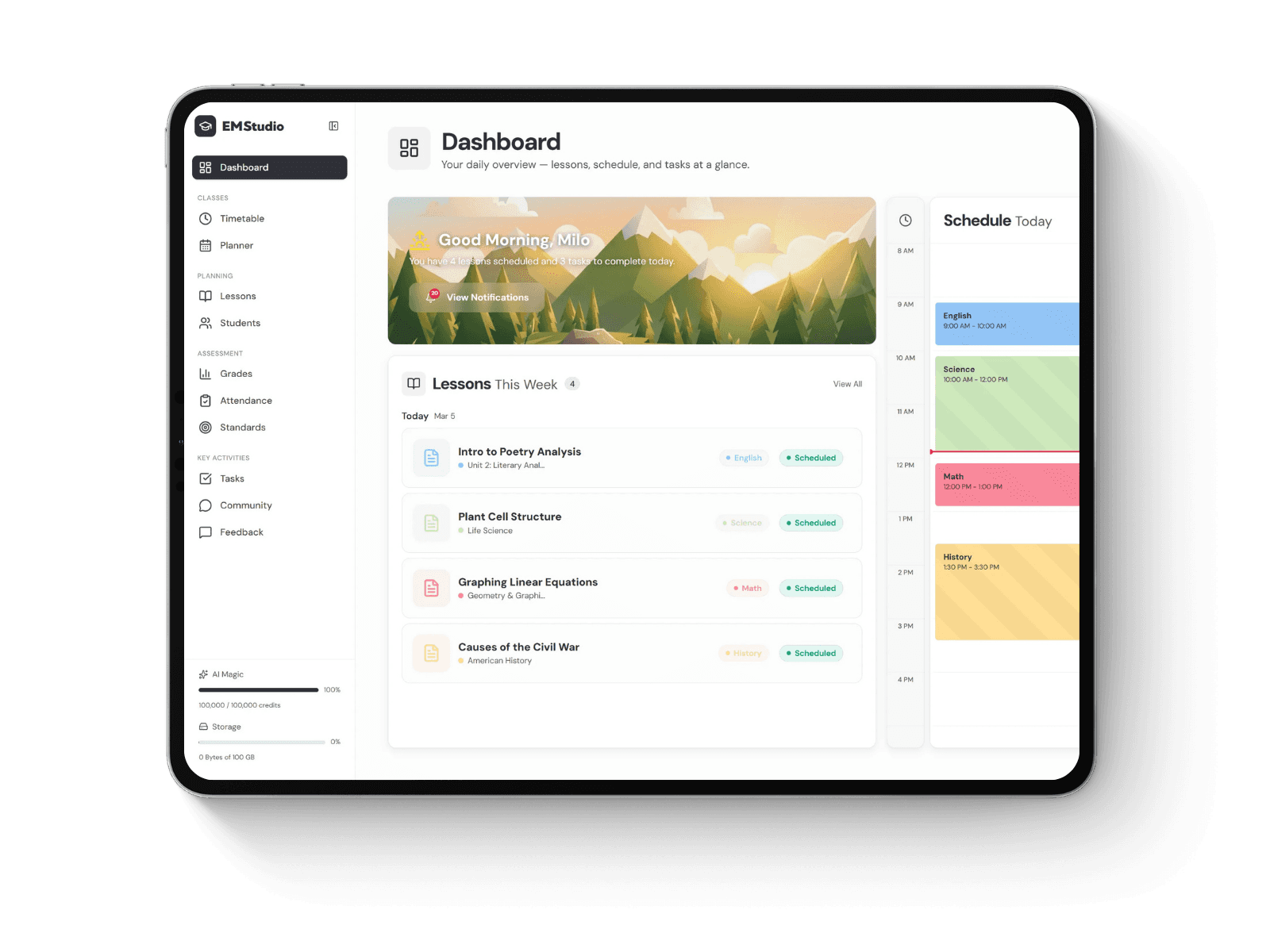
Still grading everything by hand?
EMStudio is a free teaching management app — manage your classes, students, lessons, and more!
Learn More
Table of Contents
What Are Curriculum Examples in Modern Education?
Curriculum examples are documented frameworks that translate educational standards into planned learning experiences, including scope and sequence documents, pacing guides, and unit plans. They demonstrate how objectives, content, instructional strategies, and assessments align to create coherent learning progressions for specific grade levels and subjects.
Ralph Tyler framed curriculum as planned learning experiences back in 1949. He argued that simply handing kids a textbook isn't a curriculum—it's just content. Real curriculum in education requires deliberately selecting and organizing every activity to achieve specific educational purposes.
Picture two 7th-grade science teachers. One has a textbook chapter on photosynthesis. The other has a three-week arc: a leaf pigment lab on Monday, a reading on Wednesday, and a performance assessment where students model energy transfer. Only the second teacher has a true curriculum example. The first just has pages.
Different documents serve different planning phases. The UbD 2.0 Unit Template spans twelve pages with Stage 1-3 format, usually distributed as an editable Word file for backward design. Teachers fill in desired results before planning activities. Charlotte Danielson's Framework Alignment Map comes as a PDF checklist focused on domain-specific evidence. You use it to ensure your unit hits all four evaluation domains.
Marzano's 10-Step Unit Planning Template emphasizes measurable learning goals and scales, often shared as a fillable PDF for schools using his evaluation system. The classic Tyler Rationale table—Objectives, Content, Organization, Evaluation—fits on a single spreadsheet page. It's fully editable and forces you to check alignment across all four columns before you teach.
Document scope varies by purpose. A scope and sequence charts vertical alignment across K-12, running twenty to thirty pages for a full subject. Pacing guides break the year into weekly chunks, typically two to three pages per quarter for elementary grades. Unit plans cover three-to-six week arcs in eight to fifteen pages, while daily lesson plans stay tight at one to two pages.
Instructional design operates on three levels. Intended curriculum lives in the district document: teach 4.NF.1-2 in fifteen days. Implemented curriculum is what actually happened when you spent twenty days with three reteach days. Attained curriculum shows up in the data: seventy-five percent mastery on the exit ticket versus your ninety percent target.
That gap between intended and attained triggers the gap analysis process. You compare your pacing guide against assessment results to find where the breakdown occurred. Maybe the standards alignment was off, or the formative checkpoints came too late. I once wrote objectives requiring analysis but wrote a test measuring recall. The disconnect wasted three days of reteaching.
Defining Curriculum as Planned Learning Experiences
Tyler's framework distinguishes between the planned curriculum and what sociologists call the hidden curriculum—the unintended lessons students pick up from classroom routines. When we say curriculum as planned learning experiences, we mean every minute is deliberately allocated. Not just "do a lab," but "forty-five minutes investigating density with specific materials on Tuesday."
Effective examples specify time allocations and resource requirements, not just activity descriptions. They account for your one-hundred-eighty-day school year and forty-five-minute periods. This precision separates actual curriculum documents from Pinterest boards full of "cool ideas."
The planned approach also anticipates differentiation. It notes which students need the reading support and which groups get the extension activity. Without this level of detail, you're improvising, not implementing curriculum.
Core Components of Effective Curriculum Design
Quality curriculum examples contain five non-negotiable elements. First, measurable objectives in SWBAT format—students will be able to... Second, essential questions that drive inquiry. Third, specific instructional strategies like think-pair-share or jigsaw. Fourth, assessment methods including formative checkpoints and summative tasks. Fifth, aligned resource lists with exact page numbers.
The number one failure mode in curriculum design is misalignment between assessment evidence and stated objectives. You write that students will analyze primary sources, but your test only measures recall of dates. This disconnect wastes instructional time and confuses students about expectations.
Strong examples link to core components of effective curriculum design explicitly. They show you exactly which standard each activity addresses and where the evidence of mastery appears. If you can't draw a straight line from objective to assessment, your unit planning isn't finished.
Subject-Specific vs. Integrated Curriculum Frameworks
Layout depends on your subject structure. Third-grade science typically runs in discrete forty-five-minute blocks with siloed standards. Seventh-grade humanities might blend ELA and social studies into ninety-minute blocks around a shared driving question like "How do civilizations fall?"
Integration requires thirty percent more upfront planning time but eliminates forty percent of redundant content. You stop teaching reading comprehension in isolation when students practice it analyzing historical documents. The trade-off is worth it for conceptual understanding, but deadly for skill-building like math computation or grammar.
Use subject-specific layouts for foundational skills. Use integrated frameworks for big ideas like environmental science or ancient civilizations. Your unit planning template should match your approach—tight for discrete skills, flexible for interdisciplinary projects.
Why Do Teachers Need Concrete Curriculum Examples?
Teachers need concrete curriculum examples to bridge the gap between abstract standards and daily instruction, reducing planning time by 50% while making sure alignment. These examples provide clarity on learning progressions, offer vetted assessment strategies, and support differentiation for diverse learners including ELL and special education students.
Curriculum examples turn "understand fractions" into "student can compare two fractions with unlike denominators using visual models." That specificity matters.
John Hattie's Visible Learning meta-analysis puts teacher clarity at an effect size of 0.75, well above the 0.40 hinge point. Concrete examples deliver this clarity by translating vague standards into observable student actions. Compare "understand fractions" against "student can compare two fractions with unlike denominators using visual models." The second tells you exactly what success looks like.
New teachers burn 10-12 hours weekly on planning—hunting resources, building materials, aligning standards. Vetted teacher curriculum drops that to 5-7 hours. Adaptation takes 2-3 hours versus 8-12 hours creating from scratch. That recovered time goes to analyzing student work or actually sleeping.
But watch for curriculum narrowing. This happens when teachers rigidly follow pacing guides despite formative data showing 60% of students need reteaching. Warning signs include skipping science and social studies to focus on tested subjects, ignoring student questions to "stay on schedule," and using only multiple-choice assessments because the example does. Flexibility preserves learning.
Match your support to your experience level. If you have 0-2 years, start with fully scripted examples like EngageNY or EL Education. If you have 3-5 years, use template-based examples such as Understanding by Design frameworks. If you have 6+ years and coach others, use framework-only examples like Tyler Rationale tables.
Bridging Standards and Daily Instruction
Take CCSS RL.9-10.2: "Determine a theme." A concrete example translates this into a learning objective: "SWBAT identify two themes in Of Mice and Men and cite textual evidence." Then assessment evidence: a thematic analysis paragraph. Then the learning activity: a close reading protocol with chapter 3.
This chain prevents activity-based teaching, where you pick the fun task before identifying what students should learn. Without this bridge, you end up with engaging chaos. Students enjoy the gallery walk or the TikTok project, but you can't articulate what they learned.
Concrete curriculum examples force backward design: start with the standard, define mastery, then choose activities. This ensures your pacing guides serve learning rather than dictate it. You teach the standard, not the textbook page.
Reducing Planning Time While Increasing Quality
Reducing planning time while increasing quality means choosing the right repository. OER Commons offers free materials but requires heavy vetting. Teachers Pay Teachers runs $3-15 per unit with variable quality and alignment. EngageNY provides free, comprehensive, scripted scope and sequence documents. District-adopted platforms cost $15-50 per student but guarantee standards alignment.
Quality examples include "pitfall notes"—common misconceptions and suggested teacher responses. This saves 30-45 minutes of anticipation planning per lesson. Instead of predicting where your seventh graders will struggle with slope calculations, the example warns you: "Students often confuse rise and run when lines decrease left to right." You prep the counter-example immediately.
Supporting Differentiation and Diverse Learners
Supporting differentiation and diverse learners requires tiered examples. Consider 6th-grade math ratios. Tier 1 uses on-grade textbook word problems. Tier 2 adds strategic support: manipulatives, sentence frames, and partial graphic organizers. Tier 3 provides intensive intervention: prerequisite review of multiplication facts and a 1:1 ratio of students to manipulatives.
Effective examples embed ELL supports without extra work: cognate lists, visual glossaries, and native language bridges. When teaching "photosynthesis," the example notes the Spanish cognate "fotosíntesis" and provides a labeled diagram of chloroplasts.
This instructional design happens during unit planning, not during the lesson when you're managing thirty kids. You front-load the accessibility so all students can engage with grade-level content from the start.

How Curriculum Models Structure Learning Experiences
The Tyler Rationale and Objectives-Based Models
Ralph Tyler’s 1949 model asks what objectives the school should pursue. It continues with three more: What experiences attain these goals? How do we organize them? How do we evaluate success? This curriculum model dominates traditional teacher education curriculum programs. It works best for state-tested subjects demanding tight standards alignment between daily objectives and assessments.
For an 11th-grade U.S. History Cold War unit, you start with the objective: Students analyze containment policy using primary sources. Then select content—Truman Doctrine speech, Marshall Plan data tables. Organize thematically, not chronologically, to highlight patterns. Finally, build your evaluation: a document-based essay rubric tied directly to the objective. This objectives-based models and backward planning approach takes four to six hours of unit planning time.
Understanding by Design and Backward Planning
Understanding by Design, developed by Wiggins and McTighe in 1998, flips the process. Stage 1 identifies Desired Results: Transfer goals (explain modern alliance systems), Meaning-making through essential questions (“When is intervention justified?”), and Acquisition of key terms. Stage 2 designs Assessment Evidence first—a mock NSC meeting with assigned roles proves transfer, while multiple-choice checks surface knowledge. Stage 3 builds the Learning Plan using WHERETO: Hook them with a Berlin Wall video, let them Explore documents, then Reflect on decision criteria.
Graduate-level teacher education curriculum courses prefer this backward design approach for secondary certification. Expect eight to twelve hours for instructional design that prioritizes evidence of learning over activities.
Spiral Curriculum and Mastery-Based Progressions
Jerome Bruner’s 1960 Spiral Curriculum asks when to revisit concepts. Students encounter fractions in 3rd grade with concrete models for two weeks. They return in 5th grade to unlike denominators and algorithms for three weeks. By 7th grade, they apply ratio reasoning for two weeks. In Algebra 2, they manipulate rational expressions for two weeks. Complexity moves from enactive (manipulatives) to iconic (area models) to symbolic (standard algorithm). The two-year cycle repeats with increasing abstraction each time.
This scope and sequence needs vertical teaming meetings four times yearly. Unlike mastery models with flexible pacing guides, spiraling requires strict coordination across grade levels. These curriculum examples show how structure dictates daily choices.
Subject-Specific Curriculum Layouts and Templates
These curriculum examples function as a gallery of layouts you can adapt, not copy verbatim. Each template targets a specific grade band with distinct instructional design needs. Before you use any of them, apply the Goldilocks rule. Check vocabulary density: if you see one new term per twenty words of text, modify the material. Same goes if the Flesch-Kincaid score runs two years above your students' level.
Elementary School Curriculum Maps and Pacing Guides
A solid curriculum layout for first-grade phonics spans six weeks with predictable pacing. Week one targets short a across three days. Week two covers short i for three days. Week three spends four days on initial blends.
DIBELS screening checkpoints land at weeks two, four, and six. These benchmarks tell you who needs the daily intervention block. Without them, you're guessing about which kids retained the sounds.
Daily instructional design splits the literacy block into three chunks: fifteen minutes whole group, twenty minutes stations, and fifteen minutes small group. That fifty-minute core leaves room for the twenty-minute intervention pullout that serves your lowest quartile.
Effective pacing guides list standard codes like CCSS.ELA-LITERACY.RF.1.3 next to suggested day counts. They name specific resources such as Fundations or Journeys. They also note formative assessment methods—exit tickets or running records—to track mastery daily.
Unlike secondary schedules, elementary layouts often use a six-day rotation. Day six becomes your safety valve for reteaching or enrichment, not acceleration. You can see this framework in detailed elementary school curriculum maps and pacing guides.
Middle School Interdisciplinary Unit Examples
Seventh-grade curriculum examples work best when they tear down walls between subjects. A four-week Ancient Civilizations unit runs on a ninety-minute daily block. Week one maps geography and settlement patterns. Week two analyzes governance systems and laws.
Week three follows trade routes and economic structures across the ancient world. Week four culminates in a student-built museum exhibit open to parents and younger grades. The standards alignment lists three specific Social Studies standards and two ELA writing standards that the final project assesses.
This unit planning model needs forty-five minutes of common planning time daily. Teachers share a driving question that threads through both subjects. Grades split sixty percent for content mastery and forty percent for literacy skills.
You can issue dual grades or weight the primary subject heavier depending on your report card system. The ninety-minute block breaks into thirds: thirty minutes for a shared mini-lesson, thirty for subject-specific workshops, and thirty for integrated project work.
Without that shared planning time, the curriculum layout falls apart by week two. The schedule only works if both teachers agree on the driving question and the assessment rubric before the first bell rings.
High School Scope and Sequence Documents
A high school Chemistry scope and sequence maps the full year in digestible chunks. Unit one covers Atomic Structure for three weeks using textbook chapters one and two. The opening lab is a flame test. Unit two spends two weeks on Periodic Trends with an unknown identification lab.
Unit three tackles Chemical Bonding for three weeks. Each unit aligns to specific NGSS performance expectations such as HS-PS1-1 and HS-PS1-2. This backward design keeps every lab tied to a standard rather than random demonstrations.
Complete documents start with a course description and a week-one diagnostic assessing prerequisite math skills. They list unit timeframes alongside specific textbook chapters and supplementary labs. They also mark standardized test preparation checkpoints exactly three weeks before the exam date.
High school templates include one flex day per unit for snow delays or emergency reteaching. Elementary builds intervention into daily blocks, but secondary moves that buffer to the calendar. You can see this structure in detailed high school scope and sequence documents.
Always verify text complexity before adopting any template. If the Flesch-Kincaid level exceeds your students' grade level by two years, or vocabulary density tops one new term per twenty words, the material requires significant modification before it meets the Goldilocks standard.

Digital Curriculum Resources and PDF Downloads
Choosing between open educational resources, district platforms, and customizable templates means weighing cost against control. OER offers free materials with high customization potential, though you verify standards alignment yourself and tech needs stay minimal. District platforms run $15 to $50 per student annually, guarantee alignment, but demand heavy SSO integration.
Free repositories include OER Commons for full courses, CK-12 for STEM flexbooks with adaptive practice, and EngageNY for comprehensive ELA and math modules. The Smithsonian Learning Lab provides primary source collections. District-adopted platforms such as Canvas Commons, Atlas Next, and McGraw-Hill ConnectED typically cost a 1,000-student district between $20,000 and $50,000 annually, requiring Google or Microsoft SSO integration.
Many teachers fall into digital abandonment: they perform a curriculum pdf download then never modify the material. Before using any resource, ask three questions. Does this match my students' prior knowledge? Are the assessments accessible to my ELL and IEP population? Do I have the technology and materials required for Days 1, 5, and 10?
Open Educational Resources and Free Repositories
OER Commons remains the best starting point for open educational resources and free repositories. Filter by Education Level from Preschool through Adult, Material Type such as Full Course or Unit, and Primary User whether Teacher or Student. These filters prevent the frustration of finding college-level materials when you need 7th grade content.
Districts should budget $2,000 to $5,000 annually for curation and alignment verification time, even though the resources themselves cost nothing. Someone must check that the scope and sequence actually matches your state standards before teachers use the materials.
EngageNY provides complete curriculum pdf download options for ELA with four modules per grade and for Math with six modules containing Topics A through F. Each module needs three to four hours of review time before implementation. CK-12 offers STEM flexbooks with built-in adaptive practice, while the Smithsonian Learning Lab organizes primary sources into collections for inquiry-based unit planning.
Sixty-seven percent of educators report using OER to supplement core materials, not replace them. When searching, select 'Full Course' under Material Type and 'K-12' under Education Level to surface complete curriculum examples with backward design structures already built in.
District-Adopted Digital Curriculum Platforms
Districts typically run adoption cycles every five to seven years, with pilot requirements lasting one semester minimum. You need three to five teachers testing the platform and collecting comparison data against current curriculum examples before the district commits to a $20,000 to $50,000 annual contract for a 1,000-student system. This process ensures the platform supports your scope and sequence before heavy investment.
Integration requirements dictate your daily workflow. Roster students through Clever or ClassLink to avoid manual account creation. Verify gradebook passback capabilities so scores flow directly into your SIS without double entry. Check parent portal visibility so families see assignments without needing separate passwords or complex navigation instructions.
Canvas Commons allows teachers to share modules across schools, while Atlas Next provides curriculum mapping with a unit calendar view showing standards alignment across grade levels. McGraw-Hill ConnectED bundles content with integrated assessments. All three require Google or Microsoft SSO integration to function smoothly within your existing tech ecosystem.
The hidden cost isn't just the per-student fee. Factor in professional development days, IT support hours for SSO troubleshooting, and time spent customizing the platform's rigid instructional design to fit your actual students. These systems work best for core instruction where consistency matters more than the ability to modify every lesson.
Customizable Curriculum Templates and PDF Formats
Customizable curriculum templates and PDF formats offer the highest control for backward design and unit planning. The UbD 2.0 Template in Microsoft Word contains twelve sections covering established goals, essential questions, and learning evidence. For faster planning, use the Understanding by Design single-page PDF with fillable fields that force you to focus on assessment before activities.
Google Docs curriculum maps with dropdown menus for standards alignment allow real-time collaboration with your grade-level team. Everyone edits simultaneously without passing a single file around. These formats cost little upfront, usually free to $30 one-time, but demand significant time investment from teachers to populate with quality content and instructional design.
Archive your work strategically. Keep working documents in Google Docs or Word for ongoing collaboration and edits. Save final versions as curriculum pdf download files for versioning control and legal compliance. PDFs prevent accidental changes after approval while maintaining the formatting integrity of your pacing guides and assessments.
Avoid digital abandonment by running every template through a three-question checklist before use. Does this match my students' prior knowledge? Are the assessments accessible to my ELL and IEP population? Do I have the technology and materials required for Days 1, 5, and 10? If you answer no to any question, modify the template before printing or posting to your LMS.
How to Adapt Curriculum Examples for Your Classroom
Start with a data audit. Pull last year's state test proficiency reports and your current diagnostic scores. If the median reading level is two grades below the example's target, you will need heavy modifications or a different resource entirely.
Check your materials before you fall in love with the lesson. Verify that the technology requirements match your reality. One-to-one tablets listed in the example becomes a problem when you only have the computer lab twice weekly. This is your material audit.
Watch for red flags. Cultural content that stereotypes or excludes your specific students requires immediate rejection. Reading levels exceeding your class median by two or more grades demand replacement texts, not just tweaks. Pedagogical approaches that clash with your school model—like project-based learning examples in direct-instruction environments—rarely survive first contact.
Aligning Examples with Local Standards and Mandates
Create a three-column crosswalk table. Label the columns: Example Standard, Local/State Standard, and Match Quality. Add a fourth column for Notes. Map every standard in the curriculum examples against your local requirements to expose gaps before you teach.
Pay special attention if you teach in Texas or Virginia. The TEKS and SOL frameworks do not align with Common Core, so your crosswalk will show more mismatches than matches. When you mark a standard as Low quality, you must either supplement with additional resources or select a different example entirely.
Never assume that similar numbering means identical content. Standards alignment requires reading the actual text of each benchmark. I once spent three weeks planning around an example that taught narrative writing when my state required expository analysis. The vocabulary matched but the skills diverged.
Document your decisions in the Notes column. Write why you marked something High or Low, and what resource you will use to fill gaps. This documentation saves you during unit planning next year when you cannot remember why you skipped lesson four.
Save your completed crosswalk with your lesson plans. Administrators reviewing your instructional design will see exactly how you ensured coverage. More importantly, you will see it when you revisit the unit in October and wonder why you skipped the second week.
When aligning examples with local standards and mandates, remember that perfect alignment is rare. Medium matches work if you add one or two supplemental activities. Low matches usually signal that you should keep searching.
Check your district's scope and sequence against the example's timeline. If your district teaches geometry in the fall and the example assumes spring algebra readiness, the misalignment will derail your students.
Modifying Content for Student Populations and Needs
Build your differentiation during the adaptation phase, not during the lesson. For every summative assessment, identify three tiers using MTSS or RtI protocols. Tier 1 serves eighty percent of students with grade-level text with standard graphic organizers.
Tier 2 supports fifteen percent with adapted text, sentence frames, and partner reading. Tier 3 addresses five percent with alternative text two years below grade level, one-to-one graphic organizers, and modified word banks.
Keep the essential question identical across all three tiers. The summative task should also remain consistent when possible. This ensures backward design integrity while allowing access points for diverse learners.
Consider a concrete scenario. You find a strong "Introduction to Poetry" unit designed for suburban ninth graders—seventy-five percent white, ten percent free and reduced lunch. Your urban classroom holds forty percent ELL students and sixty percent free and reduced lunch. Swap Robert Frost for Pat Mora and Langston Hughes to build cultural relevance.
Add SIOP vocabulary front-loading with cognates and word walls. Change the final assessment from a five-paragraph essay to a spoken word performance with written reflection. This maintains rigor while honoring multiple modes of expression.
Remember that curriculum examples are starting points, not scripts. The poetry unit's structure remains sound even when the texts and outputs change. Your instructional design should prioritize student access over publisher fidelity.
Check reading levels using Fleisch-Kincaid or similar tools. If the example text exceeds your class median by two grade levels, you are looking at Tier 3 material for everyone, which will fail. Replace the text or scaffold heavily.
Document your tiered modifications in your plan book. Note which students received which accommodations so you can track efficacy. If Tier 2 students consistently outperform Tier 1 on formative checks, your text adaptation was too aggressive.
Creating Implementation Timelines and Assessment Schedules
Resist the urge to overhaul everything at once. Follow a four-month implementation timeline. Month one: select and audit your example against student data. Month two: adapt the first quarter and create assessments. Month three: pilot with one unit only, conducting a formative review at week two. Month four: move to full implementation with built-in reflection checkpoints.
Teachers who rush adaptation in under two weeks face implementation failure eighty percent of the time. The planning feels productive but collapses under real classroom conditions.
Within your pilot unit, use a nine-week assessment schedule. Administer a diagnostic in week one using DRA or MAP. Schedule formative checkpoints in weeks three, five, and seven using exit tickets or brief quizzes. Place the summative assessment in week nine. Build two "flex days" into weeks four and six for reteaching based on week three and week five data.
Treat pacing guides as maps with suggested routes rather than train schedules. If your week three formative shows sixty percent mastery on thesis statements, stop. Adjust speed based on student mastery data rather than the calendar.
Run your pilot for one week only initially. Gather feedback via a five-question student survey. Ask what confused them and what helped. If the example's backward design did not survive first contact with your actual students, you want to know before you have committed twelve weeks of content.
Save your modified timeline template for next year. Note where you needed extra days and where you moved faster than expected. This becomes your custom scope and sequence for future cohorts.

What Curriculum Examples Really Comes Down To
It is not about finding the perfect template. Curriculum examples work when they give you clarity — a clear scope and sequence that keeps you from scrambling to cover the Civil War three days before winter break.
You can use backward design, follow district pacing guides, or mix both. The format matters less than the function. Your instructional design should answer one question: what do students need to know by June, and how do we get there without burning out in February?
Stop collecting PDFs you never open. Pick one framework. Map your first unit. Adjust it after you teach it. That cycle — plan, teach, revise — beats any pristine document sitting in your Google Drive.
What Are Curriculum Examples in Modern Education?
Curriculum examples are documented frameworks that translate educational standards into planned learning experiences, including scope and sequence documents, pacing guides, and unit plans. They demonstrate how objectives, content, instructional strategies, and assessments align to create coherent learning progressions for specific grade levels and subjects.
Ralph Tyler framed curriculum as planned learning experiences back in 1949. He argued that simply handing kids a textbook isn't a curriculum—it's just content. Real curriculum in education requires deliberately selecting and organizing every activity to achieve specific educational purposes.
Picture two 7th-grade science teachers. One has a textbook chapter on photosynthesis. The other has a three-week arc: a leaf pigment lab on Monday, a reading on Wednesday, and a performance assessment where students model energy transfer. Only the second teacher has a true curriculum example. The first just has pages.
Different documents serve different planning phases. The UbD 2.0 Unit Template spans twelve pages with Stage 1-3 format, usually distributed as an editable Word file for backward design. Teachers fill in desired results before planning activities. Charlotte Danielson's Framework Alignment Map comes as a PDF checklist focused on domain-specific evidence. You use it to ensure your unit hits all four evaluation domains.
Marzano's 10-Step Unit Planning Template emphasizes measurable learning goals and scales, often shared as a fillable PDF for schools using his evaluation system. The classic Tyler Rationale table—Objectives, Content, Organization, Evaluation—fits on a single spreadsheet page. It's fully editable and forces you to check alignment across all four columns before you teach.
Document scope varies by purpose. A scope and sequence charts vertical alignment across K-12, running twenty to thirty pages for a full subject. Pacing guides break the year into weekly chunks, typically two to three pages per quarter for elementary grades. Unit plans cover three-to-six week arcs in eight to fifteen pages, while daily lesson plans stay tight at one to two pages.
Instructional design operates on three levels. Intended curriculum lives in the district document: teach 4.NF.1-2 in fifteen days. Implemented curriculum is what actually happened when you spent twenty days with three reteach days. Attained curriculum shows up in the data: seventy-five percent mastery on the exit ticket versus your ninety percent target.
That gap between intended and attained triggers the gap analysis process. You compare your pacing guide against assessment results to find where the breakdown occurred. Maybe the standards alignment was off, or the formative checkpoints came too late. I once wrote objectives requiring analysis but wrote a test measuring recall. The disconnect wasted three days of reteaching.
Defining Curriculum as Planned Learning Experiences
Tyler's framework distinguishes between the planned curriculum and what sociologists call the hidden curriculum—the unintended lessons students pick up from classroom routines. When we say curriculum as planned learning experiences, we mean every minute is deliberately allocated. Not just "do a lab," but "forty-five minutes investigating density with specific materials on Tuesday."
Effective examples specify time allocations and resource requirements, not just activity descriptions. They account for your one-hundred-eighty-day school year and forty-five-minute periods. This precision separates actual curriculum documents from Pinterest boards full of "cool ideas."
The planned approach also anticipates differentiation. It notes which students need the reading support and which groups get the extension activity. Without this level of detail, you're improvising, not implementing curriculum.
Core Components of Effective Curriculum Design
Quality curriculum examples contain five non-negotiable elements. First, measurable objectives in SWBAT format—students will be able to... Second, essential questions that drive inquiry. Third, specific instructional strategies like think-pair-share or jigsaw. Fourth, assessment methods including formative checkpoints and summative tasks. Fifth, aligned resource lists with exact page numbers.
The number one failure mode in curriculum design is misalignment between assessment evidence and stated objectives. You write that students will analyze primary sources, but your test only measures recall of dates. This disconnect wastes instructional time and confuses students about expectations.
Strong examples link to core components of effective curriculum design explicitly. They show you exactly which standard each activity addresses and where the evidence of mastery appears. If you can't draw a straight line from objective to assessment, your unit planning isn't finished.
Subject-Specific vs. Integrated Curriculum Frameworks
Layout depends on your subject structure. Third-grade science typically runs in discrete forty-five-minute blocks with siloed standards. Seventh-grade humanities might blend ELA and social studies into ninety-minute blocks around a shared driving question like "How do civilizations fall?"
Integration requires thirty percent more upfront planning time but eliminates forty percent of redundant content. You stop teaching reading comprehension in isolation when students practice it analyzing historical documents. The trade-off is worth it for conceptual understanding, but deadly for skill-building like math computation or grammar.
Use subject-specific layouts for foundational skills. Use integrated frameworks for big ideas like environmental science or ancient civilizations. Your unit planning template should match your approach—tight for discrete skills, flexible for interdisciplinary projects.
Why Do Teachers Need Concrete Curriculum Examples?
Teachers need concrete curriculum examples to bridge the gap between abstract standards and daily instruction, reducing planning time by 50% while making sure alignment. These examples provide clarity on learning progressions, offer vetted assessment strategies, and support differentiation for diverse learners including ELL and special education students.
Curriculum examples turn "understand fractions" into "student can compare two fractions with unlike denominators using visual models." That specificity matters.
John Hattie's Visible Learning meta-analysis puts teacher clarity at an effect size of 0.75, well above the 0.40 hinge point. Concrete examples deliver this clarity by translating vague standards into observable student actions. Compare "understand fractions" against "student can compare two fractions with unlike denominators using visual models." The second tells you exactly what success looks like.
New teachers burn 10-12 hours weekly on planning—hunting resources, building materials, aligning standards. Vetted teacher curriculum drops that to 5-7 hours. Adaptation takes 2-3 hours versus 8-12 hours creating from scratch. That recovered time goes to analyzing student work or actually sleeping.
But watch for curriculum narrowing. This happens when teachers rigidly follow pacing guides despite formative data showing 60% of students need reteaching. Warning signs include skipping science and social studies to focus on tested subjects, ignoring student questions to "stay on schedule," and using only multiple-choice assessments because the example does. Flexibility preserves learning.
Match your support to your experience level. If you have 0-2 years, start with fully scripted examples like EngageNY or EL Education. If you have 3-5 years, use template-based examples such as Understanding by Design frameworks. If you have 6+ years and coach others, use framework-only examples like Tyler Rationale tables.
Bridging Standards and Daily Instruction
Take CCSS RL.9-10.2: "Determine a theme." A concrete example translates this into a learning objective: "SWBAT identify two themes in Of Mice and Men and cite textual evidence." Then assessment evidence: a thematic analysis paragraph. Then the learning activity: a close reading protocol with chapter 3.
This chain prevents activity-based teaching, where you pick the fun task before identifying what students should learn. Without this bridge, you end up with engaging chaos. Students enjoy the gallery walk or the TikTok project, but you can't articulate what they learned.
Concrete curriculum examples force backward design: start with the standard, define mastery, then choose activities. This ensures your pacing guides serve learning rather than dictate it. You teach the standard, not the textbook page.
Reducing Planning Time While Increasing Quality
Reducing planning time while increasing quality means choosing the right repository. OER Commons offers free materials but requires heavy vetting. Teachers Pay Teachers runs $3-15 per unit with variable quality and alignment. EngageNY provides free, comprehensive, scripted scope and sequence documents. District-adopted platforms cost $15-50 per student but guarantee standards alignment.
Quality examples include "pitfall notes"—common misconceptions and suggested teacher responses. This saves 30-45 minutes of anticipation planning per lesson. Instead of predicting where your seventh graders will struggle with slope calculations, the example warns you: "Students often confuse rise and run when lines decrease left to right." You prep the counter-example immediately.
Supporting Differentiation and Diverse Learners
Supporting differentiation and diverse learners requires tiered examples. Consider 6th-grade math ratios. Tier 1 uses on-grade textbook word problems. Tier 2 adds strategic support: manipulatives, sentence frames, and partial graphic organizers. Tier 3 provides intensive intervention: prerequisite review of multiplication facts and a 1:1 ratio of students to manipulatives.
Effective examples embed ELL supports without extra work: cognate lists, visual glossaries, and native language bridges. When teaching "photosynthesis," the example notes the Spanish cognate "fotosíntesis" and provides a labeled diagram of chloroplasts.
This instructional design happens during unit planning, not during the lesson when you're managing thirty kids. You front-load the accessibility so all students can engage with grade-level content from the start.
How Curriculum Models Structure Learning Experiences
The Tyler Rationale and Objectives-Based Models
Ralph Tyler’s 1949 model asks what objectives the school should pursue. It continues with three more: What experiences attain these goals? How do we organize them? How do we evaluate success? This curriculum model dominates traditional teacher education curriculum programs. It works best for state-tested subjects demanding tight standards alignment between daily objectives and assessments.
For an 11th-grade U.S. History Cold War unit, you start with the objective: Students analyze containment policy using primary sources. Then select content—Truman Doctrine speech, Marshall Plan data tables. Organize thematically, not chronologically, to highlight patterns. Finally, build your evaluation: a document-based essay rubric tied directly to the objective. This objectives-based models and backward planning approach takes four to six hours of unit planning time.
Understanding by Design and Backward Planning
Understanding by Design, developed by Wiggins and McTighe in 1998, flips the process. Stage 1 identifies Desired Results: Transfer goals (explain modern alliance systems), Meaning-making through essential questions (“When is intervention justified?”), and Acquisition of key terms. Stage 2 designs Assessment Evidence first—a mock NSC meeting with assigned roles proves transfer, while multiple-choice checks surface knowledge. Stage 3 builds the Learning Plan using WHERETO: Hook them with a Berlin Wall video, let them Explore documents, then Reflect on decision criteria.
Graduate-level teacher education curriculum courses prefer this backward design approach for secondary certification. Expect eight to twelve hours for instructional design that prioritizes evidence of learning over activities.
Spiral Curriculum and Mastery-Based Progressions
Jerome Bruner’s 1960 Spiral Curriculum asks when to revisit concepts. Students encounter fractions in 3rd grade with concrete models for two weeks. They return in 5th grade to unlike denominators and algorithms for three weeks. By 7th grade, they apply ratio reasoning for two weeks. In Algebra 2, they manipulate rational expressions for two weeks. Complexity moves from enactive (manipulatives) to iconic (area models) to symbolic (standard algorithm). The two-year cycle repeats with increasing abstraction each time.
This scope and sequence needs vertical teaming meetings four times yearly. Unlike mastery models with flexible pacing guides, spiraling requires strict coordination across grade levels. These curriculum examples show how structure dictates daily choices.
Subject-Specific Curriculum Layouts and Templates
These curriculum examples function as a gallery of layouts you can adapt, not copy verbatim. Each template targets a specific grade band with distinct instructional design needs. Before you use any of them, apply the Goldilocks rule. Check vocabulary density: if you see one new term per twenty words of text, modify the material. Same goes if the Flesch-Kincaid score runs two years above your students' level.
Elementary School Curriculum Maps and Pacing Guides
A solid curriculum layout for first-grade phonics spans six weeks with predictable pacing. Week one targets short a across three days. Week two covers short i for three days. Week three spends four days on initial blends.
DIBELS screening checkpoints land at weeks two, four, and six. These benchmarks tell you who needs the daily intervention block. Without them, you're guessing about which kids retained the sounds.
Daily instructional design splits the literacy block into three chunks: fifteen minutes whole group, twenty minutes stations, and fifteen minutes small group. That fifty-minute core leaves room for the twenty-minute intervention pullout that serves your lowest quartile.
Effective pacing guides list standard codes like CCSS.ELA-LITERACY.RF.1.3 next to suggested day counts. They name specific resources such as Fundations or Journeys. They also note formative assessment methods—exit tickets or running records—to track mastery daily.
Unlike secondary schedules, elementary layouts often use a six-day rotation. Day six becomes your safety valve for reteaching or enrichment, not acceleration. You can see this framework in detailed elementary school curriculum maps and pacing guides.
Middle School Interdisciplinary Unit Examples
Seventh-grade curriculum examples work best when they tear down walls between subjects. A four-week Ancient Civilizations unit runs on a ninety-minute daily block. Week one maps geography and settlement patterns. Week two analyzes governance systems and laws.
Week three follows trade routes and economic structures across the ancient world. Week four culminates in a student-built museum exhibit open to parents and younger grades. The standards alignment lists three specific Social Studies standards and two ELA writing standards that the final project assesses.
This unit planning model needs forty-five minutes of common planning time daily. Teachers share a driving question that threads through both subjects. Grades split sixty percent for content mastery and forty percent for literacy skills.
You can issue dual grades or weight the primary subject heavier depending on your report card system. The ninety-minute block breaks into thirds: thirty minutes for a shared mini-lesson, thirty for subject-specific workshops, and thirty for integrated project work.
Without that shared planning time, the curriculum layout falls apart by week two. The schedule only works if both teachers agree on the driving question and the assessment rubric before the first bell rings.
High School Scope and Sequence Documents
A high school Chemistry scope and sequence maps the full year in digestible chunks. Unit one covers Atomic Structure for three weeks using textbook chapters one and two. The opening lab is a flame test. Unit two spends two weeks on Periodic Trends with an unknown identification lab.
Unit three tackles Chemical Bonding for three weeks. Each unit aligns to specific NGSS performance expectations such as HS-PS1-1 and HS-PS1-2. This backward design keeps every lab tied to a standard rather than random demonstrations.
Complete documents start with a course description and a week-one diagnostic assessing prerequisite math skills. They list unit timeframes alongside specific textbook chapters and supplementary labs. They also mark standardized test preparation checkpoints exactly three weeks before the exam date.
High school templates include one flex day per unit for snow delays or emergency reteaching. Elementary builds intervention into daily blocks, but secondary moves that buffer to the calendar. You can see this structure in detailed high school scope and sequence documents.
Always verify text complexity before adopting any template. If the Flesch-Kincaid level exceeds your students' grade level by two years, or vocabulary density tops one new term per twenty words, the material requires significant modification before it meets the Goldilocks standard.
Digital Curriculum Resources and PDF Downloads
Choosing between open educational resources, district platforms, and customizable templates means weighing cost against control. OER offers free materials with high customization potential, though you verify standards alignment yourself and tech needs stay minimal. District platforms run $15 to $50 per student annually, guarantee alignment, but demand heavy SSO integration.
Free repositories include OER Commons for full courses, CK-12 for STEM flexbooks with adaptive practice, and EngageNY for comprehensive ELA and math modules. The Smithsonian Learning Lab provides primary source collections. District-adopted platforms such as Canvas Commons, Atlas Next, and McGraw-Hill ConnectED typically cost a 1,000-student district between $20,000 and $50,000 annually, requiring Google or Microsoft SSO integration.
Many teachers fall into digital abandonment: they perform a curriculum pdf download then never modify the material. Before using any resource, ask three questions. Does this match my students' prior knowledge? Are the assessments accessible to my ELL and IEP population? Do I have the technology and materials required for Days 1, 5, and 10?
Open Educational Resources and Free Repositories
OER Commons remains the best starting point for open educational resources and free repositories. Filter by Education Level from Preschool through Adult, Material Type such as Full Course or Unit, and Primary User whether Teacher or Student. These filters prevent the frustration of finding college-level materials when you need 7th grade content.
Districts should budget $2,000 to $5,000 annually for curation and alignment verification time, even though the resources themselves cost nothing. Someone must check that the scope and sequence actually matches your state standards before teachers use the materials.
EngageNY provides complete curriculum pdf download options for ELA with four modules per grade and for Math with six modules containing Topics A through F. Each module needs three to four hours of review time before implementation. CK-12 offers STEM flexbooks with built-in adaptive practice, while the Smithsonian Learning Lab organizes primary sources into collections for inquiry-based unit planning.
Sixty-seven percent of educators report using OER to supplement core materials, not replace them. When searching, select 'Full Course' under Material Type and 'K-12' under Education Level to surface complete curriculum examples with backward design structures already built in.
District-Adopted Digital Curriculum Platforms
Districts typically run adoption cycles every five to seven years, with pilot requirements lasting one semester minimum. You need three to five teachers testing the platform and collecting comparison data against current curriculum examples before the district commits to a $20,000 to $50,000 annual contract for a 1,000-student system. This process ensures the platform supports your scope and sequence before heavy investment.
Integration requirements dictate your daily workflow. Roster students through Clever or ClassLink to avoid manual account creation. Verify gradebook passback capabilities so scores flow directly into your SIS without double entry. Check parent portal visibility so families see assignments without needing separate passwords or complex navigation instructions.
Canvas Commons allows teachers to share modules across schools, while Atlas Next provides curriculum mapping with a unit calendar view showing standards alignment across grade levels. McGraw-Hill ConnectED bundles content with integrated assessments. All three require Google or Microsoft SSO integration to function smoothly within your existing tech ecosystem.
The hidden cost isn't just the per-student fee. Factor in professional development days, IT support hours for SSO troubleshooting, and time spent customizing the platform's rigid instructional design to fit your actual students. These systems work best for core instruction where consistency matters more than the ability to modify every lesson.
Customizable Curriculum Templates and PDF Formats
Customizable curriculum templates and PDF formats offer the highest control for backward design and unit planning. The UbD 2.0 Template in Microsoft Word contains twelve sections covering established goals, essential questions, and learning evidence. For faster planning, use the Understanding by Design single-page PDF with fillable fields that force you to focus on assessment before activities.
Google Docs curriculum maps with dropdown menus for standards alignment allow real-time collaboration with your grade-level team. Everyone edits simultaneously without passing a single file around. These formats cost little upfront, usually free to $30 one-time, but demand significant time investment from teachers to populate with quality content and instructional design.
Archive your work strategically. Keep working documents in Google Docs or Word for ongoing collaboration and edits. Save final versions as curriculum pdf download files for versioning control and legal compliance. PDFs prevent accidental changes after approval while maintaining the formatting integrity of your pacing guides and assessments.
Avoid digital abandonment by running every template through a three-question checklist before use. Does this match my students' prior knowledge? Are the assessments accessible to my ELL and IEP population? Do I have the technology and materials required for Days 1, 5, and 10? If you answer no to any question, modify the template before printing or posting to your LMS.
How to Adapt Curriculum Examples for Your Classroom
Start with a data audit. Pull last year's state test proficiency reports and your current diagnostic scores. If the median reading level is two grades below the example's target, you will need heavy modifications or a different resource entirely.
Check your materials before you fall in love with the lesson. Verify that the technology requirements match your reality. One-to-one tablets listed in the example becomes a problem when you only have the computer lab twice weekly. This is your material audit.
Watch for red flags. Cultural content that stereotypes or excludes your specific students requires immediate rejection. Reading levels exceeding your class median by two or more grades demand replacement texts, not just tweaks. Pedagogical approaches that clash with your school model—like project-based learning examples in direct-instruction environments—rarely survive first contact.
Aligning Examples with Local Standards and Mandates
Create a three-column crosswalk table. Label the columns: Example Standard, Local/State Standard, and Match Quality. Add a fourth column for Notes. Map every standard in the curriculum examples against your local requirements to expose gaps before you teach.
Pay special attention if you teach in Texas or Virginia. The TEKS and SOL frameworks do not align with Common Core, so your crosswalk will show more mismatches than matches. When you mark a standard as Low quality, you must either supplement with additional resources or select a different example entirely.
Never assume that similar numbering means identical content. Standards alignment requires reading the actual text of each benchmark. I once spent three weeks planning around an example that taught narrative writing when my state required expository analysis. The vocabulary matched but the skills diverged.
Document your decisions in the Notes column. Write why you marked something High or Low, and what resource you will use to fill gaps. This documentation saves you during unit planning next year when you cannot remember why you skipped lesson four.
Save your completed crosswalk with your lesson plans. Administrators reviewing your instructional design will see exactly how you ensured coverage. More importantly, you will see it when you revisit the unit in October and wonder why you skipped the second week.
When aligning examples with local standards and mandates, remember that perfect alignment is rare. Medium matches work if you add one or two supplemental activities. Low matches usually signal that you should keep searching.
Check your district's scope and sequence against the example's timeline. If your district teaches geometry in the fall and the example assumes spring algebra readiness, the misalignment will derail your students.
Modifying Content for Student Populations and Needs
Build your differentiation during the adaptation phase, not during the lesson. For every summative assessment, identify three tiers using MTSS or RtI protocols. Tier 1 serves eighty percent of students with grade-level text with standard graphic organizers.
Tier 2 supports fifteen percent with adapted text, sentence frames, and partner reading. Tier 3 addresses five percent with alternative text two years below grade level, one-to-one graphic organizers, and modified word banks.
Keep the essential question identical across all three tiers. The summative task should also remain consistent when possible. This ensures backward design integrity while allowing access points for diverse learners.
Consider a concrete scenario. You find a strong "Introduction to Poetry" unit designed for suburban ninth graders—seventy-five percent white, ten percent free and reduced lunch. Your urban classroom holds forty percent ELL students and sixty percent free and reduced lunch. Swap Robert Frost for Pat Mora and Langston Hughes to build cultural relevance.
Add SIOP vocabulary front-loading with cognates and word walls. Change the final assessment from a five-paragraph essay to a spoken word performance with written reflection. This maintains rigor while honoring multiple modes of expression.
Remember that curriculum examples are starting points, not scripts. The poetry unit's structure remains sound even when the texts and outputs change. Your instructional design should prioritize student access over publisher fidelity.
Check reading levels using Fleisch-Kincaid or similar tools. If the example text exceeds your class median by two grade levels, you are looking at Tier 3 material for everyone, which will fail. Replace the text or scaffold heavily.
Document your tiered modifications in your plan book. Note which students received which accommodations so you can track efficacy. If Tier 2 students consistently outperform Tier 1 on formative checks, your text adaptation was too aggressive.
Creating Implementation Timelines and Assessment Schedules
Resist the urge to overhaul everything at once. Follow a four-month implementation timeline. Month one: select and audit your example against student data. Month two: adapt the first quarter and create assessments. Month three: pilot with one unit only, conducting a formative review at week two. Month four: move to full implementation with built-in reflection checkpoints.
Teachers who rush adaptation in under two weeks face implementation failure eighty percent of the time. The planning feels productive but collapses under real classroom conditions.
Within your pilot unit, use a nine-week assessment schedule. Administer a diagnostic in week one using DRA or MAP. Schedule formative checkpoints in weeks three, five, and seven using exit tickets or brief quizzes. Place the summative assessment in week nine. Build two "flex days" into weeks four and six for reteaching based on week three and week five data.
Treat pacing guides as maps with suggested routes rather than train schedules. If your week three formative shows sixty percent mastery on thesis statements, stop. Adjust speed based on student mastery data rather than the calendar.
Run your pilot for one week only initially. Gather feedback via a five-question student survey. Ask what confused them and what helped. If the example's backward design did not survive first contact with your actual students, you want to know before you have committed twelve weeks of content.
Save your modified timeline template for next year. Note where you needed extra days and where you moved faster than expected. This becomes your custom scope and sequence for future cohorts.
What Curriculum Examples Really Comes Down To
It is not about finding the perfect template. Curriculum examples work when they give you clarity — a clear scope and sequence that keeps you from scrambling to cover the Civil War three days before winter break.
You can use backward design, follow district pacing guides, or mix both. The format matters less than the function. Your instructional design should answer one question: what do students need to know by June, and how do we get there without burning out in February?
Stop collecting PDFs you never open. Pick one framework. Map your first unit. Adjust it after you teach it. That cycle — plan, teach, revise — beats any pristine document sitting in your Google Drive.
Still grading everything by hand?
EMStudio is a free teaching management app — manage your classes, students, lessons, and more!
Learn More
Still grading everything by hand?
EMStudio is a free teaching management app — manage your classes, students, lessons, and more!
Learn More




Notion4Teachers
Notion templates to simplify administrative tasks and enhance your teaching experience.



2026 Notion4Teachers. All Rights Reserved.
Notion4Teachers
Notion templates to simplify administrative tasks and enhance your teaching experience.
2026 Notion4Teachers. All Rights Reserved.
Notion4Teachers
Notion templates to simplify administrative tasks and enhance your teaching experience.
2026 Notion4Teachers. All Rights Reserved.