
ChatGPT for Teachers: A Complete Classroom Guide
ChatGPT for Teachers: A Complete Classroom Guide

Article by
Milo
ESL Content Coordinator & Educator
ESL Content Coordinator & Educator
All Posts
OpenAI released ChatGPT to the public in November 2022. Within two months, it became the fastest-growing consumer application in history, reaching 100 million active users. That velocity matters for classrooms. When chatgpt for teachers spreads this quickly, it moves from tech curiosity to classroom reality before districts finish their policy meetings. I've watched colleagues panic and others pivot hard. Both reactions miss the point. This tool is neither magic nor menace. It's a large language model that predicts text based on patterns. Understanding that distinction saves you from embarrassing lesson plan disasters and wasted planning periods. Pedagogical AI only works when you know its limits.
I spent my first ten years teaching 54-hour weeks. Brookings Institution data confirms that number is standard, not exceptional. We lose 44% of new teachers within five years largely due to that workload. Generative AI offers a genuine offload valve. I've used it to draft differentiated instruction for reading groups in half the time. I've watched it handle classroom automation for parent emails, rubric creation, and that endless stream of IEP documentation.
But I've also seen it hallucinate historical facts and produce generic activities that bore kids to tears. This guide covers prompt engineering that gets specific, usable results. You'll learn how these models process educational queries, daily workflow shortcuts that actually stick, and subject-specific strategies for math, ELA, science, and social studies. Think of this as the practical manual I wish I'd had when administrators first announced we needed to "integrate AI" without explaining what that meant for Tuesday's actual literacy block, Friday's assessment, or next month's parent conferences.
Still grading everything by hand?
EMStudio is a free teaching management app — manage your classes, students, lessons, and more!
Learn More
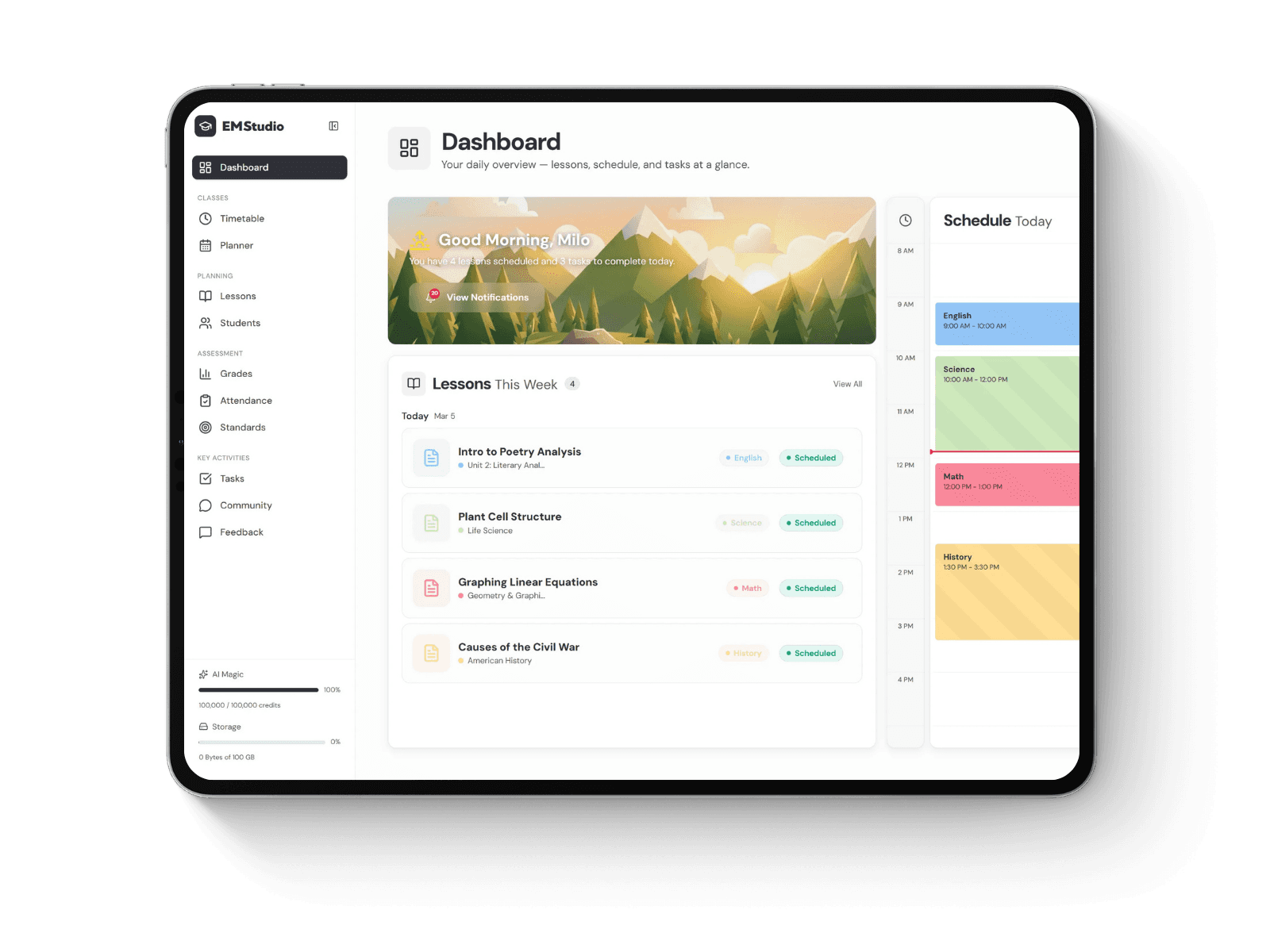
Still grading everything by hand?
EMStudio is a free teaching management app — manage your classes, students, lessons, and more!
Learn More
Table of Contents
What Is ChatGPT for Teachers?
ChatGPT for teachers is a conversational AI assistant built on GPT-4 technology that generates human-like text from prompts. It helps educators automate lesson planning, differentiate materials, and draft communications. Unlike search engines, it synthesizes patterns from training data rather than retrieving live web pages, requiring verification of facts. As more conversational AI companies develop tools for education, these technologies are becoming increasingly integrated into modern teaching workflows.
Think of it as a teaching assistant who never sleeps but occasionally lies with confidence. You type a prompt. It predicts what comes next based on patterns learned from millions of documents. It doesn't "know" anything. It just calculates probabilities.
ChatGPT runs on GPT-4 architecture—GPT-3.5 on the free tier—making it a large language model that performs next token prediction. It guesses the next word, then the next, building sentences from context. This differs fundamentally from Google. Search engines retrieve existing web pages. ChatGPT generates new text by recognizing patterns in its training data, which cuts off at April 2024. It cannot browse the live web unless you specifically enable browsing mode.
The free tier gets you GPT-3.5 with usage caps that lock you out during busy afternoons. For $20 monthly, ChatGPT Plus unlocks GPT-4, DALL-E 3 for image generation, and Advanced Data Analysis. Schools needing FERPA compliance should look at ChatGPT Team at $25 per user monthly, which adds shared workspaces, admin controls, and guarantees your data won't train future models.
You need zero coding or prompt engineering skills to use it. But you must understand that confidence does not equal accuracy. Last spring, I asked it to cite "Hattie 2023" research on visible learning. It generated a perfect-looking APA citation with page numbers and a DOI. None of it existed. The model invented plausible-sounding research because I prompted it to. Always verify statistics and citations against primary sources. The model invented plausible-sounding research because I prompted it to. Teachers who are still learning how to use chat gpt effectively should always verify statistics and citations against primary sources.
Access matters. The web browser gives you full has including Custom GPTs and file uploads. The mobile app offers voice conversation mode—useful for drafting parent emails while walking the dog. API integrations hide the ChatGPT branding entirely. Tools like AI tools for teachers and students such as MagicSchool.ai or Canvas plugins use the same engine through back-end connections.
Understanding Large Language Models in Education
These models use transformer architecture—essentially sophisticated autocomplete. They analyze context windows up to 128,000 tokens, roughly 300 pages of text, to predict what comes next. The training data includes Common Crawl, licensed books, and web pages. But here's the critical distinction: the model has no reasoning capability. It matches patterns. When you ask it to "think" about differentiated instruction, it's not thinking. It's predicting what words typically follow that phrase in educational contexts.
Test it yourself. Prompt: "Cite Rosenshine's 2022 study on classroom questioning with specific page numbers." Barak Rosenshine died in 2017. He published no 2022 study. Yet ChatGPT will likely generate a convincing abstract, methodology section, and findings. The citation looks perfect. The journal is real. The content is fabricated. This hallucination happens because the model prioritizes fluent, plausible-sounding text over factual accuracy.
The base model knows nothing after April 2024. For current events—say, new state assessment changes announced last month—you need browsing mode, which uses Bing integration. But for established pedagogical AI applications like classroom automation or explaining Pythagorean theorem, the cutoff doesn't matter. The training data already contains centuries of educational content. Use browsing for news. Use base training for lesson planning.
The Teacher-Specific Interface and Features
Custom GPTs let you build specialized bots. Create a "9th Grade Biology Quiz Bot" that always formats questions with four MC options, includes a distractor analysis, and aligns to NGSS standards—without typing those instructions every time. Advanced Data Analysis accepts CSV uploads. Drop in your gradebook and ask for visualizations of student growth trends. Voice mode turns your commute into planning time, offering hands-free interaction that complements AI in teacher education tools for multitasking educators. Speak your feedback; get written drafts.
Privacy tiers confuse everyone. Consumer accounts—even Plus—allow OpenAI to review conversations for safety. Your district's IT director needs ChatGPT Team or Enterprise for SOC 2 compliance and guaranteed data exclusion from training. Never put student PII into the free tier. For full FERPA protection, districts need API access with signed Business Associate Agreements. Check your state laws before having students interact with these tools directly.
You won't find native Canvas buttons yet. But API connections let LMS platforms embed the engine. Browser extensions like Merlin or Compose add ChatGPT to any webpage. The mobile widget lets you tap a floating icon during classroom walkthroughs to quickly draft accommodation notes. These touchpoints make generative AI invisible infrastructure rather than a separate website to visit.

Why Does AI Matter for Modern Educators?
AI matters for modern educators because it reclaims hours lost to administrative burdens, cutting lesson planning from 45 minutes to 12 and personalizing feedback for 30 students in under an hour. It enables scalable differentiation, adapting one text for three reading levels instantly, redirecting teacher energy toward high-impact instruction.
Teachers work 50-hour weeks with less than half spent on actual instruction. The rest disappears into emails, grading, and paperwork. Generative AI offers a way to reclaim that time.
Research consistently shows educators clock 50-plus hour weeks, yet less than half those hours involve direct instruction or high-impact feedback. John Hattie's meta-analysis places feedback at a 0.75 effect size—among the highest influences on student achievement. The irony stings: we know what works, but we lack the hours to do it. Classroom automation through large language models shifts that balance. When chatgpt for teachers handles the administrative load, you reclaim time for the activities that actually move student learning forward.
The time savings are concrete, not theoretical. A lesson plan that once consumed 45 minutes now takes 12. Differentiated materials that required 90 minutes of adaptation drop to 4 minutes. Report card comments for 30 students shrink from three hours to 15 minutes. These aren't marginal gains; they represent the difference between leaving at contract time and staying until dinner cold. Multiply these savings across a 180-day year, and you recover hundreds of hours.
Then there's the differentiation impossibility. In a 30-student class with IEPs, ELLs, and gifted clusters, manually adapting content requires triple the prep time. Most teachers simply cannot produce three versions of every text, worksheet, and assessment. The math doesn't work. Pedagogical AI makes tiered instruction logistically feasible for the first time, collapsing the preparation barrier that has long separated educational intention from classroom reality.
Reclaiming Hours Lost to Administrative Tasks
Start with the inbox. Drafting responses to parent concerns about missing assignments or behavioral incidents eats up planning periods. Teachers AI tools generate professional, empathetic email drafts in seconds. The same applies to IEP meeting prep—generating accommodation summary lists or drafting present level statements—and organizing field trip permission logistics or emergency sub plans with complete activities. Each task alone might take twenty minutes. Together, they consume afternoons.
The feedback gap hurts most. Hattie's research shows timely feedback has massive impact, yet teachers spend 7 to 12 hours weekly on grading. AI-assisted feedback maintains personalization while cutting that time by two-thirds. You review AI-generated comments, adjust the tone, and send. Students get specific guidance faster than the traditional three-day lag, and you keep your Sunday evenings for recovery rather than red pens.
Run a task audit. List five weekly responsibilities: newsletters, data analysis, material formatting, parent communication, documentation. Categorize each by cognitive load. Low-load tasks—formatting, template creation, routine emails—are prime candidates for immediate AI delegation. Medium-load tasks might use AI for first drafts. High-load tasks like complex behavioral interventions stay human-led. This framework mirrors hacks teachers rely on to save time, but scales them exponentially through automation.
Differentiation and Personalization at Scale
Here's what prompt engineering makes possible. Input "The Giver Chapter 3 summary" and generate three versions instantly. The 650L version uses simplified syntax with vocabulary definitions. The 850L version hits grade level. The 1050L version employs complex sentence structures and explores abstract themes. All maintain identical plot accuracy. What once required three separate reading sessions and three hours of prep now takes four minutes and one thoughtful review.
IEP scaffolding becomes manageable rather than mythical. Input specific goals—"Student will solve two-step equations with 80% accuracy using visual models"—and generate 20 tiered worksheets. Vary the number sizes, add visual supports, include answer banks, and attach self-monitoring checklists. Last year, I watched a 7th grader with processing differences finally access the same content as her peers because the visual models appeared instantly, not after my three-hour Sunday prep session. She worked independently for the first time.
ELL support extends beyond translation. Generate native language glossaries for key vocabulary in Spanish, Mandarin, or Arabic. Create sentence frames for academic discussion. Draft culturally responsive example scenarios that reflect your actual student demographics. Skip the generic textbook examples. These differentiated instruction strategies no longer require bilingual aides or hours of research. They require clear prompts and thoughtful review of the output.
How ChatGPT Processes Educational Queries
From Prompt to Pedagogical Output
ChatGPT doesn't read your prompt like a human skimming an email. It breaks text into tokens—roughly four characters or three-quarters of a word. Ask it to differentiate instruction for a reading passage, and "differentiate" becomes one token, "instruction" another, the period its own punctuation mark. This matters because every token counts against your limit. A typical lesson plan runs about 800 tokens. Thirty student essays might hit 12,000. When you hit the ceiling, the model stops reading.
The pipeline runs fast. Your prompt hits tokenization first, splitting into word pieces. Then the attention mechanism weighs relationships—connecting "photosynthesis" to "chlorophyll" across sentences, or linking a student's earlier misconception to your current explanation. Finally, a probability distribution selects the next most likely token. It’s autocomplete at massive scale, not understanding.
I learned this the hard way with my 8th graders last spring. I asked ChatGPT to explain mitosis cold. It gave me textbook precision—phases, spindle fibers, the works. Then I tried: "Explain mitosis to a confused 8th grader who thinks cells just split in half." The output shifted instantly. It addressed the misconception first, used an analogy of copying a library book before moving it. The model simulated pedagogical adjustment without actually knowing what my student was thinking. It just recognized the linguistic pattern of "confused 8th grader" and matched it to simpler explanations stored in its training data.
That’s the stochastic parrot reality. Large language models predict plausible teacher language, not truth. Ask both versions to solve (x+3)(x-2). GPT-4 usually expands correctly to x² + x - 6 through pattern matching on thousands of similar problems. GPT-3.5 often hallucinates steps, claiming the middle term is -5x or dropping the constant entirely. It calculates via statistical likelihood, not mathematical logic. For reliable computation with classroom automation, you need Wolfram Alpha integration—something to check the work rather than guess.
This limitation hits hardest with differentiated instruction. The model doesn’t actually know why your English learners struggle with articles. It just recognizes that "English learner" plus "article grammar" typically correlates with certain simplified explanations in its training data. Without explicit prompting about specific misconceptions, it defaults to generic simplification that might miss the mark entirely.
Temperature controls this randomness on a scale from 0.0 to 1.0. Set it to 0.2 for factual quiz generation—consistent, predictable outputs every time. Bump it to 0.7 for creative writing prompts, giving you balanced variety without chaos. Crank it to 0.9 for divergent thinking activities where weird connections help. You can adjust this via API calls or simply instruct the model in your prompt: "Be creative and unpredictable." Think of it as controlling how many wild cards sit in the deck.
Understanding these mechanics separates toys from real pedagogical AI tools. The model won’t replace your judgment. But it can extend your reach if you know exactly how it thinks.
Context Windows and Conversation Memory
Here’s where chatgpt for teachers gets practical. GPT-4 Turbo offers a 128k context window—about 96,000 words. That’s 300 pages of text. GPT-3.5 tops out at 16k, roughly 12,000 words or forty single-page essays. The difference changes how you plan. With 128k, you can paste your entire district curriculum map into one chat and ask it to align your next unit vertically across grades. You can dump an entire novel for literature circles and ask for discussion questions by chapter without managing multiple files.
This scale enables batch classroom automation that was impossible last year. Paste thirty 8th-grade argumentative essays into one prompt. Ask the model to rank thesis strength from weakest to strongest and group students by revision needs. It processes them simultaneously because the full text fits in the window. With GPT-3.5's smaller limit, you'd need to feed essays in batches, losing the ability to compare the strong writer in period one against the struggling writer in period three.
Test this yourself. Paste a 50-page district curriculum guide into a fresh chat, then ask, "What assessments are suggested in Unit 4?" Follow up with "Which of those use household materials?" The context holds across questions. It feels like having a curriculum coordinator who never sleeps. The model references specific page numbers and assessment types mentioned twenty pages back without you repasting a thing.
But watch the edges. When conversations exceed 128k tokens, the model silently drops the earliest messages. It’s called context truncation. You’ll notice when the AI forgets constraints you set an hour ago—"I said to use 5th grade vocabulary. Why are you using college terms?" The beginning of your chat vanished into the void. No warning bell rings. The system doesn't tell you it forgot. It just drifts, generating text based on whatever context remains. You might waste twenty minutes correcting its tone before realizing it simply lost your original instructions.
Manage this with workflow discipline. Start new chats for distinct topics to prevent confusion. Continue threads only for iterative refinement where context matters. Better yet, use custom instructions in your settings to permanently set your grade level and subject. That way, even if the conversation grows long, the core parameters stick. For generative AI to work in schools, you need to know exactly how much it remembers and when it starts forgetting. Treat long conversations like a whiteboard you’re slowly erasing from the top down. When in doubt, restart.
Daily Workflow Applications for Teachers
Lesson Planning and Resource Generation
Map your workflow like a pipeline: Task Type feeds into Prompt Template, shaping Output Format, ending at a mandatory Human Review Checkpoint. I learned this last October when a 5E Model lesson on chemical reactions suggested lab materials I didn't have in my 7th grade closet. The Explore phase looked perfect but required a spectrophotometer. Always verify.
For Backward Design, prompt: "Act as a UbD designer for NGSS MS-PS1-2." Stage 1 gives desired results, Stage 2 determines acceptable evidence, Stage 3 plans learning experiences. Output arrives as a three-column chart with essential questions. create lesson plans with AI using this framework, then build differentiated instruction tiers—Tier 1 with visual models only, Tier 3 with multi-step word problems—complete with answer keys for each level.
Assessment Creation and Feedback Automation
Never let generative AI output reach students unchecked. I follow a strict Check Then Use protocol after catching ChatGPT generating a polynomial math problem with an incorrect solution path. The same applies to historical "facts" that sound authoritative but are fabrications, or culturally insensitive reading passages. Review every item before it touches a kid's desk.
Use prompt engineering to build 4-point analytic rubrics aligned to CCSS or state standards—Exemplary, Proficient, Developing, Beginning descriptors in copy-paste table format. Export your gradebook to CSV, use Advanced Data Analysis to draft personalized feedback paragraphs ("Jordan, your analysis of theme in paragraph 2 effectively cites evidence..."), then edit before sending. Prompt for five common wrong answers to any specific math problem to create targeted reteaching mini-lessons.
Parent Communication and Administrative Writing
Manual drafting takes twenty minutes per sensitive email; ChatGPT for teachers cuts this to five including verification. This classroom automation delivers net time savings even with the Check Then Use steps because you're editing existing text, not composing from blank.
Input scenarios like "Parent email about failing grade due to missing work, student has 504 for ADHD" and receive three tone options—Collaborative ("Let's partner on..."), Direct ("Per district policy..."), or Concise (bullet points)—all FERPA-compliant. Build weekly newsletters with "This Week in 7th Grade," "Shout Outs," and "Questions to Ask Your Child," then translate to Spanish or Mandarin using GPT-4's idiomatic handling. For IEP prep, feed recent data to draft Present Levels statements and proposed accommodations for team review.
parent communication strategies work best when pedagogical AI handles structural heavy lifting while you provide the human judgment.

Subject-Specific Strategies and Examples
Not all subjects handle generative AI the same way. Humanities work carries high risk for plagiarism but low risk for factual errors, while STEM flips that equation—calculations often fail, but the process is transparent. Arts sit somewhere between: strong generation capability but ethically complex authorship questions. Early Childhood sits in its own category entirely.
Disciplinary literacy matters: these tools analyze text well, stumble on mathematical proofs, and generate creative work that complicates assessment. When using chatgpt for teachers, match the tool to the domain's specific demands. Secondary students need source evaluation protocols, middle schoolers need scaffolding for prompt engineering, and elementary AI use should remain invisible to students.
Humanities and Language Arts Applications
Input a paragraph from To Kill a Mockingbird Chapter 10. The output gives five text-dependent questions citing specific paragraphs, two inference prompts about Atticus's values, and one on Lee's use of foreshadowing. Add sentence starters for ELLs ("According to paragraph 3..."). For Socratic seminars on 1984, prompt for fifteen open-ended questions sorted by cognitive level. Analysis questions ask "How does the Party control history?" Synthesis prompts compare Orwell's telescreens to modern surveillance. Grab conversation stems ("I agree with [Name] because...") to keep the academic discussion moving.
The creative writing guardrails matter most. Prompt for "five narrative prompts about identity that resist AI generation"—tasks requiring personal artifacts, sensory details from your specific school courtyard, or family interviews. This forces authentic voice. See our full strategies for language teachers for more.
STEM and Mathematics Problem Solving
Math requires verification. I use large language models for infinite problem generation, not answer keys. I input a "two trains leave stations" template and receive ten isomorphic versions using cell phone data plans, sports statistics, or recipe scaling. Same linear equations, different contexts, varied number sets. My 8th graders can't copy answers because everyone's working different values. I also use classroom automation to build error analysis activities. I prompt the AI to generate a "student work sample" containing specific misconceptions—distributive property errors, sign mistakes—and have my actual students find and fix them. It turns AI limitations into teaching assets.
For step-by-step explanations, I prompt: "Solve this quadratic showing every algebraic step. Do not skip simplification. Explain your method." I use the output as a teaching model, but I verify every line with Wolfram Alpha first. GPT hallucinations at advanced levels are real. The output works for grade 7-8 linear equations, but I double-check anything involving quadratics or higher. Check out these STEM teacher resources and curriculum platforms for complementary tools.
Early Childhood and Elementary Adaptations
K-5 students never touch the interface directly. Pedagogical AI here is teacher-facing only. Teachers use it to generate decodable texts targeting specific phonics patterns—CVC words, then digraphs—customized to the current scope and sequence. Build social stories for behavior support ("Raising your hand on the carpet") and leveled readers about science topics that match state standards. For visuals, DALL-E integration creates vocabulary cards showing "a platypus eating" or behavior charts with space themes. Ensure diverse representations in all math word problem contexts.
For read-aloud companions, input The Very Hungry Caterpillar and receive prediction questions, sequencing activities, and simple retelling rubrics calibrated to early elementary comprehension levels. The AI handles the prep work; you handle the littles. That's differentiated instruction without exposing young kids to prompt engineering they aren't ready to navigate.
The simplification protocols matter here. Never ask for text above a 5th-grade reading level when generating content for primary students. The large language models can adjust, but teachers remain the final filter.

Getting Started: Implementation Without Overwhelm
Essential First Prompts to Master
Start small. On Day 1, use one prompt for a single low-stakes task like drafting a parent email. By Day 3, refine that same prompt based on what felt clunky. Wait until Week 2 to add a second use case. I have watched colleagues burn out trying to automate everything on a Saturday afternoon. That approach fails. Pick one workflow, master it, then expand.
Three templates will carry you through most planning tasks. The Persona Prompt sets expertise: "Act as an expert biology teacher with 20 years experience. Create a lab introduction for cellular respiration at 10th grade level. Include safety notes and a hook." The Differentiation Prompt splits complexity: "Explain photosynthesis three ways: for a struggling reader, grade-level student, and gifted learner." The Anticipation Prompt predicts errors: "List 5 wrong answers students might give for this stoichiometry problem and the misconceptions causing them."
Chain your prompts to refine output. First, generate the content. Second, ask: "Make this more culturally responsive by incorporating urban ecology examples." Third: "Convert this into a graphic organizer outline." Set up Custom Instructions in your settings to permanently store your grade level, subject, and tone preferences so you stop typing "I teach 7th grade ELA" before every request.
Building Student-Friendly Usage Guidelines
Require transparency. Have students submit an AI Use Statement with every major assignment, specifying which sections are human-generated versus AI-assisted. Provide sentence stems: "I used ChatGPT to brainstorm ideas but wrote the essay myself" or "I used AI to check my grammar but created the argument alone." This keeps everyone honest without turning you into a detective.
Post clear rules. Distinguish AI Permitted tasks—brainstorming, outlining, feedback—from AI Prohibited tasks like basic skills assessments. Teach proper MLA or APA citation for AI tools: "OpenAI. 2024. ChatGPT. Retrieved from..." Hang these guidelines on the wall where students see them daily. When students know the boundaries, they stop testing them.
Teach the flaws, not just the rules. Show them how human writing in the age of AI differs from generated text. Explain that AI detectors flag non-native speakers falsely. Emphasize process over product. Require outlines, drafts, and revision history. When I taught 11th grade last spring, I collected brainstorming notes alongside final essays. The work improved immediately because students could not fake their way through thinking.
Privacy and Academic Integrity Guardrails
Protect your students and your license. Never paste full names, ID numbers, IEP disability categories, or disciplinary records into any AI tool. Use pseudonyms: "Student A," "5th period," or "a 10th grader with reading challenges." Inputting identifiable information violates FERPA and district policy. Read up on protecting student privacy in edtech before you start.
Verify your district's Business Associate Agreement with OpenAI. Use Team or Enterprise tiers only; never put student data on the free consumer tier. Enable Temporary Chat for sensitive topics. These steps keep you compliant while using chatgpt for teachers responsibly.
Know the hard limits. Never use AI for high-stakes grading decisions without human verification. Never generate IEP goals or legal documents without your special education director reviewing every word. Never use it for real-time crisis counseling involving suicide ideation or abuse reporting. Never let it substitute for mandated IEP service minutes. These are red lines.
Check everything. AI hallucinates historical dates and scientific constants. Never use it to write negative student descriptions for legal documents. And remember: AI-generated text can match training data, so it is not plagiarism-proof. When in doubt, leave it out.
Getting Started with Chatgpt For Teachers
You don't need to rebuild your teaching practice overnight. I started with one boring task—writing those Friday parent emails—and saved twenty minutes. That small win showed me where generative AI actually helps instead of adding noise to my day.
Pick the thing that drains you most. Maybe it's differentiating reading passages at 2 AM, or writing that same feedback comment for the fifteenth time. Open ChatGPT. Type what you need like you're explaining it to a colleague during lunch. Hit enter. The first result won't be perfect. Tweak it. This is prompt engineering, and you get better by doing, not reading about it.
Choose one repetitive task from this week.
Write a specific prompt describing exactly what you need.
Use the output tomorrow and note what needs fixing.
Adjust and try again.

What Is ChatGPT for Teachers?
ChatGPT for teachers is a conversational AI assistant built on GPT-4 technology that generates human-like text from prompts. It helps educators automate lesson planning, differentiate materials, and draft communications. Unlike search engines, it synthesizes patterns from training data rather than retrieving live web pages, requiring verification of facts. As more conversational AI companies develop tools for education, these technologies are becoming increasingly integrated into modern teaching workflows.
Think of it as a teaching assistant who never sleeps but occasionally lies with confidence. You type a prompt. It predicts what comes next based on patterns learned from millions of documents. It doesn't "know" anything. It just calculates probabilities.
ChatGPT runs on GPT-4 architecture—GPT-3.5 on the free tier—making it a large language model that performs next token prediction. It guesses the next word, then the next, building sentences from context. This differs fundamentally from Google. Search engines retrieve existing web pages. ChatGPT generates new text by recognizing patterns in its training data, which cuts off at April 2024. It cannot browse the live web unless you specifically enable browsing mode.
The free tier gets you GPT-3.5 with usage caps that lock you out during busy afternoons. For $20 monthly, ChatGPT Plus unlocks GPT-4, DALL-E 3 for image generation, and Advanced Data Analysis. Schools needing FERPA compliance should look at ChatGPT Team at $25 per user monthly, which adds shared workspaces, admin controls, and guarantees your data won't train future models.
You need zero coding or prompt engineering skills to use it. But you must understand that confidence does not equal accuracy. Last spring, I asked it to cite "Hattie 2023" research on visible learning. It generated a perfect-looking APA citation with page numbers and a DOI. None of it existed. The model invented plausible-sounding research because I prompted it to. Always verify statistics and citations against primary sources. The model invented plausible-sounding research because I prompted it to. Teachers who are still learning how to use chat gpt effectively should always verify statistics and citations against primary sources.
Access matters. The web browser gives you full has including Custom GPTs and file uploads. The mobile app offers voice conversation mode—useful for drafting parent emails while walking the dog. API integrations hide the ChatGPT branding entirely. Tools like AI tools for teachers and students such as MagicSchool.ai or Canvas plugins use the same engine through back-end connections.
Understanding Large Language Models in Education
These models use transformer architecture—essentially sophisticated autocomplete. They analyze context windows up to 128,000 tokens, roughly 300 pages of text, to predict what comes next. The training data includes Common Crawl, licensed books, and web pages. But here's the critical distinction: the model has no reasoning capability. It matches patterns. When you ask it to "think" about differentiated instruction, it's not thinking. It's predicting what words typically follow that phrase in educational contexts.
Test it yourself. Prompt: "Cite Rosenshine's 2022 study on classroom questioning with specific page numbers." Barak Rosenshine died in 2017. He published no 2022 study. Yet ChatGPT will likely generate a convincing abstract, methodology section, and findings. The citation looks perfect. The journal is real. The content is fabricated. This hallucination happens because the model prioritizes fluent, plausible-sounding text over factual accuracy.
The base model knows nothing after April 2024. For current events—say, new state assessment changes announced last month—you need browsing mode, which uses Bing integration. But for established pedagogical AI applications like classroom automation or explaining Pythagorean theorem, the cutoff doesn't matter. The training data already contains centuries of educational content. Use browsing for news. Use base training for lesson planning.
The Teacher-Specific Interface and Features
Custom GPTs let you build specialized bots. Create a "9th Grade Biology Quiz Bot" that always formats questions with four MC options, includes a distractor analysis, and aligns to NGSS standards—without typing those instructions every time. Advanced Data Analysis accepts CSV uploads. Drop in your gradebook and ask for visualizations of student growth trends. Voice mode turns your commute into planning time, offering hands-free interaction that complements AI in teacher education tools for multitasking educators. Speak your feedback; get written drafts.
Privacy tiers confuse everyone. Consumer accounts—even Plus—allow OpenAI to review conversations for safety. Your district's IT director needs ChatGPT Team or Enterprise for SOC 2 compliance and guaranteed data exclusion from training. Never put student PII into the free tier. For full FERPA protection, districts need API access with signed Business Associate Agreements. Check your state laws before having students interact with these tools directly.
You won't find native Canvas buttons yet. But API connections let LMS platforms embed the engine. Browser extensions like Merlin or Compose add ChatGPT to any webpage. The mobile widget lets you tap a floating icon during classroom walkthroughs to quickly draft accommodation notes. These touchpoints make generative AI invisible infrastructure rather than a separate website to visit.
Why Does AI Matter for Modern Educators?
AI matters for modern educators because it reclaims hours lost to administrative burdens, cutting lesson planning from 45 minutes to 12 and personalizing feedback for 30 students in under an hour. It enables scalable differentiation, adapting one text for three reading levels instantly, redirecting teacher energy toward high-impact instruction.
Teachers work 50-hour weeks with less than half spent on actual instruction. The rest disappears into emails, grading, and paperwork. Generative AI offers a way to reclaim that time.
Research consistently shows educators clock 50-plus hour weeks, yet less than half those hours involve direct instruction or high-impact feedback. John Hattie's meta-analysis places feedback at a 0.75 effect size—among the highest influences on student achievement. The irony stings: we know what works, but we lack the hours to do it. Classroom automation through large language models shifts that balance. When chatgpt for teachers handles the administrative load, you reclaim time for the activities that actually move student learning forward.
The time savings are concrete, not theoretical. A lesson plan that once consumed 45 minutes now takes 12. Differentiated materials that required 90 minutes of adaptation drop to 4 minutes. Report card comments for 30 students shrink from three hours to 15 minutes. These aren't marginal gains; they represent the difference between leaving at contract time and staying until dinner cold. Multiply these savings across a 180-day year, and you recover hundreds of hours.
Then there's the differentiation impossibility. In a 30-student class with IEPs, ELLs, and gifted clusters, manually adapting content requires triple the prep time. Most teachers simply cannot produce three versions of every text, worksheet, and assessment. The math doesn't work. Pedagogical AI makes tiered instruction logistically feasible for the first time, collapsing the preparation barrier that has long separated educational intention from classroom reality.
Reclaiming Hours Lost to Administrative Tasks
Start with the inbox. Drafting responses to parent concerns about missing assignments or behavioral incidents eats up planning periods. Teachers AI tools generate professional, empathetic email drafts in seconds. The same applies to IEP meeting prep—generating accommodation summary lists or drafting present level statements—and organizing field trip permission logistics or emergency sub plans with complete activities. Each task alone might take twenty minutes. Together, they consume afternoons.
The feedback gap hurts most. Hattie's research shows timely feedback has massive impact, yet teachers spend 7 to 12 hours weekly on grading. AI-assisted feedback maintains personalization while cutting that time by two-thirds. You review AI-generated comments, adjust the tone, and send. Students get specific guidance faster than the traditional three-day lag, and you keep your Sunday evenings for recovery rather than red pens.
Run a task audit. List five weekly responsibilities: newsletters, data analysis, material formatting, parent communication, documentation. Categorize each by cognitive load. Low-load tasks—formatting, template creation, routine emails—are prime candidates for immediate AI delegation. Medium-load tasks might use AI for first drafts. High-load tasks like complex behavioral interventions stay human-led. This framework mirrors hacks teachers rely on to save time, but scales them exponentially through automation.
Differentiation and Personalization at Scale
Here's what prompt engineering makes possible. Input "The Giver Chapter 3 summary" and generate three versions instantly. The 650L version uses simplified syntax with vocabulary definitions. The 850L version hits grade level. The 1050L version employs complex sentence structures and explores abstract themes. All maintain identical plot accuracy. What once required three separate reading sessions and three hours of prep now takes four minutes and one thoughtful review.
IEP scaffolding becomes manageable rather than mythical. Input specific goals—"Student will solve two-step equations with 80% accuracy using visual models"—and generate 20 tiered worksheets. Vary the number sizes, add visual supports, include answer banks, and attach self-monitoring checklists. Last year, I watched a 7th grader with processing differences finally access the same content as her peers because the visual models appeared instantly, not after my three-hour Sunday prep session. She worked independently for the first time.
ELL support extends beyond translation. Generate native language glossaries for key vocabulary in Spanish, Mandarin, or Arabic. Create sentence frames for academic discussion. Draft culturally responsive example scenarios that reflect your actual student demographics. Skip the generic textbook examples. These differentiated instruction strategies no longer require bilingual aides or hours of research. They require clear prompts and thoughtful review of the output.
How ChatGPT Processes Educational Queries
From Prompt to Pedagogical Output
ChatGPT doesn't read your prompt like a human skimming an email. It breaks text into tokens—roughly four characters or three-quarters of a word. Ask it to differentiate instruction for a reading passage, and "differentiate" becomes one token, "instruction" another, the period its own punctuation mark. This matters because every token counts against your limit. A typical lesson plan runs about 800 tokens. Thirty student essays might hit 12,000. When you hit the ceiling, the model stops reading.
The pipeline runs fast. Your prompt hits tokenization first, splitting into word pieces. Then the attention mechanism weighs relationships—connecting "photosynthesis" to "chlorophyll" across sentences, or linking a student's earlier misconception to your current explanation. Finally, a probability distribution selects the next most likely token. It’s autocomplete at massive scale, not understanding.
I learned this the hard way with my 8th graders last spring. I asked ChatGPT to explain mitosis cold. It gave me textbook precision—phases, spindle fibers, the works. Then I tried: "Explain mitosis to a confused 8th grader who thinks cells just split in half." The output shifted instantly. It addressed the misconception first, used an analogy of copying a library book before moving it. The model simulated pedagogical adjustment without actually knowing what my student was thinking. It just recognized the linguistic pattern of "confused 8th grader" and matched it to simpler explanations stored in its training data.
That’s the stochastic parrot reality. Large language models predict plausible teacher language, not truth. Ask both versions to solve (x+3)(x-2). GPT-4 usually expands correctly to x² + x - 6 through pattern matching on thousands of similar problems. GPT-3.5 often hallucinates steps, claiming the middle term is -5x or dropping the constant entirely. It calculates via statistical likelihood, not mathematical logic. For reliable computation with classroom automation, you need Wolfram Alpha integration—something to check the work rather than guess.
This limitation hits hardest with differentiated instruction. The model doesn’t actually know why your English learners struggle with articles. It just recognizes that "English learner" plus "article grammar" typically correlates with certain simplified explanations in its training data. Without explicit prompting about specific misconceptions, it defaults to generic simplification that might miss the mark entirely.
Temperature controls this randomness on a scale from 0.0 to 1.0. Set it to 0.2 for factual quiz generation—consistent, predictable outputs every time. Bump it to 0.7 for creative writing prompts, giving you balanced variety without chaos. Crank it to 0.9 for divergent thinking activities where weird connections help. You can adjust this via API calls or simply instruct the model in your prompt: "Be creative and unpredictable." Think of it as controlling how many wild cards sit in the deck.
Understanding these mechanics separates toys from real pedagogical AI tools. The model won’t replace your judgment. But it can extend your reach if you know exactly how it thinks.
Context Windows and Conversation Memory
Here’s where chatgpt for teachers gets practical. GPT-4 Turbo offers a 128k context window—about 96,000 words. That’s 300 pages of text. GPT-3.5 tops out at 16k, roughly 12,000 words or forty single-page essays. The difference changes how you plan. With 128k, you can paste your entire district curriculum map into one chat and ask it to align your next unit vertically across grades. You can dump an entire novel for literature circles and ask for discussion questions by chapter without managing multiple files.
This scale enables batch classroom automation that was impossible last year. Paste thirty 8th-grade argumentative essays into one prompt. Ask the model to rank thesis strength from weakest to strongest and group students by revision needs. It processes them simultaneously because the full text fits in the window. With GPT-3.5's smaller limit, you'd need to feed essays in batches, losing the ability to compare the strong writer in period one against the struggling writer in period three.
Test this yourself. Paste a 50-page district curriculum guide into a fresh chat, then ask, "What assessments are suggested in Unit 4?" Follow up with "Which of those use household materials?" The context holds across questions. It feels like having a curriculum coordinator who never sleeps. The model references specific page numbers and assessment types mentioned twenty pages back without you repasting a thing.
But watch the edges. When conversations exceed 128k tokens, the model silently drops the earliest messages. It’s called context truncation. You’ll notice when the AI forgets constraints you set an hour ago—"I said to use 5th grade vocabulary. Why are you using college terms?" The beginning of your chat vanished into the void. No warning bell rings. The system doesn't tell you it forgot. It just drifts, generating text based on whatever context remains. You might waste twenty minutes correcting its tone before realizing it simply lost your original instructions.
Manage this with workflow discipline. Start new chats for distinct topics to prevent confusion. Continue threads only for iterative refinement where context matters. Better yet, use custom instructions in your settings to permanently set your grade level and subject. That way, even if the conversation grows long, the core parameters stick. For generative AI to work in schools, you need to know exactly how much it remembers and when it starts forgetting. Treat long conversations like a whiteboard you’re slowly erasing from the top down. When in doubt, restart.
Daily Workflow Applications for Teachers
Lesson Planning and Resource Generation
Map your workflow like a pipeline: Task Type feeds into Prompt Template, shaping Output Format, ending at a mandatory Human Review Checkpoint. I learned this last October when a 5E Model lesson on chemical reactions suggested lab materials I didn't have in my 7th grade closet. The Explore phase looked perfect but required a spectrophotometer. Always verify.
For Backward Design, prompt: "Act as a UbD designer for NGSS MS-PS1-2." Stage 1 gives desired results, Stage 2 determines acceptable evidence, Stage 3 plans learning experiences. Output arrives as a three-column chart with essential questions. create lesson plans with AI using this framework, then build differentiated instruction tiers—Tier 1 with visual models only, Tier 3 with multi-step word problems—complete with answer keys for each level.
Assessment Creation and Feedback Automation
Never let generative AI output reach students unchecked. I follow a strict Check Then Use protocol after catching ChatGPT generating a polynomial math problem with an incorrect solution path. The same applies to historical "facts" that sound authoritative but are fabrications, or culturally insensitive reading passages. Review every item before it touches a kid's desk.
Use prompt engineering to build 4-point analytic rubrics aligned to CCSS or state standards—Exemplary, Proficient, Developing, Beginning descriptors in copy-paste table format. Export your gradebook to CSV, use Advanced Data Analysis to draft personalized feedback paragraphs ("Jordan, your analysis of theme in paragraph 2 effectively cites evidence..."), then edit before sending. Prompt for five common wrong answers to any specific math problem to create targeted reteaching mini-lessons.
Parent Communication and Administrative Writing
Manual drafting takes twenty minutes per sensitive email; ChatGPT for teachers cuts this to five including verification. This classroom automation delivers net time savings even with the Check Then Use steps because you're editing existing text, not composing from blank.
Input scenarios like "Parent email about failing grade due to missing work, student has 504 for ADHD" and receive three tone options—Collaborative ("Let's partner on..."), Direct ("Per district policy..."), or Concise (bullet points)—all FERPA-compliant. Build weekly newsletters with "This Week in 7th Grade," "Shout Outs," and "Questions to Ask Your Child," then translate to Spanish or Mandarin using GPT-4's idiomatic handling. For IEP prep, feed recent data to draft Present Levels statements and proposed accommodations for team review.
parent communication strategies work best when pedagogical AI handles structural heavy lifting while you provide the human judgment.
Subject-Specific Strategies and Examples
Not all subjects handle generative AI the same way. Humanities work carries high risk for plagiarism but low risk for factual errors, while STEM flips that equation—calculations often fail, but the process is transparent. Arts sit somewhere between: strong generation capability but ethically complex authorship questions. Early Childhood sits in its own category entirely.
Disciplinary literacy matters: these tools analyze text well, stumble on mathematical proofs, and generate creative work that complicates assessment. When using chatgpt for teachers, match the tool to the domain's specific demands. Secondary students need source evaluation protocols, middle schoolers need scaffolding for prompt engineering, and elementary AI use should remain invisible to students.
Humanities and Language Arts Applications
Input a paragraph from To Kill a Mockingbird Chapter 10. The output gives five text-dependent questions citing specific paragraphs, two inference prompts about Atticus's values, and one on Lee's use of foreshadowing. Add sentence starters for ELLs ("According to paragraph 3..."). For Socratic seminars on 1984, prompt for fifteen open-ended questions sorted by cognitive level. Analysis questions ask "How does the Party control history?" Synthesis prompts compare Orwell's telescreens to modern surveillance. Grab conversation stems ("I agree with [Name] because...") to keep the academic discussion moving.
The creative writing guardrails matter most. Prompt for "five narrative prompts about identity that resist AI generation"—tasks requiring personal artifacts, sensory details from your specific school courtyard, or family interviews. This forces authentic voice. See our full strategies for language teachers for more.
STEM and Mathematics Problem Solving
Math requires verification. I use large language models for infinite problem generation, not answer keys. I input a "two trains leave stations" template and receive ten isomorphic versions using cell phone data plans, sports statistics, or recipe scaling. Same linear equations, different contexts, varied number sets. My 8th graders can't copy answers because everyone's working different values. I also use classroom automation to build error analysis activities. I prompt the AI to generate a "student work sample" containing specific misconceptions—distributive property errors, sign mistakes—and have my actual students find and fix them. It turns AI limitations into teaching assets.
For step-by-step explanations, I prompt: "Solve this quadratic showing every algebraic step. Do not skip simplification. Explain your method." I use the output as a teaching model, but I verify every line with Wolfram Alpha first. GPT hallucinations at advanced levels are real. The output works for grade 7-8 linear equations, but I double-check anything involving quadratics or higher. Check out these STEM teacher resources and curriculum platforms for complementary tools.
Early Childhood and Elementary Adaptations
K-5 students never touch the interface directly. Pedagogical AI here is teacher-facing only. Teachers use it to generate decodable texts targeting specific phonics patterns—CVC words, then digraphs—customized to the current scope and sequence. Build social stories for behavior support ("Raising your hand on the carpet") and leveled readers about science topics that match state standards. For visuals, DALL-E integration creates vocabulary cards showing "a platypus eating" or behavior charts with space themes. Ensure diverse representations in all math word problem contexts.
For read-aloud companions, input The Very Hungry Caterpillar and receive prediction questions, sequencing activities, and simple retelling rubrics calibrated to early elementary comprehension levels. The AI handles the prep work; you handle the littles. That's differentiated instruction without exposing young kids to prompt engineering they aren't ready to navigate.
The simplification protocols matter here. Never ask for text above a 5th-grade reading level when generating content for primary students. The large language models can adjust, but teachers remain the final filter.
Getting Started: Implementation Without Overwhelm
Essential First Prompts to Master
Start small. On Day 1, use one prompt for a single low-stakes task like drafting a parent email. By Day 3, refine that same prompt based on what felt clunky. Wait until Week 2 to add a second use case. I have watched colleagues burn out trying to automate everything on a Saturday afternoon. That approach fails. Pick one workflow, master it, then expand.
Three templates will carry you through most planning tasks. The Persona Prompt sets expertise: "Act as an expert biology teacher with 20 years experience. Create a lab introduction for cellular respiration at 10th grade level. Include safety notes and a hook." The Differentiation Prompt splits complexity: "Explain photosynthesis three ways: for a struggling reader, grade-level student, and gifted learner." The Anticipation Prompt predicts errors: "List 5 wrong answers students might give for this stoichiometry problem and the misconceptions causing them."
Chain your prompts to refine output. First, generate the content. Second, ask: "Make this more culturally responsive by incorporating urban ecology examples." Third: "Convert this into a graphic organizer outline." Set up Custom Instructions in your settings to permanently store your grade level, subject, and tone preferences so you stop typing "I teach 7th grade ELA" before every request.
Building Student-Friendly Usage Guidelines
Require transparency. Have students submit an AI Use Statement with every major assignment, specifying which sections are human-generated versus AI-assisted. Provide sentence stems: "I used ChatGPT to brainstorm ideas but wrote the essay myself" or "I used AI to check my grammar but created the argument alone." This keeps everyone honest without turning you into a detective.
Post clear rules. Distinguish AI Permitted tasks—brainstorming, outlining, feedback—from AI Prohibited tasks like basic skills assessments. Teach proper MLA or APA citation for AI tools: "OpenAI. 2024. ChatGPT. Retrieved from..." Hang these guidelines on the wall where students see them daily. When students know the boundaries, they stop testing them.
Teach the flaws, not just the rules. Show them how human writing in the age of AI differs from generated text. Explain that AI detectors flag non-native speakers falsely. Emphasize process over product. Require outlines, drafts, and revision history. When I taught 11th grade last spring, I collected brainstorming notes alongside final essays. The work improved immediately because students could not fake their way through thinking.
Privacy and Academic Integrity Guardrails
Protect your students and your license. Never paste full names, ID numbers, IEP disability categories, or disciplinary records into any AI tool. Use pseudonyms: "Student A," "5th period," or "a 10th grader with reading challenges." Inputting identifiable information violates FERPA and district policy. Read up on protecting student privacy in edtech before you start.
Verify your district's Business Associate Agreement with OpenAI. Use Team or Enterprise tiers only; never put student data on the free consumer tier. Enable Temporary Chat for sensitive topics. These steps keep you compliant while using chatgpt for teachers responsibly.
Know the hard limits. Never use AI for high-stakes grading decisions without human verification. Never generate IEP goals or legal documents without your special education director reviewing every word. Never use it for real-time crisis counseling involving suicide ideation or abuse reporting. Never let it substitute for mandated IEP service minutes. These are red lines.
Check everything. AI hallucinates historical dates and scientific constants. Never use it to write negative student descriptions for legal documents. And remember: AI-generated text can match training data, so it is not plagiarism-proof. When in doubt, leave it out.
Getting Started with Chatgpt For Teachers
You don't need to rebuild your teaching practice overnight. I started with one boring task—writing those Friday parent emails—and saved twenty minutes. That small win showed me where generative AI actually helps instead of adding noise to my day.
Pick the thing that drains you most. Maybe it's differentiating reading passages at 2 AM, or writing that same feedback comment for the fifteenth time. Open ChatGPT. Type what you need like you're explaining it to a colleague during lunch. Hit enter. The first result won't be perfect. Tweak it. This is prompt engineering, and you get better by doing, not reading about it.
Choose one repetitive task from this week.
Write a specific prompt describing exactly what you need.
Use the output tomorrow and note what needs fixing.
Adjust and try again.
Still grading everything by hand?
EMStudio is a free teaching management app — manage your classes, students, lessons, and more!
Learn More
Still grading everything by hand?
EMStudio is a free teaching management app — manage your classes, students, lessons, and more!
Learn More



Notion4Teachers
Notion templates to simplify administrative tasks and enhance your teaching experience.



2026 Notion4Teachers. All Rights Reserved.
Notion4Teachers
Notion templates to simplify administrative tasks and enhance your teaching experience.
2026 Notion4Teachers. All Rights Reserved.
Notion4Teachers
Notion templates to simplify administrative tasks and enhance your teaching experience.
2026 Notion4Teachers. All Rights Reserved.