
Carol Ann Tomlinson: Differentiated Instruction Explained
Carol Ann Tomlinson: Differentiated Instruction Explained

Article by
Milo
ESL Content Coordinator & Educator
ESL Content Coordinator & Educator
All Posts
I watched a 4th grader stare at the same math worksheet for twenty minutes while the kid next to him finished in five. Same assignment. Two completely different experiences. One kid bored, one lost. That's when I knew my one-size-fits-all approach was failing half the room.
Carol Ann Tomlinson figured this out decades ago. Her work on differentiated instruction isn't about creating 25 separate lesson plans every night. It's about responsive teaching that adjusts for readiness levels, learning profiles, and interest without burning you out completely.
In this post, I'll walk through how Tomlinson's model actually works in real classrooms. Not the Pinterest version with color-coded bins for every child. The actual, sustainable approach. We'll cover tiered assignments, flexible grouping, and what she calls "respectful tasks" that challenge every student without drowning anyone. You'll get practical strategies you can use Monday morning, plus the essential books that changed how I plan instruction.
Still grading everything by hand?
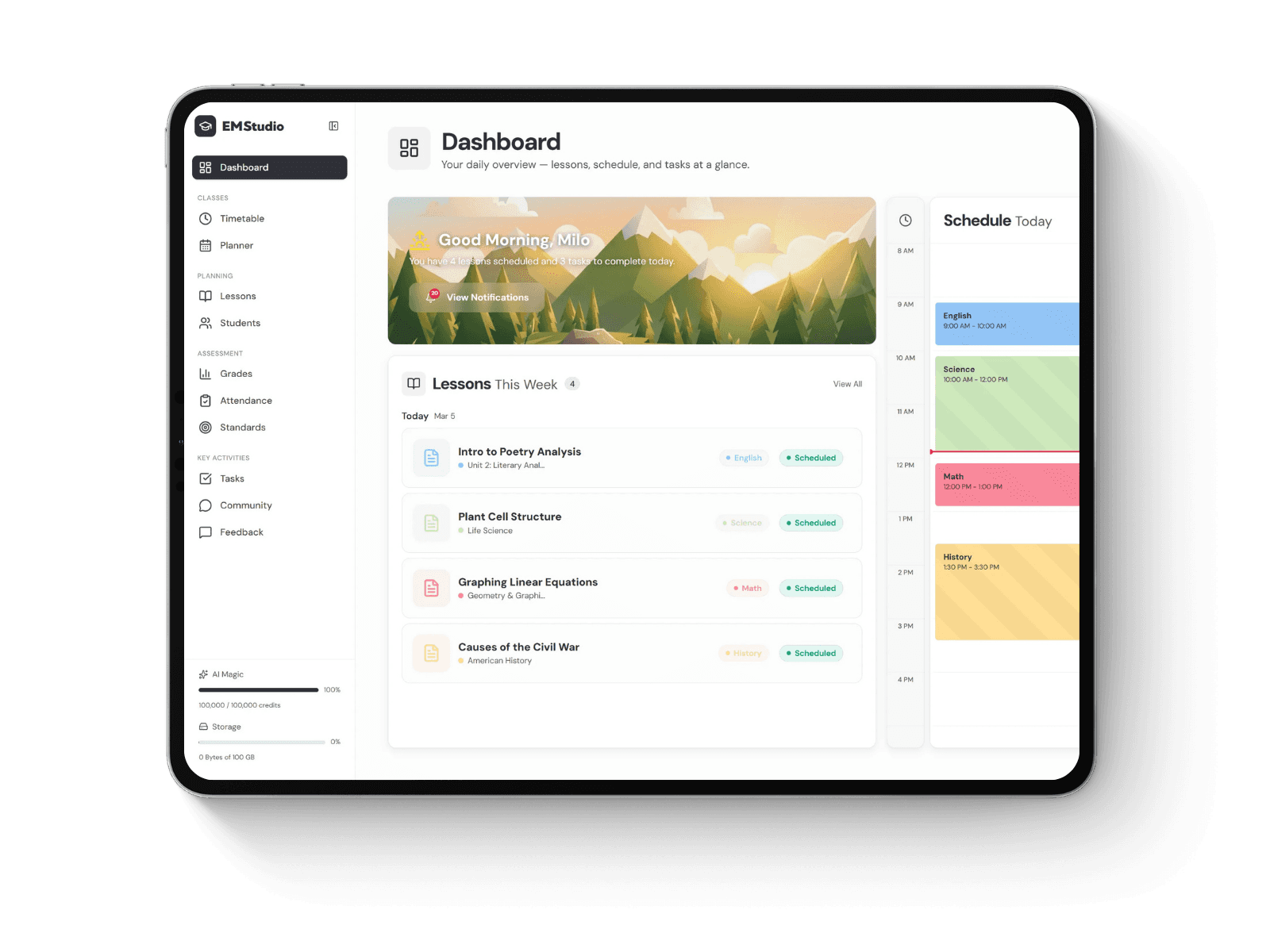
EMStudio is a free teaching management app — manage your classes, students, lessons, and more!
Learn More
Still grading everything by hand?
EMStudio is a free teaching management app — manage your classes, students, lessons, and more!
Learn More
Table of Contents
What Is Carol Ann Tomlinson's Approach to Differentiated Instruction?
Carol Ann Tomlinson's approach to differentiated instruction is a framework for responsive teaching where teachers proactively modify curriculum content, process, and products according to learner readiness, interests, and learning profile. Rather than a single strategy, it is a philosophy of honoring student variance through flexible instructional design and ongoing formative assessment. This isn't about creating 30 separate lesson plans. It's about making strategic adjustments so every student grapples with the same essential questions using materials matched to their current skill level.
Traditional teaching locks every student into the same text and assignment. Tomlinson breaks that mold. In a 7th-grade ELA class analyzing The Giver, Group A uses 800L guided notes with vocabulary banks while Group B tackles the standard 1000L text and Group C digs into 1200L excerpts from Lowry's speeches. All explore conformity. None get busywork. That's differentiated instruction carol ann tomlinson style—tiering complexity while holding learning constant. The framework rests on four non-negotiables:
High-quality curriculum for all students—not watered-down content for struggling learners.
Respectful tasks that engage every learner equally, avoiding coloring pages for some while others write essays.
Flexible grouping that shifts every 2-3 weeks based on formative data, not fixed tracks.
Ongoing formative assessment happening daily or every other day to drive instructional decisions.
Tomlinson sums up her philosophy: "Fair isn't everyone getting the same thing; fair is everyone getting what they need to succeed." Picture 4th-grade math. Some students need base-ten blocks. Others need grid paper. Others need abstract algorithms. Giving every child blocks "to be fair" actually blocks advanced learners. Carol ann tomlinson differentiated instruction means matching tools to learner needs, not distributing them equally.
The Philosophical Foundation of Responsive Teaching
Tomlinson builds on Vygotsky's Zone of Proximal Development. In a heterogeneous 5th-grade classroom, this means simultaneous pathways: some multiply using base-ten blocks, others use partial products algorithms, and others apply standard algorithms to word problems. Same standard. Three scaffolds. That's the philosophical foundation of responsive teaching. This requires "teaching up"—high expectations for all with necessary scaffolding. In 9th-grade biology, everyone completes the dissection. Some get graphic organizers with pre-labeled systems, others blank diagrams, others work from memory alone. The task stays respectful. The support varies by readiness levels.
Key Terminology and Core Definitions
Tomlinson organizes around three pillars. Readiness measures current proximity to learning targets. A pre-test on fractions shows who needs visual models and who’s ready for abstract algorithms. Interest taps passion areas. Let dinosaur-obsessed students research paleontology for their informational writing prompts instead of generic topics. Learning profile addresses working conditions. Some kids need to stand or bounce while reading; others need absolute silence to focus.
Differentiating isn't individualizing. Tomlinson uses 2-4 flexible groups, not 30 IEPs. Yes, effective DI requires 20-30% more planning time upfront for tiered assignments. But you reclaim it through reduced remediation. Match learning profile and readiness from the start, and you stop reteaching three times.

Why Does Tomlinson's Model Matter for Modern Classrooms?
Tomlinson's framework works because John Hattie's Visible Learning research shows personalized approaches yield effect sizes of 1.15—nearly double that of direct instruction. In classrooms where reading levels span four grades, this model gives you a legal, ethical way to meet every IEP and 504 without resorting to tracking or chaos.
Your classroom isn't average. It's a mix of kids reading at 2nd grade and 9th grade levels sitting in the same 6th grade room. Carol ann tomlinson built this framework specifically for that reality—not the imaginary homogeneous class your curriculum assumes.
Hattie's meta-analysis puts direct instruction at 0.59. Response to intervention and personalized learning hit 1.15. That's the difference between "some kids got it" and "most kids mastered it." Tomlinson and differentiated instruction operationalize these high-yield strategies through tiered assignments and flexible grouping. You aren't just changing the difficulty; you're changing the access point while keeping the target high. The effect size jumps because kids get exactly what they need, when they need it.
The research on the "myth of the average" is brutal. A typical class of 25-30 students contains three to four grade levels of variance in readiness. One-size-fits-all instruction misses 60-70% of your kids at any given moment. You're basically teaching to the middle third and hoping for the best. That's not teaching—that's roulette.
Don't differentiate "down." Never give struggling kids a different, easier text while advanced kids get the "real" curriculum. Instead, give everyone Romeo and Juliet. The struggling reader gets the original text with audio support and side-notes defining archaic terms. The advanced reader gets the same text with complex analysis prompts. Same complexity, different scaffolds.
Tomlinson's longitudinal work at the University of Virginia's Curry School tells the real story. In high-poverty schools implementing her model consistently, behavioral referrals dropped by 35%. When kids worked in interest-based groups—choosing topics like space or inventions while practicing the same reading standards—they stopped acting out and started engaging.
Addressing Diverse Learner Readiness and Interests
Look at your DIBELS data. In a typical 6th-grade class, you'll see scores from 150 to 250. That's a 100-point spread representing well below grade level to well above. Ann tomlinson differentiated instruction handles this through readiness levels without permanently labeling kids. Today's "low" group on figurative language might be tomorrow's "high" group on nonfiction text features. The groups flex based on pre-assessment, not ability tracking. No one gets stuck in the "dumb group" all year.
Curiosity Stations save my reluctant readers every year. I set up stations themed around space, animals, or inventions. Kids self-select based on what they actually care about. Everyone practices the same nonfiction reading standards—main idea, text structure, evidence—but they're reading about black holes or sharks or the lightbulb. Motivation skyrockets because they chose the topic. The standard doesn't change; the pathway does.
Research-Backed Outcomes and Educational Impact
The Curry School of Education followed low-SES schools using responsive teaching for three years. Schools that stuck with the model closed achievement gaps by 0.4 standard deviations. That's significant movement. The key was combining Tomlinson's model for modern classrooms with high-quality curriculum—not worksheets, but complex texts and worthy problems.
The concept of respectful tasks changes everything. When advanced learners got complex work instead of just "more" work, and struggling learners got high-interest complex text with support, engagement scores rose in every quartile. Kids know when you're giving them busywork. They also know when you believe they can handle hard things. Tomlinson's research proves that trust pays off in measurable achievement gains across all learning profiles.

How Tomlinson's Differentiated Instruction Works in Practice
Carol Ann Tomlinson organizes differentiation around four classroom elements. Here is how they compare in practice:
Element | Definition (Tomlinson's Terminology) | Concrete Example (Grades 7-9) | Prep Time Required |
|---|---|---|---|
Content | What students learn—the knowledge, understanding, and skills | Three reading levels on cell transport (9th grade) | 3 hours for tiered materials |
Process | How students make sense of and own the information | Jigsaw groups analyzing primary sources (8th grade) | 45 minutes for grouping |
Product | How students demonstrate and extend their learning | Civil War assessment menu with four options (7th grade) | 2 hours for rubric alignment |
Environment | The affective climate and physical arrangement | Campfire/Cave/Watering Hole zones (8th grade) | 15 minutes for furniture shift |
When not to differentiate? Don't attempt all four elements simultaneously in your first year. Start with content or process for one unit. Add another element each quarter.
Initial planning takes 30-40% longer—approximately two to three additional hours per unit. After your first year of responsive teaching, maintenance planning drops to a 10% increase as you reuse refined materials.
Differentiating Content for Student Readiness
Tiered assignments adjust text complexity while keeping goals constant. For 9th-grade biology, offer three readings on cell membrane transport. Level 1 uses 800L text with vocabulary banks and comprehension questions. Level 2 provides 1000L grade-level text with graphic organizers. Level 3 offers 1200L original research abstracts with analysis prompts. Everyone learns osmosis and diffusion through differentiating content, process, and products at their readiness levels.
Differentiating Process Through Flexible Instruction
Tomlinson's flexible grouping strategies shift based on the lesson objective.
Think-Pair-Share: K-12, 2 minutes, any subject.
Jigsaw: 4th-6th grade, heterogeneous groups, social studies/science.
Literature Circles: 4th-12th grade, by interest or readiness, 20-minute rotations.
Learning Centers: K-5, 15-minute stations, math/literacy.
RAFT Writing: 6th-12th grade, choice of Role/Audience/Format/Topic.
Differentiating Products Based on Learning Preferences
Give students agency with respectful tasks that vary output format while holding content standards steady. For a middle school Civil War assessment, create a product menu: historical fiction diary entry, documentary script, museum exhibit design, or Lincoln-Douglas debate. Grade all four using the same rubric checking historical accuracy, source use, and analysis of causes. The process skills differ—narrative versus technical writing—but every student proves mastery.
Designing the Physical and Emotional Learning Environment
Designing the physical learning environment supports different working styles. Tomlinson identifies four distinct zones:
Campfire: Whole-group instruction area with U-shaped desks.
Cave: Independent work zones with carrels or headphones.
Watering Hole: Collaborative tables for 3-4 students.
Mountain Top: Presentation space.
In grades 4 through 8, you need at least three of these zones operational simultaneously.
Practical Applications Across Grade Levels and Subjects
Differentiation looks different at every level. Elementary needs high structure and teacher direction. High school needs student autonomy. The time allocations and models shift accordingly.
Elementary: Centers-based instruction remains 60% teacher-directed with 15-minute rotations.
Middle School: Rotational models drop to 40% teacher-directed using 12-minute intervals.
High School: Pathway choice boards operate at 20% teacher-direction, self-paced across 3-5 days.
Resource costs differ significantly. Elementary teachers invest $200 to $500 in manipulatives, leveled books, and storage bins. The investment pays off through reduced behavior issues and increased engagement. Secondary teachers need primarily digital access. Google Classroom differentiation tools suffice. Newsela PRO subscriptions cost $18 per student yearly. Physical materials remain minimal.
Watch for "tracking by another name." Flexible grouping requires constant motion. Reassess every two weeks using exit tickets. Change composition based on specific skill gaps. A student ready for fractions might still need support with geometry. Never keep learners in the same group for more than three consecutive weeks. Fluid grouping ensures that readiness levels drive instruction, not assumptions.
Elementary Classroom Implementation Strategies
The Daily 5 workshop model organizes 2nd grade reading instruction effectively. Three groups rotate through stations every 15 minutes. You need transition music. When the song plays, students move immediately. No arguing about timing.
One group meets at your teacher table for guided reading at specific Fountas & Pinnell levels—perhaps D, J, or N depending on the child's current ability. Another group visits the listening center with audiobooks and fluency tracking sheets. The third group engages with phonics games at the word work station. Each station targets specific foundational skills needed for reading growth.
Change groupings every two weeks based on running records. That second-grader struggling with short vowels in October might jump from level D to J by November. Do not hold them back because of the calendar. This is true responsive teaching in action.
Middle School Differentiation Techniques
Curriculum compacting prevents gifted learners from reviewing mastered material in 7th grade math. Administer a 10-item diagnostic on rational numbers. The diagnostic takes one class period but saves weeks of review. Students scoring 85% or higher on the pre-assessment skip the standard unit lessons entirely.
These students move to independent Think-Tac-Toe projects instead. They might create video tutorials, design board games, or write math mysteries. Meanwhile, you provide tiered instruction to classmates who need foundational support with the concepts.
Make compacting decisions within three days. Do not let pre-assessment data sit unused. Carol Ann Tomlinson emphasizes that respectful tasks must challenge both groups equally. Explore additional strategies for mixed-ability classrooms to manage the logistics.
High School and Advanced Course Adaptations
Orbital Research Projects suit 11th-grade AP English students studying modernism. Begin with an interest inventory. Students select authors like Fitzgerald, Hurston, or Woolf based on personal curiosity and prior reading experiences.
Each student receives tiered scaffolding checklists based on their learning profile. Level 1 provides graphic organizers and sentence stems. Level 2 offers guiding questions. Level 3 permits independent inquiry. Every student completes the same literary analysis essay using identical rubric criteria.
Projects run self-paced over three to five days with only 20% teacher direction. You circulate as facilitator rather than lecturer. Students develop independent research skills important for college-level work. This approach reflects carol tomlinson the differentiated classroom philosophy for advanced secondary courses.
Subject-Specific Examples from Math to Humanities
Mathematics lends itself to tiered homework using Marzano's complexity levels. I offer four distinct levels for every assignment. Students self-select based on confidence and current mastery. This approach honors student awareness of their own understanding.
Level 1: Retrieval practice with five basic computation problems.
Level 2: Comprehension demonstrated through contextual word problems.
Level 3: Analysis requiring error detection in sample work.
Level 4: Knowledge utilization by creating original problem sets.
Humanities classes benefit from Socratic seminar fishbowl discussions. The inner circle tackles advanced discussion questions while the outer circle observes and takes structured notes. Switch roles at the 20-minute mark of the 40-minute period. Browse these subject-specific examples of differentiation for more content-area ideas.

Essential Books and Resources by Carol Ann Tomlinson
The Differentiated Classroom: Responding to the Needs of All Learners
The Differentiated Classroom: Responding to the Needs of All Learners (2nd edition, 2014) runs 197 pages and reads like the philosophical blueprint carol ann tomlinson built her career on. You will find the theoretical backbone for responsive teaching here, including updated strategies for Common Core alignment that administrators love to quote during faculty meetings.
This is the book your principal buys in bulk for summer reading. At $29.95 for the paperback, it serves best as an administrator's guide for school-wide vision setting rather than a daily lesson-planning companion. It is heavy on vision and light on reproducible handouts. Read this if you need to understand the "why" behind flexible grouping and respectful tasks before you touch a single tiered assignment.
Skip this one if you are hunting for Monday-morning activities. It is theory-heavy, designed for the exploration stage of implementation when you are still convincing yourself that differentiating by readiness levels and learning profile beats teaching to the middle every time.
How to Differentiate Instruction in Academically Diverse Classrooms
How to Differentiate Instruction in Academically Diverse Classrooms (3rd edition, 2017) is the tomlinson differentiated instruction book you actually carry to your classroom. At 186 pages and $24.95, it packs 50-plus specific strategies, the AGILE assessment framework, and classroom management techniques that keep flexible grouping from devolving into chaos when the bell rings. This is the one you highlight until the pages fall out.
New teachers need this one. It lives in the installation stage, offering step-by-step implementation guides for creating tiered assignments and addressing different learning profiles without losing your mind. You will find exactly what to do when you have three different readiness levels staring at you during math block and no time to wing it.
This is practical, not philosophical. It belongs in the exploration and installation phases when you need permission to abandon whole-group instruction and scripts for managing the transition. At this price point, it is the best investment for teachers ready to move from "what is DI?" to "how do I actually do this tomorrow morning?"
Fulfilling the Promise of the Differentiated Classroom
Fulfilling the Promise of the Differentiated Classroom (2003, 189 pages, $27.95) targets the sustainability stage when you are tired of going it alone. Carol ann tomlinson wrote this for teacher leaders who need to coach colleagues through PLC implementation and troubleshoot why that differentiated classroom tomlinson vision keeps stalling in department meetings.
The book includes case studies from urban, suburban, and rural districts attempting district-wide DI adoption. You will see your own staff meetings reflected in the barriers described here. It is the bridge between personal practice and systemic change, helping you lead responsive teaching initiatives without becoming the annoying "expert" nobody invites to lunch.
Buy this when you are ready to stop being the only teacher differentiating on your hallway. It answers the question of how to make differentiation stick when the initial enthusiasm fades. It is less about lesson plans and more about helping others understand why respectful tasks matter for every student. Perfect for instructional coaches moving from installation to sustainability.
Assessment and Student Success in a Differentiated Classroom
Assessment and Student Success in a Differentiated Classroom (2013, co-authored with Tonya Moon, 171 pages, $32.95) solves the grading puzzle that stops most teachers cold. This is the definitive resource on grading in DI environments, including specific rubric templates for tiered assignments and honest talk about the "gradebook problem" when students complete different tasks for the same standard.
You get 10 reproducible assessment protocols from ASCD that actually work with gradebook software. The reproducible forms save you from creating assessment trackers from scratch. The book addresses how to measure growth across readiness levels without creating 27 different columns in your online gradebook. It is practical implementation for the sustainability stage.
At $32.95, it is the priciest of the essential books for professional practice listed here. However, if you are losing sleep over fair grading for flexible grouping activities, this pays for itself in recovered weekends. Read this after you have mastered the basics and are ready to tackle the assessment piece without cheating or inflating grades.

How Can Teachers Begin Implementing Tomlinson's Strategies?
Teachers should audit current practices to find 'low-hanging fruit,' then pick one element to differentiate in the next unit. Start with one pre-assessment, create two readiness groups, and use anchor activities for management. Build over six weeks.
Weeks 1-2: audit. Week 3: design one pre-assessment. Weeks 4-5: implement differentiation for one element. Week 6: reflect. Invest 2-3 hours initially; by year two, planning drops to 30 minutes.
Watch for failure modes. Static ability groups kill growth. Giving advanced students "more work" instead of "different work" breeds resentment. Differentiating everything simultaneously burns you out within four weeks.
Use this matrix: If MAP scores show over two grade levels of reading variance, start with Content. If behavior management dominates, start with Process. If engagement is dead, start with Product.
Audit Your Current Instructional and Assessment Practices
Take this 10-question audit. Rate yourself 0 (never), 1 (sometimes), or 2 (consistently).
Do you use pre-assessments before new units?
Do you use flexible grouping strategies?
Do you offer tiered assignments?
Do you survey student interests?
Do you assess learning profile preferences?
Do groups change based on formative data?
Do you provide choice in content?
Do you provide choice in process?
Do you provide choice in product?
Do you adjust the learning environment?
Scored 0-10? You're exploring. 11-16? Installing. 17-20? Sustainability. Most teachers land at 8-12 initially.
Select One Element to Differentiate in Your Next Unit
Choose your first element using diagnostic data. Pick Content if pre-test scores show over 40% variance in prerequisite skills. Pick Process if your class mixes kinesthetic, auditory, and visual learners.
Choose Product if motivation barriers block learning. Choose Environment if attention issues dominate instructional time. Don't pick two.
This decision determines your planning focus. Carol ann tomlinson emphasizes that responsive teaching fails when teachers try to differentiate everything simultaneously. Master one element first. Remember carol tomlinson differentiated instruction principles: the goal is growth, not chaos.
Develop Sustainable Formative Assessment Routines
Use the Entrance/Exit Ticket routine daily. Three questions: one review, one current objective, one preview. Students complete in five minutes.
Sort responses using Tomlinson's quick sort method within four minutes. Color-code index cards: red for needs support, yellow for on target, green for ready for extension. No spreadsheets.
This creates sustainable formative assessment routines without drowning in data. You need only the cards and a timer. Adjust groups tomorrow based on today's exit ticket.
Build and Manage Flexible Grouping Systems
Rotate groups purposefully. Monday: random groups for community building. Wednesday: readiness levels groups for targeted instruction. Friday: interest or learning profile groups for application tasks.
Change readiness groups every 10 instructional days based on formative data. Never keep students in the same readiness group for more than three consecutive weeks. Stagnation kills growth.
This flexible grouping system prevents tracking. It ensures respectful tasks match student needs without creating permanent labels. The rotation keeps differentiated instruction carol ann tomlinson style manageable.
The Future of Carol Ann Tomlinson in the Classroom
Tomlinson's framework isn't software you replace next year. It's the bones of good teaching, and it's only getting more relevant as classrooms grow more diverse. AI tools now spit out tiered assignments in seconds. Data dashboards flag readiness levels before you take attendance. But the hard part remains: knowing your actual students well enough to use those tools wisely. Technology handles the logistics. You still handle the relationships.
Stay ahead of the curve by ignoring the noise. Read her recent books on leading differentiated schools. Join teacher Facebook groups where educators share fresh flexible grouping strategies. Don't chase every fad. Master one element—maybe curriculum compacting or interest-based centers—before adding another. Start small next week. Modify one lesson for two readiness levels instead of one. That's where the edge lives.

What Is Carol Ann Tomlinson's Approach to Differentiated Instruction?
Carol Ann Tomlinson's approach to differentiated instruction is a framework for responsive teaching where teachers proactively modify curriculum content, process, and products according to learner readiness, interests, and learning profile. Rather than a single strategy, it is a philosophy of honoring student variance through flexible instructional design and ongoing formative assessment. This isn't about creating 30 separate lesson plans. It's about making strategic adjustments so every student grapples with the same essential questions using materials matched to their current skill level.
Traditional teaching locks every student into the same text and assignment. Tomlinson breaks that mold. In a 7th-grade ELA class analyzing The Giver, Group A uses 800L guided notes with vocabulary banks while Group B tackles the standard 1000L text and Group C digs into 1200L excerpts from Lowry's speeches. All explore conformity. None get busywork. That's differentiated instruction carol ann tomlinson style—tiering complexity while holding learning constant. The framework rests on four non-negotiables:
High-quality curriculum for all students—not watered-down content for struggling learners.
Respectful tasks that engage every learner equally, avoiding coloring pages for some while others write essays.
Flexible grouping that shifts every 2-3 weeks based on formative data, not fixed tracks.
Ongoing formative assessment happening daily or every other day to drive instructional decisions.
Tomlinson sums up her philosophy: "Fair isn't everyone getting the same thing; fair is everyone getting what they need to succeed." Picture 4th-grade math. Some students need base-ten blocks. Others need grid paper. Others need abstract algorithms. Giving every child blocks "to be fair" actually blocks advanced learners. Carol ann tomlinson differentiated instruction means matching tools to learner needs, not distributing them equally.
The Philosophical Foundation of Responsive Teaching
Tomlinson builds on Vygotsky's Zone of Proximal Development. In a heterogeneous 5th-grade classroom, this means simultaneous pathways: some multiply using base-ten blocks, others use partial products algorithms, and others apply standard algorithms to word problems. Same standard. Three scaffolds. That's the philosophical foundation of responsive teaching. This requires "teaching up"—high expectations for all with necessary scaffolding. In 9th-grade biology, everyone completes the dissection. Some get graphic organizers with pre-labeled systems, others blank diagrams, others work from memory alone. The task stays respectful. The support varies by readiness levels.
Key Terminology and Core Definitions
Tomlinson organizes around three pillars. Readiness measures current proximity to learning targets. A pre-test on fractions shows who needs visual models and who’s ready for abstract algorithms. Interest taps passion areas. Let dinosaur-obsessed students research paleontology for their informational writing prompts instead of generic topics. Learning profile addresses working conditions. Some kids need to stand or bounce while reading; others need absolute silence to focus.
Differentiating isn't individualizing. Tomlinson uses 2-4 flexible groups, not 30 IEPs. Yes, effective DI requires 20-30% more planning time upfront for tiered assignments. But you reclaim it through reduced remediation. Match learning profile and readiness from the start, and you stop reteaching three times.
Why Does Tomlinson's Model Matter for Modern Classrooms?
Tomlinson's framework works because John Hattie's Visible Learning research shows personalized approaches yield effect sizes of 1.15—nearly double that of direct instruction. In classrooms where reading levels span four grades, this model gives you a legal, ethical way to meet every IEP and 504 without resorting to tracking or chaos.
Your classroom isn't average. It's a mix of kids reading at 2nd grade and 9th grade levels sitting in the same 6th grade room. Carol ann tomlinson built this framework specifically for that reality—not the imaginary homogeneous class your curriculum assumes.
Hattie's meta-analysis puts direct instruction at 0.59. Response to intervention and personalized learning hit 1.15. That's the difference between "some kids got it" and "most kids mastered it." Tomlinson and differentiated instruction operationalize these high-yield strategies through tiered assignments and flexible grouping. You aren't just changing the difficulty; you're changing the access point while keeping the target high. The effect size jumps because kids get exactly what they need, when they need it.
The research on the "myth of the average" is brutal. A typical class of 25-30 students contains three to four grade levels of variance in readiness. One-size-fits-all instruction misses 60-70% of your kids at any given moment. You're basically teaching to the middle third and hoping for the best. That's not teaching—that's roulette.
Don't differentiate "down." Never give struggling kids a different, easier text while advanced kids get the "real" curriculum. Instead, give everyone Romeo and Juliet. The struggling reader gets the original text with audio support and side-notes defining archaic terms. The advanced reader gets the same text with complex analysis prompts. Same complexity, different scaffolds.
Tomlinson's longitudinal work at the University of Virginia's Curry School tells the real story. In high-poverty schools implementing her model consistently, behavioral referrals dropped by 35%. When kids worked in interest-based groups—choosing topics like space or inventions while practicing the same reading standards—they stopped acting out and started engaging.
Addressing Diverse Learner Readiness and Interests
Look at your DIBELS data. In a typical 6th-grade class, you'll see scores from 150 to 250. That's a 100-point spread representing well below grade level to well above. Ann tomlinson differentiated instruction handles this through readiness levels without permanently labeling kids. Today's "low" group on figurative language might be tomorrow's "high" group on nonfiction text features. The groups flex based on pre-assessment, not ability tracking. No one gets stuck in the "dumb group" all year.
Curiosity Stations save my reluctant readers every year. I set up stations themed around space, animals, or inventions. Kids self-select based on what they actually care about. Everyone practices the same nonfiction reading standards—main idea, text structure, evidence—but they're reading about black holes or sharks or the lightbulb. Motivation skyrockets because they chose the topic. The standard doesn't change; the pathway does.
Research-Backed Outcomes and Educational Impact
The Curry School of Education followed low-SES schools using responsive teaching for three years. Schools that stuck with the model closed achievement gaps by 0.4 standard deviations. That's significant movement. The key was combining Tomlinson's model for modern classrooms with high-quality curriculum—not worksheets, but complex texts and worthy problems.
The concept of respectful tasks changes everything. When advanced learners got complex work instead of just "more" work, and struggling learners got high-interest complex text with support, engagement scores rose in every quartile. Kids know when you're giving them busywork. They also know when you believe they can handle hard things. Tomlinson's research proves that trust pays off in measurable achievement gains across all learning profiles.
How Tomlinson's Differentiated Instruction Works in Practice
Carol Ann Tomlinson organizes differentiation around four classroom elements. Here is how they compare in practice:
Element | Definition (Tomlinson's Terminology) | Concrete Example (Grades 7-9) | Prep Time Required |
|---|---|---|---|
Content | What students learn—the knowledge, understanding, and skills | Three reading levels on cell transport (9th grade) | 3 hours for tiered materials |
Process | How students make sense of and own the information | Jigsaw groups analyzing primary sources (8th grade) | 45 minutes for grouping |
Product | How students demonstrate and extend their learning | Civil War assessment menu with four options (7th grade) | 2 hours for rubric alignment |
Environment | The affective climate and physical arrangement | Campfire/Cave/Watering Hole zones (8th grade) | 15 minutes for furniture shift |
When not to differentiate? Don't attempt all four elements simultaneously in your first year. Start with content or process for one unit. Add another element each quarter.
Initial planning takes 30-40% longer—approximately two to three additional hours per unit. After your first year of responsive teaching, maintenance planning drops to a 10% increase as you reuse refined materials.
Differentiating Content for Student Readiness
Tiered assignments adjust text complexity while keeping goals constant. For 9th-grade biology, offer three readings on cell membrane transport. Level 1 uses 800L text with vocabulary banks and comprehension questions. Level 2 provides 1000L grade-level text with graphic organizers. Level 3 offers 1200L original research abstracts with analysis prompts. Everyone learns osmosis and diffusion through differentiating content, process, and products at their readiness levels.
Differentiating Process Through Flexible Instruction
Tomlinson's flexible grouping strategies shift based on the lesson objective.
Think-Pair-Share: K-12, 2 minutes, any subject.
Jigsaw: 4th-6th grade, heterogeneous groups, social studies/science.
Literature Circles: 4th-12th grade, by interest or readiness, 20-minute rotations.
Learning Centers: K-5, 15-minute stations, math/literacy.
RAFT Writing: 6th-12th grade, choice of Role/Audience/Format/Topic.
Differentiating Products Based on Learning Preferences
Give students agency with respectful tasks that vary output format while holding content standards steady. For a middle school Civil War assessment, create a product menu: historical fiction diary entry, documentary script, museum exhibit design, or Lincoln-Douglas debate. Grade all four using the same rubric checking historical accuracy, source use, and analysis of causes. The process skills differ—narrative versus technical writing—but every student proves mastery.
Designing the Physical and Emotional Learning Environment
Designing the physical learning environment supports different working styles. Tomlinson identifies four distinct zones:
Campfire: Whole-group instruction area with U-shaped desks.
Cave: Independent work zones with carrels or headphones.
Watering Hole: Collaborative tables for 3-4 students.
Mountain Top: Presentation space.
In grades 4 through 8, you need at least three of these zones operational simultaneously.
Practical Applications Across Grade Levels and Subjects
Differentiation looks different at every level. Elementary needs high structure and teacher direction. High school needs student autonomy. The time allocations and models shift accordingly.
Elementary: Centers-based instruction remains 60% teacher-directed with 15-minute rotations.
Middle School: Rotational models drop to 40% teacher-directed using 12-minute intervals.
High School: Pathway choice boards operate at 20% teacher-direction, self-paced across 3-5 days.
Resource costs differ significantly. Elementary teachers invest $200 to $500 in manipulatives, leveled books, and storage bins. The investment pays off through reduced behavior issues and increased engagement. Secondary teachers need primarily digital access. Google Classroom differentiation tools suffice. Newsela PRO subscriptions cost $18 per student yearly. Physical materials remain minimal.
Watch for "tracking by another name." Flexible grouping requires constant motion. Reassess every two weeks using exit tickets. Change composition based on specific skill gaps. A student ready for fractions might still need support with geometry. Never keep learners in the same group for more than three consecutive weeks. Fluid grouping ensures that readiness levels drive instruction, not assumptions.
Elementary Classroom Implementation Strategies
The Daily 5 workshop model organizes 2nd grade reading instruction effectively. Three groups rotate through stations every 15 minutes. You need transition music. When the song plays, students move immediately. No arguing about timing.
One group meets at your teacher table for guided reading at specific Fountas & Pinnell levels—perhaps D, J, or N depending on the child's current ability. Another group visits the listening center with audiobooks and fluency tracking sheets. The third group engages with phonics games at the word work station. Each station targets specific foundational skills needed for reading growth.
Change groupings every two weeks based on running records. That second-grader struggling with short vowels in October might jump from level D to J by November. Do not hold them back because of the calendar. This is true responsive teaching in action.
Middle School Differentiation Techniques
Curriculum compacting prevents gifted learners from reviewing mastered material in 7th grade math. Administer a 10-item diagnostic on rational numbers. The diagnostic takes one class period but saves weeks of review. Students scoring 85% or higher on the pre-assessment skip the standard unit lessons entirely.
These students move to independent Think-Tac-Toe projects instead. They might create video tutorials, design board games, or write math mysteries. Meanwhile, you provide tiered instruction to classmates who need foundational support with the concepts.
Make compacting decisions within three days. Do not let pre-assessment data sit unused. Carol Ann Tomlinson emphasizes that respectful tasks must challenge both groups equally. Explore additional strategies for mixed-ability classrooms to manage the logistics.
High School and Advanced Course Adaptations
Orbital Research Projects suit 11th-grade AP English students studying modernism. Begin with an interest inventory. Students select authors like Fitzgerald, Hurston, or Woolf based on personal curiosity and prior reading experiences.
Each student receives tiered scaffolding checklists based on their learning profile. Level 1 provides graphic organizers and sentence stems. Level 2 offers guiding questions. Level 3 permits independent inquiry. Every student completes the same literary analysis essay using identical rubric criteria.
Projects run self-paced over three to five days with only 20% teacher direction. You circulate as facilitator rather than lecturer. Students develop independent research skills important for college-level work. This approach reflects carol tomlinson the differentiated classroom philosophy for advanced secondary courses.
Subject-Specific Examples from Math to Humanities
Mathematics lends itself to tiered homework using Marzano's complexity levels. I offer four distinct levels for every assignment. Students self-select based on confidence and current mastery. This approach honors student awareness of their own understanding.
Level 1: Retrieval practice with five basic computation problems.
Level 2: Comprehension demonstrated through contextual word problems.
Level 3: Analysis requiring error detection in sample work.
Level 4: Knowledge utilization by creating original problem sets.
Humanities classes benefit from Socratic seminar fishbowl discussions. The inner circle tackles advanced discussion questions while the outer circle observes and takes structured notes. Switch roles at the 20-minute mark of the 40-minute period. Browse these subject-specific examples of differentiation for more content-area ideas.
Essential Books and Resources by Carol Ann Tomlinson
The Differentiated Classroom: Responding to the Needs of All Learners
The Differentiated Classroom: Responding to the Needs of All Learners (2nd edition, 2014) runs 197 pages and reads like the philosophical blueprint carol ann tomlinson built her career on. You will find the theoretical backbone for responsive teaching here, including updated strategies for Common Core alignment that administrators love to quote during faculty meetings.
This is the book your principal buys in bulk for summer reading. At $29.95 for the paperback, it serves best as an administrator's guide for school-wide vision setting rather than a daily lesson-planning companion. It is heavy on vision and light on reproducible handouts. Read this if you need to understand the "why" behind flexible grouping and respectful tasks before you touch a single tiered assignment.
Skip this one if you are hunting for Monday-morning activities. It is theory-heavy, designed for the exploration stage of implementation when you are still convincing yourself that differentiating by readiness levels and learning profile beats teaching to the middle every time.
How to Differentiate Instruction in Academically Diverse Classrooms
How to Differentiate Instruction in Academically Diverse Classrooms (3rd edition, 2017) is the tomlinson differentiated instruction book you actually carry to your classroom. At 186 pages and $24.95, it packs 50-plus specific strategies, the AGILE assessment framework, and classroom management techniques that keep flexible grouping from devolving into chaos when the bell rings. This is the one you highlight until the pages fall out.
New teachers need this one. It lives in the installation stage, offering step-by-step implementation guides for creating tiered assignments and addressing different learning profiles without losing your mind. You will find exactly what to do when you have three different readiness levels staring at you during math block and no time to wing it.
This is practical, not philosophical. It belongs in the exploration and installation phases when you need permission to abandon whole-group instruction and scripts for managing the transition. At this price point, it is the best investment for teachers ready to move from "what is DI?" to "how do I actually do this tomorrow morning?"
Fulfilling the Promise of the Differentiated Classroom
Fulfilling the Promise of the Differentiated Classroom (2003, 189 pages, $27.95) targets the sustainability stage when you are tired of going it alone. Carol ann tomlinson wrote this for teacher leaders who need to coach colleagues through PLC implementation and troubleshoot why that differentiated classroom tomlinson vision keeps stalling in department meetings.
The book includes case studies from urban, suburban, and rural districts attempting district-wide DI adoption. You will see your own staff meetings reflected in the barriers described here. It is the bridge between personal practice and systemic change, helping you lead responsive teaching initiatives without becoming the annoying "expert" nobody invites to lunch.
Buy this when you are ready to stop being the only teacher differentiating on your hallway. It answers the question of how to make differentiation stick when the initial enthusiasm fades. It is less about lesson plans and more about helping others understand why respectful tasks matter for every student. Perfect for instructional coaches moving from installation to sustainability.
Assessment and Student Success in a Differentiated Classroom
Assessment and Student Success in a Differentiated Classroom (2013, co-authored with Tonya Moon, 171 pages, $32.95) solves the grading puzzle that stops most teachers cold. This is the definitive resource on grading in DI environments, including specific rubric templates for tiered assignments and honest talk about the "gradebook problem" when students complete different tasks for the same standard.
You get 10 reproducible assessment protocols from ASCD that actually work with gradebook software. The reproducible forms save you from creating assessment trackers from scratch. The book addresses how to measure growth across readiness levels without creating 27 different columns in your online gradebook. It is practical implementation for the sustainability stage.
At $32.95, it is the priciest of the essential books for professional practice listed here. However, if you are losing sleep over fair grading for flexible grouping activities, this pays for itself in recovered weekends. Read this after you have mastered the basics and are ready to tackle the assessment piece without cheating or inflating grades.
How Can Teachers Begin Implementing Tomlinson's Strategies?
Teachers should audit current practices to find 'low-hanging fruit,' then pick one element to differentiate in the next unit. Start with one pre-assessment, create two readiness groups, and use anchor activities for management. Build over six weeks.
Weeks 1-2: audit. Week 3: design one pre-assessment. Weeks 4-5: implement differentiation for one element. Week 6: reflect. Invest 2-3 hours initially; by year two, planning drops to 30 minutes.
Watch for failure modes. Static ability groups kill growth. Giving advanced students "more work" instead of "different work" breeds resentment. Differentiating everything simultaneously burns you out within four weeks.
Use this matrix: If MAP scores show over two grade levels of reading variance, start with Content. If behavior management dominates, start with Process. If engagement is dead, start with Product.
Audit Your Current Instructional and Assessment Practices
Take this 10-question audit. Rate yourself 0 (never), 1 (sometimes), or 2 (consistently).
Do you use pre-assessments before new units?
Do you use flexible grouping strategies?
Do you offer tiered assignments?
Do you survey student interests?
Do you assess learning profile preferences?
Do groups change based on formative data?
Do you provide choice in content?
Do you provide choice in process?
Do you provide choice in product?
Do you adjust the learning environment?
Scored 0-10? You're exploring. 11-16? Installing. 17-20? Sustainability. Most teachers land at 8-12 initially.
Select One Element to Differentiate in Your Next Unit
Choose your first element using diagnostic data. Pick Content if pre-test scores show over 40% variance in prerequisite skills. Pick Process if your class mixes kinesthetic, auditory, and visual learners.
Choose Product if motivation barriers block learning. Choose Environment if attention issues dominate instructional time. Don't pick two.
This decision determines your planning focus. Carol ann tomlinson emphasizes that responsive teaching fails when teachers try to differentiate everything simultaneously. Master one element first. Remember carol tomlinson differentiated instruction principles: the goal is growth, not chaos.
Develop Sustainable Formative Assessment Routines
Use the Entrance/Exit Ticket routine daily. Three questions: one review, one current objective, one preview. Students complete in five minutes.
Sort responses using Tomlinson's quick sort method within four minutes. Color-code index cards: red for needs support, yellow for on target, green for ready for extension. No spreadsheets.
This creates sustainable formative assessment routines without drowning in data. You need only the cards and a timer. Adjust groups tomorrow based on today's exit ticket.
Build and Manage Flexible Grouping Systems
Rotate groups purposefully. Monday: random groups for community building. Wednesday: readiness levels groups for targeted instruction. Friday: interest or learning profile groups for application tasks.
Change readiness groups every 10 instructional days based on formative data. Never keep students in the same readiness group for more than three consecutive weeks. Stagnation kills growth.
This flexible grouping system prevents tracking. It ensures respectful tasks match student needs without creating permanent labels. The rotation keeps differentiated instruction carol ann tomlinson style manageable.
The Future of Carol Ann Tomlinson in the Classroom
Tomlinson's framework isn't software you replace next year. It's the bones of good teaching, and it's only getting more relevant as classrooms grow more diverse. AI tools now spit out tiered assignments in seconds. Data dashboards flag readiness levels before you take attendance. But the hard part remains: knowing your actual students well enough to use those tools wisely. Technology handles the logistics. You still handle the relationships.
Stay ahead of the curve by ignoring the noise. Read her recent books on leading differentiated schools. Join teacher Facebook groups where educators share fresh flexible grouping strategies. Don't chase every fad. Master one element—maybe curriculum compacting or interest-based centers—before adding another. Start small next week. Modify one lesson for two readiness levels instead of one. That's where the edge lives.
Still grading everything by hand?
EMStudio is a free teaching management app — manage your classes, students, lessons, and more!
Learn More
Still grading everything by hand?
EMStudio is a free teaching management app — manage your classes, students, lessons, and more!
Learn More




Notion4Teachers
Notion templates to simplify administrative tasks and enhance your teaching experience.



2026 Notion4Teachers. All Rights Reserved.
Notion4Teachers
Notion templates to simplify administrative tasks and enhance your teaching experience.
2026 Notion4Teachers. All Rights Reserved.
Notion4Teachers
Notion templates to simplify administrative tasks and enhance your teaching experience.
2026 Notion4Teachers. All Rights Reserved.