
15 Teaching Methodologies for Modern Classrooms
15 Teaching Methodologies for Modern Classrooms

Article by
Milo
ESL Content Coordinator & Educator
ESL Content Coordinator & Educator
All Posts
The most effective traditional teaching methodologies include Direct Instruction with an effect size of 0.59 per Hattie. Add brief lecture segments under 20 minutes with interactive checkpoints, plus spaced retrieval practice for foundational skills. These work best for declarative knowledge and procedural fluency but require supplementation for critical thinking development.
John Hattie's Visible Learning data shows direct instruction at 0.59 and teacher clarity at 0.75. These educational methods excel at foundational knowledge. Overuse them, and you cap higher-order thinking.
Lecture: Use for college intro courses, capped at 15-20 minutes.
Still grading everything by hand?
EMStudio is a free teaching management app — manage your classes, students, lessons, and more!
Learn More
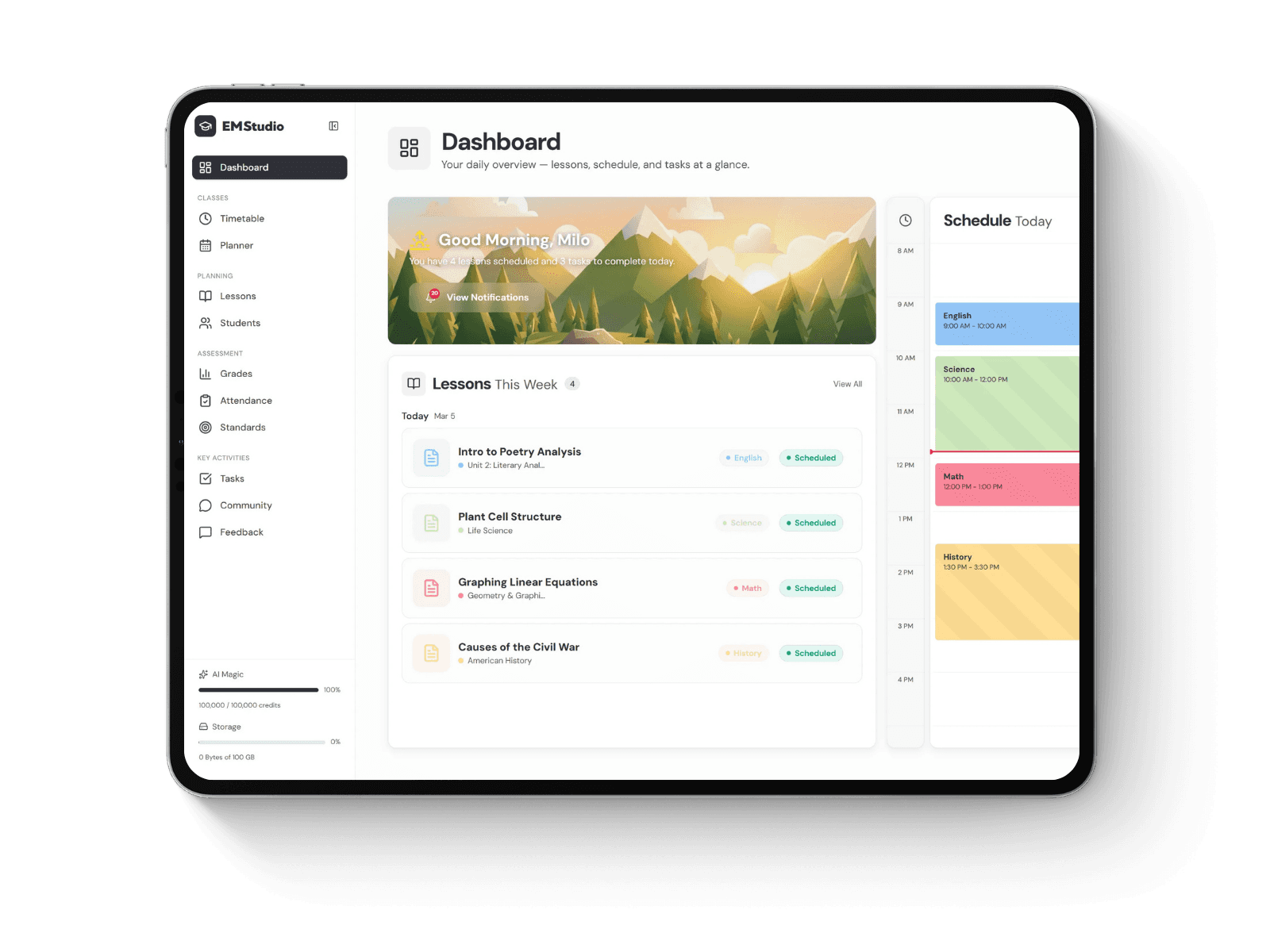
Still grading everything by hand?
EMStudio is a free teaching management app — manage your classes, students, lessons, and more!
Learn More
Table of Contents
What Are the Most Effective Traditional Teaching Methodologies?
Direct Instruction: Deploy for K-12 skill acquisition and procedure mastery.
Drill and Practice: Reserve for automating math facts and sight words.
Direct Instruction and Explicit Teaching
Rosenshine's 10 Principles of Instruction underpin these evidence-based models of direct instruction. Start with daily review. Present new material in small steps, ask frequent questions, provide models, and guide student practice with heavy scaffolding.
Run a 10-minute "I Do" with think-alouds, 15-minute "We Do" with response cards, and 10-minute "You Do" with teacher circulation and formative assessment. Use this for 1st grade phonics, 4th grade multi-digit multiplication, or 9th grade grammar mechanics. Avoid it for creative writing workshops or open-ended inquiry.
Lecture-Based Didactic Approach
Medical education research shows attention drops after 20 minutes. Use the 10-2 Rule: ten minutes of teacher talk, two minutes for turn-and-talk or quick writes. Insert interaction points using Pear Deck or Nearpod every 3-4 slides. Cap class size at 40 for feasible discussion.
Require Cornell Notes with cue columns and summary sections. Watch for failure: note-passing increases, eye contact drops below 50%, or questions decrease in complexity. Fewer than three questions per 15 minutes means abandon ship.
Drill and Practice Rote Learning
Spaced retrieval beats cramming. Use Anki or Quizlet for daily 5-minute sessions rather than weekly 30-minute blocks. For students below the 30th percentile, use cover-copy-compare; for those above the 80th, skip to application problems.
These pedagogical approaches automate understood concepts, improving learning outcomes for math facts and vocabulary. They fail at conceptual understanding. Warning: timed drills trigger math anxiety. Never drill new material—only consolidation.
Which Student-Centered Teaching Methodologies Promote Critical Thinking?
Student-centered teaching methodologies that promote critical thinking shift cognitive load to students through sustained investigation rather than passive reception. You move from lecturer to facilitator, providing scaffolding as students wrestle with authentic problems. The payoff is improved learning outcomes and transferable reasoning skills.
Stop talking so much. In student-centered pedagogical practices, you limit direct instruction to thirty percent of class time and push student discourse to sixty percent. That ten percent buffer handles transitions and tech issues. You become the guide on the side, not the sage on the stage, circulating with formative assessment prompts instead of PowerPoint slides.
Choose your instructional design based on your goal. Deploy the inquiry-based learning model when students explore phenomena without predetermined answers. Select Project-Based Learning when they must produce authentic products for real audiences. Pick the flipped classroom approach when content delivery needs differentiation. Budget three to six weeks for PBL units and three hours per video when flipping for the first time.
Avoid these teaching learning methodology choices when students lack prior knowledge. Minimal guidance instruction produces lower outcomes for novice learners due to cognitive overload. If your 7th graders cannot yet formulate testable hypotheses, do not start with open inquiry. Use direct instruction first, then release responsibility once they possess sufficient background to construct meaning independently.
Inquiry-Based Learning Model
Structure inquiry using the 5E model from BSCS. In a 7th-grade science lesson on cellular respiration, you Engage with a burning peanut demo, let students Explore yeast respiration rates in lab groups, have them Explain using a graphic organizer while reading, push them to Elaborate by comparing athlete diets, and Evaluate using a claims-evidence-reasoning poster rubric.
Run the Question Formulation Technique protocol for forty-five minutes. Students generate questions silently, identify open versus closed types, then prioritize three for investigation. You facilitate without answering, which requires specific training on holding back your expertise. This protocol builds the inquiry skills necessary for independent investigation later in the unit.
Project-Based Learning Framework
Follow Buck Institute for Education Gold Standard elements in your curriculum development. Frame a challenging problem requiring sustained inquiry over three to six weeks, ensure authenticity and student voice, and build in reflection. For example, 10th-grade civics students might address local food deserts, interviewing stakeholders and presenting data visualizations to actual city council members.
Design assessment rubrics with specific weightings: content knowledge thirty percent, collaboration twenty-five percent, presentation twenty-five percent, reflection twenty percent. Add peer evaluation via Google Forms accounting for ten percent of the grade to prevent free-riding. This structure ensures individual accountability while honoring the collaborative nature of authentic project work.
Flipped Classroom Approach
Create videos using Loom or Screencastify, capping length at seven minutes. Embed checkpoint questions using Edpuzzle to verify viewing. Your first video requires approximately three hours of preparation time for five minutes of content. Subsequent recordings drop to thirty minutes once you establish templates and workflows.
Use station rotation during class time with four distinct stations:
Independent practice with immediate feedback
Teacher-led small group limited to eight students
Peer tutoring pairs
Hands-on application tasks
This learning methodologies approach requires strong classroom management, class sizes under thirty-two, and one-to-one device access. Without these conditions, the model collapses into chaos.
Collaborative Teaching Methodologies for Social Learning
Johnson & Johnson defined five elements that separate real cooperative learning from group work chaos. Check your lessons against this list:
Positive interdependence: Students share goals, not just space.
Individual accountability: Personal quizzes prevent social loafing.
Face-to-face interaction for direct communication.
Explicit social skills instruction.
Group processing: Built-in reflection time.
Watch for failure modes. The free-rider problem kills motivation. Fix assessment equity by weighting individual pre/post-tests at sixty percent of the grade and using anonymous peer rating systems. Adapt these collaborative learning methods that drive results by level: elementary students need new base groups every two weeks; secondary thrives in heterogeneous groups for complex tasks; college students manage study groups with rotating leadership.
Cooperative Learning Structures
Try STAD (Student Teams Achievement Divisions) for five-week cycles with weekly quizzes and team recognition based on improvement points. Add Kagan Structures like Numbered Heads Together for random accountability and Rally Robin for rapid turn-taking. Keep groups at four students, heterogeneously grouped by ability.
Assign concrete roles: Reader, Recorder, Materials Manager, and Timekeeper. Give each student laminated cards with specific sentence starters for their role. When you need attention, use a "freeze" hand signal. Train groups to finish their current sentence and look up within three seconds. These protocols prevent the chaos that makes teachers abandon group work entirely.
Peer Teaching and Reciprocal Instruction
Implement Reciprocal Teaching using Palincsar and Brown's four strategies: Predicting, Questioning, Clarifying, and Summarizing. Run 30-minute guided reading cycles, gradually releasing control to students over two weeks until they facilitate the discussion themselves. This is one of the most reliable teaching methodologies for comprehension.
For cross-age tutoring, pair eighth-grade tutors with fourth graders working on math facts. Schedule twenty-minute sessions twice weekly. Tutors need a two-hour initial workshop on scaffolding techniques, plus weekly fifteen-minute check-ins to troubleshoot specific situations. This model builds fluency for both age groups without consuming your entire planning period.
Jigsaw Technique for Group Mastery
Run Jigsaw over two days. Day one: home groups of five assign topics, then expert groups research using library or database access. Day two: return to home groups to teach using graphic organizers. Cap expert groups at five to ensure everyone participates. This differs from other collaborative teaching models for K-12 teams by making each student indispensable.
Hold students accountable with an individual quiz covering all topics worth ten percent of the grade. Add a group participation rubric worth another ten percent. Include a teach-back requirement where the weakest student in each group summarizes the content for their peers to prove mastery.
Experiential and Hands-On Teaching Methodologies
Experiential teaching methodologies require logistics that worksheets don't. You'll need signed risk assessment forms, liability insurance riders, and transportation budgets. Those trips run $500 to $2,000 each. These learning pedagogies also demand continuous formative assessment rather than end-of-unit tests. Skip them when physical safety risks outweigh benefits, you have fewer than three class periods, or objectives stay purely theoretical.
Montessori Self-Directed Learning
Montessori runs on a three-hour uninterrupted work cycle with mixed-age groupings (3-6, 6-9, 9-12). The prepared environment uses specific didactic materials: the Pink Tower builds sensorial discrimination, Golden Beads make the decimal system tangible. You don't lecture. You observe, present materials only when needed, and fade into the background.
This Montessori self-directed learning principles approach demands investment. AMI or AMS certification takes nine months and costs $10,000 to $15,000. Classroom materials run $20,000 or more. Without that specialized training, you're just putting blocks on shelves.
Kolb Experiential Learning Cycle
Kolb's cycle moves through four stages: Concrete Experience (doing), Reflective Observation (reviewing what happened), Abstract Conceptualization (drawing conclusions), and Active Experimentation (planning next steps). Picture a spiral diagram where learners cycle through quadrants, building deeper understanding with each rotation.
In an 11th-grade psychology unit, students submerge hands in ice water for a cold pressor stress test. They journal for ten minutes (Reflective Observation), hear a lecture on cortisol (Abstract Conceptualization), then design and test personal coping strategies (Active Experimentation). The cycle collapses in 50-minute periods. You need 90 minutes minimum.
Required reflection prompts drive the teaching thinking forward:
What happened?
Why did it happen?
What does this mean?
How will you use this?
Place-Based and Service Learning
Place-Based education anchors curriculum development in local context and works for any age group. Students monitor the local watershed with $200 water testing kits across eight weeks, partnering with the county environmental agency. They present findings to the conservation board, not just their classmates. You avoid the $20,000 material investments required by other models.
Service Learning adds civic outcomes and structured reflection essays connecting service to academic standards. Many districts require 20 to 40 hours for graduation. Rural programs often focus on agriculture and environmental restoration; urban programs lean toward community organizing and public art. Both require careful scaffolding of student responsibilities over the full project timeline.
Check an experiential education implementation guide before committing to these pedagogy types. Your learning outcomes depend on proper instructional design and realistic classroom management of the physical environment.

Technology-Enhanced Teaching Methodologies
Know your budget before adopting these teaching methodologies. Most classrooms mix free and paid tiers:
Free tier: Khan Academy, Google Classroom, and Blooket handle core functions
Paid tier: IXL ($299/classroom), DreamBox ($25/student), Minecraft Education ($12/user)
You need 1:1 device access or a BYOD policy with backup hardware for the 15% of students lacking home internet. Avoid tech during power instability or complex SEL objectives requiring physical co-regulation. Pilot one unit for three weeks, then scale.
Gamification and Game-Based Learning
gamification and game-based learning methods work best with specific platforms. Classcraft builds avatar-based teams for classroom management. Blooket runs fast-paced quiz games. Minecraft Education unlocks sandbox building across subjects. Frame standard worksheets as "missions" using XP points, digital badges, and public leaderboards to trigger narrative engagement.
Extrinsic rewards can crowd out intrinsic motivation over time. Manage student anxiety by allowing opt-out alternatives for competitive elements. Use collaborative leaderboards pitting your class against another section, rather than ranking individuals publicly. Never create public failure states where a struggling student's low score displays for peers to see.
Blended Learning Models
Rotation models drive blended learning models for modern classrooms. Try Station Rotation with fixed 15-minute timers at four stations. Lab Rotation schedules computer lab days. Individual Rotation assigns adaptive paths so students skip mastered content. Optimal class size is 25-30 for efficient station management.
Stack your software: LMS like Canvas or Google Classroom for distribution, Khan Academy or Edpuzzle for content, Formative or Gimkit for formative assessment. Your role shifts from lecturer to data analyst, reviewing real-time dashboards to spot red zones needing immediate scaffolding.
Adaptive Learning Systems
Adaptive learning algorithms personalize pacing. Khan Academy demands 100% mastery with spaced repetition. DreamBox ($25/student) builds K-8 math pathways with virtual manipulatives. IXL ($299/classroom) provides formative assessment pinpointing specific skill gaps. Dashboards show red zones for urgent scaffolding, yellow for approaching, and green for mastery.
These systems cannot assess creative writing or collaborative problem-solving. Use them for math computation, grammar, and vocabulary only. Effect sizes range 0.4-0.6 for basic skills but drop to 0.1 for higher-order tasks. Watch for platform outages and keep screen time under two hours daily.
How Do You Choose the Right Teaching Methodology for Your Classroom?
Choose teaching methodologies based on learning objectives, student readiness data, and available resources. Use direct instruction for foundational skills with novice learners, inquiry-based methods for developing critical thinking with prepared students, and collaborative approaches for social skill building. Always pilot test with diagnostic data before full implementation.
Stop guessing. Match your teaching methodologies to what your diagnostic data actually shows, not what looks good on Pinterest. Your choice depends on three variables: how hard the content is, what your students already know, and what you actually have time to manage.
Content complexity drives the decision between examples of pedagogical approaches. Declarative knowledge—facts and concepts—works fine with direct instruction. Procedural knowledge—skills and processes—needs scaffolding and guided practice. Check your diagnostic results: below 50% prior knowledge means start with explicit instruction; 50-80% readiness allows inquiry-based learning; above 80% justifies project-based or independent study. Factor in your class size and tech access last.
Start with a formative assessment. Use exit tickets or quick diagnostics to establish baseline scores. Pilot new pedagogical approaches to teaching with just one unit—about three weeks. Track pre- and post-test scores and interview five students about their experience. Scale up only if you see at least a 0.3 effect size gain, proving you've found effective pedagogies for your specific group. Otherwise, adjust your instructional design.
Abort immediately if behavioral incidents spike more than 20%. Drop the approach if formative assessment scores fall for two straight days. Survey your students weekly; if over 30% report confusion, your scaffolding is insufficient. These metrics protect your learning outcomes from declining while you experiment with different pedagogy of teaching.
New styles of teaching and learning require training time. Don't wing it.
Inquiry-based or PBL methods: 10 hours minimum.
Cooperative learning structures: 2 hours.
Adaptive technology platforms: 5 hours.
Skip the training and your classroom management will suffer. Build this into your curriculum development calendar, not your lunch breaks. Review best teaching practices for K-12 classrooms for specific implementation guides.

What's Next for Teaching Methodologies
You don't need to master all fifteen. Pick one or two that fit your current unit and your students' needs. Last year, I started with formative assessment checkpoints built into every project. That small shift told me more about my kids than any end-of-chapter test. Start there. Build your scaffolding based on what you actually see in the room, not what the pacing guide says. When a method stops working, swap it out. Your craft evolves when you pay attention to the specific faces in front of you.
The landscape keeps shifting. AI tutors, new state standards, and hybrid classrooms are changing how we approach instructional design. Stay ahead by running small experiments. Try one new method per month. Track what works in a simple notebook. Your curriculum development should look different next year than it does today. That's the job. Keep the methods that honor your teaching style and actually move kids forward. Dump the rest without guilt.
What Are the Most Effective Traditional Teaching Methodologies?
Direct Instruction: Deploy for K-12 skill acquisition and procedure mastery.
Drill and Practice: Reserve for automating math facts and sight words.
Direct Instruction and Explicit Teaching
Rosenshine's 10 Principles of Instruction underpin these evidence-based models of direct instruction. Start with daily review. Present new material in small steps, ask frequent questions, provide models, and guide student practice with heavy scaffolding.
Run a 10-minute "I Do" with think-alouds, 15-minute "We Do" with response cards, and 10-minute "You Do" with teacher circulation and formative assessment. Use this for 1st grade phonics, 4th grade multi-digit multiplication, or 9th grade grammar mechanics. Avoid it for creative writing workshops or open-ended inquiry.
Lecture-Based Didactic Approach
Medical education research shows attention drops after 20 minutes. Use the 10-2 Rule: ten minutes of teacher talk, two minutes for turn-and-talk or quick writes. Insert interaction points using Pear Deck or Nearpod every 3-4 slides. Cap class size at 40 for feasible discussion.
Require Cornell Notes with cue columns and summary sections. Watch for failure: note-passing increases, eye contact drops below 50%, or questions decrease in complexity. Fewer than three questions per 15 minutes means abandon ship.
Drill and Practice Rote Learning
Spaced retrieval beats cramming. Use Anki or Quizlet for daily 5-minute sessions rather than weekly 30-minute blocks. For students below the 30th percentile, use cover-copy-compare; for those above the 80th, skip to application problems.
These pedagogical approaches automate understood concepts, improving learning outcomes for math facts and vocabulary. They fail at conceptual understanding. Warning: timed drills trigger math anxiety. Never drill new material—only consolidation.
Which Student-Centered Teaching Methodologies Promote Critical Thinking?
Student-centered teaching methodologies that promote critical thinking shift cognitive load to students through sustained investigation rather than passive reception. You move from lecturer to facilitator, providing scaffolding as students wrestle with authentic problems. The payoff is improved learning outcomes and transferable reasoning skills.
Stop talking so much. In student-centered pedagogical practices, you limit direct instruction to thirty percent of class time and push student discourse to sixty percent. That ten percent buffer handles transitions and tech issues. You become the guide on the side, not the sage on the stage, circulating with formative assessment prompts instead of PowerPoint slides.
Choose your instructional design based on your goal. Deploy the inquiry-based learning model when students explore phenomena without predetermined answers. Select Project-Based Learning when they must produce authentic products for real audiences. Pick the flipped classroom approach when content delivery needs differentiation. Budget three to six weeks for PBL units and three hours per video when flipping for the first time.
Avoid these teaching learning methodology choices when students lack prior knowledge. Minimal guidance instruction produces lower outcomes for novice learners due to cognitive overload. If your 7th graders cannot yet formulate testable hypotheses, do not start with open inquiry. Use direct instruction first, then release responsibility once they possess sufficient background to construct meaning independently.
Inquiry-Based Learning Model
Structure inquiry using the 5E model from BSCS. In a 7th-grade science lesson on cellular respiration, you Engage with a burning peanut demo, let students Explore yeast respiration rates in lab groups, have them Explain using a graphic organizer while reading, push them to Elaborate by comparing athlete diets, and Evaluate using a claims-evidence-reasoning poster rubric.
Run the Question Formulation Technique protocol for forty-five minutes. Students generate questions silently, identify open versus closed types, then prioritize three for investigation. You facilitate without answering, which requires specific training on holding back your expertise. This protocol builds the inquiry skills necessary for independent investigation later in the unit.
Project-Based Learning Framework
Follow Buck Institute for Education Gold Standard elements in your curriculum development. Frame a challenging problem requiring sustained inquiry over three to six weeks, ensure authenticity and student voice, and build in reflection. For example, 10th-grade civics students might address local food deserts, interviewing stakeholders and presenting data visualizations to actual city council members.
Design assessment rubrics with specific weightings: content knowledge thirty percent, collaboration twenty-five percent, presentation twenty-five percent, reflection twenty percent. Add peer evaluation via Google Forms accounting for ten percent of the grade to prevent free-riding. This structure ensures individual accountability while honoring the collaborative nature of authentic project work.
Flipped Classroom Approach
Create videos using Loom or Screencastify, capping length at seven minutes. Embed checkpoint questions using Edpuzzle to verify viewing. Your first video requires approximately three hours of preparation time for five minutes of content. Subsequent recordings drop to thirty minutes once you establish templates and workflows.
Use station rotation during class time with four distinct stations:
Independent practice with immediate feedback
Teacher-led small group limited to eight students
Peer tutoring pairs
Hands-on application tasks
This learning methodologies approach requires strong classroom management, class sizes under thirty-two, and one-to-one device access. Without these conditions, the model collapses into chaos.
Collaborative Teaching Methodologies for Social Learning
Johnson & Johnson defined five elements that separate real cooperative learning from group work chaos. Check your lessons against this list:
Positive interdependence: Students share goals, not just space.
Individual accountability: Personal quizzes prevent social loafing.
Face-to-face interaction for direct communication.
Explicit social skills instruction.
Group processing: Built-in reflection time.
Watch for failure modes. The free-rider problem kills motivation. Fix assessment equity by weighting individual pre/post-tests at sixty percent of the grade and using anonymous peer rating systems. Adapt these collaborative learning methods that drive results by level: elementary students need new base groups every two weeks; secondary thrives in heterogeneous groups for complex tasks; college students manage study groups with rotating leadership.
Cooperative Learning Structures
Try STAD (Student Teams Achievement Divisions) for five-week cycles with weekly quizzes and team recognition based on improvement points. Add Kagan Structures like Numbered Heads Together for random accountability and Rally Robin for rapid turn-taking. Keep groups at four students, heterogeneously grouped by ability.
Assign concrete roles: Reader, Recorder, Materials Manager, and Timekeeper. Give each student laminated cards with specific sentence starters for their role. When you need attention, use a "freeze" hand signal. Train groups to finish their current sentence and look up within three seconds. These protocols prevent the chaos that makes teachers abandon group work entirely.
Peer Teaching and Reciprocal Instruction
Implement Reciprocal Teaching using Palincsar and Brown's four strategies: Predicting, Questioning, Clarifying, and Summarizing. Run 30-minute guided reading cycles, gradually releasing control to students over two weeks until they facilitate the discussion themselves. This is one of the most reliable teaching methodologies for comprehension.
For cross-age tutoring, pair eighth-grade tutors with fourth graders working on math facts. Schedule twenty-minute sessions twice weekly. Tutors need a two-hour initial workshop on scaffolding techniques, plus weekly fifteen-minute check-ins to troubleshoot specific situations. This model builds fluency for both age groups without consuming your entire planning period.
Jigsaw Technique for Group Mastery
Run Jigsaw over two days. Day one: home groups of five assign topics, then expert groups research using library or database access. Day two: return to home groups to teach using graphic organizers. Cap expert groups at five to ensure everyone participates. This differs from other collaborative teaching models for K-12 teams by making each student indispensable.
Hold students accountable with an individual quiz covering all topics worth ten percent of the grade. Add a group participation rubric worth another ten percent. Include a teach-back requirement where the weakest student in each group summarizes the content for their peers to prove mastery.
Experiential and Hands-On Teaching Methodologies
Experiential teaching methodologies require logistics that worksheets don't. You'll need signed risk assessment forms, liability insurance riders, and transportation budgets. Those trips run $500 to $2,000 each. These learning pedagogies also demand continuous formative assessment rather than end-of-unit tests. Skip them when physical safety risks outweigh benefits, you have fewer than three class periods, or objectives stay purely theoretical.
Montessori Self-Directed Learning
Montessori runs on a three-hour uninterrupted work cycle with mixed-age groupings (3-6, 6-9, 9-12). The prepared environment uses specific didactic materials: the Pink Tower builds sensorial discrimination, Golden Beads make the decimal system tangible. You don't lecture. You observe, present materials only when needed, and fade into the background.
This Montessori self-directed learning principles approach demands investment. AMI or AMS certification takes nine months and costs $10,000 to $15,000. Classroom materials run $20,000 or more. Without that specialized training, you're just putting blocks on shelves.
Kolb Experiential Learning Cycle
Kolb's cycle moves through four stages: Concrete Experience (doing), Reflective Observation (reviewing what happened), Abstract Conceptualization (drawing conclusions), and Active Experimentation (planning next steps). Picture a spiral diagram where learners cycle through quadrants, building deeper understanding with each rotation.
In an 11th-grade psychology unit, students submerge hands in ice water for a cold pressor stress test. They journal for ten minutes (Reflective Observation), hear a lecture on cortisol (Abstract Conceptualization), then design and test personal coping strategies (Active Experimentation). The cycle collapses in 50-minute periods. You need 90 minutes minimum.
Required reflection prompts drive the teaching thinking forward:
What happened?
Why did it happen?
What does this mean?
How will you use this?
Place-Based and Service Learning
Place-Based education anchors curriculum development in local context and works for any age group. Students monitor the local watershed with $200 water testing kits across eight weeks, partnering with the county environmental agency. They present findings to the conservation board, not just their classmates. You avoid the $20,000 material investments required by other models.
Service Learning adds civic outcomes and structured reflection essays connecting service to academic standards. Many districts require 20 to 40 hours for graduation. Rural programs often focus on agriculture and environmental restoration; urban programs lean toward community organizing and public art. Both require careful scaffolding of student responsibilities over the full project timeline.
Check an experiential education implementation guide before committing to these pedagogy types. Your learning outcomes depend on proper instructional design and realistic classroom management of the physical environment.
Technology-Enhanced Teaching Methodologies
Know your budget before adopting these teaching methodologies. Most classrooms mix free and paid tiers:
Free tier: Khan Academy, Google Classroom, and Blooket handle core functions
Paid tier: IXL ($299/classroom), DreamBox ($25/student), Minecraft Education ($12/user)
You need 1:1 device access or a BYOD policy with backup hardware for the 15% of students lacking home internet. Avoid tech during power instability or complex SEL objectives requiring physical co-regulation. Pilot one unit for three weeks, then scale.
Gamification and Game-Based Learning
gamification and game-based learning methods work best with specific platforms. Classcraft builds avatar-based teams for classroom management. Blooket runs fast-paced quiz games. Minecraft Education unlocks sandbox building across subjects. Frame standard worksheets as "missions" using XP points, digital badges, and public leaderboards to trigger narrative engagement.
Extrinsic rewards can crowd out intrinsic motivation over time. Manage student anxiety by allowing opt-out alternatives for competitive elements. Use collaborative leaderboards pitting your class against another section, rather than ranking individuals publicly. Never create public failure states where a struggling student's low score displays for peers to see.
Blended Learning Models
Rotation models drive blended learning models for modern classrooms. Try Station Rotation with fixed 15-minute timers at four stations. Lab Rotation schedules computer lab days. Individual Rotation assigns adaptive paths so students skip mastered content. Optimal class size is 25-30 for efficient station management.
Stack your software: LMS like Canvas or Google Classroom for distribution, Khan Academy or Edpuzzle for content, Formative or Gimkit for formative assessment. Your role shifts from lecturer to data analyst, reviewing real-time dashboards to spot red zones needing immediate scaffolding.
Adaptive Learning Systems
Adaptive learning algorithms personalize pacing. Khan Academy demands 100% mastery with spaced repetition. DreamBox ($25/student) builds K-8 math pathways with virtual manipulatives. IXL ($299/classroom) provides formative assessment pinpointing specific skill gaps. Dashboards show red zones for urgent scaffolding, yellow for approaching, and green for mastery.
These systems cannot assess creative writing or collaborative problem-solving. Use them for math computation, grammar, and vocabulary only. Effect sizes range 0.4-0.6 for basic skills but drop to 0.1 for higher-order tasks. Watch for platform outages and keep screen time under two hours daily.
How Do You Choose the Right Teaching Methodology for Your Classroom?
Choose teaching methodologies based on learning objectives, student readiness data, and available resources. Use direct instruction for foundational skills with novice learners, inquiry-based methods for developing critical thinking with prepared students, and collaborative approaches for social skill building. Always pilot test with diagnostic data before full implementation.
Stop guessing. Match your teaching methodologies to what your diagnostic data actually shows, not what looks good on Pinterest. Your choice depends on three variables: how hard the content is, what your students already know, and what you actually have time to manage.
Content complexity drives the decision between examples of pedagogical approaches. Declarative knowledge—facts and concepts—works fine with direct instruction. Procedural knowledge—skills and processes—needs scaffolding and guided practice. Check your diagnostic results: below 50% prior knowledge means start with explicit instruction; 50-80% readiness allows inquiry-based learning; above 80% justifies project-based or independent study. Factor in your class size and tech access last.
Start with a formative assessment. Use exit tickets or quick diagnostics to establish baseline scores. Pilot new pedagogical approaches to teaching with just one unit—about three weeks. Track pre- and post-test scores and interview five students about their experience. Scale up only if you see at least a 0.3 effect size gain, proving you've found effective pedagogies for your specific group. Otherwise, adjust your instructional design.
Abort immediately if behavioral incidents spike more than 20%. Drop the approach if formative assessment scores fall for two straight days. Survey your students weekly; if over 30% report confusion, your scaffolding is insufficient. These metrics protect your learning outcomes from declining while you experiment with different pedagogy of teaching.
New styles of teaching and learning require training time. Don't wing it.
Inquiry-based or PBL methods: 10 hours minimum.
Cooperative learning structures: 2 hours.
Adaptive technology platforms: 5 hours.
Skip the training and your classroom management will suffer. Build this into your curriculum development calendar, not your lunch breaks. Review best teaching practices for K-12 classrooms for specific implementation guides.
What's Next for Teaching Methodologies
You don't need to master all fifteen. Pick one or two that fit your current unit and your students' needs. Last year, I started with formative assessment checkpoints built into every project. That small shift told me more about my kids than any end-of-chapter test. Start there. Build your scaffolding based on what you actually see in the room, not what the pacing guide says. When a method stops working, swap it out. Your craft evolves when you pay attention to the specific faces in front of you.
The landscape keeps shifting. AI tutors, new state standards, and hybrid classrooms are changing how we approach instructional design. Stay ahead by running small experiments. Try one new method per month. Track what works in a simple notebook. Your curriculum development should look different next year than it does today. That's the job. Keep the methods that honor your teaching style and actually move kids forward. Dump the rest without guilt.
Still grading everything by hand?
EMStudio is a free teaching management app — manage your classes, students, lessons, and more!
Learn More
Still grading everything by hand?
EMStudio is a free teaching management app — manage your classes, students, lessons, and more!
Learn More



Notion4Teachers
Notion templates to simplify administrative tasks and enhance your teaching experience.



2026 Notion4Teachers. All Rights Reserved.
Notion4Teachers
Notion templates to simplify administrative tasks and enhance your teaching experience.
2026 Notion4Teachers. All Rights Reserved.
Notion4Teachers
Notion templates to simplify administrative tasks and enhance your teaching experience.
2026 Notion4Teachers. All Rights Reserved.