
15 Digital Teacher Planners for Organized Educators
15 Digital Teacher Planners for Organized Educators

Article by
Milo
ESL Content Coordinator & Educator
ESL Content Coordinator & Educator
All Posts
Teachers spend an average of 7 hours per week on lesson planning outside contracted hours, according to a 2023 RAND Corporation survey. That is nearly a full workday of unpaid time spent wrestling with standards alignment and unit pacing. A solid digital teacher planner cuts that time in half by keeping your state standards, resources, and daily schedule in one searchable place. No more flipping between three binders to find that one vocabulary activity.
You have probably tried paper planners that looked beautiful in August but became paperweights by October. I have been there. The right lesson planning software adapts when your administrator drops a new curriculum mandate on Tuesday or when half your class is out with the flu. It moves with you, not against you. Static paper cannot pivot when the fire alarm interrupts your double-period lab.
This guide covers the planners actually worth your time. I tested fifteen teacher productivity apps across elementary and secondary classrooms, focusing on which ones handle co-teaching platforms, curriculum mapping tools, and educational technology integration without requiring a computer science degree. Some are free. Others cost less than your monthly coffee habit. Here is what works.
Still grading everything by hand?
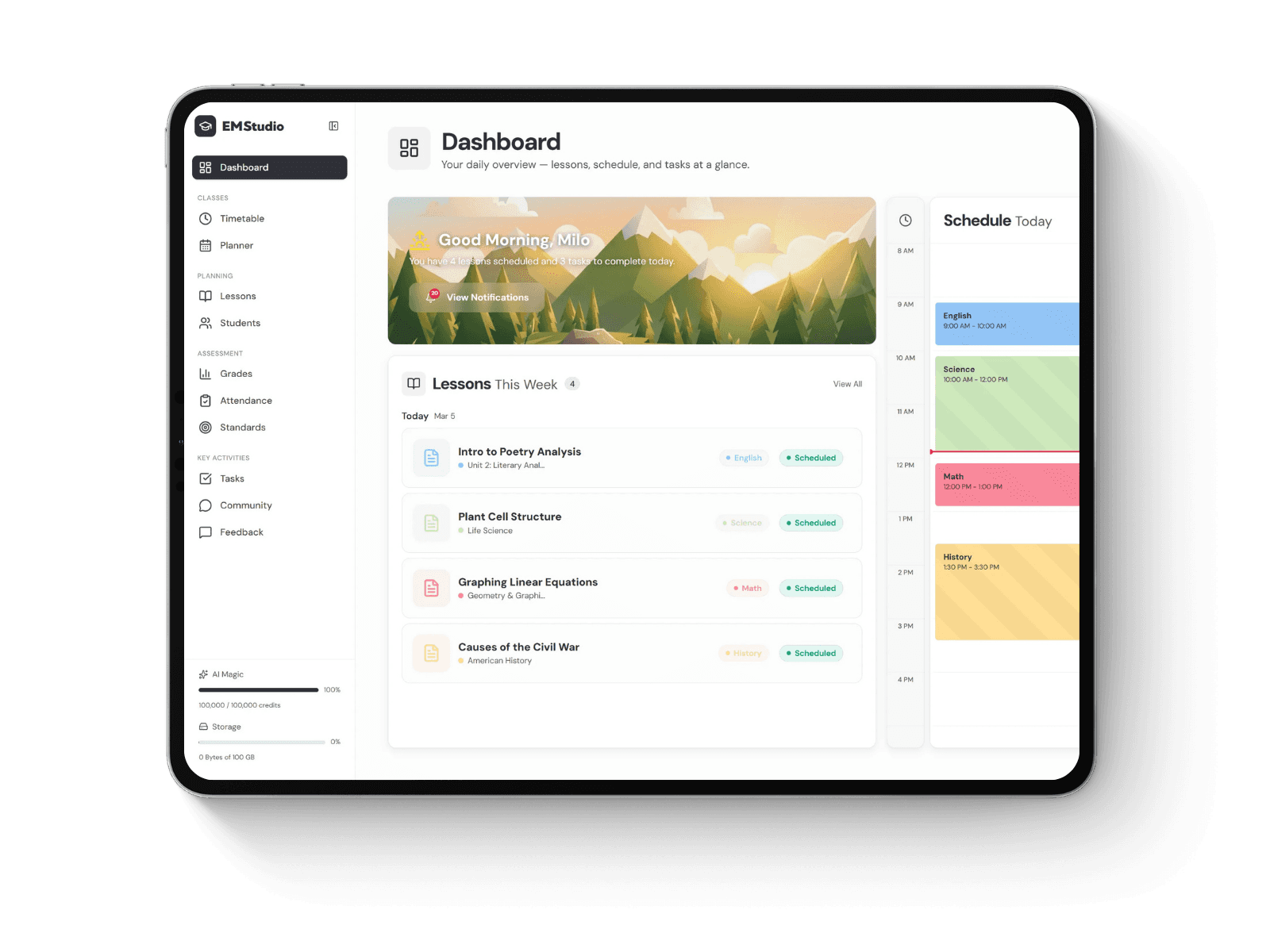
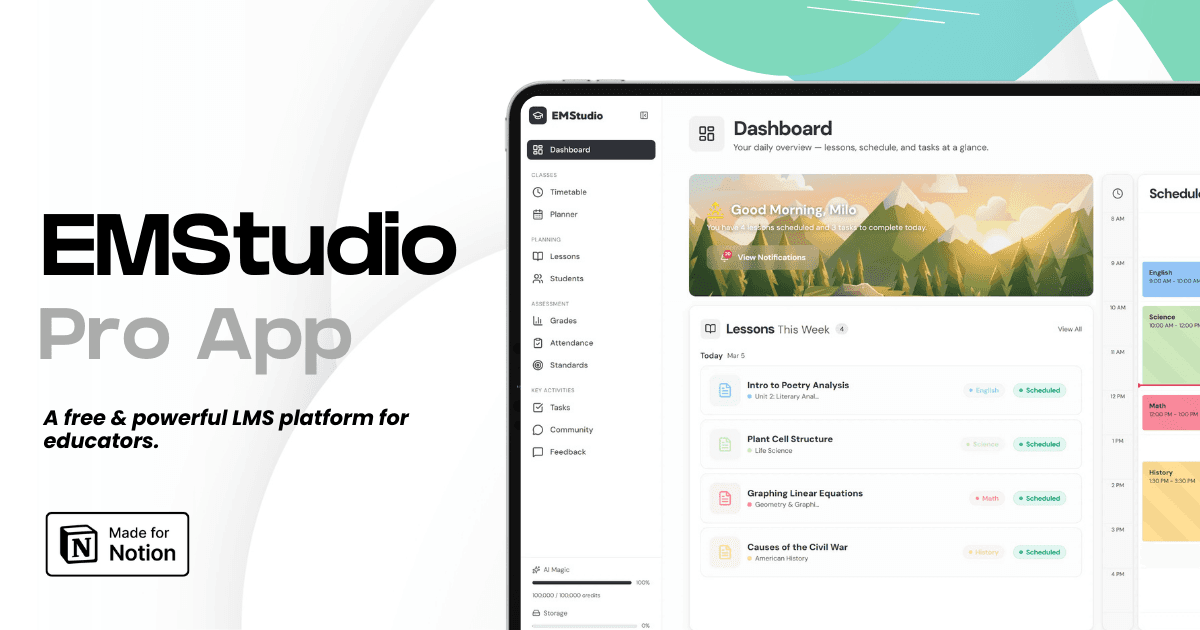
EMStudio is a free teaching management app — manage your classes, students, lessons, and more!
Learn More
Still grading everything by hand?
EMStudio is a free teaching management app — manage your classes, students, lessons, and more!
Learn More
Table of Contents
What Are the Best Free Digital Teacher Planners?
The best free digital teacher planners are Google Sheets (for spreadsheet flexibility), Notion (for database-driven organization), and OneNote Class Notebook (for stylus integration). Each offers robust $0 tiers suitable for individual teachers, though they require 2-8 hours of initial setup and lack automated standards alignment found in paid alternatives.
Free means zero dollars, not zero effort. These tools work, but you will trade money for weekends.
Educators report reducing weekly prep time by 2-3 hours after mastering these teacher productivity apps, though initial digitization of existing paper plans requires 1-2 weekends. See our comprehensive digital teacher planner guide for a full feature comparison. The investment pays off around week six when templates start generating automatically.
Google Sheets Teaching Templates
Head to sheets.google.com and open the Template Gallery. Select Education, then grab 'Lesson Plan' or 'Year Planner'. Budget 2-5 hours for setup: customize cells for 6-period days versus A/B block schedules, then build color-coded tabs for each section. You get unlimited storage, but no native mobile optimization—use your desktop for heavy data entry. Standards alignment requires manual entry; there is no auto-populate.
Picture a 7th-grade math teacher tracking 120 students across 4 sections. She sets conditional formatting to flag missing assignments automatically. It is ugly but bulletproof, and it runs on the ancient Dell laptop her district issued in 2019. Ideal for spreadsheet-comfortable teachers grades 6-12.
Notion Education Hub
Import the 'Teacher OS' template from notion.so/templates. Plan for 4-8 hours of mastery time as you set up databases for Units, Lessons, and Resources. Use linked databases to connect lessons to standards manually, creating relationships between content without code. Warning: free accounts impose a 5MB file upload limit, so host large videos on Drive and link instead.
This suits tech-early-adopters willing to learn database relationships, particularly those running complex interdisciplinary units—think 10th-grade Humanities combining History and English. The relational view shows which resources connect to which standards across both subjects, functioning as a lightweight co-teaching platform without the enterprise price tag. Grab our free Notion templates for teachers to jumpstart your setup.
OneNote Class Notebook
Create yours through Office 365 Education. The structure has three parts: Content Library for your resources, Student Notebooks for private sections, and Collaboration Space for group work. Ink-to-text conversion requires a Windows tablet or iPad with Apple Pencil for handwritten lesson annotations. The catch: you need active district license renewal to maintain access; if your IT department lapses, you lose your plans.
This shines for tablet/stylus users in 1:1 device districts—particularly K-5 teachers conducting daily digital centers or high school art teachers sketching lesson diagrams directly into the planner. Built specifically for districts prioritizing educational technology integration, it remains the only choice with robust stylus support.

Which Digital Teacher Planners Work Best for Elementary Teachers?
For elementary teachers, the best teacher planner options are Happy Planner Digital App (sticker-rich interface), Erin Condren Digital Suite (customizable aesthetics), and PlanbookEdu (standards-aligned simplicity). These prioritize visual navigation and touchscreen usability over complex database has needed in secondary grades.
Elementary teachers need touch-friendly interfaces. Little fingers swipe better than they type. Your digital teacher planner must reward visual organization with color-coding and sticker equivalents that mirror physical classroom tools. Check elementary education planning requirements for grade-specific workflows.
Criteria | Happy Planner | Erin Condren | PlanbookEdu |
|---|---|---|---|
Cost | $2.99/mo or $29.99/yr + stickers | $15-25 one-time | Free or $25/yr |
Sticker Functionality | Extensive ($0.99-$4.99 packs) | Limited/Decorative | None |
Common Core Alignment | Manual | Manual | Built-in (CCSS, NGSS, TEKS) |
Print Quality for Subs | Good | Excellent | Premium only |
Mobile Experience | Native app | PDF/GoodNotes | Web-based |
Research in organizational psychology confirms what elementary teachers already know. Visual appeal drives daily use. When your planner looks inviting, you open it. When it looks like a spreadsheet, you avoid it. That "cute factor" isn't frivolous for teachers managing 25+ young children. It's survival.
K-2 teachers need picture-based navigation. Icons for recess. Photos for centers. Third through fifth grade can handle simple text labels, but they still need heavy visual cues. Sticker rewards integration matters when choosing from available teacher productivity apps. If the lesson planning software doesn't let you drop a digital gold star on completed tasks, it's wrong for elementary.
Happy Planner Digital App
The Happy Planner Digital App runs on a subscription model. Pay $2.99 monthly or $29.99 annually through the App Store or Google Play. Sticker packs cost extra, ranging from $0.99 to $4.99 per themed collection. The interface mimics their physical coiled planners with a vertical dashboard layout.
This app shines for primary teachers who think visually. Imagine you're teaching first grade with 26 six-year-olds who need constant visual cues. You drop a "Morning Meeting" sticker block across 8:30-9:00 AM every Monday through Friday. You color-code subjects with digital stickers—red for math, blue for reading.
During chaotic transitions, you glance at your iPad and see colors, not text. That's the difference between teacher digital planner tools built for elementary versus those built for high school. You save mental energy when planning looks like your classroom.
The touchscreen optimization matters. Buttons are large. Dragging stickers feels natural. If you're already using Happy Planner paper products, the digital transition takes ten minutes. Your students recognize the color-coding immediately because it matches your wall visuals.
Erin Condren Digital Suite
Erin Condren offers a different financial model. Pay $15 for the basic digital planner or $25 for the lesson plan bundle. These are one-time purchases, not subscriptions. You receive PDF files with hyperlinks or GoodNotes-ready formats. For teachers tired of monthly charges, this brings budget certainty.
This suite targets grades 2-4 specifically. Teachers at this level want digital convenience without sacrificing the handwriting experience. Import the files into GoodNotes on your iPad. Use your Apple Pencil to write directly on the pages. You get searchable benefits with tactile feel.
The customization options run deep. Change cover designs. Add your name in script fonts. Insert curriculum mapping tools directly into hyperlinked tabs. If you resist subscription fatigue but need educational technology integration that respects how elementary teachers plan, this fits.
Teachers in private programs appreciate the neutral design options. You can print individual pages for your elementary education planning requirements documentation without formatting issues. The metallic coils on the digital covers look like the real thing.
PlanbookEdu for Primary Grades
PlanbookEdu operates on a freemium model. The free tier shows one year of plans visible only to you. Upgrade to premium for $25 annually to unlock state standards alignment including CCSS, NGSS, and TEKS. Premium adds PDF export for substitute teacher folders.
The standout feature is the "bump" button. When snow days destroy your math unit, click once. Every lesson shifts forward one day. No manual copying across weeks. For budget-conscious K-5 teachers needing documentation without district funding for enterprise co-teaching platforms, this delivers.
Target this tool if you care more about content than aesthetics. Unlike other teacher productivity apps, it tracks which standards you've covered. Administrators love the documentation. You'll love that it takes less time than planning in a paper book once you learn the shortcuts.
The printouts generate clean sub plans automatically. Your administrator sees exactly which standards you covered on sick days. For teachers juggling elementary education planning requirements across multiple preps, this saves hours during evaluation season.

Top Digital Teacher Planners for Secondary and High School
Secondary teachers manage 120 to 150 students across multiple sections, often juggling three or four different preps daily. You need a digital teacher planner that copies lab setups across four sections and tracks A/B block rotations. Skip the elementary-focused apps with cute fonts. Those lack standards databases for high school courses and collapse under semester-long pacing guides. Your secondary education structure and implementation needs tools built for complexity, not decoration.
TeacherWise Planning System
TeacherWise runs $40 annually. That investment buys you a 6-day rotation calendar—critical if your high school uses complicated block schedules where Mondays look different from Tuesdays. The system supports both CCSS and NGSS standards tracking with built-in databases, not external links that send you hunting.
The Google Classroom integration eliminates tab-hopping. You build a lesson, attach your slide deck and handout PDFs, then push assignments directly to your Google Classroom stream from inside TeacherWise. Specify which sections get which materials without rebuilding the lesson four times. Gradebook columns generate automatically when students submit.
Consider an 11th-grade Chemistry teacher managing four sections totaling 96 students. She tracks lab schedules across alternating A/B block days. Tuesday's titration lab needs specific safety prep copied to all four sections simultaneously. She builds the lab setup instructions once, duplicates them across her sections with one click, and the 6-day rotation ensures Block A sees it on Tuesday while Block B sees it Thursday. No copy-paste errors. No forgotten safety reminders for third period.
The duplication has save your sanity when you teach multiple sections of the same prep. Write once, deploy everywhere. Standards alignment happens automatically as you tag lessons, building your documentation for accreditation without the end-of-semester scramble.
Planbook.com Digital Edition
Planbook offers a 14-day free trial, then charges $15 per year for individual licenses. That price point makes it accessible for teachers who pay out-of-pocket or fear district platform switches mid-year. You get cloud-based access across devices without enterprise bloat.
The Copy to Next Year function justifies the subscription alone. Roll your entire curriculum forward with automatic date adjustments. Your August start date shifts to match next year's calendar automatically. Your scope and sequence, unit pacing, and lesson notes transfer cleanly. Adjust for snow days or assembly schedules without rebuilding weeks from scratch.
Attachment support runs up to 50MB per lesson. Upload your worksheets, answer keys, and lab safety agreements directly to specific days. When you print sub plans, every attachment appears in the margin. Substitute teachers see exactly what handout to distribute during second period.
This suits solo practitioners in grades 6-12 working without district-wide platform mandates. You maintain basic standards alignment and generate clean PDFs for administrators who require printed plan books. It handles the complexity of multiple preps without forcing collaboration has you don't need.
Eduphoria Aware Integration
Eduphoria Aware requires district purchase, running approximately $5 to $15 per student annually. Individual teachers cannot buy personal subscriptions. Your superintendent or curriculum director makes this decision for the entire secondary campus or district. It functions as both curriculum mapping tools and co-teaching platforms for departmental collaboration.
The platform specializes in curriculum mapping across grade levels. Your AP Biology team aligns cellular respiration units with middle school life science teachers using the same interface. You trace prerequisite skills from 7th grade through AP exam preparation. Assessment alignment tools show which standards your department covers versus gaps requiring attention. PLC data sharing happens in real-time—upload common assessment results Tuesday afternoon, and your vertical team analyzes them Wednesday morning without email attachments or spreadsheet version confusion.
Avoid this solution if you teach without district licensing. Small private schools with under 500 students typically find the pricing structure cost-prohibitive. You need institutional buy-in and technical support for implementation. Individual teachers seeking personal digital planner for teachers should look elsewhere; this is educational technology integration at the systems level, not a personal productivity app.

Best Digital Teacher Planners with Built-In Collaboration Tools
Co-teaching fails when partners use incompatible systems. If you're pairing SPED with GenEd or managing ESL push-in, your digital teacher planner must support true collaboration. Learn more about effective co-teaching techniques before choosing your platform. Demand these five features:
Real-time editing so both teachers see changes instantly
Comment threads for asynchronous planning conversations
Version history when someone accidentally deletes the unit
Permission tiers to protect sensitive IEP data
Parent portal integration for transparency
Check pricing carefully. Individual licenses usually block collaboration—teams need shared workspace plans, often doubling costs. Also verify LMS compatibility. If your lesson planning software doesn't talk to Canvas or Schoology, you're stuck with Sunday-night double-entry.
Microsoft Teams Class Planner
Install the Class Planner tab in your Teams channel. It connects to a shared OneNote notebook and pushes assignments to both teachers' dashboards. Your school needs Office 365 A3 or A5—free for most public schools through Microsoft Education. Without it, the tab won't appear.
Real example: Two 9th-grade English teachers splitting essay grading. One tracks intro paragraphs, the other handles conclusions. Real-time updates show exactly who's finished what. No more midnight texts asking if Jake's feedback is done.
This works as project management tools for educators should—seamlessly. But if your district uses Canvas, you'll manually transfer grades. The sync isn't automatic, which defeats the point of co-teaching platforms that promise efficiency.
Google Workspace Teaching Planner
Build a shared Drive structure: 'Unit Plans' folder with Docs for weekly lessons and Sheets for pacing guides. Google supports 100+ simultaneous editors without crashing, free with Google Workspace for Education Fundamentals.
Best for entire departments. Picture five Middle School Math teachers sharing resources across 6th-8th grade. Everyone sees which activities bombed last year. Nobody duplicates failed lessons or creates conflicting homework assignments that confuse kids moving between teachers.
The catch? Pure Drive lacks built-in standards alignment tracking. You'll manually tag state standards in Doc headers or build complex Sheet formulas. It's functional educational technology integration, but not the best teacher productivity apps can offer for mapping.
Notion Team Templates for Co-Teaching
Notion offers a free education tier for teams under 10 members with unlimited pages. Use @mentions to tag your co-teacher in specific lesson blocks. Set permissions granularly: Full access, Can comment, or View only. Database rollups show which lessons are team-approved versus draft status.
This visibility prevents disasters. You see instantly that the Civil War unit is still "draft" while your partner thinks it's ready to teach. Curriculum mapping tools built this way actually work.
But here's the reality check: If your colleagues haven't used relational databases, budget 2-3 hours for training before deployment. Otherwise, you'll spend October troubleshooting why Mrs. Johnson can't find the 3rd-grade pacing guide while admin asks for the best teacher planner recommendations.

All-in-One Digital Teacher Planners for Full Curriculum Management
All-in-one means everything lives in one place: curriculum mapping, lesson planning, assessment tracking, and resource libraries. These systems run $100 to $500+ annually, while free digital teacher planner options handle basic scheduling fine. The math only works if you actually use most of the has daily.
Districts often over-engineer this purchase. Your school pays for enterprise scope mapping and vertical alignment tools, but individual teachers use them as simple datebooks. That is money burning. If you teach one grade level without coordinating across departments, these tools add administrative weight without lifting your daily load.
Buy only if you manage cross-grade alignment—like making sure 7th-grade skills feed into 8th-grade Algebra—or if you handle district compliance reporting. Otherwise, downsize. A simpler tool beats an empty enterprise suite every time.
Forethought Lesson Planning Suite
Forethought Lesson Planning Suite costs $500+ annually for individual licenses, with district pricing tied to student headcount. It offers scope and sequence mapping, standards alignment across grade levels, and assessment calendar integration for benchmark testing windows. These curriculum mapping tools assume you are managing curriculum for multiple grades, not just teaching your own classes.
This tool serves specific coordination roles:
Instructional coaches overseeing 6-12 Science or Math vertically
Department chairs proving standard progression across grade levels
District coordinators managing curriculum mapping for educators across multiple buildings
Individual classroom teachers without coordination duties will find themselves clicking through empty fields designed for multi-year vertical planning. Skip this unless your job description explicitly includes cross-grade alignment. The learning curve is steep for a single teacher managing one roster. The price is steeper when you just need to plan next week's lessons.
Chalk Gold Digital Planner
Chalk Gold Digital Planner sits at $100-200 yearly depending on school size, making it the mid-market option. Its strength is the unit repository—teachers upload complete four-week units with attached resources, slide decks, and assessments. Other teachers import the entire package without rebuilding from scratch.
The prerequisite tracking shows exactly which 8th-grade skills from pre-algebra feed into 9th-grade Algebra I readiness. Small private schools with 100-400 students use this to maintain continuity without Forethought's enterprise budget. You get enough structure to prevent curriculum drift between classrooms. You won't spend weekends filling in district compliance templates.
This fits when your school needs shared curriculum but lacks a dedicated instructional coach. One veteran teacher builds the unit; three colleagues adapt it. Everyone stays aligned without the bloat of larger systems. For educational technology integration at smaller scale, this hits the sweet spot between capability and complexity.
PowerPlanner Pro for Educators
PowerPlanner Pro costs $0.99 monthly on iOS and Android. It is mobile-first, built for GPA calculation, weighted grade tracking, and semester overview calendars. The lesson planning has are thin—it tracks what you teach when, but not how you teach it.
Elementary teachers should skip this. The weighted grade logic confuses 3rd-grade reading groups, and the interface assumes rotating periods, not self-contained classrooms. It also fails for teachers needing detailed activity design. This is not the best teacher planner for elementary or detailed lesson design.
Use this only in college-prep high schools where GPA management drives daily decisions. If your students track weighted GPAs for college admissions and you primarily need schedule visibility, it works. For actual lesson design or co-teaching platforms, look elsewhere. The price is right for schedule management, wrong for lesson planning software or curriculum development.

How Do You Choose the Right Digital Teacher Planner for Your Workflow?
Start by auditing your specific pain points—whether it's collaboration, standards alignment, or mobile access. Test three options using free trials, running each through a single two-week unit. Choose the planner that exports easily to PDF, works offline during field trips, and requires less than 30 minutes daily maintenance.
You don't need the perfect system. You need one that survives a Tuesday in March when the copier breaks and your phone dies. Pick the tool that works when everything else doesn't.
Most teachers pick planners based on aesthetic templates. That's backwards. A beautiful digital teacher planner that can't handle your state's standards documentation is just a pretty trap.
Teachers waste August agonizing over has they'll never use. I've watched colleagues spend weeks comparing lesson planning software interfaces while their actual lessons stayed blank. Meanwhile, their gradebooks remained empty and the first day of school approached. Stop researching and start testing.
The 5-Step Decision Flowchart
Don't marry a digital planner for teachers before dating it. Run every contender through this audit before you commit.
Audit current pain points. Track where you lose time for one week. Is it standards alignment? Collaboration with your co-teacher? List your top three frustrations before opening any app. If you can't name the problem, the solution won't help.
Check district compatibility. Email your IT department before you fall in love. Ask specifically about FERPA compliance and whether the educational technology integration requires board approval. Some curriculum mapping tools store data on international servers that violate district policy. Get written confirmation.
Trial period protocol. Test with one unit—maybe two weeks of 7th-grade genetics—not your entire year.
Mobile access test. Open the app on your phone while monitoring lunch duty.
Exit strategy. Look for the export button on day one, not day three hundred.
Red Flags to Avoid
Some platforms look shiny but trap you. Watch for these warnings during your trial.
Annual contracts with no monthly option. You want the freedom to bail mid-year if the co-teaching platforms don't integrate with your partner's system. Any company confident in their product offers month-to-month.
No offline mode. Field trips happen. Underground classrooms exist. Rural schools lose Wi-Fi during rainstorms. Your planner should work when the network doesn't. Test this by turning off your phone's data and trying to edit a lesson.
Vague privacy policies. Search the terms of service for "we share data with third parties" or "partners may access." If you find it, run. FERPA compliance isn't optional, and "we take privacy seriously" means nothing without specifics.
Budget Reality Check
Research suggests free digital planning tools meet the core needs of most individual teachers, with premium tiers justified primarily for district-level coordination or specialized compliance requirements. You don't need to pay for has that look impressive in a demo but collect digital dust.
Districts often have funds for educational technology integration that individual teachers don't know about. Ask your principal about curriculum budgets before pulling out your credit card. Sometimes the money exists but requires a purchase order instead of a personal subscription.
Before you upgrade, ask what you're actually buying. Usually, it's shared libraries and admin oversight—useful for department chairs managing curriculum mapping tools, unnecessary for someone who just wants to stop losing sticky notes. The $99/year pro tier only makes sense if it saves you two hours weekly.
Switching planners mid-year costs more than money. You lose muscle memory and student data. Better to limp through June with a mediocre system than rebuild everything during standardized testing season.
Once you pick a system, choose the right teacher planner and stick with it. The magic isn't in the tool; it's in the planning habits of highly effective educators who use it daily. A mediocre planner used consistently beats a perfect one abandoned by October. Consistency matters more than features.

What Are the Best Free Digital Teacher Planners?
The best free digital teacher planners are Google Sheets (for spreadsheet flexibility), Notion (for database-driven organization), and OneNote Class Notebook (for stylus integration). Each offers robust $0 tiers suitable for individual teachers, though they require 2-8 hours of initial setup and lack automated standards alignment found in paid alternatives.
Free means zero dollars, not zero effort. These tools work, but you will trade money for weekends.
Educators report reducing weekly prep time by 2-3 hours after mastering these teacher productivity apps, though initial digitization of existing paper plans requires 1-2 weekends. See our comprehensive digital teacher planner guide for a full feature comparison. The investment pays off around week six when templates start generating automatically.
Google Sheets Teaching Templates
Head to sheets.google.com and open the Template Gallery. Select Education, then grab 'Lesson Plan' or 'Year Planner'. Budget 2-5 hours for setup: customize cells for 6-period days versus A/B block schedules, then build color-coded tabs for each section. You get unlimited storage, but no native mobile optimization—use your desktop for heavy data entry. Standards alignment requires manual entry; there is no auto-populate.
Picture a 7th-grade math teacher tracking 120 students across 4 sections. She sets conditional formatting to flag missing assignments automatically. It is ugly but bulletproof, and it runs on the ancient Dell laptop her district issued in 2019. Ideal for spreadsheet-comfortable teachers grades 6-12.
Notion Education Hub
Import the 'Teacher OS' template from notion.so/templates. Plan for 4-8 hours of mastery time as you set up databases for Units, Lessons, and Resources. Use linked databases to connect lessons to standards manually, creating relationships between content without code. Warning: free accounts impose a 5MB file upload limit, so host large videos on Drive and link instead.
This suits tech-early-adopters willing to learn database relationships, particularly those running complex interdisciplinary units—think 10th-grade Humanities combining History and English. The relational view shows which resources connect to which standards across both subjects, functioning as a lightweight co-teaching platform without the enterprise price tag. Grab our free Notion templates for teachers to jumpstart your setup.
OneNote Class Notebook
Create yours through Office 365 Education. The structure has three parts: Content Library for your resources, Student Notebooks for private sections, and Collaboration Space for group work. Ink-to-text conversion requires a Windows tablet or iPad with Apple Pencil for handwritten lesson annotations. The catch: you need active district license renewal to maintain access; if your IT department lapses, you lose your plans.
This shines for tablet/stylus users in 1:1 device districts—particularly K-5 teachers conducting daily digital centers or high school art teachers sketching lesson diagrams directly into the planner. Built specifically for districts prioritizing educational technology integration, it remains the only choice with robust stylus support.
Which Digital Teacher Planners Work Best for Elementary Teachers?
For elementary teachers, the best teacher planner options are Happy Planner Digital App (sticker-rich interface), Erin Condren Digital Suite (customizable aesthetics), and PlanbookEdu (standards-aligned simplicity). These prioritize visual navigation and touchscreen usability over complex database has needed in secondary grades.
Elementary teachers need touch-friendly interfaces. Little fingers swipe better than they type. Your digital teacher planner must reward visual organization with color-coding and sticker equivalents that mirror physical classroom tools. Check elementary education planning requirements for grade-specific workflows.
Criteria | Happy Planner | Erin Condren | PlanbookEdu |
|---|---|---|---|
Cost | $2.99/mo or $29.99/yr + stickers | $15-25 one-time | Free or $25/yr |
Sticker Functionality | Extensive ($0.99-$4.99 packs) | Limited/Decorative | None |
Common Core Alignment | Manual | Manual | Built-in (CCSS, NGSS, TEKS) |
Print Quality for Subs | Good | Excellent | Premium only |
Mobile Experience | Native app | PDF/GoodNotes | Web-based |
Research in organizational psychology confirms what elementary teachers already know. Visual appeal drives daily use. When your planner looks inviting, you open it. When it looks like a spreadsheet, you avoid it. That "cute factor" isn't frivolous for teachers managing 25+ young children. It's survival.
K-2 teachers need picture-based navigation. Icons for recess. Photos for centers. Third through fifth grade can handle simple text labels, but they still need heavy visual cues. Sticker rewards integration matters when choosing from available teacher productivity apps. If the lesson planning software doesn't let you drop a digital gold star on completed tasks, it's wrong for elementary.
Happy Planner Digital App
The Happy Planner Digital App runs on a subscription model. Pay $2.99 monthly or $29.99 annually through the App Store or Google Play. Sticker packs cost extra, ranging from $0.99 to $4.99 per themed collection. The interface mimics their physical coiled planners with a vertical dashboard layout.
This app shines for primary teachers who think visually. Imagine you're teaching first grade with 26 six-year-olds who need constant visual cues. You drop a "Morning Meeting" sticker block across 8:30-9:00 AM every Monday through Friday. You color-code subjects with digital stickers—red for math, blue for reading.
During chaotic transitions, you glance at your iPad and see colors, not text. That's the difference between teacher digital planner tools built for elementary versus those built for high school. You save mental energy when planning looks like your classroom.
The touchscreen optimization matters. Buttons are large. Dragging stickers feels natural. If you're already using Happy Planner paper products, the digital transition takes ten minutes. Your students recognize the color-coding immediately because it matches your wall visuals.
Erin Condren Digital Suite
Erin Condren offers a different financial model. Pay $15 for the basic digital planner or $25 for the lesson plan bundle. These are one-time purchases, not subscriptions. You receive PDF files with hyperlinks or GoodNotes-ready formats. For teachers tired of monthly charges, this brings budget certainty.
This suite targets grades 2-4 specifically. Teachers at this level want digital convenience without sacrificing the handwriting experience. Import the files into GoodNotes on your iPad. Use your Apple Pencil to write directly on the pages. You get searchable benefits with tactile feel.
The customization options run deep. Change cover designs. Add your name in script fonts. Insert curriculum mapping tools directly into hyperlinked tabs. If you resist subscription fatigue but need educational technology integration that respects how elementary teachers plan, this fits.
Teachers in private programs appreciate the neutral design options. You can print individual pages for your elementary education planning requirements documentation without formatting issues. The metallic coils on the digital covers look like the real thing.
PlanbookEdu for Primary Grades
PlanbookEdu operates on a freemium model. The free tier shows one year of plans visible only to you. Upgrade to premium for $25 annually to unlock state standards alignment including CCSS, NGSS, and TEKS. Premium adds PDF export for substitute teacher folders.
The standout feature is the "bump" button. When snow days destroy your math unit, click once. Every lesson shifts forward one day. No manual copying across weeks. For budget-conscious K-5 teachers needing documentation without district funding for enterprise co-teaching platforms, this delivers.
Target this tool if you care more about content than aesthetics. Unlike other teacher productivity apps, it tracks which standards you've covered. Administrators love the documentation. You'll love that it takes less time than planning in a paper book once you learn the shortcuts.
The printouts generate clean sub plans automatically. Your administrator sees exactly which standards you covered on sick days. For teachers juggling elementary education planning requirements across multiple preps, this saves hours during evaluation season.
Top Digital Teacher Planners for Secondary and High School
Secondary teachers manage 120 to 150 students across multiple sections, often juggling three or four different preps daily. You need a digital teacher planner that copies lab setups across four sections and tracks A/B block rotations. Skip the elementary-focused apps with cute fonts. Those lack standards databases for high school courses and collapse under semester-long pacing guides. Your secondary education structure and implementation needs tools built for complexity, not decoration.
TeacherWise Planning System
TeacherWise runs $40 annually. That investment buys you a 6-day rotation calendar—critical if your high school uses complicated block schedules where Mondays look different from Tuesdays. The system supports both CCSS and NGSS standards tracking with built-in databases, not external links that send you hunting.
The Google Classroom integration eliminates tab-hopping. You build a lesson, attach your slide deck and handout PDFs, then push assignments directly to your Google Classroom stream from inside TeacherWise. Specify which sections get which materials without rebuilding the lesson four times. Gradebook columns generate automatically when students submit.
Consider an 11th-grade Chemistry teacher managing four sections totaling 96 students. She tracks lab schedules across alternating A/B block days. Tuesday's titration lab needs specific safety prep copied to all four sections simultaneously. She builds the lab setup instructions once, duplicates them across her sections with one click, and the 6-day rotation ensures Block A sees it on Tuesday while Block B sees it Thursday. No copy-paste errors. No forgotten safety reminders for third period.
The duplication has save your sanity when you teach multiple sections of the same prep. Write once, deploy everywhere. Standards alignment happens automatically as you tag lessons, building your documentation for accreditation without the end-of-semester scramble.
Planbook.com Digital Edition
Planbook offers a 14-day free trial, then charges $15 per year for individual licenses. That price point makes it accessible for teachers who pay out-of-pocket or fear district platform switches mid-year. You get cloud-based access across devices without enterprise bloat.
The Copy to Next Year function justifies the subscription alone. Roll your entire curriculum forward with automatic date adjustments. Your August start date shifts to match next year's calendar automatically. Your scope and sequence, unit pacing, and lesson notes transfer cleanly. Adjust for snow days or assembly schedules without rebuilding weeks from scratch.
Attachment support runs up to 50MB per lesson. Upload your worksheets, answer keys, and lab safety agreements directly to specific days. When you print sub plans, every attachment appears in the margin. Substitute teachers see exactly what handout to distribute during second period.
This suits solo practitioners in grades 6-12 working without district-wide platform mandates. You maintain basic standards alignment and generate clean PDFs for administrators who require printed plan books. It handles the complexity of multiple preps without forcing collaboration has you don't need.
Eduphoria Aware Integration
Eduphoria Aware requires district purchase, running approximately $5 to $15 per student annually. Individual teachers cannot buy personal subscriptions. Your superintendent or curriculum director makes this decision for the entire secondary campus or district. It functions as both curriculum mapping tools and co-teaching platforms for departmental collaboration.
The platform specializes in curriculum mapping across grade levels. Your AP Biology team aligns cellular respiration units with middle school life science teachers using the same interface. You trace prerequisite skills from 7th grade through AP exam preparation. Assessment alignment tools show which standards your department covers versus gaps requiring attention. PLC data sharing happens in real-time—upload common assessment results Tuesday afternoon, and your vertical team analyzes them Wednesday morning without email attachments or spreadsheet version confusion.
Avoid this solution if you teach without district licensing. Small private schools with under 500 students typically find the pricing structure cost-prohibitive. You need institutional buy-in and technical support for implementation. Individual teachers seeking personal digital planner for teachers should look elsewhere; this is educational technology integration at the systems level, not a personal productivity app.
Best Digital Teacher Planners with Built-In Collaboration Tools
Co-teaching fails when partners use incompatible systems. If you're pairing SPED with GenEd or managing ESL push-in, your digital teacher planner must support true collaboration. Learn more about effective co-teaching techniques before choosing your platform. Demand these five features:
Real-time editing so both teachers see changes instantly
Comment threads for asynchronous planning conversations
Version history when someone accidentally deletes the unit
Permission tiers to protect sensitive IEP data
Parent portal integration for transparency
Check pricing carefully. Individual licenses usually block collaboration—teams need shared workspace plans, often doubling costs. Also verify LMS compatibility. If your lesson planning software doesn't talk to Canvas or Schoology, you're stuck with Sunday-night double-entry.
Microsoft Teams Class Planner
Install the Class Planner tab in your Teams channel. It connects to a shared OneNote notebook and pushes assignments to both teachers' dashboards. Your school needs Office 365 A3 or A5—free for most public schools through Microsoft Education. Without it, the tab won't appear.
Real example: Two 9th-grade English teachers splitting essay grading. One tracks intro paragraphs, the other handles conclusions. Real-time updates show exactly who's finished what. No more midnight texts asking if Jake's feedback is done.
This works as project management tools for educators should—seamlessly. But if your district uses Canvas, you'll manually transfer grades. The sync isn't automatic, which defeats the point of co-teaching platforms that promise efficiency.
Google Workspace Teaching Planner
Build a shared Drive structure: 'Unit Plans' folder with Docs for weekly lessons and Sheets for pacing guides. Google supports 100+ simultaneous editors without crashing, free with Google Workspace for Education Fundamentals.
Best for entire departments. Picture five Middle School Math teachers sharing resources across 6th-8th grade. Everyone sees which activities bombed last year. Nobody duplicates failed lessons or creates conflicting homework assignments that confuse kids moving between teachers.
The catch? Pure Drive lacks built-in standards alignment tracking. You'll manually tag state standards in Doc headers or build complex Sheet formulas. It's functional educational technology integration, but not the best teacher productivity apps can offer for mapping.
Notion Team Templates for Co-Teaching
Notion offers a free education tier for teams under 10 members with unlimited pages. Use @mentions to tag your co-teacher in specific lesson blocks. Set permissions granularly: Full access, Can comment, or View only. Database rollups show which lessons are team-approved versus draft status.
This visibility prevents disasters. You see instantly that the Civil War unit is still "draft" while your partner thinks it's ready to teach. Curriculum mapping tools built this way actually work.
But here's the reality check: If your colleagues haven't used relational databases, budget 2-3 hours for training before deployment. Otherwise, you'll spend October troubleshooting why Mrs. Johnson can't find the 3rd-grade pacing guide while admin asks for the best teacher planner recommendations.
All-in-One Digital Teacher Planners for Full Curriculum Management
All-in-one means everything lives in one place: curriculum mapping, lesson planning, assessment tracking, and resource libraries. These systems run $100 to $500+ annually, while free digital teacher planner options handle basic scheduling fine. The math only works if you actually use most of the has daily.
Districts often over-engineer this purchase. Your school pays for enterprise scope mapping and vertical alignment tools, but individual teachers use them as simple datebooks. That is money burning. If you teach one grade level without coordinating across departments, these tools add administrative weight without lifting your daily load.
Buy only if you manage cross-grade alignment—like making sure 7th-grade skills feed into 8th-grade Algebra—or if you handle district compliance reporting. Otherwise, downsize. A simpler tool beats an empty enterprise suite every time.
Forethought Lesson Planning Suite
Forethought Lesson Planning Suite costs $500+ annually for individual licenses, with district pricing tied to student headcount. It offers scope and sequence mapping, standards alignment across grade levels, and assessment calendar integration for benchmark testing windows. These curriculum mapping tools assume you are managing curriculum for multiple grades, not just teaching your own classes.
This tool serves specific coordination roles:
Instructional coaches overseeing 6-12 Science or Math vertically
Department chairs proving standard progression across grade levels
District coordinators managing curriculum mapping for educators across multiple buildings
Individual classroom teachers without coordination duties will find themselves clicking through empty fields designed for multi-year vertical planning. Skip this unless your job description explicitly includes cross-grade alignment. The learning curve is steep for a single teacher managing one roster. The price is steeper when you just need to plan next week's lessons.
Chalk Gold Digital Planner
Chalk Gold Digital Planner sits at $100-200 yearly depending on school size, making it the mid-market option. Its strength is the unit repository—teachers upload complete four-week units with attached resources, slide decks, and assessments. Other teachers import the entire package without rebuilding from scratch.
The prerequisite tracking shows exactly which 8th-grade skills from pre-algebra feed into 9th-grade Algebra I readiness. Small private schools with 100-400 students use this to maintain continuity without Forethought's enterprise budget. You get enough structure to prevent curriculum drift between classrooms. You won't spend weekends filling in district compliance templates.
This fits when your school needs shared curriculum but lacks a dedicated instructional coach. One veteran teacher builds the unit; three colleagues adapt it. Everyone stays aligned without the bloat of larger systems. For educational technology integration at smaller scale, this hits the sweet spot between capability and complexity.
PowerPlanner Pro for Educators
PowerPlanner Pro costs $0.99 monthly on iOS and Android. It is mobile-first, built for GPA calculation, weighted grade tracking, and semester overview calendars. The lesson planning has are thin—it tracks what you teach when, but not how you teach it.
Elementary teachers should skip this. The weighted grade logic confuses 3rd-grade reading groups, and the interface assumes rotating periods, not self-contained classrooms. It also fails for teachers needing detailed activity design. This is not the best teacher planner for elementary or detailed lesson design.
Use this only in college-prep high schools where GPA management drives daily decisions. If your students track weighted GPAs for college admissions and you primarily need schedule visibility, it works. For actual lesson design or co-teaching platforms, look elsewhere. The price is right for schedule management, wrong for lesson planning software or curriculum development.
How Do You Choose the Right Digital Teacher Planner for Your Workflow?
Start by auditing your specific pain points—whether it's collaboration, standards alignment, or mobile access. Test three options using free trials, running each through a single two-week unit. Choose the planner that exports easily to PDF, works offline during field trips, and requires less than 30 minutes daily maintenance.
You don't need the perfect system. You need one that survives a Tuesday in March when the copier breaks and your phone dies. Pick the tool that works when everything else doesn't.
Most teachers pick planners based on aesthetic templates. That's backwards. A beautiful digital teacher planner that can't handle your state's standards documentation is just a pretty trap.
Teachers waste August agonizing over has they'll never use. I've watched colleagues spend weeks comparing lesson planning software interfaces while their actual lessons stayed blank. Meanwhile, their gradebooks remained empty and the first day of school approached. Stop researching and start testing.
The 5-Step Decision Flowchart
Don't marry a digital planner for teachers before dating it. Run every contender through this audit before you commit.
Audit current pain points. Track where you lose time for one week. Is it standards alignment? Collaboration with your co-teacher? List your top three frustrations before opening any app. If you can't name the problem, the solution won't help.
Check district compatibility. Email your IT department before you fall in love. Ask specifically about FERPA compliance and whether the educational technology integration requires board approval. Some curriculum mapping tools store data on international servers that violate district policy. Get written confirmation.
Trial period protocol. Test with one unit—maybe two weeks of 7th-grade genetics—not your entire year.
Mobile access test. Open the app on your phone while monitoring lunch duty.
Exit strategy. Look for the export button on day one, not day three hundred.
Red Flags to Avoid
Some platforms look shiny but trap you. Watch for these warnings during your trial.
Annual contracts with no monthly option. You want the freedom to bail mid-year if the co-teaching platforms don't integrate with your partner's system. Any company confident in their product offers month-to-month.
No offline mode. Field trips happen. Underground classrooms exist. Rural schools lose Wi-Fi during rainstorms. Your planner should work when the network doesn't. Test this by turning off your phone's data and trying to edit a lesson.
Vague privacy policies. Search the terms of service for "we share data with third parties" or "partners may access." If you find it, run. FERPA compliance isn't optional, and "we take privacy seriously" means nothing without specifics.
Budget Reality Check
Research suggests free digital planning tools meet the core needs of most individual teachers, with premium tiers justified primarily for district-level coordination or specialized compliance requirements. You don't need to pay for has that look impressive in a demo but collect digital dust.
Districts often have funds for educational technology integration that individual teachers don't know about. Ask your principal about curriculum budgets before pulling out your credit card. Sometimes the money exists but requires a purchase order instead of a personal subscription.
Before you upgrade, ask what you're actually buying. Usually, it's shared libraries and admin oversight—useful for department chairs managing curriculum mapping tools, unnecessary for someone who just wants to stop losing sticky notes. The $99/year pro tier only makes sense if it saves you two hours weekly.
Switching planners mid-year costs more than money. You lose muscle memory and student data. Better to limp through June with a mediocre system than rebuild everything during standardized testing season.
Once you pick a system, choose the right teacher planner and stick with it. The magic isn't in the tool; it's in the planning habits of highly effective educators who use it daily. A mediocre planner used consistently beats a perfect one abandoned by October. Consistency matters more than features.
Still grading everything by hand?
EMStudio is a free teaching management app — manage your classes, students, lessons, and more!
Learn More
Still grading everything by hand?
EMStudio is a free teaching management app — manage your classes, students, lessons, and more!
Learn More



Notion4Teachers
Notion templates to simplify administrative tasks and enhance your teaching experience.



2026 Notion4Teachers. All Rights Reserved.
Notion4Teachers
Notion templates to simplify administrative tasks and enhance your teaching experience.
2026 Notion4Teachers. All Rights Reserved.
Notion4Teachers
Notion templates to simplify administrative tasks and enhance your teaching experience.
2026 Notion4Teachers. All Rights Reserved.