
12 Utopia Education Resources for K-12 Classrooms
12 Utopia Education Resources for K-12 Classrooms

Article by
Milo
ESL Content Coordinator & Educator
ESL Content Coordinator & Educator
All Posts
What exactly is utopia education, and why are veteran teachers pinning it to their planning boards? It is not a single platform. It is a network of resources built around equitable, innovative teaching. Think lesson plans that work for diverse classrooms and tools that do not require a tech degree. You have probably seen the term in district emails or PLC meetings.
These collections focus on culturally responsive teaching and genuine teacher collaboration, not glossy textbooks. They include professional learning communities where educators share actual lesson failures, educational technology that handles differentiated instruction automatically, and instructional coaching videos showing real classroom management. You get materials that reflect your students' backgrounds without hunting through 47 websites.
This post breaks down 12 specific utopia education resources that solve real problems. Each one has been tested in actual K-12 classrooms by teachers who needed solutions yesterday.
Still grading everything by hand?
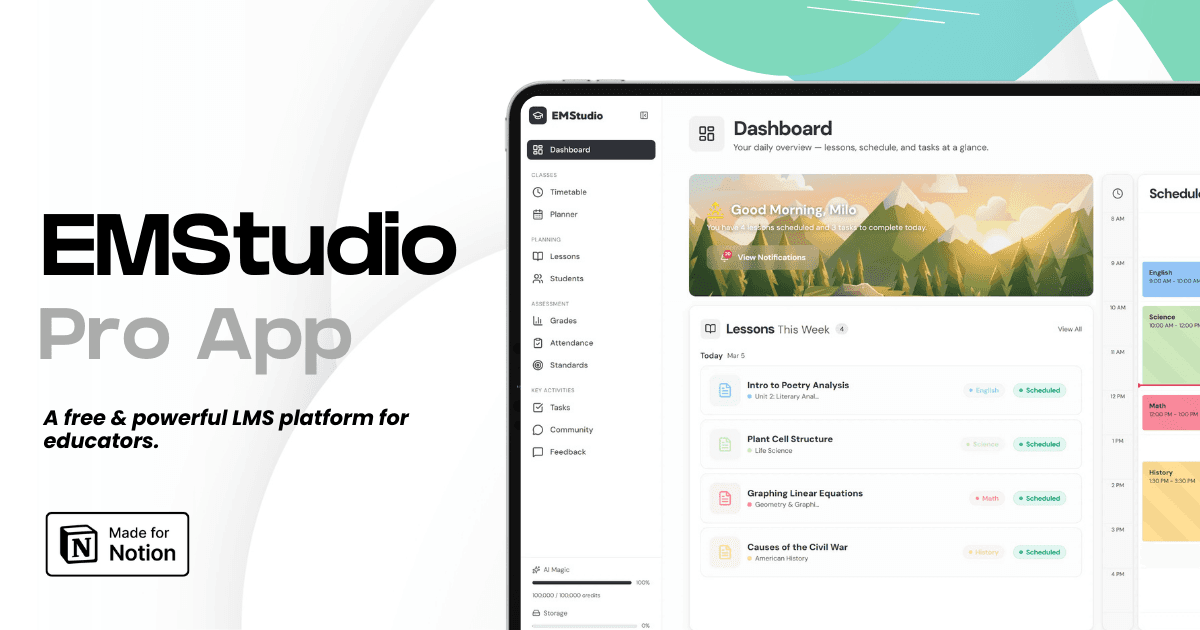
EMStudio is a free teaching management app — manage your classes, students, lessons, and more!
Learn More
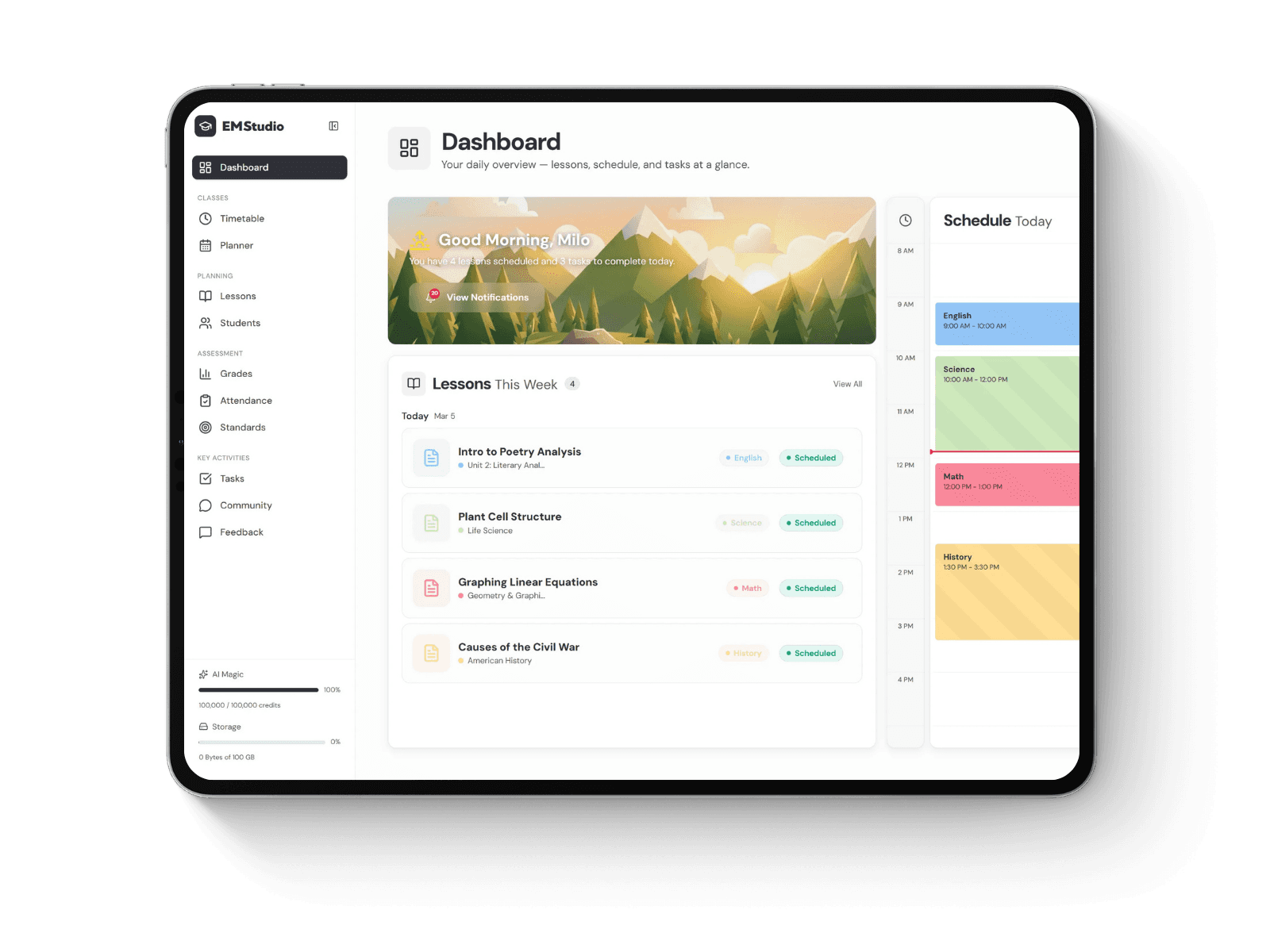
Still grading everything by hand?
EMStudio is a free teaching management app — manage your classes, students, lessons, and more!
Learn More
Table of Contents
What Are the Best Utopia Education Platforms for Innovation?
The best utopia education platforms for innovation include Edutopia for research-based PBL and SEL video strategies, Educator Innovator for connected learning networks and LRNG playlists, and Education 4 Equity for culturally responsive teaching toolkits. All offer free K-12 resources, differing in format from documentary evidence to interactive professional development modules.
These three platforms dominate the teacher collaboration field. Each serves specific instructional needs. Pick based on your immediate gap, not future goals.
Edutopia updates weekly with video documentaries. Educator Innovator releases quarterly playlists. Education 4 Equity refreshes toolkits annually. Edutopia covers K-12 broadly. Educator Innovator targets secondary grades. Education 4 Equity focuses on urban districts with high poverty rates.
Finding specific resources requires knowing the exact pathways:
Edutopia: Click "Schools That Work" for 6-8 minute documentaries or use the "Core Strategies" filter for PBL and SEL content.
Educator Innovator: Access the LRNG platform for building city-wide playlists or join the Thursday 7pm ET Twitter chat.
Education 4 Equity: Download toolkits from five specific categories for urban district equity work.
These platforms provide asynchronous resources only. They do not offer 1:1 coaching or real-time curriculum customization. If you need immediate troubleshooting for educational technology failures, look elsewhere. These tools support innovative teaching methods research, not emergency IT support.
Platform | Cost | Registration Requirements | Primary Evidence Base |
|---|---|---|---|
Edutopia | Free | None for content; email for newsletters | Case studies |
Educator Innovator | Free | Email for LRNG platform access | Research briefs |
Education 4 Equity | Free toolkits; $199-299 for certification | Email for downloads | District data |
Edutopia (George Lucas Educational Foundation)
The George Lucas Educational Foundation funds this platform entirely through grants. You pay nothing. You need no account to access articles or videos. Email registration only joins the newsletter list.
The "Schools That Work" series has 6-8 minute documentaries showing real classrooms. You watch teachers implement project-based learning or social-emotional learning in real time. Each video includes downloadable "Top Ten Tips" PDFs carrying Creative Commons licensing. Copy them freely into your professional learning communities or parent communication folders.
The "Evidence-Based Learning Strategies" section filters content by specific criteria. Select grade level bands (PreK-2, 3-5, 6-8, 9-12), subject areas, or strategies like Comprehensive Assessment. The site aligns all recommendations to Hattie's effect size research. New documentaries and articles publish weekly.
Educator Innovator
This National Writing Project initiative connects directly to the LRNG platform, now operated by Collective Shift. You create city-wide learning playlists spanning 2-4 weeks. Each playlist contains 5-7 connected activities linking classroom content with community resources like museums or libraries.
The annual Educator Innovator Summit offers free virtual attendance for all sessions. In-person attendance historically required $450-650 for registration and travel. The #EducatorInnovator Twitter chat meets every Thursday at 7pm ET, focusing specifically on connected learning and out-of-school educational opportunities.
The platform targets secondary educators serving grades 6-12 and informal learning coordinators. Use these tools to differentiate instruction for students needing flexible pathways outside traditional school hours. The framework emphasizes teacher collaboration across school and community organizational boundaries. For many students, these flexible pathways include a mix of community-based exploration and a reliable assignment service to ensure their core academic requirements remain on track while they engage in out-of-school learning.
Education 4 Equity
Education 4 Equity serves urban districts where over 50% of students qualify for free or reduced lunch. The platform organizes content into five downloadable toolkit categories:
Culturally Responsive Teaching
Restorative Practices
Trauma-Informed Practices
Anti-Racist Education
Equity Audits
The Equity Audit tool provides a comprehensive 20-page rubric for evaluating building-level discipline data, curriculum representation, and family engagement practices. Plan to spend 3-5 hours completing this audit with your leadership team. The E4E certification process offers 15-hour online modules costing $199-299 for individual educators.
Use these resources for instructional coaching focused on systemic equity transformation. The tools support implementing culturally responsive teaching across entire grade levels or buildings. Content updates arrive quarterly rather than weekly.

Which Utopia Education Communities Provide Essential Education Support?
Essential education support communities include We Are Educators for peer emotional support through social media, the National Education Association for legal protection and micro-credentials, and specialized coalitions like Teach Plus for policy advocacy. Select based on whether you need daily collaboration, contractual safeguards, or opportunities to influence district-level systemic change.
Join the wrong one and you pay for benefits you never use. Match your actual needs to what each community delivers.
We Are Educators costs nothing and hosts 180,000 members in a moderated Facebook group, but offers zero legal protection. National Education Association membership runs $200 to $800 annually depending on your state and includes $1-3 million professional liability insurance. Coalitions like Teach Plus accept only 20-30% of applicants but pay $1,000-1,500 stipends for fellowship work.
Your choice depends on your actual problem:
Choose We Are Educators when you need daily emotional support and lesson sharing.
Pick the NEA for contractual safeguards and micro-credentialing in culturally responsive teaching.
Select coalitions if you want to write policy briefs that reach the superintendent's desk.
Teachers often join the NEA for the resources, then never activate:
The free micro-credential stacks on classroom management or differentiated instruction.
The legal consultation hotline.
You must call within your first 30 days to establish your file.
John Hattie's research shows collective teacher efficacy carries an effect size of 1.57. Teachers participating in these professional learning communities for more than two hours weekly show measurably higher retention rates. The community building in education happens through consistent interaction, not passive membership.
We Are Educators
The Facebook group includes 180,000 members with strict moderation. No product sales. No administrator bashing. The Sunday Night Teacher Chat runs at 8pm EST weekly. The podcast drops 30-minute episodes featuring classroom teachers.
This is not a union. You get no legal representation. The group skews toward elementary and special education teachers. Moderators delete toxic positivity posts. You'll find virtual education strategies for support alongside educational technology debates.
Use this space when you need to vent about a lesson that bombed. The utopia education dream lives in the comments. Do not expect them to represent you in a contract dispute.
National Education Association Membership Resources
Your membership unlocks free micro-credential stacks that cost $75-125 elsewhere. Each requires 10-15 hours covering STEM integration, differentiated instruction, or cultural competency. The GPS Network forums connect you with teacher collaboration partners. The Members Only section hosts lesson databases aligned to CCSS and NGSS.
The liability insurance matters. You get $1-3 million in professional liability coverage for student injury or parent litigation. This activates immediately.
Dues range from $200 in right-to-work states to $800 in the Northeast. Some districts offer payroll deduction. The national education association membership pays for itself the first time you call the legal hotline about a questionable evaluation.
Education Support Coalitions and Alliances
Teach Plus offers a 60-hour policy fellowship paying $1,200. Educators for Excellence lets teachers write state policy recommendations. The Education Trust trains you in data analysis. These groups build your resume while you change systems.
Most require three years of experience and principal recommendations. Acceptance rates hover at 20-30% due to funding limits. You cannot just sign up.
Fellows spend 5-10 hours monthly on policy work. About 40% move into leadership within three years. This is education support for teachers planning to become principals or instructional coaches.

Top Utopia Education Tools for Personalized Student Learning
Adaptive platforms, virtual classrooms, and PBL repositories serve different needs within a utopia education framework. Setup ranges from one hour for repositories to eight-plus hours for adaptive systems requiring rostering and standards alignment. FERPA compliance certification is mandatory for all three. Verify signed privacy agreements before purchase. Grade-level suitability varies: primary students thrive with tactile PBL experiences while secondary learners need adaptive math pathways. Cost structures split between per-seat licensing at four to eight dollars monthly and site licenses running two thousand dollars annually.
Before committing, run a four-week pilot with support from your professional learning communities.
Week one: Establish baseline metrics using existing district data.
Week two: Deploy the educational technology to a ten-student test group while your instructional coaching team observes.
Week three: Capture student voice and document teacher collaboration through five-point Likert scale surveys.
Week four: Review data and make a go/no-go decision. You need ten percent improvement in your target metric to justify expansion.
Educate Me Adaptive Learning Platforms
These systems use AI-driven pathways that adjust difficulty in real-time following fifteen-minute diagnostic assessments, typically covering mathematics and literacy standards. You will need one-to-one device access or a two-to-one minimum, ten megabits per second bandwidth per student, and eight to twelve hours for initial setup including rostering and standards alignment. Expect four to six dollars per student monthly for site licenses, with Title I discounts of twenty to thirty percent available.
Imagine your seventh-grade mathematics class of twenty-eight students rotating through three twenty-minute stations. Group them heterogeneously by prior achievement—mixed ability levels keep peer tutoring active. While the platform handles differentiation automatically, you circulate for conferencing rather than direct instruction. Never launch during standardized testing windows; the diagnostic assessments interfere with state test prep and spike student anxiety unnecessarily.
Connection Education Virtual Classrooms
Synchronous virtual classrooms support breakout rooms optimally sized for six to eight students to maintain discussion quality. Features include infinite canvas whiteboarding and automatic session recording for absent students. Technical requirements demand five megabits per second upload and download for teachers, two for students, with mobile app compatibility for phone-only households.
Respect cognitive limits. Cap sessions at forty-five minutes for kindergarten through fifth grade, ninety minutes for sixth through twelfth. Insert mandatory five-minute movement breaks every twenty minutes to prevent screen fatigue. These structures honor attention spans while maintaining academic rigor through mastering differentiated instruction in remote settings.
Project-Based Learning Repositories
Three repositories dominate the market:
PBLWorks from the Buck Institute offers Gold Standard projects lasting two or six weeks.
Defined Learning provides career-connected performance tasks.
New Tech Network maintains libraries with built-in rubrics.
Compare these repositories by assessment type—analytic rubrics break down specific skills while holistic versions provide overall scores—and standards alignment depth, looking for NGSS three-dimensional integration versus surface-level CCSS coverage plus scaffolding for ELL students.
Access costs five hundred to fifteen hundred dollars per school annually for full libraries, with free limited trials offering three to five sample projects. These resources support culturally responsive teaching through authentic community connections. For implementation strategies, consult our project-based learning implementation guide.

Utopia Education Networks for Professional Development
Utopia education networks vary wildly in cost and time commitment. Global exchanges run $3,500 to $5,000 including travel and demand a two-week summer commitment. Social justice networks cost nothing to $400 with five to ten hour asynchronous modules. Tech professional learning communities (PLCs) are free and eat two hours monthly.
Pick your path strategically. Choose global exchanges to build cross-cultural curriculum units. Select social justice networks when your school shows achievement gaps wider than fifteen percentage points. Join tech PLCs when implementing new one-to-one device initiatives.
John Hattie's research shows PD fails when you chase certificate hours without collaborative implementation. Require evidence you used the strategies within thirty days. Global programs need district release approval for international travel; PLCs need principal support for meeting coverage.
Global Education Exchange Programs
Fulbright Teacher Exchanges send you overseas for six months on a reciprocal swap, requiring three years classroom experience, US citizenship, and district release approval secured months ahead. iEARN runs online collaborative projects across 140 countries for $100 to $200 yearly membership. VIF International Education, now called Participate Learning, offers shorter cultural immersion programs when you cannot leave your students for half a year.
Three primary options dominate this space:
Fulbright Teacher Exchanges: Six-month reciprocal placements requiring three years experience, US citizenship, and district release approval.
iEARN: Online project exchanges across 140 countries with $100-$200 yearly membership fees.
VIF International Education (now Participate Learning): Shorter cultural immersion programs for teachers who cannot commit to semester-long travel.
Fulbright needs a bachelor's degree, clean disciplinary record, and signed administrative support letter promising job protection. Acceptance hovers around fifteen percent. Apply in January for the following academic year.
Participants must create ten to fifteen lesson plans incorporating Asia Society global competence standards within six months of return. Your curriculum coordinator reviews these for alignment with state frameworks. These exchanges constitute serious career development opportunities for educators seeking to build culturally responsive teaching skills that transfer directly to diverse classrooms.
Social Justice Education Networks
Learning for Justice, formerly Teaching Tolerance, offers free ninety-minute webinars like 'Teaching Hard History' and 'Let's Talk' that include certificates for your license renewal. The Zinn Education Project provides people's history resources that supplement standard textbooks without requiring full curriculum rewrites. Facing History and Ourselves runs twelve-hour professional learning sequences on Holocaust and human rights education.
These networks address systemic racism, LGBTQ+ inclusion, and economic inequality with grade-specific case studies:
Elementary teachers receive concrete strategies for interrupting biased language on the playground.
Secondary teachers analyze redlining history and housing discrimination using primary source documents.
Materials target specific grade bands rather than generic K-12 approaches.
Teachers completing eight-plus hours of this focused PD report twenty to thirty percent higher student civic engagement than peers attending general differentiated instruction workshops. You must apply these frameworks to actual classroom discussions within thirty days, not just file the certificate.
Technology Integration Professional Learning Communities
ISTE Professional Learning Networks offer twenty-plus special interest groups including Teacher Education and STEM. Edcamp unconferences are free, locally organized Saturday events following the 'rule of two feet'—leave any session that does not serve your needs. Google and Microsoft certified trainer communities provide structured teacher collaboration around specific educational technology tools your district actually purchased.
ISTE PLNs meet monthly via Zoom with asynchronous Slack channels for troubleshooting when your smartboard fails. Edcamps run Saturdays eight to one, with session boards built collaboratively at eight-thirty based on who shows up and what they need that morning. No canned presentations or forced seating.
Google Certified Trainer certification requires:
Twelve hours of approved training modules.
A fifteen-dollar exam fee.
Renewal every three years to maintain access to beta testing and direct developer feedback channels.
This beats sitting through generic instructional coaching sessions that ignore your specific one-to-one device setup and software constraints.
How to Choose the Right Utopia Education Resources for Your Classroom?
Choose utopia education resources by first identifying your primary classroom need—student engagement, skill remediation, or professional growth—then auditing your available technology, budget under $500 or over, and prep time. Pilot with 10 students for four weeks before full implementation, measuring both usage data and student outcome changes to ensure the resource fits your specific context.
Start with brutal honesty about your constraints. Last year I watched a colleague fall in love with a VR-based history platform only to discover our building had six headsets for 400 students. Before browsing features, list your non-negotiables: one-to-one device access or shared cart, annual software budget caps, and weekly prep time available for educational technology integration.
Your needs assessment determines everything. Platforms promising high engagement through gamification require different infrastructure than those supporting differentiated instruction for diverse learners. Be specific about whether you need remediation for struggling readers or enrichment for advanced mathematicians. The same tool rarely serves both extremes well without significant customization that eats your planning time.
Run your selection through this four-step filter:
Define the primary need. Are you addressing engagement gaps, specific skill remediation, or building professional learning communities? Each requires different platform architectures.
Audit available resources. Catalog your tech reality (1:1 Chromebooks vs. weekly computer lab access), budget tier ($0, under $500, or district-level funding), and time investment (two hours weekly vs. ten hours for full differentiated instruction redesign).
Match to platform category. Drill-and-practice tools suit skill gaps. Collaboration platforms support teacher collaboration and instructional coaching. Immersive environments demand high engagement but heavy tech requirements.
Execute the 4-week pilot. Select ten students representing your full demographic range. Track usage logs and assessment deltas alongside qualitative feedback.
Watch for these red flags before committing:
The platform requires hardware unavailable in your building, such as VR headsets or high-end tablets.
It lacks WCAG 2.1 accessibility compliance, blocking students with IEPs or 504 plans from full participation.
Essential has vanish behind paywalls after the free trial expires, forcing budget surprises mid-year.
No peer-reviewed efficacy studies exist from the last five years, especially for platforms claiming culturally responsive teaching alignment.
Accessibility failures kill implementation fast. I once trialed a writing platform that looked perfect for my 7th graders until three students with visual impairments could not access the text-to-speech functions. Test with your most vulnerable learners first, not your tech-savvy early adopters. If it fails them, it fails your classroom.
Structure your pilot implementation with military precision. Days 1 through 7 focus on technical setup and baseline data collection—pre-assessments and engagement surveys. Days 8 through 21 mark active implementation with your ten-student cohort, requiring daily check-ins but minimal interference. Days 22 through 28 distribute stakeholder surveys using five-point Likert scales to students, parents, and support staff. On day 30, apply your decision matrix: continue only if satisfaction ratings exceed 70 percent and you see measurable outcome improvement against your baseline.
Document everything during the pilot. Screenshot error messages when the platform crashes. Record time spent troubleshooting versus time spent teaching. These logs become leverage during contract negotiations or cancellation discussions with administrators who pushed the purchase.
Never sign multi-year contracts during the pilot phase. I learned this after being stuck with a literacy program that worked beautifully in September but crashed every Friday afternoon by November. Negotiate month-to-month terms for the first semester. This protects you when student demographics shift or when the platform updates break compatibility with your specific hardware.
Budget surprises derail programs. Calculate total cost of ownership including professional development hours, IT support time, and replacement hardware needs. A $200 subscription becomes $2000 quickly if it requires new headphones or tablets to function properly.
The right resource should feel like choosing the right teacher planner—intuitive enough for daily use, flexible enough for your teaching style, and robust enough to survive a full academic year. Your utopia education solution exists, but only you can determine whether it fits your actual classroom, not the idealized version in the sales demo.

What's Next for Utopia Education
Utopia education is moving fast. The platforms that felt cutting-edge last September now share space with AI tutors and micro-learning apps that adapt in real time. Your students already expect differentiated instruction that shifts to match their pace, and the communities you join tomorrow will run on shared playlists of classroom-tested strategies rather than static forums. The gap between early adopters and everyone else is shrinking because these tools are finally getting easier to implement.
Stay ahead by staying small. Pick one tool from this list and use it with one unit next month. Join one professional learning community and post a single win or failure. Utopia education works best when you test it in the wild with actual kids, not during a summer workshop. The teachers who thrive next year won't be the ones who mastered every platform; they'll be the ones who found two or three resources that actually stick.
The resources that survive will be the ones teachers use between bells. Watch for tools that cut your grading time in half or connect you with educators solving the same problems. That's where utopia education is heading—less hype, more help.

What Are the Best Utopia Education Platforms for Innovation?
The best utopia education platforms for innovation include Edutopia for research-based PBL and SEL video strategies, Educator Innovator for connected learning networks and LRNG playlists, and Education 4 Equity for culturally responsive teaching toolkits. All offer free K-12 resources, differing in format from documentary evidence to interactive professional development modules.
These three platforms dominate the teacher collaboration field. Each serves specific instructional needs. Pick based on your immediate gap, not future goals.
Edutopia updates weekly with video documentaries. Educator Innovator releases quarterly playlists. Education 4 Equity refreshes toolkits annually. Edutopia covers K-12 broadly. Educator Innovator targets secondary grades. Education 4 Equity focuses on urban districts with high poverty rates.
Finding specific resources requires knowing the exact pathways:
Edutopia: Click "Schools That Work" for 6-8 minute documentaries or use the "Core Strategies" filter for PBL and SEL content.
Educator Innovator: Access the LRNG platform for building city-wide playlists or join the Thursday 7pm ET Twitter chat.
Education 4 Equity: Download toolkits from five specific categories for urban district equity work.
These platforms provide asynchronous resources only. They do not offer 1:1 coaching or real-time curriculum customization. If you need immediate troubleshooting for educational technology failures, look elsewhere. These tools support innovative teaching methods research, not emergency IT support.
Platform | Cost | Registration Requirements | Primary Evidence Base |
|---|---|---|---|
Edutopia | Free | None for content; email for newsletters | Case studies |
Educator Innovator | Free | Email for LRNG platform access | Research briefs |
Education 4 Equity | Free toolkits; $199-299 for certification | Email for downloads | District data |
Edutopia (George Lucas Educational Foundation)
The George Lucas Educational Foundation funds this platform entirely through grants. You pay nothing. You need no account to access articles or videos. Email registration only joins the newsletter list.
The "Schools That Work" series has 6-8 minute documentaries showing real classrooms. You watch teachers implement project-based learning or social-emotional learning in real time. Each video includes downloadable "Top Ten Tips" PDFs carrying Creative Commons licensing. Copy them freely into your professional learning communities or parent communication folders.
The "Evidence-Based Learning Strategies" section filters content by specific criteria. Select grade level bands (PreK-2, 3-5, 6-8, 9-12), subject areas, or strategies like Comprehensive Assessment. The site aligns all recommendations to Hattie's effect size research. New documentaries and articles publish weekly.
Educator Innovator
This National Writing Project initiative connects directly to the LRNG platform, now operated by Collective Shift. You create city-wide learning playlists spanning 2-4 weeks. Each playlist contains 5-7 connected activities linking classroom content with community resources like museums or libraries.
The annual Educator Innovator Summit offers free virtual attendance for all sessions. In-person attendance historically required $450-650 for registration and travel. The #EducatorInnovator Twitter chat meets every Thursday at 7pm ET, focusing specifically on connected learning and out-of-school educational opportunities.
The platform targets secondary educators serving grades 6-12 and informal learning coordinators. Use these tools to differentiate instruction for students needing flexible pathways outside traditional school hours. The framework emphasizes teacher collaboration across school and community organizational boundaries. For many students, these flexible pathways include a mix of community-based exploration and a reliable assignment service to ensure their core academic requirements remain on track while they engage in out-of-school learning.
Education 4 Equity
Education 4 Equity serves urban districts where over 50% of students qualify for free or reduced lunch. The platform organizes content into five downloadable toolkit categories:
Culturally Responsive Teaching
Restorative Practices
Trauma-Informed Practices
Anti-Racist Education
Equity Audits
The Equity Audit tool provides a comprehensive 20-page rubric for evaluating building-level discipline data, curriculum representation, and family engagement practices. Plan to spend 3-5 hours completing this audit with your leadership team. The E4E certification process offers 15-hour online modules costing $199-299 for individual educators.
Use these resources for instructional coaching focused on systemic equity transformation. The tools support implementing culturally responsive teaching across entire grade levels or buildings. Content updates arrive quarterly rather than weekly.
Which Utopia Education Communities Provide Essential Education Support?
Essential education support communities include We Are Educators for peer emotional support through social media, the National Education Association for legal protection and micro-credentials, and specialized coalitions like Teach Plus for policy advocacy. Select based on whether you need daily collaboration, contractual safeguards, or opportunities to influence district-level systemic change.
Join the wrong one and you pay for benefits you never use. Match your actual needs to what each community delivers.
We Are Educators costs nothing and hosts 180,000 members in a moderated Facebook group, but offers zero legal protection. National Education Association membership runs $200 to $800 annually depending on your state and includes $1-3 million professional liability insurance. Coalitions like Teach Plus accept only 20-30% of applicants but pay $1,000-1,500 stipends for fellowship work.
Your choice depends on your actual problem:
Choose We Are Educators when you need daily emotional support and lesson sharing.
Pick the NEA for contractual safeguards and micro-credentialing in culturally responsive teaching.
Select coalitions if you want to write policy briefs that reach the superintendent's desk.
Teachers often join the NEA for the resources, then never activate:
The free micro-credential stacks on classroom management or differentiated instruction.
The legal consultation hotline.
You must call within your first 30 days to establish your file.
John Hattie's research shows collective teacher efficacy carries an effect size of 1.57. Teachers participating in these professional learning communities for more than two hours weekly show measurably higher retention rates. The community building in education happens through consistent interaction, not passive membership.
We Are Educators
The Facebook group includes 180,000 members with strict moderation. No product sales. No administrator bashing. The Sunday Night Teacher Chat runs at 8pm EST weekly. The podcast drops 30-minute episodes featuring classroom teachers.
This is not a union. You get no legal representation. The group skews toward elementary and special education teachers. Moderators delete toxic positivity posts. You'll find virtual education strategies for support alongside educational technology debates.
Use this space when you need to vent about a lesson that bombed. The utopia education dream lives in the comments. Do not expect them to represent you in a contract dispute.
National Education Association Membership Resources
Your membership unlocks free micro-credential stacks that cost $75-125 elsewhere. Each requires 10-15 hours covering STEM integration, differentiated instruction, or cultural competency. The GPS Network forums connect you with teacher collaboration partners. The Members Only section hosts lesson databases aligned to CCSS and NGSS.
The liability insurance matters. You get $1-3 million in professional liability coverage for student injury or parent litigation. This activates immediately.
Dues range from $200 in right-to-work states to $800 in the Northeast. Some districts offer payroll deduction. The national education association membership pays for itself the first time you call the legal hotline about a questionable evaluation.
Education Support Coalitions and Alliances
Teach Plus offers a 60-hour policy fellowship paying $1,200. Educators for Excellence lets teachers write state policy recommendations. The Education Trust trains you in data analysis. These groups build your resume while you change systems.
Most require three years of experience and principal recommendations. Acceptance rates hover at 20-30% due to funding limits. You cannot just sign up.
Fellows spend 5-10 hours monthly on policy work. About 40% move into leadership within three years. This is education support for teachers planning to become principals or instructional coaches.
Top Utopia Education Tools for Personalized Student Learning
Adaptive platforms, virtual classrooms, and PBL repositories serve different needs within a utopia education framework. Setup ranges from one hour for repositories to eight-plus hours for adaptive systems requiring rostering and standards alignment. FERPA compliance certification is mandatory for all three. Verify signed privacy agreements before purchase. Grade-level suitability varies: primary students thrive with tactile PBL experiences while secondary learners need adaptive math pathways. Cost structures split between per-seat licensing at four to eight dollars monthly and site licenses running two thousand dollars annually.
Before committing, run a four-week pilot with support from your professional learning communities.
Week one: Establish baseline metrics using existing district data.
Week two: Deploy the educational technology to a ten-student test group while your instructional coaching team observes.
Week three: Capture student voice and document teacher collaboration through five-point Likert scale surveys.
Week four: Review data and make a go/no-go decision. You need ten percent improvement in your target metric to justify expansion.
Educate Me Adaptive Learning Platforms
These systems use AI-driven pathways that adjust difficulty in real-time following fifteen-minute diagnostic assessments, typically covering mathematics and literacy standards. You will need one-to-one device access or a two-to-one minimum, ten megabits per second bandwidth per student, and eight to twelve hours for initial setup including rostering and standards alignment. Expect four to six dollars per student monthly for site licenses, with Title I discounts of twenty to thirty percent available.
Imagine your seventh-grade mathematics class of twenty-eight students rotating through three twenty-minute stations. Group them heterogeneously by prior achievement—mixed ability levels keep peer tutoring active. While the platform handles differentiation automatically, you circulate for conferencing rather than direct instruction. Never launch during standardized testing windows; the diagnostic assessments interfere with state test prep and spike student anxiety unnecessarily.
Connection Education Virtual Classrooms
Synchronous virtual classrooms support breakout rooms optimally sized for six to eight students to maintain discussion quality. Features include infinite canvas whiteboarding and automatic session recording for absent students. Technical requirements demand five megabits per second upload and download for teachers, two for students, with mobile app compatibility for phone-only households.
Respect cognitive limits. Cap sessions at forty-five minutes for kindergarten through fifth grade, ninety minutes for sixth through twelfth. Insert mandatory five-minute movement breaks every twenty minutes to prevent screen fatigue. These structures honor attention spans while maintaining academic rigor through mastering differentiated instruction in remote settings.
Project-Based Learning Repositories
Three repositories dominate the market:
PBLWorks from the Buck Institute offers Gold Standard projects lasting two or six weeks.
Defined Learning provides career-connected performance tasks.
New Tech Network maintains libraries with built-in rubrics.
Compare these repositories by assessment type—analytic rubrics break down specific skills while holistic versions provide overall scores—and standards alignment depth, looking for NGSS three-dimensional integration versus surface-level CCSS coverage plus scaffolding for ELL students.
Access costs five hundred to fifteen hundred dollars per school annually for full libraries, with free limited trials offering three to five sample projects. These resources support culturally responsive teaching through authentic community connections. For implementation strategies, consult our project-based learning implementation guide.
Utopia Education Networks for Professional Development
Utopia education networks vary wildly in cost and time commitment. Global exchanges run $3,500 to $5,000 including travel and demand a two-week summer commitment. Social justice networks cost nothing to $400 with five to ten hour asynchronous modules. Tech professional learning communities (PLCs) are free and eat two hours monthly.
Pick your path strategically. Choose global exchanges to build cross-cultural curriculum units. Select social justice networks when your school shows achievement gaps wider than fifteen percentage points. Join tech PLCs when implementing new one-to-one device initiatives.
John Hattie's research shows PD fails when you chase certificate hours without collaborative implementation. Require evidence you used the strategies within thirty days. Global programs need district release approval for international travel; PLCs need principal support for meeting coverage.
Global Education Exchange Programs
Fulbright Teacher Exchanges send you overseas for six months on a reciprocal swap, requiring three years classroom experience, US citizenship, and district release approval secured months ahead. iEARN runs online collaborative projects across 140 countries for $100 to $200 yearly membership. VIF International Education, now called Participate Learning, offers shorter cultural immersion programs when you cannot leave your students for half a year.
Three primary options dominate this space:
Fulbright Teacher Exchanges: Six-month reciprocal placements requiring three years experience, US citizenship, and district release approval.
iEARN: Online project exchanges across 140 countries with $100-$200 yearly membership fees.
VIF International Education (now Participate Learning): Shorter cultural immersion programs for teachers who cannot commit to semester-long travel.
Fulbright needs a bachelor's degree, clean disciplinary record, and signed administrative support letter promising job protection. Acceptance hovers around fifteen percent. Apply in January for the following academic year.
Participants must create ten to fifteen lesson plans incorporating Asia Society global competence standards within six months of return. Your curriculum coordinator reviews these for alignment with state frameworks. These exchanges constitute serious career development opportunities for educators seeking to build culturally responsive teaching skills that transfer directly to diverse classrooms.
Social Justice Education Networks
Learning for Justice, formerly Teaching Tolerance, offers free ninety-minute webinars like 'Teaching Hard History' and 'Let's Talk' that include certificates for your license renewal. The Zinn Education Project provides people's history resources that supplement standard textbooks without requiring full curriculum rewrites. Facing History and Ourselves runs twelve-hour professional learning sequences on Holocaust and human rights education.
These networks address systemic racism, LGBTQ+ inclusion, and economic inequality with grade-specific case studies:
Elementary teachers receive concrete strategies for interrupting biased language on the playground.
Secondary teachers analyze redlining history and housing discrimination using primary source documents.
Materials target specific grade bands rather than generic K-12 approaches.
Teachers completing eight-plus hours of this focused PD report twenty to thirty percent higher student civic engagement than peers attending general differentiated instruction workshops. You must apply these frameworks to actual classroom discussions within thirty days, not just file the certificate.
Technology Integration Professional Learning Communities
ISTE Professional Learning Networks offer twenty-plus special interest groups including Teacher Education and STEM. Edcamp unconferences are free, locally organized Saturday events following the 'rule of two feet'—leave any session that does not serve your needs. Google and Microsoft certified trainer communities provide structured teacher collaboration around specific educational technology tools your district actually purchased.
ISTE PLNs meet monthly via Zoom with asynchronous Slack channels for troubleshooting when your smartboard fails. Edcamps run Saturdays eight to one, with session boards built collaboratively at eight-thirty based on who shows up and what they need that morning. No canned presentations or forced seating.
Google Certified Trainer certification requires:
Twelve hours of approved training modules.
A fifteen-dollar exam fee.
Renewal every three years to maintain access to beta testing and direct developer feedback channels.
This beats sitting through generic instructional coaching sessions that ignore your specific one-to-one device setup and software constraints.
How to Choose the Right Utopia Education Resources for Your Classroom?
Choose utopia education resources by first identifying your primary classroom need—student engagement, skill remediation, or professional growth—then auditing your available technology, budget under $500 or over, and prep time. Pilot with 10 students for four weeks before full implementation, measuring both usage data and student outcome changes to ensure the resource fits your specific context.
Start with brutal honesty about your constraints. Last year I watched a colleague fall in love with a VR-based history platform only to discover our building had six headsets for 400 students. Before browsing features, list your non-negotiables: one-to-one device access or shared cart, annual software budget caps, and weekly prep time available for educational technology integration.
Your needs assessment determines everything. Platforms promising high engagement through gamification require different infrastructure than those supporting differentiated instruction for diverse learners. Be specific about whether you need remediation for struggling readers or enrichment for advanced mathematicians. The same tool rarely serves both extremes well without significant customization that eats your planning time.
Run your selection through this four-step filter:
Define the primary need. Are you addressing engagement gaps, specific skill remediation, or building professional learning communities? Each requires different platform architectures.
Audit available resources. Catalog your tech reality (1:1 Chromebooks vs. weekly computer lab access), budget tier ($0, under $500, or district-level funding), and time investment (two hours weekly vs. ten hours for full differentiated instruction redesign).
Match to platform category. Drill-and-practice tools suit skill gaps. Collaboration platforms support teacher collaboration and instructional coaching. Immersive environments demand high engagement but heavy tech requirements.
Execute the 4-week pilot. Select ten students representing your full demographic range. Track usage logs and assessment deltas alongside qualitative feedback.
Watch for these red flags before committing:
The platform requires hardware unavailable in your building, such as VR headsets or high-end tablets.
It lacks WCAG 2.1 accessibility compliance, blocking students with IEPs or 504 plans from full participation.
Essential has vanish behind paywalls after the free trial expires, forcing budget surprises mid-year.
No peer-reviewed efficacy studies exist from the last five years, especially for platforms claiming culturally responsive teaching alignment.
Accessibility failures kill implementation fast. I once trialed a writing platform that looked perfect for my 7th graders until three students with visual impairments could not access the text-to-speech functions. Test with your most vulnerable learners first, not your tech-savvy early adopters. If it fails them, it fails your classroom.
Structure your pilot implementation with military precision. Days 1 through 7 focus on technical setup and baseline data collection—pre-assessments and engagement surveys. Days 8 through 21 mark active implementation with your ten-student cohort, requiring daily check-ins but minimal interference. Days 22 through 28 distribute stakeholder surveys using five-point Likert scales to students, parents, and support staff. On day 30, apply your decision matrix: continue only if satisfaction ratings exceed 70 percent and you see measurable outcome improvement against your baseline.
Document everything during the pilot. Screenshot error messages when the platform crashes. Record time spent troubleshooting versus time spent teaching. These logs become leverage during contract negotiations or cancellation discussions with administrators who pushed the purchase.
Never sign multi-year contracts during the pilot phase. I learned this after being stuck with a literacy program that worked beautifully in September but crashed every Friday afternoon by November. Negotiate month-to-month terms for the first semester. This protects you when student demographics shift or when the platform updates break compatibility with your specific hardware.
Budget surprises derail programs. Calculate total cost of ownership including professional development hours, IT support time, and replacement hardware needs. A $200 subscription becomes $2000 quickly if it requires new headphones or tablets to function properly.
The right resource should feel like choosing the right teacher planner—intuitive enough for daily use, flexible enough for your teaching style, and robust enough to survive a full academic year. Your utopia education solution exists, but only you can determine whether it fits your actual classroom, not the idealized version in the sales demo.
What's Next for Utopia Education
Utopia education is moving fast. The platforms that felt cutting-edge last September now share space with AI tutors and micro-learning apps that adapt in real time. Your students already expect differentiated instruction that shifts to match their pace, and the communities you join tomorrow will run on shared playlists of classroom-tested strategies rather than static forums. The gap between early adopters and everyone else is shrinking because these tools are finally getting easier to implement.
Stay ahead by staying small. Pick one tool from this list and use it with one unit next month. Join one professional learning community and post a single win or failure. Utopia education works best when you test it in the wild with actual kids, not during a summer workshop. The teachers who thrive next year won't be the ones who mastered every platform; they'll be the ones who found two or three resources that actually stick.
The resources that survive will be the ones teachers use between bells. Watch for tools that cut your grading time in half or connect you with educators solving the same problems. That's where utopia education is heading—less hype, more help.
Still grading everything by hand?
EMStudio is a free teaching management app — manage your classes, students, lessons, and more!
Learn More
Still grading everything by hand?
EMStudio is a free teaching management app — manage your classes, students, lessons, and more!
Learn More



Notion4Teachers
Notion templates to simplify administrative tasks and enhance your teaching experience.



2026 Notion4Teachers. All Rights Reserved.
Notion4Teachers
Notion templates to simplify administrative tasks and enhance your teaching experience.
2026 Notion4Teachers. All Rights Reserved.
Notion4Teachers
Notion templates to simplify administrative tasks and enhance your teaching experience.
2026 Notion4Teachers. All Rights Reserved.