Using five-minute word chains as a zero-prep classroom bell-ringer

Every teacher knows how fragile the first five minutes of a lesson can be. Students trickle in at different speeds, notebooks are still buried in backpacks, and trying to jump straight into a heavy reading passage or grammar worksheet before the room settles usually means repeating the instructions three times.
The best bell-ringers solve that transition cleanly. They need zero logins, zero device headaches, clear visual structure on a projector or whiteboard, and enough layered difficulty that early finishers stay engaged while quieter learners still grab an early win.
Compound word chains fit all four criteria remarkably well. Whether you teach upper-elementary literacy, middle-school ELA, or adult ESL classes, putting a single five-to-seven-word chain on the board wakes up vocabulary recall, morphology awareness, and collaborative reasoning in less than five minutes.
Still grading everything by hand?
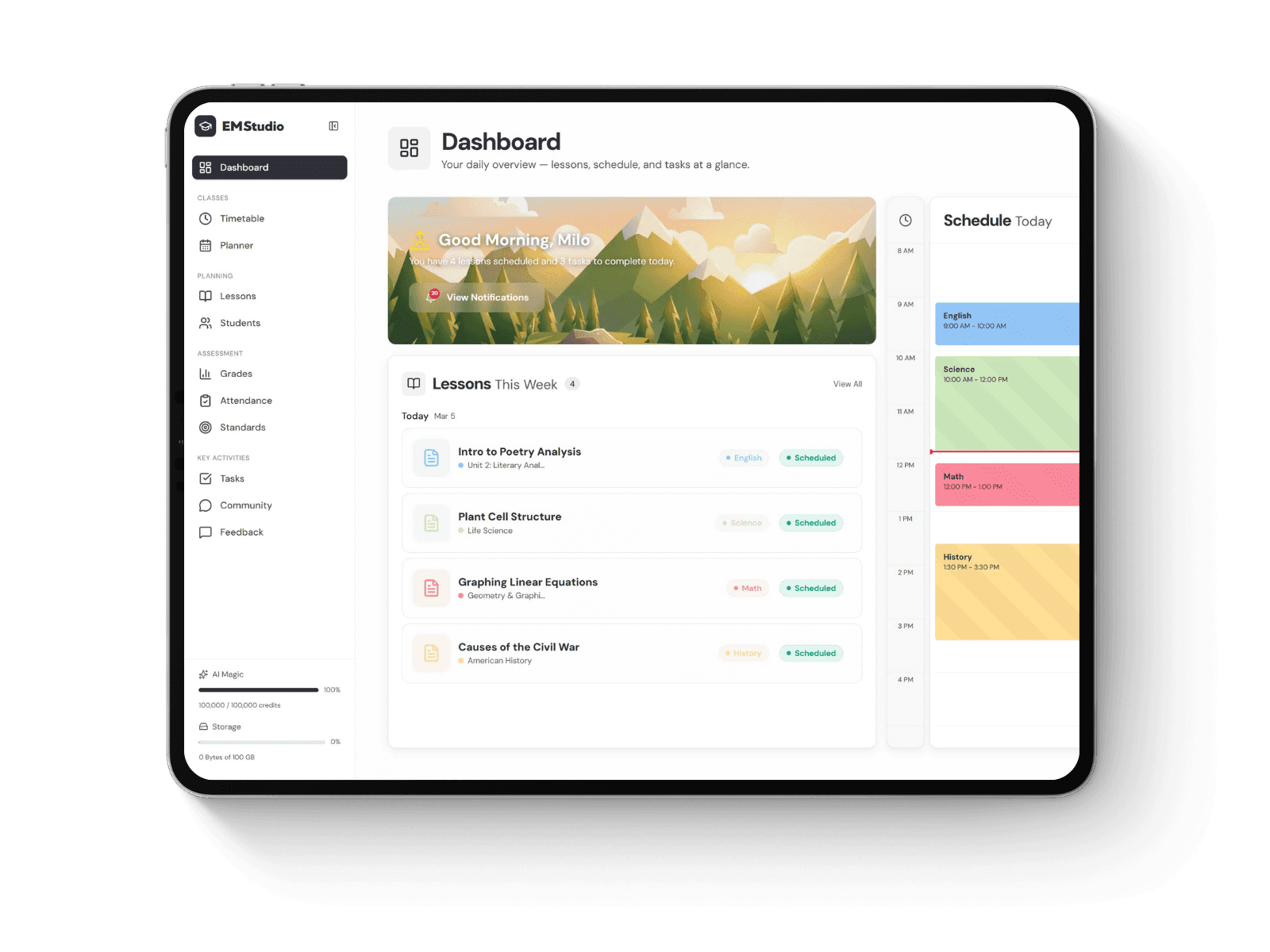
EMStudio is a free teaching management app — manage your classes, students, lessons, and more!
How a classroom word chain works on the board
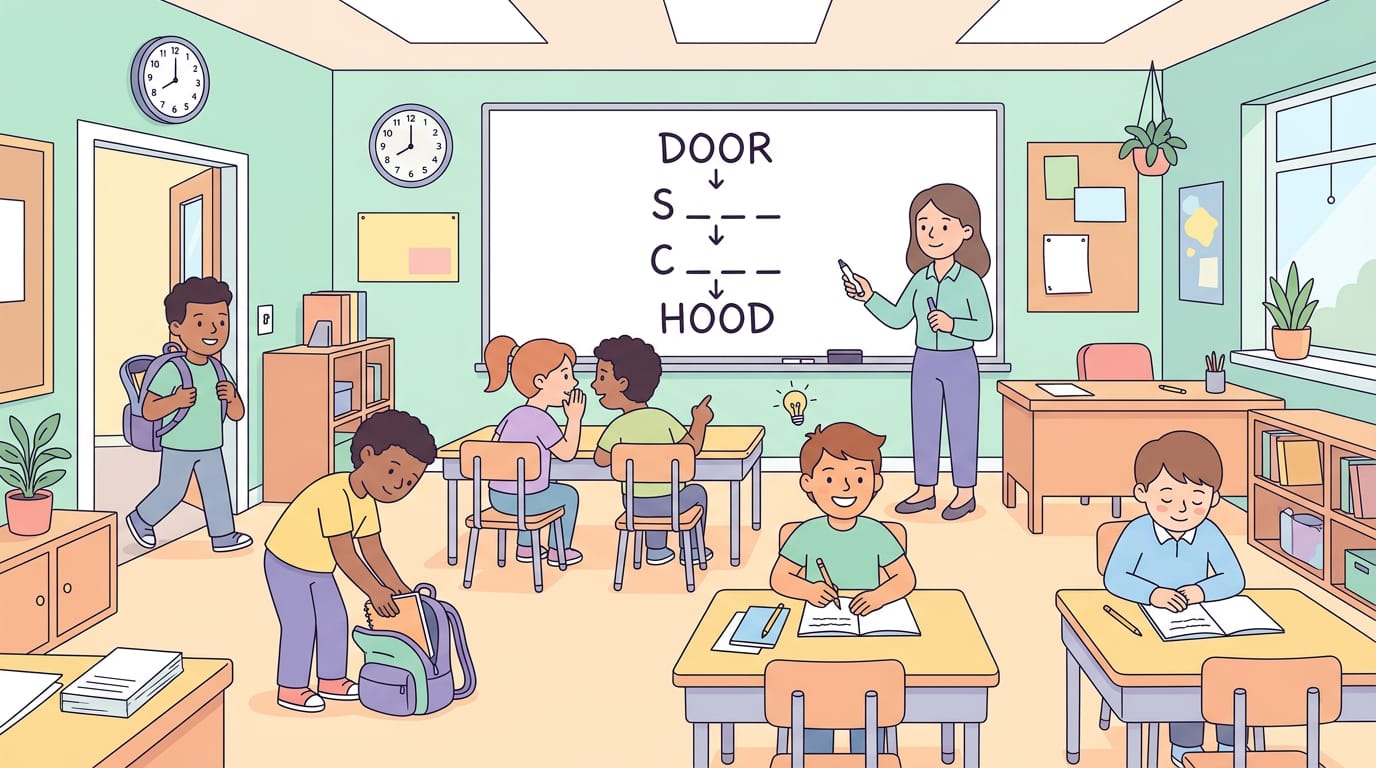
Write a starting word at the top, an ending word at the bottom, and the opening letter of each hidden bridge word down the middle. Every adjacent pair must form a familiar closed compound word or everyday English phrase.
Here is a four-word warm-up you can put on any whiteboard tomorrow morning:
DOOR
S _ _ _
C _ _ _ _
HOOD
Students test compounds starting with DOOR and beginning with S (doorstep), carry STEP forward into C (stepchild), and confirm that CHILD connects cleanly into HOOD (childhood).
A quick three-word starter works even for younger grades: SNOW -> B _ _ _ -> R _ _ _ resolves immediately to SNOW -> BALL -> ROOM (snowball, ballroom).
Because every link relies on real-world phrases like raincoat, toothbrush, sunflower, bathtub, and bow tie rather than obscure spelling-bee vocabulary, struggling readers and English language learners participate on equal footing with stronger spellers.
Why teachers like the morphology payoff
Beyond settling the room, compound word chains reinforce several core literacy skills without looking like a drill sheet:
Structural word analysis. Students practice splitting and recombining familiar root words, noticing how meaning shifts when a base word moves from the end of one compound to the front of the next.
Collocation awareness for ESL learners. Non-native speakers often memorize individual nouns long before they internalize natural pairings. Seeing how everyday words lock together builds idiomatic fluency far better than isolated flashcard lists.
Bidirectional problem-solving. When clue number two feels ambiguous, students learn to skip downward, work backward from the final anchor, and narrow down the middle links by logic.
Low-stakes oral participation. Calling out candidate pairs ("Could it be snowstorm? No, storm doesn't fit R...") normalizes testing hypotheses out loud and revising quickly when evidence says otherwise.
Free classroom-ready tools with zero student logins
Many teachers hesitate to project free web games in class because ad banners, pop-ups, or unmoderated dictionary entries can derail a lesson instantly. Word Chain Games avoids those pitfalls: it is completely free, displays no ads, requires no student accounts, and runs on a hand-checked bank of 5,478 pairs specifically audited to exclude mature content and obscure UK-only slang.
Three specific pages on the site map directly onto real teaching workflows:
1. Ready-to-print packets for sub plans and literacy centers
When you need quick material for early finishers, substitute teacher folders, or small-group stations, pulling from a tested library of word chain game examples saves hours of drafting. The page organizes 60 complete chains ranging from five to ten words across Easy, Medium, and Hard tiers, with expandable answer keys online and a clean printable PDF you can photocopy straight out of the browser.
2. Custom chains tailored to your weekly unit
Sometimes you want a warm-up built around seasonal themes, read-aloud vocabulary, or specific root words your class studied yesterday. Using a browser-based word chain generator, you can assemble custom chains, edit individual links, find valid routes between two chosen words, and print or share the finished puzzle with a link in under two minutes.
3. Quick compound practice for stations and ESL pairs
For younger learners or ELL students who benefit from focusing purely on pairing two root words together before tackling longer seven-word ladders, the site's compound word game isolates the core pairing mechanic in short, repeatable rounds. Alongside it, teachers can rotate in Last Letter Game, Word Association, or English Shiritori on Fridays to keep vocabulary review fresh.
Five practical ways to run word chains in class
If you want to slot word chains into your weekly routine without losing instructional time, try rotating these formats:
Silent Entry, Partner Check (3 minutes). Project a five-word chain as students walk in. Give ninety seconds of quiet solo thinking on scrap paper or mini whiteboards, then sixty seconds to compare answers with a desk partner before revealing the solution together.
One-Letter Lifeline. If the entire class stalls on row four, reveal only the second letter of that word rather than giving away the answer. Watching half the hands shoot up after one extra letter creates great classroom energy.
Top-Down vs. Bottom-Up Teams. Split the room in half on a seven-word chain. One side proposes the next step down from the top anchor while the other works upward from the bottom anchor until both teams meet in the middle.
Student-Authored Exit Tickets. Spend the last four minutes of a Friday lesson asking pairs to invent their own four-word compound chain on an index card and test whether another pair can solve it. Checking whether each adjacent pair is a genuine everyday phrase turns into a lively mini-debate about how English works.
Printable Early-Finisher Binder. Print the 60-chain PDF packet, slip pages into dry-erase sleeves, and keep them in a calm corner bin alongside fine-tip markers. Students who finish an assessment early grab a sleeve instead of distracting neighbors.
Fitting it into a sustainable weekly system
Teachers who keep digital planners or Notion lesson hubs often build a small bank of reusable five-minute openers so Monday morning never starts with frantic searching. Saving a link to the daily chain (which refreshes once every 24 hours at 00:00 UTC), bookmarking the printable examples pack, and keeping one or two custom unit chains ready gives you an entire semester of calm, screen-light literacy warm-ups that students actually ask to play.
Still grading everything by hand?
EMStudio is a free teaching management app — manage your classes, students, lessons, and more!