Teaching in Italy with UK qualifications: a document checklist

Teaching in Italy appeals to plenty of UK teachers, whether that's in an international school, a language school or the Italian state system.
Whichever route you take, your qualifications will need to make sense to an Italian employer.
That usually means paperwork, and the earlier you organise it, the smoother the move.
Still grading everything by hand?
EMStudio is a free teaching management app — manage your classes, students, lessons, and more!
Why documents matter more in Italy
Italian employers and authorities, particularly in the public sector, work with formal, official documents.
A UK degree certificate on its own may not be enough for them to understand your qualification.
For roles in Italian state schools and other public bodies, you're likely to be asked for a Dichiarazione di Valore, a Declaration of Value issued by an Italian consulate that describes your UK qualification.
International and private schools have their own requirements, so always ask the school directly.
Your document checklist
Here's a practical list to work through:
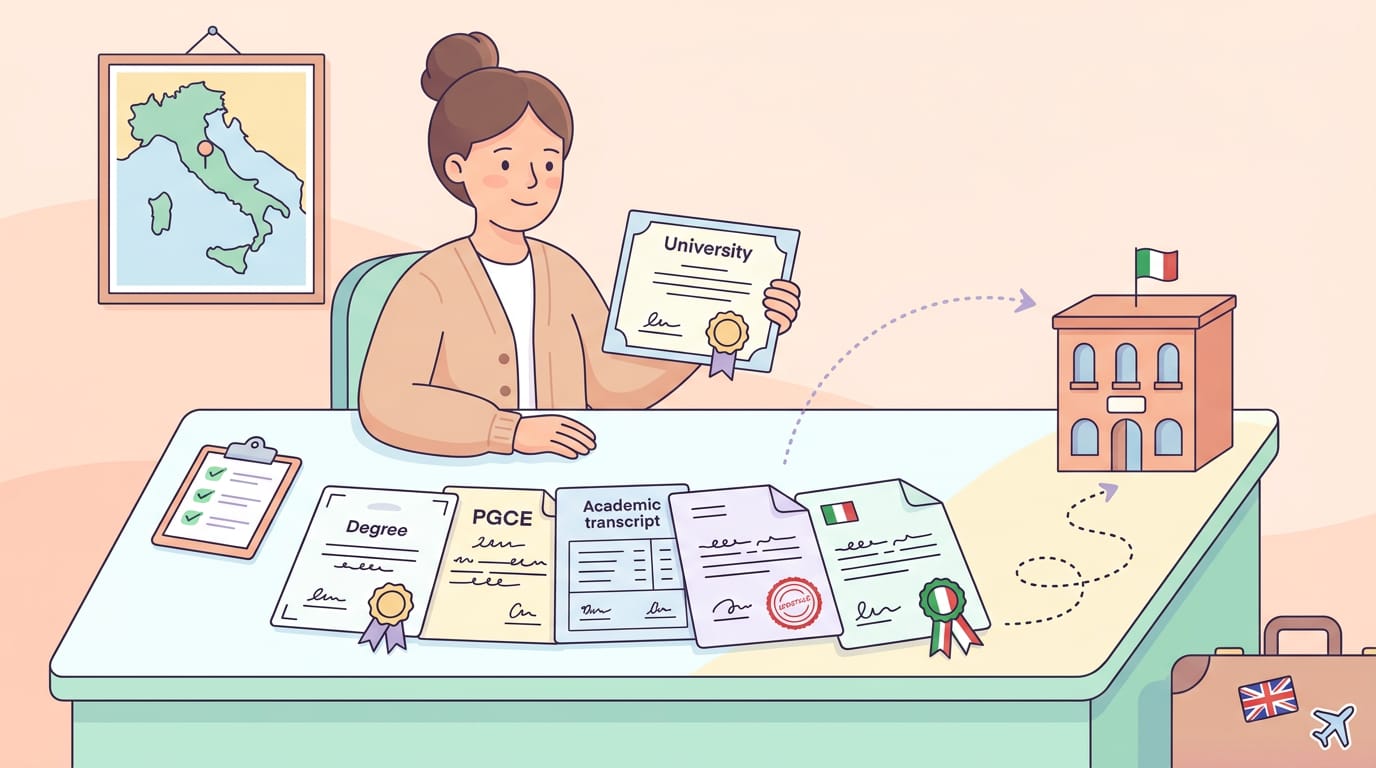
Degree certificate and transcript from your university.
Teaching qualification, such as a PGCE, and evidence of qualified teacher status if you hold it.
Verification of your degree from the awarding university.
A notarised copy with an FCDO apostille for any document going to an Italian authority.
Italian translations of your degree-level documents.
A Declaration of Value from the relevant Italian consulate, where required.
A criminal record check suitable for working with children, plus references.
Not every employer will want every item, but it's far easier to have them ready than to chase them after you've accepted a post.
How the Declaration of Value works
The declaration is issued by the Italian consulate responsible for the part of the UK where you obtained your qualification.
Before the consulate will issue it, your degree documents normally need to be verified, notarised, apostilled and translated into Italian.
The declaration describes your qualification, but the employer or authority still decides how to treat it.
If you want to see the steps in detail, notarypubliclondon.co.uk sets them out clearly, and the London notary firm behind it can handle the preparation for you.
Stay organised
Teachers are good at planning, and this is the moment to use that skill.
Create one tracker for every document, with columns for requested, received, certified and sent.
Store scans of everything in one folder, named consistently.
Note every deadline, including the school's start date and any visa or permit dates.
Keep a record of who you sent originals to, and when.
A simple tracker template saves hours of searching through emails later.
International schools
Many UK teachers start in Italy at an international or British school, where English is the language of instruction.
These schools often follow UK or international curricula and may be more flexible about documents than the state sector.
Even so, many still ask for apostilled copies of your qualifications, so it's worth having them prepared whichever route you choose.
Timing
University verification can take a couple of weeks, and the consulate sets its own processing times.
If you're aiming for a September start, beginning the document process in the spring is a good rule of thumb.
Final thought
Moving to Italy to teach is a big adventure, and the paperwork is only one small part of it.
Get it organised early, keep good records, and you can spend your energy on the parts that matter: the classroom, the language and the life you're building.
Still grading everything by hand?
EMStudio is a free teaching management app — manage your classes, students, lessons, and more!