Math Games for 3rd Graders That Build Real Skills

Ever notice how a 3rd grader will happily count out a bag of crackers but groan at a page of addition problems? That gap is why math games work so well. Play turns practice into something kids actually want to do, so the facts stick without the battle.
In this post, we'll sort the games by format and by skill, showing how to play each one and the concept it builds. You'll also find practical tips for choosing, adapting, and using them with different learners, whether in class or at home.
Still grading everything by hand?
EMStudio is a free teaching management app — manage your classes, students, lessons, and more!
Benefits of Math Games for 3rd Graders
Why bother with games over worksheets? Games give kids the same practice with a reason to keep going. Worksheets still suit quick checks.
Skills kids build while playing
Reinforcing key concepts. Repetition builds fluency, the quick recall that frees up brainpower.
Critical thinking skills. Games reward how kids think, not just whether they're right.
Problem-solving and logic. When a plan fails, kids adjust and try something new.
Engagement and fun. Many kids who groan at worksheets still beg for one more round. Fun keeps them coming back.
Matching games to third-grade standards
Games for every standard. Most skills on your class list can become a game, so you rarely start from scratch.
Common Core standards. If your school uses Common Core, choose games that practice the exact skill each standard names.
Practice for third-grade topics. Consider a teacher who ends class with a dice game. In minutes, she sees who still mixes up facts.
Matching games to skill level. Choose a game a child can win with effort, then raise the challenge.
How to teach math to a 3rd grader?
We'd suggest a simple rhythm: introduce the skill, play a round, then check what stuck.
Classroom use. Run a short game during warm-ups so it becomes routine.
Homeschooling routines. Play right after you teach a new skill, while it's still fresh.
Take-home exercises. Send home a simple card game kids can play with family.
Parent involvement. Share the rules so parents can ask the same questions the game does.
Differentiating games for mixed abilities. Keep one game and adjust the number range: bigger for stronger players, smaller for kids still building.
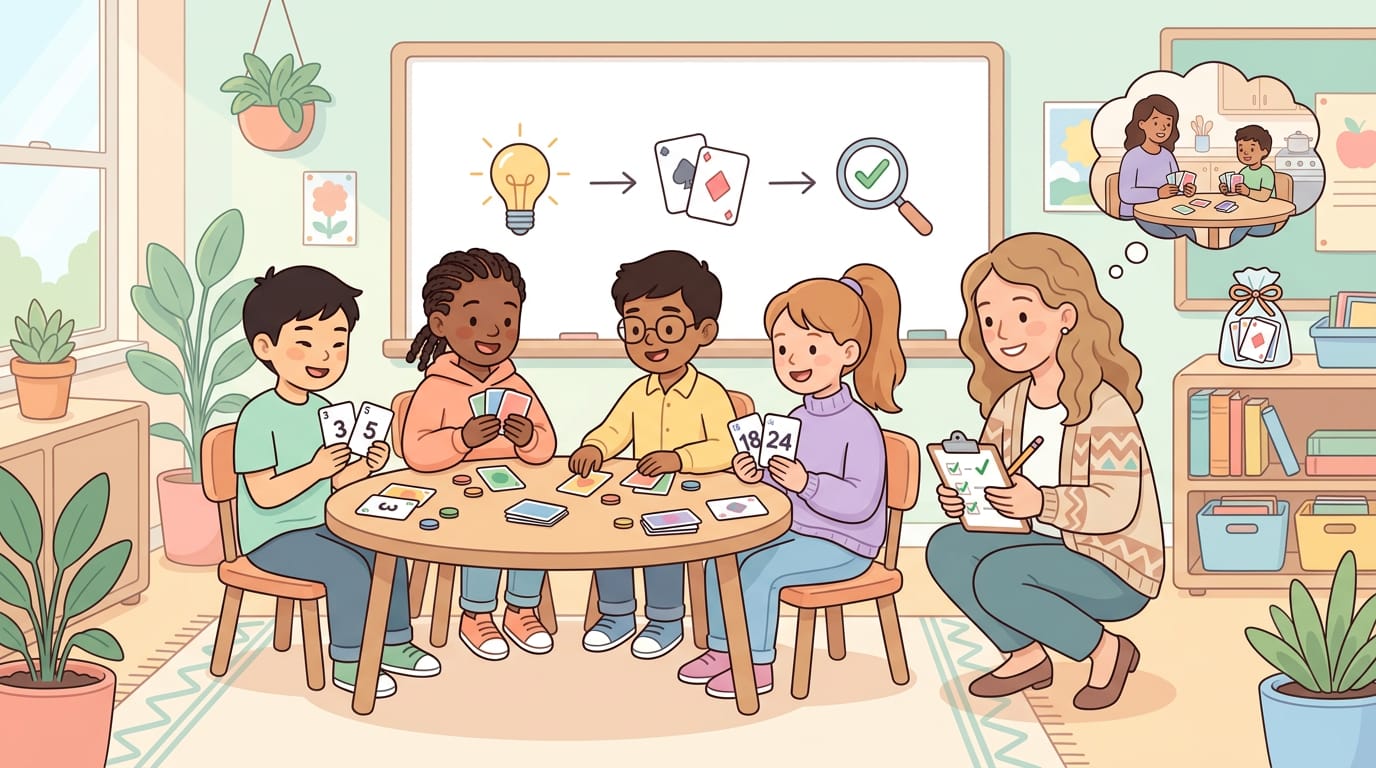
Find Games by the Skill You Need
Start with the skill your learners need most, not the game that sounds most fun. Think of a teacher whose class has mastered addition but freezes whenever fractions show up, so she heads straight to the fraction games. Practice lands where the gap is. A class still shaky on early number skills should start with pre-K math games.
Playing with multiplication and division
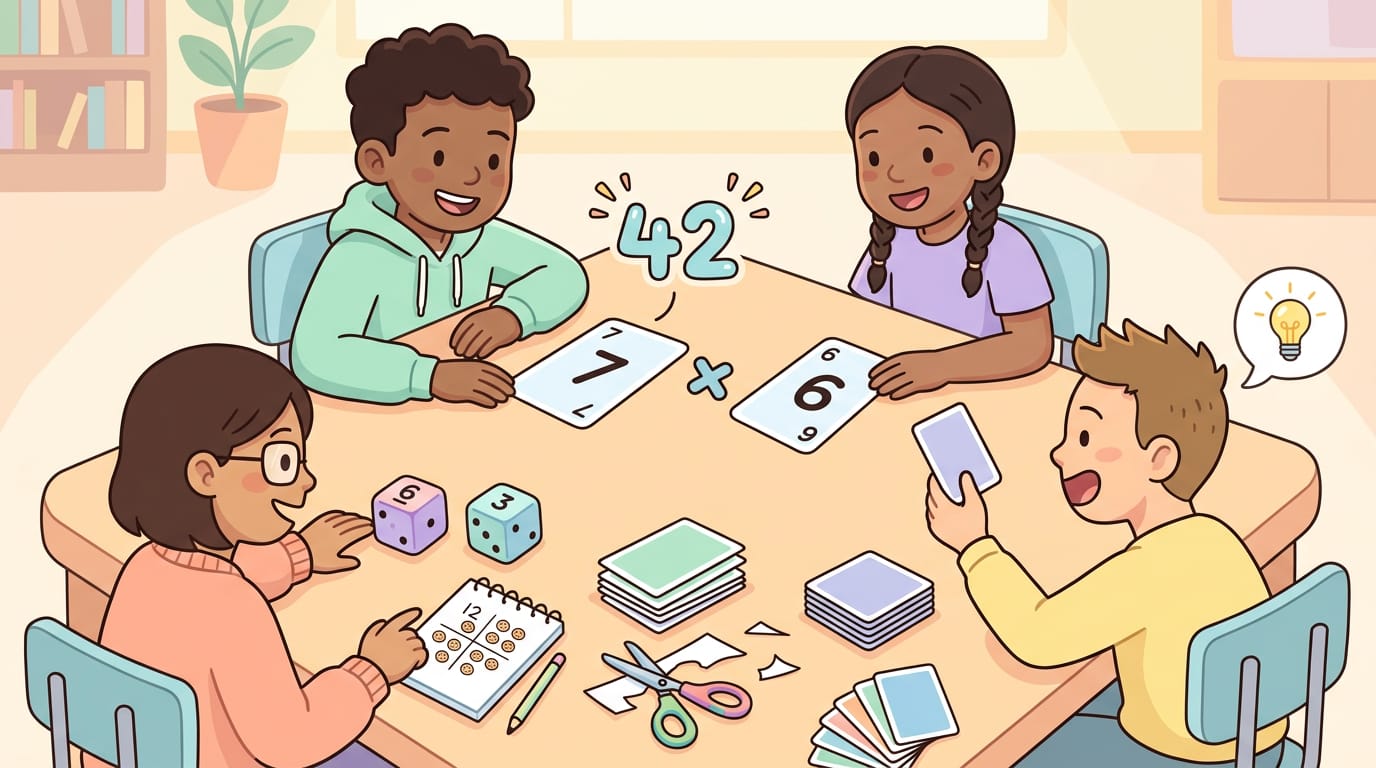
Multiplication race. Partners race to name the product of two flipped number cards. Builds fact recall.
Array match-up. Pair each array (a grid of dots or squares) with its multiplication equation. Builds the idea of equal groups.
Division Derby. Students split counters into equal groups, moving a token for each correct answer. Builds division as equal sharing.
Multiplication facts cards. Sort flashcards into known and still-learning piles, then drill only the second pile. Builds focused practice.
Long division. Say each step aloud (divide, multiply, subtract, bring down) on a few problems. Builds a repeatable routine.
Adding and subtracting with confidence
Math Man Jr. Players roll dice, solve the addition or subtraction problem, and move only when they're right. Builds mental math.
Addition word problems. Students underline the numbers and the question, then write a number sentence before solving. Builds the skill of turning words into math.
Subtraction with carrying. Use base-ten blocks and trade one ten for ten ones when you're short. Builds regrouping, which some call borrowing.
Math facts practice. Partners quiz each other on facts within 20 and log scores to beat. Builds recall rather than counting on fingers.
Making sense of fractions and decimals
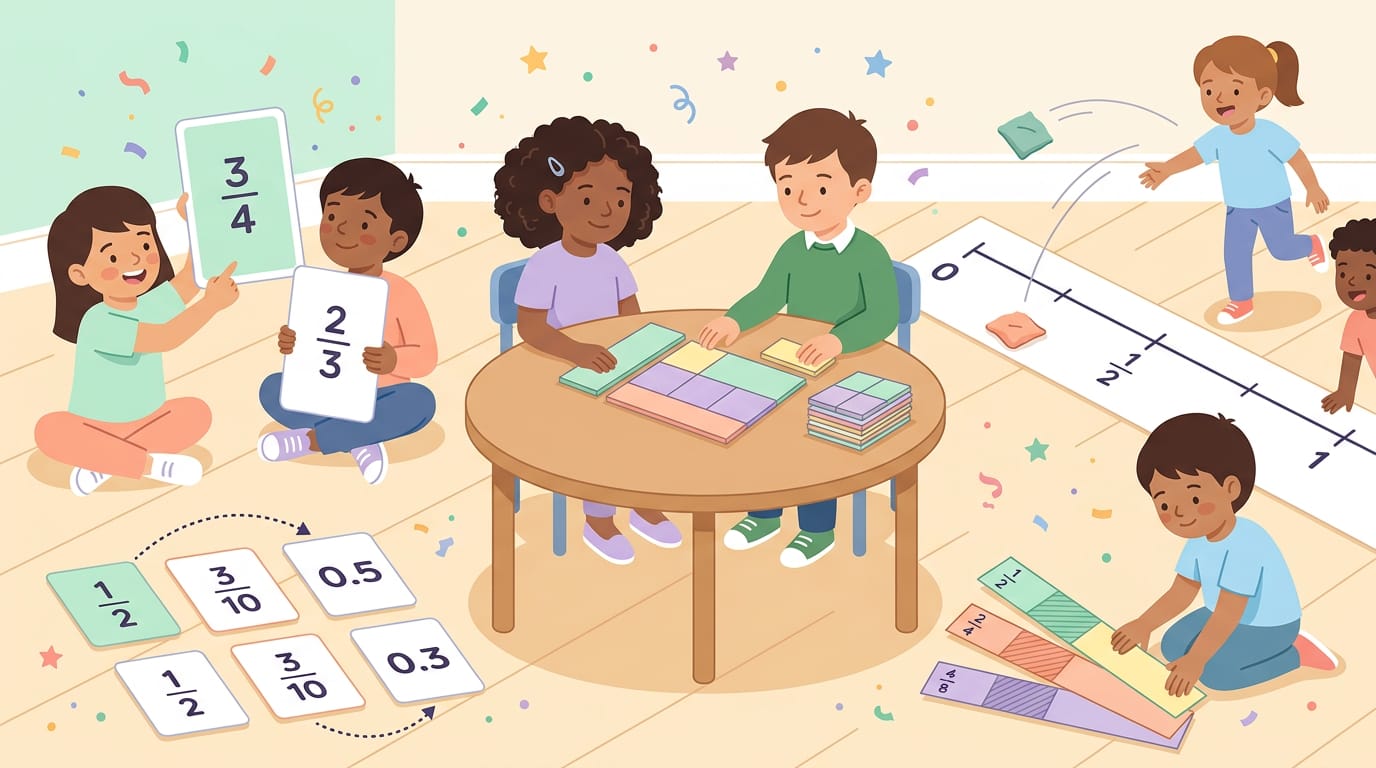
Fraction tiles puzzles. Fit halves, thirds, and fourths together to rebuild one whole. Builds fractions as parts of a whole.
Fraction Fiesta. Players draw two fraction cards and name the greater one. Builds comparing fractions.
Fraction Fling. Toss a beanbag onto a 0-to-1 number line and name the nearest fraction. Builds fraction placement.
Fractions to decimals. Match fractions like 1/2 and 3/10 to decimals like 0.5 and 0.3. Builds the link between the two forms.
Equivalent fractions. Fold paper strips to compare 1/2, 2/4, and 4/8. Builds the idea of different names for the same amount.
Getting comfortable with place value and rounding
Place value pirates. Students build treasure numbers from hundreds, tens, and ones blocks. Builds what each digit is worth.
Round-Up Rodeo. Students round to the nearest ten, going up when the ones digit is 5 or more. Builds the rounding rule.
Estimation Station. Show a jar of objects for a few seconds, have students guess, then count. Builds reasonable estimates.
Expanded form cards. Split 384 into 300 + 80 + 4, then rebuild it. Builds expanded form and each digit's value.
Ascending number order. Students arrange number cards in ascending order, smallest to largest. Builds comparing and ordering numbers.
Exploring shapes, area and perimeter
Shape classification. Sort shape cards by sides, corners, or curves. Builds describing shapes by their attributes.
Symmetry puzzles. Fold paper to find the line that makes two mirror-image halves. Builds symmetry as matching halves.
Perimeter and area games. Build rectangles from square tiles to measure perimeter and area. Builds the difference between distance around and space inside.
Angles and types. Use a paper corner to sort angles as right, smaller, or larger. Builds recognizing angle types.
3D shapes. Pass around cubes, cones, and spheres, counting faces, edges, and corners. Builds naming solids by their parts.
Time, money, measurement and data practice
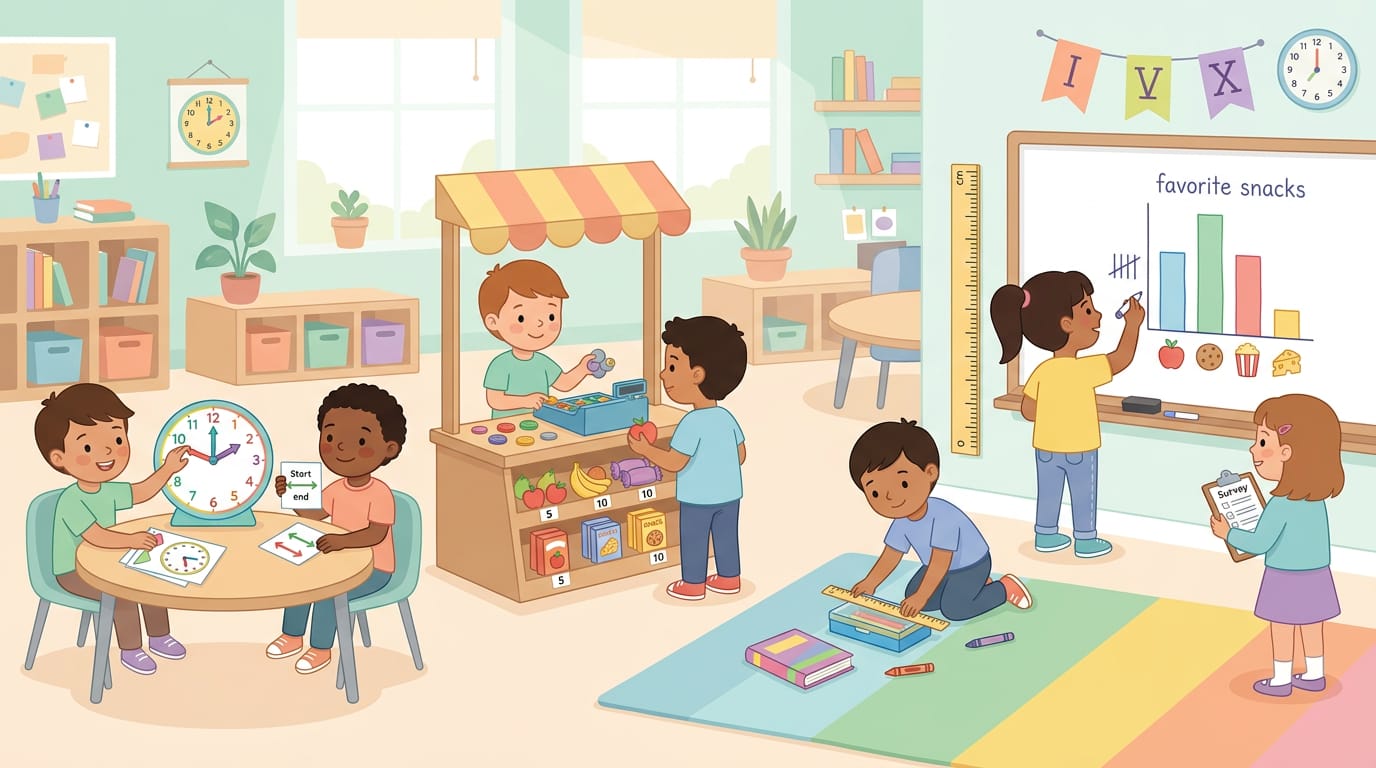
Telling and elapsed time. Set a clock to a start time, then count forward to the end. Builds elapsed time, the time between two moments.
Counting money, making change. Students run a class store, paying with coins and counting back change. Builds coin counting and making change.
Metric conversions. Measure objects in centimeters, then check how many centimeters fit in a meter. Builds a feel for metric units.
Bar graphs and data. Survey classmates on favorite snacks, tally answers, and draw a bar graph. Builds reading and making graphs.
Roman numerals. Match I, V, and X to clock faces or chapter numbers. Builds reading and writing basic Roman numerals.
How to Make Math Fun?
Making math fun is less about what kids practice and more about how they practice it. Games turn repetition into play, so kids keep trying when a problem gets tricky, and we've sorted them by format and skill so you can pick what fits your class or home.
Fun is the hook; practice is the payoff.
Turning favorite games into math games
Tic-Tac-Math. Students answer a problem to claim a square. Builds fact fluency.
Math Bingo. Call out problems, and players mark matching answers. Builds quick recall.
Math Jeopardy. Teams pick a category, then answer a math question for points. Builds mental math.
Math Charades. One player acts out a math word, like sum or half, while teammates guess. Builds vocabulary.
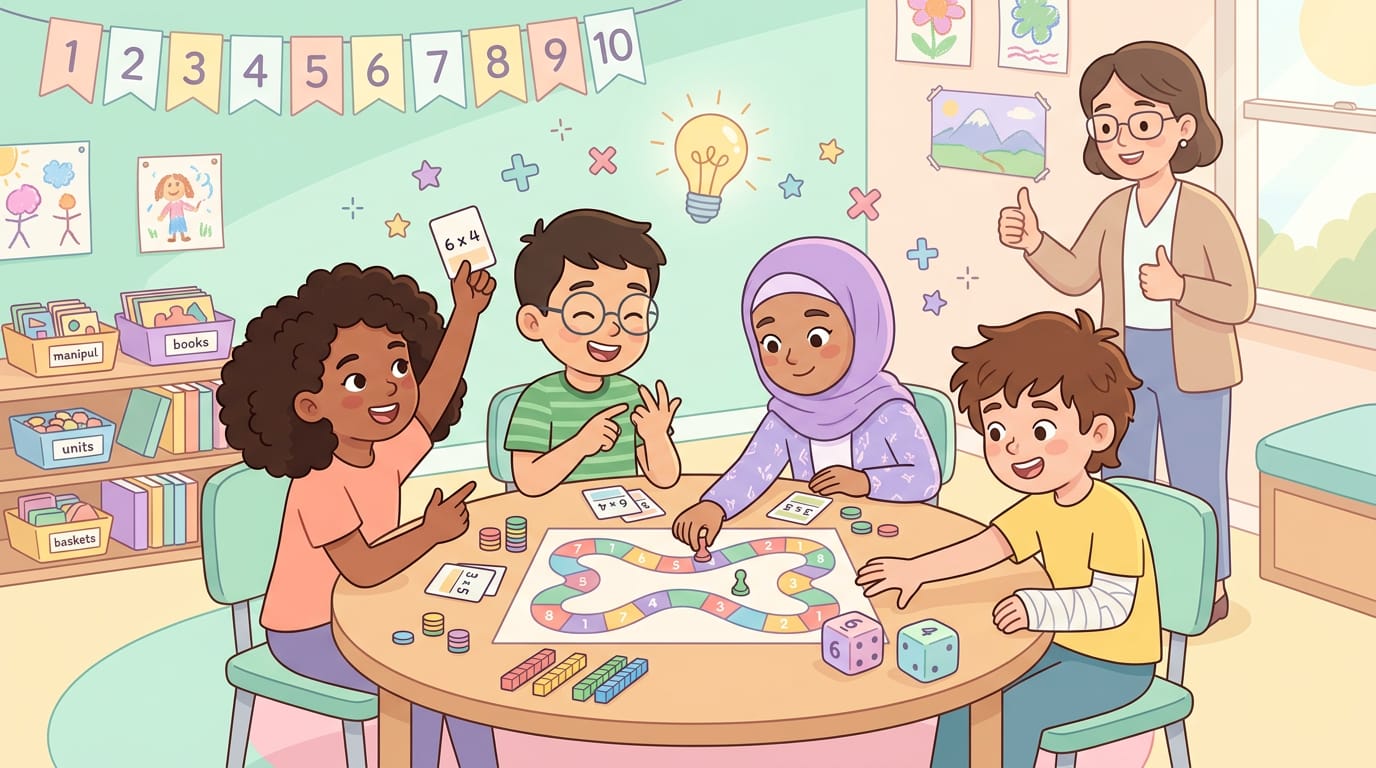
Math board games. Players answer a math card before each move on a familiar game. Builds whatever skill the cards cover.
Friendly team competitions and relays
Math relay teams. Each teammate solves one problem, then tags the next runner. Builds speed with basic facts.
Math toss targets. Students toss a beanbag onto a number, then solve a problem tied to it. Builds number sense.
Calculator races. Teams key in an answer, then read it back to check. Builds place value.
Timed competitions. Students beat their own score on a short fact set. The aim is personal progress rather than ranking. Builds fluency.
Math hunts and escape room challenges
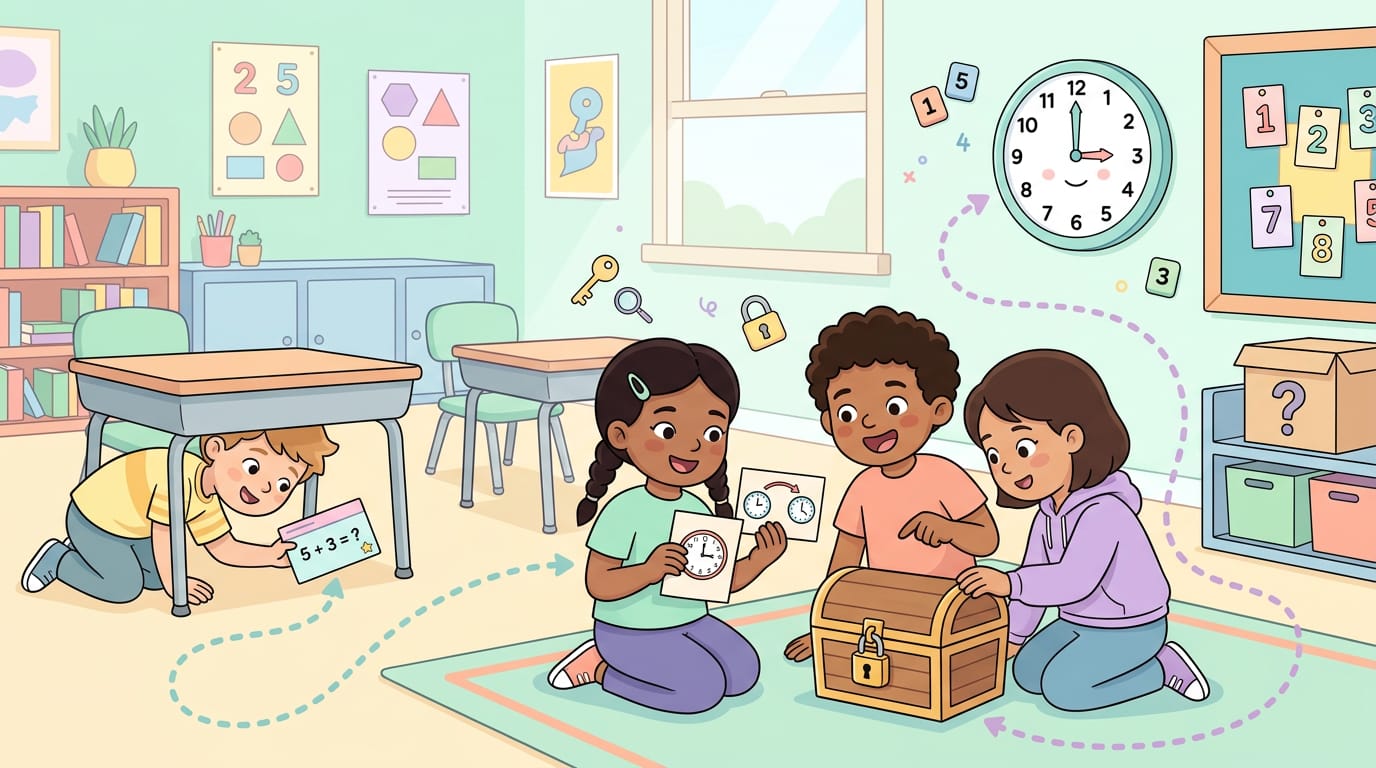
Math scavenger hunt. Each correct answer on a hidden card leads to the next clue. Builds problem solving.
Telling time treasure hunt. Students read a clock card to find each next stop. Builds clock reading.
Elapsed time escape room. Teams solve problems about elapsed time, the time between a start and an end, to open each lock. Builds time reasoning.
Clue-based puzzles. Students combine number clues to uncover a hidden number. Builds logical reasoning.
Getting kids moving with math
Skip-counting hopscotch. Hop by 2s, 5s, or 10s on a chalk grid. Builds skip counting, or counting forward by a set number.
Number line leapfrog. Leap forward or back along a taped number line. Builds the idea that addition moves you forward and subtraction moves you back.
Moving math. Post an answer in each corner, and students walk to the one they choose. Builds quick reasoning.
Jumping jacks math. Do three sets of seven jumps to show that 3 times 7 means three equal groups. Builds multiplication.
Quick stations rotation setup. Groups rotate through four games, such as hopscotch and cards. Picture a teacher who sets this up once, then pulls aside students who need help while everyone else keeps playing. Builds routines and the skills each game targets.
Math through cooking, shopping and building
Everyday tasks give math a reason to exist.
Baking and cooking fractions. Measuring half and quarter cups shows fractions, or equal parts of a whole. Builds fraction sense.
Cash register play. Students take turns as cashier and customer, making change. Builds money counting and subtraction.
Building robots on grid paper. Draw a robot, then count its squares. Builds area.
Building 3D structures. Count the cubes in stacked blocks. Builds spatial reasoning.
Playing math with cards and dice
War or Go Fish twist. Play War or Go Fish, but students multiply their cards and compare products. Builds multiplication facts.
Dice division. Roll dice to make a division problem, then solve it together. Builds division as equal sharing.
Printable card sets. Use ready-made sets, or make your own, for matching or sorting. Builds whatever skill the cards target.
Take turns drawing cards. Students draw, solve out loud, and explain their answer. Builds mental math and reasoning.
Math Games Kids Can Play Online
Online math games can make practice feel less like drill and more like play. Here are the classics we'd pick and how you can choose wisely.
What are the classic cool math games?
Start with these five:
Multiplayer racing games: kids race classmates or friends through problems.
Math Facts Basketball: a sports-style game built on basic facts.
Brainie levels: stage-based play that builds skills gradually.
Math Quiz with difficulty levels: kids step up when they're ready.
Clear It Multiplication: focused practice on multiplication facts.
Why digital games help kids learn
The biggest advantage is immediate feedback. A kid who misses a problem sees the answer at once, while the problem is still fresh.
Bright visuals and rewards keep kids engaged, and new levels give them a reason to return. Kids learn at their own pace, so a fast learner can move on while a classmate keeps practicing.
A second-order meta-analysis by Yao found that gamified learning in math produced a moderate, statistically significant gain over traditional instruction (effect size 0.407). Kids don't just enjoy these games. They learn from them.
Progress reports show parents and teachers where kids need help. A 3rd-grade teacher checks the report Sunday night, sees three students stuck on the same multiplication facts, and pulls them into a small group on Monday.
Choosing quality, standards-aligned games
Run these checks first.
Common Core alignment: Choose games that name the Common Core standards they cover.
Online safety certification: Check for one before kids create accounts.
Affordability and free access: Compare prices, and check whether a free version covers your needs.
Choose well, and screen time becomes practice time.
The right math game does more than fill a spare five minutes. When you match the game to the skill, adapt it for each learner, and keep the play light, kids build confidence and fluency at the same time.
Whether you're at a kitchen table or a classroom desk, that's a win for everyone.
Ready to bring more hands-on ideas into your teaching? Check out our Teaching Strategies & Concepts posts for more approaches to try in your next lesson.
References
Still grading everything by hand?
EMStudio is a free teaching management app — manage your classes, students, lessons, and more!