
Technology Literacy: A Complete Guide for K-12 Educators
Technology Literacy: A Complete Guide for K-12 Educators

Article by
Milo
ESL Content Coordinator & Educator
ESL Content Coordinator & Educator
All Posts
Last Tuesday, my 7th graders were researching climate change. One student copied a "fact" from a website that looked professional but was actually a sponsored post from an oil company. She had no idea. That moment showed me we need to talk about more than just how to click buttons.
Technology literacy isn't knowing which icon to tap. It's the ability to find reliable information, judge what you see online, and use digital tools to actually solve problems. It covers everything from spotting fake news to understanding how algorithms sort your search results. When my student trusted that sponsored content, she wasn't lacking tech skills—she lacked the critical lens to question what the screen showed her. That gap is everywhere.
This guide covers how technology literacy develops across grade levels, from kindergarten digital citizenship to high school computational thinking. You'll get practical steps you can use tomorrow, not theory that sits in a binder. Because teaching kids to use technology without teaching them to think about it? That's how we end up with students who can post TikToks but can't verify a source. We can fix that starting now.
Still grading everything by hand?
EMStudio is a free teaching management app — manage your classes, students, lessons, and more!
Learn More
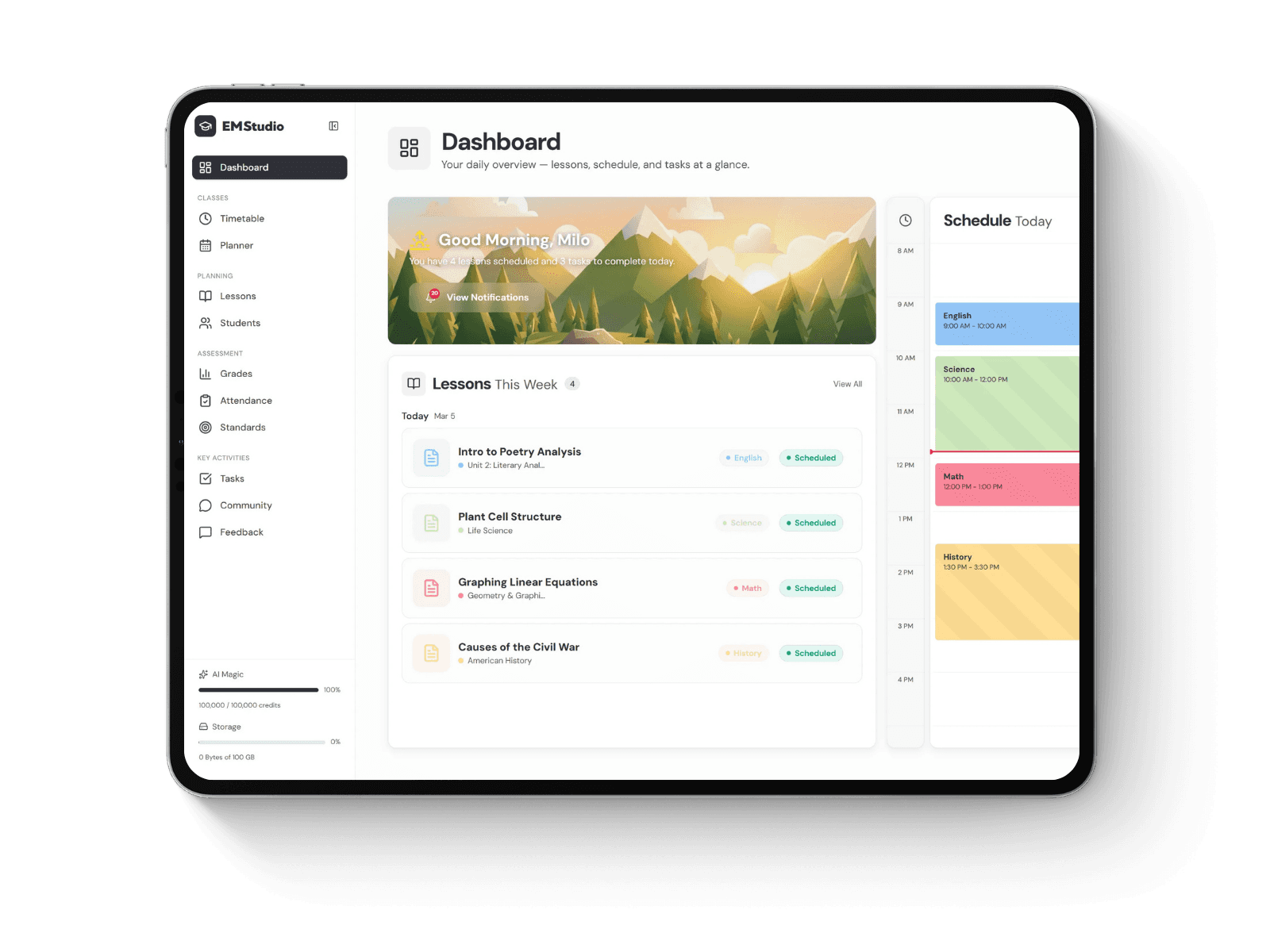
Still grading everything by hand?
EMStudio is a free teaching management app — manage your classes, students, lessons, and more!
Learn More
Table of Contents
What Is Technology Literacy?
Technology literacy is the ability to effectively, critically, and safely use digital tools to find, evaluate, create, and communicate information. It extends beyond basic computer skills to include information evaluation, computational thinking, and ethical digital citizenship, enabling students to solve problems and participate fully in academic and civic life.
Computer literacy is knowing how to log in. Technology literacy is knowing whether the information you find is worth believing.
The ISTE Standards for Students separate operational fluency from critical thinking. Computer literacy in education covers typing and software navigation. Technology literacy needs that students evaluate source credibility, practice ethical digital citizenship, and create original content while maintaining online safety. Most districts teach the basics through keyboarding apps. The second requires structured lessons in our essential digital literacy skills framework and guided practice.
Four pillars define the scope. Operational Skills mean device fluency—Kindergarteners logging out without help. Information Literacy involves research and evaluation—5th graders using quotation marks in search queries. Media Creation and media literacy cover communication—8th graders editing documentary footage and recognizing bias in visual rhetoric. Computational Thinking requires problem decomposition—12th graders building spreadsheet models. These represent a developmental continuum, not a checklist to complete.
Myth | Reality |
|---|---|
Technology literacy means coding proficiency. | Coding is one component of computational thinking, not the entire skill set. |
Digital natives are automatically literate. | Explicit instruction is required for critical evaluation and ethical use. |
Beyond Computer Skills: The Four Core Pillars
These standards map directly onto classroom behaviors. Empowered Learner aligns with operational skills—I watched a 4th grader adjust text-to-speech settings independently during state testing. Digital Citizen covers ethical and social dimensions including online safety protocols. Knowledge Constructor matches information literacy. Innovative Designer pairs with computational thinking, like when my 8th graders decomposed a broken Scratch game to debug it line by line.
Unlike the SAMR model, which measures task substitution versus transformation, these pillars define what students can actually do with technology. Students rarely progress evenly. A 10th grader might write Python functions while still copy-pasting unchecked Wikipedia facts. The pillars act as lenses for diagnosis, not gates to pass through sequentially.
Information Literacy and Critical Evaluation
I teach the SIFT method using real viral claims. When a TikTok health trend hit my 7th graders last year, we practiced lateral reading. Students left the app, opened MayoClinic.org, and checked the "About Us" page for funding sources. Four minutes of investigation debunked the claim. They learned that professional websites list credentials; conspiracy sites hide them.
For high school research papers, I model the CRAAP Test (Currency, Relevance, Authority, Accuracy, Purpose). My 5-minute mini-lesson script: "Look at the URL. Look at the date. Ask who paid for this." Students practice on two articles about climate change—one from a university journal, one from a lobbying group. The difference becomes obvious when you check the author’s degree.
Media Creation and Digital Communication
Creation tools demand specific outputs and storage planning. Video files clog Google Drive, so we use shared servers for raw footage and Drive for finished exports. Distinguish between clickable and interactive media. PowerPoint with hyperlinks is clickable—students follow linear paths. Twine branching narratives or Scratch simulations are interactive, requiring conditional logic. The cognitive load differs. I assess clickable work for content accuracy. Interactive projects demand debugging and user-testing.
Canva builds infographics for grades 4-12, exporting PDF or PNG files.
Adobe Spark Video handles digital storytelling in grades 6-12, rendering MP4 format.
GarageBand produces podcasts for grades 5-12 as M4A downloads.
Book Creator makes e-books for grades K-8 in ePub format.
Computational Thinking and Problem Solving
Computational thinking breaks into four moves. Decomposition splits complex problems—like the "peanut butter sandwich" unplugged activity where Kindergarteners sequence steps for a robot. Pattern Recognition finds similarities across datasets. Abstraction filters irrelevant details. Algorithms create step-by-step solutions, evolving from block commands to Python functions in high school.
Scratch Jr serves K-2 with intuitive drag-and-drop blocks.
Scratch or Blockly fits grades 3-5 with structured logic.
Tynker and Code.org bridge grades 6-8 toward text syntax.
Python or JavaScript challenges grades 9-12 with authentic programming.
Expect 10 hours for block-based proficiency, but 40-plus hours before students write functional text-based code independently.
Why Does Technology Literacy Matter in Modern Classrooms?
Technology literacy matters because modern careers require digital fluency regardless of industry, and students must navigate unprecedented information volumes. Research indicates students struggle to distinguish credible sources from misinformation without explicit instruction. These skills prevent costly digital mistakes while opening economic opportunities in an increasingly automated workforce.
I watched a senior lose a scholarship last spring because she shared a manipulated image on Instagram without checking the source. One screenshot. One wrong click. That is why we teach this.
The Stanford History Education Group found that most middle schoolers cannot distinguish sponsored content from news articles. When shown mixed homepages, they judged credibility by photos and fonts, ignoring funding sources. This is cognitive vulnerability. Technology literacy functions as protection against manipulation, teaching students to ask who paid for the information.
The Bureau of Labor Statistics tracks a clear trend: over ninety percent of jobs across all sectors now require digital competency beyond basic email. Modern agriculture uses GPS-guided tractors. Nursing needs EHR navigation. Construction crews work with BIM software. Job postings list Salesforce, Google Workspace, Tableau, and LinkedIn portfolio maintenance as baseline expectations.
Students without these skills face specific vulnerabilities. They fall for phishing schemes disguised as financial aid notifications. They share misinformation that derails college applications. Last year, three of my juniors reposted a fake scholarship link that harvested their personal data. Digital illiteracy is a risk that needs administrative attention as a mitigation strategy.
College and Career Readiness in a Digital Economy
The digital skills gap hits hardest in non-STEM fields where teachers assume tech literacy is optional. My cousin's welding program required blueprint software before he touched metal. Modern agriculture operates GPS-guided tractors. Nurses navigate complex EHR Software. Construction managers use BIM platforms. The fast-growth careers in the digital economy include these hybrid roles.
Google Workspace Certification: Free training, $10 exam, performance-based tasks.
Microsoft Office Specialist: $100-$120, practical application testing.
IC3 Digital Literacy: $0-$80 depending on district partnerships, multiple choice and simulation mix.
These certifications prove tech literacy to employers who cannot train new hires on basic platforms. Last year, a local hospital consortium told our guidance department they auto-screen for EHR familiarity. Students with these credentials skip the slush pile. The ROI is immediate: a $100 exam fee versus a $15 hourly wage bump.
I keep a bulletin board tracking which seniors passed these exams. Employers notice. These certifications prove a student can navigate the platforms listed in job postings without hand-holding.
We cannot stop at substitution. The SAMR model shows us that simply swapping paper worksheets for Google Docs is not enough. We need modification and redefinition, where students use tech to analyze tractor data or simulate patient care. That is when digital literacies for learning become career skills.
Navigating Information Overload and Misinformation
The Stanford researchers documented "sponsored content blindness." When shown native ads labeled "Sponsored Content," fewer than twenty-five percent of high school students identified the material as paid advertising. They read the label as a formatting quirk. This is media literacy failure in real time.
I run a three-lesson sequence. Day one examines native advertising structure. Day two trains slanted language detection using highlighter battles. Day three teaches reverse image search using Google Images and TinEye. By Friday, my students side-eye every "article" in their feeds.
The Dunning-Kruger Effect thrives in digital contexts. Students overestimate their search abilities while demonstrating poor query formulation. I prove this by timing them. Then I teach Boolean operators—AND, OR, NOT—and domain filtering using site:.edu. We compare before and after results. The shift from fifty thousand random hits to twelve peer-reviewed sources shocks them. That is information literacy.
Ethical Digital Citizenship and Online Safety
I teach the Digital Tattoo metaphor. Footprints wash away. Tattoos stay. A tattoo is chosen, permanent, and visible. We use the Wayback Machine to pull up deleted posts from ten years ago. We set Google Alerts on their own names. This makes ethical digital citizenship and online safety concrete, not abstract.
For cyberbullying prevention, we drill the Stop, Block, Tell, Report protocol. Stop engaging. Block the user. Tell a trusted adult. Report through official channels. Instagram uses the three-dot menu. TikTok uses "Report" in the share arrow. Snapchat uses the gear icon. Most jurisdictions classify cyberbullying as mandatory reporting territory for educators.
Computational thinking underpins all of this. It is the logic of breaking problems into steps, whether coding or deciding what to share. When students apply this framework to their online choices, they move from reactive posting to intentional digital presence. That is the endgame of digital literacies for learning.

How Does Technology Literacy Develop in Students?
Technology literacy develops through scaffolded progression from teacher-directed exploration to independent creation. Students begin with guided interaction using protected environments, gradually building toward complex problem-solving and collaborative production. This trajectory follows cognitive development stages, making sure skills align with age-appropriate critical thinking and executive function capabilities.
Kids don't wake up knowing how to evaluate a Wikipedia source. They start with guided access to Epic Books in kindergarten. By senior year, they're managing complex digital citizenship dilemmas independently.
Computer literacy in education follows the same neural pathways as learning to read. Kindergarteners need walled gardens—apps that open directly to content without passwords they can't yet type. Third graders develop information literacy through structured searches, while sixth graders exercise executive function evaluating sources for bias. Only when the prefrontal cortex matures around high school can students fully manage the abstract reasoning required for computational thinking and professional-grade content creation. This mirrors Piaget's stages exactly.
I track a strict consumption-to-creation ratio: three hours of passive screen time earns one hour of building. For second graders, creation means remixing—dragging shapes in Seesaw or recording voice-overs. Fifth graders assemble multi-slide presentations from templates. By eighth grade, they're designing original infographics from blank canvases, and seniors author complete documentaries. This progression mirrors the SAMR model, moving from substitution to true redefinition.
Traditional Classroom | Technology-Literate Classroom |
|---|---|
Computer lab once a week | Daily integration with visible metacognition about tool selection |
Teacher controls all logins | Students demonstrate ICT literacy by troubleshooting basic issues independently |
Consuming digital worksheets | Creating with purpose using media literacy frameworks |
The Scaffolded Skills Progression Framework
The ISTE Standards scaffold doesn't hand ninth graders the same checklist we give first graders. In kindergarten, Empowered Learner means a five-year-old can tap the app icon and record a response without tangling headphone wires. By twelfth grade, that standard requires customizing digital workflows—automating citations in Zotero or building dashboards to track capstone projects. I write rubrics with observable behaviors only. "Can troubleshoot login issues without teacher assistance" signals Level 2 operational skill. "Explains why a source is unreliable using evidence" hits Level 4 information literacy.
Differentiation means technology literacy can't wait for grade-level reading proficiency. I had a fourth grader with severe dyslexia who couldn't decode the stream but could navigate Immersive Reader and Read&Write extensions to access content. Assistive technology is the entry ramp. Students with physical disabilities use voice-to-text to demonstrate computational thinking before they can hold a pencil.
From Digital Consumption to Content Creation
Students move through four distinct phases:
Interaction: Clicking, dragging, learning that the cursor follows the finger.
Consumption: Listening to audiobooks on Epic or watching videos.
Remixing: Modifying templates in Adobe Express or changing variables in coding tutorials.
Creation: Building ebooks in Book Creator or composing original music from blank canvases.
I watch for the moment students stop asking "Which button?" and start asking "What's possible?"
Watch out for the messy middle. Sixth through eighth graders gain autonomy just as peer influence peaks, and online safety behaviors often regress. Last October, my seventh graders started sharing passwords to "help" each other finish work. I had to backtrack and explicitly teach privacy settings for each platform—how to disable location tags, manage Google Workspace sharing permissions, and recognize phishing in comments. This window requires intensive digital citizenship monitoring even for kids who seemed responsible in fifth grade.
Collaborative Learning in Connected Environments
Real collaboration in tech-enabled collaborative learning environments requires explicit protocols. My students use Google Workspace with suggesting mode turned on—every edit tracked in version history. We practice the 2-Minute Rule: if you change something in a shared document, you comment within two minutes explaining why. For video discussion, Flipgrid lets my introverts draft responses before recording. Microsoft Teams channels keep project chatter separate from general chat noise.
Beware the collaboration illusion. I've watched four students "work together" on a shared slide deck by dividing slides and avoiding eye contact. No cognitive interdependence. I fix this by assigning rotating roles—today you're the scribe, tomorrow you play Devil's Advocate and must challenge one claim in the document. In history class, I require the skeptic to highlight unsupported facts in yellow before the final submission. This forces actual dialogue, not parallel play.
Practical Applications Across Grade Levels and Subjects
Elementary: Foundational Digital Exploration and Safety
In kindergarten through second grade, focus first on input device fluency and basic online safety. I use these tools in 20-minute centers:
Seesaw for ELA portfolios. Students photograph handwritten stories and record voice narrations. Free for teachers.
Kodable for math sequencing. Introduces computational thinking through directional commands. Free tier available.
OSMO for science exploration. Bridges physical and digital learning with tangible coding blocks. Base costs around $100; substitute with digital tools for teaching coding in elementary school if budgets are tight.
Third through fifth graders need structured autonomy. Teach the 3 Before Me rule: check three digital help sources before raising a hand. This builds troubleshooting stamina. Run 20-minute centers two or three times weekly. Rotate groups through device stations while others work offline. You do not need 1:1 devices. One projector and student phones suffice for digital literacies for learning—students photograph physical math manipulatives, edit in Photopea (free), and present to the class.
Physical habits matter. Enforce the 20-20-20 rule: every 20 minutes, look 20 feet away for 20 seconds. Check chair posture. These foundations prevent the chronic eye strain I see in older students who started too late.
Middle School: Research Skills and Multimedia Projects
Sixth through eighth grade is when information literacy separates surface skimming from deep research. In social studies, I assign geographic inquiry using Google Earth (free). Students layer historical maps over current satellite imagery. For ELA research papers, NoodleTools manages note cards and generates MLA citations; individual licenses cost around $15, but many districts subscribe. The Local History Documentary project spans four weeks: students pull primary sources from the Digital Public Library of America, use Boolean searching with graphic organizers, and require five credible sources with proper attribution.
For multimedia creation, WeVideo offers cloud-based editing. The free version watermarks exports, so I recommend CapCut as the zero-cost alternative to Adobe Premiere. It handles split-screen interviews and captioning on Chromebooks. This addresses media literacy through production rather than just consumption.
Remember COPPA gates: students under 13 cannot legally maintain accounts on most social platforms. Use district-managed Google Workspace instead. When devices are scarce, employ station rotation: one group films B-roll on phones while another writes scripts on paper, then switch.
High School: Data Analysis and Professional Digital Portfolios
Ninth through twelfth graders need data literacy and professional identity management. In math and science classes, teach data cleaning in Excel or Google Sheets, then visualization with Tableau Public (free). Computer science students should maintain GitHub repositories—these serve as proof of coding competency for internships. For digital citizenship and career readiness, guide seniors through LinkedIn profile creation, emphasizing privacy settings and professional tone.
The Data Biase lesson hits hard: students analyze their TikTok "For You" pages, documenting how the algorithm curates different content based on interaction history. We connect this to filter bubbles and confirmation bias. It makes ICT literacy personal. When students see the machine learning behind their scroll, they understand why diverse sourcing matters.
For creating effective professional digital portfolios, skip expensive Adobe subscriptions. Canva Education offers free verified teacher accounts with full features. Photopea handles complex photo editing in the browser. If students lack home internet, they can build offline in LibreOffice and upload during lunch.
Cross-Curricular Integration Strategies for Any Subject
The SAMR model helps you audit whether you're substituting or transforming. Apply these subject-specific frameworks:
Math: Desmos for modeling functions, GeoGebra for geometric proof through manipulation.
ELA: CommonLit for text analysis with built-in annotation tools.
Science: PhET simulations (University of Colorado's free library) for hypothesis documentation without lab equipment.
Social Studies: Library of Congress primary source analysis using the Observe-Reflect-Question protocol.
The Sustainable City Design PBL integrates everything. Students model 3D structures in Tinkercad (free), import into Minecraft: Education Edition, and justify material choices using spreadsheet cost-benefit analysis. They present findings via Loom or Screencastify screencasts. This builds computational thinking across disciplines.
Do not wait for 1:1 deployment. Run the station rotation model: six groups, two devices per station, 12-minute rotations. While one group researches on phones, another drafts on paper, a third peer-edits using a single projector. Technology literacy develops when students move between analog and digital, not when they stare at screens endlessly. Start tomorrow with what you have.
How Can Teachers Build Technology Literacy Starting Tomorrow?
Teachers can build technology literacy by first auditing current practices using the SAMR model to identify substitution versus transformation opportunities. Start with one authentic assessment requiring digital creation, model source evaluation using lateral reading techniques, and establish monthly peer collaboration cycles for sustainable professional growth without overwhelming workload.
Master three free tools before you touch twenty. My starter kit builds foundational tech literacy without overwhelm: Google Workspace for collaboration, Common Sense Education for curriculum, and Flipgrid for formative assessment. Do not attempt Redefinition activities—global collaborative wikis or complex coding projects—until students have mastered basic Substitution skills like typing and file management. Give each SAMR level six weeks. Crawl through Substitution, walk through Augmentation, then run toward transformation.
Audit Current Tech Integration Using the SAMR Model
Before you add another app, figure out if you're actually transforming learning or just digitizing worksheets. The SAMR model gives you a ladder to climb instead of a cliff to jump off. Be honest about where you land.
Score your current lessons 1-4 using this audit:
Am I using PDF worksheets instead of paper? (Substitution)
Are students typing answers without using spell-check or cloud storage? (Substitution)
Is the device replacing a $2 worksheet but costing $400? (Substitution trap)
Do students use cloud storage to access work across devices? (Augmentation)
Are they using grammar tools or calculators that provide feedback? (Augmentation)
Can they collaborate on the same document simultaneously? (Augmentation)
Are students creating multimedia to demonstrate understanding? (Modification)
Do they embed videos, audio, or interactive elements? (Modification)
Is the work published for a global audience beyond the classroom? (Redefinition)
Are students collaborating with experts or other classrooms in real-time? (Redefinition)
If your total sits below 12, you're stuck in Substitution. Stop buying new hardware and redesign three lessons for Augmentation first. I once watched a 4th grade class use Chromebooks to fill out digital math facts identical to the paper version. That's a $20,000 photocopier.
Watch for the "entertainment versus education" trap too. If the tech is flashy but the learning target hasn't changed, you're not building technology literacy. You're running a digital circus that wastes instructional minutes.
Design Authentic Assessments That Require Digital Creation
Digital worksheets prove students can click. Digital creation proves they can think. Split your rubrics evenly: 50 percent for content accuracy, 50 percent for digital skills like navigation, citation, and design.
For elementary, try Book Creator for interactive science journals. Middle schoolers can use Adobe Spark to produce video book trailers. High school students should build portfolios using Wix or Adobe Portfolio that they'll actually use for college applications or job interviews.
Stop the "digital landfill" where student work gets deleted after grading. Publish to classroom blogs using Edublogs, or partner with other classrooms through Empatico. Last year, my 7th graders created infographics about local water quality and presented them to our city council. The mayor asked hard questions. Suddenly, citation standards mattered.
Curate everything in modern AI tools for digital creation or portfolio platforms like Google Sites or Wakelet. If the work disappears after the unit ends, students learn that digital content is disposable.
Model Metacognitive Strategies for Evaluating Online Sources
Students can't spot fake news if we don't show them how we spot it. Project a dubious site like AllAboutExplorers.com and talk through your skepticism in real time. Say out loud: "This looks official, but I'm opening a new tab to search the organization name plus 'funding' to verify bias."
Teach lateral reading by leaving the site to verify credibility. Skip vertical reading, where students stay on the page looking for clues. The About Us section lies. Google doesn't.
Give students a bookmark with five questions they must answer before citing any source: Who funds this? What credentials does the author have? Do other sites confirm this claim?
When was this published? Why might this perspective be biased? Laminate it. Make them use it until the questions become habit. This builds media literacy and information literacy that outlasts any single assignment. See our comprehensive educational technology integration guide for lesson templates.
Create Partnerships for Ongoing Professional Development
You don't need a master's degree in edtech. You need 15 minutes and a colleague who won't judge you when the Wi-Fi fails. Structure your growth by time commitment and sustainability.
Try micro-learning through 15-minute "Tech Tips" during staff meetings covering online safety basics. Self-paced options like Common Sense Education's free modules let you build digital citizenship knowledge during lunch. For deeper dives, attend Edcamp unconferences (free) or pursue ISTE U certificates ($100-$300) for formal credentials.
Establish "Tech Buddies" pairing confident teachers with hesitant ones for non-evaluative co-planning. Meet for 30-minute "Tech Tuesdays" monthly. Share one failure and one success. This builds the psychological safety necessary for risk-taking with new tools.
Insist on a "Safe Failure" agreement with administrators: no test score evaluations during the first semester of new technology integration attempts. You can't build computational thinking if you're afraid a failed app will cost you your evaluation rating.
What This Means for Your Classroom
You don't need to become a computer science teacher overnight. Technology literacy isn't about coding apps or troubleshooting the network printer. It's about teaching kids to think clearly when they meet a new tool. It's helping them spot a sketchy website. It's letting them create something that matters using whatever device is in front of them. Start with one skill. Maybe it's evaluating sources in your research unit. Or discussing online kindness during morning meeting. Build from there.
The students in your room right now will graduate into jobs that don't exist yet. They'll use tools that haven't been invented. What you teach them this week lasts longer than any app. Show them how to question a source. Teach them to break a problem into steps. Remind them to be decent human beings online. That's the real goal. Not perfect tech integration. Just kids who can handle whatever comes next.

What Is Technology Literacy?
Technology literacy is the ability to effectively, critically, and safely use digital tools to find, evaluate, create, and communicate information. It extends beyond basic computer skills to include information evaluation, computational thinking, and ethical digital citizenship, enabling students to solve problems and participate fully in academic and civic life.
Computer literacy is knowing how to log in. Technology literacy is knowing whether the information you find is worth believing.
The ISTE Standards for Students separate operational fluency from critical thinking. Computer literacy in education covers typing and software navigation. Technology literacy needs that students evaluate source credibility, practice ethical digital citizenship, and create original content while maintaining online safety. Most districts teach the basics through keyboarding apps. The second requires structured lessons in our essential digital literacy skills framework and guided practice.
Four pillars define the scope. Operational Skills mean device fluency—Kindergarteners logging out without help. Information Literacy involves research and evaluation—5th graders using quotation marks in search queries. Media Creation and media literacy cover communication—8th graders editing documentary footage and recognizing bias in visual rhetoric. Computational Thinking requires problem decomposition—12th graders building spreadsheet models. These represent a developmental continuum, not a checklist to complete.
Myth | Reality |
|---|---|
Technology literacy means coding proficiency. | Coding is one component of computational thinking, not the entire skill set. |
Digital natives are automatically literate. | Explicit instruction is required for critical evaluation and ethical use. |
Beyond Computer Skills: The Four Core Pillars
These standards map directly onto classroom behaviors. Empowered Learner aligns with operational skills—I watched a 4th grader adjust text-to-speech settings independently during state testing. Digital Citizen covers ethical and social dimensions including online safety protocols. Knowledge Constructor matches information literacy. Innovative Designer pairs with computational thinking, like when my 8th graders decomposed a broken Scratch game to debug it line by line.
Unlike the SAMR model, which measures task substitution versus transformation, these pillars define what students can actually do with technology. Students rarely progress evenly. A 10th grader might write Python functions while still copy-pasting unchecked Wikipedia facts. The pillars act as lenses for diagnosis, not gates to pass through sequentially.
Information Literacy and Critical Evaluation
I teach the SIFT method using real viral claims. When a TikTok health trend hit my 7th graders last year, we practiced lateral reading. Students left the app, opened MayoClinic.org, and checked the "About Us" page for funding sources. Four minutes of investigation debunked the claim. They learned that professional websites list credentials; conspiracy sites hide them.
For high school research papers, I model the CRAAP Test (Currency, Relevance, Authority, Accuracy, Purpose). My 5-minute mini-lesson script: "Look at the URL. Look at the date. Ask who paid for this." Students practice on two articles about climate change—one from a university journal, one from a lobbying group. The difference becomes obvious when you check the author’s degree.
Media Creation and Digital Communication
Creation tools demand specific outputs and storage planning. Video files clog Google Drive, so we use shared servers for raw footage and Drive for finished exports. Distinguish between clickable and interactive media. PowerPoint with hyperlinks is clickable—students follow linear paths. Twine branching narratives or Scratch simulations are interactive, requiring conditional logic. The cognitive load differs. I assess clickable work for content accuracy. Interactive projects demand debugging and user-testing.
Canva builds infographics for grades 4-12, exporting PDF or PNG files.
Adobe Spark Video handles digital storytelling in grades 6-12, rendering MP4 format.
GarageBand produces podcasts for grades 5-12 as M4A downloads.
Book Creator makes e-books for grades K-8 in ePub format.
Computational Thinking and Problem Solving
Computational thinking breaks into four moves. Decomposition splits complex problems—like the "peanut butter sandwich" unplugged activity where Kindergarteners sequence steps for a robot. Pattern Recognition finds similarities across datasets. Abstraction filters irrelevant details. Algorithms create step-by-step solutions, evolving from block commands to Python functions in high school.
Scratch Jr serves K-2 with intuitive drag-and-drop blocks.
Scratch or Blockly fits grades 3-5 with structured logic.
Tynker and Code.org bridge grades 6-8 toward text syntax.
Python or JavaScript challenges grades 9-12 with authentic programming.
Expect 10 hours for block-based proficiency, but 40-plus hours before students write functional text-based code independently.
Why Does Technology Literacy Matter in Modern Classrooms?
Technology literacy matters because modern careers require digital fluency regardless of industry, and students must navigate unprecedented information volumes. Research indicates students struggle to distinguish credible sources from misinformation without explicit instruction. These skills prevent costly digital mistakes while opening economic opportunities in an increasingly automated workforce.
I watched a senior lose a scholarship last spring because she shared a manipulated image on Instagram without checking the source. One screenshot. One wrong click. That is why we teach this.
The Stanford History Education Group found that most middle schoolers cannot distinguish sponsored content from news articles. When shown mixed homepages, they judged credibility by photos and fonts, ignoring funding sources. This is cognitive vulnerability. Technology literacy functions as protection against manipulation, teaching students to ask who paid for the information.
The Bureau of Labor Statistics tracks a clear trend: over ninety percent of jobs across all sectors now require digital competency beyond basic email. Modern agriculture uses GPS-guided tractors. Nursing needs EHR navigation. Construction crews work with BIM software. Job postings list Salesforce, Google Workspace, Tableau, and LinkedIn portfolio maintenance as baseline expectations.
Students without these skills face specific vulnerabilities. They fall for phishing schemes disguised as financial aid notifications. They share misinformation that derails college applications. Last year, three of my juniors reposted a fake scholarship link that harvested their personal data. Digital illiteracy is a risk that needs administrative attention as a mitigation strategy.
College and Career Readiness in a Digital Economy
The digital skills gap hits hardest in non-STEM fields where teachers assume tech literacy is optional. My cousin's welding program required blueprint software before he touched metal. Modern agriculture operates GPS-guided tractors. Nurses navigate complex EHR Software. Construction managers use BIM platforms. The fast-growth careers in the digital economy include these hybrid roles.
Google Workspace Certification: Free training, $10 exam, performance-based tasks.
Microsoft Office Specialist: $100-$120, practical application testing.
IC3 Digital Literacy: $0-$80 depending on district partnerships, multiple choice and simulation mix.
These certifications prove tech literacy to employers who cannot train new hires on basic platforms. Last year, a local hospital consortium told our guidance department they auto-screen for EHR familiarity. Students with these credentials skip the slush pile. The ROI is immediate: a $100 exam fee versus a $15 hourly wage bump.
I keep a bulletin board tracking which seniors passed these exams. Employers notice. These certifications prove a student can navigate the platforms listed in job postings without hand-holding.
We cannot stop at substitution. The SAMR model shows us that simply swapping paper worksheets for Google Docs is not enough. We need modification and redefinition, where students use tech to analyze tractor data or simulate patient care. That is when digital literacies for learning become career skills.
Navigating Information Overload and Misinformation
The Stanford researchers documented "sponsored content blindness." When shown native ads labeled "Sponsored Content," fewer than twenty-five percent of high school students identified the material as paid advertising. They read the label as a formatting quirk. This is media literacy failure in real time.
I run a three-lesson sequence. Day one examines native advertising structure. Day two trains slanted language detection using highlighter battles. Day three teaches reverse image search using Google Images and TinEye. By Friday, my students side-eye every "article" in their feeds.
The Dunning-Kruger Effect thrives in digital contexts. Students overestimate their search abilities while demonstrating poor query formulation. I prove this by timing them. Then I teach Boolean operators—AND, OR, NOT—and domain filtering using site:.edu. We compare before and after results. The shift from fifty thousand random hits to twelve peer-reviewed sources shocks them. That is information literacy.
Ethical Digital Citizenship and Online Safety
I teach the Digital Tattoo metaphor. Footprints wash away. Tattoos stay. A tattoo is chosen, permanent, and visible. We use the Wayback Machine to pull up deleted posts from ten years ago. We set Google Alerts on their own names. This makes ethical digital citizenship and online safety concrete, not abstract.
For cyberbullying prevention, we drill the Stop, Block, Tell, Report protocol. Stop engaging. Block the user. Tell a trusted adult. Report through official channels. Instagram uses the three-dot menu. TikTok uses "Report" in the share arrow. Snapchat uses the gear icon. Most jurisdictions classify cyberbullying as mandatory reporting territory for educators.
Computational thinking underpins all of this. It is the logic of breaking problems into steps, whether coding or deciding what to share. When students apply this framework to their online choices, they move from reactive posting to intentional digital presence. That is the endgame of digital literacies for learning.
How Does Technology Literacy Develop in Students?
Technology literacy develops through scaffolded progression from teacher-directed exploration to independent creation. Students begin with guided interaction using protected environments, gradually building toward complex problem-solving and collaborative production. This trajectory follows cognitive development stages, making sure skills align with age-appropriate critical thinking and executive function capabilities.
Kids don't wake up knowing how to evaluate a Wikipedia source. They start with guided access to Epic Books in kindergarten. By senior year, they're managing complex digital citizenship dilemmas independently.
Computer literacy in education follows the same neural pathways as learning to read. Kindergarteners need walled gardens—apps that open directly to content without passwords they can't yet type. Third graders develop information literacy through structured searches, while sixth graders exercise executive function evaluating sources for bias. Only when the prefrontal cortex matures around high school can students fully manage the abstract reasoning required for computational thinking and professional-grade content creation. This mirrors Piaget's stages exactly.
I track a strict consumption-to-creation ratio: three hours of passive screen time earns one hour of building. For second graders, creation means remixing—dragging shapes in Seesaw or recording voice-overs. Fifth graders assemble multi-slide presentations from templates. By eighth grade, they're designing original infographics from blank canvases, and seniors author complete documentaries. This progression mirrors the SAMR model, moving from substitution to true redefinition.
Traditional Classroom | Technology-Literate Classroom |
|---|---|
Computer lab once a week | Daily integration with visible metacognition about tool selection |
Teacher controls all logins | Students demonstrate ICT literacy by troubleshooting basic issues independently |
Consuming digital worksheets | Creating with purpose using media literacy frameworks |
The Scaffolded Skills Progression Framework
The ISTE Standards scaffold doesn't hand ninth graders the same checklist we give first graders. In kindergarten, Empowered Learner means a five-year-old can tap the app icon and record a response without tangling headphone wires. By twelfth grade, that standard requires customizing digital workflows—automating citations in Zotero or building dashboards to track capstone projects. I write rubrics with observable behaviors only. "Can troubleshoot login issues without teacher assistance" signals Level 2 operational skill. "Explains why a source is unreliable using evidence" hits Level 4 information literacy.
Differentiation means technology literacy can't wait for grade-level reading proficiency. I had a fourth grader with severe dyslexia who couldn't decode the stream but could navigate Immersive Reader and Read&Write extensions to access content. Assistive technology is the entry ramp. Students with physical disabilities use voice-to-text to demonstrate computational thinking before they can hold a pencil.
From Digital Consumption to Content Creation
Students move through four distinct phases:
Interaction: Clicking, dragging, learning that the cursor follows the finger.
Consumption: Listening to audiobooks on Epic or watching videos.
Remixing: Modifying templates in Adobe Express or changing variables in coding tutorials.
Creation: Building ebooks in Book Creator or composing original music from blank canvases.
I watch for the moment students stop asking "Which button?" and start asking "What's possible?"
Watch out for the messy middle. Sixth through eighth graders gain autonomy just as peer influence peaks, and online safety behaviors often regress. Last October, my seventh graders started sharing passwords to "help" each other finish work. I had to backtrack and explicitly teach privacy settings for each platform—how to disable location tags, manage Google Workspace sharing permissions, and recognize phishing in comments. This window requires intensive digital citizenship monitoring even for kids who seemed responsible in fifth grade.
Collaborative Learning in Connected Environments
Real collaboration in tech-enabled collaborative learning environments requires explicit protocols. My students use Google Workspace with suggesting mode turned on—every edit tracked in version history. We practice the 2-Minute Rule: if you change something in a shared document, you comment within two minutes explaining why. For video discussion, Flipgrid lets my introverts draft responses before recording. Microsoft Teams channels keep project chatter separate from general chat noise.
Beware the collaboration illusion. I've watched four students "work together" on a shared slide deck by dividing slides and avoiding eye contact. No cognitive interdependence. I fix this by assigning rotating roles—today you're the scribe, tomorrow you play Devil's Advocate and must challenge one claim in the document. In history class, I require the skeptic to highlight unsupported facts in yellow before the final submission. This forces actual dialogue, not parallel play.
Practical Applications Across Grade Levels and Subjects
Elementary: Foundational Digital Exploration and Safety
In kindergarten through second grade, focus first on input device fluency and basic online safety. I use these tools in 20-minute centers:
Seesaw for ELA portfolios. Students photograph handwritten stories and record voice narrations. Free for teachers.
Kodable for math sequencing. Introduces computational thinking through directional commands. Free tier available.
OSMO for science exploration. Bridges physical and digital learning with tangible coding blocks. Base costs around $100; substitute with digital tools for teaching coding in elementary school if budgets are tight.
Third through fifth graders need structured autonomy. Teach the 3 Before Me rule: check three digital help sources before raising a hand. This builds troubleshooting stamina. Run 20-minute centers two or three times weekly. Rotate groups through device stations while others work offline. You do not need 1:1 devices. One projector and student phones suffice for digital literacies for learning—students photograph physical math manipulatives, edit in Photopea (free), and present to the class.
Physical habits matter. Enforce the 20-20-20 rule: every 20 minutes, look 20 feet away for 20 seconds. Check chair posture. These foundations prevent the chronic eye strain I see in older students who started too late.
Middle School: Research Skills and Multimedia Projects
Sixth through eighth grade is when information literacy separates surface skimming from deep research. In social studies, I assign geographic inquiry using Google Earth (free). Students layer historical maps over current satellite imagery. For ELA research papers, NoodleTools manages note cards and generates MLA citations; individual licenses cost around $15, but many districts subscribe. The Local History Documentary project spans four weeks: students pull primary sources from the Digital Public Library of America, use Boolean searching with graphic organizers, and require five credible sources with proper attribution.
For multimedia creation, WeVideo offers cloud-based editing. The free version watermarks exports, so I recommend CapCut as the zero-cost alternative to Adobe Premiere. It handles split-screen interviews and captioning on Chromebooks. This addresses media literacy through production rather than just consumption.
Remember COPPA gates: students under 13 cannot legally maintain accounts on most social platforms. Use district-managed Google Workspace instead. When devices are scarce, employ station rotation: one group films B-roll on phones while another writes scripts on paper, then switch.
High School: Data Analysis and Professional Digital Portfolios
Ninth through twelfth graders need data literacy and professional identity management. In math and science classes, teach data cleaning in Excel or Google Sheets, then visualization with Tableau Public (free). Computer science students should maintain GitHub repositories—these serve as proof of coding competency for internships. For digital citizenship and career readiness, guide seniors through LinkedIn profile creation, emphasizing privacy settings and professional tone.
The Data Biase lesson hits hard: students analyze their TikTok "For You" pages, documenting how the algorithm curates different content based on interaction history. We connect this to filter bubbles and confirmation bias. It makes ICT literacy personal. When students see the machine learning behind their scroll, they understand why diverse sourcing matters.
For creating effective professional digital portfolios, skip expensive Adobe subscriptions. Canva Education offers free verified teacher accounts with full features. Photopea handles complex photo editing in the browser. If students lack home internet, they can build offline in LibreOffice and upload during lunch.
Cross-Curricular Integration Strategies for Any Subject
The SAMR model helps you audit whether you're substituting or transforming. Apply these subject-specific frameworks:
Math: Desmos for modeling functions, GeoGebra for geometric proof through manipulation.
ELA: CommonLit for text analysis with built-in annotation tools.
Science: PhET simulations (University of Colorado's free library) for hypothesis documentation without lab equipment.
Social Studies: Library of Congress primary source analysis using the Observe-Reflect-Question protocol.
The Sustainable City Design PBL integrates everything. Students model 3D structures in Tinkercad (free), import into Minecraft: Education Edition, and justify material choices using spreadsheet cost-benefit analysis. They present findings via Loom or Screencastify screencasts. This builds computational thinking across disciplines.
Do not wait for 1:1 deployment. Run the station rotation model: six groups, two devices per station, 12-minute rotations. While one group researches on phones, another drafts on paper, a third peer-edits using a single projector. Technology literacy develops when students move between analog and digital, not when they stare at screens endlessly. Start tomorrow with what you have.
How Can Teachers Build Technology Literacy Starting Tomorrow?
Teachers can build technology literacy by first auditing current practices using the SAMR model to identify substitution versus transformation opportunities. Start with one authentic assessment requiring digital creation, model source evaluation using lateral reading techniques, and establish monthly peer collaboration cycles for sustainable professional growth without overwhelming workload.
Master three free tools before you touch twenty. My starter kit builds foundational tech literacy without overwhelm: Google Workspace for collaboration, Common Sense Education for curriculum, and Flipgrid for formative assessment. Do not attempt Redefinition activities—global collaborative wikis or complex coding projects—until students have mastered basic Substitution skills like typing and file management. Give each SAMR level six weeks. Crawl through Substitution, walk through Augmentation, then run toward transformation.
Audit Current Tech Integration Using the SAMR Model
Before you add another app, figure out if you're actually transforming learning or just digitizing worksheets. The SAMR model gives you a ladder to climb instead of a cliff to jump off. Be honest about where you land.
Score your current lessons 1-4 using this audit:
Am I using PDF worksheets instead of paper? (Substitution)
Are students typing answers without using spell-check or cloud storage? (Substitution)
Is the device replacing a $2 worksheet but costing $400? (Substitution trap)
Do students use cloud storage to access work across devices? (Augmentation)
Are they using grammar tools or calculators that provide feedback? (Augmentation)
Can they collaborate on the same document simultaneously? (Augmentation)
Are students creating multimedia to demonstrate understanding? (Modification)
Do they embed videos, audio, or interactive elements? (Modification)
Is the work published for a global audience beyond the classroom? (Redefinition)
Are students collaborating with experts or other classrooms in real-time? (Redefinition)
If your total sits below 12, you're stuck in Substitution. Stop buying new hardware and redesign three lessons for Augmentation first. I once watched a 4th grade class use Chromebooks to fill out digital math facts identical to the paper version. That's a $20,000 photocopier.
Watch for the "entertainment versus education" trap too. If the tech is flashy but the learning target hasn't changed, you're not building technology literacy. You're running a digital circus that wastes instructional minutes.
Design Authentic Assessments That Require Digital Creation
Digital worksheets prove students can click. Digital creation proves they can think. Split your rubrics evenly: 50 percent for content accuracy, 50 percent for digital skills like navigation, citation, and design.
For elementary, try Book Creator for interactive science journals. Middle schoolers can use Adobe Spark to produce video book trailers. High school students should build portfolios using Wix or Adobe Portfolio that they'll actually use for college applications or job interviews.
Stop the "digital landfill" where student work gets deleted after grading. Publish to classroom blogs using Edublogs, or partner with other classrooms through Empatico. Last year, my 7th graders created infographics about local water quality and presented them to our city council. The mayor asked hard questions. Suddenly, citation standards mattered.
Curate everything in modern AI tools for digital creation or portfolio platforms like Google Sites or Wakelet. If the work disappears after the unit ends, students learn that digital content is disposable.
Model Metacognitive Strategies for Evaluating Online Sources
Students can't spot fake news if we don't show them how we spot it. Project a dubious site like AllAboutExplorers.com and talk through your skepticism in real time. Say out loud: "This looks official, but I'm opening a new tab to search the organization name plus 'funding' to verify bias."
Teach lateral reading by leaving the site to verify credibility. Skip vertical reading, where students stay on the page looking for clues. The About Us section lies. Google doesn't.
Give students a bookmark with five questions they must answer before citing any source: Who funds this? What credentials does the author have? Do other sites confirm this claim?
When was this published? Why might this perspective be biased? Laminate it. Make them use it until the questions become habit. This builds media literacy and information literacy that outlasts any single assignment. See our comprehensive educational technology integration guide for lesson templates.
Create Partnerships for Ongoing Professional Development
You don't need a master's degree in edtech. You need 15 minutes and a colleague who won't judge you when the Wi-Fi fails. Structure your growth by time commitment and sustainability.
Try micro-learning through 15-minute "Tech Tips" during staff meetings covering online safety basics. Self-paced options like Common Sense Education's free modules let you build digital citizenship knowledge during lunch. For deeper dives, attend Edcamp unconferences (free) or pursue ISTE U certificates ($100-$300) for formal credentials.
Establish "Tech Buddies" pairing confident teachers with hesitant ones for non-evaluative co-planning. Meet for 30-minute "Tech Tuesdays" monthly. Share one failure and one success. This builds the psychological safety necessary for risk-taking with new tools.
Insist on a "Safe Failure" agreement with administrators: no test score evaluations during the first semester of new technology integration attempts. You can't build computational thinking if you're afraid a failed app will cost you your evaluation rating.
What This Means for Your Classroom
You don't need to become a computer science teacher overnight. Technology literacy isn't about coding apps or troubleshooting the network printer. It's about teaching kids to think clearly when they meet a new tool. It's helping them spot a sketchy website. It's letting them create something that matters using whatever device is in front of them. Start with one skill. Maybe it's evaluating sources in your research unit. Or discussing online kindness during morning meeting. Build from there.
The students in your room right now will graduate into jobs that don't exist yet. They'll use tools that haven't been invented. What you teach them this week lasts longer than any app. Show them how to question a source. Teach them to break a problem into steps. Remind them to be decent human beings online. That's the real goal. Not perfect tech integration. Just kids who can handle whatever comes next.
Still grading everything by hand?
EMStudio is a free teaching management app — manage your classes, students, lessons, and more!
Learn More
Still grading everything by hand?
EMStudio is a free teaching management app — manage your classes, students, lessons, and more!
Learn More



Notion4Teachers
Notion templates to simplify administrative tasks and enhance your teaching experience.



2026 Notion4Teachers. All Rights Reserved.
Notion4Teachers
Notion templates to simplify administrative tasks and enhance your teaching experience.
2026 Notion4Teachers. All Rights Reserved.
Notion4Teachers
Notion templates to simplify administrative tasks and enhance your teaching experience.
2026 Notion4Teachers. All Rights Reserved.