
Technology for Teachers: 18 Essential Tools for 2024
Technology for Teachers: 18 Essential Tools for 2024

Article by
Milo
ESL Content Coordinator & Educator
ESL Content Coordinator & Educator
All Posts
You’ve got twenty tabs open and zero minutes to figure out which app actually works. Last year’s “game-changing” platform collected digital dust by October. The district keeps adding logins. You need technology for teachers that survives past the first PD session and cuts your workload.
This list covers eighteen tools I’ve used in real classrooms. We’re talking classroom management that stops the chaos, assessment tech that grades while you sleep, and content creation shortcuts that win back your Sunday nights. Plus communication tools that keep parents informed without ten separate logins, and organization hacks that really stick past November.
No fluff. No computer science degree required to set up. Just practical instructional technology for blended learning, digital pedagogy that doesn’t feel forced, and teacher productivity software that handles the boring stuff so you can teach.
Still grading everything by hand?
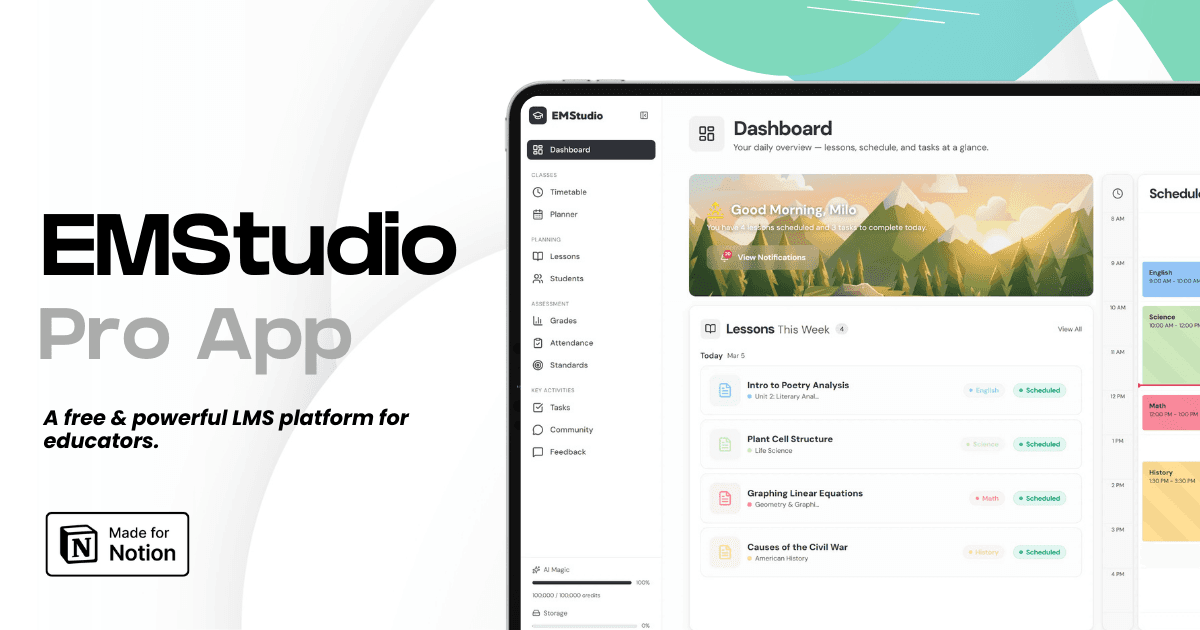
EMStudio is a free teaching management app — manage your classes, students, lessons, and more!
Learn More
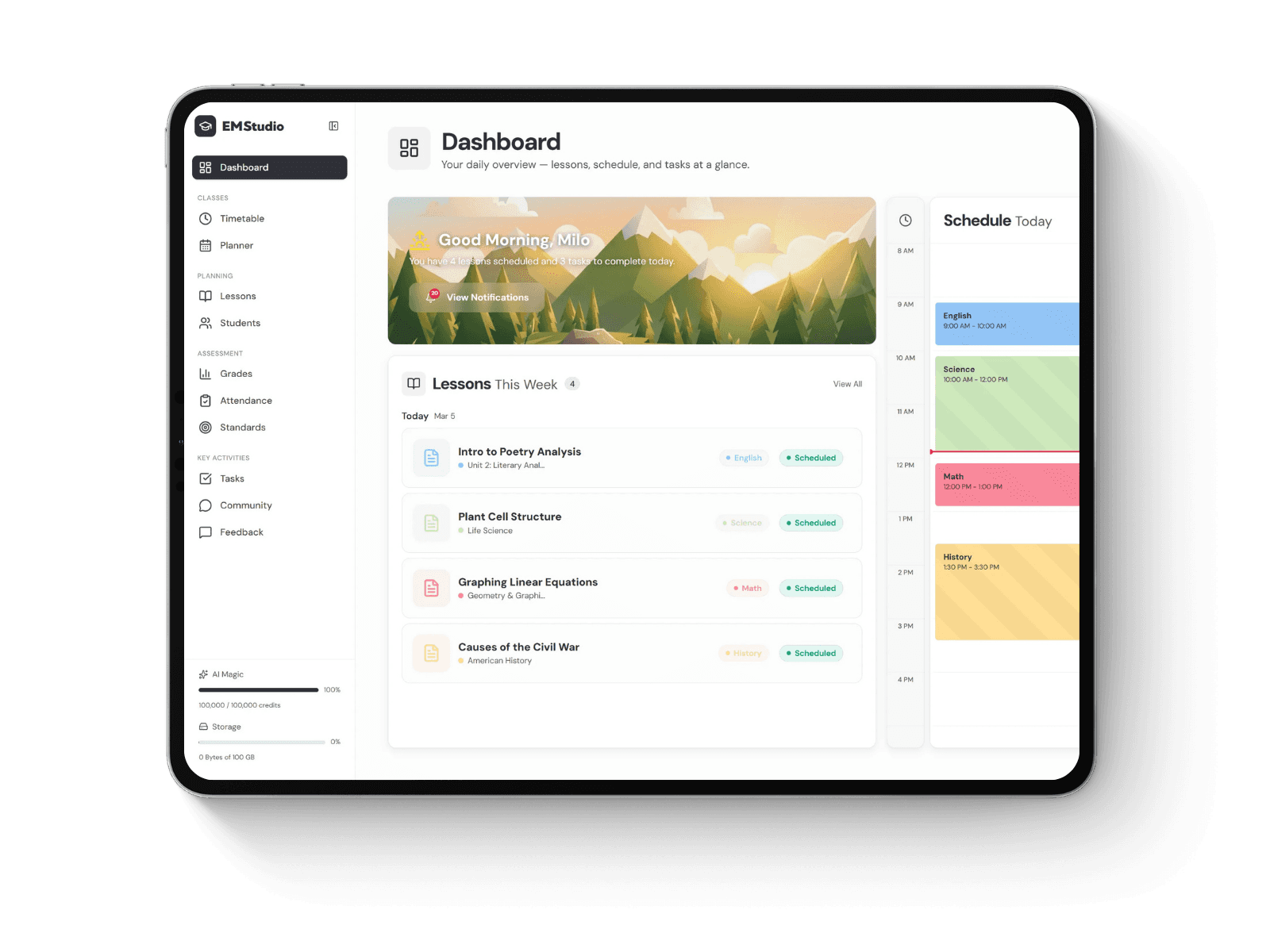
Still grading everything by hand?
EMStudio is a free teaching management app — manage your classes, students, lessons, and more!
Learn More
Table of Contents
What Are the Essential Classroom Management Technologies for Teachers?
You need three core technology for teachers stacks: engagement platforms like Nearpod to pull kids in, behavior trackers like PBIS Rewards to catch the good moments, and whiteboard software like Microsoft Whiteboard for thinking together. These cut your admin time in half while keeping eyes on the work.
Master one platform per category. Juggling five dashboards burns the mental energy you need for actual teaching.
Category | Cost | Device Requirements | Setup Time |
|---|---|---|---|
Real-Time Engagement (Nearpod, Pear Deck, ClassDojo) | Free–$125/year | Student devices | 10–15 minutes |
Behavior Tracking (ClassCraft, PBIS Rewards) | $4/student to custom pricing | Teacher device | 15–30 minutes |
Interactive Whiteboards (Jamboard, Microsoft Whiteboard) | Free to $3,000+ | Touchscreen or browser | 5–60 minutes |
If you have 1:1 Chromebooks, prioritize Nearpod or Pear Deck. With shared device carts, use ClassDojo for behavior first. No student devices? Focus on teacher-controlled whiteboard software until your hardware catches up.
Real-Time Student Engagement Platforms
Nearpod costs $120 yearly and gets you VR field trips plus forty interactive activities. Pear Deck lives inside Google Slides at $125 per year; kids drag responses across their screens. ClassDojo is free and handles digital portfolios with parent messaging.
Nearpod works best for grades 3–12 but caps free accounts at forty students.
ClassDojo dominates the K-5 elementary years.
Pear Deck suits grades 6–12 in Google districts.
Prioritize tools with draggable responses, drawing canvases, and collaborative boards. These features turn passive watching into doing.
Digital Behavior Tracking and Reward Systems
ClassCraft runs $4 per student annually and gamifies your room with avatars. PBIS Rewards scales school-wide with custom district pricing and tracks culture metrics. ClassDojo remains free, offering instant parent messaging alongside points.
ClassCraft: Budget fifteen minutes for setup, but thirty minutes to customize game rules.
PBIS Rewards: Requires IT coordination for roster syncing.
ClassDojo: Runs on five minutes of manual entry.
Start with our digital behavior tracking sheets if you want to test workflows before buying software.
Interactive Whiteboard and Display Software
Google Jamboard dies in October 2024; export to PDF or migrate to FigJam Education before deletion hits. Microsoft Whiteboard is free with Office 365 Education and offers an infinite canvas on any touchscreen. Promethean ActivInspire requires specific ActivPanel hardware costing $3,000-plus.
Microsoft Whiteboard: Works on any touchscreen you already own.
ActivInspire: Locks you into proprietary displays.
Jamboard: Needs only a browser, but that sunset clock is ticking.
See our guide on integrating interactive whiteboards in the classroom for migration checklists.

Assessment and Feedback Technology for Teachers
John Hattie's Visible Learning puts feedback effect size at 0.79—nearly double typical instruction growth. Rapid feedback technology for teachers compresses cycles from days to minutes. Teachers using AI grading assistants cut multiple-choice grading time by roughly 50% compared to manual methods.
AI-Powered Grading and Feedback Assistants
Gradescope runs $1.50 per student monthly. It handles bubble sheets and handwritten math. You scan papers, the AI clusters identical answers, and you grade once to apply scores to the entire batch. Turnitin Feedback Studio requires an institutional license but adds similarity checking and voice comments.
Gradescope dominates STEM and standardized responses. Turnitin fits writing-intensive subjects. Either way, budget 45 minutes for training to unlock full features. Never let AI grade creative writing without your eyes—it misses sarcasm, cultural context, and the kid who wrote a poem instead of an essay.
Formative Assessment and Polling Apps
Match the tool to your specific goal:
Kahoot! Best for test review energy. Free tier caps at 50 players; paid upgrades run $36/year.
Quizizz Homework mode and differentiation options shine. Full features cost $99/year.
Mentimeter Word clouds spark discussion. Free version limits you to 2 questions per slide.
Pick Kahoot! for Friday review games. Use Quizizz when you need leveled homework assignments. Grab Mentimeter before Socratic seminars to surface student questions anonymously.
Digital Portfolio and Progress Tracking Platforms
Three approaches to creating effective student portfolios:
Seesaw K-5 focus with family app integration. Plan 2 hours for full class setup.
Google Sites Better for 6-12 long-term student ownership. Twenty minutes gets you started.
Wakelet Curation-first and completely free. Ten-minute setup, but portfolios default public without an education account.
Seesaw requires parent consent for students under 13. Google Sites follows your district's Workspace privacy settings. Check compatibility with AI-powered grading and feedback assistants before committing.

Which Content Creation Tools Save Teachers the Most Time?
AI lesson plan generators like MagicSchool AI and Eduaide reduce prep time by 50-70%, while interactive video builders such as Edpuzzle and multimedia designers like Canva Education eliminate repetitive formatting work. These teacher tech tools automate resource creation, allowing educators to focus on differentiation rather than document design.
You can reclaim your Sunday evenings. The right technology for teachers cuts lesson planning from two hours to thirty minutes and shrinks worksheet design from forty-five minutes to ten. That is not marketing hype.
Test these tools with identical prompts: "Generate a 7th-grade NGSS-aligned lesson on photosynthesis—compare outputs for differentiation suggestions." You will spot which handles scaffolding and which delivers generic fluff.
Verify every output. AI hallucinates historical dates and miscalculates math problems. One wrong date in a timeline ruins your credibility. Check facts against your district curriculum before students see them. For a broader view of classroom applications and limitations, review this artificial intelligence resource before choosing a generator.
When comparing AI lesson plan generators, evaluate four factors:
Output Quality: Does it write usable objectives or just buzzword soup?
Standards Alignment: Is CCSS or state-specific tagging accurate and complete?
Customization Depth: Can you adjust for 504 plans, ELL levels, or reading accommodations?
Cost per Month: Does the free tier cover your actual weekly prep load?
AI Lesson Plan and Resource Generators
Eduaide costs $6 monthly and generates bell-ringers, exit tickets, and IEP modifications automatically. ChatGPT Plus runs $20 and requires custom instruction setup for consistent formatting, though it handles nuanced differentiation better. MagicSchool AI provides 100 free daily prompts and includes built-in math problem generators.
Input "5th-grade fractions, 45 minutes, include visual models" to each platform. Eduaide delivers three tiered versions instantly. ChatGPT requires explicit prompting. MagicSchool suggests scaffolding but keeps the activity single-level unless prompted.
Interactive Video and Multimedia Builders
Edpuzzle offers 30 free videos or $120 yearly for unlimited content with seamless YouTube integration. PlayPosit charges $249 annually but embeds directly into your LMS with advanced branching scenarios. H5P remains open-source and free, though you need WordPress or Drupal hosting for the deepest customization.
Time investment varies significantly. Adding five questions to a ten-minute video takes fifteen minutes in Edpuzzle. PlayPosit requires thirty minutes for branching scenarios that adapt based on wrong answers. H5P demands setup initially but pays dividends during iterative units.
Digital Worksheet and Infographic Designers
Canva Education remains free for teachers with 500+ education templates and one-click exports to Google Classroom. Genially costs $95 yearly and specializes in interactive infographics with clickable hotspots for virtual galleries. Google Docs costs nothing and excels at collaborative note-taking templates.
Use Canva for parent newsletters—ten minutes, done. Build interactive syllabi in Genially so students cannot claim they missed the late work policy. Reserve Google Docs for living documents. Canva wins for printables; Genially for digital galleries.

Communication and Parent Engagement Tech
Secure Two-Way Messaging Platforms
Remind is free and masks your phone number behind a 150-character limit with 10-language translation. ClassDojo runs free with a $60 premium option, offering unlimited messages, read receipts, and 35 languages. TalkingPoints stays free for teachers and handles 100+ languages, optimized for families who don't speak English at home.
These apps provide practical technology for teachers managing diverse classrooms. Check our guide on parent communication strategies for modern teachers for implementation tips.
Remind works through SMS—parents text your class code without downloading anything. ClassDojo requires the app. TalkingPoints translates both directions automatically. Each takes about five minutes to set up.
Set boundaries. Turn off notifications after 6 PM. Parents will message you at 11 PM if you let them. These apps blur the line between home and school—guard your time aggressively.
Automated Newsletter and Announcement Creators
I used to spend 45 minutes formatting paper newsletters in Word, saving them as PDFs, and attaching them to emails. Smore, Canva, or Mailchimp drop that to 10 minutes using drag-and-drop templates. Smore costs $79 yearly for educators and tracks open rates. Canva stays free with gorgeous layouts but zero analytics. Mailchimp handles up to 500 contacts free, though the interface overwhelms.
Choose Smore if you need proof parents read your updates. Pick Canva for visual appeal on a budget. Reserve Mailchimp for school-wide communications managers. These educational software options work best when matched to actual needs, not shiny features.
Always check COPPA compliance before importing student names into any newsletter platform. If your roster includes kids under 13, verify the tool meets federal data privacy standards or risk district penalties.
Virtual Conference and Meeting Scheduling Tools
Three options cover different budgets.
Google Calendar Appointment Slots: Free, simplest, no external accounts needed.
Calendly: Free for one event type, $96 yearly for unlimited scheduling.
SignUpGenius: Free for volunteer signups, $120 yearly if you collect payments.
Never use Calendly or SignUpGenius for IEP meetings, 504 reviews, or disciplinary conferences. These platforms lack FERPA-compliant security. Always schedule sensitive meetings through your district's secure portal to protect student privacy.
Before downloading any scheduling or instructional technology, verify three things: COPPA compliance for students under 13, FERPA protection for education records, and explicit district IT approval. One non-compliant screenshot shared accidentally becomes a firing risk. Stick to approved teacher technology tools only.

Organization and Workflow Automation Tools
Smart technology for teachers cuts busywork. Automating attendance with Google Forms drops daily taking from five minutes to thirty seconds. Digital planners slash weekly prep from forty-five minutes to fifteen. But beware over-engineering: I once spent three hours building a folder system with seventeen subcategories. Searching took longer than the messy desktop. Keep your classroom technology integration simple.
All-in-One Digital Teacher Planners
Choosing an all-in-one digital teacher planner depends on your setup tolerance. Planbook costs $15 yearly with drag-drop lessons and fifty state standards pre-loaded. Its "bump" feature shifts schedules when assemblies strike. Planboard is free with basic Google Classroom integration and co-teacher collaboration. Google Sheets costs nothing and offers infinite customization, though you need formula knowledge. Sheets works if you love tinkering. Planbook works if you just want to teach.
Feature | Planbook | Planboard | Google Sheets |
|---|---|---|---|
Standards Alignment | Pre-loaded | Limited | Manual entry |
Google Classroom Integration | Moderate | Basic | None (manual) |
Mobile App Quality | Excellent | Good | Functional |
Automated Attendance and Seating Chart Systems
You have three real options for this daily task. Google Forms with timestamp is free and takes five minutes to set up; responses auto-populate a spreadsheet. TeachPoint comes district-purchased and comprehensive, but expensive and complex. Seesaw integrates with student portfolios and offers friendly check-in features for younger kids.
To build the Forms method:
Create a dropdown with student names.
Add Present, Absent, or Tardy multiple choice.
Set the form to collect timestamps.
Project the QR code for student check-in.
You verify the sheet once to confirm.
Cloud-Based Resource Libraries and Tagging Systems
Your cloud-based digital resource library needs a rigid naming system or it becomes a junk drawer. Use this taxonomy: Subject_Grade_Unit_Date_ResourceType. Example: Math_7th_Ratios_2024Q2_Worksheet.
Google Drive offers color-coded folders and 15GB free. Notion provides relational databases for $48 yearly. Padlet gives visual boards with three free padlets.
Combine Drive's color coding—Red for Urgent, Blue for Resources, Green for Assessments—with search operators like type:pdf Math 7th. This educational software approach beats fifty nested folders. If tagging takes longer than searching, you have over-engineered the system.

Professional Development and Collaboration Platforms
Teacher Community and Discussion Forums
Reddit r/Teachers hosts over 800,000 educators trading anonymous advice. It is where you vent without your principal watching.
Facebook Groups like "First Grade Teachers" or "Bilingual Education" offer immediate troubleshooting. Someone uploads a worksheet at 7:45 AM; by 8:00 AM, three colleagues have tweaked it.
Edutopia runs moderated discussions focused on research-backed strategies. Head here when you need evidence that a method actually moves student data.
Match the platform to your need. Use Reddit for asynchronous perspective, Facebook for real-time file sharing, and Edutopia for long-form case studies. These spaces function as digital professional learning communities and teacher forums.
Micro-Credentialing and Skill Tracking Apps
BloomBoard partners with districts to offer $75 micro-courses that stack into graduate credit. Digital Promise provides free competency-based badge stacks. Canvas Credentials integrates directly with your district's existing PD tracking system.
Most badges require 10 to 15 hours of work. Districts typically advance salary schedules by $500 to $2,000 annually for these credentials. That beats the $500 stipend for a 30-hour seat-time workshop.
Do not hoard digital trophies. Before uploading your next badge to your evaluation folder, attach student work samples or assessment data proving the skill changed your instruction. Otherwise, you have just collected stickers.
Peer Observation and Coaching Recording Tools
Swivl ($399) follows you with a wearable marker and captures 360-degree audio. It needs 30 minutes of calibration, unlike a $25 phone tripod that only works if you stand still.
Edthena ($50/year) lets coaches leave time-stamped comments. Your district must sign a data privacy agreement before you upload.
Loom is free for 25 videos and works immediately, though it only records your screen, not the full classroom soundscape.
Choose hardware based on your coaching goals. If you need to hear student discussions, invest in the robot. If you just need to review your own board work, Loom suffices. This targeted technology for teachers beats generic observation forms.

How to Build Your Teacher Technology Stack Without Overspending?
Start by auditing your current digital spending, then identify one 'anchor' platform (typically your LMS) before adding specialized technology for teachers. Use 30-day free trials, negotiate education pricing (often 40-60% below commercial rates), and prioritize tools with free teacher tiers like Canva Education or Planboard. Calculate ROI by comparing subscription costs against hourly time savings.
Most teachers bleed money on forgotten subscriptions. Pull your last twelve months of credit card statements and sort every technology tool for teachers to use in the classroom into three buckets. Free options like Google Workspace, Planboard, and Canva Education cost nothing but time. Mid-tier educational software like Planbook or Eduaide runs $50-100 yearly. Comprehensive suites like Nearpod or PlayPosit top $200. If you're paying for two tools that both make quizzes, cancel one today.
Pick your anchor before you shop. This is usually your LMS—Google Classroom, Canvas, or Schoology. Every supplemental tool must talk to it. I learned this the hard way when I bought a beautiful gradebook that wouldn't export to PowerSchool. Smart classroom technology integration starts with your data pipeline. Your anchor determines what flows where, so choose stability over flash.
Run a 30-day trial with your actual students, not the demo class. Load it with 32 kids and see if it breaks. Check three things before you buy:
Can it handle your largest class size without lag?
Can you export grades or student work when the trial ends?
Does the mobile app actually work, or is it just a shrunken website?
Test with one period before you ask your principal for site-wide licenses. This prevents the "it worked fine in August" disaster.
Do the math. (Hours Saved Weekly × Your Hourly Rate × 36 Weeks) − Annual Cost = Net Value. If a $60 tool saves you two hours monthly, it pays for itself. I calculate my time at $35/hour—substitute pay in my district. Two hours saved weekly equals $2,520 yearly value. Subtract the subscription. If the number is red, cancel. Most teacher productivity software breaks even at two hours saved per month.
Email sales directly. Ask for the "teacher rate" or "education pricing." Most instructional technology vendors like Smore, Nearpod, and Pear Deck list commercial prices but hide 40-60% discounts for educators. Mention your student count and your district's procurement process. Sometimes they'll throw in features to close the deal. It feels weird to haggle, but these budgets come from your classroom supply fund.
Watch for three traps. Shiny object syndrome hits in August when every blended learning tool looks transformative. Buy for the workflow you have, not the teacher you want to become. Don't pay for district licenses when a classroom account suffices—start small. Finally, avoid feature overlap. If you're paying for Formative and Gimkit and Blooket, you're running three assessment tools. Pick one. Integrating educational technology seamlessly means fewer, better tools, not more subscriptions.

The Bigger Picture on Technology For Teachers
You don't need eighteen new logins by Monday. Pick one tool from classroom management, one from assessment and feedback, and one from communication and parent engagement. These three form the spine of your day. Everything else — the content creation apps, the automation workflows, the PD platforms — builds outward from there. If your core trio doesn't save you ten minutes daily, the rest won't matter.
Start with free tiers. Most educational software companies bank on districts buying bulk licenses, but their free versions handle a single classroom just fine. Test for three weeks. If you haven't opened an app in that time, delete it. Good instructional technology should feel invisible, not like another job. The best blended learning tools are the ones your students use without asking for help, and that give you gradebook data without extra clicks.
Next year, you can add the fourth tool. Master your stack before you expand it.

What Are the Essential Classroom Management Technologies for Teachers?
You need three core technology for teachers stacks: engagement platforms like Nearpod to pull kids in, behavior trackers like PBIS Rewards to catch the good moments, and whiteboard software like Microsoft Whiteboard for thinking together. These cut your admin time in half while keeping eyes on the work.
Master one platform per category. Juggling five dashboards burns the mental energy you need for actual teaching.
Category | Cost | Device Requirements | Setup Time |
|---|---|---|---|
Real-Time Engagement (Nearpod, Pear Deck, ClassDojo) | Free–$125/year | Student devices | 10–15 minutes |
Behavior Tracking (ClassCraft, PBIS Rewards) | $4/student to custom pricing | Teacher device | 15–30 minutes |
Interactive Whiteboards (Jamboard, Microsoft Whiteboard) | Free to $3,000+ | Touchscreen or browser | 5–60 minutes |
If you have 1:1 Chromebooks, prioritize Nearpod or Pear Deck. With shared device carts, use ClassDojo for behavior first. No student devices? Focus on teacher-controlled whiteboard software until your hardware catches up.
Real-Time Student Engagement Platforms
Nearpod costs $120 yearly and gets you VR field trips plus forty interactive activities. Pear Deck lives inside Google Slides at $125 per year; kids drag responses across their screens. ClassDojo is free and handles digital portfolios with parent messaging.
Nearpod works best for grades 3–12 but caps free accounts at forty students.
ClassDojo dominates the K-5 elementary years.
Pear Deck suits grades 6–12 in Google districts.
Prioritize tools with draggable responses, drawing canvases, and collaborative boards. These features turn passive watching into doing.
Digital Behavior Tracking and Reward Systems
ClassCraft runs $4 per student annually and gamifies your room with avatars. PBIS Rewards scales school-wide with custom district pricing and tracks culture metrics. ClassDojo remains free, offering instant parent messaging alongside points.
ClassCraft: Budget fifteen minutes for setup, but thirty minutes to customize game rules.
PBIS Rewards: Requires IT coordination for roster syncing.
ClassDojo: Runs on five minutes of manual entry.
Start with our digital behavior tracking sheets if you want to test workflows before buying software.
Interactive Whiteboard and Display Software
Google Jamboard dies in October 2024; export to PDF or migrate to FigJam Education before deletion hits. Microsoft Whiteboard is free with Office 365 Education and offers an infinite canvas on any touchscreen. Promethean ActivInspire requires specific ActivPanel hardware costing $3,000-plus.
Microsoft Whiteboard: Works on any touchscreen you already own.
ActivInspire: Locks you into proprietary displays.
Jamboard: Needs only a browser, but that sunset clock is ticking.
See our guide on integrating interactive whiteboards in the classroom for migration checklists.
Assessment and Feedback Technology for Teachers
John Hattie's Visible Learning puts feedback effect size at 0.79—nearly double typical instruction growth. Rapid feedback technology for teachers compresses cycles from days to minutes. Teachers using AI grading assistants cut multiple-choice grading time by roughly 50% compared to manual methods.
AI-Powered Grading and Feedback Assistants
Gradescope runs $1.50 per student monthly. It handles bubble sheets and handwritten math. You scan papers, the AI clusters identical answers, and you grade once to apply scores to the entire batch. Turnitin Feedback Studio requires an institutional license but adds similarity checking and voice comments.
Gradescope dominates STEM and standardized responses. Turnitin fits writing-intensive subjects. Either way, budget 45 minutes for training to unlock full features. Never let AI grade creative writing without your eyes—it misses sarcasm, cultural context, and the kid who wrote a poem instead of an essay.
Formative Assessment and Polling Apps
Match the tool to your specific goal:
Kahoot! Best for test review energy. Free tier caps at 50 players; paid upgrades run $36/year.
Quizizz Homework mode and differentiation options shine. Full features cost $99/year.
Mentimeter Word clouds spark discussion. Free version limits you to 2 questions per slide.
Pick Kahoot! for Friday review games. Use Quizizz when you need leveled homework assignments. Grab Mentimeter before Socratic seminars to surface student questions anonymously.
Digital Portfolio and Progress Tracking Platforms
Three approaches to creating effective student portfolios:
Seesaw K-5 focus with family app integration. Plan 2 hours for full class setup.
Google Sites Better for 6-12 long-term student ownership. Twenty minutes gets you started.
Wakelet Curation-first and completely free. Ten-minute setup, but portfolios default public without an education account.
Seesaw requires parent consent for students under 13. Google Sites follows your district's Workspace privacy settings. Check compatibility with AI-powered grading and feedback assistants before committing.
Which Content Creation Tools Save Teachers the Most Time?
AI lesson plan generators like MagicSchool AI and Eduaide reduce prep time by 50-70%, while interactive video builders such as Edpuzzle and multimedia designers like Canva Education eliminate repetitive formatting work. These teacher tech tools automate resource creation, allowing educators to focus on differentiation rather than document design.
You can reclaim your Sunday evenings. The right technology for teachers cuts lesson planning from two hours to thirty minutes and shrinks worksheet design from forty-five minutes to ten. That is not marketing hype.
Test these tools with identical prompts: "Generate a 7th-grade NGSS-aligned lesson on photosynthesis—compare outputs for differentiation suggestions." You will spot which handles scaffolding and which delivers generic fluff.
Verify every output. AI hallucinates historical dates and miscalculates math problems. One wrong date in a timeline ruins your credibility. Check facts against your district curriculum before students see them. For a broader view of classroom applications and limitations, review this artificial intelligence resource before choosing a generator.
When comparing AI lesson plan generators, evaluate four factors:
Output Quality: Does it write usable objectives or just buzzword soup?
Standards Alignment: Is CCSS or state-specific tagging accurate and complete?
Customization Depth: Can you adjust for 504 plans, ELL levels, or reading accommodations?
Cost per Month: Does the free tier cover your actual weekly prep load?
AI Lesson Plan and Resource Generators
Eduaide costs $6 monthly and generates bell-ringers, exit tickets, and IEP modifications automatically. ChatGPT Plus runs $20 and requires custom instruction setup for consistent formatting, though it handles nuanced differentiation better. MagicSchool AI provides 100 free daily prompts and includes built-in math problem generators.
Input "5th-grade fractions, 45 minutes, include visual models" to each platform. Eduaide delivers three tiered versions instantly. ChatGPT requires explicit prompting. MagicSchool suggests scaffolding but keeps the activity single-level unless prompted.
Interactive Video and Multimedia Builders
Edpuzzle offers 30 free videos or $120 yearly for unlimited content with seamless YouTube integration. PlayPosit charges $249 annually but embeds directly into your LMS with advanced branching scenarios. H5P remains open-source and free, though you need WordPress or Drupal hosting for the deepest customization.
Time investment varies significantly. Adding five questions to a ten-minute video takes fifteen minutes in Edpuzzle. PlayPosit requires thirty minutes for branching scenarios that adapt based on wrong answers. H5P demands setup initially but pays dividends during iterative units.
Digital Worksheet and Infographic Designers
Canva Education remains free for teachers with 500+ education templates and one-click exports to Google Classroom. Genially costs $95 yearly and specializes in interactive infographics with clickable hotspots for virtual galleries. Google Docs costs nothing and excels at collaborative note-taking templates.
Use Canva for parent newsletters—ten minutes, done. Build interactive syllabi in Genially so students cannot claim they missed the late work policy. Reserve Google Docs for living documents. Canva wins for printables; Genially for digital galleries.
Communication and Parent Engagement Tech
Secure Two-Way Messaging Platforms
Remind is free and masks your phone number behind a 150-character limit with 10-language translation. ClassDojo runs free with a $60 premium option, offering unlimited messages, read receipts, and 35 languages. TalkingPoints stays free for teachers and handles 100+ languages, optimized for families who don't speak English at home.
These apps provide practical technology for teachers managing diverse classrooms. Check our guide on parent communication strategies for modern teachers for implementation tips.
Remind works through SMS—parents text your class code without downloading anything. ClassDojo requires the app. TalkingPoints translates both directions automatically. Each takes about five minutes to set up.
Set boundaries. Turn off notifications after 6 PM. Parents will message you at 11 PM if you let them. These apps blur the line between home and school—guard your time aggressively.
Automated Newsletter and Announcement Creators
I used to spend 45 minutes formatting paper newsletters in Word, saving them as PDFs, and attaching them to emails. Smore, Canva, or Mailchimp drop that to 10 minutes using drag-and-drop templates. Smore costs $79 yearly for educators and tracks open rates. Canva stays free with gorgeous layouts but zero analytics. Mailchimp handles up to 500 contacts free, though the interface overwhelms.
Choose Smore if you need proof parents read your updates. Pick Canva for visual appeal on a budget. Reserve Mailchimp for school-wide communications managers. These educational software options work best when matched to actual needs, not shiny features.
Always check COPPA compliance before importing student names into any newsletter platform. If your roster includes kids under 13, verify the tool meets federal data privacy standards or risk district penalties.
Virtual Conference and Meeting Scheduling Tools
Three options cover different budgets.
Google Calendar Appointment Slots: Free, simplest, no external accounts needed.
Calendly: Free for one event type, $96 yearly for unlimited scheduling.
SignUpGenius: Free for volunteer signups, $120 yearly if you collect payments.
Never use Calendly or SignUpGenius for IEP meetings, 504 reviews, or disciplinary conferences. These platforms lack FERPA-compliant security. Always schedule sensitive meetings through your district's secure portal to protect student privacy.
Before downloading any scheduling or instructional technology, verify three things: COPPA compliance for students under 13, FERPA protection for education records, and explicit district IT approval. One non-compliant screenshot shared accidentally becomes a firing risk. Stick to approved teacher technology tools only.
Organization and Workflow Automation Tools
Smart technology for teachers cuts busywork. Automating attendance with Google Forms drops daily taking from five minutes to thirty seconds. Digital planners slash weekly prep from forty-five minutes to fifteen. But beware over-engineering: I once spent three hours building a folder system with seventeen subcategories. Searching took longer than the messy desktop. Keep your classroom technology integration simple.
All-in-One Digital Teacher Planners
Choosing an all-in-one digital teacher planner depends on your setup tolerance. Planbook costs $15 yearly with drag-drop lessons and fifty state standards pre-loaded. Its "bump" feature shifts schedules when assemblies strike. Planboard is free with basic Google Classroom integration and co-teacher collaboration. Google Sheets costs nothing and offers infinite customization, though you need formula knowledge. Sheets works if you love tinkering. Planbook works if you just want to teach.
Feature | Planbook | Planboard | Google Sheets |
|---|---|---|---|
Standards Alignment | Pre-loaded | Limited | Manual entry |
Google Classroom Integration | Moderate | Basic | None (manual) |
Mobile App Quality | Excellent | Good | Functional |
Automated Attendance and Seating Chart Systems
You have three real options for this daily task. Google Forms with timestamp is free and takes five minutes to set up; responses auto-populate a spreadsheet. TeachPoint comes district-purchased and comprehensive, but expensive and complex. Seesaw integrates with student portfolios and offers friendly check-in features for younger kids.
To build the Forms method:
Create a dropdown with student names.
Add Present, Absent, or Tardy multiple choice.
Set the form to collect timestamps.
Project the QR code for student check-in.
You verify the sheet once to confirm.
Cloud-Based Resource Libraries and Tagging Systems
Your cloud-based digital resource library needs a rigid naming system or it becomes a junk drawer. Use this taxonomy: Subject_Grade_Unit_Date_ResourceType. Example: Math_7th_Ratios_2024Q2_Worksheet.
Google Drive offers color-coded folders and 15GB free. Notion provides relational databases for $48 yearly. Padlet gives visual boards with three free padlets.
Combine Drive's color coding—Red for Urgent, Blue for Resources, Green for Assessments—with search operators like type:pdf Math 7th. This educational software approach beats fifty nested folders. If tagging takes longer than searching, you have over-engineered the system.
Professional Development and Collaboration Platforms
Teacher Community and Discussion Forums
Reddit r/Teachers hosts over 800,000 educators trading anonymous advice. It is where you vent without your principal watching.
Facebook Groups like "First Grade Teachers" or "Bilingual Education" offer immediate troubleshooting. Someone uploads a worksheet at 7:45 AM; by 8:00 AM, three colleagues have tweaked it.
Edutopia runs moderated discussions focused on research-backed strategies. Head here when you need evidence that a method actually moves student data.
Match the platform to your need. Use Reddit for asynchronous perspective, Facebook for real-time file sharing, and Edutopia for long-form case studies. These spaces function as digital professional learning communities and teacher forums.
Micro-Credentialing and Skill Tracking Apps
BloomBoard partners with districts to offer $75 micro-courses that stack into graduate credit. Digital Promise provides free competency-based badge stacks. Canvas Credentials integrates directly with your district's existing PD tracking system.
Most badges require 10 to 15 hours of work. Districts typically advance salary schedules by $500 to $2,000 annually for these credentials. That beats the $500 stipend for a 30-hour seat-time workshop.
Do not hoard digital trophies. Before uploading your next badge to your evaluation folder, attach student work samples or assessment data proving the skill changed your instruction. Otherwise, you have just collected stickers.
Peer Observation and Coaching Recording Tools
Swivl ($399) follows you with a wearable marker and captures 360-degree audio. It needs 30 minutes of calibration, unlike a $25 phone tripod that only works if you stand still.
Edthena ($50/year) lets coaches leave time-stamped comments. Your district must sign a data privacy agreement before you upload.
Loom is free for 25 videos and works immediately, though it only records your screen, not the full classroom soundscape.
Choose hardware based on your coaching goals. If you need to hear student discussions, invest in the robot. If you just need to review your own board work, Loom suffices. This targeted technology for teachers beats generic observation forms.
How to Build Your Teacher Technology Stack Without Overspending?
Start by auditing your current digital spending, then identify one 'anchor' platform (typically your LMS) before adding specialized technology for teachers. Use 30-day free trials, negotiate education pricing (often 40-60% below commercial rates), and prioritize tools with free teacher tiers like Canva Education or Planboard. Calculate ROI by comparing subscription costs against hourly time savings.
Most teachers bleed money on forgotten subscriptions. Pull your last twelve months of credit card statements and sort every technology tool for teachers to use in the classroom into three buckets. Free options like Google Workspace, Planboard, and Canva Education cost nothing but time. Mid-tier educational software like Planbook or Eduaide runs $50-100 yearly. Comprehensive suites like Nearpod or PlayPosit top $200. If you're paying for two tools that both make quizzes, cancel one today.
Pick your anchor before you shop. This is usually your LMS—Google Classroom, Canvas, or Schoology. Every supplemental tool must talk to it. I learned this the hard way when I bought a beautiful gradebook that wouldn't export to PowerSchool. Smart classroom technology integration starts with your data pipeline. Your anchor determines what flows where, so choose stability over flash.
Run a 30-day trial with your actual students, not the demo class. Load it with 32 kids and see if it breaks. Check three things before you buy:
Can it handle your largest class size without lag?
Can you export grades or student work when the trial ends?
Does the mobile app actually work, or is it just a shrunken website?
Test with one period before you ask your principal for site-wide licenses. This prevents the "it worked fine in August" disaster.
Do the math. (Hours Saved Weekly × Your Hourly Rate × 36 Weeks) − Annual Cost = Net Value. If a $60 tool saves you two hours monthly, it pays for itself. I calculate my time at $35/hour—substitute pay in my district. Two hours saved weekly equals $2,520 yearly value. Subtract the subscription. If the number is red, cancel. Most teacher productivity software breaks even at two hours saved per month.
Email sales directly. Ask for the "teacher rate" or "education pricing." Most instructional technology vendors like Smore, Nearpod, and Pear Deck list commercial prices but hide 40-60% discounts for educators. Mention your student count and your district's procurement process. Sometimes they'll throw in features to close the deal. It feels weird to haggle, but these budgets come from your classroom supply fund.
Watch for three traps. Shiny object syndrome hits in August when every blended learning tool looks transformative. Buy for the workflow you have, not the teacher you want to become. Don't pay for district licenses when a classroom account suffices—start small. Finally, avoid feature overlap. If you're paying for Formative and Gimkit and Blooket, you're running three assessment tools. Pick one. Integrating educational technology seamlessly means fewer, better tools, not more subscriptions.
The Bigger Picture on Technology For Teachers
You don't need eighteen new logins by Monday. Pick one tool from classroom management, one from assessment and feedback, and one from communication and parent engagement. These three form the spine of your day. Everything else — the content creation apps, the automation workflows, the PD platforms — builds outward from there. If your core trio doesn't save you ten minutes daily, the rest won't matter.
Start with free tiers. Most educational software companies bank on districts buying bulk licenses, but their free versions handle a single classroom just fine. Test for three weeks. If you haven't opened an app in that time, delete it. Good instructional technology should feel invisible, not like another job. The best blended learning tools are the ones your students use without asking for help, and that give you gradebook data without extra clicks.
Next year, you can add the fourth tool. Master your stack before you expand it.
Still grading everything by hand?
EMStudio is a free teaching management app — manage your classes, students, lessons, and more!
Learn More
Still grading everything by hand?
EMStudio is a free teaching management app — manage your classes, students, lessons, and more!
Learn More




Notion4Teachers
Notion templates to simplify administrative tasks and enhance your teaching experience.



2026 Notion4Teachers. All Rights Reserved.
Notion4Teachers
Notion templates to simplify administrative tasks and enhance your teaching experience.
2026 Notion4Teachers. All Rights Reserved.
Notion4Teachers
Notion templates to simplify administrative tasks and enhance your teaching experience.
2026 Notion4Teachers. All Rights Reserved.