
Teaching Students: A 4-Step Classroom Framework
Teaching Students: A 4-Step Classroom Framework

Article by
Milo
ESL Content Coordinator & Educator
ESL Content Coordinator & Educator
All Posts
Teaching students isn't about collecting the newest strategies or filling your toolkit with buzzwords. It's about having a system that works when your classroom management is falling apart. Half your kids are lost. The lesson plan is useless. After fifteen years in classrooms, I know this: most teachers don't fail because they lack heart. They fail because they're drowning in complexity without a clear framework.
This post cuts through the noise. I'll walk you through four steps that hold up during real instruction. You'll define learning objectives that stick. You'll build scaffolding that supports without enabling. You'll drive student engagement through active work, not passive listening. You'll use formative assessment to adjust on the fly. No theory that falls apart at 2:00 PM on a Tuesday. Just a practical sequence for teaching students that you can use tomorrow.
Still grading everything by hand?
EMStudio is a free teaching management app — manage your classes, students, lessons, and more!
Learn More
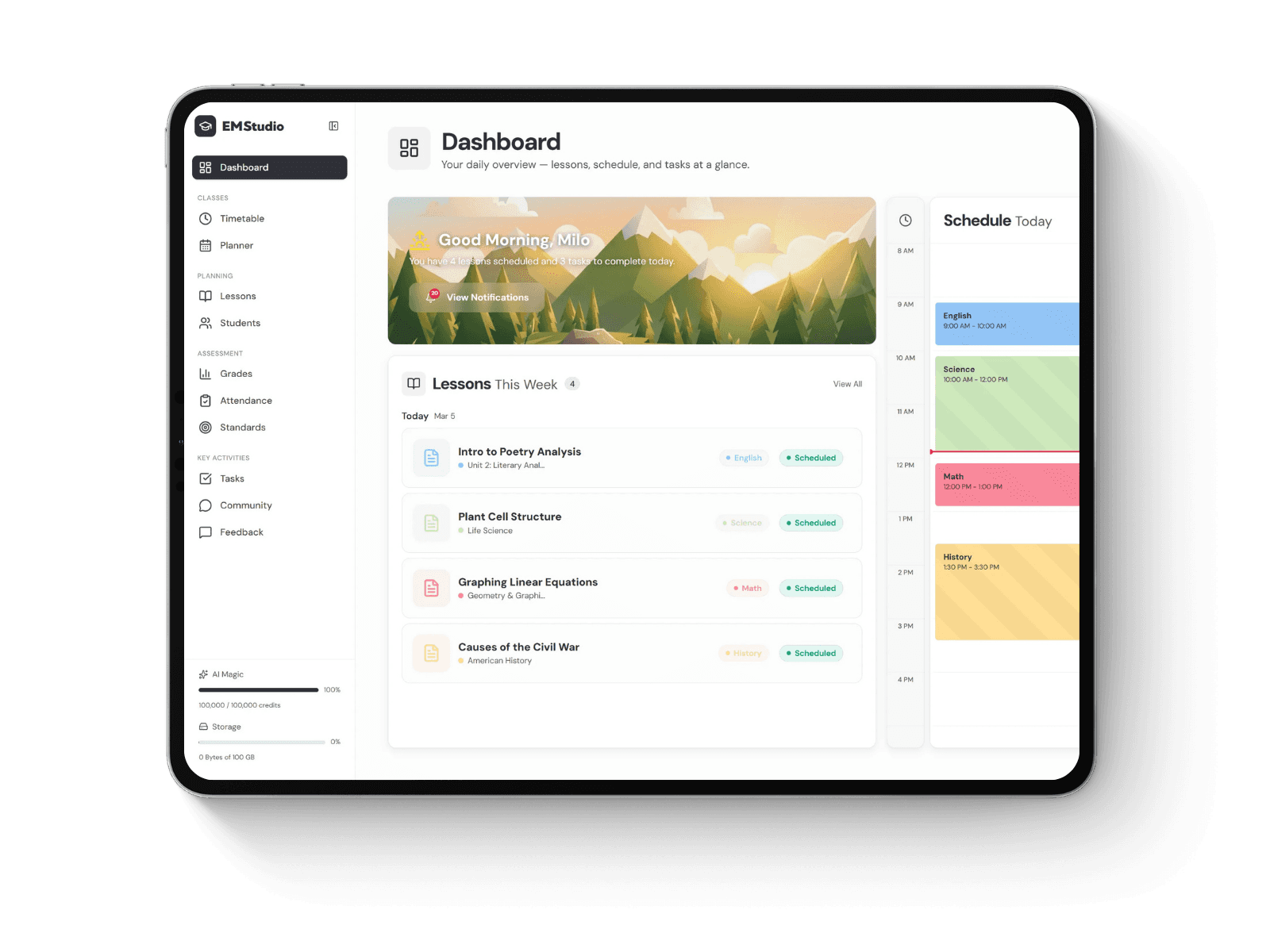
Still grading everything by hand?
EMStudio is a free teaching management app — manage your classes, students, lessons, and more!
Learn More
Table of Contents
Prerequisites — What Effective Teaching for Students Actually Requires
Effective teaching for students rests on three sequential gates. Diagnostic assessment happens Days 1-2. Management systems lock down by Week 1. Your instructional toolkit runs ongoing. Skip any step and you hit October chaos—that moment when unprepared classrooms collapse under content demands because you never built the foundation.
Invest five hours in this prerequisite setup now. You will save forty-plus hours of remediation and behavioral interruptions over the semester. These principles work from kindergarten through higher education. I have watched 3rd-grade reading teachers and 11th-grade chemistry instructors use this same framework to keep their heads above water while others drowned in paperwork.
Mapping Your Students' Prior Knowledge Baseline
Deploy the KWL Plus diagnostic within 48 hours. Students complete a three-column chart—Know, Want to know, Learned—followed by a five-question low-stakes Google Forms quiz or paper exit ticket. This gives you hard data on learning objectives and gaps.
Set your intervention threshold immediately. If sixty percent or more students miss the same prerequisite concept—like fractions in Algebra 1—schedule a twenty-minute reteach before introducing new material. Do not push forward into quicksand.
Adapt this across grade levels. Ninth-grade biology teachers run a ten-item pre-test on cellular structures. Seventh-grade ELA teachers conduct oral questioning circles with five comprehension prompts. Both identify who needs scaffolding before the real work begins.
Establishing Non-Negotiable Classroom Management Systems
Establishing non-negotiable classroom management systems starts with CHAMPS. For every activity, define Conversation level, Help method, Activity objective, Movement allowed, Participation signal, and Success criteria on a visible poster. Students cannot hit a target they cannot see.
Train three attention signals—perhaps "Class-Yes," a chime, or a countdown—and drill until execution takes under three seconds with full compliance. Seconds matter when you're teaching students who are still learning to regulate themselves in a structured environment.
Script every transition. Students collect a "Do Now" within thirty seconds of entering and submit exit tickets to a tray before dismissal. Post the checklist at the door so the routine becomes muscle memory, not a daily negotiation.
Curating Your Essential Instructional Toolkit
Assemble a physical toolkit costing under one hundred fifty dollars. Buy a class set of thirty-two individual whiteboards with markers, Plickers cards A-D for device-free polling, a visible countdown timer, and a document camera for live modeling. These four items drive more student engagement than any wall-mounted interactive display.
Curate your digital essentials. You need a learning management system like Google Classroom or Canvas, a formative assessment platform such as Kahoot!, Quizizz, or Pear Deck, and a behavior tracking system like ClassDojo or a simple clipboard checklist.
Title I funds often cover these supplies. If you are paying out of pocket, use laminated paper with dry-erase markers and free versions of Mentimeter for polling. The goal is responsiveness and differentiated instruction, not expensive gear.
Step 1 — Define Clear Outcomes Before You Teach Any Course
Vague objectives burn instructional minutes. When you tell 7th graders they will "understand photosynthesis," nobody knows what success looks like. Kids guess. You reteach. The period ends.
John Hattie's research validates what tired teachers already suspect. Teacher clarity carries an effect size of 0.75—double the average intervention. When you explicitly define learning intentions, teaching students accelerates. They see the target. They hit it.
Weak Objective | Measurable Objective |
|---|---|
Students will understand photosynthesis. | Students will diagram the light-dependent reactions with 90% accuracy. |
Students will learn about the Civil War. | Students will compare Union and Confederate economic advantages using primary source data. |
Students will know fractions. | Students will convert mixed numbers to improper fractions in 4 out of 5 attempts. |
Students will appreciate poetry. | Students will identify three literary devices in a sonnet and explain their effect on tone. |
Students will study grammar. | Students will revise paragraphs to eliminate comma splices with 100% accuracy. |
Backward design prevents this drift. Start with your unit summative assessment. Identify the 3-5 component skills required to pass it. Then sequence daily objectives to build those skills progressively. If the final demands a persuasive essay, your daily objectives might target claim construction, evidence selection, and rebuttal drafting—each with concrete success criteria.
Writing Measurable Objectives Using Action Verbs
Ditch "understand," "know," and "learn." You cannot grade understanding. You can grade action. These words hide weak planning.
Use Bloom's Taxonomy verbs that show thinking. Have students analyze, synthesize, classify, or construct. These reveal cognition. Follow the formula: "Students will [action verb] + [content] + [measure of success]." Example: "Students will solve 8 out of 10 two-digit multiplication problems using the standard algorithm within 15 minutes."
Keep this cheat sheet taped to your desk:
Define (Remember)
Compare (Understand)
Predict (Apply)
Demonstrate (Apply)
Interpret (Analyze)
Evaluate (Evaluate)
Justify (Evaluate)
Design (Create)
Aligning Daily Goals With Long-Term Curriculum Standards
Map the chain. State Standard CCSS.ELA-LITERACY.RL.9-10.1 becomes Unit Goal "cite textual evidence" becomes Daily Objective "underline 3 quotes supporting character analysis." When aligning daily goals with long-term curriculum standards, visibility prevents drift.
Build in 20% flex days. If formative data shows less than 70% mastery on a standard, use the buffer to reteach. Do not advance to thesis statements when half the class cannot identify a claim.
Post your pacing guide. Show students which standard lives on which day and how it connects to the upcoming assessment. Transparency kills anxiety.
Communicating Expectations Explicitly on Day One
Hand out a one-page Success Criteria sheet. List 3-5 concrete skills, 2-3 major projects, and the grade breakdown—participation 20%, assessments 80%. No surprises.
Run the "Unwrapping the Standard" activity. Project the standard text. Have students highlight action verbs and key nouns. Translate these into "I can" statements. Post them on the wall. When kids ask "why are we doing this," point to the wall.
Establish help protocols within the first 10 minutes. Implement "Ask 3 Before Me." Post office hours. Stop procedural interruptions before they start.
Step 2 — Structure Lessons That Make Complex Concepts Teach Easy
Chunking Content Into 10-15 Minute Cognitive Bursts
Rosenshine's Principles of Instruction changed how I plan. Optimal learning happens when we present information in small steps with guided practice after each chunk. Not 45-minute lectures where eyes glaze over by minute twenty and retention drops to zero.
Structure every lesson into 10-15 minute cognitive bursts. I set a visible timer—either my old kitchen timer or classroomscreen.com—to signal transitions. When the bell sounds, we switch modes. No exceptions. This keeps student engagement locked in because the brain can't absorb what the butt can't endure.
Plan cognitive reset activities between chunks. Thirty-second stand-and-stretches work wonders after dense input. Or try a quick write-pair-share to verbalize thinking. Sometimes I switch from visual slides to auditory discussion to refresh working memory. Script your lesson clock explicitly: minutes 0-12 for direct instruction, minutes 12-15 for turn-and-talk processing, minutes 15-27 for guided practice. No single input mode exceeds the attention threshold when you police the clock.
Building Scaffolds That Fade as Competency Grows
The I Do, We Do, You Do model anchors every segment. I model with a think-aloud for five minutes, showing my messy thinking. Then we practice together with scaffolding for five. Finally, students attempt independently for five. This gradual release happens within single lessons, but also stretches across days when teaching students complex, multi-step skills.
When building scaffolds that fade as competency grows, plan the exit strategy upfront. Day one: I model completely. Day two: guided practice with graphic organizers. Day three: independent work with checklists. Day four: cold assessment with no supports. For ELL students, I tape sentence starters to desks ("The character feels ___ because ___"). Math learners get laminated multiplication charts. Science classes use word banks taped to corners.
Define clear fade criteria. When students hit 80% accuracy on two consecutive formative assessments, strip the supports immediately. Move them to the next skill level with reduced help. This makes differentiated instruction sustainable because you're not creating twenty different assignments—just adjusting the safety rails until they can ride solo.
Selecting the Right Modality for Each Learning Target
Match your method to the learning objectives. Teaching long division? Use direct instruction with whiteboard practice—procedural skills need explicit modeling first. Exploring the concept of democracy? Shift to inquiry discussions where students construct understanding. Memorizing state capitals? Deploy Quizlet Live for spaced repetition that sticks.
I use a simple VARK check against my content. Visual elements include diagrams and graphic organizers. Aural moments thrive on discussion and short podcasts. Read/Write students want Cornell notes or structured summaries. Kinesthetic learners need manipulatives or role-play. This isn't learning styles pseudoscience—it's matching input modality to the specific content type to teach easy.
Know when to skip group work. During initial introductions of complex procedures, cognitive load is already maxed. Individual processing works better for encoding brand-new information. Save collaboration for application phases after the basics are locked in. Smart classroom management means recognizing that strategic silence sometimes produces the deepest learning, especially when the material is fresh and heavy.
Step 3 — Facilitate Active Participation During Teaching Classes
John Hattie's visible learning data puts classroom discussion at an effect size of 0.82. That places it in the "zone of desired effects" — high-impact strategies that drive student engagement when teaching students complex material. The killer combo? Structured protocols ensuring equity, plus the 20-minute production rule: every twenty minutes, kids must produce something aligned to your learning objectives, not just receive input.
Designing Discussion Protocols That Ensure Equity
Think-Pair-Share fails when you skip the structure. I use strict timing: 30 seconds of silent think time, 90 seconds of pair talk using numbered partners (1 and 2), then cold call — never volunteers. The randomness keeps everyone accountable. Clock Buddies work better for mixed-ability grouping; students carry a clock face with 12 appointments, and you call "meet with your 3 o'clock partner" to eliminate stigma.
For larger discussions, try the Fishbowl protocol. The inner circle discusses while the outer circle takes notes on specific lenses — "track evidence usage" or "count interruptions." Then they switch. Everyone participates, but the stakes feel lower for introverts. Check our discussion protocols that ensure equity for printable templates.
Managing Group Work Without Losing Control
Assign roles with deliverables, not just titles. The Facilitator keeps the group on task, the Recorder writes the final answer, the Timekeeper monitors eight-minute segments, and the Reporter shares out. Rotate daily so the same kid isn't always the scribe. This builds scaffolding into the process itself.
Use Numbered Heads Together: groups huddle to ensure every member can answer, then you roll a die to pick who responds (1-4). No more hiding behind the smart kid. For physical classroom management, cap groups at four, assign zones around the room — not just "turn and talk" — and enforce "group voice level 2" using a visible volume chart.
Embedding Hands-On Tasks Every 20 Minutes
The 20-minute production rule prevents passive learning. Schedule stop and jot moments every 15-20 minutes: one-sentence summaries on index cards or quick polls using Plickers or Mentimeter. This formative assessment tells you who is lost before you move on. See our ultimate guide to active learning strategies for more tactics.
Use Total Physical Response for vocabulary across subjects. Kids act out "photosynthesis" or use hand signals for agree/disagree during debates. For 45-minute periods, run a Station Rotation: three stations at twelve minutes each (teacher-led small group, independent digital practice, collaborative task) with a one-minute transition cue using a chime. Differentiated instruction happens naturally when you control the groupings.

Step 4 — How Do You Assess and Adjust While Teaching Students?
Assess students every 10-15 minutes using quick checks like whiteboard holds, thumbs up/down, or digital polls. If fewer than 70% demonstrate understanding, immediately pivot. Reteach with a different modality, pull a small group, or use a 'turn and teach' protocol. Adjust within the lesson block rather than waiting for the next day.
Assessment for Learning means collecting data every ten minutes, interpreting immediately, and adjusting before the period ends. When monitoring student performance trends in real time, you catch misconceptions while there's time to fix them.
Deploying Real-Time Formative Check-Ins
Use the Thumbs to Forehead protocol. Students signal thumbs up (got it), sideways (unsure), or down (lost). You scan in five seconds. Thumbs up move to extension work. Sideways and down join you for a five-minute micro-group reteach. This keeps student engagement visible.
Whiteboard holds reveal true understanding. Every student writes the answer and holds it up simultaneously. Scan for the 80% accuracy threshold. Seeing six wrong answers in twenty-five means stopping. Model one more example before releasing to independent practice.
For digital real-time formative check-ins, Pear Deck or Nearpod work beautifully. Students respond anonymously. If fewer than 60% answer correctly, the built-in reteach slide activates. Switch from text to visual immediately. Formative assessment should drive your next move within sixty seconds.
End with a 3-2-1 exit ticket: three things learned, two questions, one connection to prior knowledge. Students complete these during the last three minutes while you scan. Spot gaps immediately. Sort them during passing period: got it, almost there, needs reteaching.
Reading Non-Verbal Cues for Cognitive Overload
Watch for the glazed eye cluster: slack jaw, fixed stare, stopped writing. This signals working memory is full. Seeing three or more students with these signs means pausing immediately. Model one more example. Differentiated instruction starts with recognizing cognitive overload before frustration sets in.
Monitor pencil movement. If thirty percent of your class has stopped writing during guided practice, you've lost them. Scan every two minutes. Seeing that slump means inserting a sixty-second "turn and teach" break. Partners explain the last step before returning to work.
Check posture shifts after ten to twelve minutes. When students slump or lean back, you've hit the attention limit. Insert a "stand and stretch" or switch modalities. Your classroom management improves when you read the room before behavior escalates. These non-verbal cues teach us more than any exit ticket about cognitive load.
Pivoting Your Strategy Without Derailing the Lesson
Maintain a Plan B in 5 protocol. If reteach is needed, you have five minutes of alternative explanation ready. Switch from abstract to concrete using manipulatives. Or shift from verbal to visual with a diagram. Keep base-ten blocks ready for these moments when teaching students who are stuck.
Use the Parking Lot for off-target questions. When a student asks a tangential question, say: "Let's park it on the chart and explore tomorrow so we can master the foundation now." This prevents derailment while validating curiosity. It protects your learning objectives without crushing student enthusiasm or losing the thread.
Follow the decision tree. If fewer than fifty percent demonstrate understanding, stop and reteach using a different modality. If fifty to seventy percent understand, use station rotation for targeted small groups. If over eighty percent understand, proceed but pull the twenty percent for tutoring during independent practice. Scaffolding happens now.

Critical Mistakes That Undermine Your Authority in the Classroom
These three authority killers destroy trust and waste instructional time. Each costs you five to ten minutes per instance. Compound that daily, and you lose over ninety hours annually. You work harder while your students learn less.
I stop teaching to manage behavior more than twice per period.
Students regularly ask what to do after I give instructions.
Lecturing Beyond the 15-Minute Attention Threshold
Cognitive load research is clear: after 12-15 minutes of continuous lecture, retention tanks. The brain needs processing time. Use the 10-2 rule instead. Ten minutes of input, two minutes of processing.
When you exceed this threshold, student engagement crashes. Kids zone out and start talking. You stop teaching students to manage behavior. You lose the time you tried to save by lecturing longer.
Script your lectures into 8-10 minute chunks. Build in "turn and teach" or "stop and jot" breaks. Reset attention before it drifts.
Assuming Prior Knowledge That Does Not Exist
The curse of knowledge blinds you. I once assigned an argumentative essay without teaching thesis construction. Thirty confused students stared back. Sixty minutes vanished.
Fix this with a three-question entry ticket. If forty percent miss question one, reteach. This formative assessment enables differentiated instruction and saves twenty minutes.
Watch for the warning sign: repeated questions about what to do. Insert scaffolding immediately.
Neglecting to Establish Clear Transitions and Procedures
Saying "get into groups" without defining size, location, roles, or voice level creates five minutes of chaos. That is five minutes of lost instruction.
Do the math: five minutes per transition times six daily times one hundred eighty days equals ninety hours lost annually. Classroom management failures steal your time.
Use the CHAMPS model for clear transitions and procedures. Post your learning objectives and define Conversation, Help, Activity, Movement, Participation, and Success criteria.
Prerequisites — What Effective Teaching for Students Actually Requires
Effective teaching for students rests on three sequential gates. Diagnostic assessment happens Days 1-2. Management systems lock down by Week 1. Your instructional toolkit runs ongoing. Skip any step and you hit October chaos—that moment when unprepared classrooms collapse under content demands because you never built the foundation.
Invest five hours in this prerequisite setup now. You will save forty-plus hours of remediation and behavioral interruptions over the semester. These principles work from kindergarten through higher education. I have watched 3rd-grade reading teachers and 11th-grade chemistry instructors use this same framework to keep their heads above water while others drowned in paperwork.
Mapping Your Students' Prior Knowledge Baseline
Deploy the KWL Plus diagnostic within 48 hours. Students complete a three-column chart—Know, Want to know, Learned—followed by a five-question low-stakes Google Forms quiz or paper exit ticket. This gives you hard data on learning objectives and gaps.
Set your intervention threshold immediately. If sixty percent or more students miss the same prerequisite concept—like fractions in Algebra 1—schedule a twenty-minute reteach before introducing new material. Do not push forward into quicksand.
Adapt this across grade levels. Ninth-grade biology teachers run a ten-item pre-test on cellular structures. Seventh-grade ELA teachers conduct oral questioning circles with five comprehension prompts. Both identify who needs scaffolding before the real work begins.
Establishing Non-Negotiable Classroom Management Systems
Establishing non-negotiable classroom management systems starts with CHAMPS. For every activity, define Conversation level, Help method, Activity objective, Movement allowed, Participation signal, and Success criteria on a visible poster. Students cannot hit a target they cannot see.
Train three attention signals—perhaps "Class-Yes," a chime, or a countdown—and drill until execution takes under three seconds with full compliance. Seconds matter when you're teaching students who are still learning to regulate themselves in a structured environment.
Script every transition. Students collect a "Do Now" within thirty seconds of entering and submit exit tickets to a tray before dismissal. Post the checklist at the door so the routine becomes muscle memory, not a daily negotiation.
Curating Your Essential Instructional Toolkit
Assemble a physical toolkit costing under one hundred fifty dollars. Buy a class set of thirty-two individual whiteboards with markers, Plickers cards A-D for device-free polling, a visible countdown timer, and a document camera for live modeling. These four items drive more student engagement than any wall-mounted interactive display.
Curate your digital essentials. You need a learning management system like Google Classroom or Canvas, a formative assessment platform such as Kahoot!, Quizizz, or Pear Deck, and a behavior tracking system like ClassDojo or a simple clipboard checklist.
Title I funds often cover these supplies. If you are paying out of pocket, use laminated paper with dry-erase markers and free versions of Mentimeter for polling. The goal is responsiveness and differentiated instruction, not expensive gear.
Step 1 — Define Clear Outcomes Before You Teach Any Course
Vague objectives burn instructional minutes. When you tell 7th graders they will "understand photosynthesis," nobody knows what success looks like. Kids guess. You reteach. The period ends.
John Hattie's research validates what tired teachers already suspect. Teacher clarity carries an effect size of 0.75—double the average intervention. When you explicitly define learning intentions, teaching students accelerates. They see the target. They hit it.
Weak Objective | Measurable Objective |
|---|---|
Students will understand photosynthesis. | Students will diagram the light-dependent reactions with 90% accuracy. |
Students will learn about the Civil War. | Students will compare Union and Confederate economic advantages using primary source data. |
Students will know fractions. | Students will convert mixed numbers to improper fractions in 4 out of 5 attempts. |
Students will appreciate poetry. | Students will identify three literary devices in a sonnet and explain their effect on tone. |
Students will study grammar. | Students will revise paragraphs to eliminate comma splices with 100% accuracy. |
Backward design prevents this drift. Start with your unit summative assessment. Identify the 3-5 component skills required to pass it. Then sequence daily objectives to build those skills progressively. If the final demands a persuasive essay, your daily objectives might target claim construction, evidence selection, and rebuttal drafting—each with concrete success criteria.
Writing Measurable Objectives Using Action Verbs
Ditch "understand," "know," and "learn." You cannot grade understanding. You can grade action. These words hide weak planning.
Use Bloom's Taxonomy verbs that show thinking. Have students analyze, synthesize, classify, or construct. These reveal cognition. Follow the formula: "Students will [action verb] + [content] + [measure of success]." Example: "Students will solve 8 out of 10 two-digit multiplication problems using the standard algorithm within 15 minutes."
Keep this cheat sheet taped to your desk:
Define (Remember)
Compare (Understand)
Predict (Apply)
Demonstrate (Apply)
Interpret (Analyze)
Evaluate (Evaluate)
Justify (Evaluate)
Design (Create)
Aligning Daily Goals With Long-Term Curriculum Standards
Map the chain. State Standard CCSS.ELA-LITERACY.RL.9-10.1 becomes Unit Goal "cite textual evidence" becomes Daily Objective "underline 3 quotes supporting character analysis." When aligning daily goals with long-term curriculum standards, visibility prevents drift.
Build in 20% flex days. If formative data shows less than 70% mastery on a standard, use the buffer to reteach. Do not advance to thesis statements when half the class cannot identify a claim.
Post your pacing guide. Show students which standard lives on which day and how it connects to the upcoming assessment. Transparency kills anxiety.
Communicating Expectations Explicitly on Day One
Hand out a one-page Success Criteria sheet. List 3-5 concrete skills, 2-3 major projects, and the grade breakdown—participation 20%, assessments 80%. No surprises.
Run the "Unwrapping the Standard" activity. Project the standard text. Have students highlight action verbs and key nouns. Translate these into "I can" statements. Post them on the wall. When kids ask "why are we doing this," point to the wall.
Establish help protocols within the first 10 minutes. Implement "Ask 3 Before Me." Post office hours. Stop procedural interruptions before they start.
Step 2 — Structure Lessons That Make Complex Concepts Teach Easy
Chunking Content Into 10-15 Minute Cognitive Bursts
Rosenshine's Principles of Instruction changed how I plan. Optimal learning happens when we present information in small steps with guided practice after each chunk. Not 45-minute lectures where eyes glaze over by minute twenty and retention drops to zero.
Structure every lesson into 10-15 minute cognitive bursts. I set a visible timer—either my old kitchen timer or classroomscreen.com—to signal transitions. When the bell sounds, we switch modes. No exceptions. This keeps student engagement locked in because the brain can't absorb what the butt can't endure.
Plan cognitive reset activities between chunks. Thirty-second stand-and-stretches work wonders after dense input. Or try a quick write-pair-share to verbalize thinking. Sometimes I switch from visual slides to auditory discussion to refresh working memory. Script your lesson clock explicitly: minutes 0-12 for direct instruction, minutes 12-15 for turn-and-talk processing, minutes 15-27 for guided practice. No single input mode exceeds the attention threshold when you police the clock.
Building Scaffolds That Fade as Competency Grows
The I Do, We Do, You Do model anchors every segment. I model with a think-aloud for five minutes, showing my messy thinking. Then we practice together with scaffolding for five. Finally, students attempt independently for five. This gradual release happens within single lessons, but also stretches across days when teaching students complex, multi-step skills.
When building scaffolds that fade as competency grows, plan the exit strategy upfront. Day one: I model completely. Day two: guided practice with graphic organizers. Day three: independent work with checklists. Day four: cold assessment with no supports. For ELL students, I tape sentence starters to desks ("The character feels ___ because ___"). Math learners get laminated multiplication charts. Science classes use word banks taped to corners.
Define clear fade criteria. When students hit 80% accuracy on two consecutive formative assessments, strip the supports immediately. Move them to the next skill level with reduced help. This makes differentiated instruction sustainable because you're not creating twenty different assignments—just adjusting the safety rails until they can ride solo.
Selecting the Right Modality for Each Learning Target
Match your method to the learning objectives. Teaching long division? Use direct instruction with whiteboard practice—procedural skills need explicit modeling first. Exploring the concept of democracy? Shift to inquiry discussions where students construct understanding. Memorizing state capitals? Deploy Quizlet Live for spaced repetition that sticks.
I use a simple VARK check against my content. Visual elements include diagrams and graphic organizers. Aural moments thrive on discussion and short podcasts. Read/Write students want Cornell notes or structured summaries. Kinesthetic learners need manipulatives or role-play. This isn't learning styles pseudoscience—it's matching input modality to the specific content type to teach easy.
Know when to skip group work. During initial introductions of complex procedures, cognitive load is already maxed. Individual processing works better for encoding brand-new information. Save collaboration for application phases after the basics are locked in. Smart classroom management means recognizing that strategic silence sometimes produces the deepest learning, especially when the material is fresh and heavy.
Step 3 — Facilitate Active Participation During Teaching Classes
John Hattie's visible learning data puts classroom discussion at an effect size of 0.82. That places it in the "zone of desired effects" — high-impact strategies that drive student engagement when teaching students complex material. The killer combo? Structured protocols ensuring equity, plus the 20-minute production rule: every twenty minutes, kids must produce something aligned to your learning objectives, not just receive input.
Designing Discussion Protocols That Ensure Equity
Think-Pair-Share fails when you skip the structure. I use strict timing: 30 seconds of silent think time, 90 seconds of pair talk using numbered partners (1 and 2), then cold call — never volunteers. The randomness keeps everyone accountable. Clock Buddies work better for mixed-ability grouping; students carry a clock face with 12 appointments, and you call "meet with your 3 o'clock partner" to eliminate stigma.
For larger discussions, try the Fishbowl protocol. The inner circle discusses while the outer circle takes notes on specific lenses — "track evidence usage" or "count interruptions." Then they switch. Everyone participates, but the stakes feel lower for introverts. Check our discussion protocols that ensure equity for printable templates.
Managing Group Work Without Losing Control
Assign roles with deliverables, not just titles. The Facilitator keeps the group on task, the Recorder writes the final answer, the Timekeeper monitors eight-minute segments, and the Reporter shares out. Rotate daily so the same kid isn't always the scribe. This builds scaffolding into the process itself.
Use Numbered Heads Together: groups huddle to ensure every member can answer, then you roll a die to pick who responds (1-4). No more hiding behind the smart kid. For physical classroom management, cap groups at four, assign zones around the room — not just "turn and talk" — and enforce "group voice level 2" using a visible volume chart.
Embedding Hands-On Tasks Every 20 Minutes
The 20-minute production rule prevents passive learning. Schedule stop and jot moments every 15-20 minutes: one-sentence summaries on index cards or quick polls using Plickers or Mentimeter. This formative assessment tells you who is lost before you move on. See our ultimate guide to active learning strategies for more tactics.
Use Total Physical Response for vocabulary across subjects. Kids act out "photosynthesis" or use hand signals for agree/disagree during debates. For 45-minute periods, run a Station Rotation: three stations at twelve minutes each (teacher-led small group, independent digital practice, collaborative task) with a one-minute transition cue using a chime. Differentiated instruction happens naturally when you control the groupings.
Step 4 — How Do You Assess and Adjust While Teaching Students?
Assess students every 10-15 minutes using quick checks like whiteboard holds, thumbs up/down, or digital polls. If fewer than 70% demonstrate understanding, immediately pivot. Reteach with a different modality, pull a small group, or use a 'turn and teach' protocol. Adjust within the lesson block rather than waiting for the next day.
Assessment for Learning means collecting data every ten minutes, interpreting immediately, and adjusting before the period ends. When monitoring student performance trends in real time, you catch misconceptions while there's time to fix them.
Deploying Real-Time Formative Check-Ins
Use the Thumbs to Forehead protocol. Students signal thumbs up (got it), sideways (unsure), or down (lost). You scan in five seconds. Thumbs up move to extension work. Sideways and down join you for a five-minute micro-group reteach. This keeps student engagement visible.
Whiteboard holds reveal true understanding. Every student writes the answer and holds it up simultaneously. Scan for the 80% accuracy threshold. Seeing six wrong answers in twenty-five means stopping. Model one more example before releasing to independent practice.
For digital real-time formative check-ins, Pear Deck or Nearpod work beautifully. Students respond anonymously. If fewer than 60% answer correctly, the built-in reteach slide activates. Switch from text to visual immediately. Formative assessment should drive your next move within sixty seconds.
End with a 3-2-1 exit ticket: three things learned, two questions, one connection to prior knowledge. Students complete these during the last three minutes while you scan. Spot gaps immediately. Sort them during passing period: got it, almost there, needs reteaching.
Reading Non-Verbal Cues for Cognitive Overload
Watch for the glazed eye cluster: slack jaw, fixed stare, stopped writing. This signals working memory is full. Seeing three or more students with these signs means pausing immediately. Model one more example. Differentiated instruction starts with recognizing cognitive overload before frustration sets in.
Monitor pencil movement. If thirty percent of your class has stopped writing during guided practice, you've lost them. Scan every two minutes. Seeing that slump means inserting a sixty-second "turn and teach" break. Partners explain the last step before returning to work.
Check posture shifts after ten to twelve minutes. When students slump or lean back, you've hit the attention limit. Insert a "stand and stretch" or switch modalities. Your classroom management improves when you read the room before behavior escalates. These non-verbal cues teach us more than any exit ticket about cognitive load.
Pivoting Your Strategy Without Derailing the Lesson
Maintain a Plan B in 5 protocol. If reteach is needed, you have five minutes of alternative explanation ready. Switch from abstract to concrete using manipulatives. Or shift from verbal to visual with a diagram. Keep base-ten blocks ready for these moments when teaching students who are stuck.
Use the Parking Lot for off-target questions. When a student asks a tangential question, say: "Let's park it on the chart and explore tomorrow so we can master the foundation now." This prevents derailment while validating curiosity. It protects your learning objectives without crushing student enthusiasm or losing the thread.
Follow the decision tree. If fewer than fifty percent demonstrate understanding, stop and reteach using a different modality. If fifty to seventy percent understand, use station rotation for targeted small groups. If over eighty percent understand, proceed but pull the twenty percent for tutoring during independent practice. Scaffolding happens now.
Critical Mistakes That Undermine Your Authority in the Classroom
These three authority killers destroy trust and waste instructional time. Each costs you five to ten minutes per instance. Compound that daily, and you lose over ninety hours annually. You work harder while your students learn less.
I stop teaching to manage behavior more than twice per period.
Students regularly ask what to do after I give instructions.
Lecturing Beyond the 15-Minute Attention Threshold
Cognitive load research is clear: after 12-15 minutes of continuous lecture, retention tanks. The brain needs processing time. Use the 10-2 rule instead. Ten minutes of input, two minutes of processing.
When you exceed this threshold, student engagement crashes. Kids zone out and start talking. You stop teaching students to manage behavior. You lose the time you tried to save by lecturing longer.
Script your lectures into 8-10 minute chunks. Build in "turn and teach" or "stop and jot" breaks. Reset attention before it drifts.
Assuming Prior Knowledge That Does Not Exist
The curse of knowledge blinds you. I once assigned an argumentative essay without teaching thesis construction. Thirty confused students stared back. Sixty minutes vanished.
Fix this with a three-question entry ticket. If forty percent miss question one, reteach. This formative assessment enables differentiated instruction and saves twenty minutes.
Watch for the warning sign: repeated questions about what to do. Insert scaffolding immediately.
Neglecting to Establish Clear Transitions and Procedures
Saying "get into groups" without defining size, location, roles, or voice level creates five minutes of chaos. That is five minutes of lost instruction.
Do the math: five minutes per transition times six daily times one hundred eighty days equals ninety hours lost annually. Classroom management failures steal your time.
Use the CHAMPS model for clear transitions and procedures. Post your learning objectives and define Conversation, Help, Activity, Movement, Participation, and Success criteria.
Still grading everything by hand?
EMStudio is a free teaching management app — manage your classes, students, lessons, and more!
Learn More
Still grading everything by hand?
EMStudio is a free teaching management app — manage your classes, students, lessons, and more!
Learn More





Notion4Teachers
Notion templates to simplify administrative tasks and enhance your teaching experience.



2026 Notion4Teachers. All Rights Reserved.
Notion4Teachers
Notion templates to simplify administrative tasks and enhance your teaching experience.
2026 Notion4Teachers. All Rights Reserved.
Notion4Teachers
Notion templates to simplify administrative tasks and enhance your teaching experience.
2026 Notion4Teachers. All Rights Reserved.