
Student centric learning: Complete Guide for K-12 Teachers
Student centric learning: Complete Guide for K-12 Teachers

Article by
Milo
ESL Content Coordinator & Educator
ESL Content Coordinator & Educator
All Posts
Is student centric learning just code for letting kids do whatever they want while you catch up on email? Not even close. It means your students do the heavy lifting—the thinking, questioning, and connecting—while you shift from lecturer to architect.
This approach centers on student agency and inquiry-based instruction. You move from covering content to designing experiences where kids construct knowledge themselves. That looks like differentiated instruction paths in math, authentic learning projects in social studies, or quick formative assessment check-ins that actually change tomorrow's lesson. It's constructivist learning in action. Not chaos. Just strategic transfer of cognitive load from you to them. When it clicks, you stop pushing information and start watching students pull it.
Still grading everything by hand?
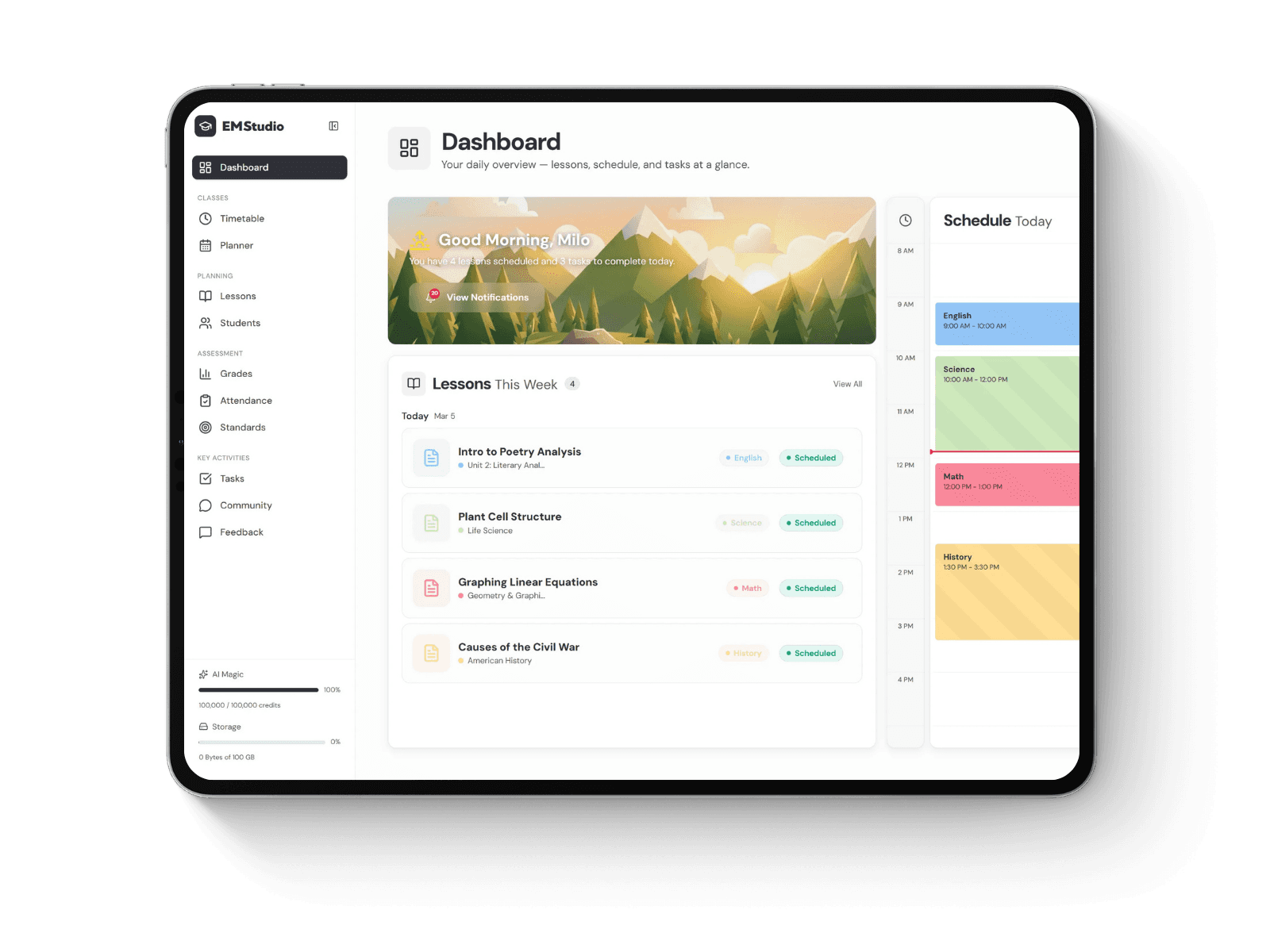
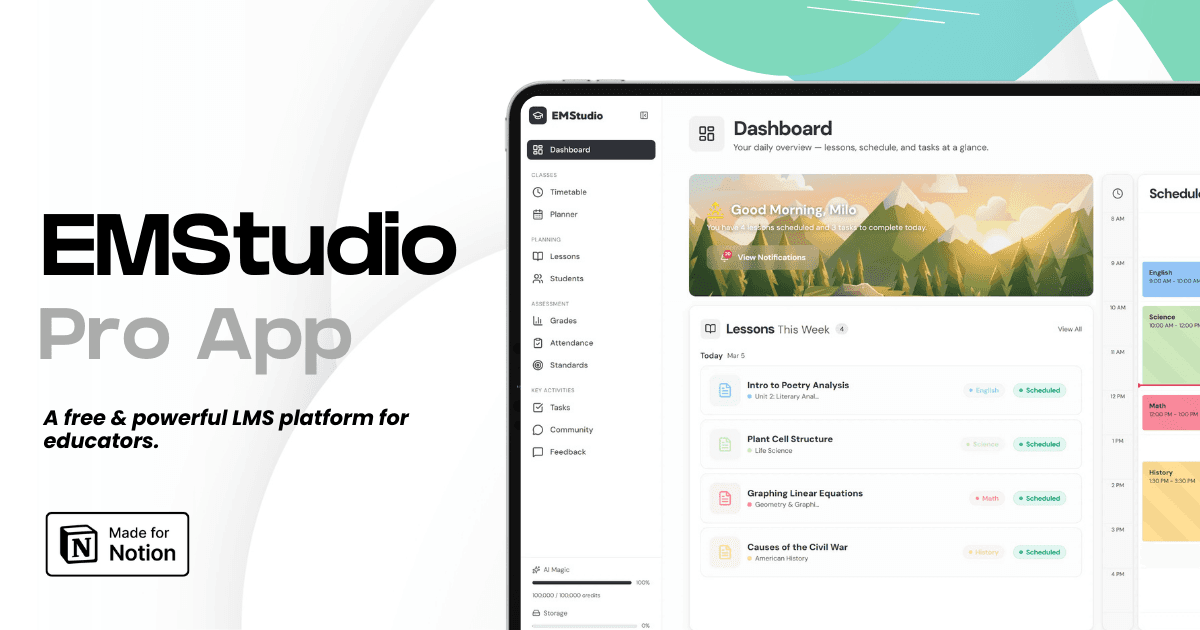
EMStudio is a free teaching management app — manage your classes, students, lessons, and more!
Learn More
Still grading everything by hand?
EMStudio is a free teaching management app — manage your classes, students, lessons, and more!
Learn More
Table of Contents
What Is Student Centric Learning?
Student centric learning is an instructional model where students actively participate in decisions about what they learn, how they learn it, and how they demonstrate mastery. Unlike teacher-centered lectures, this approach positions the educator as a facilitator who designs structured choices, promotes inquiry, and builds student agency while maintaining rigorous learning targets.
You shift from "sage on the stage" to "guide on the side." But this isn't a free-for-all. You still set the learning targets and design the framework. Students just get meaningful choices within your boundaries.
Student centric learning rests on constructivist learning theory. Dewey and Piaget argued that learners build understanding through experience, not passive reception. You aren't abandoning structure. You're designing conditions where students construct knowledge through inquiry-based instruction and authentic learning tasks.
Dewey believed education should mirror real life problem-solving. Piaget showed that kids actively construct mental models through interaction. Your job is to create those interactions intentionally. You aren't removing yourself from the equation. You're repositioning yourself as the architect of learning experiences.
This approach differs from "student-driven" chaos. In unstructured classrooms, kids wander without purpose. Here, you maintain rigorous learning targets while building student agency. You decide the destination, but students help navigate the route. That's the difference between a road trip with a map and driving aimlessly.
Picture two 7th-grade social studies classrooms. In one, you lecture on Civil War battles while students copy notes. In the other, you set up inquiry stations. Kids choose to analyze primary source letters, create timeline maps, or debate military strategy. Everyone hits the same standards. The second classroom uses a true learner centered approach.
Choice doesn't mean three versions of a worksheet. It means fundamentally different ways to access the content. One student reads letters from soldiers. Another manipulates battlefield maps. Both analyze cause and effect. Both develop historical thinking skills. You check understanding through the same standards-aligned rubric.
The first teacher controls content, process, and product. The second controls only the standards and assessment criteria. Students decide how to engage with the material. This shift requires more planning, not less. You design three pathways instead of one.
Look for three specific markers in your daily practice. These distinguish real student agency from superficial "student choice" that offers trivial options:
Student voice in topic selection. Offer at least two pathways to explore the same standard. Let them choose between Reconstruction policies or Civil Rights leaders when studying justice.
Student choice in product demonstration. Written, visual, or kinesthetic options provide natural differentiated instruction. A kid who can't write an essay might build a working model instead.
Metacognitive reflection through formative assessment. Use 3-2-1 exit tickets daily: three things learned, two questions, one connection. This builds awareness of their own thinking.
Real choice affects the depth and direction of learning. It requires you to trust your students with authentic learning decisions while holding firm on non-negotiable standards.
True inquiry-based instruction feels messy on day one. Kids ask questions you didn't anticipate. Timelines shift. But the depth of understanding exceeds what lecture provides. You trade tight control for deeper retention. Most teachers find the trade worthwhile after the first unit.
The Control Continuum helps you visualize the shift. Traditional teaching puts you at 90% control. You talk, they listen. A student centered approach lands around 60%. You still design the unit, create rubrics, and facilitate discussions. Students own the process and product decisions.
Zero percent control is abdication, not education. You never drop below that 60% threshold. You're still the expert who ensures coverage of standards and maintains classroom culture. You're just transferring the cognitive load to students where appropriate. Follow this comprehensive framework for student-centered learning to maintain your balance while building student independence.

Why Does Student Centric Learning Matter Today?
Student-centered learning matters because research consistently shows that active engagement strategies outperform passive instruction for long-term retention and skill transfer. In today's educational field, this approach addresses declining student engagement while building the critical thinking, collaboration, and self-regulation skills required for modern college and career readiness.
You already know the lecture-and-worksheet model isn't working. Kids check out. You check out. Student centric learning breaks that cycle by putting the thinking work back on students where it belongs.
John Hattie’s Visible Learning meta-analysis gives us hard numbers. Reciprocal teaching shows an effect size of 0.74, nearly double the threshold for significant impact. Student self-reported grades hit 1.44.
But here’s the catch. Unstructured discovery learning without teacher scaffolding barely moves the needle. You can’t just hand kids a project and disappear. Constructivist learning only works when you provide the framework.
The high-impact strategies combine student agency with deliberate guidance. That’s where active learning strategies that shift focus to the learner actually pay off.
Since 2020, you’ve felt the engagement crater. Students who spent years in remote learning lost the muscle for independent work. They wait for you to tell them exactly what to do.
Learner oriented teaching rebuilds that lost autonomy. It restores intrinsic motivation by giving students meaningful choices within structured boundaries. You’re not just teaching content anymore. You’re rebuilding their relationship with learning itself.
The World Economic Forum lists critical thinking and self-management among the top skills employers need. Traditional worksheet compliance won’t get your kids there.
Authentic learning through inquiry-based instruction forces students to wrestle with real problems. They learn to manage their time, evaluate their own work, and collaborate without constant supervision. These are the exact muscles they’ll need in college and careers.
Let’s talk about the real objection. Yes, your first unit plan will take about two extra hours. You’re designing differentiated instruction pathways and formative assessment checkpoints instead of photocopying worksheets.
But once routines click, you’ll reclaim that time with interest. Teachers report behavior management drops by roughly 40% once student oriented teaching routines are established. Kids stop acting out because they’re no longer bored. You stop refereeing and start teaching.
Compliance is quiet. Engagement is noisy. You know the difference between a room where kids are filling in blanks to avoid trouble and one where they’re arguing about evidence.
Student centric learning creates the second kind of noise. It generates the productive struggle that shows up on assessments months later.
Today’s students grew up with devices in their hands. They don’t need you to deliver information. They need you to help them filter it.
Inquiry-based instruction teaches them to question sources, synthesize conflicting information, and build original arguments. These are survival skills for the information age, not just school skills.
Formative assessment changes in a student-centered room. You stop grading piles of papers after class. You start circulating with a clipboard, catching misconceptions while they’re still fixable.
Kids get immediate feedback and adjust on the spot. You spot the confusion before it becomes a failing grade.
Differentiated instruction isn’t about creating seventeen different worksheets. It’s about offering choice in process, product, or content while holding everyone to the same rigorous standards.
One student writes an essay. Another creates a podcast. Both analyze the same primary source evidence. You’re teaching the thinking, not the format.
The switch feels messy at first. Your room gets louder. Lessons take longer. You’ll wonder if you’re doing it wrong.
That discomfort is normal. You’re transferring the cognitive load from yourself to your students, and they’ll resist the workout at first. Stay consistent. The payoff hits around week six.
You can’t sustain being the sage on the stage for 180 days. You’ll burn out.
Learner oriented teaching distributes the mental work across thirty brains instead of yours alone. You become the architect, not the construction worker. That shift saves your evenings and your sanity.

How Student Centric Learning Works in Practice
You stop talking at them. You shift to a learner centered teaching approach where they build knowledge through authentic learning tasks. They construct meaning. They don't just memorize yours.
Traditional classrooms run on a broadcast model. Student centric learning runs on a conversation model. Here is how the shift shows up in your room:
Role of Teacher: Sage vs Guide. You quit delivering monologues and start asking the questions that make them think.
Role of Student: Recipient vs Constructor. They stop memorizing your slides and start building mental models through constructivist learning.
Classroom Arrangement: Rows vs Flexible Clusters. Desks move from isolated islands to collaboration stations where groups solve problems together.
Assessment Type: Summative-heavy vs Formative-embedded. You check understanding daily with quick checks, not just at the unit test.
Error Handling: Correction vs Learning Opportunity. Wrong answers become valuable data points, not reasons for red pen shame.
The physical room changes. So does the noise level. Productive chatter replaces silent compliance.
Moving to this model feels messy at first. You're not failing. You're recalibrating. The chaos is productive struggle, not disorder.
Choice Architecture puts student agency into daily routines. You build a Must Do/May Do board with six distinct activity options.
The Must Do column holds your non-negotiables. The May Do column offers extension work, fluency games, or creative applications. Kids pick their path while you pull small groups for targeted help. Everyone stays busy with meaningful work, not busywork.
You limit the options to six to avoid decision paralysis. Too many choices freeze kids, especially younger ones. Rotate the May Do options weekly to keep engagement high.
You post the board at the front. Kids check it after the mini-lesson. Some head to the library corner for research. Others stay at desks for practice pages. You circulate or pull your intervention group. The room runs itself.
Collaborative Protocols keep group work from becoming chaos. Use Think-Pair-Share with written accountability slips.
After the "think" phase, students jot their initial idea on a slip of paper. During the "pair," they compare slips and merge their thinking. The "share" becomes a report-out of their combined conclusion. No more one kid doing all the talking while three others stare at the ceiling tiles.
The written slip forces every brain to engage. It is your proof of thinking for grading and grouping. You can scan the room and spot misconceptions before they fossilize.
Accountability slips go in a basket as the exit ticket. You review them during planning to see who needs reteaching tomorrow. The data drives your next mini-lesson.
Inquiry Cycles drive inquiry-based instruction. Try the PEOR model: Predict, Explore, Observe, Record.
In science or social studies, post a phenomenon or primary source image. Students Predict what is happening and why. They Explore materials or texts to test their ideas. They Observe evidence carefully. They Record findings in a structured notebook. This mirrors real inquiry-based learning models used by actual researchers in the field.
PEOR works for any content where discovery beats lecture. In math, Predict the answer, Explore with manipulatives, Observe patterns, Record the rule. The cycle builds deeper retention than notes copied from a slide.
Students record PEOR findings in dedicated inquiry notebooks. You collect these every Friday for a quick progress check. The notebooks show growth over time better than any worksheet stack.
Metacognitive Journals build self-awareness. Implement daily Glow and Grow reflections.
At lesson end, students write one Glow (something they nailed today) and one Grow (something that still needs work). This formative assessment takes two minutes but reveals more than any multiple-choice quiz. You see their metacognition, not just their final answers.
Glow and Grow language shifts focus from scores to strategies. Students stop asking "What did I get?" and start asking "How did I think?" That is the win.
Keep the journals in a basket by the door. The routine takes five minutes at dismissal. Kids grab, write, drop, leave. You read them after school with your coffee. It is the best daily data you will get.
Do not attempt this shift without prerequisites in place. The structure allows the freedom.
Trying to run this without management is like trying to cook without heat. You have all the ingredients but no way to transform them.
Solid Classroom Management: You need CHAMPS procedures or similar clear expectations. Without them, flexible seating becomes a playground.
Psychological Safety: Run community circles to establish trust. If kids fear looking stupid, they won't take academic risks or share draft thinking.
Clear Learning Targets: Post SWBAT statements in student-friendly language. When they know the destination, they can help drive the instruction.
Start every Monday with a ten-minute circle. Share highs and lows. It builds the trust required for academic vulnerability later in the week.
Write them in "I can" statements kids actually understand. Avoid edu-jargon. If a ten-year-old cannot explain the target, it is useless.
With these foundations, you can deploy differentiated instruction without losing your mind.

Practical Applications Across Grade Levels and Subjects
Student centric learning looks different in kindergarten than in AP Physics, but the DNA stays the same: kids making choices, teachers facilitating. You don't need to rebuild your room or buy fancy furniture. You just need protocols that shift the cognitive load to the learners and keep it there. These four setups show you how it scales.
K-2: Daily 5 literacy stations with three rotation choices, fifteen-minute intervals. You pull small groups while the rest self-select between Read to Self, Word Work, and Listen to Reading using a pocket chart.
3-5: Genius Hour implementing twenty percent time weekly with project pitch templates. Fourth graders propose driving questions like "Why don't sharks get cavities?" then research for forty-five minutes every Friday in the library.
6-8: Socratic Seminar using inner/outer circle protocol with text-dependent questions. Eighth graders discuss The Giver while the outer circle live-tweets observations on a shared doc in real time.
9-12: Project-Based Learning using Buck Institute Gold Standard framework, three to four week duration. Juniors design food security solutions for your county. See our guide on implementing project-based learning.
Math classes thrive with 3-Act Tasks: show a video of a watermelon exploding, ask what kids notice and wonder, then let them request the information they need to solve it. That's inquiry-based instruction in action. Science shifts to phenomenon-based inquiry—start with an anchoring event like a local oil spill, not the chapter vocabulary list. Kids observe, question, then investigate.
In ELA, Literature Circles with defined role sheets give every student a job: Discussion Director, Connector, Illustrator. The Connector finds real-world links to the text while the Illustrator draws a key scene. No one hides behind "I didn't read it." The Director keeps the conversation moving. These structures create authentic learning experiences that stick better than any lecture.
You don't lower the rigor for IEP or 504 students; you change the pathway. Offer audiobooks for the Literature Circle reading task so the target stays on analysis, not decoding. Provide sentence starters for the Socratic Seminar script to support expressive language deficits. The cognitive demand stays identical. These are differentiated instruction techniques that preserve student agency. Every learner meets the same target; they just bring different tools to the construction site.
Constructivist learning needs stuff, but not much money. Individual whiteboards let math kids sketch their 3-Act thinking without wasting paper. Digital portfolio platforms track growth: SeeSaw for K-5, Google Sites for 6-12. Flexible seating doesn't require a grant. Carpet squares from the custodian's closet, standing desks made from stacked copy-paper boxes, or pillows from home create zones for different tasks. The student centered approach to teaching runs on these small shifts, not thousand-dollar furniture catalogs.
Formative assessment happens throughout these activities, not just at the end. Watch the Daily 5 choices to see who avoids reading. Check the Genius Hour pitch templates for question quality. Listen to the Socratic Seminar inner circle for text evidence. The data is in the doing, not the quiz. You'll know it's working when they stop asking "Is this for a grade?" and start asking "Can we keep going?"

Common Misconceptions That Block Implementation
"I tried student centric learning once. The kids took it as a free-for-all." That's the Loss of Control fear talking. But here's the truth: learner centered approach in teaching needs tighter systems, not looser rules. The classroom doesn't get quieter. It gets more focused.
When you run Station Rotation, you don't just let them wander. You write detailed task cards that map every step. You teach the "Ask Three Before Me" protocol so peers answer routine questions first. Kids stay focused because the structure guides them, not because you're hovering. The systems do the heavy lifting. modern classroom management strategies actually work better here—you're orchestrating movement and cognition, not just policing volume.
"It takes too much time to plan." Yes, your first unit needs 2-3 extra hours upfront. You build the templates, create the rubrics, and align the differentiated instruction pathways. Those hours save you from the December panic when half the class still doesn't understand fractions. Track your reteaching days honestly. Traditional lecture models force you to circle back on content roughly 20% of the academic year because kids nodded along without learning. Constructivist learning drops that reteaching need to 5%. You buy back weeks in April.
"My test scores will tank." Not if you embed explicit instruction inside the inquiry. Inquiry-based instruction isn't 45 minutes of unguided discovery where kids guess randomly. It's 10 minutes of direct teaching, then immediate application. Research from PBL implementation in urban districts shows standardized assessment performance remains stable or improves, particularly on constructed-response sections. That's where authentic learning pays dividends. Kids outperform on analysis items, not just recall. They practice defending solutions daily.
"This only works for advanced kids." Wrong. Last year I watched a 4th-grade inclusive classroom with IEPs and ESOL students run differentiated instruction through choice boards. Struggling readers used leveled texts with audio support. Advanced students tackled grade-level passages with complex syntax. Every single kid analyzed theme using the same depth-of-knowledge level 3 questions. The IEP students used sentence starters while the gifted group worked with symbolism. The student agency lived in how they accessed the text. Same bar, different ladders.
Know when to pause the formative assessment cycles and just teach directly. Initial procedures need step-by-step modeling until they become automatic. Safety protocols in chemistry or PE require explicit demonstration before any inquiry-based instruction begins. Foundational automaticity skills—multiplication facts, grammar conventions, phonics patterns—need direct instruction and spaced practice. You can't inquire your way into knowing 8×7 instantly. Master the basics first. Then watch them apply those facts in complex problems.

Getting Started With Student Centric Learning
You don't need to overhaul your curriculum this weekend. Start small, stay consistent, and build from there.
Pull out your plans for next week. Look at the Control Continuum—a simple checklist that ranks how much teacher direction each lesson requires. Rank each upcoming activity from 1 to 5, with 5 being you talking and 1 being kids figuring it out alone.
Circle the lessons scoring 1 or 2. That's your 20% with lowest complexity. These are your testing grounds. Use these low-stakes wins. You don't want to experiment with the hardest concept of the year while you're also learning the system. Simple vocabulary review or basic computation practice works perfectly.
Pick one lesson. Offer a binary choice: Option A or Option B. Both hit the same standard. One uses a video; one uses a text. Maybe Option A is individual work and Option B is partner work. No rewrite needed. Just a fork in the road that takes thirty seconds to create.
When students choose, ownership shifts immediately. Last year, I offered a video or a reading about photosynthesis. Eight kids picked the text because they "hate watching slow videos." I never would have guessed. That data shapes your future offerings.
Weeks 1-2, keep it tight. Use a Must Do/May Do board. Everyone completes the essential task; then they pick one extension from the May Do column. This establishes the routine without overwhelming you or them.
By weeks 3-4, expand to 3-4 options. Watch how they choose. Some kids always pick the computer. Others always draw. Note these patterns. They tell you who needs variety and who needs comfort.
Watch for the kid who always picks the computer. He might need movement, or he might need the text-to-speech support. These observations become your differentiated instruction roadmap without formal assessments.
Month 2, roll out the full menu. Try the Choice Board with 9 Squares. Draw a tic-tac-toe grid. Label the rows Content, Process, and Product. Students pick one from each row, or three in a line to complete the activity.
Content row: Watch the video, read the article, or interview a classmate about the topic.
Process row: Take Cornell notes, sketch a diagram, or create a digital mind map.
Product row: Write a paragraph, record a two-minute voice memo, or build a physical model.
This structure supports differentiated instruction without creating nine different lesson plans. It honors constructivist learning by letting students select how they process information based on what clicks for their brain.
Quit asking "Any questions?" You'll hear crickets. That question puts the burden on confused kids to admit they're lost in front of everyone.
Replace it with: "Turn and tell your partner one pattern you noticed." Give them 30 seconds. The room gets loud. That's the sound of thinking escaping their brains and entering the air. Walk around and listen. You'll hear misconceptions to address immediately.
Then implement Wait Time 2. After a student speaks, count to five in your head before you respond. Those three to five seconds feel eternal. Your instinct will be to fill the silence with praise or clarification. Don't.
The silence feels awkward. Lean into it. Your students will glance at each other, shrug, then someone will say "I agree but I thought the character was scared, not angry." Boom. Discussion started without you.
That pause forces other students to fill the void with follow-up questions or alternative ideas. Student-to-student discourse jumps immediately when you stop being the bottleneck. Try it tomorrow. Count Mississippis. It works.
Introduce self-assessment before you touch the gradebook. Use a 4-point mastery rubric. Post it on the wall. Have students circle their level on a sticky note before submission.
Beginning: I need help with the basics and extra examples.
Developing: I understand parts but need support to finish.
Proficient: I meet the learning target independently.
Advanced: I can teach this to someone else and extend the concept.
You'll see fewer surprise grades and more honest reflection. Kids will write "Developing" when they know they rushed. This is formative assessment in real time, not after the fact.
They start using the rubric language in conferences. "I think I'm Developing because my conclusion is weak." That's a kid diagnosing their own writing. That's the goal.
For peer review, use Two Stars and a Wish. Partners share two specific things that worked and one concrete suggestion. Model the language first.
"I liked your thesis statement and your evidence from the text. I wish you had explained the quote more so I understood the connection." Specific, kind, useful. No "good job" allowed. That teaches nothing.
Kids will go off-task. They'll choose the poster option then draw Pokémon instead of the water cycle. Skip the "Stop fooling around." Use this script: "I see you've chosen the poster option. Let's check your rubric criteria 3."
It keeps the conversation neutral. You're not the enforcer; you're the consultant checking specs. "Does your current work meet the criteria you selected?" Most kids self-correct immediately.
This redirects without shame. It reconnects them to the student agency they chose. They picked the tool. Now they must use it correctly. The conversation stays about the work, not the behavior.
Uneven group work kills momentum fast. One kid does everything; three kids watch. Use Clock Partners to fix it. Students draw a clock face on paper. They walk around and sign up with 12 different partners at specific times—3 o'clock, 6 o'clock, 9 o'clock, noon.
When you say "Meet with your 3 o'clock partner for peer review," they know exactly where to go. No negotiating. When one group stalls, shift students instantly: "Jamal, go meet with your 6 o'clock partner instead." Flexible grouping keeps inquiry-based instruction moving without the drama of hurt feelings or cliques.
It eliminates the "who should I work with" dance that eats five minutes of every class. Everyone has pre-assigned partners. No one is left out. The system is fair because they signed the clocks themselves.
This student centered approach in teaching builds slowly over months. You're not abandoning structure; you're redistributing control with intention. The goal is authentic learning that sticks because students built the understanding themselves, not because they memorized your PowerPoint.
For tracking these individual pathways and choices, check out our guide on managing individual learning plans. It helps you keep tabs on who chose what without losing your mind in a sea of sticky notes.
Remember: Student centric learning isn't chaos. It's intentional design with the kid at the wheel and your hand lightly on the emergency brake.
How Do You Measure Success Without Traditional Grades?
Measure success through competency-based rubrics tracking mastery levels from Beginning to Advanced, digital portfolios collecting artifacts with student reflections, and student-led conferences where learners present growth evidence. Focus on growth metrics and self-assessment accuracy, not averaged percentages. John Hattie's research confirms feedback on learning processes outperforms grades for student improvement.
Traditional percentage grades obscure actual learning. Student centric learning needs clearer indicators of what students know and can do. These three replacements reveal true mastery without averaging points.
Competency-Based Progressions use 4-point rubrics with concrete descriptors: Beginning, Developing, Proficient, and Advanced. Students advance only after demonstrating consistent mastery, not when the calendar says move on.
Digital Portfolios in SeeSaw (K-5) or Google Sites (6-12) require three artifacts per standard with written reflection captions explaining their thinking. This creates tangible evidence of growth over time.
Student-Led Conferences follow a scripted protocol where learners present specific evidence of growth to parents using their portfolio work. You become the facilitator while students own the narrative.
Competency tracking shows precise gaps. Portfolios preserve the learning journey. Student conferences build metacognitive skills. Together they create a triangulated picture no single test score could capture.
John Hattie's visible learning research is definitive. Immediate feedback delivered within 24 hours on specific process strategies yields higher effect sizes than delayed summative grades.
Stop marking papers for three days while students forget their thinking. Give them performance-based assessment methods with instant actionable next steps instead.
I used 24-hour feedback last year. Students who ignored graded quizzes began revising immediately when I commented on their strategy use within a day. The difference was immediate.
This shift supports constructivist learning and inquiry-based instruction by valuing thinking processes over final products. When students receive feedback during the messy middle, they develop student agency and self-correct. This is formative assessment in its purest form.
Watch for these measurable shifts. They indicate students are internalizing the assessment criteria and using it to guide their own learning pathways.
Frequency of student-generated questions increases visibly within three weeks of implementation.
Peer-to-peer academic talk occupies 50% or more of class time during authentic learning tasks.
Off-task behavior referrals decrease according to administrative tracking data.
Track these metrics weekly. I keep a simple tally sheet for question frequency and time stamps for peer talk ratios. When students own the assessment process, behavior issues naturally decline because they understand the learning path.
These indicators prove differentiated instruction is working. But parents need translation. They understand percentages from their own schooling. You must explicitly connect redefining success metrics beyond traditional testing to their child's daily experience.
Send this at quarter start:
Subject: How We're Measuring Growth This Year
We're using mastery-based scales, not traditional percentages. Your child will advance through Beginning, Developing, Proficient, and Advanced levels for each standard. This measures growth against learning targets without comparing your child to peers. You'll see specific evidence in their digital portfolio with their own reflections attached. Questions? Hit reply.
Keep it brief. Parents scan emails on phones. One teacher I coached sent a novel-length explanation and received fifty confused replies. The short version gets buy-in.
Cut the percentages. Watch what happens when students stop chasing points and start chasing understanding. The data backs it up, and so does the classroom energy.

What Student Centric Learning Really Comes Down To
Student centric learning isn't a curriculum you buy or a checklist you complete. It's you, stepping back so kids can step up. Whether you're using inquiry-based instruction in science or differentiated instruction during math centers, the goal stays the same. Move from you talking to them working. That's the shift.
Forget the myth that this means chaos or zero structure. Real constructivist learning happens within clear boundaries you set. You still plan, still assess, still teach. You're just trading some control for student agency. The payoff is kids who think. They won't just copy.
Start small. Pick one lesson next week where students choose their path or ask the questions. Notice who lights up when they own the learning. That's your data. That's success. You don't need to rebuild your whole practice overnight. You just need one moment of real choice.

What Is Student Centric Learning?
Student centric learning is an instructional model where students actively participate in decisions about what they learn, how they learn it, and how they demonstrate mastery. Unlike teacher-centered lectures, this approach positions the educator as a facilitator who designs structured choices, promotes inquiry, and builds student agency while maintaining rigorous learning targets.
You shift from "sage on the stage" to "guide on the side." But this isn't a free-for-all. You still set the learning targets and design the framework. Students just get meaningful choices within your boundaries.
Student centric learning rests on constructivist learning theory. Dewey and Piaget argued that learners build understanding through experience, not passive reception. You aren't abandoning structure. You're designing conditions where students construct knowledge through inquiry-based instruction and authentic learning tasks.
Dewey believed education should mirror real life problem-solving. Piaget showed that kids actively construct mental models through interaction. Your job is to create those interactions intentionally. You aren't removing yourself from the equation. You're repositioning yourself as the architect of learning experiences.
This approach differs from "student-driven" chaos. In unstructured classrooms, kids wander without purpose. Here, you maintain rigorous learning targets while building student agency. You decide the destination, but students help navigate the route. That's the difference between a road trip with a map and driving aimlessly.
Picture two 7th-grade social studies classrooms. In one, you lecture on Civil War battles while students copy notes. In the other, you set up inquiry stations. Kids choose to analyze primary source letters, create timeline maps, or debate military strategy. Everyone hits the same standards. The second classroom uses a true learner centered approach.
Choice doesn't mean three versions of a worksheet. It means fundamentally different ways to access the content. One student reads letters from soldiers. Another manipulates battlefield maps. Both analyze cause and effect. Both develop historical thinking skills. You check understanding through the same standards-aligned rubric.
The first teacher controls content, process, and product. The second controls only the standards and assessment criteria. Students decide how to engage with the material. This shift requires more planning, not less. You design three pathways instead of one.
Look for three specific markers in your daily practice. These distinguish real student agency from superficial "student choice" that offers trivial options:
Student voice in topic selection. Offer at least two pathways to explore the same standard. Let them choose between Reconstruction policies or Civil Rights leaders when studying justice.
Student choice in product demonstration. Written, visual, or kinesthetic options provide natural differentiated instruction. A kid who can't write an essay might build a working model instead.
Metacognitive reflection through formative assessment. Use 3-2-1 exit tickets daily: three things learned, two questions, one connection. This builds awareness of their own thinking.
Real choice affects the depth and direction of learning. It requires you to trust your students with authentic learning decisions while holding firm on non-negotiable standards.
True inquiry-based instruction feels messy on day one. Kids ask questions you didn't anticipate. Timelines shift. But the depth of understanding exceeds what lecture provides. You trade tight control for deeper retention. Most teachers find the trade worthwhile after the first unit.
The Control Continuum helps you visualize the shift. Traditional teaching puts you at 90% control. You talk, they listen. A student centered approach lands around 60%. You still design the unit, create rubrics, and facilitate discussions. Students own the process and product decisions.
Zero percent control is abdication, not education. You never drop below that 60% threshold. You're still the expert who ensures coverage of standards and maintains classroom culture. You're just transferring the cognitive load to students where appropriate. Follow this comprehensive framework for student-centered learning to maintain your balance while building student independence.
Why Does Student Centric Learning Matter Today?
Student-centered learning matters because research consistently shows that active engagement strategies outperform passive instruction for long-term retention and skill transfer. In today's educational field, this approach addresses declining student engagement while building the critical thinking, collaboration, and self-regulation skills required for modern college and career readiness.
You already know the lecture-and-worksheet model isn't working. Kids check out. You check out. Student centric learning breaks that cycle by putting the thinking work back on students where it belongs.
John Hattie’s Visible Learning meta-analysis gives us hard numbers. Reciprocal teaching shows an effect size of 0.74, nearly double the threshold for significant impact. Student self-reported grades hit 1.44.
But here’s the catch. Unstructured discovery learning without teacher scaffolding barely moves the needle. You can’t just hand kids a project and disappear. Constructivist learning only works when you provide the framework.
The high-impact strategies combine student agency with deliberate guidance. That’s where active learning strategies that shift focus to the learner actually pay off.
Since 2020, you’ve felt the engagement crater. Students who spent years in remote learning lost the muscle for independent work. They wait for you to tell them exactly what to do.
Learner oriented teaching rebuilds that lost autonomy. It restores intrinsic motivation by giving students meaningful choices within structured boundaries. You’re not just teaching content anymore. You’re rebuilding their relationship with learning itself.
The World Economic Forum lists critical thinking and self-management among the top skills employers need. Traditional worksheet compliance won’t get your kids there.
Authentic learning through inquiry-based instruction forces students to wrestle with real problems. They learn to manage their time, evaluate their own work, and collaborate without constant supervision. These are the exact muscles they’ll need in college and careers.
Let’s talk about the real objection. Yes, your first unit plan will take about two extra hours. You’re designing differentiated instruction pathways and formative assessment checkpoints instead of photocopying worksheets.
But once routines click, you’ll reclaim that time with interest. Teachers report behavior management drops by roughly 40% once student oriented teaching routines are established. Kids stop acting out because they’re no longer bored. You stop refereeing and start teaching.
Compliance is quiet. Engagement is noisy. You know the difference between a room where kids are filling in blanks to avoid trouble and one where they’re arguing about evidence.
Student centric learning creates the second kind of noise. It generates the productive struggle that shows up on assessments months later.
Today’s students grew up with devices in their hands. They don’t need you to deliver information. They need you to help them filter it.
Inquiry-based instruction teaches them to question sources, synthesize conflicting information, and build original arguments. These are survival skills for the information age, not just school skills.
Formative assessment changes in a student-centered room. You stop grading piles of papers after class. You start circulating with a clipboard, catching misconceptions while they’re still fixable.
Kids get immediate feedback and adjust on the spot. You spot the confusion before it becomes a failing grade.
Differentiated instruction isn’t about creating seventeen different worksheets. It’s about offering choice in process, product, or content while holding everyone to the same rigorous standards.
One student writes an essay. Another creates a podcast. Both analyze the same primary source evidence. You’re teaching the thinking, not the format.
The switch feels messy at first. Your room gets louder. Lessons take longer. You’ll wonder if you’re doing it wrong.
That discomfort is normal. You’re transferring the cognitive load from yourself to your students, and they’ll resist the workout at first. Stay consistent. The payoff hits around week six.
You can’t sustain being the sage on the stage for 180 days. You’ll burn out.
Learner oriented teaching distributes the mental work across thirty brains instead of yours alone. You become the architect, not the construction worker. That shift saves your evenings and your sanity.
How Student Centric Learning Works in Practice
You stop talking at them. You shift to a learner centered teaching approach where they build knowledge through authentic learning tasks. They construct meaning. They don't just memorize yours.
Traditional classrooms run on a broadcast model. Student centric learning runs on a conversation model. Here is how the shift shows up in your room:
Role of Teacher: Sage vs Guide. You quit delivering monologues and start asking the questions that make them think.
Role of Student: Recipient vs Constructor. They stop memorizing your slides and start building mental models through constructivist learning.
Classroom Arrangement: Rows vs Flexible Clusters. Desks move from isolated islands to collaboration stations where groups solve problems together.
Assessment Type: Summative-heavy vs Formative-embedded. You check understanding daily with quick checks, not just at the unit test.
Error Handling: Correction vs Learning Opportunity. Wrong answers become valuable data points, not reasons for red pen shame.
The physical room changes. So does the noise level. Productive chatter replaces silent compliance.
Moving to this model feels messy at first. You're not failing. You're recalibrating. The chaos is productive struggle, not disorder.
Choice Architecture puts student agency into daily routines. You build a Must Do/May Do board with six distinct activity options.
The Must Do column holds your non-negotiables. The May Do column offers extension work, fluency games, or creative applications. Kids pick their path while you pull small groups for targeted help. Everyone stays busy with meaningful work, not busywork.
You limit the options to six to avoid decision paralysis. Too many choices freeze kids, especially younger ones. Rotate the May Do options weekly to keep engagement high.
You post the board at the front. Kids check it after the mini-lesson. Some head to the library corner for research. Others stay at desks for practice pages. You circulate or pull your intervention group. The room runs itself.
Collaborative Protocols keep group work from becoming chaos. Use Think-Pair-Share with written accountability slips.
After the "think" phase, students jot their initial idea on a slip of paper. During the "pair," they compare slips and merge their thinking. The "share" becomes a report-out of their combined conclusion. No more one kid doing all the talking while three others stare at the ceiling tiles.
The written slip forces every brain to engage. It is your proof of thinking for grading and grouping. You can scan the room and spot misconceptions before they fossilize.
Accountability slips go in a basket as the exit ticket. You review them during planning to see who needs reteaching tomorrow. The data drives your next mini-lesson.
Inquiry Cycles drive inquiry-based instruction. Try the PEOR model: Predict, Explore, Observe, Record.
In science or social studies, post a phenomenon or primary source image. Students Predict what is happening and why. They Explore materials or texts to test their ideas. They Observe evidence carefully. They Record findings in a structured notebook. This mirrors real inquiry-based learning models used by actual researchers in the field.
PEOR works for any content where discovery beats lecture. In math, Predict the answer, Explore with manipulatives, Observe patterns, Record the rule. The cycle builds deeper retention than notes copied from a slide.
Students record PEOR findings in dedicated inquiry notebooks. You collect these every Friday for a quick progress check. The notebooks show growth over time better than any worksheet stack.
Metacognitive Journals build self-awareness. Implement daily Glow and Grow reflections.
At lesson end, students write one Glow (something they nailed today) and one Grow (something that still needs work). This formative assessment takes two minutes but reveals more than any multiple-choice quiz. You see their metacognition, not just their final answers.
Glow and Grow language shifts focus from scores to strategies. Students stop asking "What did I get?" and start asking "How did I think?" That is the win.
Keep the journals in a basket by the door. The routine takes five minutes at dismissal. Kids grab, write, drop, leave. You read them after school with your coffee. It is the best daily data you will get.
Do not attempt this shift without prerequisites in place. The structure allows the freedom.
Trying to run this without management is like trying to cook without heat. You have all the ingredients but no way to transform them.
Solid Classroom Management: You need CHAMPS procedures or similar clear expectations. Without them, flexible seating becomes a playground.
Psychological Safety: Run community circles to establish trust. If kids fear looking stupid, they won't take academic risks or share draft thinking.
Clear Learning Targets: Post SWBAT statements in student-friendly language. When they know the destination, they can help drive the instruction.
Start every Monday with a ten-minute circle. Share highs and lows. It builds the trust required for academic vulnerability later in the week.
Write them in "I can" statements kids actually understand. Avoid edu-jargon. If a ten-year-old cannot explain the target, it is useless.
With these foundations, you can deploy differentiated instruction without losing your mind.
Practical Applications Across Grade Levels and Subjects
Student centric learning looks different in kindergarten than in AP Physics, but the DNA stays the same: kids making choices, teachers facilitating. You don't need to rebuild your room or buy fancy furniture. You just need protocols that shift the cognitive load to the learners and keep it there. These four setups show you how it scales.
K-2: Daily 5 literacy stations with three rotation choices, fifteen-minute intervals. You pull small groups while the rest self-select between Read to Self, Word Work, and Listen to Reading using a pocket chart.
3-5: Genius Hour implementing twenty percent time weekly with project pitch templates. Fourth graders propose driving questions like "Why don't sharks get cavities?" then research for forty-five minutes every Friday in the library.
6-8: Socratic Seminar using inner/outer circle protocol with text-dependent questions. Eighth graders discuss The Giver while the outer circle live-tweets observations on a shared doc in real time.
9-12: Project-Based Learning using Buck Institute Gold Standard framework, three to four week duration. Juniors design food security solutions for your county. See our guide on implementing project-based learning.
Math classes thrive with 3-Act Tasks: show a video of a watermelon exploding, ask what kids notice and wonder, then let them request the information they need to solve it. That's inquiry-based instruction in action. Science shifts to phenomenon-based inquiry—start with an anchoring event like a local oil spill, not the chapter vocabulary list. Kids observe, question, then investigate.
In ELA, Literature Circles with defined role sheets give every student a job: Discussion Director, Connector, Illustrator. The Connector finds real-world links to the text while the Illustrator draws a key scene. No one hides behind "I didn't read it." The Director keeps the conversation moving. These structures create authentic learning experiences that stick better than any lecture.
You don't lower the rigor for IEP or 504 students; you change the pathway. Offer audiobooks for the Literature Circle reading task so the target stays on analysis, not decoding. Provide sentence starters for the Socratic Seminar script to support expressive language deficits. The cognitive demand stays identical. These are differentiated instruction techniques that preserve student agency. Every learner meets the same target; they just bring different tools to the construction site.
Constructivist learning needs stuff, but not much money. Individual whiteboards let math kids sketch their 3-Act thinking without wasting paper. Digital portfolio platforms track growth: SeeSaw for K-5, Google Sites for 6-12. Flexible seating doesn't require a grant. Carpet squares from the custodian's closet, standing desks made from stacked copy-paper boxes, or pillows from home create zones for different tasks. The student centered approach to teaching runs on these small shifts, not thousand-dollar furniture catalogs.
Formative assessment happens throughout these activities, not just at the end. Watch the Daily 5 choices to see who avoids reading. Check the Genius Hour pitch templates for question quality. Listen to the Socratic Seminar inner circle for text evidence. The data is in the doing, not the quiz. You'll know it's working when they stop asking "Is this for a grade?" and start asking "Can we keep going?"
Common Misconceptions That Block Implementation
"I tried student centric learning once. The kids took it as a free-for-all." That's the Loss of Control fear talking. But here's the truth: learner centered approach in teaching needs tighter systems, not looser rules. The classroom doesn't get quieter. It gets more focused.
When you run Station Rotation, you don't just let them wander. You write detailed task cards that map every step. You teach the "Ask Three Before Me" protocol so peers answer routine questions first. Kids stay focused because the structure guides them, not because you're hovering. The systems do the heavy lifting. modern classroom management strategies actually work better here—you're orchestrating movement and cognition, not just policing volume.
"It takes too much time to plan." Yes, your first unit needs 2-3 extra hours upfront. You build the templates, create the rubrics, and align the differentiated instruction pathways. Those hours save you from the December panic when half the class still doesn't understand fractions. Track your reteaching days honestly. Traditional lecture models force you to circle back on content roughly 20% of the academic year because kids nodded along without learning. Constructivist learning drops that reteaching need to 5%. You buy back weeks in April.
"My test scores will tank." Not if you embed explicit instruction inside the inquiry. Inquiry-based instruction isn't 45 minutes of unguided discovery where kids guess randomly. It's 10 minutes of direct teaching, then immediate application. Research from PBL implementation in urban districts shows standardized assessment performance remains stable or improves, particularly on constructed-response sections. That's where authentic learning pays dividends. Kids outperform on analysis items, not just recall. They practice defending solutions daily.
"This only works for advanced kids." Wrong. Last year I watched a 4th-grade inclusive classroom with IEPs and ESOL students run differentiated instruction through choice boards. Struggling readers used leveled texts with audio support. Advanced students tackled grade-level passages with complex syntax. Every single kid analyzed theme using the same depth-of-knowledge level 3 questions. The IEP students used sentence starters while the gifted group worked with symbolism. The student agency lived in how they accessed the text. Same bar, different ladders.
Know when to pause the formative assessment cycles and just teach directly. Initial procedures need step-by-step modeling until they become automatic. Safety protocols in chemistry or PE require explicit demonstration before any inquiry-based instruction begins. Foundational automaticity skills—multiplication facts, grammar conventions, phonics patterns—need direct instruction and spaced practice. You can't inquire your way into knowing 8×7 instantly. Master the basics first. Then watch them apply those facts in complex problems.
Getting Started With Student Centric Learning
You don't need to overhaul your curriculum this weekend. Start small, stay consistent, and build from there.
Pull out your plans for next week. Look at the Control Continuum—a simple checklist that ranks how much teacher direction each lesson requires. Rank each upcoming activity from 1 to 5, with 5 being you talking and 1 being kids figuring it out alone.
Circle the lessons scoring 1 or 2. That's your 20% with lowest complexity. These are your testing grounds. Use these low-stakes wins. You don't want to experiment with the hardest concept of the year while you're also learning the system. Simple vocabulary review or basic computation practice works perfectly.
Pick one lesson. Offer a binary choice: Option A or Option B. Both hit the same standard. One uses a video; one uses a text. Maybe Option A is individual work and Option B is partner work. No rewrite needed. Just a fork in the road that takes thirty seconds to create.
When students choose, ownership shifts immediately. Last year, I offered a video or a reading about photosynthesis. Eight kids picked the text because they "hate watching slow videos." I never would have guessed. That data shapes your future offerings.
Weeks 1-2, keep it tight. Use a Must Do/May Do board. Everyone completes the essential task; then they pick one extension from the May Do column. This establishes the routine without overwhelming you or them.
By weeks 3-4, expand to 3-4 options. Watch how they choose. Some kids always pick the computer. Others always draw. Note these patterns. They tell you who needs variety and who needs comfort.
Watch for the kid who always picks the computer. He might need movement, or he might need the text-to-speech support. These observations become your differentiated instruction roadmap without formal assessments.
Month 2, roll out the full menu. Try the Choice Board with 9 Squares. Draw a tic-tac-toe grid. Label the rows Content, Process, and Product. Students pick one from each row, or three in a line to complete the activity.
Content row: Watch the video, read the article, or interview a classmate about the topic.
Process row: Take Cornell notes, sketch a diagram, or create a digital mind map.
Product row: Write a paragraph, record a two-minute voice memo, or build a physical model.
This structure supports differentiated instruction without creating nine different lesson plans. It honors constructivist learning by letting students select how they process information based on what clicks for their brain.
Quit asking "Any questions?" You'll hear crickets. That question puts the burden on confused kids to admit they're lost in front of everyone.
Replace it with: "Turn and tell your partner one pattern you noticed." Give them 30 seconds. The room gets loud. That's the sound of thinking escaping their brains and entering the air. Walk around and listen. You'll hear misconceptions to address immediately.
Then implement Wait Time 2. After a student speaks, count to five in your head before you respond. Those three to five seconds feel eternal. Your instinct will be to fill the silence with praise or clarification. Don't.
The silence feels awkward. Lean into it. Your students will glance at each other, shrug, then someone will say "I agree but I thought the character was scared, not angry." Boom. Discussion started without you.
That pause forces other students to fill the void with follow-up questions or alternative ideas. Student-to-student discourse jumps immediately when you stop being the bottleneck. Try it tomorrow. Count Mississippis. It works.
Introduce self-assessment before you touch the gradebook. Use a 4-point mastery rubric. Post it on the wall. Have students circle their level on a sticky note before submission.
Beginning: I need help with the basics and extra examples.
Developing: I understand parts but need support to finish.
Proficient: I meet the learning target independently.
Advanced: I can teach this to someone else and extend the concept.
You'll see fewer surprise grades and more honest reflection. Kids will write "Developing" when they know they rushed. This is formative assessment in real time, not after the fact.
They start using the rubric language in conferences. "I think I'm Developing because my conclusion is weak." That's a kid diagnosing their own writing. That's the goal.
For peer review, use Two Stars and a Wish. Partners share two specific things that worked and one concrete suggestion. Model the language first.
"I liked your thesis statement and your evidence from the text. I wish you had explained the quote more so I understood the connection." Specific, kind, useful. No "good job" allowed. That teaches nothing.
Kids will go off-task. They'll choose the poster option then draw Pokémon instead of the water cycle. Skip the "Stop fooling around." Use this script: "I see you've chosen the poster option. Let's check your rubric criteria 3."
It keeps the conversation neutral. You're not the enforcer; you're the consultant checking specs. "Does your current work meet the criteria you selected?" Most kids self-correct immediately.
This redirects without shame. It reconnects them to the student agency they chose. They picked the tool. Now they must use it correctly. The conversation stays about the work, not the behavior.
Uneven group work kills momentum fast. One kid does everything; three kids watch. Use Clock Partners to fix it. Students draw a clock face on paper. They walk around and sign up with 12 different partners at specific times—3 o'clock, 6 o'clock, 9 o'clock, noon.
When you say "Meet with your 3 o'clock partner for peer review," they know exactly where to go. No negotiating. When one group stalls, shift students instantly: "Jamal, go meet with your 6 o'clock partner instead." Flexible grouping keeps inquiry-based instruction moving without the drama of hurt feelings or cliques.
It eliminates the "who should I work with" dance that eats five minutes of every class. Everyone has pre-assigned partners. No one is left out. The system is fair because they signed the clocks themselves.
This student centered approach in teaching builds slowly over months. You're not abandoning structure; you're redistributing control with intention. The goal is authentic learning that sticks because students built the understanding themselves, not because they memorized your PowerPoint.
For tracking these individual pathways and choices, check out our guide on managing individual learning plans. It helps you keep tabs on who chose what without losing your mind in a sea of sticky notes.
Remember: Student centric learning isn't chaos. It's intentional design with the kid at the wheel and your hand lightly on the emergency brake.
How Do You Measure Success Without Traditional Grades?
Measure success through competency-based rubrics tracking mastery levels from Beginning to Advanced, digital portfolios collecting artifacts with student reflections, and student-led conferences where learners present growth evidence. Focus on growth metrics and self-assessment accuracy, not averaged percentages. John Hattie's research confirms feedback on learning processes outperforms grades for student improvement.
Traditional percentage grades obscure actual learning. Student centric learning needs clearer indicators of what students know and can do. These three replacements reveal true mastery without averaging points.
Competency-Based Progressions use 4-point rubrics with concrete descriptors: Beginning, Developing, Proficient, and Advanced. Students advance only after demonstrating consistent mastery, not when the calendar says move on.
Digital Portfolios in SeeSaw (K-5) or Google Sites (6-12) require three artifacts per standard with written reflection captions explaining their thinking. This creates tangible evidence of growth over time.
Student-Led Conferences follow a scripted protocol where learners present specific evidence of growth to parents using their portfolio work. You become the facilitator while students own the narrative.
Competency tracking shows precise gaps. Portfolios preserve the learning journey. Student conferences build metacognitive skills. Together they create a triangulated picture no single test score could capture.
John Hattie's visible learning research is definitive. Immediate feedback delivered within 24 hours on specific process strategies yields higher effect sizes than delayed summative grades.
Stop marking papers for three days while students forget their thinking. Give them performance-based assessment methods with instant actionable next steps instead.
I used 24-hour feedback last year. Students who ignored graded quizzes began revising immediately when I commented on their strategy use within a day. The difference was immediate.
This shift supports constructivist learning and inquiry-based instruction by valuing thinking processes over final products. When students receive feedback during the messy middle, they develop student agency and self-correct. This is formative assessment in its purest form.
Watch for these measurable shifts. They indicate students are internalizing the assessment criteria and using it to guide their own learning pathways.
Frequency of student-generated questions increases visibly within three weeks of implementation.
Peer-to-peer academic talk occupies 50% or more of class time during authentic learning tasks.
Off-task behavior referrals decrease according to administrative tracking data.
Track these metrics weekly. I keep a simple tally sheet for question frequency and time stamps for peer talk ratios. When students own the assessment process, behavior issues naturally decline because they understand the learning path.
These indicators prove differentiated instruction is working. But parents need translation. They understand percentages from their own schooling. You must explicitly connect redefining success metrics beyond traditional testing to their child's daily experience.
Send this at quarter start:
Subject: How We're Measuring Growth This Year
We're using mastery-based scales, not traditional percentages. Your child will advance through Beginning, Developing, Proficient, and Advanced levels for each standard. This measures growth against learning targets without comparing your child to peers. You'll see specific evidence in their digital portfolio with their own reflections attached. Questions? Hit reply.
Keep it brief. Parents scan emails on phones. One teacher I coached sent a novel-length explanation and received fifty confused replies. The short version gets buy-in.
Cut the percentages. Watch what happens when students stop chasing points and start chasing understanding. The data backs it up, and so does the classroom energy.
What Student Centric Learning Really Comes Down To
Student centric learning isn't a curriculum you buy or a checklist you complete. It's you, stepping back so kids can step up. Whether you're using inquiry-based instruction in science or differentiated instruction during math centers, the goal stays the same. Move from you talking to them working. That's the shift.
Forget the myth that this means chaos or zero structure. Real constructivist learning happens within clear boundaries you set. You still plan, still assess, still teach. You're just trading some control for student agency. The payoff is kids who think. They won't just copy.
Start small. Pick one lesson next week where students choose their path or ask the questions. Notice who lights up when they own the learning. That's your data. That's success. You don't need to rebuild your whole practice overnight. You just need one moment of real choice.
Still grading everything by hand?
EMStudio is a free teaching management app — manage your classes, students, lessons, and more!
Learn More
Still grading everything by hand?
EMStudio is a free teaching management app — manage your classes, students, lessons, and more!
Learn More



Notion4Teachers
Notion templates to simplify administrative tasks and enhance your teaching experience.



2026 Notion4Teachers. All Rights Reserved.
Notion4Teachers
Notion templates to simplify administrative tasks and enhance your teaching experience.
2026 Notion4Teachers. All Rights Reserved.
Notion4Teachers
Notion templates to simplify administrative tasks and enhance your teaching experience.
2026 Notion4Teachers. All Rights Reserved.