
Social Studies Worksheets Template for K-12 Classrooms
Social Studies Worksheets Template for K-12 Classrooms

Article by
Milo
ESL Content Coordinator & Educator
ESL Content Coordinator & Educator
All Posts
This template breaks every lesson into five modular components you can mix, match, or run sequentially. Each block fills a 45 to 60 minute class period or homework assignment. I built this after watching my 7th graders drown in dense social studies worksheets. Those old packets tried to cover everything at once. Now I pull the exact pieces I need: one day we focus solely on primary source analysis, the next we tackle document based questions without reinventing the layout.
It works for grades 3 through 12 because the modification protocols are built in, not bolted on. You get the same rigorous historical thinking skills across all levels. Fourth graders analyze photographs while seniors dissect Supreme Court opinions using the same frame. The files come as Google Docs and Slides templates you can edit in five minutes, plus PDF print formats for the copy room. No more reformatting when the wifi drops.
The alignment isn't an afterthought. Every unit maps to NCSS Thematic Standards, specifically Time, Continuity, and Change and People, Places, and Environments. It also hits Common Core Literacy Standards for History/Social Studies without the checkbox fatigue. I stopped trying to staple standards onto activities that didn't fit. These graphic organizers and analysis frames were built around the standards first.
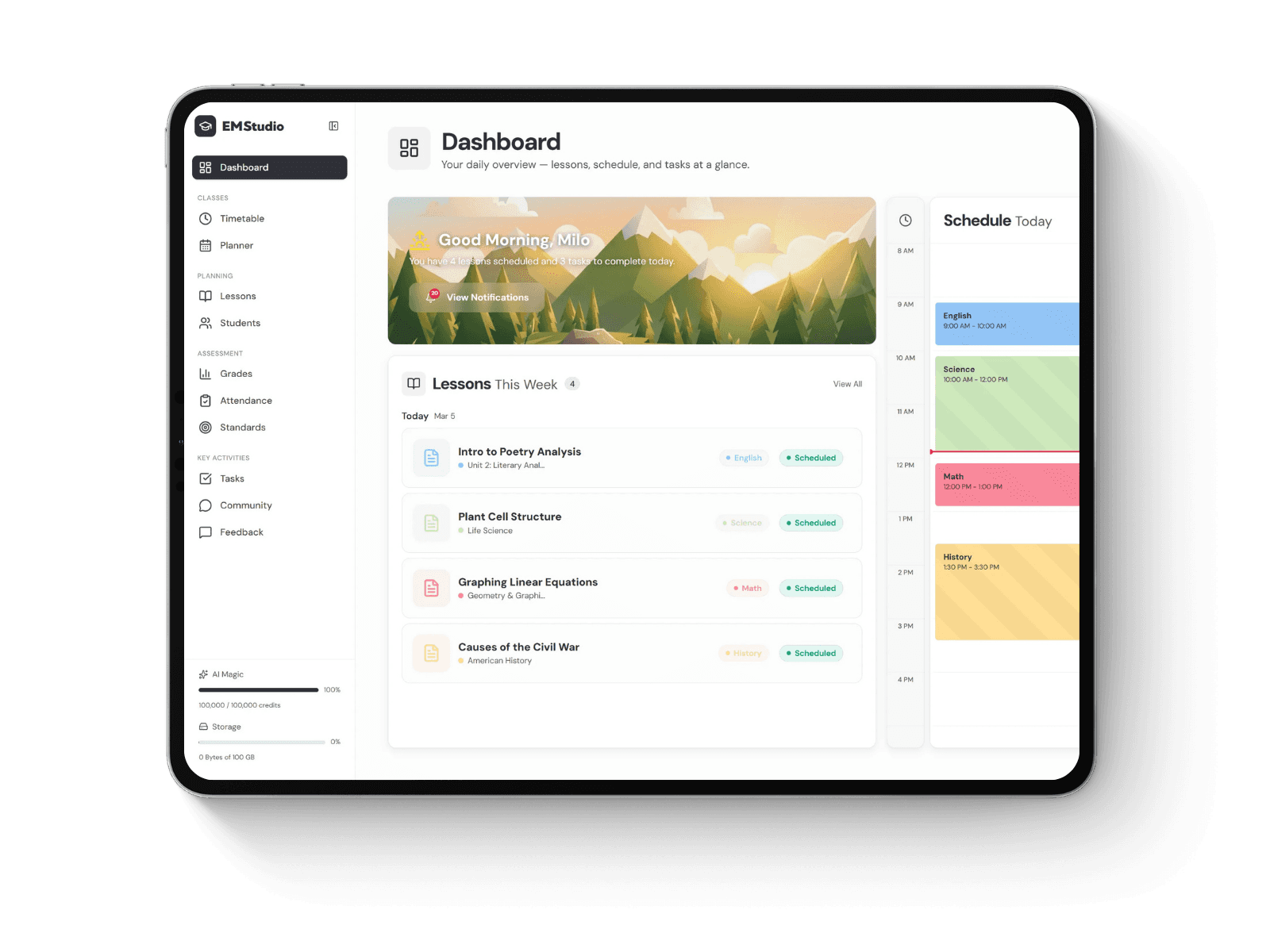
Still grading everything by hand?
EMStudio is a free teaching management app — manage your classes, students, lessons, and more!
Learn More
Still grading everything by hand?
EMStudio is a free teaching management app — manage your classes, students, lessons, and more!
Learn More
Table of Contents
What This Template Covers
Your prep time drops to about 30 minutes once you know the workflow. That includes finding your sources and formatting them. I source a political cartoon and drop it into the differentiated instruction column. Three versions print before my coffee gets cold.
The visual design matters for attention spans. I use 1-inch margins, 12-point sans-serif body text, and keep 30% white space minimum on every page. Crowded civics education materials shut kids down. This layout gives their eyes room to rest between heavy reading tasks.

Template Structure and Core Components
These social studies worksheets follow a cognitive ladder: observation, chronology, spatial reasoning, analysis, metacognition. Each component fits on one page—front and back—because I've seen crowded pages shut down 8th graders. Teacher answer keys include sample responses at proficiency and approaching levels. The five parts form a complete lesson arc for formative or summative use alongside digital tools that transform history classrooms.
Primary Source Analysis Section
This primary source analysis section uses the SOAP framework with boxes for Source, Occasion, Audience, Purpose. I use Library of Congress materials: political cartoons from 1830s-1960s, handwritten letters, battlefield photographs. Students complete the 3-2-1 protocol: three observations, two questions, one inference.
Timeline and Chronology Activities
Timelines contain five to seven events maximum to prevent overload and support differentiated instruction. Students practice BCE/CE dating with cut-and-paste strips or digital alternatives. Graphic organizers show cause-and-effect chains connecting three events.
Map Skills and Geography Integration
Each worksheet includes one historical map—1914 alliances, 1754 Colonies, or Silk Road routes. Students plot latitude/longitude, calculate scale distance, or analyze elevation. A Geography Connection box uses three to four sentences explaining how physical place shaped the event.
Critical Thinking Question Bank
Questions follow Bloom's Taxonomy: two Remember/Understand, two Apply/Analyze, one Evaluate/Create. I include sentence starters for ELL students. One question requires evidence from two sources for document based questions, using strategies for teaching critical thinking.
Assessment Rubric and Reflection Prompt
The single-point rubric uses 3=Meets, 2=Approaching, 1=Beginning. Students check: "I cited evidence," "I explained reasoning," "I connected to today." The exit ticket links civics education to historical thinking skills by asking for one past pattern relating to now.
Step-by-Step Setup Guide
Start with your exit ticket. Write the learning objective you want students to prove in twelve minutes at the bell, then build backward. I use Google Docs for quick collaboration with my PLC, Canva for visual timelines that don't look like clip art, and PowerPoint for layering maps—it's surprisingly good for stacking historical borders. Budget thirty minutes total. Before you print or post, sit down and complete the sheet yourself. If you can't finish in the target time, neither can your seventh graders.
Step 1: Select Your Historical Topic and Standards
Match your topic to a specific standard. I footnote every social studies worksheet with the NCSS Thematic Strand or state code—Texas TEKS 8.4A or California HSS 11.1.3. Pick topics with solid primary source availability from DocsTeach or Stanford History Education Group. Narrow the scope to one or two specific events. "Boston Tea Party" works for civics education. "American Revolution" is too broad for a single period.
Step 2: Choose Your Differentiation Level
Set your reading level using Lexile bands—600-900 for middle school, 900-1200 for high school—or run the text through a Flesch-Kincaid checker. Choose your scaffolding tier: Level A provides guided notes with word banks, Level B offers partial completion frames, and Level C needs independent inquiry. Embed graphic organizers directly into the layout for differentiated instruction, and prepare Spanish glossaries or ensure text-to-speech compatibility.
Step 3: Insert Primary Sources and Evidence
Select two or three contrasting sources showing different perspectives. Federalist versus Anti-Federalist essays work well, or colonial accounts alongside indigenous oral histories. Cap each source at 300 words. Excerpt longer documents with ellipses and bracketed context like [President discussing tariffs]. Use simplified citation boxes—Author, Date, Type—rather than full MLA to keep the page clean for primary source analysis.
Step 4: Build Your Question Sequence
Sequence questions to build historical thinking skills, moving from literal "what" through inferential "why" to evaluative "what if." Include vocabulary boxes defining three to five terms using student-friendly language. Add a Challenge Question for early finishers that functions like a mini document based question, requiring students to practice using evidence to back up historical arguments hypothetically.
Step 5: Finalize Digital or Print Distribution
For print distribution, export a PDF with half-inch margins and test one copy in grayscale to verify image clarity. For digital, use Google Classroom's "make a copy" option so students can annotate directly, or build fillable fields with PDFescape. Always test on an 11-inch Chromebook screen before pushing out the assignment. Maps that look crisp on your desktop often blur on student devices.

How Do You Adapt This Template for US History vs. World History?
For US History, use NARA and Library of Congress sources focusing on founding documents, Civil Rights speeches, and immigration narratives. For World History, incorporate translated sources from World History Archive and British Museum, emphasizing cross-cultural comparisons and diverse perspectives. Adjust reading complexity for each.
US History worksheets demand deep dives into single documents. I ask my 8th graders to dissect a single paragraph from the Federalist Papers. World History requires broader frames. Students compare a Ming Dynasty edict with a Portuguese trade letter, spotting bias across cultures. The maps differ too. US units use boundary-change maps showing territorial expansion. World units trace cultural diffusion, like how Buddhism traveled the Silk Road.
Assessment alignment shapes the questions. Document Based Questions in US classes mirror state civics exams. Students argue constitutional intent using four provided texts. World History social studies worksheets align with global studies standards. They require synthesis across time zones. Students analyze Atlantic Revolutions by pairing Haitian and French declarations. The skill is connection, not singular analysis.
Modifications for US History Worksheets
I build us history worksheets around the NARA database. Founding Fathers documents anchor the colonial unit. Civil Rights speeches and suffrage petitions drive the 20th century. Primary source analysis stays tight. We examine one speech or one photograph for twenty minutes. Graphic organizers track constitutional principles. Students map how the 14th Amendment reappears in Loving v. Virginia and Obergefell.
The differentiated instruction comes in complexity, not topic. I use the same Emancipation Proclamation for honors and support classes. Honors analyzes rhetorical shifts. Support classes focus on vocabulary. Both groups answer document based questions styled after our state exam. They identify bias, purpose, and historical context. The civics education thread runs through every sheet.
Adjustments for World History Content
World History forces me to hunt for voices. I pull Medieval Islamic pharmacy manuals and African oral tradition excerpts, then pair them with European texts. Historical thinking skills here mean spotting the global exchange. Students ask: Who benefited? Who disappeared? Edo period woodblocks and British East India Company logs reveal the Opium Wars from two angles.
Every social studies worksheet needs a non-Western anchor. I mandate one African, Asian, or Indigenous American source per assignment. This means integrating global perspectives into your curriculum by design, not accident. Question stems focus on connection. How did the Columbian Exchange alter diets in China? Why did Cold War proxy wars erupt in Africa? The analysis spreads wide.
Differentiation Strategies for Elementary Through High School
Elementary: Picture-Based and Graphic Organizer Focus
For third graders in October, concrete operational thinking still dominates. I learned this the hard way when my class stared blankly at a text-heavy Pilgrim diary entry. Now my social studies worksheets use a ninety-percent visual ratio. Students analyze artifacts, photographs, and paintings through circle-the-answer tasks.
Graphic organizers become hands-on tools—kids sequence three to four events using cut-and-paste picture cards, not written summaries. The concrete operational stage needs tactile manipulation of historical evidence. I target fifteen to twenty minutes for completion. Picture dictionaries define vocabulary with icons. Reading levels stay strictly within two years of grade level. Output expectations center on recognition and sequencing, not abstract interpretation.
Middle School: Transitional Literacy and Source Analysis
Sixth graders straddle the line between concrete and formal operational thinking. I use transitional scaffolding like half-completed SOAPSTone templates—students finish analyzing Speaker, Occasion, and Audience while I model Purpose, Subject, and Tone. Two-column Cornell notes help them distinguish explicit source content from personal inference.
This builds primary source analysis endurance through structured practice. Sentence frames provide support for constructed responses: "Based on Document A, I can infer that... because..." These tools honor cognitive development strategies by grade level while pushing students toward independent textual analysis. Task duration extends to thirty minutes. Output shifts from identification to basic interpretation and evidence-based inference.
High School: Document-Based Questions and Synthesis
By junior year, students manage abstract reasoning and college-level source complexity. My history worksheets require full document based questions architecture. Students complete argumentative thesis practice, contextualization paragraphs, and HIPP analysis—Historical Context, Intended Audience, Purpose, Point of View—for each primary source.
Students synthesize across time periods—connecting earlier unit content to current topics in sophisticated conclusion questions. This is the full literacy progression from visual literacy to historiographical synthesis. For supporting differentiated instruction strategies, I provide tiered source sets. Forty-five minutes allows deep engagement. Output needs original argumentation and complex civics education synthesis using historical thinking skills.

What Are Common Mistakes to Avoid When Creating These Worksheets?
Avoid exceeding 250 words per page of text, which overwhelms struggling readers. Don't rely solely on textbook excerpts—incorporate diverse artifacts, images, and voices. Always check reading levels; if vocabulary exceeds grade-level expectations by more than 2 years, provide glossaries or adapted versions.
I see these errors most often when we're rushing to prep. We grab dense textbook pages, slap on three questions, and call them document based questions. They fail every time.
Overloading Pages with Text Dense Content
I learned this the hard way with my 8th graders last fall. I gave them a four-page social studies worksheet packed with a full Lincoln-Douglas debate transcript and wondered why half the class stared blankly after twenty minutes. Keep high school text blocks under 250 words per page; middle schoolers need 150 to 200 max. Break long primary sources into numbered chunks with line numbers for citation practice. Leave 30% white space.
Watch for the red flag: if students exceed class time without finishing, you've hit cognitive overload. Fix it by trimming text density and adding graphic organizers to chunk the reading. Stop halfway through to process.
Neglecting Primary Source Variety
If every worksheet uses textbook excerpts, you're teaching summary, not historical thinking skills. Mix three source types minimum: one visual like a political cartoon or map, one textual like a letter, and one data set or artifact. Check your voice diversity carefully. Are only white male politicians speaking? Add testimony from women, indigenous groups, or working-class perspectives, not just elites.
The warning sign here is speed: if students finish in under ten minutes, the source selection is too narrow or simple. Correct this by swapping secondary summaries for raw primary source analysis. Diverse sources force kids to corroborate conflicting accounts, which slows them down appropriately and builds real inquiry skills.
Ignoring Accessibility and Reading Levels
Run every text through a Lexile analyzer or Hemingway Editor. If the level exceeds your grade band by two years without scaffolding, rewrite or provide glossaries. For digital distribution, Section 508 compliance isn't optional—it's law. Check color contrast ratios of 4.5:1 on maps, write alt-text for images, and ensure screen reader compatibility.
I use specific tools for accessible learning and inclusion to check my PDFs before posting. For ELL students, offer Spanish translations or native language glossaries when Tier 2 vocabulary dominates. This is differentiated instruction, not remediation. Accessibility barriers shut out learners before the lesson starts.

Implementation Checklist and Next Steps
Pre-Planning Verification Steps
Treat this as your printable checklist for pre-distribution verification. Open your social studies worksheets on a student-issue Chromebook and an iPad. Fill out the PDF fields, close the document, and reopen it to confirm the data actually saved. Check the box only after you see the saved text remain. Last semester, I watched three students lose twenty minutes of primary source analysis work because the fillable form didn't cache properly on our district's older tablets.
Print one physical copy on the copier's grayscale setting. Hold it at arm's length. If the political cartoon's shading obscures the facial expressions or text bubbles, students cannot complete the document based questions you prepared. Adjust the brightness before you run the full set. This thirty-second check prevents confusion during the lesson when students claim they cannot see the image.
Sketch out your answer key alongside the blank worksheet. Jot down what a proficient response looks like and note the three most common misconceptions you expect to address during the historical thinking skills review. Keep this reference clipped to your clipboard during the activity. You will need it when the first hand shoots up asking for clarification on question four. This preparation prevents you from pausing the entire class for a single confusion.
Distribution Methods: Digital vs. Print
Digital distribution requires advance planning for differentiated instruction. Push copies to Google Classroom twenty-four hours early for students with IEP accommodations requiring advance materials. Use the "make a copy for each student" setting to prevent collaborative editing on individual us history worksheets. This protects academic integrity while allowing you to view revision history if disputes arise.
When transitioning to digital assessments, always keep ten percent extra printed copies in a folder near your desk. Devices fail during first period more often than you expect. That backup stack saves you from sending a student to the library mid-lesson. The paper sits ready for immediate handout without disrupting the flow of your civics education activity.
Physical packets need practical assembly. Staple the upper-left corner only. Never three-hole punch maps or graphic organizers that cross the fold; the holes obliterate territory labels or timeline dates. For a hybrid approach, print the worksheet with a QR code linking to audio recordings of primary sources. This supports struggling readers without singling them out during the lesson. The QR code removes the barrier of difficult text while maintaining rigor.
Follow-Up Activities and Assessment Timing
Timing determines whether the worksheet becomes a learning tool or a forgotten task. Collect and provide feedback within forty-eight hours to hit the maximum retention window. Students need to see their errors while the document based questions remain fresh in their working memory. Prompt return shows students that the work mattered and that you value their historical thinking skills.
Schedule a Socratic seminar or gallery walk using the worksheet notes as evidence within two class periods. Delay beyond one week and the connections you built begin to erode. Use a single-point rubric for scoring. It takes three minutes per sheet versus ten for traditional marks. Enter the scores before the weekend to maintain momentum. Quick turnaround proves you prioritize their growth over your grading burden.
Build in spiral review during the following week. Drop two or three questions from this worksheet into your bell-ringer to combat the forgetting curve. When students retrieve the information repeatedly, the primary source analysis strategies stick long after the unit ends. This cycle cements the learning into long-term memory.

Social Studies Worksheets: The 3-Step Kickoff
I’ve seen too many teachers spend August building perfect worksheets that collect dust by October. Start small. Pick one unit where kids typically struggle—maybe the Civil War causes for 8th grade or ancient river civilizations for 6th—and test your template there. You’ll find the graphic organizers need tweaking after real students use them, not before.
The best social studies worksheets I’ve used didn’t come from a district kit. They came from colleagues sharing what actually worked in their third-period class. Build yours, share one with a teammate, and steal something back that makes your primary source analysis sharper. That’s how this gets better.
Print your blank template and fill it out yourself as if you were a student—catch the confusing instructions now.
Run it with one class period before you push it schoolwide.
File the tweaked version where your team can find it next year.

What This Template Covers
Your prep time drops to about 30 minutes once you know the workflow. That includes finding your sources and formatting them. I source a political cartoon and drop it into the differentiated instruction column. Three versions print before my coffee gets cold.
The visual design matters for attention spans. I use 1-inch margins, 12-point sans-serif body text, and keep 30% white space minimum on every page. Crowded civics education materials shut kids down. This layout gives their eyes room to rest between heavy reading tasks.
Template Structure and Core Components
These social studies worksheets follow a cognitive ladder: observation, chronology, spatial reasoning, analysis, metacognition. Each component fits on one page—front and back—because I've seen crowded pages shut down 8th graders. Teacher answer keys include sample responses at proficiency and approaching levels. The five parts form a complete lesson arc for formative or summative use alongside digital tools that transform history classrooms.
Primary Source Analysis Section
This primary source analysis section uses the SOAP framework with boxes for Source, Occasion, Audience, Purpose. I use Library of Congress materials: political cartoons from 1830s-1960s, handwritten letters, battlefield photographs. Students complete the 3-2-1 protocol: three observations, two questions, one inference.
Timeline and Chronology Activities
Timelines contain five to seven events maximum to prevent overload and support differentiated instruction. Students practice BCE/CE dating with cut-and-paste strips or digital alternatives. Graphic organizers show cause-and-effect chains connecting three events.
Map Skills and Geography Integration
Each worksheet includes one historical map—1914 alliances, 1754 Colonies, or Silk Road routes. Students plot latitude/longitude, calculate scale distance, or analyze elevation. A Geography Connection box uses three to four sentences explaining how physical place shaped the event.
Critical Thinking Question Bank
Questions follow Bloom's Taxonomy: two Remember/Understand, two Apply/Analyze, one Evaluate/Create. I include sentence starters for ELL students. One question requires evidence from two sources for document based questions, using strategies for teaching critical thinking.
Assessment Rubric and Reflection Prompt
The single-point rubric uses 3=Meets, 2=Approaching, 1=Beginning. Students check: "I cited evidence," "I explained reasoning," "I connected to today." The exit ticket links civics education to historical thinking skills by asking for one past pattern relating to now.
Step-by-Step Setup Guide
Start with your exit ticket. Write the learning objective you want students to prove in twelve minutes at the bell, then build backward. I use Google Docs for quick collaboration with my PLC, Canva for visual timelines that don't look like clip art, and PowerPoint for layering maps—it's surprisingly good for stacking historical borders. Budget thirty minutes total. Before you print or post, sit down and complete the sheet yourself. If you can't finish in the target time, neither can your seventh graders.
Step 1: Select Your Historical Topic and Standards
Match your topic to a specific standard. I footnote every social studies worksheet with the NCSS Thematic Strand or state code—Texas TEKS 8.4A or California HSS 11.1.3. Pick topics with solid primary source availability from DocsTeach or Stanford History Education Group. Narrow the scope to one or two specific events. "Boston Tea Party" works for civics education. "American Revolution" is too broad for a single period.
Step 2: Choose Your Differentiation Level
Set your reading level using Lexile bands—600-900 for middle school, 900-1200 for high school—or run the text through a Flesch-Kincaid checker. Choose your scaffolding tier: Level A provides guided notes with word banks, Level B offers partial completion frames, and Level C needs independent inquiry. Embed graphic organizers directly into the layout for differentiated instruction, and prepare Spanish glossaries or ensure text-to-speech compatibility.
Step 3: Insert Primary Sources and Evidence
Select two or three contrasting sources showing different perspectives. Federalist versus Anti-Federalist essays work well, or colonial accounts alongside indigenous oral histories. Cap each source at 300 words. Excerpt longer documents with ellipses and bracketed context like [President discussing tariffs]. Use simplified citation boxes—Author, Date, Type—rather than full MLA to keep the page clean for primary source analysis.
Step 4: Build Your Question Sequence
Sequence questions to build historical thinking skills, moving from literal "what" through inferential "why" to evaluative "what if." Include vocabulary boxes defining three to five terms using student-friendly language. Add a Challenge Question for early finishers that functions like a mini document based question, requiring students to practice using evidence to back up historical arguments hypothetically.
Step 5: Finalize Digital or Print Distribution
For print distribution, export a PDF with half-inch margins and test one copy in grayscale to verify image clarity. For digital, use Google Classroom's "make a copy" option so students can annotate directly, or build fillable fields with PDFescape. Always test on an 11-inch Chromebook screen before pushing out the assignment. Maps that look crisp on your desktop often blur on student devices.
How Do You Adapt This Template for US History vs. World History?
For US History, use NARA and Library of Congress sources focusing on founding documents, Civil Rights speeches, and immigration narratives. For World History, incorporate translated sources from World History Archive and British Museum, emphasizing cross-cultural comparisons and diverse perspectives. Adjust reading complexity for each.
US History worksheets demand deep dives into single documents. I ask my 8th graders to dissect a single paragraph from the Federalist Papers. World History requires broader frames. Students compare a Ming Dynasty edict with a Portuguese trade letter, spotting bias across cultures. The maps differ too. US units use boundary-change maps showing territorial expansion. World units trace cultural diffusion, like how Buddhism traveled the Silk Road.
Assessment alignment shapes the questions. Document Based Questions in US classes mirror state civics exams. Students argue constitutional intent using four provided texts. World History social studies worksheets align with global studies standards. They require synthesis across time zones. Students analyze Atlantic Revolutions by pairing Haitian and French declarations. The skill is connection, not singular analysis.
Modifications for US History Worksheets
I build us history worksheets around the NARA database. Founding Fathers documents anchor the colonial unit. Civil Rights speeches and suffrage petitions drive the 20th century. Primary source analysis stays tight. We examine one speech or one photograph for twenty minutes. Graphic organizers track constitutional principles. Students map how the 14th Amendment reappears in Loving v. Virginia and Obergefell.
The differentiated instruction comes in complexity, not topic. I use the same Emancipation Proclamation for honors and support classes. Honors analyzes rhetorical shifts. Support classes focus on vocabulary. Both groups answer document based questions styled after our state exam. They identify bias, purpose, and historical context. The civics education thread runs through every sheet.
Adjustments for World History Content
World History forces me to hunt for voices. I pull Medieval Islamic pharmacy manuals and African oral tradition excerpts, then pair them with European texts. Historical thinking skills here mean spotting the global exchange. Students ask: Who benefited? Who disappeared? Edo period woodblocks and British East India Company logs reveal the Opium Wars from two angles.
Every social studies worksheet needs a non-Western anchor. I mandate one African, Asian, or Indigenous American source per assignment. This means integrating global perspectives into your curriculum by design, not accident. Question stems focus on connection. How did the Columbian Exchange alter diets in China? Why did Cold War proxy wars erupt in Africa? The analysis spreads wide.
Differentiation Strategies for Elementary Through High School
Elementary: Picture-Based and Graphic Organizer Focus
For third graders in October, concrete operational thinking still dominates. I learned this the hard way when my class stared blankly at a text-heavy Pilgrim diary entry. Now my social studies worksheets use a ninety-percent visual ratio. Students analyze artifacts, photographs, and paintings through circle-the-answer tasks.
Graphic organizers become hands-on tools—kids sequence three to four events using cut-and-paste picture cards, not written summaries. The concrete operational stage needs tactile manipulation of historical evidence. I target fifteen to twenty minutes for completion. Picture dictionaries define vocabulary with icons. Reading levels stay strictly within two years of grade level. Output expectations center on recognition and sequencing, not abstract interpretation.
Middle School: Transitional Literacy and Source Analysis
Sixth graders straddle the line between concrete and formal operational thinking. I use transitional scaffolding like half-completed SOAPSTone templates—students finish analyzing Speaker, Occasion, and Audience while I model Purpose, Subject, and Tone. Two-column Cornell notes help them distinguish explicit source content from personal inference.
This builds primary source analysis endurance through structured practice. Sentence frames provide support for constructed responses: "Based on Document A, I can infer that... because..." These tools honor cognitive development strategies by grade level while pushing students toward independent textual analysis. Task duration extends to thirty minutes. Output shifts from identification to basic interpretation and evidence-based inference.
High School: Document-Based Questions and Synthesis
By junior year, students manage abstract reasoning and college-level source complexity. My history worksheets require full document based questions architecture. Students complete argumentative thesis practice, contextualization paragraphs, and HIPP analysis—Historical Context, Intended Audience, Purpose, Point of View—for each primary source.
Students synthesize across time periods—connecting earlier unit content to current topics in sophisticated conclusion questions. This is the full literacy progression from visual literacy to historiographical synthesis. For supporting differentiated instruction strategies, I provide tiered source sets. Forty-five minutes allows deep engagement. Output needs original argumentation and complex civics education synthesis using historical thinking skills.
What Are Common Mistakes to Avoid When Creating These Worksheets?
Avoid exceeding 250 words per page of text, which overwhelms struggling readers. Don't rely solely on textbook excerpts—incorporate diverse artifacts, images, and voices. Always check reading levels; if vocabulary exceeds grade-level expectations by more than 2 years, provide glossaries or adapted versions.
I see these errors most often when we're rushing to prep. We grab dense textbook pages, slap on three questions, and call them document based questions. They fail every time.
Overloading Pages with Text Dense Content
I learned this the hard way with my 8th graders last fall. I gave them a four-page social studies worksheet packed with a full Lincoln-Douglas debate transcript and wondered why half the class stared blankly after twenty minutes. Keep high school text blocks under 250 words per page; middle schoolers need 150 to 200 max. Break long primary sources into numbered chunks with line numbers for citation practice. Leave 30% white space.
Watch for the red flag: if students exceed class time without finishing, you've hit cognitive overload. Fix it by trimming text density and adding graphic organizers to chunk the reading. Stop halfway through to process.
Neglecting Primary Source Variety
If every worksheet uses textbook excerpts, you're teaching summary, not historical thinking skills. Mix three source types minimum: one visual like a political cartoon or map, one textual like a letter, and one data set or artifact. Check your voice diversity carefully. Are only white male politicians speaking? Add testimony from women, indigenous groups, or working-class perspectives, not just elites.
The warning sign here is speed: if students finish in under ten minutes, the source selection is too narrow or simple. Correct this by swapping secondary summaries for raw primary source analysis. Diverse sources force kids to corroborate conflicting accounts, which slows them down appropriately and builds real inquiry skills.
Ignoring Accessibility and Reading Levels
Run every text through a Lexile analyzer or Hemingway Editor. If the level exceeds your grade band by two years without scaffolding, rewrite or provide glossaries. For digital distribution, Section 508 compliance isn't optional—it's law. Check color contrast ratios of 4.5:1 on maps, write alt-text for images, and ensure screen reader compatibility.
I use specific tools for accessible learning and inclusion to check my PDFs before posting. For ELL students, offer Spanish translations or native language glossaries when Tier 2 vocabulary dominates. This is differentiated instruction, not remediation. Accessibility barriers shut out learners before the lesson starts.
Implementation Checklist and Next Steps
Pre-Planning Verification Steps
Treat this as your printable checklist for pre-distribution verification. Open your social studies worksheets on a student-issue Chromebook and an iPad. Fill out the PDF fields, close the document, and reopen it to confirm the data actually saved. Check the box only after you see the saved text remain. Last semester, I watched three students lose twenty minutes of primary source analysis work because the fillable form didn't cache properly on our district's older tablets.
Print one physical copy on the copier's grayscale setting. Hold it at arm's length. If the political cartoon's shading obscures the facial expressions or text bubbles, students cannot complete the document based questions you prepared. Adjust the brightness before you run the full set. This thirty-second check prevents confusion during the lesson when students claim they cannot see the image.
Sketch out your answer key alongside the blank worksheet. Jot down what a proficient response looks like and note the three most common misconceptions you expect to address during the historical thinking skills review. Keep this reference clipped to your clipboard during the activity. You will need it when the first hand shoots up asking for clarification on question four. This preparation prevents you from pausing the entire class for a single confusion.
Distribution Methods: Digital vs. Print
Digital distribution requires advance planning for differentiated instruction. Push copies to Google Classroom twenty-four hours early for students with IEP accommodations requiring advance materials. Use the "make a copy for each student" setting to prevent collaborative editing on individual us history worksheets. This protects academic integrity while allowing you to view revision history if disputes arise.
When transitioning to digital assessments, always keep ten percent extra printed copies in a folder near your desk. Devices fail during first period more often than you expect. That backup stack saves you from sending a student to the library mid-lesson. The paper sits ready for immediate handout without disrupting the flow of your civics education activity.
Physical packets need practical assembly. Staple the upper-left corner only. Never three-hole punch maps or graphic organizers that cross the fold; the holes obliterate territory labels or timeline dates. For a hybrid approach, print the worksheet with a QR code linking to audio recordings of primary sources. This supports struggling readers without singling them out during the lesson. The QR code removes the barrier of difficult text while maintaining rigor.
Follow-Up Activities and Assessment Timing
Timing determines whether the worksheet becomes a learning tool or a forgotten task. Collect and provide feedback within forty-eight hours to hit the maximum retention window. Students need to see their errors while the document based questions remain fresh in their working memory. Prompt return shows students that the work mattered and that you value their historical thinking skills.
Schedule a Socratic seminar or gallery walk using the worksheet notes as evidence within two class periods. Delay beyond one week and the connections you built begin to erode. Use a single-point rubric for scoring. It takes three minutes per sheet versus ten for traditional marks. Enter the scores before the weekend to maintain momentum. Quick turnaround proves you prioritize their growth over your grading burden.
Build in spiral review during the following week. Drop two or three questions from this worksheet into your bell-ringer to combat the forgetting curve. When students retrieve the information repeatedly, the primary source analysis strategies stick long after the unit ends. This cycle cements the learning into long-term memory.
Social Studies Worksheets: The 3-Step Kickoff
I’ve seen too many teachers spend August building perfect worksheets that collect dust by October. Start small. Pick one unit where kids typically struggle—maybe the Civil War causes for 8th grade or ancient river civilizations for 6th—and test your template there. You’ll find the graphic organizers need tweaking after real students use them, not before.
The best social studies worksheets I’ve used didn’t come from a district kit. They came from colleagues sharing what actually worked in their third-period class. Build yours, share one with a teammate, and steal something back that makes your primary source analysis sharper. That’s how this gets better.
Print your blank template and fill it out yourself as if you were a student—catch the confusing instructions now.
Run it with one class period before you push it schoolwide.
File the tweaked version where your team can find it next year.
Still grading everything by hand?
EMStudio is a free teaching management app — manage your classes, students, lessons, and more!
Learn More
Still grading everything by hand?
EMStudio is a free teaching management app — manage your classes, students, lessons, and more!
Learn More



Notion4Teachers
Notion templates to simplify administrative tasks and enhance your teaching experience.



2026 Notion4Teachers. All Rights Reserved.
Notion4Teachers
Notion templates to simplify administrative tasks and enhance your teaching experience.
2026 Notion4Teachers. All Rights Reserved.
Notion4Teachers
Notion templates to simplify administrative tasks and enhance your teaching experience.
2026 Notion4Teachers. All Rights Reserved.