Project Based Curriculum: 4 Steps to Classroom Implementation
Project Based Curriculum: 4 Steps to Classroom Implementation

Article by
Milo
ESL Content Coordinator & Educator
ESL Content Coordinator & Educator
All Posts
How do you actually shift from textbooks to projects without drowning in prep? You don't wing it. You map four concrete moves that keep standards tight and student agency high. I've spent years refining this process in my own classroom, and the teachers I coach hit the same wall every time: they try to replace every worksheet with a "project" and burn out by October when the grading piles up.
Project based curriculum isn't chaos with poster boards. It's structured inquiry built on scaffolded instruction and authentic assessment. This post walks through four specific steps—from drafting driving questions that actually map to your scope and sequence, to building sustainable timelines that won't break your weekends. No theory. Just the workflow I use to keep 8th graders engaged without sacrificing my sanity.
Still grading everything by hand?
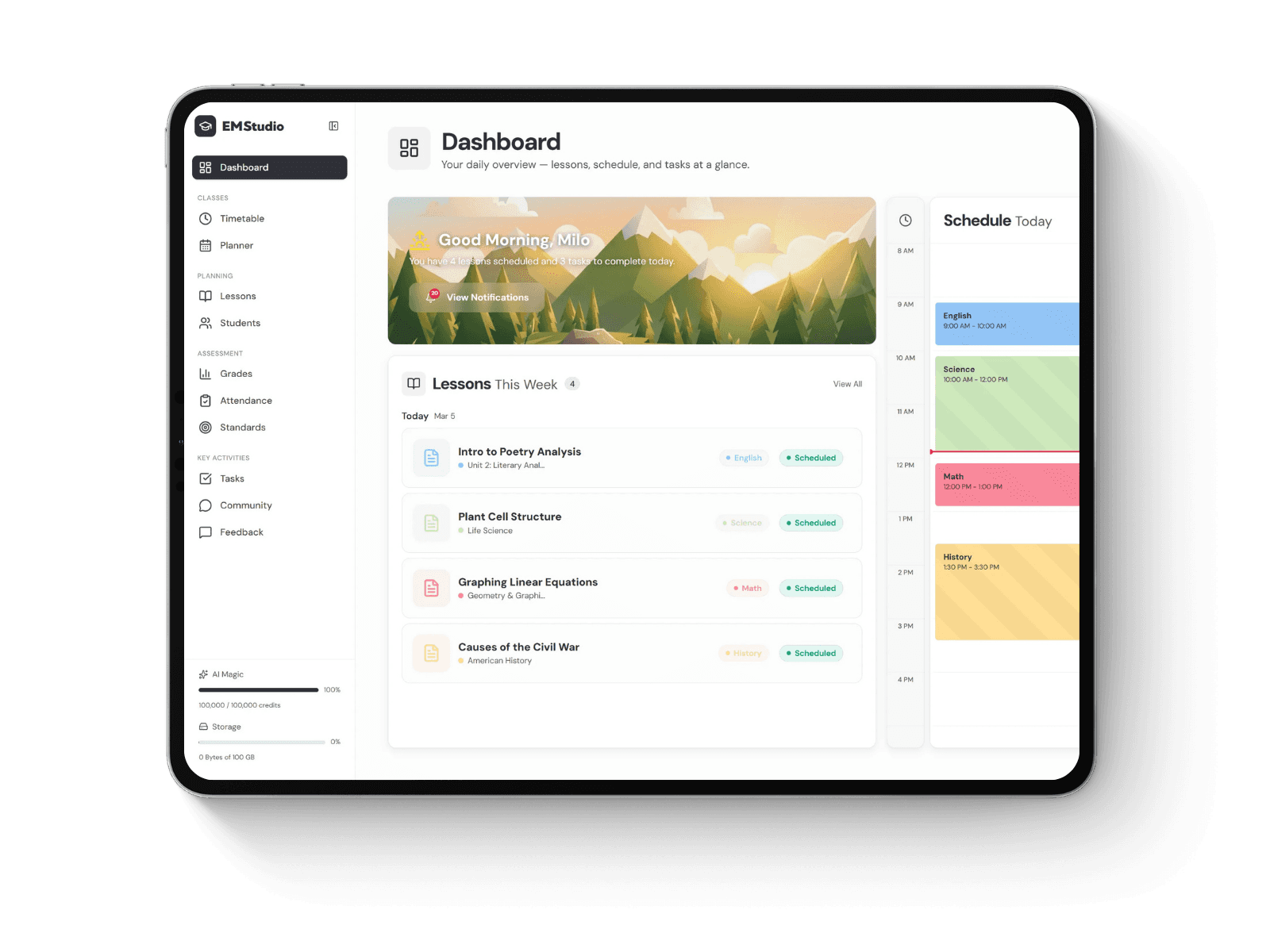
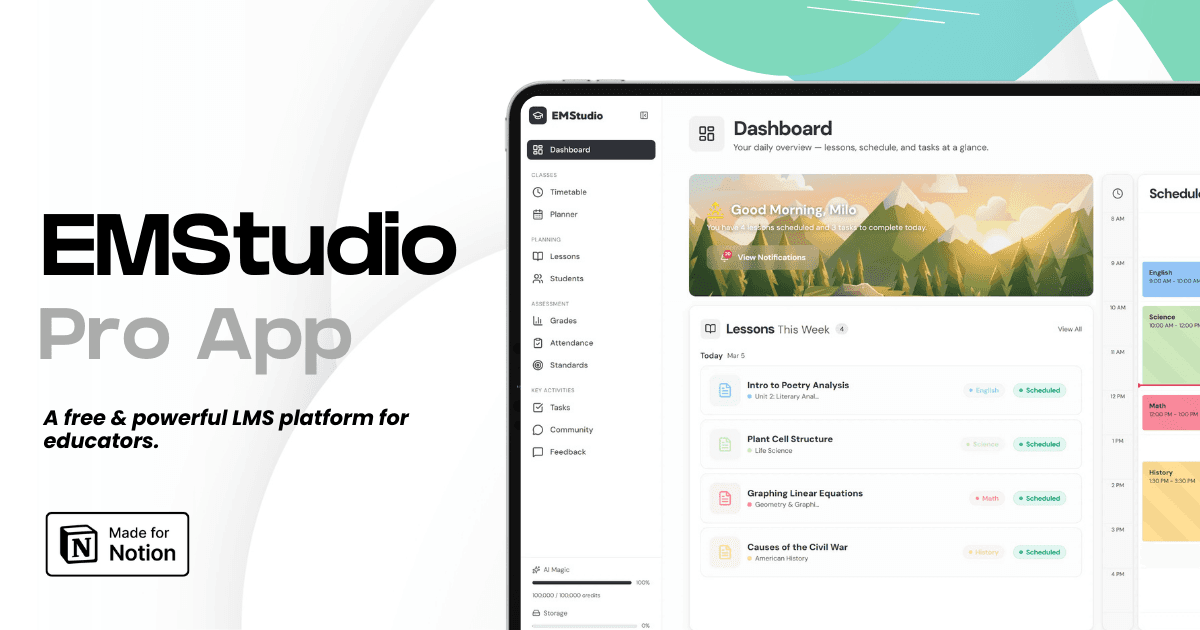
EMStudio is a free teaching management app — manage your classes, students, lessons, and more!
Learn More
Still grading everything by hand?
EMStudio is a free teaching management app — manage your classes, students, lessons, and more!
Learn More
Table of Contents
Essential Prerequisites for Transitioning to Project Based Curriculum
Start with Understanding by Design (UbD). Audit your current standards alignment to identify units thick enough for 3-4 week project arcs versus thin activities that last one day. A true project based curriculum replaces instruction; it doesn’t just decorate existing lessons with poster paper.
Dessert projects happen after the test. Main-course PBL happens during the learning. If students can skip the project and still master the standards through a worksheet, you’re serving dessert, not dinner. Driving questions should drive the unit, not just cap the Friday activity. Authentic project based curriculum requires sustained inquiry.
Calculate your tech floor. Secondary students in grades 6-12 need 1:1 device ratios for research and digital production. Elementary classrooms grades K-5 function on 2:1 ratios with station rotation models. Budget $50 to $150 per student annually for consumable materials—presentation boards, craft supplies, circuit kits. Track every receipt. Administrators question costs when glue sticks vanish without documentation. You cannot run a project based learning curriculum on paper and pencil alone.
Establish non-negotiable protocols before day one. Group contracts with signed accountability matrices prevent the “he’s not doing anything” complaints. Post a noise level protocol: 0 for silent research, 3 for active building. Map physical workspace zones for ideation, build, and presentation. Install storage systems for multi-day projects. I learned this the hard way when a custodian tossed three days of cardboard prototypes during science fair week.
Three failure modes destroy transitions. Insufficient administrative buy-in for schedule flexibility kills deep inquiry-based learning—mitigate by piloting with one grade level first. Lack of storage space for ongoing physical projects forces daily restart—mitigate by securing rolling carts or hallway corners before launch. Rigid 45-minute bell schedules fragment scaffolded instruction—mitigate by partnering with adjacent teachers for block scheduling or using “Genius Hour” slots. Address these before day one.
Run the Green Light readiness checklist before you commit:
Standards mapping density audit complete with identified 3-4 week arcs.
Administrative support level confirmed for schedule flexibility.
Parental communication plan drafted explaining authentic assessment methods.
Assessment flexibility established for formative assessment checkpoints during project work.
Safety protocols for hands-on work posted and reviewed with students.
Device ratios met: 1:1 for grades 6-12, 2:1 for K-5 with station rotation.
Materials budget approved at $50-150 per student annually for consumables.
Group contract templates printed with signed accountability matrices.
Storage systems installed and labeled for multi-day physical projects.
Noise level protocols and workspace zones physically mapped in the room.
Missing more than two items? Delay your launch. A comprehensive project-based learning implementation guide helps, but prerequisites matter more than enthusiasm. Build the structure, then release the student agency.
Step 1 — Map Standards to Real-World Driving Questions
Every project in your project based curriculum starts with a single, sticky question. Not a topic. Not a unit title. A question that makes kids forget to ask "when will we use this?" The best questions demand inquiry-based learning that stretches across subjects.
I use the GRASPS framework to torture-test standards until they bleed real-world context. Take CCSS.MATH.CONTENT.7.SP.C.8, that dry probability standard about compound events. Goal: Predict outcomes using probability models. Role: City planners. Audience: Town council. Situation: Intersection safety crisis after three accidents. Product: Traffic pattern analysis with safety recommendations backed by data. Standard: Embedded in every calculation. The driving question becomes: "How can we predict traffic patterns to present safety recommendations to the town council?" Kids aren't filling out worksheets about colored marbles. They're keeping actual neighborhoods alive.
Run the So What? test before you commit. Give yourself two minutes. If you cannot explain why the answer matters to someone outside the school building—a grandparent, a barista, the mail carrier—burn the question and start over. This gut-check ensures your authentic assessment measures something worth measuring, not just recall. One driving question fuels exactly one three-week project cycle. Any more fragments the inquiry and kills momentum.
Match the cognitive complexity to your project based learning curriculum and grade band. Elementary driving questions stay concrete and local. "How can we make our school garden grow better?" works because 8-year-olds can touch the soil and smell the compost. They see cause and effect in real time. Secondary students need systemic abstraction. "How do agricultural subsidies impact regional food security?" forces them to trace invisible economic systems across state lines. Both require scaffolded instruction, but the starting altitude differs dramatically.
Follow this conversion workflow for every standard you map:
Standard → Deconstruct the specific skill (not the whole benchmark)
Deconstructed Skill → Attach to authentic community context (who does this professionally?)
Authentic Context → Draft driving question that needs synthesis
Driving Question → Decision checkpoint: Can Google answer this in 30 seconds? If yes, revise for analysis.
Final Question → Co-create success criteria with students (what does "good" look like to the town council?)
Watch formative assessment happen in the questions kids ask while wrestling with the problem, not just the final deliverable.
When designing an effective PBL curriculum, resist packing in multiple standards. One meaty question with true student agency beats five thin investigations. Use digital tools for aligning standards with a digital curriculum tool, but remember: the software tracks the mapping. You craft the humanity that makes inquiry-based learning stick.

Step 2 — How Do You Structure Projects for Elementary and Secondary Success?
Elementary projects (K-5) require concrete 45-60 minute daily segments with heavy scaffolding and sensory materials, while secondary projects (6-12) support 90-120 minute deep work blocks with abstract research and digital tools. Both need clear milestone checkpoints every 3-5 days and defined group roles to prevent free-riding.
Structure dictates survival. Get the daily rhythm wrong, and your project based curriculum collapses into chaos by week two.
Third graders cannot manage six-week timelines. Eighth graders get bored with two-week sprints. Duration drives engagement.
Elementary (K-5) | Secondary (6-12) |
|---|---|
Duration: 3 weeks max | Duration: 6-8 weeks |
Group Size: 3-4 students | Group Size: 4-5 students |
Daily Blocks: 45-60 minutes | Daily Blocks: 90-120 minutes |
Facilitation: Check-in every 15 minutes | Facilitation: Consultant model |
Younger students lose focus after an hour. Secondary students need uninterrupted stretches to wrestle with complexity. Match the timeline to the brain.
Checkpoints every 3-5 days prevent disaster. Elementary teachers use elementary education frameworks with visible countdown charts. Secondary teachers use digital milestone markers.
Secondary facilitation shifts to a consultant model. You circulate every 20-30 minutes, not every 15. They raise hands when stuck.
Entry Events look different across grade bands. Younger students need physical artifacts or guest speakers—a 15-minute sensory hook—while older students analyze complex case studies or raw data sets for 30 minutes. Both formats demand a student-created "Need to Know" list before the bell rings.
Sensory hooks create emotional anchors. Pass around polluted water samples for an ecology unit. Let them feel the texture of historical artifacts.
Raw data sets build statistical literacy. Give them unfiltered climate data or census spreadsheets. Watch them struggle, then strategize.
This list becomes your compass for formative assessment. It tells you what they actually care about. Revise your driving questions based on their curiosity.
Scaffolded instruction varies by developmental stage. Project based learning curriculum elementary implementations require sentence stems, graphic organizers, and teacher-curated resource packets capped at five sources. Secondary students access JSTOR and Google Scholar, manage workflows through Trello or Asana free tiers, and co-construct rubrics with you.
Limiting elementary sources to five creates productive constraints. They learn to read deeply rather than skim widely. This mirrors real research skills.
Trello boards visualize workflow for teenagers. Move cards from "Research" to "Draft" to "Revision". You see bottlenecks instantly.
These tools support genuine inquiry-based learning without drowning kids in options. The goal is independence, not dependence.
The Group Work Trap kills student agency when one kid does everything. Assign rotating roles: Facilitator, Materials Manager, Recorder, and Timekeeper. Create explicit responsibility matrices.
Color-coded cards eliminate arguments about who does what. The Materials Manager wears the blue lanyard. The Recorder holds the clipboard.
Digital contracts include specific penalties for ghosting teammates. Miss two meetings, and the group votes to redistribute your workload. Consequences matter.
For secondary education structures, draft digital collaboration contracts signed by all members. Authentic assessment depends on seeing individual contributions clearly.

Step 3 — Build Sustainable Timelines and Resource Workflows
Map your project based curriculum across six weeks. Week 1 launches with your driving question and initial research. Weeks 2 and 3 are for building and creating—the heavy lifting. Week 4 shifts to revision and peer review. Week 5 hosts presentations and exhibitions. Week 6 locks in reflection and standards transfer.
Pad your timeline based on age. Elementary projects need 20% extra buffer time. Those 3rd graders will spill glue, lose notes, and rediscover the same Wikipedia article three times. Secondary students work faster—give them 10%. I learned the hard way when my 7th graders finished their podcasts in four days but my 4th graders needed eight.
Lock down physical materials before day one. Elementary teachers need 16-quart Sterilite bins—about $12 each at Target—labeled per group with masking tape. Set up checkout logs and material stations so kids aren't rummaging through your cabinets during inquiry-based learning. Place the bins on back shelves. Students return them there at the bell.
Secondary classrooms run on digital asset management. Build strict Google Drive folder structures with naming conventions like "Period3_GroupA_Draft_v2." Budget $25 to $40 per group for consumables. That covers poster board, printer ink, and the inevitable hot glue sticks for engineering prototypes. I keep receipts in an envelope taped to my desk.
Install the Sustainability Safeguard. Schedule exactly two "catch-up days" per project cycle for groups falling behind pace. These aren't free days—they're targeted intervention blocks. Maintain a parking lot chart on your wall for brilliant off-scope ideas students raise during research. These become driving questions for future units.
Set a hard deadline extension protocol. Allow one extension per group per project maximum. Require 24-hour notice. No exceptions. This forces student agency and prevents the "we need one more day" chorus five minutes before the exhibition.
Match your workflow to your schedule:
45-minute classes: Run station rotations with three centers. One group researches, one builds, one meets with you for scaffolded instruction. Rotate every 15 minutes.
90-minute blocks: Use a workshop model. Open with a 10-minute mini-lesson, then workshop time while you circulate for formative assessment. Save the last 10 minutes for cleanup.
Mixed schedules: Go hybrid. Post asynchronous digital checkpoints in your LMS for days when you see them briefly, and save heavy collaboration for block days.
Consider utilizing project management tools to track group progress. A simple Kanban board shows which teams stalled on research and which ones are ready for authentic assessment. I check mine during lunch.
Student agency depends on predictable routines. When kids know exactly where to find materials and how many days remain, they stop asking procedural questions. They start asking content questions. That shift is when real learning happens in a project based learning curriculum.
Step 4 — How Do You Assess Mastery Without Traditional Tests?
Use Hattie's visible learning principles by combining frequent formative checkpoints (exit tickets, milestone reviews) with summative exhibitions. Employ rubrics aligned to standards-based grading on a 4-point scale, incorporating self-assessment (30% weight), peer critique (20%), and teacher evaluation (50%) to ensure valid, reliable measurement without traditional testing.
Build a Standards-Based Assessment Matrix that translates rubric levels into specific project deliverables. Beginning means one cited source and a hand-drawn graph. Developing requires two sources with basic digital charts. Proficient needs three academic sources and two distinct data visualizations. Advanced requires primary source interviews plus statistical analysis. Students see exactly what sits on their desk when they hit each tier. No surprises. No last-minute confusion about expectations.
Run a Defense of Learning protocol. Students lead ten-minute conferences using portfolio evidence. In third grade, use a modified Show and Tell with five prepared questions you emailed parents the night before. In eleventh grade, host a Socratic seminar. Invite external expert panelists when possible—a city planner questioning a zoning proposal beats any standardized test for authentic assessment. The audience asks follow-up questions. Students defend their methodology.
Pick your rubric type based on your planning period length.
Single-Point Rubric: You mark where they hit the target and note concerns. Fast feedback. The disadvantage? Students can't see what separates Developing from Proficient without your verbal explanation.
Analytic Rubric: Breaks every standard into four performance levels. Shows detailed criteria clearly. The trade-off: scoring thirty projects takes three hours and kills your weekend.
Mastery Checklist: Binary yes/no for each skill. Clear completion tracking. The risk: you miss nuanced understanding of inquiry-based learning when students complete tasks without grasping concepts.
These performance-based assessments measure real skill better than multiple choice. When creating real-world assessments, anchor them to driving questions that demand cited evidence, not personal opinions.
Insert frequent formative assessment checkpoints before the final exhibition. Use exit tickets that ask students to identify the weakest source in their research. Run milestone reviews where peers check rough drafts against the Mastery Checklist. Catch gaps early so you aren't grading thirty projects that all missed the same requirement.
Avoid the Participation Grade Trap. I once assigned 15% for "classroom citizenship." It was subjective and sparked parent emails. Ban purely subjective participation grades entirely.
Replace them with structured peer evaluation via Google Forms. Use Likert scales on four specific collaboration behaviors: meeting deadlines, contributing evidence-based ideas, respecting turn-taking protocol, and quality of individual deliverables. The data gives you concrete talking points for conferences. Students rate themselves first. Then they rate three assigned teammates.
This assessment system supports a sustainable project based curriculum. It respects student agency by letting students prove mastery through choice. Use scaffolded instruction to teach peer critique—model how to give specific feedback using the rubric before they assess each other's work. Start with a fishbowl demonstration where you evaluate a sample project aloud.
Weight the final grade to prioritize growth. I use 40% for the defense presentation, 30% for the final product, and 30% for the process documentation. This balance rewards students who iterate based on feedback rather than those who ace it on the first try.
Implementation Tips for Long-Term Curriculum Success
You can't build a project based curriculum overnight. Sustainable implementation requires systems that outlast your own memory and survive staff turnover.
Start with an Iteration Protocol. After every project, run a 15-minute Plus/Delta debrief with students. Ask what worked (Plus) and what to change (Delta). Document it immediately in a shared spreadsheet while the pain points are fresh.
Maintain a Project Bank that rates difficulty 1-5. Note actual time versus planned, specific standards alignment, and which driving questions flopped. Record material costs and parent complaints. Next year's you will thank present you when you remember that the ecology unit always runs three days long.
Build vertical alignment through your PLC. Project based learning curriculum elementary teachers should lock in research and citation basics by grade 6. Secondary teachers need to assume those skills as prerequisites, not luxuries. Coordinate with the fifth-grade team now so seventh-grade science teachers don't spend two weeks reteaching note-taking.
Use the Pilot Strategy: Year 1, run one project per semester. Year 2, scale to two. Full conversion happens Year 3. This prevents the burnout that sinks most district initiatives by Christmas.
Identify Quick Win projects for first-timers. Keep them to three weeks, use familiar content like local geography, and cap material costs at $50 total. Early wins build teacher confidence faster than grand failures. These short cycles also let you practice formative assessment techniques without drowning in grading.
Reference Hattie's research when administrators question planning time. Feedback has an effect size of 0.70; collective teacher efficacy hits 1.57. Those numbers mean collaborative planning isn't optional fluff—it's the engine that makes inquiry-based learning actually work. Protect that PLC time like you'd protect your lunch break.
Demand thirty hours of sustained professional development annually. Teachers need time to design authentic assessment rubrics and practice scaffolded instruction techniques. Student agency only grows when educators feel competent and supported. One Saturday workshop won't cut it.
Check out the 7 steps to project-based teaching implementation for the full roadmap. Browse real-world impact projects to stock your initial Project Bank with tested units.

What to Remember About Project Based Curriculum
Start with one unit. Pick the standards you dread teaching most and flip them into a driving question that actually matters to kids. You don't need ten projects—one solid implementation beats a year of rushed experiments. Let the textbook gather dust for three weeks while students wrestle with real problems that don't have answer keys in the back.
Authentic assessment isn't optional; it's the point. When students defend their work to real audiences, they learn more than any multiple-choice test could reveal. Build that presentation day into your calendar first, then scaffold backwards with weekly checkpoints that keep teams on track without killing their creative momentum or your sanity.
This work is messy. Your first project will run long, some groups will flounder, and you'll want to return to the safety of worksheets. Stick with it. The engagement you'll see in week three—when a reluctant student explains their research to a community expert—makes the chaos of week one worth every single minute.

Essential Prerequisites for Transitioning to Project Based Curriculum
Start with Understanding by Design (UbD). Audit your current standards alignment to identify units thick enough for 3-4 week project arcs versus thin activities that last one day. A true project based curriculum replaces instruction; it doesn’t just decorate existing lessons with poster paper.
Dessert projects happen after the test. Main-course PBL happens during the learning. If students can skip the project and still master the standards through a worksheet, you’re serving dessert, not dinner. Driving questions should drive the unit, not just cap the Friday activity. Authentic project based curriculum requires sustained inquiry.
Calculate your tech floor. Secondary students in grades 6-12 need 1:1 device ratios for research and digital production. Elementary classrooms grades K-5 function on 2:1 ratios with station rotation models. Budget $50 to $150 per student annually for consumable materials—presentation boards, craft supplies, circuit kits. Track every receipt. Administrators question costs when glue sticks vanish without documentation. You cannot run a project based learning curriculum on paper and pencil alone.
Establish non-negotiable protocols before day one. Group contracts with signed accountability matrices prevent the “he’s not doing anything” complaints. Post a noise level protocol: 0 for silent research, 3 for active building. Map physical workspace zones for ideation, build, and presentation. Install storage systems for multi-day projects. I learned this the hard way when a custodian tossed three days of cardboard prototypes during science fair week.
Three failure modes destroy transitions. Insufficient administrative buy-in for schedule flexibility kills deep inquiry-based learning—mitigate by piloting with one grade level first. Lack of storage space for ongoing physical projects forces daily restart—mitigate by securing rolling carts or hallway corners before launch. Rigid 45-minute bell schedules fragment scaffolded instruction—mitigate by partnering with adjacent teachers for block scheduling or using “Genius Hour” slots. Address these before day one.
Run the Green Light readiness checklist before you commit:
Standards mapping density audit complete with identified 3-4 week arcs.
Administrative support level confirmed for schedule flexibility.
Parental communication plan drafted explaining authentic assessment methods.
Assessment flexibility established for formative assessment checkpoints during project work.
Safety protocols for hands-on work posted and reviewed with students.
Device ratios met: 1:1 for grades 6-12, 2:1 for K-5 with station rotation.
Materials budget approved at $50-150 per student annually for consumables.
Group contract templates printed with signed accountability matrices.
Storage systems installed and labeled for multi-day physical projects.
Noise level protocols and workspace zones physically mapped in the room.
Missing more than two items? Delay your launch. A comprehensive project-based learning implementation guide helps, but prerequisites matter more than enthusiasm. Build the structure, then release the student agency.
Step 1 — Map Standards to Real-World Driving Questions
Every project in your project based curriculum starts with a single, sticky question. Not a topic. Not a unit title. A question that makes kids forget to ask "when will we use this?" The best questions demand inquiry-based learning that stretches across subjects.
I use the GRASPS framework to torture-test standards until they bleed real-world context. Take CCSS.MATH.CONTENT.7.SP.C.8, that dry probability standard about compound events. Goal: Predict outcomes using probability models. Role: City planners. Audience: Town council. Situation: Intersection safety crisis after three accidents. Product: Traffic pattern analysis with safety recommendations backed by data. Standard: Embedded in every calculation. The driving question becomes: "How can we predict traffic patterns to present safety recommendations to the town council?" Kids aren't filling out worksheets about colored marbles. They're keeping actual neighborhoods alive.
Run the So What? test before you commit. Give yourself two minutes. If you cannot explain why the answer matters to someone outside the school building—a grandparent, a barista, the mail carrier—burn the question and start over. This gut-check ensures your authentic assessment measures something worth measuring, not just recall. One driving question fuels exactly one three-week project cycle. Any more fragments the inquiry and kills momentum.
Match the cognitive complexity to your project based learning curriculum and grade band. Elementary driving questions stay concrete and local. "How can we make our school garden grow better?" works because 8-year-olds can touch the soil and smell the compost. They see cause and effect in real time. Secondary students need systemic abstraction. "How do agricultural subsidies impact regional food security?" forces them to trace invisible economic systems across state lines. Both require scaffolded instruction, but the starting altitude differs dramatically.
Follow this conversion workflow for every standard you map:
Standard → Deconstruct the specific skill (not the whole benchmark)
Deconstructed Skill → Attach to authentic community context (who does this professionally?)
Authentic Context → Draft driving question that needs synthesis
Driving Question → Decision checkpoint: Can Google answer this in 30 seconds? If yes, revise for analysis.
Final Question → Co-create success criteria with students (what does "good" look like to the town council?)
Watch formative assessment happen in the questions kids ask while wrestling with the problem, not just the final deliverable.
When designing an effective PBL curriculum, resist packing in multiple standards. One meaty question with true student agency beats five thin investigations. Use digital tools for aligning standards with a digital curriculum tool, but remember: the software tracks the mapping. You craft the humanity that makes inquiry-based learning stick.
Step 2 — How Do You Structure Projects for Elementary and Secondary Success?
Elementary projects (K-5) require concrete 45-60 minute daily segments with heavy scaffolding and sensory materials, while secondary projects (6-12) support 90-120 minute deep work blocks with abstract research and digital tools. Both need clear milestone checkpoints every 3-5 days and defined group roles to prevent free-riding.
Structure dictates survival. Get the daily rhythm wrong, and your project based curriculum collapses into chaos by week two.
Third graders cannot manage six-week timelines. Eighth graders get bored with two-week sprints. Duration drives engagement.
Elementary (K-5) | Secondary (6-12) |
|---|---|
Duration: 3 weeks max | Duration: 6-8 weeks |
Group Size: 3-4 students | Group Size: 4-5 students |
Daily Blocks: 45-60 minutes | Daily Blocks: 90-120 minutes |
Facilitation: Check-in every 15 minutes | Facilitation: Consultant model |
Younger students lose focus after an hour. Secondary students need uninterrupted stretches to wrestle with complexity. Match the timeline to the brain.
Checkpoints every 3-5 days prevent disaster. Elementary teachers use elementary education frameworks with visible countdown charts. Secondary teachers use digital milestone markers.
Secondary facilitation shifts to a consultant model. You circulate every 20-30 minutes, not every 15. They raise hands when stuck.
Entry Events look different across grade bands. Younger students need physical artifacts or guest speakers—a 15-minute sensory hook—while older students analyze complex case studies or raw data sets for 30 minutes. Both formats demand a student-created "Need to Know" list before the bell rings.
Sensory hooks create emotional anchors. Pass around polluted water samples for an ecology unit. Let them feel the texture of historical artifacts.
Raw data sets build statistical literacy. Give them unfiltered climate data or census spreadsheets. Watch them struggle, then strategize.
This list becomes your compass for formative assessment. It tells you what they actually care about. Revise your driving questions based on their curiosity.
Scaffolded instruction varies by developmental stage. Project based learning curriculum elementary implementations require sentence stems, graphic organizers, and teacher-curated resource packets capped at five sources. Secondary students access JSTOR and Google Scholar, manage workflows through Trello or Asana free tiers, and co-construct rubrics with you.
Limiting elementary sources to five creates productive constraints. They learn to read deeply rather than skim widely. This mirrors real research skills.
Trello boards visualize workflow for teenagers. Move cards from "Research" to "Draft" to "Revision". You see bottlenecks instantly.
These tools support genuine inquiry-based learning without drowning kids in options. The goal is independence, not dependence.
The Group Work Trap kills student agency when one kid does everything. Assign rotating roles: Facilitator, Materials Manager, Recorder, and Timekeeper. Create explicit responsibility matrices.
Color-coded cards eliminate arguments about who does what. The Materials Manager wears the blue lanyard. The Recorder holds the clipboard.
Digital contracts include specific penalties for ghosting teammates. Miss two meetings, and the group votes to redistribute your workload. Consequences matter.
For secondary education structures, draft digital collaboration contracts signed by all members. Authentic assessment depends on seeing individual contributions clearly.
Step 3 — Build Sustainable Timelines and Resource Workflows
Map your project based curriculum across six weeks. Week 1 launches with your driving question and initial research. Weeks 2 and 3 are for building and creating—the heavy lifting. Week 4 shifts to revision and peer review. Week 5 hosts presentations and exhibitions. Week 6 locks in reflection and standards transfer.
Pad your timeline based on age. Elementary projects need 20% extra buffer time. Those 3rd graders will spill glue, lose notes, and rediscover the same Wikipedia article three times. Secondary students work faster—give them 10%. I learned the hard way when my 7th graders finished their podcasts in four days but my 4th graders needed eight.
Lock down physical materials before day one. Elementary teachers need 16-quart Sterilite bins—about $12 each at Target—labeled per group with masking tape. Set up checkout logs and material stations so kids aren't rummaging through your cabinets during inquiry-based learning. Place the bins on back shelves. Students return them there at the bell.
Secondary classrooms run on digital asset management. Build strict Google Drive folder structures with naming conventions like "Period3_GroupA_Draft_v2." Budget $25 to $40 per group for consumables. That covers poster board, printer ink, and the inevitable hot glue sticks for engineering prototypes. I keep receipts in an envelope taped to my desk.
Install the Sustainability Safeguard. Schedule exactly two "catch-up days" per project cycle for groups falling behind pace. These aren't free days—they're targeted intervention blocks. Maintain a parking lot chart on your wall for brilliant off-scope ideas students raise during research. These become driving questions for future units.
Set a hard deadline extension protocol. Allow one extension per group per project maximum. Require 24-hour notice. No exceptions. This forces student agency and prevents the "we need one more day" chorus five minutes before the exhibition.
Match your workflow to your schedule:
45-minute classes: Run station rotations with three centers. One group researches, one builds, one meets with you for scaffolded instruction. Rotate every 15 minutes.
90-minute blocks: Use a workshop model. Open with a 10-minute mini-lesson, then workshop time while you circulate for formative assessment. Save the last 10 minutes for cleanup.
Mixed schedules: Go hybrid. Post asynchronous digital checkpoints in your LMS for days when you see them briefly, and save heavy collaboration for block days.
Consider utilizing project management tools to track group progress. A simple Kanban board shows which teams stalled on research and which ones are ready for authentic assessment. I check mine during lunch.
Student agency depends on predictable routines. When kids know exactly where to find materials and how many days remain, they stop asking procedural questions. They start asking content questions. That shift is when real learning happens in a project based learning curriculum.
Step 4 — How Do You Assess Mastery Without Traditional Tests?
Use Hattie's visible learning principles by combining frequent formative checkpoints (exit tickets, milestone reviews) with summative exhibitions. Employ rubrics aligned to standards-based grading on a 4-point scale, incorporating self-assessment (30% weight), peer critique (20%), and teacher evaluation (50%) to ensure valid, reliable measurement without traditional testing.
Build a Standards-Based Assessment Matrix that translates rubric levels into specific project deliverables. Beginning means one cited source and a hand-drawn graph. Developing requires two sources with basic digital charts. Proficient needs three academic sources and two distinct data visualizations. Advanced requires primary source interviews plus statistical analysis. Students see exactly what sits on their desk when they hit each tier. No surprises. No last-minute confusion about expectations.
Run a Defense of Learning protocol. Students lead ten-minute conferences using portfolio evidence. In third grade, use a modified Show and Tell with five prepared questions you emailed parents the night before. In eleventh grade, host a Socratic seminar. Invite external expert panelists when possible—a city planner questioning a zoning proposal beats any standardized test for authentic assessment. The audience asks follow-up questions. Students defend their methodology.
Pick your rubric type based on your planning period length.
Single-Point Rubric: You mark where they hit the target and note concerns. Fast feedback. The disadvantage? Students can't see what separates Developing from Proficient without your verbal explanation.
Analytic Rubric: Breaks every standard into four performance levels. Shows detailed criteria clearly. The trade-off: scoring thirty projects takes three hours and kills your weekend.
Mastery Checklist: Binary yes/no for each skill. Clear completion tracking. The risk: you miss nuanced understanding of inquiry-based learning when students complete tasks without grasping concepts.
These performance-based assessments measure real skill better than multiple choice. When creating real-world assessments, anchor them to driving questions that demand cited evidence, not personal opinions.
Insert frequent formative assessment checkpoints before the final exhibition. Use exit tickets that ask students to identify the weakest source in their research. Run milestone reviews where peers check rough drafts against the Mastery Checklist. Catch gaps early so you aren't grading thirty projects that all missed the same requirement.
Avoid the Participation Grade Trap. I once assigned 15% for "classroom citizenship." It was subjective and sparked parent emails. Ban purely subjective participation grades entirely.
Replace them with structured peer evaluation via Google Forms. Use Likert scales on four specific collaboration behaviors: meeting deadlines, contributing evidence-based ideas, respecting turn-taking protocol, and quality of individual deliverables. The data gives you concrete talking points for conferences. Students rate themselves first. Then they rate three assigned teammates.
This assessment system supports a sustainable project based curriculum. It respects student agency by letting students prove mastery through choice. Use scaffolded instruction to teach peer critique—model how to give specific feedback using the rubric before they assess each other's work. Start with a fishbowl demonstration where you evaluate a sample project aloud.
Weight the final grade to prioritize growth. I use 40% for the defense presentation, 30% for the final product, and 30% for the process documentation. This balance rewards students who iterate based on feedback rather than those who ace it on the first try.
Implementation Tips for Long-Term Curriculum Success
You can't build a project based curriculum overnight. Sustainable implementation requires systems that outlast your own memory and survive staff turnover.
Start with an Iteration Protocol. After every project, run a 15-minute Plus/Delta debrief with students. Ask what worked (Plus) and what to change (Delta). Document it immediately in a shared spreadsheet while the pain points are fresh.
Maintain a Project Bank that rates difficulty 1-5. Note actual time versus planned, specific standards alignment, and which driving questions flopped. Record material costs and parent complaints. Next year's you will thank present you when you remember that the ecology unit always runs three days long.
Build vertical alignment through your PLC. Project based learning curriculum elementary teachers should lock in research and citation basics by grade 6. Secondary teachers need to assume those skills as prerequisites, not luxuries. Coordinate with the fifth-grade team now so seventh-grade science teachers don't spend two weeks reteaching note-taking.
Use the Pilot Strategy: Year 1, run one project per semester. Year 2, scale to two. Full conversion happens Year 3. This prevents the burnout that sinks most district initiatives by Christmas.
Identify Quick Win projects for first-timers. Keep them to three weeks, use familiar content like local geography, and cap material costs at $50 total. Early wins build teacher confidence faster than grand failures. These short cycles also let you practice formative assessment techniques without drowning in grading.
Reference Hattie's research when administrators question planning time. Feedback has an effect size of 0.70; collective teacher efficacy hits 1.57. Those numbers mean collaborative planning isn't optional fluff—it's the engine that makes inquiry-based learning actually work. Protect that PLC time like you'd protect your lunch break.
Demand thirty hours of sustained professional development annually. Teachers need time to design authentic assessment rubrics and practice scaffolded instruction techniques. Student agency only grows when educators feel competent and supported. One Saturday workshop won't cut it.
Check out the 7 steps to project-based teaching implementation for the full roadmap. Browse real-world impact projects to stock your initial Project Bank with tested units.
What to Remember About Project Based Curriculum
Start with one unit. Pick the standards you dread teaching most and flip them into a driving question that actually matters to kids. You don't need ten projects—one solid implementation beats a year of rushed experiments. Let the textbook gather dust for three weeks while students wrestle with real problems that don't have answer keys in the back.
Authentic assessment isn't optional; it's the point. When students defend their work to real audiences, they learn more than any multiple-choice test could reveal. Build that presentation day into your calendar first, then scaffold backwards with weekly checkpoints that keep teams on track without killing their creative momentum or your sanity.
This work is messy. Your first project will run long, some groups will flounder, and you'll want to return to the safety of worksheets. Stick with it. The engagement you'll see in week three—when a reluctant student explains their research to a community expert—makes the chaos of week one worth every single minute.
Still grading everything by hand?
EMStudio is a free teaching management app — manage your classes, students, lessons, and more!
Learn More
Still grading everything by hand?
EMStudio is a free teaching management app — manage your classes, students, lessons, and more!
Learn More



Notion4Teachers
Notion templates to simplify administrative tasks and enhance your teaching experience.



2026 Notion4Teachers. All Rights Reserved.
Notion4Teachers
Notion templates to simplify administrative tasks and enhance your teaching experience.
2026 Notion4Teachers. All Rights Reserved.
Notion4Teachers
Notion templates to simplify administrative tasks and enhance your teaching experience.
2026 Notion4Teachers. All Rights Reserved.