
Online Medical Certifications for School Staff
Online Medical Certifications for School Staff

Article by
Milo
ESL Content Coordinator & Educator
ESL Content Coordinator & Educator
All Posts
Ultimate Teacher Planner
The ultimate all-in-one education management system in Notion.
Learn More
Ultimate Teacher Planner
The ultimate all-in-one education management system in Notion.
Learn More
Table of Contents
Right now, a school office is probably holding a small pile of half-checked forms, expired CPR cards, and a renewal email that came in too late. A nurse is trying to confirm who can administer medication, a principal wants staff cleared for a field trip, and HR needs one clean answer before the week gets busier. That's the core job of online medical certifications in education, not just earning a certificate, but making sure the right adults are properly prepared, properly documented, and ready when students need them.
For schools, the challenge isn't learning about health and safety in theory. It's choosing training that fits local rules, holds up under review, and can be tracked without turning every renewal season into a spreadsheet crisis. The schools that handle this well treat certification as an ongoing compliance system, not a one-time purchase.
Understanding Online Medical Certifications in Education
A school can have excellent policies on paper and still be exposed the moment an expired credential shows up during a trip, a clinic day, or a playground incident. That is why online medical certifications matter in education, they keep staff training visible, current, and easier to manage across many roles at once.
What these certificates actually represent
In a school setting, a medical certification usually means proof that a staff member has completed a recognized training program tied to a safety function. That might be CPR, first aid, bloodborne pathogen safety, or a specialized response course for medication support or emergencies. The key point is that these are not ordinary enrichment courses, they're credentials that affect whether someone is cleared to act in a health-related moment.
Online delivery changed how those credentials are earned. Harvard Medical School's 2017 launch of HMX Fundamentals showed how an elite institution could package remote, paid certificate learning for physiology, immunology, biochemistry, and genetics, with published pricing of $800 for one course, $1,000 for two, and $1,800 for all four in a public application model Harvard Medical School's first online certificate program. That milestone mattered because it normalized the idea that structured credentialed learning could happen beyond a campus classroom.
For schools, the practical lesson is simple. Digital training isn't a shortcut by default, it's a delivery method that can be rigorous when the provider is legitimate and the course matches local requirements.
Practical rule: if the certificate affects student safety, the school should verify both the content and the issuer, not just the convenience of the platform.
Why schools treat this as compliance, not convenience
School leaders often discover that the hardest part isn't training staff once, it's proving that the right people were trained at the right time. That proof matters because audits, licensing checks, and district reviews usually focus on records, dates, and the quality of the credential.
Online learning helps because it creates a clear paper trail. A completed course can be stored, linked to a staff record, and checked later without searching email threads or filing cabinets. When a school combines that with a central tracking workflow, certification stops being reactive and starts becoming manageable.
Essential Health and Safety Credentials for School Staff
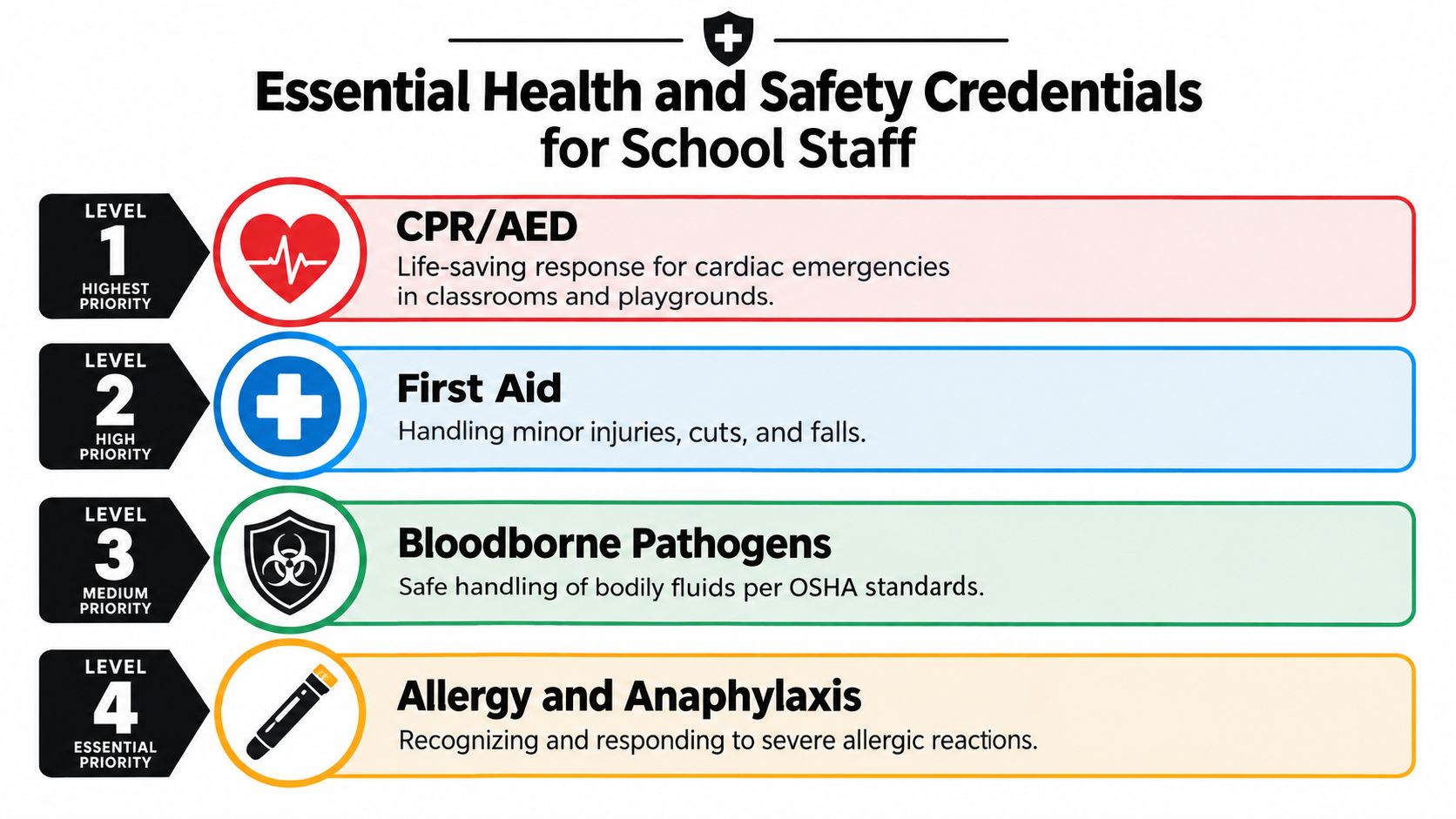
School staff don't all need the same credential, but many roles overlap in ways that make basic health and safety training essential. A classroom teacher may never expect to handle a medical emergency, yet still be the first adult present when a child collapses, chokes, falls, or reacts to an allergen. That's why the most useful certification stack is built around real school incidents, not abstract job titles.
The core training categories schools rely on
CPR and AED training sits at the top because it addresses the worst-case moment, sudden cardiac arrest or a life-threatening collapse. In schools, that training matters for teachers, coaches, bus staff, office teams, and anyone supervising groups away from immediate medical support.
First aid covers the more routine but still urgent issues schools see every day, such as cuts, bruises, nosebleeds, and playground falls. Staff who know how to respond calmly can reduce panic and prevent a small injury from becoming a bigger one.
Bloodborne pathogen training helps staff handle bodily fluids safely during cleanup, an overlooked part of school life that comes up more often than people expect. This is especially relevant for custodial teams, nurses, paraprofessionals, and anyone assigned to sick-room support.
Allergy and anaphylaxis response is increasingly important in schools with known food allergies or complex health plans. Staff need to recognize warning signs early and know where emergency medication is kept.
The video below is useful for leaders comparing training priorities and deciding who should be first in the queue.
How those credentials map to daily school work
The right credential depends on what a person does on campus. A front office assistant may need different coverage than a coach, but both can end up dealing with a student emergency. A nurse or designated medication aide may need a deeper protocol set than a homeroom teacher, yet all of them still benefit from common response training.
Schools that want a stronger baseline often compare CPR, first aid, and emergency response against the same standard: if a child is hurt before the nurse arrives, can the nearest adult act safely? That standard is easier to support when training records are organized, current, and easy to verify.
For a practical school-oriented explanation of why CPR preparation matters in education settings, see this guidance on CPR training for teachers and safe schools.
Comparing Fully Online and Blended Delivery Formats
Not every certificate should be judged by the same delivery rule. Some courses work well online because they teach policy, recognition, or decision-making. Others need a live skills check so a trainer can see whether the learner can perform the task under pressure.
Where fully online works well
Fully online delivery fits training that is mostly knowledge-based. Bloodborne pathogen awareness, refresher content on safety procedures, and some first aid theory modules can often be completed online without losing much value. Schools like these formats because they're easier to schedule, cheaper to roll out, and simpler to repeat when new hires arrive mid-year.
CPR and AED are more complicated. The classroom component can teach what to do, but staff usually also need hands-on practice for chest compressions, pad placement, and response sequence. A certificate that never verifies the physical skill may not satisfy local expectations, especially if the school or state asks for in-person demonstration.
Where blended learning is the safer purchase
Blended programs combine online instruction with an in-person skills check. That makes them useful when a school wants convenience without sacrificing credibility. The online portion handles content efficiently, and the face-to-face part confirms that the staff member can perform the task correctly.
A school should pay for the format that matches the risk. If the credential affects emergency response, a skills check is usually worth the scheduling effort.
The table below gives administrators a simple way to compare common options before buying.
Certification Type | Fully Online Viability | Blended Requirement | Key Consideration |
|---|---|---|---|
CPR and AED | Limited | Usually needed | Hands-on performance matters |
First Aid Theory | Often suitable | Sometimes useful | Check local acceptance |
Bloodborne Pathogens | Often suitable | Rarely needed | Focus on procedure accuracy |
Allergy and Anaphylaxis Response | Mixed | Often useful | Confirm emergency response expectations |
Schools that want a broader framework for distance learning in medical education can also review this discussion of distance learning, medical education, and tradition. The decision should always start with the job role, then the local rule, then the delivery format.
How ProMed Certifications Can Help
Some school leaders need a provider that keeps the process simple without stripping away rigor. ProMed Certifications is one example to review when a district wants online medical certifications for staff who need flexible access, repeatable training, and fast completion tracking across multiple people. Its value is strongest when the school needs a platform that can support health-related certification renewal without forcing every learner into the same schedule.
The platform at online medical certifications can be useful for administrators comparing course access, retake flexibility, and staff-friendly pacing. It's especially relevant where an organization needs a clean way to assign or complete courses without turning each renewal into a separate manual process.

The right way to judge a provider like this is to ask three questions. First, does the course match the credential the school needs. Second, will the certificate be accepted by the relevant local authority or employer policy. Third, can the school document completion without chasing staff one by one. If those answers are yes, the platform may be a practical fit.
For schools, the biggest benefit isn't marketing language, it's operational clarity. A provider is useful when it helps reduce missed renewals, improves record keeping, and lets staff complete required training without derailing the school day.
Navigating Accreditation and State Regulatory Requirements
A certificate only helps if the school can defend it during a review. That means the provider, the content, and the format all need to align with the local environment, not just with a general internet claim. The safest process is to treat accreditation as a checklist, not a guess.
How to verify a certificate before buying it
Start with the issuer. A legitimate provider should clearly show who created the course, what body recognizes it, and what the certificate covers. If the website makes the training sound instant, universal, or interchangeable with every other credential, the school should slow down.
Next, check whether the certificate format matches the local rule. Some jurisdictions accept remote learning for certain topics, while others expect hands-on validation or physician-level oversight for particular tasks. Singapore's medical council, for example, says online medical certificates must rest on proper medical grounds and clinical assessment, with video consultation sometimes acceptable depending on circumstances, while India's telemedicine guidelines allow registered doctors to issue certificates after remote consultation, though practices vary widely across providers online certificate acceptability and professional standards.
The source of truth is always local policy. A school can save money by buying the wrong course, but it can lose much more if that course fails an audit or doesn't satisfy the employer's documentation standard.
How to build a compliance file in Notion
A centralized workspace should store five things for every credential, the staff member's name, the certificate type, the issue date, the expiration date, and the document itself. The goal is to make compliance visible at a glance, not buried in attachments. When renewal dates are all in one place, the school can sort by urgency and see risk before it becomes a problem.
A simple workflow helps:
Record the staff member the day the credential is assigned.
Attach the certificate or completion record in the same entry.
Tag the jurisdiction or policy basis so the school knows why the credential was chosen.
Set reminder dates well before expiration.
Review exceptions where a certificate needs special local approval.
Best practice: if a certificate can't be found in one minute, the system isn't finished yet.
For a structured way to expand that database into a broader compliance system, see this continuing education tracking guide. The point is not software for its own sake. It's making sure a district can answer who is current, who is expiring soon, and who can legally work tomorrow.

Tracking Faculty Compliance with Notion4Teachers
A school rarely fails compliance because nobody cared. It fails because the information lived in too many places, and renewal dates were managed by memory. A good tracking system turns that chaos into a working calendar that the nurse, principal, and HR coordinator can all trust.
What a strong dashboard needs
The best setup begins with linked databases. One database should hold staff profiles, another should hold certification types, and a third should store issue and expiry dates. When those databases are connected, the school can filter by campus, job role, or urgency instead of opening dozens of separate files.
A well-designed compliance dashboard should also show status labels. A simple set like current, expiring soon, and expired is often enough to make action obvious. That view helps the school nurse or HR lead spot the people who need follow-up this week rather than discovering them at the end of the term.
How to make the system sustainable
Automation matters, but only after the data structure is clean. If the entries are inconsistent, reminders won't fix the mess. The first priority is making sure every certificate is entered the same way, every time, so roll-ups and alerts mean something.
That's where Notion-based templates can be useful for schools that want a consistent framework instead of building from scratch. Notion4Teachers is most relevant here as an organizational layer, because it helps educators set up repeatable systems for staff tracking, planning, and oversight rather than improvised folders and scattered notes.
A strong compliance setup should include:
One record per staff member with all current credentials linked.
One credential template for each certification type used by the school.
One renewal calendar with reminders tied to expiration dates.
One exception log for missing documents, local waivers, or pending approvals.
One review routine each month so small problems don't sit unnoticed.
Schools that keep the workflow simple usually keep it usable. A complicated system looks impressive on day one and gets abandoned by day twenty.
Building a Sustainable Renewal and Onboarding Workflow
The most reliable schools don't wait for renewals to bunch up at the end of the year. They build a rhythm that starts on hiring day and repeats before expiration becomes urgent. That approach protects students, reduces staff stress, and gives administrators a process they can maintain.
A cleaner onboarding sequence
New hires should enter the compliance system on day one, even if some certificates are still pending. That way, the school knows exactly what's complete, what's missing, and what needs follow-up before the first instructional day. The onboarding file should include the current credential list, the renewal schedule, and any role-specific requirements that apply to that person.
A useful pattern is to separate must-have credentials from nice-to-have training. The must-have list determines whether the employee is cleared for duty. The optional list supports professional growth but shouldn't be confused with compliance. That distinction prevents schools from overbuying courses or underbuying essential ones.
Keeping renewal reminders manageable
Renewals work best when they're staggered. If every CPR card expires in the same month, the school gets a paperwork surge right when other year-end demands are also peaking. A better system spreads reminders across the year and sets earlier alerts so staff can renew before deadlines become emergencies.

A simple renewal cycle usually works best when it follows the same order every time:
Onboard the staff member and record every required credential.
Monitor dates with automated reminders inside the tracking system.
Renew before expiration so there's time for course completion or skills checking.
Verify the new certificate and update the compliance record immediately.
The schools that win here are not the ones with the fanciest tools. They're the ones that make the process boring, visible, and repeatable. A clean workflow keeps leadership out of last-minute panic and keeps staff focused on students instead of paperwork.
If the school is ready to replace expired-card panic with a real compliance system, the next step is to build one central workspace for staff credentials, renewal dates, and document storage. A Notion-based setup from Notion4Teachers can help turn that process into something clear, shared, and easy to keep current across the whole faculty.
Right now, a school office is probably holding a small pile of half-checked forms, expired CPR cards, and a renewal email that came in too late. A nurse is trying to confirm who can administer medication, a principal wants staff cleared for a field trip, and HR needs one clean answer before the week gets busier. That's the core job of online medical certifications in education, not just earning a certificate, but making sure the right adults are properly prepared, properly documented, and ready when students need them.
For schools, the challenge isn't learning about health and safety in theory. It's choosing training that fits local rules, holds up under review, and can be tracked without turning every renewal season into a spreadsheet crisis. The schools that handle this well treat certification as an ongoing compliance system, not a one-time purchase.
Understanding Online Medical Certifications in Education
A school can have excellent policies on paper and still be exposed the moment an expired credential shows up during a trip, a clinic day, or a playground incident. That is why online medical certifications matter in education, they keep staff training visible, current, and easier to manage across many roles at once.
What these certificates actually represent
In a school setting, a medical certification usually means proof that a staff member has completed a recognized training program tied to a safety function. That might be CPR, first aid, bloodborne pathogen safety, or a specialized response course for medication support or emergencies. The key point is that these are not ordinary enrichment courses, they're credentials that affect whether someone is cleared to act in a health-related moment.
Online delivery changed how those credentials are earned. Harvard Medical School's 2017 launch of HMX Fundamentals showed how an elite institution could package remote, paid certificate learning for physiology, immunology, biochemistry, and genetics, with published pricing of $800 for one course, $1,000 for two, and $1,800 for all four in a public application model Harvard Medical School's first online certificate program. That milestone mattered because it normalized the idea that structured credentialed learning could happen beyond a campus classroom.
For schools, the practical lesson is simple. Digital training isn't a shortcut by default, it's a delivery method that can be rigorous when the provider is legitimate and the course matches local requirements.
Practical rule: if the certificate affects student safety, the school should verify both the content and the issuer, not just the convenience of the platform.
Why schools treat this as compliance, not convenience
School leaders often discover that the hardest part isn't training staff once, it's proving that the right people were trained at the right time. That proof matters because audits, licensing checks, and district reviews usually focus on records, dates, and the quality of the credential.
Online learning helps because it creates a clear paper trail. A completed course can be stored, linked to a staff record, and checked later without searching email threads or filing cabinets. When a school combines that with a central tracking workflow, certification stops being reactive and starts becoming manageable.
Essential Health and Safety Credentials for School Staff
School staff don't all need the same credential, but many roles overlap in ways that make basic health and safety training essential. A classroom teacher may never expect to handle a medical emergency, yet still be the first adult present when a child collapses, chokes, falls, or reacts to an allergen. That's why the most useful certification stack is built around real school incidents, not abstract job titles.
The core training categories schools rely on
CPR and AED training sits at the top because it addresses the worst-case moment, sudden cardiac arrest or a life-threatening collapse. In schools, that training matters for teachers, coaches, bus staff, office teams, and anyone supervising groups away from immediate medical support.
First aid covers the more routine but still urgent issues schools see every day, such as cuts, bruises, nosebleeds, and playground falls. Staff who know how to respond calmly can reduce panic and prevent a small injury from becoming a bigger one.
Bloodborne pathogen training helps staff handle bodily fluids safely during cleanup, an overlooked part of school life that comes up more often than people expect. This is especially relevant for custodial teams, nurses, paraprofessionals, and anyone assigned to sick-room support.
Allergy and anaphylaxis response is increasingly important in schools with known food allergies or complex health plans. Staff need to recognize warning signs early and know where emergency medication is kept.
The video below is useful for leaders comparing training priorities and deciding who should be first in the queue.
How those credentials map to daily school work
The right credential depends on what a person does on campus. A front office assistant may need different coverage than a coach, but both can end up dealing with a student emergency. A nurse or designated medication aide may need a deeper protocol set than a homeroom teacher, yet all of them still benefit from common response training.
Schools that want a stronger baseline often compare CPR, first aid, and emergency response against the same standard: if a child is hurt before the nurse arrives, can the nearest adult act safely? That standard is easier to support when training records are organized, current, and easy to verify.
For a practical school-oriented explanation of why CPR preparation matters in education settings, see this guidance on CPR training for teachers and safe schools.
Comparing Fully Online and Blended Delivery Formats
Not every certificate should be judged by the same delivery rule. Some courses work well online because they teach policy, recognition, or decision-making. Others need a live skills check so a trainer can see whether the learner can perform the task under pressure.
Where fully online works well
Fully online delivery fits training that is mostly knowledge-based. Bloodborne pathogen awareness, refresher content on safety procedures, and some first aid theory modules can often be completed online without losing much value. Schools like these formats because they're easier to schedule, cheaper to roll out, and simpler to repeat when new hires arrive mid-year.
CPR and AED are more complicated. The classroom component can teach what to do, but staff usually also need hands-on practice for chest compressions, pad placement, and response sequence. A certificate that never verifies the physical skill may not satisfy local expectations, especially if the school or state asks for in-person demonstration.
Where blended learning is the safer purchase
Blended programs combine online instruction with an in-person skills check. That makes them useful when a school wants convenience without sacrificing credibility. The online portion handles content efficiently, and the face-to-face part confirms that the staff member can perform the task correctly.
A school should pay for the format that matches the risk. If the credential affects emergency response, a skills check is usually worth the scheduling effort.
The table below gives administrators a simple way to compare common options before buying.
Certification Type | Fully Online Viability | Blended Requirement | Key Consideration |
|---|---|---|---|
CPR and AED | Limited | Usually needed | Hands-on performance matters |
First Aid Theory | Often suitable | Sometimes useful | Check local acceptance |
Bloodborne Pathogens | Often suitable | Rarely needed | Focus on procedure accuracy |
Allergy and Anaphylaxis Response | Mixed | Often useful | Confirm emergency response expectations |
Schools that want a broader framework for distance learning in medical education can also review this discussion of distance learning, medical education, and tradition. The decision should always start with the job role, then the local rule, then the delivery format.
How ProMed Certifications Can Help
Some school leaders need a provider that keeps the process simple without stripping away rigor. ProMed Certifications is one example to review when a district wants online medical certifications for staff who need flexible access, repeatable training, and fast completion tracking across multiple people. Its value is strongest when the school needs a platform that can support health-related certification renewal without forcing every learner into the same schedule.
The platform at online medical certifications can be useful for administrators comparing course access, retake flexibility, and staff-friendly pacing. It's especially relevant where an organization needs a clean way to assign or complete courses without turning each renewal into a separate manual process.
The right way to judge a provider like this is to ask three questions. First, does the course match the credential the school needs. Second, will the certificate be accepted by the relevant local authority or employer policy. Third, can the school document completion without chasing staff one by one. If those answers are yes, the platform may be a practical fit.
For schools, the biggest benefit isn't marketing language, it's operational clarity. A provider is useful when it helps reduce missed renewals, improves record keeping, and lets staff complete required training without derailing the school day.
Navigating Accreditation and State Regulatory Requirements
A certificate only helps if the school can defend it during a review. That means the provider, the content, and the format all need to align with the local environment, not just with a general internet claim. The safest process is to treat accreditation as a checklist, not a guess.
How to verify a certificate before buying it
Start with the issuer. A legitimate provider should clearly show who created the course, what body recognizes it, and what the certificate covers. If the website makes the training sound instant, universal, or interchangeable with every other credential, the school should slow down.
Next, check whether the certificate format matches the local rule. Some jurisdictions accept remote learning for certain topics, while others expect hands-on validation or physician-level oversight for particular tasks. Singapore's medical council, for example, says online medical certificates must rest on proper medical grounds and clinical assessment, with video consultation sometimes acceptable depending on circumstances, while India's telemedicine guidelines allow registered doctors to issue certificates after remote consultation, though practices vary widely across providers online certificate acceptability and professional standards.
The source of truth is always local policy. A school can save money by buying the wrong course, but it can lose much more if that course fails an audit or doesn't satisfy the employer's documentation standard.
How to build a compliance file in Notion
A centralized workspace should store five things for every credential, the staff member's name, the certificate type, the issue date, the expiration date, and the document itself. The goal is to make compliance visible at a glance, not buried in attachments. When renewal dates are all in one place, the school can sort by urgency and see risk before it becomes a problem.
A simple workflow helps:
Record the staff member the day the credential is assigned.
Attach the certificate or completion record in the same entry.
Tag the jurisdiction or policy basis so the school knows why the credential was chosen.
Set reminder dates well before expiration.
Review exceptions where a certificate needs special local approval.
Best practice: if a certificate can't be found in one minute, the system isn't finished yet.
For a structured way to expand that database into a broader compliance system, see this continuing education tracking guide. The point is not software for its own sake. It's making sure a district can answer who is current, who is expiring soon, and who can legally work tomorrow.
Tracking Faculty Compliance with Notion4Teachers
A school rarely fails compliance because nobody cared. It fails because the information lived in too many places, and renewal dates were managed by memory. A good tracking system turns that chaos into a working calendar that the nurse, principal, and HR coordinator can all trust.
What a strong dashboard needs
The best setup begins with linked databases. One database should hold staff profiles, another should hold certification types, and a third should store issue and expiry dates. When those databases are connected, the school can filter by campus, job role, or urgency instead of opening dozens of separate files.
A well-designed compliance dashboard should also show status labels. A simple set like current, expiring soon, and expired is often enough to make action obvious. That view helps the school nurse or HR lead spot the people who need follow-up this week rather than discovering them at the end of the term.
How to make the system sustainable
Automation matters, but only after the data structure is clean. If the entries are inconsistent, reminders won't fix the mess. The first priority is making sure every certificate is entered the same way, every time, so roll-ups and alerts mean something.
That's where Notion-based templates can be useful for schools that want a consistent framework instead of building from scratch. Notion4Teachers is most relevant here as an organizational layer, because it helps educators set up repeatable systems for staff tracking, planning, and oversight rather than improvised folders and scattered notes.
A strong compliance setup should include:
One record per staff member with all current credentials linked.
One credential template for each certification type used by the school.
One renewal calendar with reminders tied to expiration dates.
One exception log for missing documents, local waivers, or pending approvals.
One review routine each month so small problems don't sit unnoticed.
Schools that keep the workflow simple usually keep it usable. A complicated system looks impressive on day one and gets abandoned by day twenty.
Building a Sustainable Renewal and Onboarding Workflow
The most reliable schools don't wait for renewals to bunch up at the end of the year. They build a rhythm that starts on hiring day and repeats before expiration becomes urgent. That approach protects students, reduces staff stress, and gives administrators a process they can maintain.
A cleaner onboarding sequence
New hires should enter the compliance system on day one, even if some certificates are still pending. That way, the school knows exactly what's complete, what's missing, and what needs follow-up before the first instructional day. The onboarding file should include the current credential list, the renewal schedule, and any role-specific requirements that apply to that person.
A useful pattern is to separate must-have credentials from nice-to-have training. The must-have list determines whether the employee is cleared for duty. The optional list supports professional growth but shouldn't be confused with compliance. That distinction prevents schools from overbuying courses or underbuying essential ones.
Keeping renewal reminders manageable
Renewals work best when they're staggered. If every CPR card expires in the same month, the school gets a paperwork surge right when other year-end demands are also peaking. A better system spreads reminders across the year and sets earlier alerts so staff can renew before deadlines become emergencies.
A simple renewal cycle usually works best when it follows the same order every time:
Onboard the staff member and record every required credential.
Monitor dates with automated reminders inside the tracking system.
Renew before expiration so there's time for course completion or skills checking.
Verify the new certificate and update the compliance record immediately.
The schools that win here are not the ones with the fanciest tools. They're the ones that make the process boring, visible, and repeatable. A clean workflow keeps leadership out of last-minute panic and keeps staff focused on students instead of paperwork.
If the school is ready to replace expired-card panic with a real compliance system, the next step is to build one central workspace for staff credentials, renewal dates, and document storage. A Notion-based setup from Notion4Teachers can help turn that process into something clear, shared, and easy to keep current across the whole faculty.
Ultimate Teacher Planner
The ultimate all-in-one education management system in Notion.
Learn More
Ultimate Teacher Planner
The ultimate all-in-one education management system in Notion.
Learn More


Notion4Teachers
Notion templates to simplify administrative tasks and enhance your teaching experience.



2026 Notion4Teachers. All Rights Reserved.
Notion4Teachers
Notion templates to simplify administrative tasks and enhance your teaching experience.
2026 Notion4Teachers. All Rights Reserved.
Notion4Teachers
Notion templates to simplify administrative tasks and enhance your teaching experience.
2026 Notion4Teachers. All Rights Reserved.