
Online Learning at Home: Practical Tips to Help Your Child Succeed
Online Learning at Home: Practical Tips to Help Your Child Succeed

Article by
Milo
ESL Content Coordinator & Educator
ESL Content Coordinator & Educator
All Posts
When schools first moved learning onto laptops and tablets, most parents thought that the biggest hurdle would be the ‘internet speed.’ But that wasn’t the case.
The real problem started after a week or two:
Kids losing focus, parents standing over them, and homework getting dragged into dinnertime.
So, if you, as a parent, have been through this, even for one rough semester of remote or hybrid learning, you already know that the ‘structure matters more than the tools you’re using for online learning.’
Therefore, after extensive research, we’ve discovered some tips that you, as a parent, can use to actually help your child succeed in online learning. So, let’s discuss them!
Still grading everything by hand?
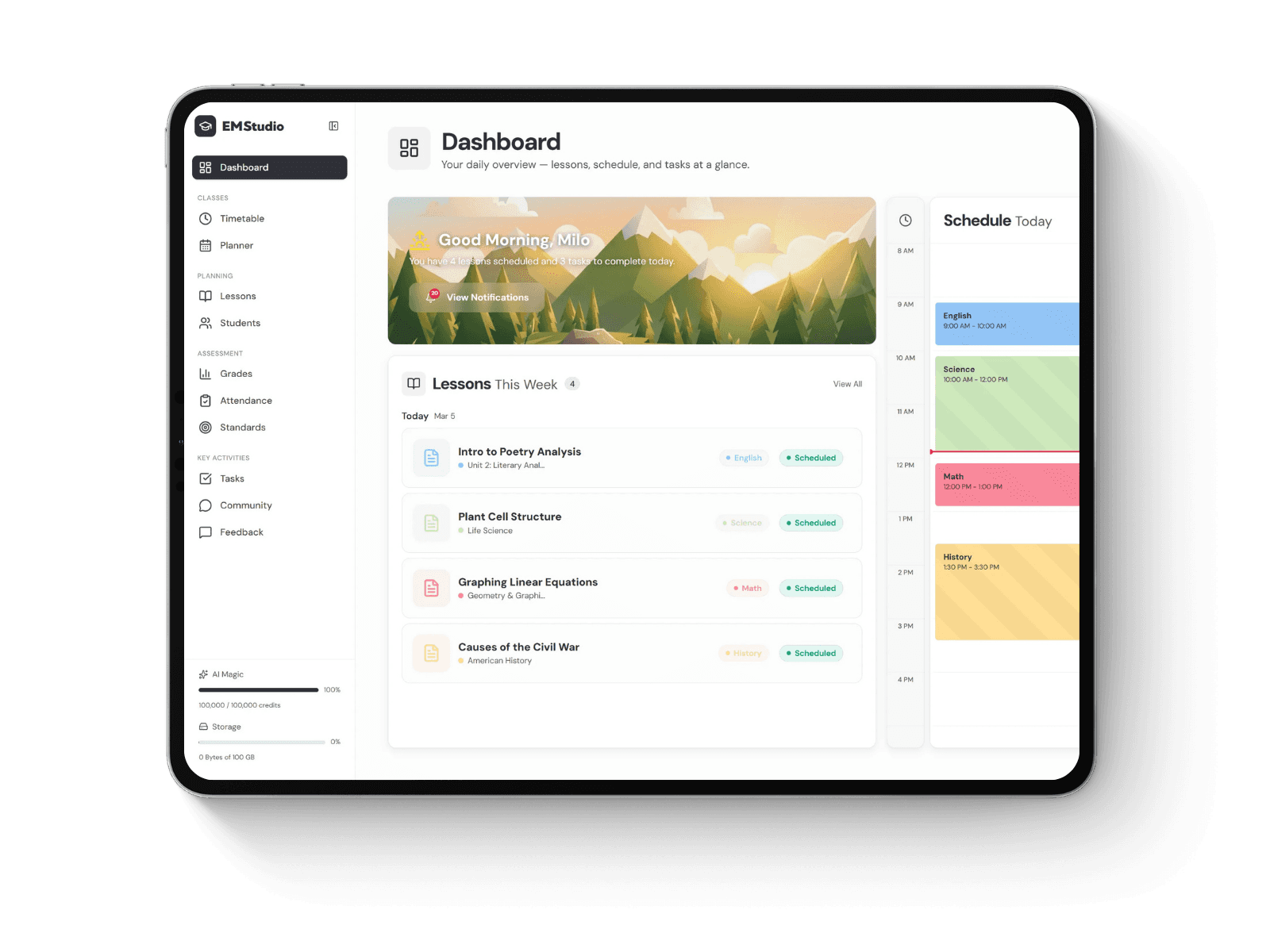
EMStudio is a free teaching management app — manage your classes, students, lessons, and more!
Learn More
Still grading everything by hand?
EMStudio is a free teaching management app — manage your classes, students, lessons, and more!
Learn More
Table of Contents
Tip # 1: Give Your Child a Spot That Means ‘School’
Kids read physical cues faster than we expect. A desk in a quiet corner, even something as simple as a folding table by a window, signals that it’s time to focus.
But the important thing to note here is that:
Furniture doesn’t matter! Consistency is the ‘key.’
For instance, doing spelling or some other kind of homework at the kitchen table one day and on the bed the next makes kids lose their focus and start over every time. And that’s why consistency matters the most!
Additionally, as a parent, you should keep the remote, the phone, and random or scattered toys out of reach during study blocks. But why?
Well, using this approach has nothing to do with ‘trust’; it’s about ‘willpower’ that runs out fast, even in adults. Therefore, removing temptation works better than fighting it moment to moment.
Tip # 2: Build a Schedule That Fits How Kids Actually Work
Adults can handle loose, flexible days. But most kids can’t, especially the younger ones. Therefore, a simple daily plan works better. Here is an example of such a plan:
Wake-up time, study blocks, breaks, and a clear stopping point for the school day.
So, as a parent, you should ‘stick’ a plan like the one we’ve mentioned above on the fridge or above the desk where your child sees it without asking.
Also, remember that breaks aren’t optional extras because parents who try to push through 3 straight hours of screen time usually end up fighting meltdowns instead of finishing homework faster. Therefore, a short walk or stretch between subjects keeps attention from collapsing by mid-morning.
Tip # 3: Choose a Few Good Tools Instead of a Dozen Average Ones
App Store, Google Play, and other application stores are full of programs that promise to make learning fun. But most parents end up downloading far too many.
Instead, the better approach here is to pick apps for students that actually match your child’s grade level and learning style.
For instance, a visual, game-based app might click for one kid and completely miss for another who does better with plain reading and short quizzes. Therefore, as a parent, you should try the app yourself first, even if it’s for ten minutes. In this way, you will know what your child is looking at before it becomes a part of their daily routine.
Also, remember that two or three solid apps, used consistently, beat five apps opened once and abandoned. Therefore, give each one a real trial period before deciding it isn’t working.
Tip # 4: Stay Close Without Standing Over Your Child
Sitting beside your child through every single lesson can burn you out as a parent. Plus, it can make your child dependent on having someone next to them to focus. Therefore, as a parent, you should ‘check in’ instead at natural breakpoints, right:
After a lesson ends
or
During a scheduled break
And while doing so, you should ask your child about ‘what they learned’ instead of ‘whether the work got done.’
However, if your child gets stuck somewhere, wait before stepping in. Give them a minute or two to work through it alone first because that short struggle is often where the actual learning happens.
Tip # 5: Notice Burnout Before It Becomes a Bigger Problem
Screen fatigue shows up differently in every kid:
Some get short-tempered by mid-afternoon.
Others start rushing through assignments just to be finished.
So, if grades start slipping or your child dreads logging in every morning, then that’s a signal to adjust, not push harder.
For instance, your child can study in shorter blocks and take more frequent breaks. In fact, you can even reshuffle which subjects come first in the day, as doing so can make a real difference.
But if the problem doesn’t ease up after a week or two of adjustments, you should involve the teacher. That’s because teachers see the same pattern across a whole classroom and can usually tell you whether what you’re seeing is typical or worth addressing head-on.
Tip # 6: Don’t Let the Social Side Disappear
Online learning cuts out the hallway conversations and lunchroom friendships that make school bearable for a lot of kids. Therefore, as a parent, you should arrange a short video call for your child—that could be with a classmate or some other friend from school, but it should be after lessons.
You can even arrange some unstructured outdoor time with neighborhood friends, as this strategy can also help fill part of that gap.
But why do parents need to do all of this?
Well, simply because kids need the social piece as much as the academic one to stay engaged.
The Bottom Line — Final Verdict
To conclude, the home-based learning setup works best when it borrows the structure of a real classroom:
A fixed space, a predictable schedule, a handful of well-chosen tools, and a parent who checks in without taking over.
But remember, it won’t run perfectly every day, which is completely normal. So, as a parent, your goal should be to build habits that make learning feel doable, not only for your child but for you as well.
Tip # 1: Give Your Child a Spot That Means ‘School’
Kids read physical cues faster than we expect. A desk in a quiet corner, even something as simple as a folding table by a window, signals that it’s time to focus.
But the important thing to note here is that:
Furniture doesn’t matter! Consistency is the ‘key.’
For instance, doing spelling or some other kind of homework at the kitchen table one day and on the bed the next makes kids lose their focus and start over every time. And that’s why consistency matters the most!
Additionally, as a parent, you should keep the remote, the phone, and random or scattered toys out of reach during study blocks. But why?
Well, using this approach has nothing to do with ‘trust’; it’s about ‘willpower’ that runs out fast, even in adults. Therefore, removing temptation works better than fighting it moment to moment.
Tip # 2: Build a Schedule That Fits How Kids Actually Work
Adults can handle loose, flexible days. But most kids can’t, especially the younger ones. Therefore, a simple daily plan works better. Here is an example of such a plan:
Wake-up time, study blocks, breaks, and a clear stopping point for the school day.
So, as a parent, you should ‘stick’ a plan like the one we’ve mentioned above on the fridge or above the desk where your child sees it without asking.
Also, remember that breaks aren’t optional extras because parents who try to push through 3 straight hours of screen time usually end up fighting meltdowns instead of finishing homework faster. Therefore, a short walk or stretch between subjects keeps attention from collapsing by mid-morning.
Tip # 3: Choose a Few Good Tools Instead of a Dozen Average Ones
App Store, Google Play, and other application stores are full of programs that promise to make learning fun. But most parents end up downloading far too many.
Instead, the better approach here is to pick apps for students that actually match your child’s grade level and learning style.
For instance, a visual, game-based app might click for one kid and completely miss for another who does better with plain reading and short quizzes. Therefore, as a parent, you should try the app yourself first, even if it’s for ten minutes. In this way, you will know what your child is looking at before it becomes a part of their daily routine.
Also, remember that two or three solid apps, used consistently, beat five apps opened once and abandoned. Therefore, give each one a real trial period before deciding it isn’t working.
Tip # 4: Stay Close Without Standing Over Your Child
Sitting beside your child through every single lesson can burn you out as a parent. Plus, it can make your child dependent on having someone next to them to focus. Therefore, as a parent, you should ‘check in’ instead at natural breakpoints, right:
After a lesson ends
or
During a scheduled break
And while doing so, you should ask your child about ‘what they learned’ instead of ‘whether the work got done.’
However, if your child gets stuck somewhere, wait before stepping in. Give them a minute or two to work through it alone first because that short struggle is often where the actual learning happens.
Tip # 5: Notice Burnout Before It Becomes a Bigger Problem
Screen fatigue shows up differently in every kid:
Some get short-tempered by mid-afternoon.
Others start rushing through assignments just to be finished.
So, if grades start slipping or your child dreads logging in every morning, then that’s a signal to adjust, not push harder.
For instance, your child can study in shorter blocks and take more frequent breaks. In fact, you can even reshuffle which subjects come first in the day, as doing so can make a real difference.
But if the problem doesn’t ease up after a week or two of adjustments, you should involve the teacher. That’s because teachers see the same pattern across a whole classroom and can usually tell you whether what you’re seeing is typical or worth addressing head-on.
Tip # 6: Don’t Let the Social Side Disappear
Online learning cuts out the hallway conversations and lunchroom friendships that make school bearable for a lot of kids. Therefore, as a parent, you should arrange a short video call for your child—that could be with a classmate or some other friend from school, but it should be after lessons.
You can even arrange some unstructured outdoor time with neighborhood friends, as this strategy can also help fill part of that gap.
But why do parents need to do all of this?
Well, simply because kids need the social piece as much as the academic one to stay engaged.
The Bottom Line — Final Verdict
To conclude, the home-based learning setup works best when it borrows the structure of a real classroom:
A fixed space, a predictable schedule, a handful of well-chosen tools, and a parent who checks in without taking over.
But remember, it won’t run perfectly every day, which is completely normal. So, as a parent, your goal should be to build habits that make learning feel doable, not only for your child but for you as well.
Still grading everything by hand?
EMStudio is a free teaching management app — manage your classes, students, lessons, and more!
Learn More
Still grading everything by hand?
EMStudio is a free teaching management app — manage your classes, students, lessons, and more!
Learn More




Notion4Teachers
Notion templates to simplify administrative tasks and enhance your teaching experience.



2026 Notion4Teachers. All Rights Reserved.
Notion4Teachers
Notion templates to simplify administrative tasks and enhance your teaching experience.
2026 Notion4Teachers. All Rights Reserved.
Notion4Teachers
Notion templates to simplify administrative tasks and enhance your teaching experience.
2026 Notion4Teachers. All Rights Reserved.