
7 Best Educational Field Trips in Southern California: Which Carry a Graded Task?
7 Best Educational Field Trips in Southern California: Which Carry a Graded Task?

Article by
Milo
ESL Content Coordinator & Educator
ESL Content Coordinator & Educator
All Posts
Images: https://drive.google.com/drive/folders/1q68X4TGgjQyelEaZqBdpTqj_Vekf94u4
Suggested URL: https://www.notion4teachers.com/blog/best-educational-field-trips-southern-california
You need a field trip that thrills students and wins a principal’s instant yes. This guide compares seven standout educational field trips in Southern California, from mountain day trips to dinosaur halls. For every stop, you’ll see grade fit, cost, logistics, and the graded task students bring back to class.
Still grading everything by hand?
EMStudio is a free teaching management app — manage your classes, students, lessons, and more!
Learn More
Still grading everything by hand?
EMStudio is a free teaching management app — manage your classes, students, lessons, and more!
Learn More
Table of Contents
Scan the Options in Seconds
Want the best educational field trips in Southern California at a glance? The table below pairs each site with grade bands, costs, and available funding. Skim the rows, note any approval flags, and jump to the full write-up when you spot a match.
Venue | Best for | Grades | County | Cost | Funding help | Approval flag |
Pali Institute | Outdoor day trips: team building, ecology, arts, high ropes | 3–12 | San Bernardino / Los Angeles | Quote on request | Ask when booking | Non-peak dates |
Angeles District State Parks | Tide pools, oak woodlands, California history | K–12 | Los Angeles | Ask the park | Bus fees can be waived on self-guided trips | 60 students per trip |
Chino Creek Wetlands (IEUA Water Discovery) | Wetlands, habitat, and water stewardship | School groups | San Bernardino | Free | Need-based busing mini-grant | Tuesday–Thursday only |
California Science Center | Science exhibits and IMAX | All ages | Los Angeles | Core galleries free; IMAX extra | Group discounts | Groups of 20+ must reserve |
Natural History Museum of LA County | Dinosaurs and biodiversity | Pre-K–12 | Los Angeles | Free for qualifying California schools | Free school visits | Book 3+ weeks ahead |
Discovery Cube Orange County | Hands-on STEM workshops | Elementary and middle school | Orange | See current pricing | Ask when booking | Groups of 15+ |
San Bernardino County Museum | Regional natural and cultural history | K–12 | San Bernardino | $4 per student, $5 per adult | Group rate for 10+ | 1:10 chaperone ratio for K–8 |
Caption: Comparison table of seven Southern California field-trip options, showing audience fit, cost, funding support, and common approval hurdles.
Next stop: outdoor adventures where science feels alive.
1. Pali Institute: Outdoor Day Trips with a Product to Grade
Pali Institute runs day trips at two locations, Pali Mountain and Pali Acton, built around team building and hands-on learning. Grades 3–5 get Young Explorers: group games and team building, then an afternoon hike on forest ecology and wilderness skills. Grades 4–12 choose among three formats: Visual & Performing Arts (pottery, painting, photography, and creative design tied to arts standards), Outdoor Experience (team building, then three classes the teacher selects; no high ropes), and Leadership Experience (team building and a short hike in the morning, the high ropes course in the afternoon).
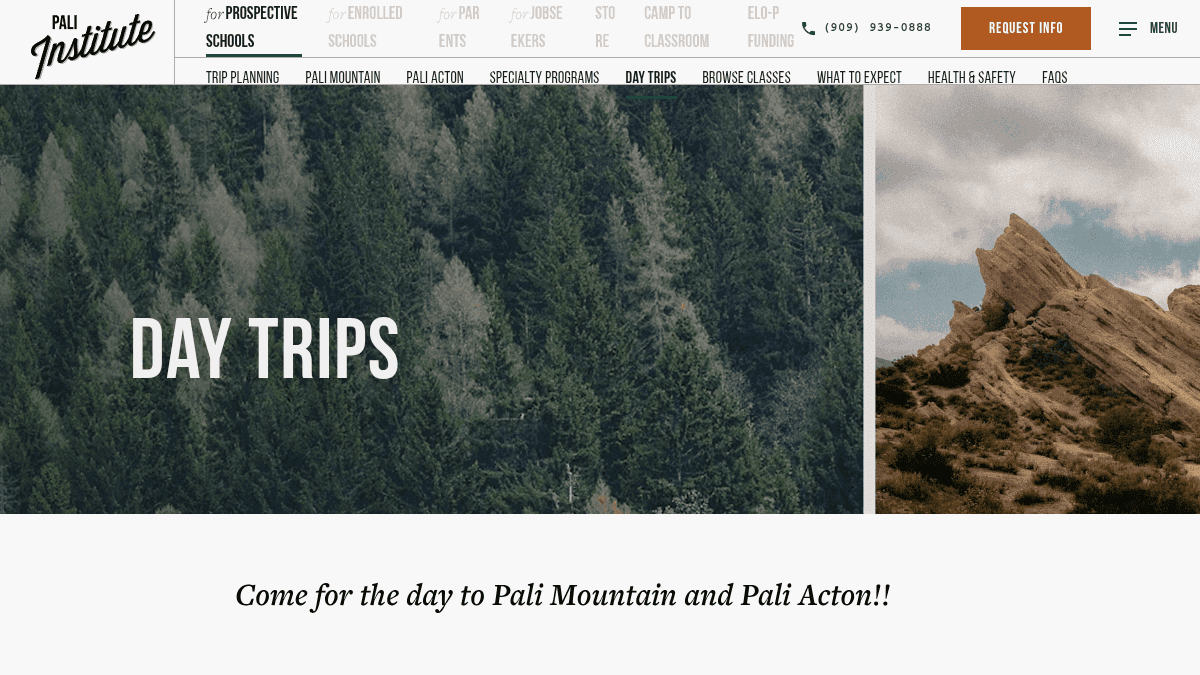
Pali Institute’s day trips page: come for the day to Pali Mountain or Pali Acton.
That menu makes the graded task easy to set before you go: a field journal on forest ecology, a portfolio piece from the art session, or a written reflection on the ropes-course challenge.
Compare the formats in the day trips for schools at Pali Institute guide and download the day trip flyer for your approval packet. Overnight programs remain Pali’s main offering and day trips run in non-peak times, so ask about dates early.
2. Angeles District State Parks: Place-Based Ecology and California History
California State Parks’ Angeles District lists five field-trip sites for schools: Leo Carrillo State Park, Malibu Creek State Park, Los Encinos State Historic Park, Baldwin Hills Scenic Overlook, and Pio Pico State Historic Park. Together they cover tide pools, oak woodlands, urban biodiversity, and the Mexican and Rancho eras.

The Angeles District field-trip page lists the park sites your school can visit.
At Leo Carrillo, the guided program for grades 3–12 starts with a 45-minute virtual pre-visit. Then, depending on the tide, students explore the tide pools or the wrack line and study how marine life adapts to the intertidal zone, followed by a bluff-trail nature walk.
The guided trip takes up to 60 students with one adult per 10 students. A self-guided option serves grades K–12, and bus fees can be waived. At Los Encinos, students explore the 1849 De la Osa Adobe, the 1872 Garnier Building, and the natural spring.
At Baldwin Hills, they walk the hillside with binoculars and play a habitat-fragmentation game.
For a graded task, have students sketch and label three intertidal adaptations at Leo Carrillo, or write a short comparison of rancho life at Los Encinos and Pio Pico. Sign-ups for 2026–2027 are open on the Angeles District page.
3. Chino Creek Wetlands: Free Water Discovery Trips in the Inland Empire
The Inland Empire Utilities Agency (IEUA) offers free Discover the Environment and Water (DEW) field trips at the Chino Creek Wetlands and Educational Park in Chino. The program connects students with the environment, shows how natural treatment wetlands work, and explains how the park creates habitat for endangered and sensitive species.
Trips run Tuesdays, Wednesdays, and Thursdays during the school year, from 9:30 a.m. bus drop-off to 12:00 p.m. lunch. The park takes up to 60 students per day and one school per day, so larger groups split over two or more days. Weather can postpone or cancel a trip.
Schools in IEUA’s service area can apply for a need-based busing mini-grant. Schools outside the service area can ask about busing sponsorship through IEUA’s partner water districts. Note that treatment-plant tours are paused while Regional Water Recycling Plant No. 5 is under expansion.
For a graded task, ask students to map one habitat they observed and explain how the wetland cleans water before it moves on.
4. California Science Center: Free Core Galleries and Group IMAX Days
The California Science Center sits in Exposition Park, across the street from the Expo Park/USC station on the Metro E Line. Its core exhibit galleries are free and need no reservation for general visitors. Field trips and groups of 20 or more get self-guided exhibit visits and IMAX movies at discounted prices, but these groups must reserve by phone at (213) 744-2019.
Space Shuttle Endeavour is off display until the new Samuel Oschin Air and Space Center opens to the public, which the Science Center has announced for November 13, 2026. Check the Science Center’s site for how school groups will reserve the new center once it opens.
Eating is allowed only in designated indoor and outdoor dining areas, so plan lunch before you arrive. Close the trip with a design brief, such as “protect an egg through re-entry,” and you have measurable evidence for any skeptical principal.
5. Natural History Museum of Los Angeles County: Dinosaurs, Gardens, and Evidence Skills
The Natural History Museum gives free self-guided field trips to accredited California Pre-K–12 public or private school groups of 10 or more students. Free admission covers students, teachers, and one chaperone for every five students. Extra chaperones pay a discounted $12 ticket on arrival. Submit the booking form at least three weeks before your visit; the form for the 2026–2027 school year is open now.
Start in the Dinosaur Hall, then move outside to the Nature Gardens to look for birds, butterflies, and lizards. Brief chaperones on a fixed route and a meeting point before you go.
Back in class, ask students to write a one-paragraph Claim–Evidence–Reasoning statement based on a fossil photo they took on site, proving the trip delivered standards-aligned science, not just eye candy.
6. Discovery Cube Orange County: Hands-On STEM for Elementary and Middle School
Discovery Cube’s Santa Ana campus tailors its field trips to elementary and middle school students, with grade-specific programs aligned with the Next Generation Science Standards (NGSS). Teachers choose SPARK assemblies with live demonstrations or IGNITE hands-on workshops.
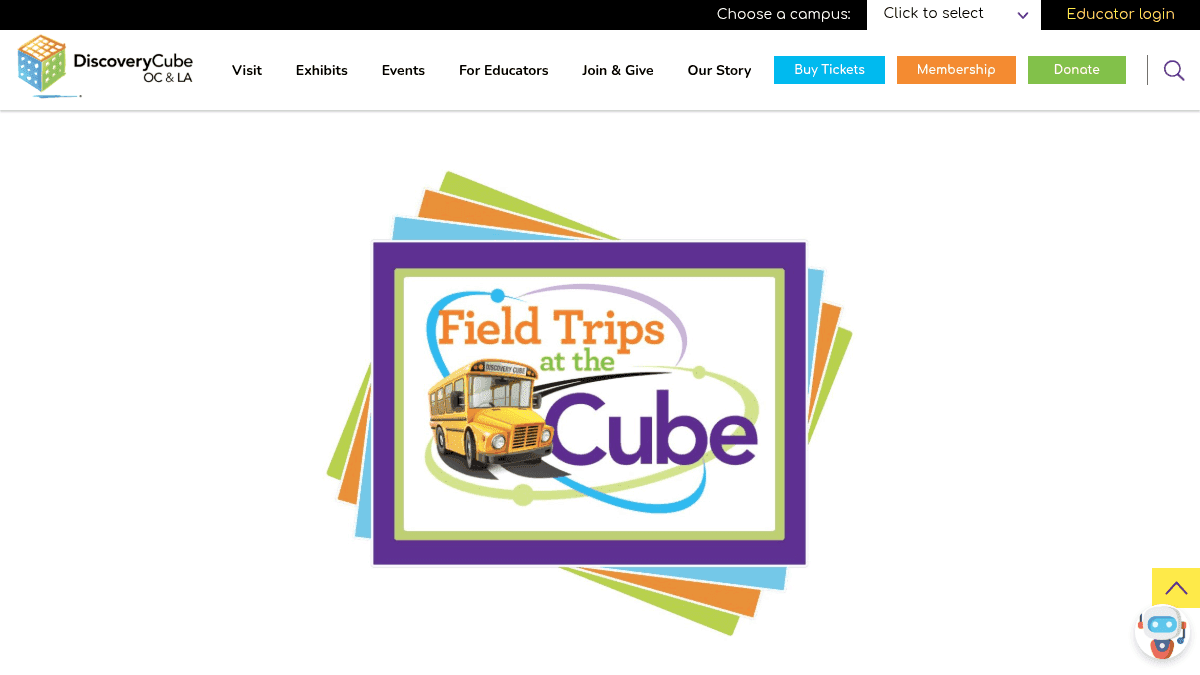
Discovery Cube’s field trip page, where teachers pick a campus and a program.
Groups of 15 or more can book Independent Discovery: a three-hour visit with a 20–45 minute workshop or assembly and dedicated exploration time in the center. Pricing and chaperone requirements are on the field-trip page and can change, so confirm both when you book.
Hand students a simple inquiry sheet: “What variable did you change at each station, and what happened?” Your trip shifts from recess to data collection.
7. San Bernardino County Museum: Low-Cost Regional History in Redlands
San Bernardino County Museum in Redlands offers one of the lowest admission costs on this list. Groups of 10 or more pay $4 per student and $5 per teacher, chaperone, or adult. K–8 groups need one adult for every 10 students. The museum also books field trips at the Victor Valley Museum in Apple Valley and the historic María Merced Williams and John Rains House in Rancho Cucamonga.
Groups can eat at shaded picnic benches in front of the museum or in the courtyard; lunches stay on the bus or in backpacks until then. Request any accommodations in the booking form. Volunteer-led examination stations run during public hours, but the museum does not guarantee them during field trip season, so plan your activity without them.
For a graded task, have students sketch and describe one specimen and explain what it tells us about the region’s past.
What Principals Usually Need Before Approving a Field Trip
Here is a checklist you can paste into your approval packet.
A One-Sentence Curricular Rationale
“Students will collect tide-pool data at Leo Carrillo State Park to model ecosystem interactions (NGSS 5-LS2-1) and present their findings in a claim-evidence-reasoning poster.”
One line answers four questions at a glance: where, what, which standard, and how learning will be assessed.
Exact Standards and Learning Product
Pre-trip: Model how matter moves among plants, animals, and decomposers in a terrarium (NGSS 5-LS2-1).
On-site: Record producer–consumer interactions at the site.
Post-trip: Edit a two-minute video that explains how matter moves through that ecosystem.
To grade the post-trip product fairly, this guide to performance-based assessments walks through clear criteria, rubrics, and feedback.
Complete Itinerary and Supervision Plan
List arrival, roll call, departure, each on-site block, lunch, and dismissal, with times. Attach a color-coded map with chaperone names and both the lead teacher’s and venue’s cell numbers.
Risk and Emergency Documentation
Venue certificate of insurance
Trained staff list; epi-pen/inhaler locations
District security and backup admin numbers
Rally point and indoor refuge locations
Weather and air-quality thresholds your district uses
Equity and Accessibility Plan
Funding. List per-student cost, grants, and the voluntary-donation process.
Transportation. Flag any bus grants and their deadlines.
Accessibility. Note accessible routes, restrooms, and requested aides or interpreters.
Alternate access. Explain the in-class version for students who cannot attend.
Funding Summary
“No student will be excluded for nonpayment; alternative funding will cover all balances.”
Create a mini-table that shows each expense line and its funding source, plus application and payment deadlines.
How to Calculate the Real Cost
True trip cost = transportation + driver overtime + admission + add-ons + parking/tolls + meals + substitutes + aides – grants.
Gather actual quotes and attach copies; principals approve faster when the math is transparent.
Eight-Week Planning Timeline
8–12 weeks out: Pick standards, request principal pre-approval, hold the venue date, and get a bus quote.
6–8 weeks: File the district form, apply for grants, flag IEP or medical needs, and recruit cleared chaperones.
4 weeks: Send multilingual permission slips, teach the pre-trip lesson, and finalize the emergency plan.
1 week: Confirm the roster, check weather and air quality, brief chaperones, and print materials.
Day after: Run the assessment, log any incidents, and save notes for next year.
Conclusion
The best educational field trips in Southern California do two jobs: they give students a day they remember, and they send them back with work you can grade.
Each of the seven trips above pairs a hands-on experience with a clear product, from a forest-ecology journal or a ropes-course reflection on a Pali Institute day trip to a wetland habitat map, a fossil claim-evidence-reasoning paragraph, or an inquiry sheet from a STEM workshop.
Pick the trip that fits your standards, set the graded task before you book, and hand your principal a packet that answers every question on the first read.
Scan the Options in Seconds
Want the best educational field trips in Southern California at a glance? The table below pairs each site with grade bands, costs, and available funding. Skim the rows, note any approval flags, and jump to the full write-up when you spot a match.
Venue | Best for | Grades | County | Cost | Funding help | Approval flag |
Pali Institute | Outdoor day trips: team building, ecology, arts, high ropes | 3–12 | San Bernardino / Los Angeles | Quote on request | Ask when booking | Non-peak dates |
Angeles District State Parks | Tide pools, oak woodlands, California history | K–12 | Los Angeles | Ask the park | Bus fees can be waived on self-guided trips | 60 students per trip |
Chino Creek Wetlands (IEUA Water Discovery) | Wetlands, habitat, and water stewardship | School groups | San Bernardino | Free | Need-based busing mini-grant | Tuesday–Thursday only |
California Science Center | Science exhibits and IMAX | All ages | Los Angeles | Core galleries free; IMAX extra | Group discounts | Groups of 20+ must reserve |
Natural History Museum of LA County | Dinosaurs and biodiversity | Pre-K–12 | Los Angeles | Free for qualifying California schools | Free school visits | Book 3+ weeks ahead |
Discovery Cube Orange County | Hands-on STEM workshops | Elementary and middle school | Orange | See current pricing | Ask when booking | Groups of 15+ |
San Bernardino County Museum | Regional natural and cultural history | K–12 | San Bernardino | $4 per student, $5 per adult | Group rate for 10+ | 1:10 chaperone ratio for K–8 |
Caption: Comparison table of seven Southern California field-trip options, showing audience fit, cost, funding support, and common approval hurdles.
Next stop: outdoor adventures where science feels alive.
1. Pali Institute: Outdoor Day Trips with a Product to Grade
Pali Institute runs day trips at two locations, Pali Mountain and Pali Acton, built around team building and hands-on learning. Grades 3–5 get Young Explorers: group games and team building, then an afternoon hike on forest ecology and wilderness skills. Grades 4–12 choose among three formats: Visual & Performing Arts (pottery, painting, photography, and creative design tied to arts standards), Outdoor Experience (team building, then three classes the teacher selects; no high ropes), and Leadership Experience (team building and a short hike in the morning, the high ropes course in the afternoon).
Pali Institute’s day trips page: come for the day to Pali Mountain or Pali Acton.
That menu makes the graded task easy to set before you go: a field journal on forest ecology, a portfolio piece from the art session, or a written reflection on the ropes-course challenge.
Compare the formats in the day trips for schools at Pali Institute guide and download the day trip flyer for your approval packet. Overnight programs remain Pali’s main offering and day trips run in non-peak times, so ask about dates early.
2. Angeles District State Parks: Place-Based Ecology and California History
California State Parks’ Angeles District lists five field-trip sites for schools: Leo Carrillo State Park, Malibu Creek State Park, Los Encinos State Historic Park, Baldwin Hills Scenic Overlook, and Pio Pico State Historic Park. Together they cover tide pools, oak woodlands, urban biodiversity, and the Mexican and Rancho eras.
The Angeles District field-trip page lists the park sites your school can visit.
At Leo Carrillo, the guided program for grades 3–12 starts with a 45-minute virtual pre-visit. Then, depending on the tide, students explore the tide pools or the wrack line and study how marine life adapts to the intertidal zone, followed by a bluff-trail nature walk.
The guided trip takes up to 60 students with one adult per 10 students. A self-guided option serves grades K–12, and bus fees can be waived. At Los Encinos, students explore the 1849 De la Osa Adobe, the 1872 Garnier Building, and the natural spring.
At Baldwin Hills, they walk the hillside with binoculars and play a habitat-fragmentation game.
For a graded task, have students sketch and label three intertidal adaptations at Leo Carrillo, or write a short comparison of rancho life at Los Encinos and Pio Pico. Sign-ups for 2026–2027 are open on the Angeles District page.
3. Chino Creek Wetlands: Free Water Discovery Trips in the Inland Empire
The Inland Empire Utilities Agency (IEUA) offers free Discover the Environment and Water (DEW) field trips at the Chino Creek Wetlands and Educational Park in Chino. The program connects students with the environment, shows how natural treatment wetlands work, and explains how the park creates habitat for endangered and sensitive species.
Trips run Tuesdays, Wednesdays, and Thursdays during the school year, from 9:30 a.m. bus drop-off to 12:00 p.m. lunch. The park takes up to 60 students per day and one school per day, so larger groups split over two or more days. Weather can postpone or cancel a trip.
Schools in IEUA’s service area can apply for a need-based busing mini-grant. Schools outside the service area can ask about busing sponsorship through IEUA’s partner water districts. Note that treatment-plant tours are paused while Regional Water Recycling Plant No. 5 is under expansion.
For a graded task, ask students to map one habitat they observed and explain how the wetland cleans water before it moves on.
4. California Science Center: Free Core Galleries and Group IMAX Days
The California Science Center sits in Exposition Park, across the street from the Expo Park/USC station on the Metro E Line. Its core exhibit galleries are free and need no reservation for general visitors. Field trips and groups of 20 or more get self-guided exhibit visits and IMAX movies at discounted prices, but these groups must reserve by phone at (213) 744-2019.
Space Shuttle Endeavour is off display until the new Samuel Oschin Air and Space Center opens to the public, which the Science Center has announced for November 13, 2026. Check the Science Center’s site for how school groups will reserve the new center once it opens.
Eating is allowed only in designated indoor and outdoor dining areas, so plan lunch before you arrive. Close the trip with a design brief, such as “protect an egg through re-entry,” and you have measurable evidence for any skeptical principal.
5. Natural History Museum of Los Angeles County: Dinosaurs, Gardens, and Evidence Skills
The Natural History Museum gives free self-guided field trips to accredited California Pre-K–12 public or private school groups of 10 or more students. Free admission covers students, teachers, and one chaperone for every five students. Extra chaperones pay a discounted $12 ticket on arrival. Submit the booking form at least three weeks before your visit; the form for the 2026–2027 school year is open now.
Start in the Dinosaur Hall, then move outside to the Nature Gardens to look for birds, butterflies, and lizards. Brief chaperones on a fixed route and a meeting point before you go.
Back in class, ask students to write a one-paragraph Claim–Evidence–Reasoning statement based on a fossil photo they took on site, proving the trip delivered standards-aligned science, not just eye candy.
6. Discovery Cube Orange County: Hands-On STEM for Elementary and Middle School
Discovery Cube’s Santa Ana campus tailors its field trips to elementary and middle school students, with grade-specific programs aligned with the Next Generation Science Standards (NGSS). Teachers choose SPARK assemblies with live demonstrations or IGNITE hands-on workshops.
Discovery Cube’s field trip page, where teachers pick a campus and a program.
Groups of 15 or more can book Independent Discovery: a three-hour visit with a 20–45 minute workshop or assembly and dedicated exploration time in the center. Pricing and chaperone requirements are on the field-trip page and can change, so confirm both when you book.
Hand students a simple inquiry sheet: “What variable did you change at each station, and what happened?” Your trip shifts from recess to data collection.
7. San Bernardino County Museum: Low-Cost Regional History in Redlands
San Bernardino County Museum in Redlands offers one of the lowest admission costs on this list. Groups of 10 or more pay $4 per student and $5 per teacher, chaperone, or adult. K–8 groups need one adult for every 10 students. The museum also books field trips at the Victor Valley Museum in Apple Valley and the historic María Merced Williams and John Rains House in Rancho Cucamonga.
Groups can eat at shaded picnic benches in front of the museum or in the courtyard; lunches stay on the bus or in backpacks until then. Request any accommodations in the booking form. Volunteer-led examination stations run during public hours, but the museum does not guarantee them during field trip season, so plan your activity without them.
For a graded task, have students sketch and describe one specimen and explain what it tells us about the region’s past.
What Principals Usually Need Before Approving a Field Trip
Here is a checklist you can paste into your approval packet.
A One-Sentence Curricular Rationale
“Students will collect tide-pool data at Leo Carrillo State Park to model ecosystem interactions (NGSS 5-LS2-1) and present their findings in a claim-evidence-reasoning poster.”
One line answers four questions at a glance: where, what, which standard, and how learning will be assessed.
Exact Standards and Learning Product
Pre-trip: Model how matter moves among plants, animals, and decomposers in a terrarium (NGSS 5-LS2-1).
On-site: Record producer–consumer interactions at the site.
Post-trip: Edit a two-minute video that explains how matter moves through that ecosystem.
To grade the post-trip product fairly, this guide to performance-based assessments walks through clear criteria, rubrics, and feedback.
Complete Itinerary and Supervision Plan
List arrival, roll call, departure, each on-site block, lunch, and dismissal, with times. Attach a color-coded map with chaperone names and both the lead teacher’s and venue’s cell numbers.
Risk and Emergency Documentation
Venue certificate of insurance
Trained staff list; epi-pen/inhaler locations
District security and backup admin numbers
Rally point and indoor refuge locations
Weather and air-quality thresholds your district uses
Equity and Accessibility Plan
Funding. List per-student cost, grants, and the voluntary-donation process.
Transportation. Flag any bus grants and their deadlines.
Accessibility. Note accessible routes, restrooms, and requested aides or interpreters.
Alternate access. Explain the in-class version for students who cannot attend.
Funding Summary
“No student will be excluded for nonpayment; alternative funding will cover all balances.”
Create a mini-table that shows each expense line and its funding source, plus application and payment deadlines.
How to Calculate the Real Cost
True trip cost = transportation + driver overtime + admission + add-ons + parking/tolls + meals + substitutes + aides – grants.
Gather actual quotes and attach copies; principals approve faster when the math is transparent.
Eight-Week Planning Timeline
8–12 weeks out: Pick standards, request principal pre-approval, hold the venue date, and get a bus quote.
6–8 weeks: File the district form, apply for grants, flag IEP or medical needs, and recruit cleared chaperones.
4 weeks: Send multilingual permission slips, teach the pre-trip lesson, and finalize the emergency plan.
1 week: Confirm the roster, check weather and air quality, brief chaperones, and print materials.
Day after: Run the assessment, log any incidents, and save notes for next year.
Conclusion
The best educational field trips in Southern California do two jobs: they give students a day they remember, and they send them back with work you can grade.
Each of the seven trips above pairs a hands-on experience with a clear product, from a forest-ecology journal or a ropes-course reflection on a Pali Institute day trip to a wetland habitat map, a fossil claim-evidence-reasoning paragraph, or an inquiry sheet from a STEM workshop.
Pick the trip that fits your standards, set the graded task before you book, and hand your principal a packet that answers every question on the first read.
Still grading everything by hand?
EMStudio is a free teaching management app — manage your classes, students, lessons, and more!
Learn More
Still grading everything by hand?
EMStudio is a free teaching management app — manage your classes, students, lessons, and more!
Learn More



Notion4Teachers
Notion templates to simplify administrative tasks and enhance your teaching experience.



2026 Notion4Teachers. All Rights Reserved.
Notion4Teachers
Notion templates to simplify administrative tasks and enhance your teaching experience.
2026 Notion4Teachers. All Rights Reserved.
Notion4Teachers
Notion templates to simplify administrative tasks and enhance your teaching experience.
2026 Notion4Teachers. All Rights Reserved.