
Kindergarten Class: 4 Steps to Success
Kindergarten Class: 4 Steps to Success

Article by
Milo
ESL Content Coordinator & Educator
ESL Content Coordinator & Educator
All Posts
Teaching a kindergarten class is the hardest job in the building, and anyone who says otherwise has never spent a full day with twenty-five five-year-olds who all need to pee at different times. You’re not just teaching letters and sounds; you’re teaching children how to exist in a school for the very first time. That means everything from opening a milk carton to understanding that markers don’t go in mouths. If you think kindergarten is just coloring and nap time, you’re in for a shock that hits somewhere around 9:15 AM on the first day.
The real magic happens when you stop fighting the chaos and start structuring it. After twelve years in early childhood classrooms, I can tell you that successful kindergarten teachers aren’t the ones with the quietest rooms or the cutest bulletin boards. They’re the ones who build systems so solid that kids know what to do without being told. This means embedding early literacy into every corner, using play as your primary teaching tool, and collecting data without traumatizing anyone with bubble sheets. It’s not about perfection. It’s about predictable routines that leave space for joy.
This post cuts through the Pinterest-perfect nonsense and gives you four concrete steps that actually work. You’ll learn how to build a print-rich environment that gets kids talking, morning routines that sneak in critical thinking before they even take off their backpacks, and how to structure play-based lessons so admin sees the learning happening. We’ll also cover how to track progress without drilling five-year-olds with tests they can’t read yet. These are the moves that saved my sanity and kept my students growing.
Still grading everything by hand?
EMStudio is a free teaching management app — manage your classes, students, lessons, and more!
Learn More
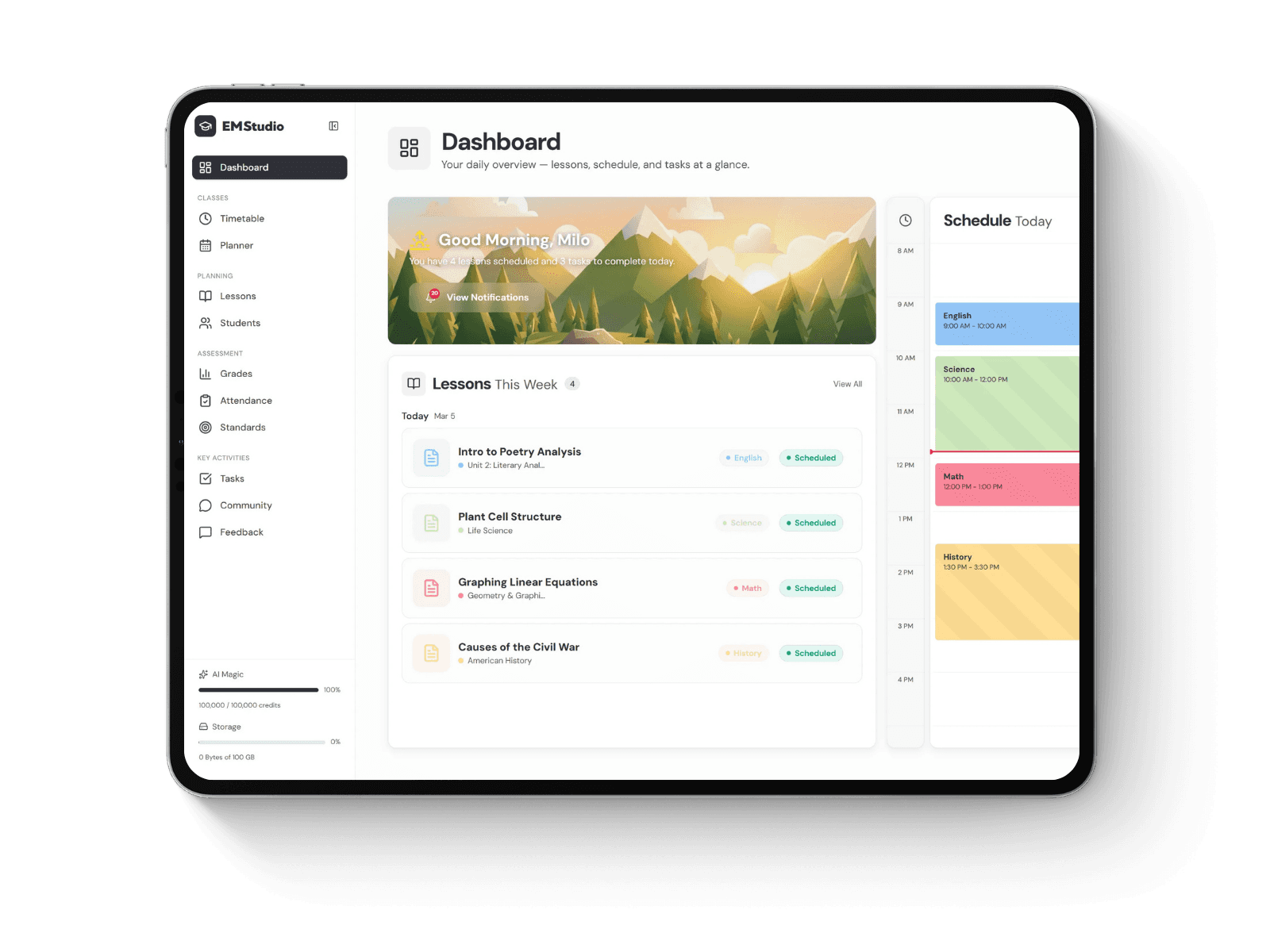
Still grading everything by hand?
EMStudio is a free teaching management app — manage your classes, students, lessons, and more!
Learn More
Table of Contents
What Should You Know Before Teaching Kindergarten?
Before teaching kindergarten, understand that children enter with vastly different developmental timelines—some still developing fine motor control, others reading already. You need knowledge of state licensing ratios (typically 1:8 to 1:12). You need physical stamina for 90+ minutes of daily gross motor time. And you need willingness to prioritize social-emotional learning over academics for the first six weeks.
A four-and-a-half-year-old might grip a pencil with a full fist while a six-year-old writes sentences. That eighteen-month spread is normal in one room. Watch for red flags: a child who cannot sit for a five-minute read-aloud, struggles to separate from parents after three weeks, or shows no interest in emergent reading activities like pretend book reading. These signal a need for play-based learning, not worksheets. Meet them where they are.
States set strict rules for your kindergarten class. Meeting these essential requirements for a kindergarten teacher isn't bureaucracy—it's safety. Violations can shut you down.
Student-teacher ratios typically run 1:8 to 1:12 with mixed ages.
Square footage requirements demand 35-50 square feet per child indoors.
Naptime regulations specify minimum durations and supervision ratios.
Outdoor time mandates require weather-permitting daily exposure.
CPR and first aid certification for all adults in the room.
Your schedule must accommodate 90-120 minutes of gross motor play daily. I block 30 minutes at arrival, 45 minutes after lunch, and 20 minutes mid-afternoon while others do centers. This protects classroom management—tired bodies can't focus on phonemic awareness drills or early literacy stations. Skip this, and you will spend October managing tantrums instead of teaching kindergarten content. Treat movement as non-negotiable curriculum.
Ignore the pacing guide for September. The first six weeks are for routines and relationships, not letter recognition. If you push formative assessment of sight words before children trust you, you will fight behaviors all year. Build the foundation first. The academics will come faster later when kids feel safe. Rushed early literacy instruction without social-emotional readiness creates struggling readers who hate books.
Step 1 — How Do You Create a Print-Rich Environment for Language Development?
Create a print-rich environment by labeling eight functional areas and five learning centers using 72pt Sassoon Primary font at thirty-six to forty-two inches from the floor. Build a three-tier library with half the shelves facing predictable text outward, add five high-frequency words to your word wall weekly with color-coded parts of speech, and tape up cereal boxes and street signs.
Kids can't read what they can't see. Mount everything at eye level for five-year-olds, not adults.
Start with environmental print that anchors your classroom management routines. Print labels for eight functional spots: door, window, sink, trash, light switch, cubby, bathroom, and pencil sharpener. Add five interest-based signs for centers like blocks, library, art, science, and dramatic play.
Cut out four authentic pieces from cereal boxes, fast-food bags, stop signs, or traffic lights. Use Sassoon Primary or Comic Sans at seventy-two point minimum. Position the bottom edge thirty-six to forty-two inches from the floor so kids can trace letters without standing on tiptoes.
Your classroom library drives early literacy more than any poster. Split it into three tiers: fifty percent predictable text picture books with strong picture cues, thirty percent concept books covering ABCs and 123s, and twenty percent wordless books that build sequencing skills.
Face covers outward—research shows this triples engagement compared to spines. Refresh twenty percent of the titles monthly during play-based learning transitions so kids don't stop looking. This rotation becomes part of your ongoing formative assessment of their changing interests.
The interactive word wall lives at student eye level, not above the whiteboard. Add five high-frequency words each Monday. Color-code by part of speech: blue nouns, red verbs, green adjectives.
Snap photos of kids demonstrating action verbs—jumping for "jump," hugging for "kind"—and tape them beside the words. This bridges phonemic awareness and real movement in your kindergarten class. It also supports emergent reading behaviors during independent browsing.
Feature | Commercial Labels | Teacher-Made Labels |
Cost per label | $0.50–$2.00 | $0.05 (paper/ink) |
Durability | Laminated, 3+ years | Needs yearly replacement |
Customization time | Zero | 2 hours initial setup |
Font consistency | Varies by pack | You control Sassoon/Comic Sans |
Go hybrid. Buy commercial labels for high-traffic areas like the bathroom and sink where durability matters. Make your own for center labels and the word wall where font consistency matters most. This balances your budget with effective classroom design and learning zones.

Step 2 — What Morning Routines Build English Critical Thinking Skills?
Build critical thinking through a 'Question of the Day' using a decision flowchart: yes/no questions get thumbs responses, preference questions create graphs, and prediction questions form hypotheses. Follow with 5-minute 'Sort It Out' activities using tangible objects with progressive difficulty—single attribute sorting, then dual attributes, then student-generated categories using inference-based language like 'What do you notice?'
Question of the Day runs on a simple flowchart you draw on chart paper. If you ask a yes/no question, kids respond with thumbs up or down. You record the tally and ask, "Why do you think that?" This builds english critical thinking through justification.
Yes/no examples: "Is a spider an insect?" "Can you eat soup with a fork?" "Does 'ship' start with /sh/?" Each forces evidence-based reasoning and builds phonemic awareness. Kids defend answers using emergent reading skills.
Preference questions use student photos on a graph. Try: "Do you prefer snow or rain?" "Which book should we read first?" "Would you rather be tiny or giant?" Kids analyze data and draw conclusions about their kindergarten class.
Prediction questions require hypotheses. Ask: "Will this pumpkin sink or float?" "Will the shadow be longer at 9am or noon?" "Will ice melt faster in sun or shade?" Test immediately. This mirrors scientific inquiry and formative assessment.
Sort It Out takes five minutes with tangible objects. Use buttons, attribute blocks, or nature items. Start Week 1 with single attributes like color. Week 2 adds dual attributes—color and size. Week 3 lets kids create their own categories.
Dump a mixed bucket on the rug. Watch them negotiate: "This has holes." "That is shiny." The debate is the lesson. They practice discourse while you listen.
Week 2 needs sharper focus. Find only the big blue blocks, ignoring small blue ones. Holding two variables simultaneously strengthens working memory. This predicts later reading comprehension success.
By Week 3, kids generate categories. One sorts by "crunchy" versus "smooth." Another uses "smells good." Ask, "How did you decide?" Their reasoning reveals thinking processes.
The magic is your language. Never ask, "What color is this?" Say, "What do you notice?" This shift needs observation and classification. It builds the inference skills needed for early literacy.
Replace rote calendar counting with Mystery Number clues. Say, "This number is greater than 5 but less than 10, and it looks like a snowman." Kids infer the answer is 8. They explain their reasoning, not just shout digits.
Keep this tight. Research shows attention spans run 2-3 minutes per year of age. For five-year-olds, that's 8-10 minutes max. After minute eight, you lose them. Stop before they check out.
Watch for passive routines. If kids chant days of the week while staring at the floor, you've lost them. Static calendar time kills engagement at exactly minute eight. Replace it with problem-solving or add kinesthetic movement.
Good classroom management means knowing when to abandon ship. Dead time undermines your play-based learning environment. Active minds need active routines, not endless calendar drills.
These strategies for teaching critical thinking work because they treat children as investigators. You're not managing downtime. You're launching inquiry.
Step 3 — How Do You Structure Play-Based Kindergarten English Lessons?
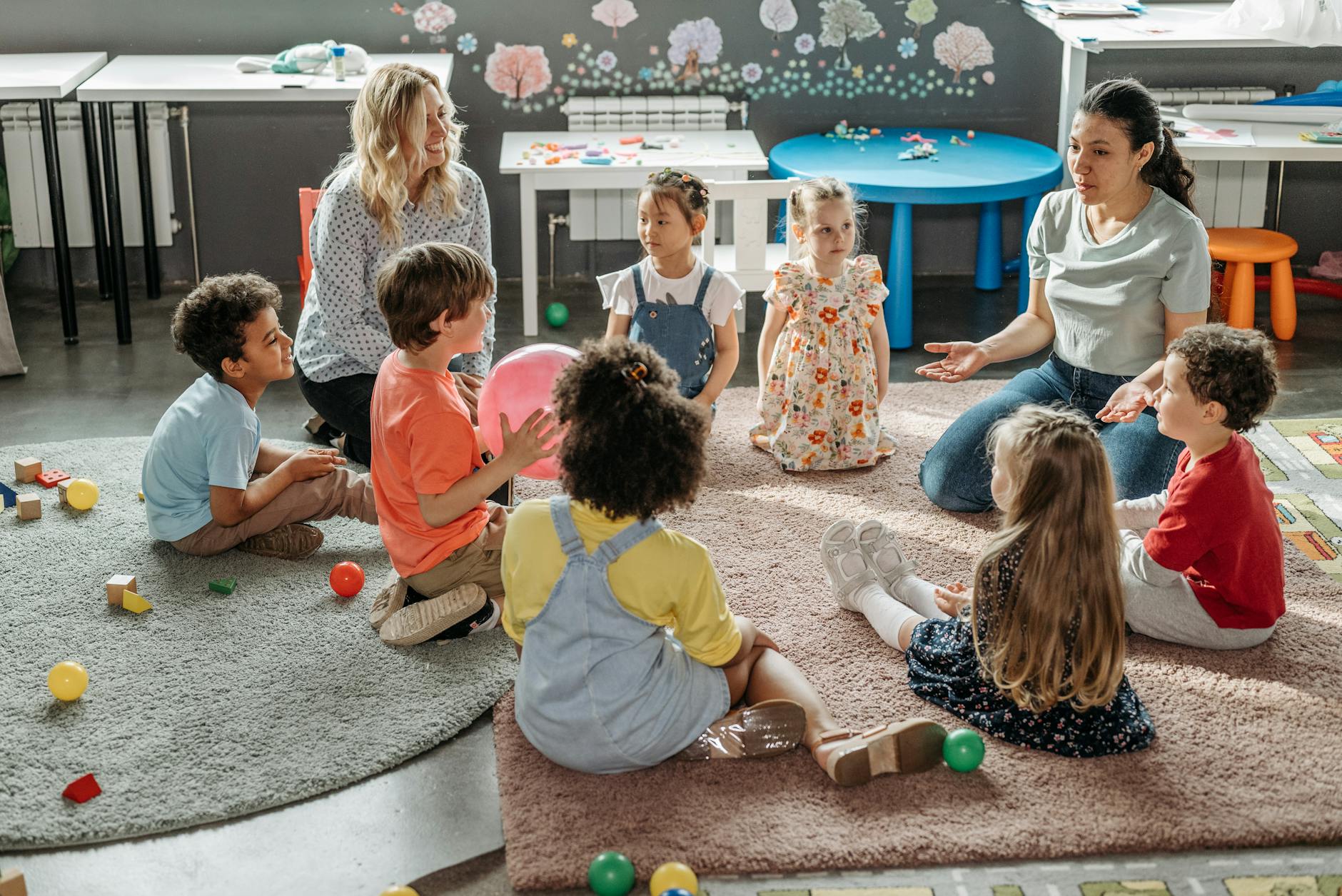
Structure play-based lessons using four 12-minute literacy centers (Listening, Writing, Word Work, Library) with 2-minute transitions. Rotate dramatic play themes every three weeks (Grocery Store, Post Office, Vet Clinic), embedding 10-15 content-specific vocabulary words through authentic props like receipt pads and patient charts. Use a 9-square choice board with 3 'Must Do' and 6 'May Do' activities.
Run four literacy centers during your kindergarten english lessons. Each station lasts twelve minutes. Use a two-minute musical transition buffer—try the clean-up song or a gentle chime. Group your twenty-four kids into heterogeneous tables of four. Rotate groups every three weeks so friendships don't fossilize. Prep visual direction cards with photo instructions. Non-readers need to see exactly where the orange markers go without asking you.
Rotate dramatic play units every three weeks. Cycle through Grocery Store, Post Office, and Vet Clinic. Stock the Grocery Store with receipt pads and pricing guns. Add address forms and envelopes to the Post Office. Place patient charts and symptom checklists at the Vet Clinic. Embed ten to fifteen content-specific vocabulary words naturally—"receipt," "address," "symptom"—through authentic use, not flashcard drills.
Build a 9-square choice board for independent work. Place three "Must Do" activities in the top row—these are teacher-directed tasks like a phonemic awareness sort. Fill the other six squares with "May Do" options. Use a visual icon system: green circles mean "go," red stop signs mean "finished." This keeps your classroom management sane while building autonomy.
Know the three play types operating in your kindergarten class.
Teacher role: You script scenarios in Teacher-Directed Play. You observe from afar during Free Play. You sit as a co-player during Guided Play.
Learning objectives: Directed play targets specific emergent reading skills. Free play builds social negotiation. Guided play hits early literacy goals through conversation.
Materials prep: Directed play needs hours of prop creation. Free play needs zero setup. Guided play requires quick daily tweaks.
Assessment: Directed play yields structured formative assessment checklists. Free play produces anecdotal notes. Guided play captures phonemic awareness in real time.
For more play-based learning ideas for kindergarten, check our activity bank. These structures fit into stress-free kindergarten lesson plans that actually work.
Step 4 — How Can You Assess Progress Without Traditional Tests?
Assess without tests using the ABC anecdotal method (Action, Behavior, Context) recorded on sticky notes or ESGI software, aiming for one 30-second observation per child every three days. Create digital portfolios in Seesaw with two weekly uploads per child—one photo with voice recording, one work sample—while conducting running records for three students daily using the 90% accuracy threshold for reading levels.
Five-year-olds can't bubble in answer sheets. They show growth through play, conversations, and the stories they build in the block corner.
Capture these moments with the ABC anecdotal method. Write down the Action (what you saw), the Behavior (what they said or did), and the Context (what was happening). Keep a seating chart clipped to a clipboard and slap sticky notes directly onto squares during centers. When the bell rings, peel them off and stick them in student folders. Low tech, zero prep, always accessible.
Or skip the paper entirely. Tap observations into ESGI software on your phone while you circulate. The app sorts entries by standard automatically.
Follow the 30-second rule. Jot one observation per child every three days during natural play, not formal testing. Sort your notes into three buckets:
Social-emotional: How they solve conflicts during group work.
Literacy: Attempts at early literacy during sign-making in the dramatic play area.
Math: Strategies for sharing blocks equally among friends.
You'll spot patterns fast. Maybe Jayden only negotiates trade disputes during dramatic play, or your kindergarten class suddenly grasps phonemic awareness when rhyming pops up in the puppet theater. These snapshots replace gradebook entries.
Build a formative assessment archive with digital portfolios. Use Seesaw or ClassDojo to upload exactly two items weekly per child. Snap a photo of the marble run with a voice recording explaining how she balanced the structure. Scan one physical work sample—a dictated story, a math sorting page. Parents respond to just one item weekly with a voice comment or text. This rhythm keeps families connected without overwhelming your inbox. Hearing them explain their thinking beats any worksheet checkmark. Check our creating effective student portfolios guide for setup tips.
Track emergent reading with running records. Assess three students daily for ten minutes each using Fountas & Pinnell Benchmark Assessment or similar tools. That's fifteen kids per week, everyone covered twice a semester. Mark a text at 90% accuracy or higher as independent level; 90-94% lands at instructional level. Anything below 90% is frustration level—put that book away.
Don't track every standard. Pick eight to ten Power Standards per quarter and watch those closely. Trying to document all 47 math standards will break you. See our performance assessment guide for teachers for selecting those targets.
Avoid documentation paralysis. Photographing every tower and painting will bury you in data you can't use. You cannot teach while acting as a full-time archivist. Instead, adopt the One Best Thing approach. Capture only the most significant learning moment per child per week. Your classroom management improves when you're observing instead of fumbling with your camera, and your play-based learning stays centered on kids, not devices.

How Do You Avoid Burnout During Your First Semester?
Avoid burnout by batching tasks: copy on Mondays, answer parent emails on Fridays using a 48-hour response policy, and prep during specific planning periods. Enforce 'school stays at school' boundaries by leaving at contract time twice weekly, disabling email notifications after 6 PM, and scheduling high-energy movement breaks during the 10:30 AM 'witching hour' when young children's engagement naturally drops.
Your first semester will chew you up if you react to every notification. Stop living in your inbox. Batch your work or you'll spend every Sunday night panicking about Monday while your classroom management plan falls apart.
I batch everything into four categories:
Mondays: Copy early literacy centers and phonemic awareness games for the week.
Wednesdays: Grade during planning period 3.
Tuesdays/Thursdays: Prep during lunch.
Fridays: Handle parent emails with my hard 48-hour response policy.
The 2-minute rule keeps small tasks from clogging my lists. If it takes less than two minutes, complete it immediately. Don't add it to your list. Save your brain space for early literacy lesson plans.
I enforce a strict "school stays at school" protocol. I leave by contract time Tuesday and Thursday without guilt. My phone goes on Do Not Disturb during dinner.
Email notifications die at 6 PM. Sunday prep gets one hour max for the week ahead. These evidence-based strategies for teacher work-life balance saved my sanity when I taught my first kindergarten class.
The 10:30 AM "witching hour" hits when cortisol drops and kids melt down. Don't fight it with worksheets. I blast GoNoodle dance parties or run "freeze dance" breaks.
High-energy movement works better than calm-down activities here. It resets classroom management without sacrificing play-based learning time. Save the breathing exercises for after lunch when kids actually need to calm down.
I stopped doing jobs parents can handle. My volunteers handle three non-instructional tasks:
Sharpening pencils
Cutting laminating for emergent reading centers
Sorting leveled books
For formative assessment data and behavior tracking, ClassDojo sends automated weekly reports. No more individual parent emails about who talked during phonemic awareness drills. Check out these teacher stress management techniques for more automation ideas that protect your evenings.

Should You Try Kindergarten Class?
If you thrive on structure disguised as chaos, yes. Teaching five-year-olds means managing bathroom emergencies while building phonemic awareness through puppet shows. It is exhausting. It is also the only grade where you watch emergent reading click in real time.
The four steps above aren't separate strategies. They are the daily rhythm of a room where early literacy takes root. You will tape labels on chairs. You will assess with clipboard checklists during block play. You will repeat yourself seventeen times before lunch. That is the job.
But here is the truth: if the thought of singing the alphabet while tying shoelaces makes you want to quit teaching entirely, listen to your gut. Classroom management in a kindergarten class requires joy as a fuel source. Can you see yourself genuinely celebrating when a child finally hears the /b/ sound in "bat"? If your answer is yes, the little ones are waiting.
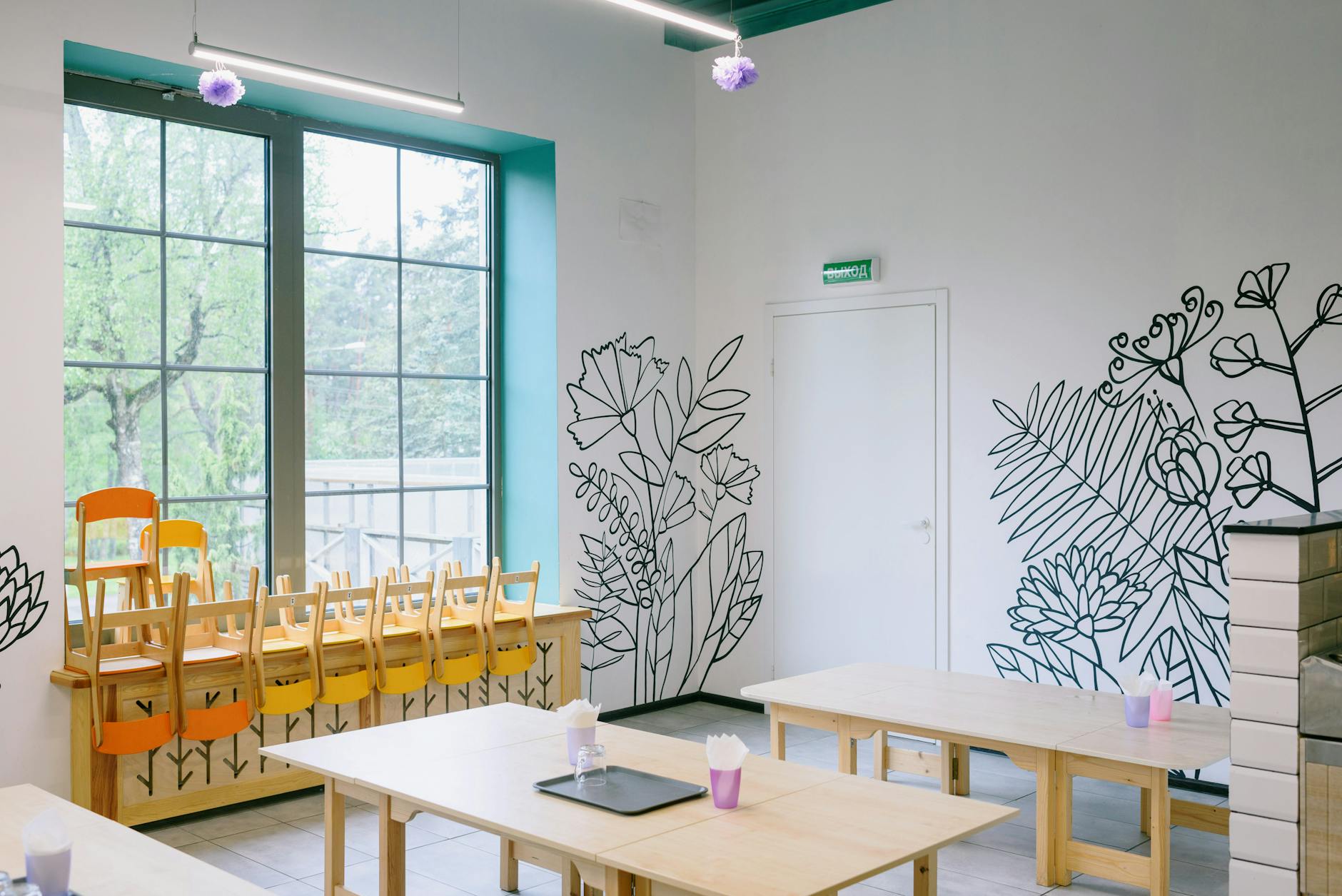
What Should You Know Before Teaching Kindergarten?
Before teaching kindergarten, understand that children enter with vastly different developmental timelines—some still developing fine motor control, others reading already. You need knowledge of state licensing ratios (typically 1:8 to 1:12). You need physical stamina for 90+ minutes of daily gross motor time. And you need willingness to prioritize social-emotional learning over academics for the first six weeks.
A four-and-a-half-year-old might grip a pencil with a full fist while a six-year-old writes sentences. That eighteen-month spread is normal in one room. Watch for red flags: a child who cannot sit for a five-minute read-aloud, struggles to separate from parents after three weeks, or shows no interest in emergent reading activities like pretend book reading. These signal a need for play-based learning, not worksheets. Meet them where they are.
States set strict rules for your kindergarten class. Meeting these essential requirements for a kindergarten teacher isn't bureaucracy—it's safety. Violations can shut you down.
Student-teacher ratios typically run 1:8 to 1:12 with mixed ages.
Square footage requirements demand 35-50 square feet per child indoors.
Naptime regulations specify minimum durations and supervision ratios.
Outdoor time mandates require weather-permitting daily exposure.
CPR and first aid certification for all adults in the room.
Your schedule must accommodate 90-120 minutes of gross motor play daily. I block 30 minutes at arrival, 45 minutes after lunch, and 20 minutes mid-afternoon while others do centers. This protects classroom management—tired bodies can't focus on phonemic awareness drills or early literacy stations. Skip this, and you will spend October managing tantrums instead of teaching kindergarten content. Treat movement as non-negotiable curriculum.
Ignore the pacing guide for September. The first six weeks are for routines and relationships, not letter recognition. If you push formative assessment of sight words before children trust you, you will fight behaviors all year. Build the foundation first. The academics will come faster later when kids feel safe. Rushed early literacy instruction without social-emotional readiness creates struggling readers who hate books.
Step 1 — How Do You Create a Print-Rich Environment for Language Development?
Create a print-rich environment by labeling eight functional areas and five learning centers using 72pt Sassoon Primary font at thirty-six to forty-two inches from the floor. Build a three-tier library with half the shelves facing predictable text outward, add five high-frequency words to your word wall weekly with color-coded parts of speech, and tape up cereal boxes and street signs.
Kids can't read what they can't see. Mount everything at eye level for five-year-olds, not adults.
Start with environmental print that anchors your classroom management routines. Print labels for eight functional spots: door, window, sink, trash, light switch, cubby, bathroom, and pencil sharpener. Add five interest-based signs for centers like blocks, library, art, science, and dramatic play.
Cut out four authentic pieces from cereal boxes, fast-food bags, stop signs, or traffic lights. Use Sassoon Primary or Comic Sans at seventy-two point minimum. Position the bottom edge thirty-six to forty-two inches from the floor so kids can trace letters without standing on tiptoes.
Your classroom library drives early literacy more than any poster. Split it into three tiers: fifty percent predictable text picture books with strong picture cues, thirty percent concept books covering ABCs and 123s, and twenty percent wordless books that build sequencing skills.
Face covers outward—research shows this triples engagement compared to spines. Refresh twenty percent of the titles monthly during play-based learning transitions so kids don't stop looking. This rotation becomes part of your ongoing formative assessment of their changing interests.
The interactive word wall lives at student eye level, not above the whiteboard. Add five high-frequency words each Monday. Color-code by part of speech: blue nouns, red verbs, green adjectives.
Snap photos of kids demonstrating action verbs—jumping for "jump," hugging for "kind"—and tape them beside the words. This bridges phonemic awareness and real movement in your kindergarten class. It also supports emergent reading behaviors during independent browsing.
Feature | Commercial Labels | Teacher-Made Labels |
Cost per label | $0.50–$2.00 | $0.05 (paper/ink) |
Durability | Laminated, 3+ years | Needs yearly replacement |
Customization time | Zero | 2 hours initial setup |
Font consistency | Varies by pack | You control Sassoon/Comic Sans |
Go hybrid. Buy commercial labels for high-traffic areas like the bathroom and sink where durability matters. Make your own for center labels and the word wall where font consistency matters most. This balances your budget with effective classroom design and learning zones.
Step 2 — What Morning Routines Build English Critical Thinking Skills?
Build critical thinking through a 'Question of the Day' using a decision flowchart: yes/no questions get thumbs responses, preference questions create graphs, and prediction questions form hypotheses. Follow with 5-minute 'Sort It Out' activities using tangible objects with progressive difficulty—single attribute sorting, then dual attributes, then student-generated categories using inference-based language like 'What do you notice?'
Question of the Day runs on a simple flowchart you draw on chart paper. If you ask a yes/no question, kids respond with thumbs up or down. You record the tally and ask, "Why do you think that?" This builds english critical thinking through justification.
Yes/no examples: "Is a spider an insect?" "Can you eat soup with a fork?" "Does 'ship' start with /sh/?" Each forces evidence-based reasoning and builds phonemic awareness. Kids defend answers using emergent reading skills.
Preference questions use student photos on a graph. Try: "Do you prefer snow or rain?" "Which book should we read first?" "Would you rather be tiny or giant?" Kids analyze data and draw conclusions about their kindergarten class.
Prediction questions require hypotheses. Ask: "Will this pumpkin sink or float?" "Will the shadow be longer at 9am or noon?" "Will ice melt faster in sun or shade?" Test immediately. This mirrors scientific inquiry and formative assessment.
Sort It Out takes five minutes with tangible objects. Use buttons, attribute blocks, or nature items. Start Week 1 with single attributes like color. Week 2 adds dual attributes—color and size. Week 3 lets kids create their own categories.
Dump a mixed bucket on the rug. Watch them negotiate: "This has holes." "That is shiny." The debate is the lesson. They practice discourse while you listen.
Week 2 needs sharper focus. Find only the big blue blocks, ignoring small blue ones. Holding two variables simultaneously strengthens working memory. This predicts later reading comprehension success.
By Week 3, kids generate categories. One sorts by "crunchy" versus "smooth." Another uses "smells good." Ask, "How did you decide?" Their reasoning reveals thinking processes.
The magic is your language. Never ask, "What color is this?" Say, "What do you notice?" This shift needs observation and classification. It builds the inference skills needed for early literacy.
Replace rote calendar counting with Mystery Number clues. Say, "This number is greater than 5 but less than 10, and it looks like a snowman." Kids infer the answer is 8. They explain their reasoning, not just shout digits.
Keep this tight. Research shows attention spans run 2-3 minutes per year of age. For five-year-olds, that's 8-10 minutes max. After minute eight, you lose them. Stop before they check out.
Watch for passive routines. If kids chant days of the week while staring at the floor, you've lost them. Static calendar time kills engagement at exactly minute eight. Replace it with problem-solving or add kinesthetic movement.
Good classroom management means knowing when to abandon ship. Dead time undermines your play-based learning environment. Active minds need active routines, not endless calendar drills.
These strategies for teaching critical thinking work because they treat children as investigators. You're not managing downtime. You're launching inquiry.
Step 3 — How Do You Structure Play-Based Kindergarten English Lessons?
Structure play-based lessons using four 12-minute literacy centers (Listening, Writing, Word Work, Library) with 2-minute transitions. Rotate dramatic play themes every three weeks (Grocery Store, Post Office, Vet Clinic), embedding 10-15 content-specific vocabulary words through authentic props like receipt pads and patient charts. Use a 9-square choice board with 3 'Must Do' and 6 'May Do' activities.
Run four literacy centers during your kindergarten english lessons. Each station lasts twelve minutes. Use a two-minute musical transition buffer—try the clean-up song or a gentle chime. Group your twenty-four kids into heterogeneous tables of four. Rotate groups every three weeks so friendships don't fossilize. Prep visual direction cards with photo instructions. Non-readers need to see exactly where the orange markers go without asking you.
Rotate dramatic play units every three weeks. Cycle through Grocery Store, Post Office, and Vet Clinic. Stock the Grocery Store with receipt pads and pricing guns. Add address forms and envelopes to the Post Office. Place patient charts and symptom checklists at the Vet Clinic. Embed ten to fifteen content-specific vocabulary words naturally—"receipt," "address," "symptom"—through authentic use, not flashcard drills.
Build a 9-square choice board for independent work. Place three "Must Do" activities in the top row—these are teacher-directed tasks like a phonemic awareness sort. Fill the other six squares with "May Do" options. Use a visual icon system: green circles mean "go," red stop signs mean "finished." This keeps your classroom management sane while building autonomy.
Know the three play types operating in your kindergarten class.
Teacher role: You script scenarios in Teacher-Directed Play. You observe from afar during Free Play. You sit as a co-player during Guided Play.
Learning objectives: Directed play targets specific emergent reading skills. Free play builds social negotiation. Guided play hits early literacy goals through conversation.
Materials prep: Directed play needs hours of prop creation. Free play needs zero setup. Guided play requires quick daily tweaks.
Assessment: Directed play yields structured formative assessment checklists. Free play produces anecdotal notes. Guided play captures phonemic awareness in real time.
For more play-based learning ideas for kindergarten, check our activity bank. These structures fit into stress-free kindergarten lesson plans that actually work.
Step 4 — How Can You Assess Progress Without Traditional Tests?
Assess without tests using the ABC anecdotal method (Action, Behavior, Context) recorded on sticky notes or ESGI software, aiming for one 30-second observation per child every three days. Create digital portfolios in Seesaw with two weekly uploads per child—one photo with voice recording, one work sample—while conducting running records for three students daily using the 90% accuracy threshold for reading levels.
Five-year-olds can't bubble in answer sheets. They show growth through play, conversations, and the stories they build in the block corner.
Capture these moments with the ABC anecdotal method. Write down the Action (what you saw), the Behavior (what they said or did), and the Context (what was happening). Keep a seating chart clipped to a clipboard and slap sticky notes directly onto squares during centers. When the bell rings, peel them off and stick them in student folders. Low tech, zero prep, always accessible.
Or skip the paper entirely. Tap observations into ESGI software on your phone while you circulate. The app sorts entries by standard automatically.
Follow the 30-second rule. Jot one observation per child every three days during natural play, not formal testing. Sort your notes into three buckets:
Social-emotional: How they solve conflicts during group work.
Literacy: Attempts at early literacy during sign-making in the dramatic play area.
Math: Strategies for sharing blocks equally among friends.
You'll spot patterns fast. Maybe Jayden only negotiates trade disputes during dramatic play, or your kindergarten class suddenly grasps phonemic awareness when rhyming pops up in the puppet theater. These snapshots replace gradebook entries.
Build a formative assessment archive with digital portfolios. Use Seesaw or ClassDojo to upload exactly two items weekly per child. Snap a photo of the marble run with a voice recording explaining how she balanced the structure. Scan one physical work sample—a dictated story, a math sorting page. Parents respond to just one item weekly with a voice comment or text. This rhythm keeps families connected without overwhelming your inbox. Hearing them explain their thinking beats any worksheet checkmark. Check our creating effective student portfolios guide for setup tips.
Track emergent reading with running records. Assess three students daily for ten minutes each using Fountas & Pinnell Benchmark Assessment or similar tools. That's fifteen kids per week, everyone covered twice a semester. Mark a text at 90% accuracy or higher as independent level; 90-94% lands at instructional level. Anything below 90% is frustration level—put that book away.
Don't track every standard. Pick eight to ten Power Standards per quarter and watch those closely. Trying to document all 47 math standards will break you. See our performance assessment guide for teachers for selecting those targets.
Avoid documentation paralysis. Photographing every tower and painting will bury you in data you can't use. You cannot teach while acting as a full-time archivist. Instead, adopt the One Best Thing approach. Capture only the most significant learning moment per child per week. Your classroom management improves when you're observing instead of fumbling with your camera, and your play-based learning stays centered on kids, not devices.
How Do You Avoid Burnout During Your First Semester?
Avoid burnout by batching tasks: copy on Mondays, answer parent emails on Fridays using a 48-hour response policy, and prep during specific planning periods. Enforce 'school stays at school' boundaries by leaving at contract time twice weekly, disabling email notifications after 6 PM, and scheduling high-energy movement breaks during the 10:30 AM 'witching hour' when young children's engagement naturally drops.
Your first semester will chew you up if you react to every notification. Stop living in your inbox. Batch your work or you'll spend every Sunday night panicking about Monday while your classroom management plan falls apart.
I batch everything into four categories:
Mondays: Copy early literacy centers and phonemic awareness games for the week.
Wednesdays: Grade during planning period 3.
Tuesdays/Thursdays: Prep during lunch.
Fridays: Handle parent emails with my hard 48-hour response policy.
The 2-minute rule keeps small tasks from clogging my lists. If it takes less than two minutes, complete it immediately. Don't add it to your list. Save your brain space for early literacy lesson plans.
I enforce a strict "school stays at school" protocol. I leave by contract time Tuesday and Thursday without guilt. My phone goes on Do Not Disturb during dinner.
Email notifications die at 6 PM. Sunday prep gets one hour max for the week ahead. These evidence-based strategies for teacher work-life balance saved my sanity when I taught my first kindergarten class.
The 10:30 AM "witching hour" hits when cortisol drops and kids melt down. Don't fight it with worksheets. I blast GoNoodle dance parties or run "freeze dance" breaks.
High-energy movement works better than calm-down activities here. It resets classroom management without sacrificing play-based learning time. Save the breathing exercises for after lunch when kids actually need to calm down.
I stopped doing jobs parents can handle. My volunteers handle three non-instructional tasks:
Sharpening pencils
Cutting laminating for emergent reading centers
Sorting leveled books
For formative assessment data and behavior tracking, ClassDojo sends automated weekly reports. No more individual parent emails about who talked during phonemic awareness drills. Check out these teacher stress management techniques for more automation ideas that protect your evenings.
Should You Try Kindergarten Class?
If you thrive on structure disguised as chaos, yes. Teaching five-year-olds means managing bathroom emergencies while building phonemic awareness through puppet shows. It is exhausting. It is also the only grade where you watch emergent reading click in real time.
The four steps above aren't separate strategies. They are the daily rhythm of a room where early literacy takes root. You will tape labels on chairs. You will assess with clipboard checklists during block play. You will repeat yourself seventeen times before lunch. That is the job.
But here is the truth: if the thought of singing the alphabet while tying shoelaces makes you want to quit teaching entirely, listen to your gut. Classroom management in a kindergarten class requires joy as a fuel source. Can you see yourself genuinely celebrating when a child finally hears the /b/ sound in "bat"? If your answer is yes, the little ones are waiting.
Still grading everything by hand?
EMStudio is a free teaching management app — manage your classes, students, lessons, and more!
Learn More
Still grading everything by hand?
EMStudio is a free teaching management app — manage your classes, students, lessons, and more!
Learn More



Notion4Teachers
Notion templates to simplify administrative tasks and enhance your teaching experience.



2026 Notion4Teachers. All Rights Reserved.
Notion4Teachers
Notion templates to simplify administrative tasks and enhance your teaching experience.
2026 Notion4Teachers. All Rights Reserved.
Notion4Teachers
Notion templates to simplify administrative tasks and enhance your teaching experience.
2026 Notion4Teachers. All Rights Reserved.