Field Day Games: A Complete Guide to Every Type

Think about the last party you planned. You had a plan for food, music, and games, and you knew the mix mattered. Field day works the same way. The right lineup turns a long outdoor day into one kids remember, not one that wears everyone out.
Field day games are the races, relays, lawn games, water activities, and contests that get a whole crowd moving together.
In this post, we'll sort them by type, note the setup and age fit for each, and share running tips that keep things fair, inclusive, and safe.
Still grading everything by hand?
EMStudio is a free teaching management app — manage your classes, students, lessons, and more!
Choosing Field Day Games for Your Crowd
The right game depends on who's playing, so start with the crowd.
Picnic games that bring families together
Family reunion picnics are ideal for field day games. The goal is less about winning and more about connecting. Simple shared games make memories and strengthen bonds, and they work for every age from toddler to grandparent. Everyone gets a turn.
Running a school field day smoothly
Field day is an annual student event, so form a small planning committee of teachers and parents. It also lets students meet friends and show talents. Group kids into class or grade teams, then match games to age:
K-2: one-rule games like bean bag toss.
3-5: relays and sack races.
Middle school: strategy challenges, like tug-of-war.
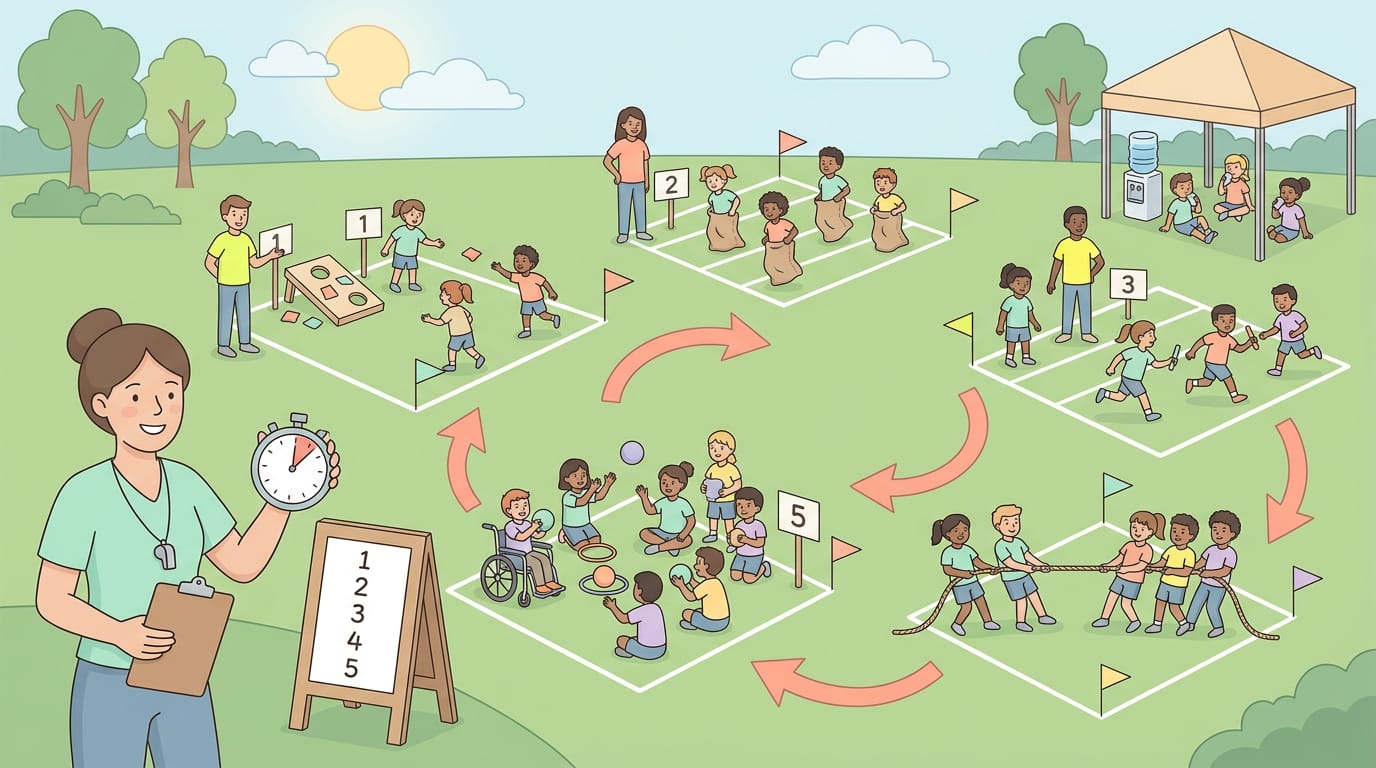
Offer inclusive play with a seated or stationary role in every race. Assign an adult to every station and mark clear boundaries. On sunny days, schedule shade and water breaks, and watch for overheating. Controlling who can reach the grounds during a crowded day calls for a school physical security plan.
Run a station rotation with a posted order and a timer. Picture a third-grade teacher whose groups rotate clockwise on the timer, so nobody bunches up at any one game.
Office games that get departments mixing
Teambuilding outside the office pulls people out of their usual teams. Aim for interdepartmental mixing so colleagues meet people they'd otherwise only email.
Survey staff early about what they enjoy and any disability-related access needs, then choose games everyone can join, like seated relays.
Twenty indoor games for rainy days: balloon keep-up, musical chairs, freeze dance, Simon Says, tag, hot potato, four corners, cup stacking, bean bag toss, indoor bowling, charades, bingo, scavenger hunt, human knot, paper airplane contest, ring toss, word association, hula hoop pass, sharks and minnows, and Pictionary.
Remote teams can try trivia on video.
Health perks and where to get gear
The Centers for Disease Control and Prevention (CDC) notes that regular physical activity can help keep your thinking, learning, and judgment sharp, and can reduce your risk of depression and anxiety.
The same guidance says some benefits show up right after moderate-to-vigorous activity, including reduced short-term anxiety for adults. For mood, keep games low-pressure so everyone stays willing to join in.
Amazon sells ready-made equipment kits, so you won't hunt down each item. For an office outing, you can also book paintball or laser tag.
Timeless Team Races and Relays
Classic races need little more than open ground. Here's how we'd run each one safely.
Sack races and fun twists
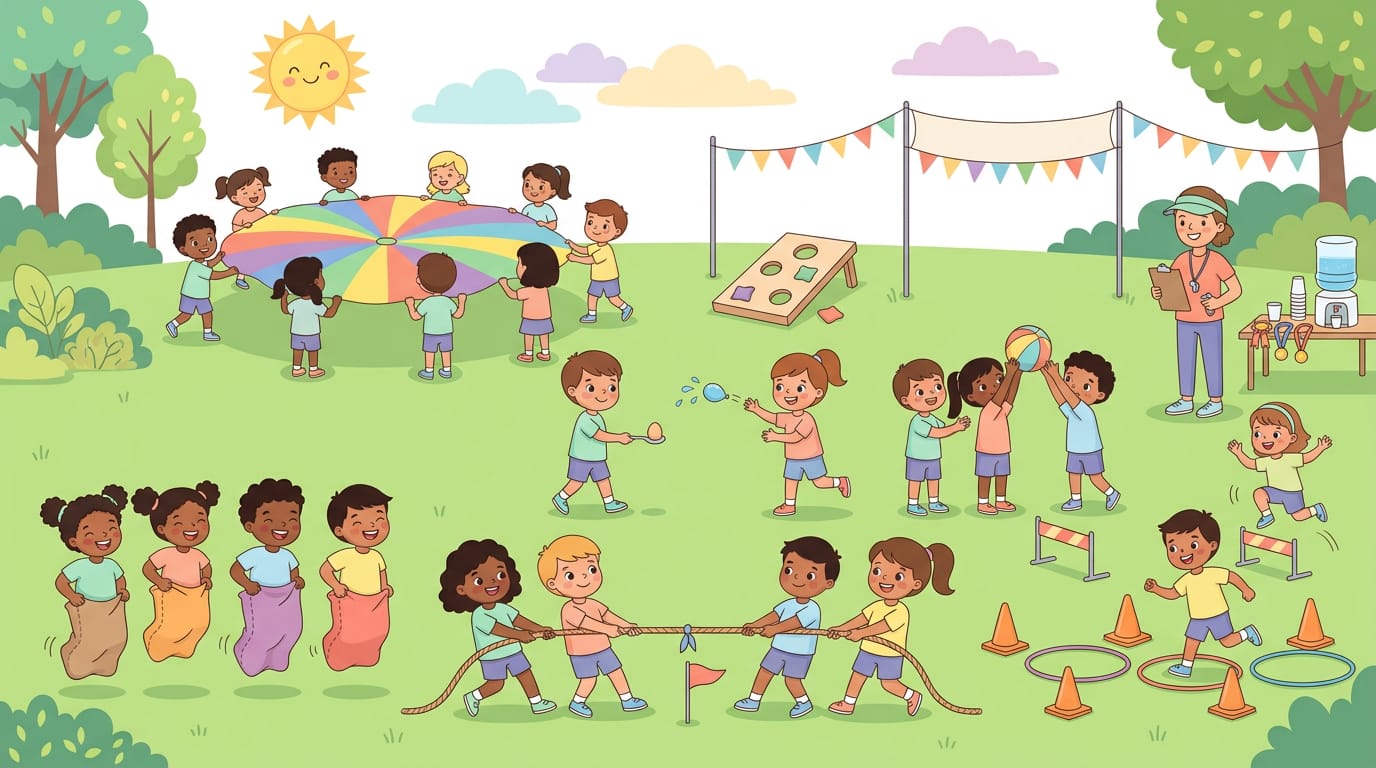
Start with the sack race. Burlap sacks are classic, but pillowcases make a fine stand-in. Racers hop to the finish line with both feet inside, so keep the course short for younger students.
For a twist, have racers hold a spoon with a ball on it as they hop. For a team relay, each hopper taps the next teammate on return.
A gym teacher with one set of sacks runs two lanes at once, so every team gets more turns.
Pair up for three-legged and wheelbarrow races
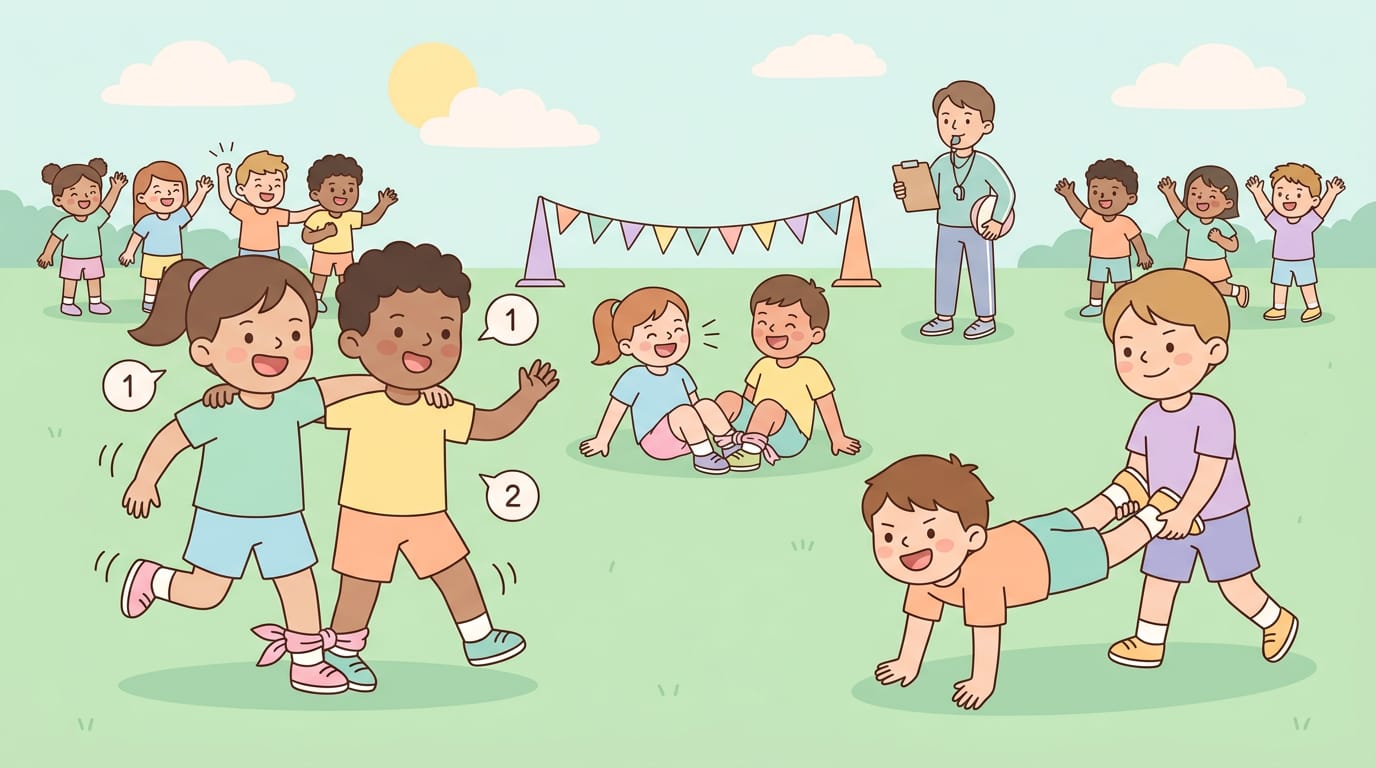
For a three-legged race, pair students up and tie their inside legs together at the ankle with a soft cloth. Partners must count steps together, or they'll both end up on the grass.
This is less about speed and more about teamwork. Partners who call out each step stay steadier than those who just charge.
In a wheelbarrow race, one partner holds the other's ankles while the walker moves on their hands. Halfway down, switch roles so everyone tries both jobs. Match similar heights for safety.
Random pairs mix friend groups, while chosen partners suit students who know each other well. Settle pairs before the whistle.
Relays that test your balance
Each of these asks something different of the runner:
Baton pass relay. The next runner waits until they hold the baton.
Egg and spoon race. Racers carry an egg on a spoon, and plastic eggs keep cleanup simple.
Balloon between knees. Students walk or hop with a balloon squeezed between their knees. It's trickier than it sounds. Steady hands win.
Pizza box and tray balance. Runners balance a beanbag on a light tray or empty pizza box.
Car wash sponge relay. Teammates pass a damp sponge down the line. Keep it damp, not soaked.
Sprints, jumps and tire rolls
A 100m dash is the classic sprint: time each runner from a standing start. For the long jump, tape a takeoff line and measure to where each student lands. For hurdles, set low cones or a rope at a height every student can clear.
For the tire roll, students guide a light tire around a cone and back with a stick.
What Are the Top Outdoor Team Games?
Searching for the top 10 outdoor games in India? We can't verify a ranking, so we've gathered classic team favorites that work on most school fields.
Tug of war for teamwork and balance
Picture a physical education teacher with 28 students splitting into two teams at either end of a sturdy rope. Each side pulls to drag the other across the center line. Running a game like this with a whole class takes planning, and PE lesson plans for every grade can help.
The real skill is balance: match team size and power so one side doesn't win before the rope even moves.
When teams are evenly matched, the game rewards coordination over raw strength, and the friendly competition keeps everyone pulling together. Fair teams are fun teams.
Dodgeball, kickball and capture the flag
These elimination team games get hearts pumping. In dodgeball, a player who gets hit is out, and the last team standing wins. Kickball works like baseball, with the kicking team running the bases.
In capture the flag, teams guard their own flag while sneaking across to grab the other side's. Tagged players go to jail until a teammate frees them. Because these games are strenuous and competitive, you'll want clear boundaries and regular rotations.
Obstacle courses for climbing and crawling
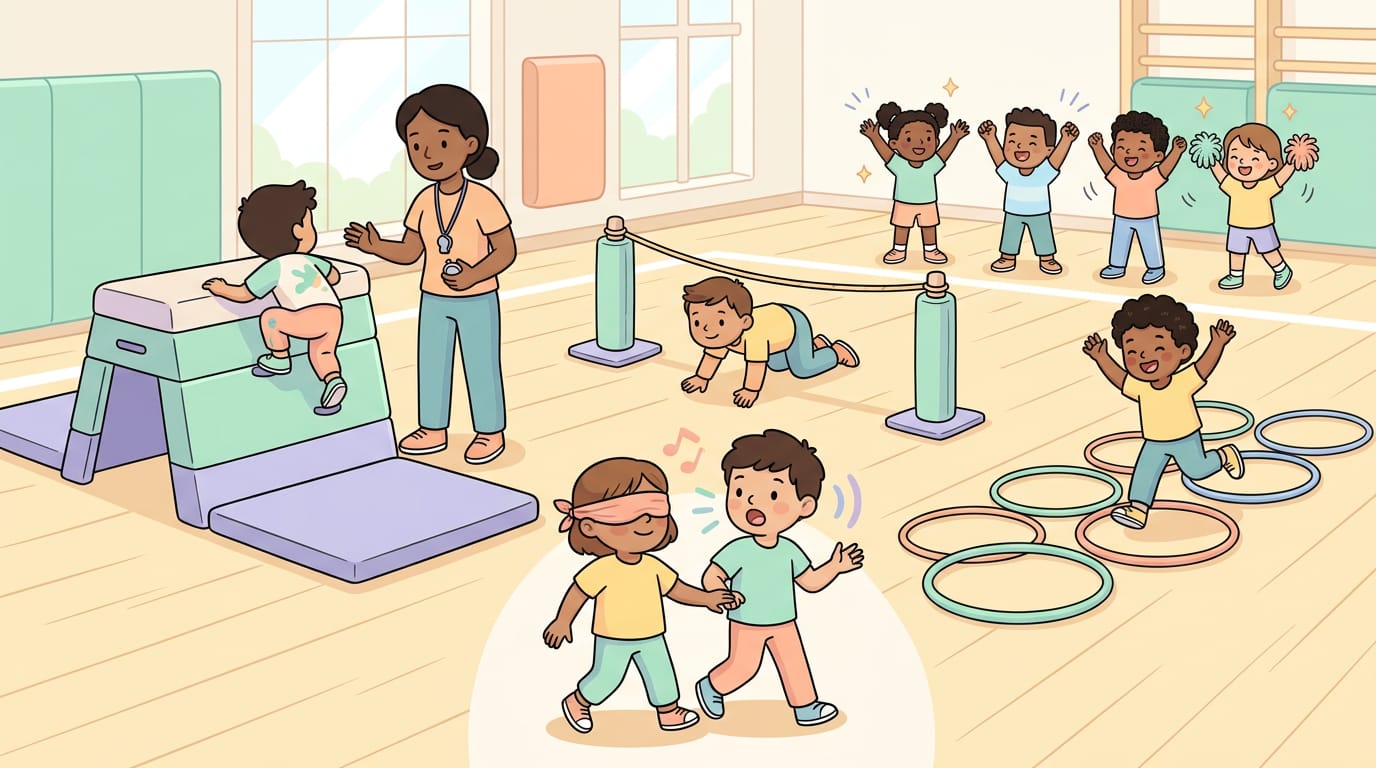
Build a course with three kinds of stations:
Climbing up and over a sturdy platform
Crawling under a low rope
Jumping through marked hoops
Students run it solo or in relay teams, with relays adding speed and cheering. For a twist, try a blindfolded version: one student wears a blindfold while a partner's voice is the only guide. That builds listening and clear, specific directions.
Because climbing carries real risk, rent proper equipment rather than improvising, since a professionally built course is far safer than a makeshift one.
Lawn Games for Tossing and Aiming
Tossing and aiming games need only open space, so you can run them almost anywhere. Here's what to run.
Giant board games you play outside
Picture a physical education teacher with a short window before the bell. Giant board games keep the whole class moving. Options include:
Giant Jenga: students pull oversized blocks from a stack and set them on top.
Frisbee tic-tac-toe: teams toss discs to claim squares on a grid.
Giant Connect 4: teams drop markers into a tall grid to line up four.
Giant checkers: students move across a taped-off board, where planning matters more than speed.
Store-bought sets save setup time, while DIY (do-it-yourself) versions can be sized to your students.
Bowling, cornhole and ring toss
Lawn bowling and cornhole both reward control rather than power. Bowlers roll balls at a target, while cornhole players toss bags through a hole in a sloped board. Ring toss asks students to aim a ring over a peg.
For a quicker challenge, try a tennis ball tin pyramid, where students throw balls at stacked tin cans. A free throw contest needs only a ball and a line. Little gear, quick resets.
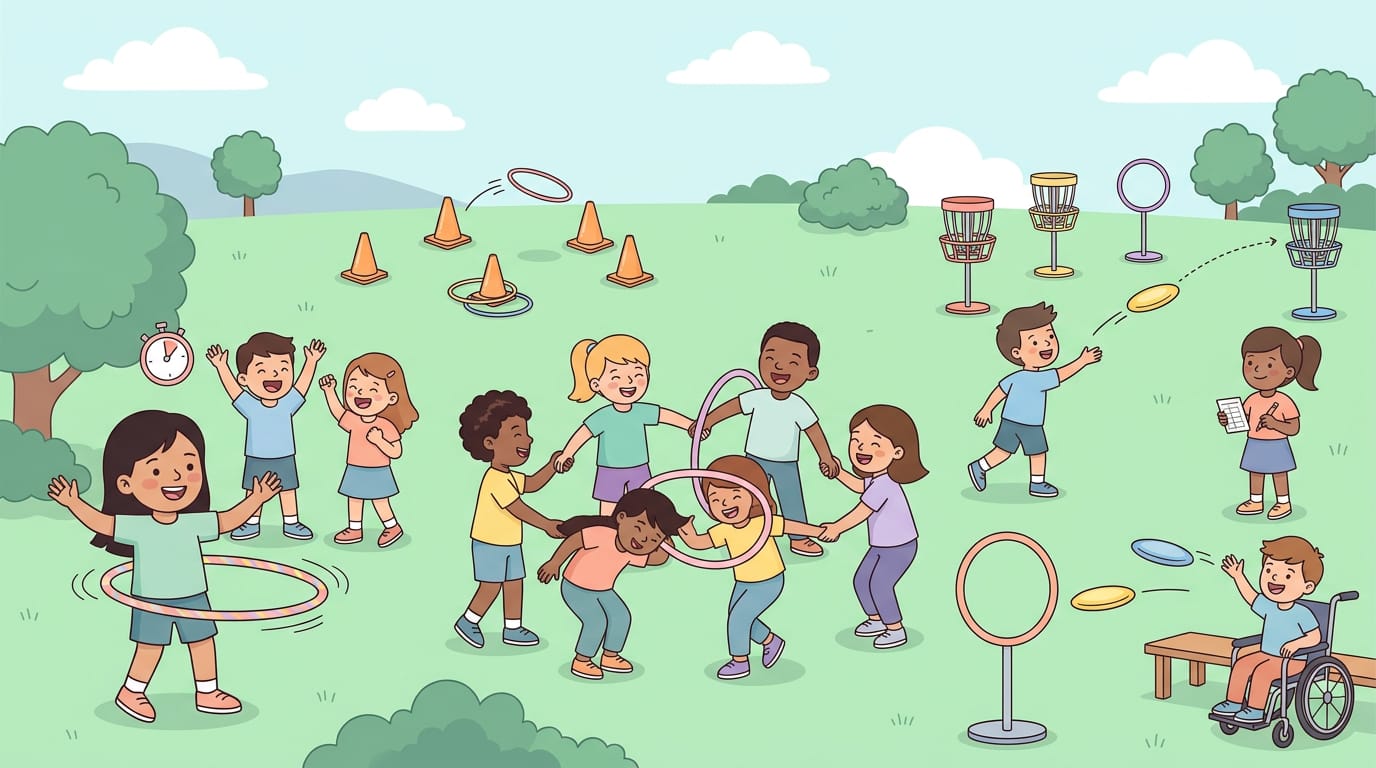
Hula hoop contests and frisbee golf
A hula hoop contest asks students to keep a hoop spinning the longest. In hoop tossing at cones, students flip hoops over cones for points. The hoop relay has teams pass a hoop down a line while holding hands, so everyone has to coordinate.
Frisbee golf sets up a course of targets, and students count throws the way golfers count strokes. Offer a slower or seated option so everyone can take part.
Water Games to Cool Off
Water games keep your class moving when the heat is on. Start gentle, then let the splashing begin.
Water balloon toss for hot days
Begin with pairs. Partners toss a balloon back and forth and step back after each clean catch. Under this step-back rule, the challenge is control more than speed. Try these other versions too:
Last intact balloon wins: Any balloon that breaks is out, and the last unbroken one takes the round.
Team line-pass version: Teams pass one balloon hand to hand down a line, and the first team to reach the end without a pop wins.
On a hot summer day, lead with this one. Picture a physical education teacher whose class starts with the pairs toss, so reluctant students are moving before you reach the big splashes.
Pick up popped pieces right away, and don't skip the latex allergy question.
More splashy activities to try
Once everyone's warm, bring out the bigger splashes:
Water gun tag: Tagged players sit out until the round ends. Aim below the shoulders so nobody gets a face full of water.
Pass the water blindfolded: Players pass a cup down a line with eyes covered, and the team with the most water left in its cup wins.
Car wash relay: Teams take turns running to a pretend car (a chair works), scrubbing it with a wet sponge, then tagging the next teammate.
Dunking booth: A willing staff member sits above a tank while students take turns throwing balls at a target to drop them into the water.
Tie-dye with water guns: Students squirt washable paint or diluted food coloring onto white shirts or cloth. Cover the tables first.
Which Music and Contest Games Are Fun?
Music, silly contests, and quiet art stations all belong on field day. There's no single top 10, so you'll want to mix a few from each group below.
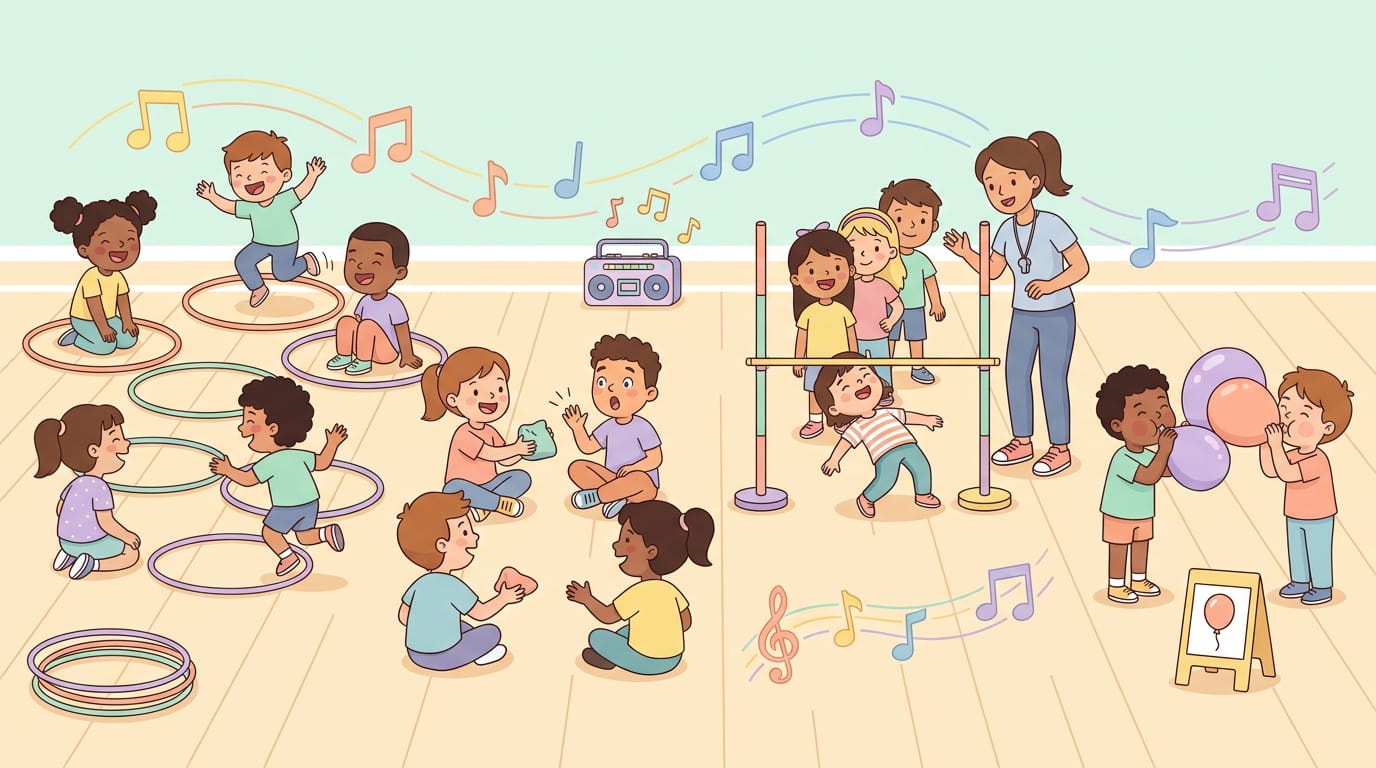
Music, limbo and hot potato
Musical hoops. Players dance around hoops and scramble into one when the music stops. Remove one hoop each round.
Hot potato. Students pass a bean bag until the music stops, and whoever holds it sits out. A gym teacher keeps rounds short so the line keeps moving.
Limbo rock. Players pass under a bar that drops each round. Start high enough for the youngest to clear it.
Balloon blowing contest. The first to fill a balloon to a set size wins. Ask about latex allergies first.
Silly skill contests for the family
For hilarious family games, these contests are about laughing more than winning.
Jump rope endurance. Teams jump in turns, and the group counts how long each one lasts.
Hanging donuts. Players eat a donut tied at face height, without using their hands. Check for food allergies first.
Mummy wrap. Teams wrap a teammate in toilet paper, and the first team done wins. Keep the wraps loose.
Coin tower. Players stack coins in turn, and the tallest standing tower wins. Use plastic coins for young kids.
Paper airplane toss. Players throw folded planes, and the longest flight wins. Mark a throwing line.
Calmer art, dance and bubble activities
Chalk art contest. Teams draw on pavement around one theme, like a favorite animal.
Art corner. Set up a shaded table with paper and markers for drawing between events. Add a quiet spot nearby.
Zumba or dance contest. Students copy upbeat moves, and groups show off a routine. Offer seated moves too.
Bubble station. Set out wands and solution away from walkways, since spills make the ground slippery.
Charades printable cards. Students act out simple cards while the group guesses. Add picture cards for early readers.
Great field day games come down to matching the activity to the crowd and the space. Mix team races, lawn games, water play, and contests, and you'll give every age a way to join in and a reason to cheer.
Whatever you pick, keep safety and fairness in view, and the day will feel like a win for everyone. Ready to bring that same energy into your classroom?
Check out Teaching Strategies & Concepts for more ideas that keep students engaged long after the last whistle.
References
Benefits of Physical Activity | Physical Activity Basics — cdc.gov (2026)
Still grading everything by hand?
EMStudio is a free teaching management app — manage your classes, students, lessons, and more!