
15 Education Software Platforms for K-12 Classrooms
15 Education Software Platforms for K-12 Classrooms

Article by
Milo
ESL Content Coordinator & Educator
ESL Content Coordinator & Educator
All Posts
I watched a fourth grader stare at a blank Google Doc for ten minutes last October. She knew the math concept cold, but the platform navigation stopped her cold. The cursor blinked. She raised her hand. Another lesson lost to bad UI.
That's when I stopped caring about education software feature lists. I started caring about whether kids can actually use the thing without a manual. Over fifteen years, I've cycled through dozens of platforms—some brilliant, some digital filing cabinets with better marketing. I've seen instructional technology that saves hours and tools that create busywork. The difference matters. In my blended learning environments, the right digital curriculum resources mean the difference between teaching and troubleshooting logins.
This list cuts through the noise. I'll show you fifteen platforms that actually work for K-12 classrooms—the LMS systems worth your login, the formative assessment technology that replaces your gradebook, and the classroom communication systems parents actually read. No hype. Just what I've used, what broke, and what I'd buy with my own classroom budget tomorrow.
Still grading everything by hand?
EMStudio is a free teaching management app — manage your classes, students, lessons, and more!
Learn More
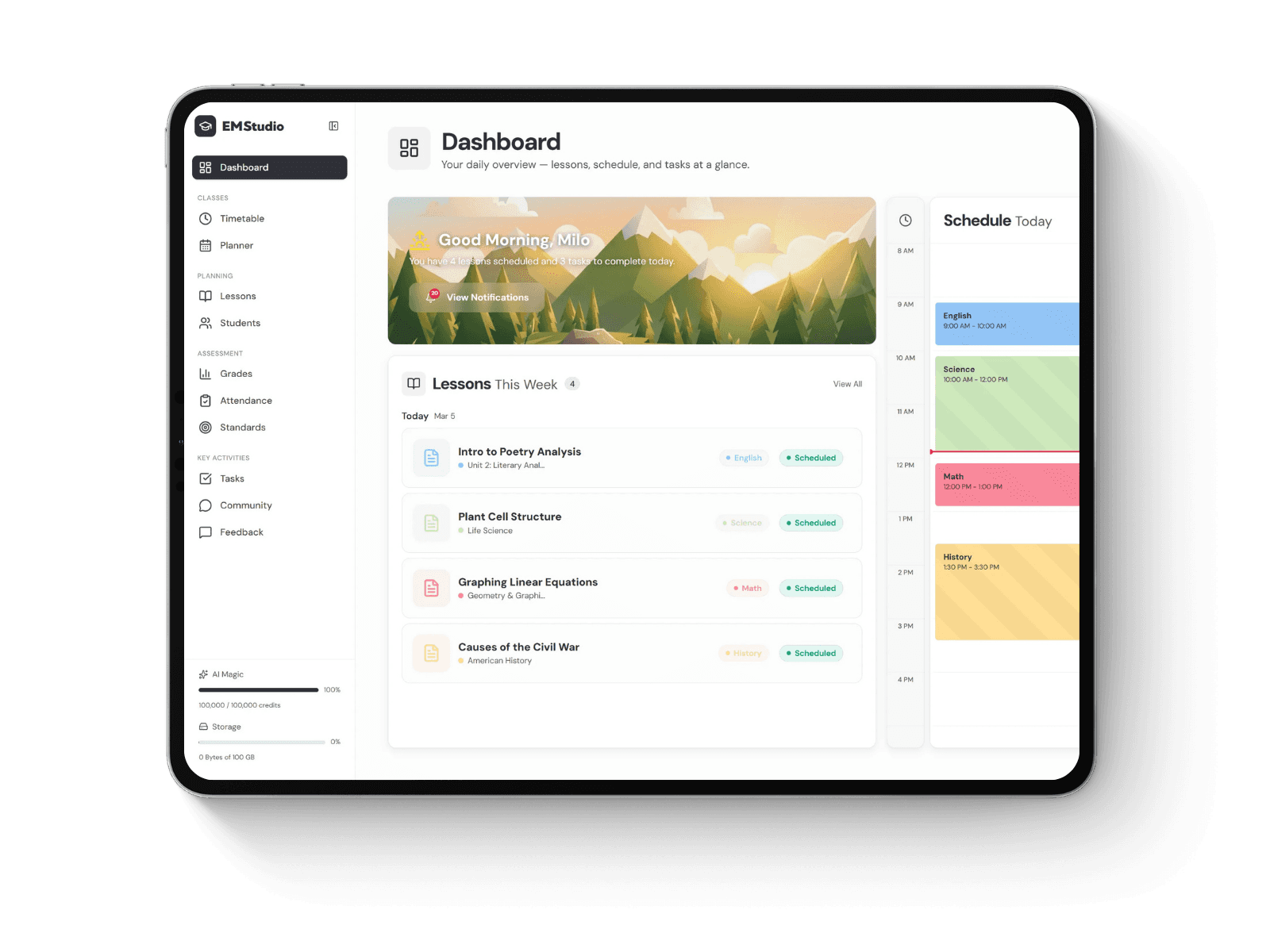
Still grading everything by hand?
EMStudio is a free teaching management app — manage your classes, students, lessons, and more!
Learn More
Table of Contents
Learning Management Systems and Digital Classrooms
District surveys show teachers juggling over 100 different educational applications annually. That's exhaustion, not innovation. Consolidating around core technology platforms for education cuts cognitive load and keeps focus on instruction rather than navigation. See our comprehensive guide to learning management systems for deeper comparison.
Platform | Setup Time | Cost | Best Fit | Student Limits |
|---|---|---|---|---|
Google Classroom | 10 minutes | Free Fundamentals | Individual teachers | 100 |
Canvas | 2 weeks | Quote-based | High school college prep | Unlimited |
Schoology | 1 month | Enterprise tier | District-wide consistency | Unlimited |
Use Google Classroom if you need immediate deployment with existing Workspace accounts. Choose Canvas if you're preparing 9th-12th graders for university LMS environments. Select Schoology when your district needs cross-building resource sharing and PowerSchool SIS integration.
Before purchasing any education software, verify LTI 1.3 Advantage compliance for gradebook passback. Confirm rostering works via OneRoster or Clever. Without these instructional technology standards, you're stuck with manual CSV uploads every semester. Don't skip this check.
Google Classroom for Streamlined Workflow
I once set up a 7th-grade science class during lunch. Create the class. Generate the six-digit join code. Post an announcement with a Drive resource. Five minutes total. That's the workflow teachers crave.
But know the hard limits. The 100-student cap kills it for high school chorus or combined sections. No native weighted gradebook calculations means exporting to add-ons like Gradebook by Individual. The parent portal is view-only; no direct messaging.
Cost keeps budgets breathing. Fundamentals is free forever. Plus edition runs $50 per student yearly, adding originality reports and practice sets. Most districts stick with the free tier until compliance needs force the upgrade.
Canvas for Secondary and Higher Ed Alignment
Canvas dominates secondary blended learning environments. SpeedGrader aligns rubrics to Common Core standards as you swipe through submissions. Outcomes-based grading tracks mastery over time, not point averages. Parent accounts mirror exactly what students see.
Implementation needs patience. Plan two to four weeks for SIS integration and course templating. I wouldn't deploy below grade 6; the interface assumes digital literacy younger kids haven't built. It prepares 9th-12th graders for college LMS environments.
The numbers back this up. Canvas lives in over 6,000 K-12 districts. Mobile apps support offline assignment access—important for students without home Wi-Fi who download content on campus.
Schoology for District-Wide Consistency
Schoology wins when districts need architectural consistency across buildings. PowerSchool integration syncs rosters nightly and passes grades back to your SIS automatically. No more Friday afternoon CSV wrestling matches.
District-wide resource repositories let teachers share formative assessment technology across grade levels. Professional learning communities cross building lines. Admins get granular analytics on teacher adoption rates—who's logging in and who's avoiding the platform.
This fits multi-school districts with three or more buildings. Classroom communication systems stay consistent from kindergarten through 12th grade. Everyone knows where to look for grades, announcements, and digital curriculum resources.

Interactive Lesson and Content Creation Tools
These education software tools flip the script. Students aren't passively watching slideshows anymore. They build, annotate, and publish. I've watched quiet kids become loud contributors when they shift from audience to author.
But let's talk logistics before you commit. Your district's 1:1 device choice—Chromebook or iPad—determines what actually works in your room. And prep time varies wildly. Plan 15 minutes to add interactivity to existing slides, 30 minutes to build a gamified lesson from scratch, and 45 minutes for full multimodal storytelling projects.
Nearpod for Real-Time Student Engagement
Nearpod turns your direct instruction into a two-way street. You launch a lesson, students join with a code, and suddenly 4th through 12th graders aren't just staring at screens.
The platform packs 20+ activity types:
Time to Climb: Gamified quizzes with leaderboards
VR field trips: 360° images that require gyroscopes (iPads work better than Chromebooks here)
Collaborate Board: Digital sticky notes for brainstorming
Draw It: Annotation tools for sketching answers
Prep takes about 30 minutes to build from scratch. The free tier handles 50 students with 100MB storage. Upgrade to Gold for $159/year when you need unlimited storage and Google Slides integration.
Pear Deck for Formative Assessment Integration
Pear Deck lives inside Google Slides as an add-on. Your existing presentations become interactive in 15 minutes flat. You drop in Draggable activities, Drawing questions, or multiple choice checks directly between content slides.
What I love is the anonymous mode. When my 7th graders discussed the protagonist's motivation last fall, the shy ones chimed in without fear. The real-time dashboard flashes red when a student flags confusion. The free version caps you at 30 students per session; Premium runs $149.99/year and unlocks 100 students plus student-paced homework mode.
Book Creator for Digital Storytelling Projects
Book Creator sits at the deep end of the creation pool. Students blend video recordings, audio narration, hand-drawn illustrations, and embedded Google Maps into single digital books. It is one of those innovative tools to engage and inspire students when poster projects feel stale.
This one needs 45 minutes of prep to set up templates and rubrics. Chromebooks run the web version smoothly with Drive export, while the iPad app shines with Apple Pencil support. The free tier allows 40 books per library; the $120/year teacher plan unlocks unlimited books and real-time collaboration where multiple students edit simultaneously like Google Docs.

What Are the Best Assessment and Grading Platforms?
The best assessment platforms include Kahoot! for live gamified checks supporting 40+ players, Quizizz for self-paced homework with instant meme feedback, and Formative for real-time written work monitoring. Select based on whether you prioritize engagement speed, mastery depth, or authentic work samples.
John Hattie's Visible Learning research puts feedback effect size at 0.73—nearly double the average intervention. These education software options close that loop instantly. No more waiting three days for graded papers. While classroom communication systems connect us to parents, these platforms connect us to student cognition. Speed wins for retrieval practice, but competitive timers devastate students with processing disabilities or test anxiety. Use Team mode or switch platforms entirely for those kids. The matrix is simple: Kahoot owns speed, Quizizz owns differentiation, Formative owns depth.
Kahoot! for Gamified Check-Ins
Kahoot! runs on adrenaline. Three game mechanics drive engagement:
Classic mode displays a competitive leaderboard after every question.
Team mode lets students huddle over shared devices.
Ghost mode has them racing against their own previous scores.
The 2-4 second response window keeps energy high but destroys any chance for multi-step math work or essay responses. Stick to rapid recall and vocabulary review.
The free tier caps you at 40 players, though the platform supports over 2,000 question types including word clouds and puzzles. In k12 ed tech, this fills the last ten minutes of class perfectly. Just avoid it for high-stakes checks where speed punishes slow processors.
Quizizz for Self-Paced Mastery
Quizizz wins on differentiation. You can assign Group A fractions while Group B works decimals simultaneously—no visible grouping stigma, just different codes. The homework mode runs asynchronously, firing customizable meme feedback when students finish. With 30 million teacher-created items, this stands out among educational applications for personalization.
The free version shows class averages, but the $99 School edition reveals item analysis: which distractors students chose and where misconceptions live. This formative assessment technology fits homework better than live competition. Students control their pace, removing the anxiety that sinks struggling learners in timed races.
Formative for Live Response Tracking
Formative (now called GoFormative) shows you student work as it happens. Unlike static digital curriculum resources, it captures authentic thinking through the Show Your Work tool. Students draw, type, or upload photos of handwritten work on a split-screen while viewing the question. I watched my 9th grader struggle with graphing linear equations in real time and reached her desk before she submitted. This instructional technology gives that immediate window into thinking.
The teacher dashboard updates live as students type—no submit button required. You see the hesitation, the half-erasures, the breakthrough moments. Free accounts limit you to 30 students; the $15/month Premium tier unlocks unlimited classes and advanced question types like graphing and audio response. For authentic formative assessment examples for immediate classroom use, this tool captures the messy work that multiple-choice misses.

Which Communication Tools Connect Teachers and Families?
Remind excels for urgent safety alerts with 150-character messages and 100-language translation. ClassDojo connects daily behavior feedback with digital portfolios for elementary students. Seesaw lets K-5 learners document their own learning for student-led conferences.
Remind for Quick Announcements and Safety
Remind handles urgent announcements through 150-character base messages that force clarity. You can attach PDFs, images, or voice clips, and two-way translation supports 100+ languages including non-Roman scripts like Arabic or Mandarin.
Phone numbers stay masked behind a relay system, protecting teacher privacy in blended learning environments. Districts can push emergency alerts to every parent device in under two minutes. This fits the rare, high-intensity communication pattern—lockdowns, snow days, early dismissal.
The tool has hard limits. You cannot share student work samples or digital curriculum resources here. It transmits safety information, not learning visibility.
ClassDojo for Behavioral Feedback and Portfolios
I run my 2nd grade classroom community through ClassDojo, implementing effective parent communication strategies for modern teachers. Real-time positive reinforcement—points for teamwork, participation, or "needs work" tags—reaches parents before dismissal. This daily rhythm builds behavior faster than Friday folders.
Student Stories let children photograph their STEM projects or record reading fluency, creating digital portfolios families access instantly. For digital technology in early childhood education, the platform maintains strict COPPA compliance, requiring verifiable parental consent before activating student accounts.
Privacy works differently here than with masked phone numbers. Parents see only their child's behavioral data and portfolio, walled off from classmates. This instructional technology dominates U.S. elementary schools because it connects conduct with content.
Seesaw for Student-Led Family Updates
Seesaw shifts agency to the student. In K-5 classrooms, children independently upload photos, record voice reflections explaining their math thinking, and draw annotations to demonstrate understanding. The interface works on tablets even for PreK learners.
Family apps automatically translate posts into 100+ languages, and privacy walls ensure parents see only their child's journal. Unlike the open communication of classroom communication systems like Remind, permissions here are granular and portfolio-based.
This tool handles weekly learning updates, avoiding the daily ping of behavior apps. Students curate evidence for conferences, developing metacognition as they present their growth to parents. These educational applications prioritize visibility over urgency.

Specialized Subject Software for STEM and Literacy
IXL for Adaptive Math and Language Practice
IXL runs diagnostics across 8,500 skills in Math, ELA, Science, and Social Studies. The algorithm spots gaps and adjusts difficulty in real-time when kids miss questions. I've watched my 6th graders drop from a 600 level to 400 after three consecutive errors. They climb back as they master the prerequisite.
The pricing hits $299 yearly for 25 students, or drops to $7 per student for site-wide licenses. Levels span 0 to 1300, covering PreK through 12th grade. This instructional technology adapts to a struggling 8th grader working at level 450. It also lets a 5th grader push into middle school content without switching platforms.
Research suggests 15 to 20 minutes of daily practice builds measurable retention. Kids earn virtual awards and certificates, which keeps them clicking through blended learning environments without constant teacher prodding.
Desmos for Graphing and Mathematical Exploration
Desmos offers something rare in educational applications: it's completely free. No paid tiers. No ads. The graphing calculator carries approval for SAT, ACT, AP, and IB exams. You can teach with the same tool they'll use on test day.
The Activity Builder lets you create Marbleslides for algebraic thinking or Card Sorts for categorization. These work for 3rd through 12th grade, though the graphing has shine brightest in 9th through 12th. Students manipulate variables to discover relationships without memorizing procedures.
This inquiry-based approach contrasts sharply with drill-focused digital curriculum resources. It fits naturally alongside essential STEM teacher resources and curriculum platforms when you want exploration over repetition.
Epic! for Digital Reading Libraries
Epic! hosts 40,000 books with read-to-me audio for emergent readers. The collection includes graphic novels and nonfiction with built-in comprehension quizzes. This leveled library approach concentrates usage in PreK-2 for guided reading blocks. Upper elementary teachers also use it for differentiated independent reading.
Teachers get free access for one class of up to 36 students. However, it only works from 7am to 4pm on weekdays. Families pay $72 yearly for home access. That time restriction creates a hard stop for homework assignments.
The platform tracks individual reading minutes and streaks, which motivates daily habits better than paper logs ever did. For formative assessment technology, the quick quizzes give you data without stopping the flow of reading time.

How to Evaluate and Select Education Software?
Map has to your curriculum standards first. Verify COPPA compliance and SOC 2 Type II security certifications when evaluating technology platforms for education. Run a 4-week pilot with 2-3 teachers. Measure for 80% student completion rates and under 5-minute troubleshooting time. If it passes, scale. If not, abandon.
Align Features with Learning Objectives
Start with what kids need to know, not what the software does. I learned this the hard way with a 4th-grade math pilot. We bought the flashiest formative assessment technology only to realize it couldn't handle our district's fractional unit sequence. The vendor had twenty features. We needed three. That's feature bloat—you pay for classroom communication systems your teachers never touch. Use backward design: learning objective first, evidence of learning second, tool selection last.
Watch for hidden integration costs. SSO setup fees can surprise your budget. Some vendors charge thousands to connect with your existing student information system. Follow Step 1 and Step 2 of your audit: align learning objectives, then check interoperability.
Confirm LTI 1.3 Advantage for automatic gradebook passback.
Verify OneRoster API handles rostering so you aren't uploading CSVs weekly.
Demand SAML 2.0 SSO to prevent password fatigue in blended learning environments.
List required versus nice-to-have features. If essentials sit behind premium tiers, walk away.
Check Data Privacy and COPPA Compliance
I used to skim the privacy policy. Then I found a vendor selling anonymized student data to third parties for research. That's a privacy gap you cannot accept. Never again. Now I demand a Data Processing Agreement showing data minimization—they collect only what's necessary. They must delete everything when the contract ends. No behavioral advertising to kids under thirteen.
Verify FERPA's school official exception documentation. Confirm they cannot use student data for commercial purposes or AI training without explicit consent. This is critical when selecting instructional technology and educational applications that track every click.
This is Step 3 of your audit. Read more about protecting student privacy in the age of edtech. Request these security standards before any pilot:
Request SOC 2 Type II reports, not just Type I.
Check for ISO 27001 certification.
Verify state-specific compliance like NY Ed Law 2-D or the California Student Privacy Agreement.
Pilot Test with a Small Cohort First
District-wide mandates without testing fail. Studies show pilot programs with defined success metrics achieve 80% adoption rates compared to 30% for top-down rollouts. I watched a district spend six figures on digital curriculum resources that teachers abandoned within a month because no one tested them first. Four weeks with two volunteers would have saved the budget.
Run your Pilot Protocol with 2-3 early-adopter teachers across different grade levels. Provide two hours of initial professional development and one hour weekly support. Measure quantitative data: 80% student login rates and less than 10% technical failure. Track qualitative feedback—teacher Net Promoter Score above 7, plus observable engagement via participation logs. Look for under 5-minute resolution time when teachers need help.
Set hard exit criteria. If adoption stays below 50% after training, or technical issues eat more than 10 minutes of class time weekly, abandon the education software before scaling. Don't sink cost into failing tools. This is Step 4 and Step 5: Pilot, then Scale or Abandon.

Getting Started: Rolling Out New Tools Without Overwhelm
Cognitive load research suggests teachers can effectively master only one major education software platform per semester. Roll out two, and both get superficial adoption. Roll out three, and teachers abandon everything. Districts often ignore this reality during initiatives.
The "digital native" fallacy destroys more implementations than broken servers. Students cannot navigate file directories. They cannot attach documents without explicit instruction. You must teach these skills alongside your content, or you will spend October troubleshooting instead of teaching. Use a essential digital literacy skills framework to check assumptions before expecting academic output.
Follow this phased timeline:
Week 1: Teacher setup and testing. Know where the "undo" button lives before students arrive.
Weeks 2-3: Basic student login routines. Students enter passwords until they can do it blindfolded.
Week 4+: Advanced has like rubrics or peer review, but only if login is automatic.
Month 2: Full integration with blended learning environments.
Apply the substitution-before-redefinition rule: use the new tool to replace an existing worksheet first. Once that routine is automatic, transform the practice. Do not attempt redefinition on day one.
Start with One Platform Per Semester
Master one core platform completely before adding secondary tools. Start with the LMS or gradebook because teachers check grades daily but use interactive whiteboards weekly. This prevents platform fatigue and password chaos. Your working memory has limits.
Choose the tool with highest daily usage impact. If your gradebook touches every assignment but your classroom communication systems only send monthly newsletters, prioritize the gradebook. If students access digital curriculum resources hourly but use formative assessment technology weekly, pick the curriculum platform. Build habits where they matter most.
Allow three weeks for basic proficiency before expecting advanced usage. Schedule no other new instructional technology introductions during this window. Week one is for you to test workflows. Weeks two and three are for students to automate login. If you introduce educational applications too quickly, you create cognitive overload for everyone.
Create Consistent Routines Before Adding Features
Students should retrieve devices, log in, and open the platform in under three minutes without your direction. Automate this procedure before introducing complex assignments. If you are still talking them through login steps during instructional time, you cannot teach content. The routine must be automatic.
Create visual supports. Build anchor charts showing login steps and troubleshooting flowcharts that read: Check WiFi, Refresh, Raise Hand. Post digital citizenship norms for commenting and collaboration. These visuals prevent you from becoming the help desk.
Use the same warmup procedure daily for two weeks. Use "Bellringer in Google Classroom" every morning until muscle memory forms. Only then do you vary activities. This consistency lets you integrate edtech seamlessly into your lesson plans. Routines first. Complexity later.
Build Student Tech Literacy Alongside Content
Teach file naming conventions explicitly. Require LastName_Assignment_Date for every submission. Fifth graders often lack the executive function skills to organize digital spaces. Last October, I assumed they knew how to create folders. They did not. We spent three days organizing Google Drive instead of learning science. Never again.
Integrate digital citizenship lessons during the first month of using any new tool. Cover password security, recognizing phishing attempts, and evaluating source credibility while students are still learning the platform interface. These skills stick when taught in context, not as separate computer lab specials.
Pre-assess with a "tech check" assignment before content-heavy work. Ask students to attach a file, copy and paste text, and insert a hyperlink. This reveals skill gaps without jeopardizing academic grades. If half your class cannot attach a document, pause the history essay. Fix the basics first.

The Future of Education Software in the Classroom
I remember when education software meant a CD-ROM that crashed every time the computer went to sleep. Now we're managing blended learning environments where kids toggle between paper notebooks and tablets without missing a beat. The shift isn't about collecting more tools. It's about finding instructional technology that cuts your prep time, not adds twenty new browser tabs.
What's changing? AI tutors are showing up in math apps, and digital curriculum resources now adapt in real time to student responses. But the biggest shift I've seen is interoperability—platforms finally talking to each other so your gradebook syncs with your LMS and your parent messaging app. The days of manually copying scores between three educational applications are ending.
To stay ahead, test one new tool per quarter. Pick something that solves a specific pain point, like automating reading assessments or simplifying STEM simulations. Ask your students what works; they spot clunky interfaces faster than we do. The future belongs to teachers who treat education software as a utility, not a spectacle—reliable infrastructure that gets out of the way so you can actually teach.

Learning Management Systems and Digital Classrooms
District surveys show teachers juggling over 100 different educational applications annually. That's exhaustion, not innovation. Consolidating around core technology platforms for education cuts cognitive load and keeps focus on instruction rather than navigation. See our comprehensive guide to learning management systems for deeper comparison.
Platform | Setup Time | Cost | Best Fit | Student Limits |
|---|---|---|---|---|
Google Classroom | 10 minutes | Free Fundamentals | Individual teachers | 100 |
Canvas | 2 weeks | Quote-based | High school college prep | Unlimited |
Schoology | 1 month | Enterprise tier | District-wide consistency | Unlimited |
Use Google Classroom if you need immediate deployment with existing Workspace accounts. Choose Canvas if you're preparing 9th-12th graders for university LMS environments. Select Schoology when your district needs cross-building resource sharing and PowerSchool SIS integration.
Before purchasing any education software, verify LTI 1.3 Advantage compliance for gradebook passback. Confirm rostering works via OneRoster or Clever. Without these instructional technology standards, you're stuck with manual CSV uploads every semester. Don't skip this check.
Google Classroom for Streamlined Workflow
I once set up a 7th-grade science class during lunch. Create the class. Generate the six-digit join code. Post an announcement with a Drive resource. Five minutes total. That's the workflow teachers crave.
But know the hard limits. The 100-student cap kills it for high school chorus or combined sections. No native weighted gradebook calculations means exporting to add-ons like Gradebook by Individual. The parent portal is view-only; no direct messaging.
Cost keeps budgets breathing. Fundamentals is free forever. Plus edition runs $50 per student yearly, adding originality reports and practice sets. Most districts stick with the free tier until compliance needs force the upgrade.
Canvas for Secondary and Higher Ed Alignment
Canvas dominates secondary blended learning environments. SpeedGrader aligns rubrics to Common Core standards as you swipe through submissions. Outcomes-based grading tracks mastery over time, not point averages. Parent accounts mirror exactly what students see.
Implementation needs patience. Plan two to four weeks for SIS integration and course templating. I wouldn't deploy below grade 6; the interface assumes digital literacy younger kids haven't built. It prepares 9th-12th graders for college LMS environments.
The numbers back this up. Canvas lives in over 6,000 K-12 districts. Mobile apps support offline assignment access—important for students without home Wi-Fi who download content on campus.
Schoology for District-Wide Consistency
Schoology wins when districts need architectural consistency across buildings. PowerSchool integration syncs rosters nightly and passes grades back to your SIS automatically. No more Friday afternoon CSV wrestling matches.
District-wide resource repositories let teachers share formative assessment technology across grade levels. Professional learning communities cross building lines. Admins get granular analytics on teacher adoption rates—who's logging in and who's avoiding the platform.
This fits multi-school districts with three or more buildings. Classroom communication systems stay consistent from kindergarten through 12th grade. Everyone knows where to look for grades, announcements, and digital curriculum resources.
Interactive Lesson and Content Creation Tools
These education software tools flip the script. Students aren't passively watching slideshows anymore. They build, annotate, and publish. I've watched quiet kids become loud contributors when they shift from audience to author.
But let's talk logistics before you commit. Your district's 1:1 device choice—Chromebook or iPad—determines what actually works in your room. And prep time varies wildly. Plan 15 minutes to add interactivity to existing slides, 30 minutes to build a gamified lesson from scratch, and 45 minutes for full multimodal storytelling projects.
Nearpod for Real-Time Student Engagement
Nearpod turns your direct instruction into a two-way street. You launch a lesson, students join with a code, and suddenly 4th through 12th graders aren't just staring at screens.
The platform packs 20+ activity types:
Time to Climb: Gamified quizzes with leaderboards
VR field trips: 360° images that require gyroscopes (iPads work better than Chromebooks here)
Collaborate Board: Digital sticky notes for brainstorming
Draw It: Annotation tools for sketching answers
Prep takes about 30 minutes to build from scratch. The free tier handles 50 students with 100MB storage. Upgrade to Gold for $159/year when you need unlimited storage and Google Slides integration.
Pear Deck for Formative Assessment Integration
Pear Deck lives inside Google Slides as an add-on. Your existing presentations become interactive in 15 minutes flat. You drop in Draggable activities, Drawing questions, or multiple choice checks directly between content slides.
What I love is the anonymous mode. When my 7th graders discussed the protagonist's motivation last fall, the shy ones chimed in without fear. The real-time dashboard flashes red when a student flags confusion. The free version caps you at 30 students per session; Premium runs $149.99/year and unlocks 100 students plus student-paced homework mode.
Book Creator for Digital Storytelling Projects
Book Creator sits at the deep end of the creation pool. Students blend video recordings, audio narration, hand-drawn illustrations, and embedded Google Maps into single digital books. It is one of those innovative tools to engage and inspire students when poster projects feel stale.
This one needs 45 minutes of prep to set up templates and rubrics. Chromebooks run the web version smoothly with Drive export, while the iPad app shines with Apple Pencil support. The free tier allows 40 books per library; the $120/year teacher plan unlocks unlimited books and real-time collaboration where multiple students edit simultaneously like Google Docs.
What Are the Best Assessment and Grading Platforms?
The best assessment platforms include Kahoot! for live gamified checks supporting 40+ players, Quizizz for self-paced homework with instant meme feedback, and Formative for real-time written work monitoring. Select based on whether you prioritize engagement speed, mastery depth, or authentic work samples.
John Hattie's Visible Learning research puts feedback effect size at 0.73—nearly double the average intervention. These education software options close that loop instantly. No more waiting three days for graded papers. While classroom communication systems connect us to parents, these platforms connect us to student cognition. Speed wins for retrieval practice, but competitive timers devastate students with processing disabilities or test anxiety. Use Team mode or switch platforms entirely for those kids. The matrix is simple: Kahoot owns speed, Quizizz owns differentiation, Formative owns depth.
Kahoot! for Gamified Check-Ins
Kahoot! runs on adrenaline. Three game mechanics drive engagement:
Classic mode displays a competitive leaderboard after every question.
Team mode lets students huddle over shared devices.
Ghost mode has them racing against their own previous scores.
The 2-4 second response window keeps energy high but destroys any chance for multi-step math work or essay responses. Stick to rapid recall and vocabulary review.
The free tier caps you at 40 players, though the platform supports over 2,000 question types including word clouds and puzzles. In k12 ed tech, this fills the last ten minutes of class perfectly. Just avoid it for high-stakes checks where speed punishes slow processors.
Quizizz for Self-Paced Mastery
Quizizz wins on differentiation. You can assign Group A fractions while Group B works decimals simultaneously—no visible grouping stigma, just different codes. The homework mode runs asynchronously, firing customizable meme feedback when students finish. With 30 million teacher-created items, this stands out among educational applications for personalization.
The free version shows class averages, but the $99 School edition reveals item analysis: which distractors students chose and where misconceptions live. This formative assessment technology fits homework better than live competition. Students control their pace, removing the anxiety that sinks struggling learners in timed races.
Formative for Live Response Tracking
Formative (now called GoFormative) shows you student work as it happens. Unlike static digital curriculum resources, it captures authentic thinking through the Show Your Work tool. Students draw, type, or upload photos of handwritten work on a split-screen while viewing the question. I watched my 9th grader struggle with graphing linear equations in real time and reached her desk before she submitted. This instructional technology gives that immediate window into thinking.
The teacher dashboard updates live as students type—no submit button required. You see the hesitation, the half-erasures, the breakthrough moments. Free accounts limit you to 30 students; the $15/month Premium tier unlocks unlimited classes and advanced question types like graphing and audio response. For authentic formative assessment examples for immediate classroom use, this tool captures the messy work that multiple-choice misses.
Which Communication Tools Connect Teachers and Families?
Remind excels for urgent safety alerts with 150-character messages and 100-language translation. ClassDojo connects daily behavior feedback with digital portfolios for elementary students. Seesaw lets K-5 learners document their own learning for student-led conferences.
Remind for Quick Announcements and Safety
Remind handles urgent announcements through 150-character base messages that force clarity. You can attach PDFs, images, or voice clips, and two-way translation supports 100+ languages including non-Roman scripts like Arabic or Mandarin.
Phone numbers stay masked behind a relay system, protecting teacher privacy in blended learning environments. Districts can push emergency alerts to every parent device in under two minutes. This fits the rare, high-intensity communication pattern—lockdowns, snow days, early dismissal.
The tool has hard limits. You cannot share student work samples or digital curriculum resources here. It transmits safety information, not learning visibility.
ClassDojo for Behavioral Feedback and Portfolios
I run my 2nd grade classroom community through ClassDojo, implementing effective parent communication strategies for modern teachers. Real-time positive reinforcement—points for teamwork, participation, or "needs work" tags—reaches parents before dismissal. This daily rhythm builds behavior faster than Friday folders.
Student Stories let children photograph their STEM projects or record reading fluency, creating digital portfolios families access instantly. For digital technology in early childhood education, the platform maintains strict COPPA compliance, requiring verifiable parental consent before activating student accounts.
Privacy works differently here than with masked phone numbers. Parents see only their child's behavioral data and portfolio, walled off from classmates. This instructional technology dominates U.S. elementary schools because it connects conduct with content.
Seesaw for Student-Led Family Updates
Seesaw shifts agency to the student. In K-5 classrooms, children independently upload photos, record voice reflections explaining their math thinking, and draw annotations to demonstrate understanding. The interface works on tablets even for PreK learners.
Family apps automatically translate posts into 100+ languages, and privacy walls ensure parents see only their child's journal. Unlike the open communication of classroom communication systems like Remind, permissions here are granular and portfolio-based.
This tool handles weekly learning updates, avoiding the daily ping of behavior apps. Students curate evidence for conferences, developing metacognition as they present their growth to parents. These educational applications prioritize visibility over urgency.
Specialized Subject Software for STEM and Literacy
IXL for Adaptive Math and Language Practice
IXL runs diagnostics across 8,500 skills in Math, ELA, Science, and Social Studies. The algorithm spots gaps and adjusts difficulty in real-time when kids miss questions. I've watched my 6th graders drop from a 600 level to 400 after three consecutive errors. They climb back as they master the prerequisite.
The pricing hits $299 yearly for 25 students, or drops to $7 per student for site-wide licenses. Levels span 0 to 1300, covering PreK through 12th grade. This instructional technology adapts to a struggling 8th grader working at level 450. It also lets a 5th grader push into middle school content without switching platforms.
Research suggests 15 to 20 minutes of daily practice builds measurable retention. Kids earn virtual awards and certificates, which keeps them clicking through blended learning environments without constant teacher prodding.
Desmos for Graphing and Mathematical Exploration
Desmos offers something rare in educational applications: it's completely free. No paid tiers. No ads. The graphing calculator carries approval for SAT, ACT, AP, and IB exams. You can teach with the same tool they'll use on test day.
The Activity Builder lets you create Marbleslides for algebraic thinking or Card Sorts for categorization. These work for 3rd through 12th grade, though the graphing has shine brightest in 9th through 12th. Students manipulate variables to discover relationships without memorizing procedures.
This inquiry-based approach contrasts sharply with drill-focused digital curriculum resources. It fits naturally alongside essential STEM teacher resources and curriculum platforms when you want exploration over repetition.
Epic! for Digital Reading Libraries
Epic! hosts 40,000 books with read-to-me audio for emergent readers. The collection includes graphic novels and nonfiction with built-in comprehension quizzes. This leveled library approach concentrates usage in PreK-2 for guided reading blocks. Upper elementary teachers also use it for differentiated independent reading.
Teachers get free access for one class of up to 36 students. However, it only works from 7am to 4pm on weekdays. Families pay $72 yearly for home access. That time restriction creates a hard stop for homework assignments.
The platform tracks individual reading minutes and streaks, which motivates daily habits better than paper logs ever did. For formative assessment technology, the quick quizzes give you data without stopping the flow of reading time.
How to Evaluate and Select Education Software?
Map has to your curriculum standards first. Verify COPPA compliance and SOC 2 Type II security certifications when evaluating technology platforms for education. Run a 4-week pilot with 2-3 teachers. Measure for 80% student completion rates and under 5-minute troubleshooting time. If it passes, scale. If not, abandon.
Align Features with Learning Objectives
Start with what kids need to know, not what the software does. I learned this the hard way with a 4th-grade math pilot. We bought the flashiest formative assessment technology only to realize it couldn't handle our district's fractional unit sequence. The vendor had twenty features. We needed three. That's feature bloat—you pay for classroom communication systems your teachers never touch. Use backward design: learning objective first, evidence of learning second, tool selection last.
Watch for hidden integration costs. SSO setup fees can surprise your budget. Some vendors charge thousands to connect with your existing student information system. Follow Step 1 and Step 2 of your audit: align learning objectives, then check interoperability.
Confirm LTI 1.3 Advantage for automatic gradebook passback.
Verify OneRoster API handles rostering so you aren't uploading CSVs weekly.
Demand SAML 2.0 SSO to prevent password fatigue in blended learning environments.
List required versus nice-to-have features. If essentials sit behind premium tiers, walk away.
Check Data Privacy and COPPA Compliance
I used to skim the privacy policy. Then I found a vendor selling anonymized student data to third parties for research. That's a privacy gap you cannot accept. Never again. Now I demand a Data Processing Agreement showing data minimization—they collect only what's necessary. They must delete everything when the contract ends. No behavioral advertising to kids under thirteen.
Verify FERPA's school official exception documentation. Confirm they cannot use student data for commercial purposes or AI training without explicit consent. This is critical when selecting instructional technology and educational applications that track every click.
This is Step 3 of your audit. Read more about protecting student privacy in the age of edtech. Request these security standards before any pilot:
Request SOC 2 Type II reports, not just Type I.
Check for ISO 27001 certification.
Verify state-specific compliance like NY Ed Law 2-D or the California Student Privacy Agreement.
Pilot Test with a Small Cohort First
District-wide mandates without testing fail. Studies show pilot programs with defined success metrics achieve 80% adoption rates compared to 30% for top-down rollouts. I watched a district spend six figures on digital curriculum resources that teachers abandoned within a month because no one tested them first. Four weeks with two volunteers would have saved the budget.
Run your Pilot Protocol with 2-3 early-adopter teachers across different grade levels. Provide two hours of initial professional development and one hour weekly support. Measure quantitative data: 80% student login rates and less than 10% technical failure. Track qualitative feedback—teacher Net Promoter Score above 7, plus observable engagement via participation logs. Look for under 5-minute resolution time when teachers need help.
Set hard exit criteria. If adoption stays below 50% after training, or technical issues eat more than 10 minutes of class time weekly, abandon the education software before scaling. Don't sink cost into failing tools. This is Step 4 and Step 5: Pilot, then Scale or Abandon.
Getting Started: Rolling Out New Tools Without Overwhelm
Cognitive load research suggests teachers can effectively master only one major education software platform per semester. Roll out two, and both get superficial adoption. Roll out three, and teachers abandon everything. Districts often ignore this reality during initiatives.
The "digital native" fallacy destroys more implementations than broken servers. Students cannot navigate file directories. They cannot attach documents without explicit instruction. You must teach these skills alongside your content, or you will spend October troubleshooting instead of teaching. Use a essential digital literacy skills framework to check assumptions before expecting academic output.
Follow this phased timeline:
Week 1: Teacher setup and testing. Know where the "undo" button lives before students arrive.
Weeks 2-3: Basic student login routines. Students enter passwords until they can do it blindfolded.
Week 4+: Advanced has like rubrics or peer review, but only if login is automatic.
Month 2: Full integration with blended learning environments.
Apply the substitution-before-redefinition rule: use the new tool to replace an existing worksheet first. Once that routine is automatic, transform the practice. Do not attempt redefinition on day one.
Start with One Platform Per Semester
Master one core platform completely before adding secondary tools. Start with the LMS or gradebook because teachers check grades daily but use interactive whiteboards weekly. This prevents platform fatigue and password chaos. Your working memory has limits.
Choose the tool with highest daily usage impact. If your gradebook touches every assignment but your classroom communication systems only send monthly newsletters, prioritize the gradebook. If students access digital curriculum resources hourly but use formative assessment technology weekly, pick the curriculum platform. Build habits where they matter most.
Allow three weeks for basic proficiency before expecting advanced usage. Schedule no other new instructional technology introductions during this window. Week one is for you to test workflows. Weeks two and three are for students to automate login. If you introduce educational applications too quickly, you create cognitive overload for everyone.
Create Consistent Routines Before Adding Features
Students should retrieve devices, log in, and open the platform in under three minutes without your direction. Automate this procedure before introducing complex assignments. If you are still talking them through login steps during instructional time, you cannot teach content. The routine must be automatic.
Create visual supports. Build anchor charts showing login steps and troubleshooting flowcharts that read: Check WiFi, Refresh, Raise Hand. Post digital citizenship norms for commenting and collaboration. These visuals prevent you from becoming the help desk.
Use the same warmup procedure daily for two weeks. Use "Bellringer in Google Classroom" every morning until muscle memory forms. Only then do you vary activities. This consistency lets you integrate edtech seamlessly into your lesson plans. Routines first. Complexity later.
Build Student Tech Literacy Alongside Content
Teach file naming conventions explicitly. Require LastName_Assignment_Date for every submission. Fifth graders often lack the executive function skills to organize digital spaces. Last October, I assumed they knew how to create folders. They did not. We spent three days organizing Google Drive instead of learning science. Never again.
Integrate digital citizenship lessons during the first month of using any new tool. Cover password security, recognizing phishing attempts, and evaluating source credibility while students are still learning the platform interface. These skills stick when taught in context, not as separate computer lab specials.
Pre-assess with a "tech check" assignment before content-heavy work. Ask students to attach a file, copy and paste text, and insert a hyperlink. This reveals skill gaps without jeopardizing academic grades. If half your class cannot attach a document, pause the history essay. Fix the basics first.
The Future of Education Software in the Classroom
I remember when education software meant a CD-ROM that crashed every time the computer went to sleep. Now we're managing blended learning environments where kids toggle between paper notebooks and tablets without missing a beat. The shift isn't about collecting more tools. It's about finding instructional technology that cuts your prep time, not adds twenty new browser tabs.
What's changing? AI tutors are showing up in math apps, and digital curriculum resources now adapt in real time to student responses. But the biggest shift I've seen is interoperability—platforms finally talking to each other so your gradebook syncs with your LMS and your parent messaging app. The days of manually copying scores between three educational applications are ending.
To stay ahead, test one new tool per quarter. Pick something that solves a specific pain point, like automating reading assessments or simplifying STEM simulations. Ask your students what works; they spot clunky interfaces faster than we do. The future belongs to teachers who treat education software as a utility, not a spectacle—reliable infrastructure that gets out of the way so you can actually teach.
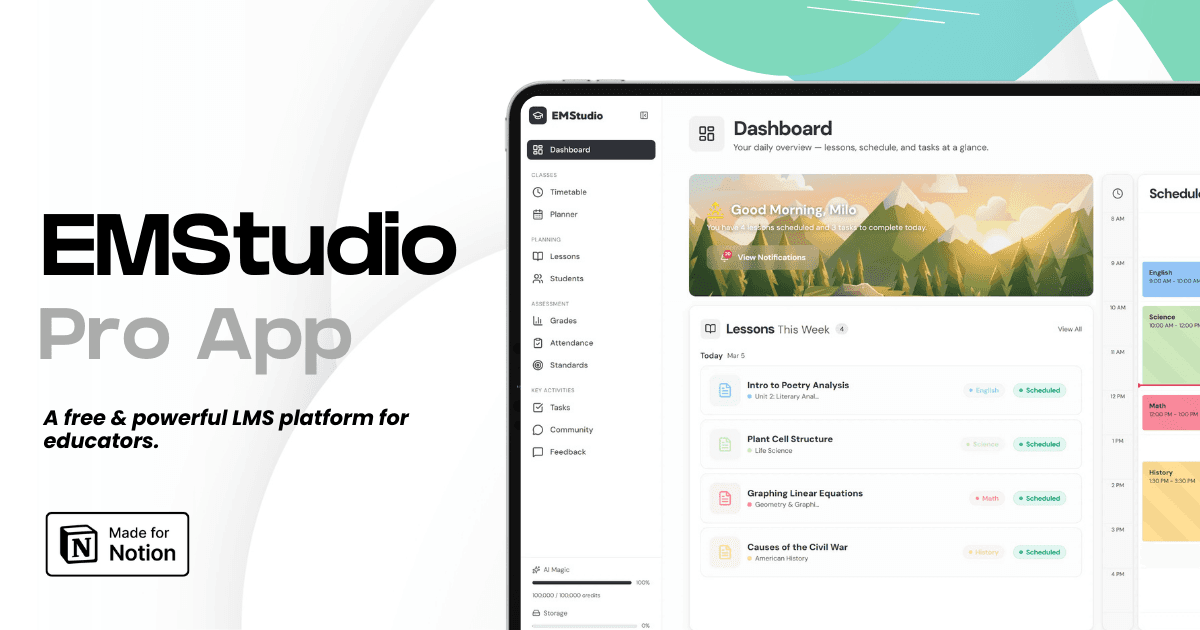
Still grading everything by hand?
EMStudio is a free teaching management app — manage your classes, students, lessons, and more!
Learn More
Still grading everything by hand?
EMStudio is a free teaching management app — manage your classes, students, lessons, and more!
Learn More



Notion4Teachers
Notion templates to simplify administrative tasks and enhance your teaching experience.



2026 Notion4Teachers. All Rights Reserved.
Notion4Teachers
Notion templates to simplify administrative tasks and enhance your teaching experience.
2026 Notion4Teachers. All Rights Reserved.
Notion4Teachers
Notion templates to simplify administrative tasks and enhance your teaching experience.
2026 Notion4Teachers. All Rights Reserved.