
Create Google Classroom: Step-by-Step Setup Guide
Create Google Classroom: Step-by-Step Setup Guide

Article by
Milo
ESL Content Coordinator & Educator
ESL Content Coordinator & Educator
All Posts
Google Classroom isn't the best learning management system out there. It's rigid and lacks a real digital gradebook configuration. You have to jump through hoops just to archive old classes or copy assignments between sections. The interface hasn't changed much since 2014, and you still can't reorder posts without awkward workarounds. But it's free, your district probably already pays for Google Workspace for Education, and students actually know how to use it without a 45-minute tutorial. So here we are.
When you create google classroom for the first time, doing it right saves you three months of headaches. I've watched teachers skip steps during virtual classroom setup and spend the whole year chasing down guardian email summaries that never sent. Others wonder why their student information system integration didn't pull rosters correctly. Some have to rebuild everything mid-year because they didn't set up their classwork structure properly from the start. This guide walks you through the exact clicks — from that first sign-in to adding your last co-teacher and organizing your first week of assignments — so you can stop wrestling with the tech and start teaching.
No ed-tech buzzwords. Just the setup process that actually works in real classrooms with real kids who will definitely click the wrong button the first time. By the end, you'll have a fully functional virtual classroom setup that won't crash during your first live lesson.
Still grading everything by hand?
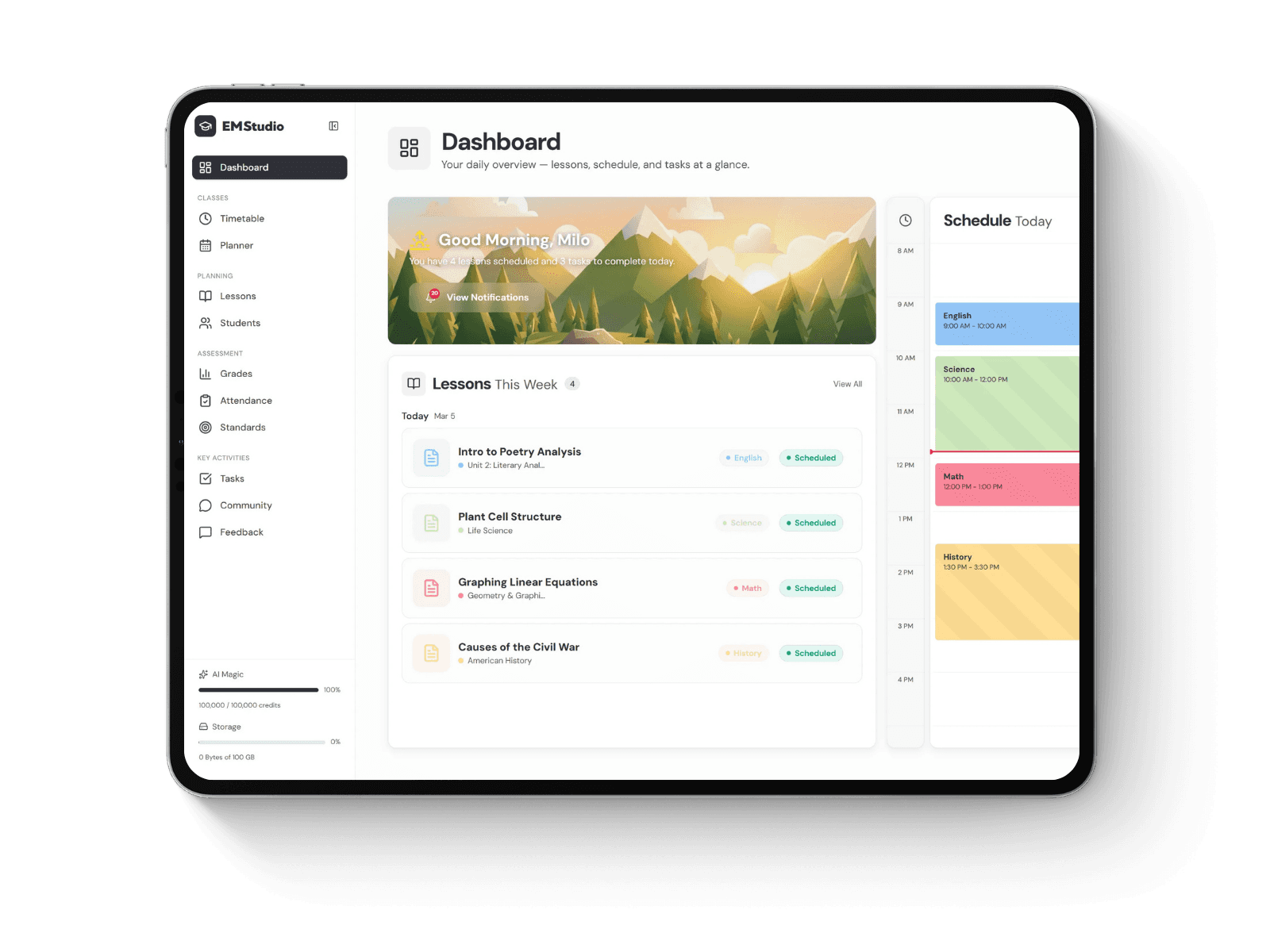
EMStudio is a free teaching management app — manage your classes, students, lessons, and more!
Learn More
Still grading everything by hand?
EMStudio is a free teaching management app — manage your classes, students, lessons, and more!
Learn More
Table of Contents
What Do You Need Before You Begin?
You need a Google Workspace for Education account through your school domain (not personal Gmail), a compatible browser such as Chrome 90+ or Safari 15+, and a completed student roster with email addresses. Verify your IT administrator has enabled Classroom in the Google Admin console and gather your class schedule details including periods and room numbers.
Google Workspace for Education Account Requirements
Personal Gmail accounts won't cut it. You need to verify three things before proceeding:
Account Domain Verification: Ensure you're using @yourschool.edu, not @gmail.com. A grayed-out "Create class" button means you're logged into the wrong account.
Organizational Unit: Your IT admin must set your role to "Teacher" in Admin Console > Apps > Google Workspace > Classroom.
Storage Tier: Fundamentals provides 100TB pooled per institution; Plus adds enhanced security for your virtual classroom setup.
Last fall, I watched a student teacher panic when that button stayed gray during her first day of solo teaching. She'd been logging into her personal account all summer preparing lessons. Switching to her district login fixed it instantly and activated her guardian email summaries.
Device and Browser Compatibility Check
Your browser needs to handle HTML5 standards without choking. Update to one of these versions before you start:
Chrome 90 or newer
Safari 15+
Microsoft Edge 100+
Firefox 95+
For the classroom app, iPhones and iPads need iOS 14.0 or later. Android devices require version 8.0 (API level 26) with at least 100MB free storage space. Keep a minimum bandwidth of 1.5 Mbps if you're streaming video content through your learning management system.
Update everything before the first day. Nothing kills momentum like compatibility errors when you're demonstrating the digital gradebook configuration to new students.
Student Roster and Class Schedule Information
Prepare your roster before touching the "Create class" button. Your CSV file needs these exact headers:
First Name
Last Name
Email Address
PowerSchool, Infinite Campus, and Skyward all export compatible formats for student information system integration. Gather period identifiers like "Period 3," room numbers, and term dates in MM/DD/YYYY format. Having this ready makes the virtual classroom setup faster than hunting through emails during your planning period.
This prep pairs with other essential digital tools for new teachers. Get the data right once, and you won't be manually typing emails while your coffee gets cold.

Step 1 — Access Google Classroom and Sign In
You can't create google classroom until you get past the front door. I learned this with 5th graders staring at me while I fumbled for the URL. Bookmark it now so you don't waste minutes during bell work.
Navigate to classroom.google.com or Open the Google Classroom App
Getting in starts with picking your device:
Desktop: Type classroom.google.com directly into your address bar.
Mobile: Download the google classroom app from the App Store or Google Play Store.
Don't Google the URL on desktop — you'll end up clicking ads. Drag that lock icon to your bookmarks bar for one-click access every morning. That bookmark saves you thirty seconds daily, which adds up during a hectic semester.
On mobile, verify the developer is Google LLC before you tap Get or Install. The download runs about 43MB, so use Wi-Fi. Android users need version 8.0 or higher for full compatibility with this learning management system.
Sign In with Your School-Issued Credentials
Type your school email exactly as provided: usually firstname.lastname@district.edu. Enter your district password — most require eight characters with complexity.
If your district uses Clever or ClassLink SSO, clicking "Sign in with Google" redirects you to that portal. Enter credentials there, complete any two-factor prompts, then accept permissions for Classroom, Drive, and Gmail. This finishes launching your virtual classroom.
Seeing "You don't have permission"? Your IT department hasn't added you to the Google Workspace for Education roster yet. Shoot them a quick email. They'll sync your account from the student information system integration, usually within a few hours. Once cleared, handle digital gradebook configuration and enable guardian email summaries as part of your virtual classroom setup.

Step 2 — Create Your Class and Configure Basic Settings
You are ready to create google classroom spaces that actually make sense. The setup takes two minutes if you know what buttons matter. Get the naming wrong now, and you will be stuck with "Science Class" in your dropdown menu all year.
Click the Plus Icon and Select Create Class
Look for the circular plus button in the top-right corner, right next to your profile picture. It is 32 pixels across, hard to miss. Click it and you will see two options:
"Join class" (for students)
"Create class" (for teachers)
Pick "Create class."
If you are using a personal Gmail account, a warning dialog pops up immediately. It says "You cannot create a class here." You need a Google Workspace for Education account through your school. Teachers with valid accounts can create up to 1,000 classes, though nobody needs that many. I have 8 running right now and that feels like plenty.
First time users must check the box confirming they have read the terms. Click "Continue" and the class creation form opens. The terms screen only shows up once per teacher account, so do not panic if you never see it again after this first time.
Name Your Class and Add Section Details
This is where effective classroom management strategies start. Use a naming convention you can stick with. Try this format:
Subject-Grade-Period-Year (e.g., "BIO-9-3-2024")
Or descriptive: "AP Bio - Period 3 - Fall 2024"
Avoid cute names like "Ms. Johnson's Super Scientists." You will regret that when you are scrolling at 6 AM looking for the right class.
The class name field allows 100 characters max. The Section field below it gets 200 characters. Use Section for details like "Period 3, Room 205" or "Blue Days, Second Block." When I taught 7th grade life science, I learned the hard way that "Period 3" alone is useless after winter break when schedules change and your student information system integration updates rosters.
Good naming saves you during parent conferences. You can pull up the right class instantly instead of guessing which "Science" entry holds your actual gradebook.
Select Subject and Grade Level from Dropdown Menus
These dropdowns do more than organize your Drive. The Subject selection determines which default assignment templates load and whether Google Meet integration appears in your toolbar. Pick "Science" and you get different options than "Mathematics." The system uses this data to suggest rubrics and topic headers that match your content area.
Grade level controls guardian email summaries. Select "9th Grade" or any K-12 option, and parents automatically get weekly progress emails. Pick "Higher Education" and that feature disappears. This also affects Google Meet permissions. K-12 classes have restricted join settings by default; college classes do not.
Your choices here lock in your digital gradebook configuration and virtual classroom setup security. Once students join, you cannot change the grade level without archiving the class. Double-check before you hit that final button.
Everything look right? Click "Create." Your learning management system shell is ready for students.
Step 3 — Invite Students and Add Co-Teachers
Once you create google classroom, you need bodies in seats. Google caps each class at 1,000 students, though anything over 35 defeats the purpose of a virtual classroom setup. I learned this the hard way with my 8th graders last fall — 42 kids made the digital gradebook configuration unusable during essay grading.
Send Direct Email Invitations to Students
Click the People tab, then Invite Students. Paste addresses separated by commas. You can add up to 100 per batch, which helps when your student information system integration exports clean contact lists.
Direct and reliable — students get a Gmail notification with a Join button.
Requires known addresses upfront. Bounces show in the Pending tab for quick fixes.
This method beats reading codes aloud during passing periods.
Display and Share the Unique Class Code
Head to the Stream tab. Google generates a 7-character code like hx4k9m2. Project it on your board. Students navigate to classroom.google.com, click Join class, and enter the string.
Fast for large groups. Everyone joins simultaneously while you watch the roster populate.
Reset instantly via the drop-down if compromised. The old code dies immediately, cutting off hallway sharers.
This approach skips the learning management system email delays entirely.
Add Co-Teachers and Set Permission Levels
Go to People > Invite Teachers. Enter your colleague's school email. You can add up to 20 co-teachers per class.
Primary teacher retains deletion rights and class ownership.
Co-teachers grade submissions, post announcements, and view guardian email summaries. They cannot delete the class or remove you.
This hierarchy protects your Google Workspace for Education data from accidental wipes. For strategies on splitting duties, check out these collaborative co-teaching techniques. Clear roles prevent confusion when two teachers manage the same assignment.

Step 4 — Set Up Classwork and Materials
Once you create google classroom and students join through your student information system integration, you'll need a virtual classroom setup that won't collapse by October. The right digital gradebook configuration and clear organization determine whether parents see accurate guardian email summaries or chaos.
Create Topics to Organize Assignments and Resources
Click the Classwork tab, then Create > Topic. Name these by unit ("Unit 2: Ecosystems") or by week ("Week of Sept 8"). I learned this the hard way with 8th graders last fall—without topics, assignment 47 gets buried fast.
Drag assignments using the six-dot handle to reorder under headers.
Stop at 30 topics max. More creates scroll fatigue.
Upload Syllabus and Welcome Materials
Create > Material > Upload. Drop PDFs, DOCX, PPTX, or Google Workspace for Education formats from Drive. Each file caps at 5TB, which counts against your school's 100TB pooled storage.
Set syllabi to "Students can view" to lock your contact info.
Set templates to "Make a copy" for individual student work.
Post the First Announcement to Test the Stream
Head to the Stream tab in your learning management system and click "Share something with your class." Type a welcome message under 1,000 characters. Attach your Course Resources folder so students have immediate access to everything.
Before students arrive, go to Settings > Stream and select "Only teachers can post." This stops the chat spam. When you're integrating EdTech into your lesson plans, always test notifications by having a colleague join as a student using the Google Classroom app on their phone.

Step 5 — How Do You Configure Grading and Assignment Settings?
Navigate to Class Settings > Grading to select Total Points or Weighted by Category calculation. Set category weights such as Homework 30% and Assessments 70%, configure late work penalties (typically 10% per day), and choose whether to display overall grades to students. For standards-based grading, alternatives like activelylearn com offer mastery tracking without percentage weights.
You face three choices for the calculation method:
No overall grade hides totals for formative-only classrooms where feedback beats averages.
Total points sums earned divided by possible, best for elementary with fewer than 50 assignments.
Weighted by category multiplies averages by your weights, ideal for AP or IB courses.
Set Up Grade Categories and Weight Percentages
Head to Settings > Grading > Grade categories to build your framework. Click Add Grade Category and name your first bucket. I taught 7th grade ELA and ran Classwork at 20%, Quizzes at 30%, and Essays at 50% because writing showed actual mastery. The progress bar glows green when you hit 100%, so you know the math works. Assign these defaults to specific assignment types so every new task lands in the right bucket automatically when you create google classroom assignments. This prevents manual sorting every Monday morning.
Choose Overall Grade Calculation Method
Your digital gradebook setup depends on picking the right math. Choose No overall grade if you want formative feedback without averages terrifying kids. Select Total points for elementary classes with fewer than 50 assignments—it is simple division of earned over possible. Pick Weighted by category for AP or IB courses where exams should crush daily homework in the final average. This digital gradebook configuration talks directly to your student information system integration, so pick wisely before the first import locks you into a method that does not match your syllabus.
Configure Late Work Policies and Submission Rules
Toggle Accept late work ON, then set your penalty sting. Use 10% per day with a 50% max so kids still turn things in during week two for partial credit. Set Mark as missing after 7 days to trigger guardian email summaries automatically. Remember the difference: due dates expect work, close dates lock the submission form entirely. Unlike activelylearn com which ignores lateness for pure mastery tracking, this Google Workspace for Education learning management system docks points automatically based on your virtual classroom setup rules.

What Are the Most Common Setup Mistakes to Avoid?
Never use personal Gmail accounts—create classes only through your school's Google Workspace for Education domain to ensure student information system integration and directory access. Archive completed classes to preserve digital gradebook configuration records for transcript requests. Enable guardian email summaries during the first week to automate parent communication, unlike attendance moodle which requires separate module configuration for family access.
Here is what breaks when you rush the virtual classroom setup:
Personal Gmail usage: Students cannot find your class via the school directory, and your mistakes to avoid when managing digital records multiply when data lives outside district control.
Deleting instead of archiving: Permanent grade loss hits after 30 days in Trash, destroying evidence of student growth.
Delaying guardian setup: You inherit the manual burden of weekly parent updates instead of automated daily digests.
Verify your account type before you create google classroom sections. If your email ends with @gmail.com, contact IT for a Workspace migration. Classes born in personal accounts never integrate with the district SIS or guardian email systems. Worse, student data remains trapped under your personal ownership after you leave the district.
Archiving in this learning management system differs from other platforms. When you archive a Google Classroom, it vanishes from your active dashboard but preserves the entire Drive folder structure indefinitely. Contrast this with attendance moodle systems that bake attendance logs into permanent gradebook exports. Google Classroom lacks native attendance tracking; you will need Forms or third-party apps for that data.
Using Personal Gmail Instead of School Domain Account
Check your email address format. If it ends with @gmail.com instead of @schooldistrict.edu, you are in the wrong account. Personal Gmail often shows the "Create class" button grayed out or throws a "You need permission" error when you attempt to build your first section.
Request a Google Workspace for Education license from your IT admin immediately. Data ownership differs drastically between account types. Personal accounts retain student data indefinitely after teacher departure; Workspace accounts transfer cleanly to admin control. Last year, I watched a 7th grade colleague lose an entire semester of writing portfolios because she built her virtual classroom setup on a personal account before district onboarding. The district could not recover the files.
Forgetting to Archive or Delete Old Class Sections
Establish an end-of-semester protocol now. Click the three-dot menu next to the class tile and select Archive. This retains all assignment data and student submissions while removing the visual clutter from your active dashboard. The digital gradebook configuration stays intact.
Never click Delete. That moves the class to Trash with a 30-day ticking clock before permanent erasure. I archive every June to prevent incoming students from joining old sections through outdated invite codes. Archives remain accessible for transcript verification or grade disputes years later, unlike attendance moodle exports that require manual backup procedures.
Neglecting Guardian Email Notifications Setup
Enable this before students join. Navigate to Settings, then Guardian Email Summaries, and toggle it on. Input guardian emails through the Students tab by clicking Invite Guardians. Do this during the first week of school.
Select frequency carefully—Daily overwhelms parents of disorganized kids; Weekly hides urgent issues. I recommend Daily for middle school, Weekly for high school. Delayed setup forces manual outreach via strategies for effective parent communication that eat your Sunday evenings. Automated guardian email summaries reduce information asymmetry and cut your email load by half while keeping families informed of missing work instantly.

What Do You Need Before You Begin?
You need a Google Workspace for Education account through your school domain (not personal Gmail), a compatible browser such as Chrome 90+ or Safari 15+, and a completed student roster with email addresses. Verify your IT administrator has enabled Classroom in the Google Admin console and gather your class schedule details including periods and room numbers.
Google Workspace for Education Account Requirements
Personal Gmail accounts won't cut it. You need to verify three things before proceeding:
Account Domain Verification: Ensure you're using @yourschool.edu, not @gmail.com. A grayed-out "Create class" button means you're logged into the wrong account.
Organizational Unit: Your IT admin must set your role to "Teacher" in Admin Console > Apps > Google Workspace > Classroom.
Storage Tier: Fundamentals provides 100TB pooled per institution; Plus adds enhanced security for your virtual classroom setup.
Last fall, I watched a student teacher panic when that button stayed gray during her first day of solo teaching. She'd been logging into her personal account all summer preparing lessons. Switching to her district login fixed it instantly and activated her guardian email summaries.
Device and Browser Compatibility Check
Your browser needs to handle HTML5 standards without choking. Update to one of these versions before you start:
Chrome 90 or newer
Safari 15+
Microsoft Edge 100+
Firefox 95+
For the classroom app, iPhones and iPads need iOS 14.0 or later. Android devices require version 8.0 (API level 26) with at least 100MB free storage space. Keep a minimum bandwidth of 1.5 Mbps if you're streaming video content through your learning management system.
Update everything before the first day. Nothing kills momentum like compatibility errors when you're demonstrating the digital gradebook configuration to new students.
Student Roster and Class Schedule Information
Prepare your roster before touching the "Create class" button. Your CSV file needs these exact headers:
First Name
Last Name
Email Address
PowerSchool, Infinite Campus, and Skyward all export compatible formats for student information system integration. Gather period identifiers like "Period 3," room numbers, and term dates in MM/DD/YYYY format. Having this ready makes the virtual classroom setup faster than hunting through emails during your planning period.
This prep pairs with other essential digital tools for new teachers. Get the data right once, and you won't be manually typing emails while your coffee gets cold.
Step 1 — Access Google Classroom and Sign In
You can't create google classroom until you get past the front door. I learned this with 5th graders staring at me while I fumbled for the URL. Bookmark it now so you don't waste minutes during bell work.
Navigate to classroom.google.com or Open the Google Classroom App
Getting in starts with picking your device:
Desktop: Type classroom.google.com directly into your address bar.
Mobile: Download the google classroom app from the App Store or Google Play Store.
Don't Google the URL on desktop — you'll end up clicking ads. Drag that lock icon to your bookmarks bar for one-click access every morning. That bookmark saves you thirty seconds daily, which adds up during a hectic semester.
On mobile, verify the developer is Google LLC before you tap Get or Install. The download runs about 43MB, so use Wi-Fi. Android users need version 8.0 or higher for full compatibility with this learning management system.
Sign In with Your School-Issued Credentials
Type your school email exactly as provided: usually firstname.lastname@district.edu. Enter your district password — most require eight characters with complexity.
If your district uses Clever or ClassLink SSO, clicking "Sign in with Google" redirects you to that portal. Enter credentials there, complete any two-factor prompts, then accept permissions for Classroom, Drive, and Gmail. This finishes launching your virtual classroom.
Seeing "You don't have permission"? Your IT department hasn't added you to the Google Workspace for Education roster yet. Shoot them a quick email. They'll sync your account from the student information system integration, usually within a few hours. Once cleared, handle digital gradebook configuration and enable guardian email summaries as part of your virtual classroom setup.
Step 2 — Create Your Class and Configure Basic Settings
You are ready to create google classroom spaces that actually make sense. The setup takes two minutes if you know what buttons matter. Get the naming wrong now, and you will be stuck with "Science Class" in your dropdown menu all year.
Click the Plus Icon and Select Create Class
Look for the circular plus button in the top-right corner, right next to your profile picture. It is 32 pixels across, hard to miss. Click it and you will see two options:
"Join class" (for students)
"Create class" (for teachers)
Pick "Create class."
If you are using a personal Gmail account, a warning dialog pops up immediately. It says "You cannot create a class here." You need a Google Workspace for Education account through your school. Teachers with valid accounts can create up to 1,000 classes, though nobody needs that many. I have 8 running right now and that feels like plenty.
First time users must check the box confirming they have read the terms. Click "Continue" and the class creation form opens. The terms screen only shows up once per teacher account, so do not panic if you never see it again after this first time.
Name Your Class and Add Section Details
This is where effective classroom management strategies start. Use a naming convention you can stick with. Try this format:
Subject-Grade-Period-Year (e.g., "BIO-9-3-2024")
Or descriptive: "AP Bio - Period 3 - Fall 2024"
Avoid cute names like "Ms. Johnson's Super Scientists." You will regret that when you are scrolling at 6 AM looking for the right class.
The class name field allows 100 characters max. The Section field below it gets 200 characters. Use Section for details like "Period 3, Room 205" or "Blue Days, Second Block." When I taught 7th grade life science, I learned the hard way that "Period 3" alone is useless after winter break when schedules change and your student information system integration updates rosters.
Good naming saves you during parent conferences. You can pull up the right class instantly instead of guessing which "Science" entry holds your actual gradebook.
Select Subject and Grade Level from Dropdown Menus
These dropdowns do more than organize your Drive. The Subject selection determines which default assignment templates load and whether Google Meet integration appears in your toolbar. Pick "Science" and you get different options than "Mathematics." The system uses this data to suggest rubrics and topic headers that match your content area.
Grade level controls guardian email summaries. Select "9th Grade" or any K-12 option, and parents automatically get weekly progress emails. Pick "Higher Education" and that feature disappears. This also affects Google Meet permissions. K-12 classes have restricted join settings by default; college classes do not.
Your choices here lock in your digital gradebook configuration and virtual classroom setup security. Once students join, you cannot change the grade level without archiving the class. Double-check before you hit that final button.
Everything look right? Click "Create." Your learning management system shell is ready for students.
Step 3 — Invite Students and Add Co-Teachers
Once you create google classroom, you need bodies in seats. Google caps each class at 1,000 students, though anything over 35 defeats the purpose of a virtual classroom setup. I learned this the hard way with my 8th graders last fall — 42 kids made the digital gradebook configuration unusable during essay grading.
Send Direct Email Invitations to Students
Click the People tab, then Invite Students. Paste addresses separated by commas. You can add up to 100 per batch, which helps when your student information system integration exports clean contact lists.
Direct and reliable — students get a Gmail notification with a Join button.
Requires known addresses upfront. Bounces show in the Pending tab for quick fixes.
This method beats reading codes aloud during passing periods.
Display and Share the Unique Class Code
Head to the Stream tab. Google generates a 7-character code like hx4k9m2. Project it on your board. Students navigate to classroom.google.com, click Join class, and enter the string.
Fast for large groups. Everyone joins simultaneously while you watch the roster populate.
Reset instantly via the drop-down if compromised. The old code dies immediately, cutting off hallway sharers.
This approach skips the learning management system email delays entirely.
Add Co-Teachers and Set Permission Levels
Go to People > Invite Teachers. Enter your colleague's school email. You can add up to 20 co-teachers per class.
Primary teacher retains deletion rights and class ownership.
Co-teachers grade submissions, post announcements, and view guardian email summaries. They cannot delete the class or remove you.
This hierarchy protects your Google Workspace for Education data from accidental wipes. For strategies on splitting duties, check out these collaborative co-teaching techniques. Clear roles prevent confusion when two teachers manage the same assignment.
Step 4 — Set Up Classwork and Materials
Once you create google classroom and students join through your student information system integration, you'll need a virtual classroom setup that won't collapse by October. The right digital gradebook configuration and clear organization determine whether parents see accurate guardian email summaries or chaos.
Create Topics to Organize Assignments and Resources
Click the Classwork tab, then Create > Topic. Name these by unit ("Unit 2: Ecosystems") or by week ("Week of Sept 8"). I learned this the hard way with 8th graders last fall—without topics, assignment 47 gets buried fast.
Drag assignments using the six-dot handle to reorder under headers.
Stop at 30 topics max. More creates scroll fatigue.
Upload Syllabus and Welcome Materials
Create > Material > Upload. Drop PDFs, DOCX, PPTX, or Google Workspace for Education formats from Drive. Each file caps at 5TB, which counts against your school's 100TB pooled storage.
Set syllabi to "Students can view" to lock your contact info.
Set templates to "Make a copy" for individual student work.
Post the First Announcement to Test the Stream
Head to the Stream tab in your learning management system and click "Share something with your class." Type a welcome message under 1,000 characters. Attach your Course Resources folder so students have immediate access to everything.
Before students arrive, go to Settings > Stream and select "Only teachers can post." This stops the chat spam. When you're integrating EdTech into your lesson plans, always test notifications by having a colleague join as a student using the Google Classroom app on their phone.
Step 5 — How Do You Configure Grading and Assignment Settings?
Navigate to Class Settings > Grading to select Total Points or Weighted by Category calculation. Set category weights such as Homework 30% and Assessments 70%, configure late work penalties (typically 10% per day), and choose whether to display overall grades to students. For standards-based grading, alternatives like activelylearn com offer mastery tracking without percentage weights.
You face three choices for the calculation method:
No overall grade hides totals for formative-only classrooms where feedback beats averages.
Total points sums earned divided by possible, best for elementary with fewer than 50 assignments.
Weighted by category multiplies averages by your weights, ideal for AP or IB courses.
Set Up Grade Categories and Weight Percentages
Head to Settings > Grading > Grade categories to build your framework. Click Add Grade Category and name your first bucket. I taught 7th grade ELA and ran Classwork at 20%, Quizzes at 30%, and Essays at 50% because writing showed actual mastery. The progress bar glows green when you hit 100%, so you know the math works. Assign these defaults to specific assignment types so every new task lands in the right bucket automatically when you create google classroom assignments. This prevents manual sorting every Monday morning.
Choose Overall Grade Calculation Method
Your digital gradebook setup depends on picking the right math. Choose No overall grade if you want formative feedback without averages terrifying kids. Select Total points for elementary classes with fewer than 50 assignments—it is simple division of earned over possible. Pick Weighted by category for AP or IB courses where exams should crush daily homework in the final average. This digital gradebook configuration talks directly to your student information system integration, so pick wisely before the first import locks you into a method that does not match your syllabus.
Configure Late Work Policies and Submission Rules
Toggle Accept late work ON, then set your penalty sting. Use 10% per day with a 50% max so kids still turn things in during week two for partial credit. Set Mark as missing after 7 days to trigger guardian email summaries automatically. Remember the difference: due dates expect work, close dates lock the submission form entirely. Unlike activelylearn com which ignores lateness for pure mastery tracking, this Google Workspace for Education learning management system docks points automatically based on your virtual classroom setup rules.
What Are the Most Common Setup Mistakes to Avoid?
Never use personal Gmail accounts—create classes only through your school's Google Workspace for Education domain to ensure student information system integration and directory access. Archive completed classes to preserve digital gradebook configuration records for transcript requests. Enable guardian email summaries during the first week to automate parent communication, unlike attendance moodle which requires separate module configuration for family access.
Here is what breaks when you rush the virtual classroom setup:
Personal Gmail usage: Students cannot find your class via the school directory, and your mistakes to avoid when managing digital records multiply when data lives outside district control.
Deleting instead of archiving: Permanent grade loss hits after 30 days in Trash, destroying evidence of student growth.
Delaying guardian setup: You inherit the manual burden of weekly parent updates instead of automated daily digests.
Verify your account type before you create google classroom sections. If your email ends with @gmail.com, contact IT for a Workspace migration. Classes born in personal accounts never integrate with the district SIS or guardian email systems. Worse, student data remains trapped under your personal ownership after you leave the district.
Archiving in this learning management system differs from other platforms. When you archive a Google Classroom, it vanishes from your active dashboard but preserves the entire Drive folder structure indefinitely. Contrast this with attendance moodle systems that bake attendance logs into permanent gradebook exports. Google Classroom lacks native attendance tracking; you will need Forms or third-party apps for that data.
Using Personal Gmail Instead of School Domain Account
Check your email address format. If it ends with @gmail.com instead of @schooldistrict.edu, you are in the wrong account. Personal Gmail often shows the "Create class" button grayed out or throws a "You need permission" error when you attempt to build your first section.
Request a Google Workspace for Education license from your IT admin immediately. Data ownership differs drastically between account types. Personal accounts retain student data indefinitely after teacher departure; Workspace accounts transfer cleanly to admin control. Last year, I watched a 7th grade colleague lose an entire semester of writing portfolios because she built her virtual classroom setup on a personal account before district onboarding. The district could not recover the files.
Forgetting to Archive or Delete Old Class Sections
Establish an end-of-semester protocol now. Click the three-dot menu next to the class tile and select Archive. This retains all assignment data and student submissions while removing the visual clutter from your active dashboard. The digital gradebook configuration stays intact.
Never click Delete. That moves the class to Trash with a 30-day ticking clock before permanent erasure. I archive every June to prevent incoming students from joining old sections through outdated invite codes. Archives remain accessible for transcript verification or grade disputes years later, unlike attendance moodle exports that require manual backup procedures.
Neglecting Guardian Email Notifications Setup
Enable this before students join. Navigate to Settings, then Guardian Email Summaries, and toggle it on. Input guardian emails through the Students tab by clicking Invite Guardians. Do this during the first week of school.
Select frequency carefully—Daily overwhelms parents of disorganized kids; Weekly hides urgent issues. I recommend Daily for middle school, Weekly for high school. Delayed setup forces manual outreach via strategies for effective parent communication that eat your Sunday evenings. Automated guardian email summaries reduce information asymmetry and cut your email load by half while keeping families informed of missing work instantly.
Still grading everything by hand?
EMStudio is a free teaching management app — manage your classes, students, lessons, and more!
Learn More
Still grading everything by hand?
EMStudio is a free teaching management app — manage your classes, students, lessons, and more!
Learn More




Notion4Teachers
Notion templates to simplify administrative tasks and enhance your teaching experience.



2026 Notion4Teachers. All Rights Reserved.
Notion4Teachers
Notion templates to simplify administrative tasks and enhance your teaching experience.
2026 Notion4Teachers. All Rights Reserved.
Notion4Teachers
Notion templates to simplify administrative tasks and enhance your teaching experience.
2026 Notion4Teachers. All Rights Reserved.