12 Science Lessons for Elementary Classrooms
12 Science Lessons for Elementary Classrooms

Article by
Milo
ESL Content Coordinator & Educator
ESL Content Coordinator & Educator
All Posts
You clicked on this because your district just handed you a new scope and sequence, and your current science lessons feel like a mismatched collection of Pinterest activities and last-minute worksheets. You have milk cartons in your supply closet that were supposed to become something scientific three months ago, and a textbook that mentions inquiry-based learning but offers step-by-step worksheets where every student gets the same answer. You need classroom investigations that actually fit into 45-minute blocks, use supplies you can find at a grocery store, and meet your standards without requiring a graduate degree in physics to teach.
This post gives you twelve lessons that work. I have broken them into physical science, life science, and earth and space units—each one field-tested in real elementary classrooms with real spills and epiphanies. These are hands-on experiments where students ask the questions, not just follow the steps. You will find the scientific method embedded naturally, not as a separate worksheet kids fill out after the fun ends. Each lesson includes NGSS alignment notes so you can defend your choices during the next curriculum audit without digging through standards documents at midnight.
Over the next sections, I will walk you through selecting lessons that match your specific grade-level standards and building a STEM curriculum that sustains itself past the first excited week. You will get a four-week implementation roadmap that accounts for setup time, cleanup reality, and the kid who inevitably tries to drink the baking soda solution. These are not demonstration lessons where you perform and they watch. These are investigations where your third graders argue about evidence, your fifth graders redesign failed prototypes, and you finally use that cabinet of random supplies for something other than storage.
Still grading everything by hand?
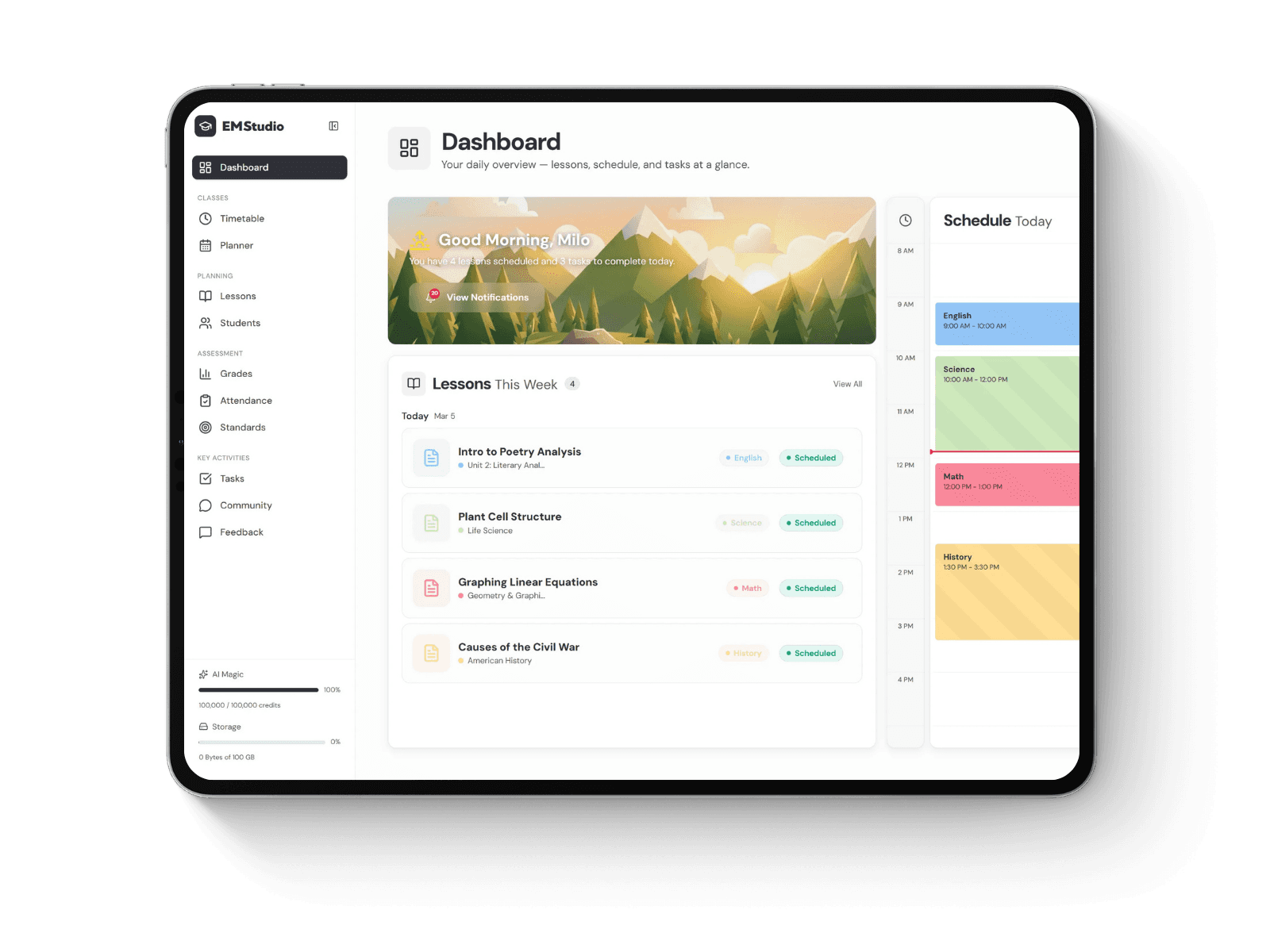
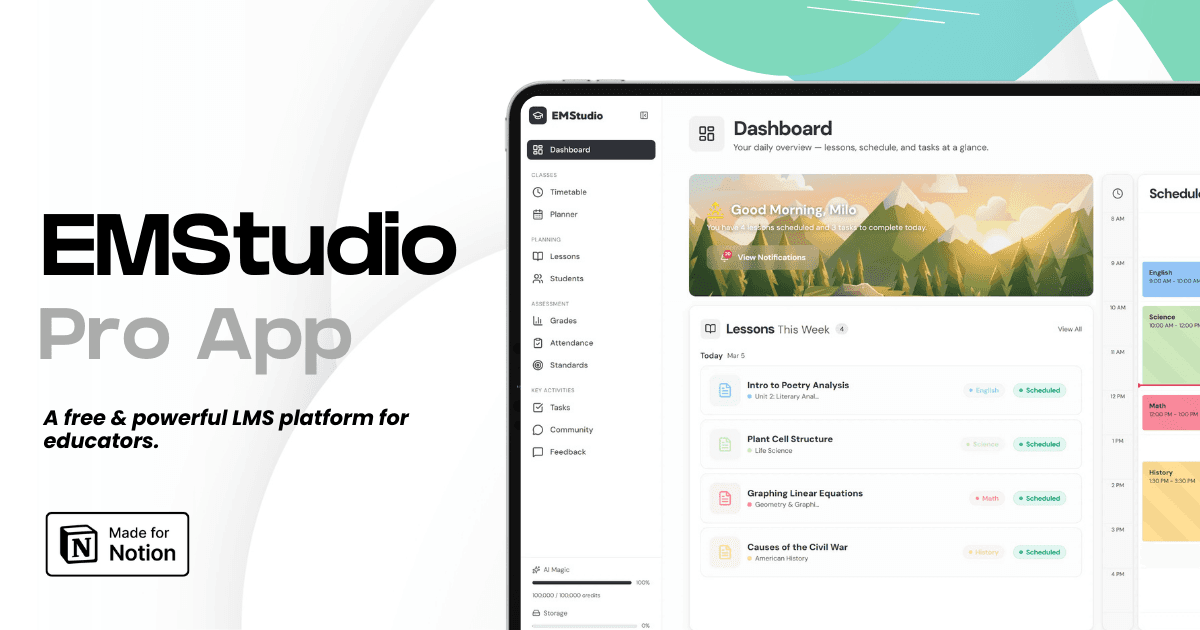
EMStudio is a free teaching management app — manage your classes, students, lessons, and more!
Learn More
Still grading everything by hand?
EMStudio is a free teaching management app — manage your classes, students, lessons, and more!
Learn More
Table of Contents
What Are the Best Physical Science Lessons for Elementary?
The best physical science lessons for elementary combine hands-on materials with clear concepts. States of matter experiments using cornstarch and water (Oobleck), simple machines built with LEGO pulleys, balloon rocket force investigations, and pizza-box solar oven energy transfers provide concrete experiences. These work across grades K-5 with materials costing $0-$10 per activity.
Physical science concepts like energy transfer remain abstract until students manipulate concrete materials. I've learned that effective science lessons bridge this gap using household items costing under $15 per class.
Cost tiers break down by material type. Recyclables like pizza boxes cost $0-5 per student. Consumables such as Arm & Hammer baking soda run $5-15. Durable tools jump to $15+. Stay in that middle tier.
Avoid activity for activity's sake. Every investigation must target a specific disciplinary core idea—whether PS1.A Structure and Properties of Matter or PS3.B Conservation of Energy—to ensure inquiry-based learning builds lasting understanding.
States of Matter Investigations: Grades K-3. Oobleck (2 cups cornstarch + 1 cup water) and baking soda reactions (16oz bottle, 1/2 cup vinegar, balloon). 30-45 minutes. Science practice: modeling PS1.A.
Simple Machines Challenges: Grades 2-4. Ramp races with Matchbox cars on varied surfaces, plus lever construction with rulers. 45 minutes. Science practice: data collection for PS3.C.
Force and Motion Probes: Grades K-5. Balloon rockets (string, straw, 5 pumps) and magnetic mazes (paper plate, wand). 20-40 minutes. Science practice: PS2.B investigation.
Energy Transfer Builds: Grades 2-5. Pizza-box solar ovens and butter-melting conduction tests. 60 minutes. Science practice: argumentation about PS3.A.
States of Matter Experiments
Mix Arm & Hammer baking soda with vinegar to witness gas production. Slide two tablespoons into a balloon stretched over a 16oz bottle containing half a cup vinegar. Lift the balloon and watch it expand, connecting directly to PS1.A Structure and Properties of Matter for grades 3-5.
Younger students explore non-Newtonian fluids by combining two cups cornstarch with one cup water to create Oobleck. This defies the solid/liquid binary for grades 1-3. For K-1, run an ice-melting race placing identical cubes on wood, metal, and plastic, checking every fifteen minutes.
Simple Machines Challenges
Skip expensive kits. Build an inclined plane using a wooden board on books, measuring angles with a protractor. Create a lever with a ruler, pencil fulcrum, and pennies. Construct a pulley using paper clips and string to lift a rice bag, targeting data collection for grades 2-4.
Run the Ramp Race using Matchbox cars on surfaces covered with sandpaper, wax paper, and aluminum foil. Students predict outcomes, conduct three trials, and measure distances. This 45-minute investigation connects to PS3.C Relationship Between Energy and Forces.
Force and Motion Investigations
Thread string through a drinking straw and tape an inflated balloon to demonstrate propulsion. Mark one-meter intervals with masking tape across the floor. When released, the balloon rockets along the string, illustrating action-reaction pairs for grades 3-5. Add variables like balloon size to deepen hands-on learning activities.
For K-2, create a Magnetic Maze using a paper plate, magnet wand held beneath, and a paperclip "mouse" on top. Students navigate through obstacles in twenty minutes, exploring PS2.B Types of Interactions.
Energy Transfer Activities
Construct solar ovens from pizza boxes, aluminum foil, plastic wrap, and black construction paper. On sunny days above 85°F, these cook s'mores in one hour while demonstrating radiation for grades 3-5. This exemplifies essential STEM teacher resources built from recyclables.
Demonstrate thermal conductivity by placing butter on handles of plastic, wood, and metal spoons submerged in 180°F water. Time the melting to compare conduction rates. You handle the hot water while grades 2-4 observe, connecting to PS3.A Definitions of Energy through argumentation.

Which Life Science Lessons Work Best for Young Learners?
Effective life science lessons for young learners emphasize observation and modeling. Fast plant growth cycles (Brassica rapa, 14 days), bird beak adaptation simulations using household tools (tweezers vs. spoons), 2-liter bottle ecosystems, and heart rate investigations using real stethoscopes connect abstract concepts to concrete experiences. These accommodate varying reading levels through visual data collection.
Match the observation duration to their attention spans. One-day classroom investigations suit animal behaviors and immediate physical responses. Multi-week studies support growth patterns and ecosystem changes.
The strongest elementary science lessons target four living scales: individual organisms, populations, ecosystems, and human body systems. These science lesson plans employ the scientific method through direct measurement, not worksheets.
If you have 14 days and grow lights → use Fast Plants.
If you have 3 days and window sills → use lima bean germination bags.
If you have 45 minutes → run the bird beak simulation.
Commercial owl pellets cost $3 each, but a schoolyard invertebrate hunt costs $0 and teaches equivalent predator-prey concepts. This cost transparency helps you budget hands-on experiments across your STEM curriculum.
Plant Growth and Observation Labs
Wisconsin Fast Plants (Brassica rapa) complete their cycle in 14 days from seed to flower under 24-hour fluorescent grow lights positioned 2-3 inches above the soil. Compare this to the Lima Bean Window Bag method: ziplock bags with wet paper towels taped to windows, sprouting in 3-5 days. Kindergarten and first grade classes should use the bag method; grades 2-5 handle Fast Plants with daily measurement charts tracking height to the nearest centimeter.
Use the Plant Journal format: date, measurement, drawing with three labeled parts (roots, stem, leaves), and a prediction column. First graders draw their observations, third graders write one sentence, and fifth graders record hypothesis-driven observations using an inquiry-based learning approach.
Animal Adaptations Studies
Run the Battle of the Beaks simulation: students use tweezers, clothespins, toothpicks, and spoons to pick up raisins, rice, and marbles representing different food types. Time 30-second trials, record data on tally charts, and connect results to Darwin's finch beak variations. This works for grades 3-5 in a 45-minute block.
For younger students, play the camouflage hunting game. Hide colored pom-poms in grass or playground wood chips. Students act as predators with 30 seconds to collect prey. Compare survival rates of different colors to teach habitat matching and survival.
Ecosystems and Food Web Simulations
Build 2-liter bottle terrariums by cutting the top third off, adding gravel drainage, charcoal, soil, and small plants like moss from the schoolyard. Seal for two weeks to observe the water cycle. Cost stays at $0 when using recycled materials and experiential education strategies.
Dissect Carolina Biological Supply owl pellets at $2.95 each, or use the free alternative: create paper food webs using yarn connections between species cards (producer, consumer, decomposer) arranged in a circle. Both options work for grades 2-5.
Human Body Systems Explorations
Conduct heart rate investigations using real stethoscopes. Students measure resting pulse after sitting for two minutes, then measure again after two minutes of jumping jacks. Record results in bar graphs comparing before and after states. This emphasizes systems thinking for grades 1-5 and builds NGSS alignment through data collection.
Demonstrate digestion by placing a cracker in a ziplock bag representing the stomach, adding water for saliva, and mashing to simulate peristalsis. Observe breakdown over 20 minutes. Restrict this to grades K-2 with an explicit "do not eat" safety protocol.
Earth and Space Science Lessons That Build Critical Thinking
Earth and space science trips teachers up more than biology or chemistry. We jump to solar system models before kids notice their own shadows. Effective elementary science lessons must begin with the sidewalk outside your building. Students need to track local weather patterns before they understand global climate systems.
The 5E model prevents these abstract failures through inquiry-based learning. Each framework below anchors to local phenomena first. Then it bridges to universal scales. This approach develops higher order thinking skills and strategies for teaching critical thinking without losing your 2nd graders in outer space.
When NOT to Use These Lessons
Avoid solar system scale models with K-1 students. Proportional reasoning develops around age 8.
Skip 30-day weather tracking unless you guarantee five minutes daily at 9:00 AM. Missing days ruins the data set.
Never teach rock identification without local samples. Generic photos fail to connect geology to your school's neighborhood.
Weather Pattern Tracking Projects
Begin with the 30-day weather journal for grades 2-5. Students record temperature from an outdoor thermometer, note precipitation yes/no, and classify cloud cover as cirrus, cumulus, or stratus. Do this at exactly 9:00 AM daily. This routine anchors the scientific method to your playground.
Explore local patterns by comparing your 30-day data against NOAA's JetStream historical records. This bridges to abstract climate systems. Students see that your October temperatures deviate from ten-year averages. Then elaborate using hands-on experiments like DIY barometers. Stretch a balloon over a glass jar, glue a straw to the center, and tape a marked index card behind. Calibrate for three days. Predict weather changes based on air pressure shifts. Evaluate predictions against actual conditions. This connects to ESS2.D standards.
Rock Cycle and Geology Labs
Engage students with a schoolyard geology hunt for grades K-5. Find three local rock types, test hardness using penny and nail scratch tests, and record results in field notebooks. Sketch the rock locations near your building. This costs nothing compared to $40 rock kits.
Explore and explain the rock cycle using the Starburst candy simulation. Cut candies into pieces to represent weathering. Press them between books for sedimentary formation. Wrap them in foil and warm with hands for metamorphic pressure. You handle the microwave for ten seconds to demonstrate igneous melting. Students draw each stage in a circular diagram. Evaluate by asking which schoolyard rocks show weathering patterns matching their models. This bridges to abstract geological processes.
Solar System Scale Models
Use the toilet paper solar system for grades 3-5 only. One sheet equals one Astronomical Unit. Place the Sun at the start. Mercury sits at 0.4 sheets, Earth at 1 sheet, Jupiter at 5.2 sheets, and Neptune at 30 sheets. You need thirty feet of hallway or playground space. K-2 students lack the proportional reasoning for this concrete model.
For planet sizes, try the Fruit Scale during the elaborate phase. Mercury becomes a peppercorn, Earth a cherry tomato, Jupiter a watermelon, and the Sun a yoga ball. Critical warning: Never run this simultaneously with the distance scale. Students conflate size and distance, creating new misconceptions. Evaluate understanding by asking students to model why the solar system is mostly empty space.
Water Cycle Demonstrations
The Bag on the Window demo engages grades K-2 with local observation. Seal water in a clear bag taped to a sunny window. Over three days, students observe evaporation, condensation, and precipitation. Label the three stages directly on the bag using dry-erase markers. This makes the invisible visible.
Elaborate for grades 2-5 using the groundwater pollution demo. Fill a clear cup with gravel. Pour clean water to represent groundwater. Add three drops of red food coloring as a pollutant at the top. Watch contamination spread through the gravel. Explain how this connects to your local watershed issues. Ask students to identify potential pollution sources near your school. This brings NGSS alignment to ESS3.C standards while bridging to abstract environmental systems.
Phenomenon First Checklist
Does the lesson begin with something students observe in their neighborhood?
Does it require measurement over time?
Does it connect to human impact?
These classroom investigations build STEM curriculum that sticks. Begin with the sidewalk. End with the stars.

How to Choose the Right Science Lessons for Your Standards?
Choose science lessons by first matching activities to specific NGSS performance expectations or state standards using the three-dimensional learning framework. Then evaluate material costs (aim for under $15 per class), time requirements (prep vs. instructional time), and built-in differentiation options. Prioritize lessons that include assessment rubrics and cross-curricular connections to maximize instructional efficiency.
Stop collecting Pinterest activities that look fun but lead nowhere. NGSS three-dimensional learning requires lessons that integrate at least two dimensions: disciplinary core ideas, crosscutting concepts, and science and engineering practices. If a lesson only has kids following steps to get a cool result, you have a craft project, not standards-aligned instruction.
Standard Code | Lesson Activity | Dimension 1 Alignment | Dimension 2 Alignment | Assessment Evidence |
|---|---|---|---|---|
5-PS1-3 | Mixing baking soda and vinegar | Science Practices: Planning investigations | Core Idea: PS1.A Structure and properties of matter | Lab sheet with variable identification |
Avoid "activity shopping." Try the 5-Minute Check: can you state the specific performance expectation (like 5-PS1-3) this lesson addresses within five minutes? If not, it's entertainment, not education. aligning lessons with curriculum standards means knowing the code before kids enter.
Differentiation must be a selection criterion, not a midnight retrofit. Your lessons need built-in supports:
Vocabulary cards with images for ELLs.
Pre-measured materials for fine motor difficulties.
Extension tasks for early finishers.
If the science lesson plans lack these, keep searching.
Map Lessons to NGSS or State Standards
Start with your grade band—K-2, 3-5, or 6-8—then locate the disciplinary core idea. For Earth and human activity, look for ESS3.B. Match to the specific performance expectation code like 5-ESS3-1. Use the NSTA Hub "Classroom Resources" filter by standard code.
Apply the 3D Lesson Checklist to any candidate. Circle the crosscutting concept—patterns or cause and effect. Underline the science practice—modeling or analyzing data. Highlight the core idea. A lesson must have at least two marked. One dimension means hands-on experiments without the thinking.
Evaluate Time and Material Requirements
Plot candidates on a cost-time matrix. X-axis shows prep time: 0-15, 15-30, or 30-plus minutes. Y-axis shows cost per student: $0, $1-5, or $5-plus. Aim for the "Low Prep/Low Cost" quadrant for weekly classroom investigations. Reserve "High Prep" for monthly units.
Free resources stretch budgets:
Mystery Science (limited free tier).
NASA Education.
PhET for elementary inquiry-based learning.
Local utility kits.
These reduce costs but need NGSS alignment checks. A free lesson that misses standards wastes 45 minutes of STEM curriculum time.
Check for Differentiation Options
Inspect ELL supports before downloading. Free science lesson plans need visual vocabulary cards with images and cognates. Look for sentence frames like "I observed ___ because ___" and hands-on materials that reduce language load so students can show understanding without essays.
Verify IEP and 504 accommodations exist:
Pre-measured materials for fine motor challenges.
Audio recordings for reading disabilities.
Alternative formats—drawing instead of writing.
support differentiated instruction by selecting lessons with these scaffolds built in, not added later. Verify they engage all students with the scientific method.
Implementation Roadmap: Your First Month of Science Lessons
Treat your first month of elementary science lessons as culture-building, not content-coverage. Rushing into complex investigations before establishing safety and procedures leads to 70% higher management issues, according to classroom management research. Students need muscle memory for cleanup signals and material handling before touching chemicals or heat sources.
Pace it: Week 1 is 100% procedures. Week 2 shifts to 80% investigation and 20% reflection. Weeks 3-4 settle into 60% investigation and 40% data analysis. When plants die or measurements fail, deploy the Science Mess-Up Recovery Plan. Use the "What Went Wrong?" protocol: hypothesize causes, redesign, retry. This reframes failure as data, not disaster.
Week 1: Setting Up Procedures and Safety
Open with the Science Safety Contract. List five rules using positive language: "I will wear goggles when using liquids," "I will walk with materials," "I will keep my hands to myself," "I will listen to the cleanup signal," and "I will report spills immediately." Students sign, parents sign, you file it. Goggles must meet ANSI Z87.1 standards—costume glasses shatter.
Assign roles rotating every two weeks: Material Manager (distributes/collects), Safety Monitor (checks goggles), Recorder (writes data), and Timekeeper (manages phases). Practice dry runs with empty cups before adding liquids. If they can't carry an empty cup without spilling, they aren't ready for water.
Week 2: Launching with Low-Prep Investigations
Run three 15-minute classroom investigations to anchor your science lesson plans: Sink or Float with pencil/eraser/paperclip, Magnetic or Not with a wand and ten items, and Living or Nonliving sort. Focus on procedure practice, not mastery. These low-stakes trials build confidence for complex STEM curriculum units later. Check your first-year teaching survival guide if chaos erupts.
Use the Turn and Talk protocol. Every five minutes, students stop and answer a specific question to their partner: "What do you notice about the paperclip?" This builds academic language during hands-on experiments. Watch for groups that skip this.
Weeks 3-4: Building to Long-Term Projects
Launch projects requiring daily observation under five minutes: decomposition jars, crystal growth, or plant tracking. Set up data notebooks with left page for predictions, right for observations, bottom for conclusions. This supports inquiry-based learning without overwhelming working memory.
Run Friday Analysis for twenty minutes weekly. Students graph data, identify patterns, and adjust conditions. This builds NGSS alignment through the practice of analyzing data (SEP 4). By week four, students handle materials independently while you circulate.
Before launching your science lessons, confirm:
Material manager roles assigned
Cleanup signal established
Emergency spill kit accessible
Safety contracts signed by students and parents
ANSI Z87.1 goggles distributed
Dry runs completed with empty cups
Role rotation schedule posted
Turn and Talk protocol modeled
Data notebook templates copied
Friday Analysis time blocked
Is Science Lessons Right for Your Students?
Yes—if you want kids touching real materials instead of just reading about them. These lessons work whether you have a dedicated science block or twenty minutes before lunch. You don't need a lab coat or a budget big enough for robotics kits.
The best elementary science happens when students argue about why the ice melted faster on the blacktop than the grass. That is inquiry-based learning in action. Combine those hands-on experiments with solid NGSS alignment and you stop teaching isolated facts. You start teaching kids to think. The scientific method becomes something they actually use, not just posters on the wall.
Pick one lesson from this list and try it next week. See who lights up when they figure out the pattern. Then ask yourself: what’s stopping you from making this the norm instead of the exception?
What Are the Best Physical Science Lessons for Elementary?
The best physical science lessons for elementary combine hands-on materials with clear concepts. States of matter experiments using cornstarch and water (Oobleck), simple machines built with LEGO pulleys, balloon rocket force investigations, and pizza-box solar oven energy transfers provide concrete experiences. These work across grades K-5 with materials costing $0-$10 per activity.
Physical science concepts like energy transfer remain abstract until students manipulate concrete materials. I've learned that effective science lessons bridge this gap using household items costing under $15 per class.
Cost tiers break down by material type. Recyclables like pizza boxes cost $0-5 per student. Consumables such as Arm & Hammer baking soda run $5-15. Durable tools jump to $15+. Stay in that middle tier.
Avoid activity for activity's sake. Every investigation must target a specific disciplinary core idea—whether PS1.A Structure and Properties of Matter or PS3.B Conservation of Energy—to ensure inquiry-based learning builds lasting understanding.
States of Matter Investigations: Grades K-3. Oobleck (2 cups cornstarch + 1 cup water) and baking soda reactions (16oz bottle, 1/2 cup vinegar, balloon). 30-45 minutes. Science practice: modeling PS1.A.
Simple Machines Challenges: Grades 2-4. Ramp races with Matchbox cars on varied surfaces, plus lever construction with rulers. 45 minutes. Science practice: data collection for PS3.C.
Force and Motion Probes: Grades K-5. Balloon rockets (string, straw, 5 pumps) and magnetic mazes (paper plate, wand). 20-40 minutes. Science practice: PS2.B investigation.
Energy Transfer Builds: Grades 2-5. Pizza-box solar ovens and butter-melting conduction tests. 60 minutes. Science practice: argumentation about PS3.A.
States of Matter Experiments
Mix Arm & Hammer baking soda with vinegar to witness gas production. Slide two tablespoons into a balloon stretched over a 16oz bottle containing half a cup vinegar. Lift the balloon and watch it expand, connecting directly to PS1.A Structure and Properties of Matter for grades 3-5.
Younger students explore non-Newtonian fluids by combining two cups cornstarch with one cup water to create Oobleck. This defies the solid/liquid binary for grades 1-3. For K-1, run an ice-melting race placing identical cubes on wood, metal, and plastic, checking every fifteen minutes.
Simple Machines Challenges
Skip expensive kits. Build an inclined plane using a wooden board on books, measuring angles with a protractor. Create a lever with a ruler, pencil fulcrum, and pennies. Construct a pulley using paper clips and string to lift a rice bag, targeting data collection for grades 2-4.
Run the Ramp Race using Matchbox cars on surfaces covered with sandpaper, wax paper, and aluminum foil. Students predict outcomes, conduct three trials, and measure distances. This 45-minute investigation connects to PS3.C Relationship Between Energy and Forces.
Force and Motion Investigations
Thread string through a drinking straw and tape an inflated balloon to demonstrate propulsion. Mark one-meter intervals with masking tape across the floor. When released, the balloon rockets along the string, illustrating action-reaction pairs for grades 3-5. Add variables like balloon size to deepen hands-on learning activities.
For K-2, create a Magnetic Maze using a paper plate, magnet wand held beneath, and a paperclip "mouse" on top. Students navigate through obstacles in twenty minutes, exploring PS2.B Types of Interactions.
Energy Transfer Activities
Construct solar ovens from pizza boxes, aluminum foil, plastic wrap, and black construction paper. On sunny days above 85°F, these cook s'mores in one hour while demonstrating radiation for grades 3-5. This exemplifies essential STEM teacher resources built from recyclables.
Demonstrate thermal conductivity by placing butter on handles of plastic, wood, and metal spoons submerged in 180°F water. Time the melting to compare conduction rates. You handle the hot water while grades 2-4 observe, connecting to PS3.A Definitions of Energy through argumentation.
Which Life Science Lessons Work Best for Young Learners?
Effective life science lessons for young learners emphasize observation and modeling. Fast plant growth cycles (Brassica rapa, 14 days), bird beak adaptation simulations using household tools (tweezers vs. spoons), 2-liter bottle ecosystems, and heart rate investigations using real stethoscopes connect abstract concepts to concrete experiences. These accommodate varying reading levels through visual data collection.
Match the observation duration to their attention spans. One-day classroom investigations suit animal behaviors and immediate physical responses. Multi-week studies support growth patterns and ecosystem changes.
The strongest elementary science lessons target four living scales: individual organisms, populations, ecosystems, and human body systems. These science lesson plans employ the scientific method through direct measurement, not worksheets.
If you have 14 days and grow lights → use Fast Plants.
If you have 3 days and window sills → use lima bean germination bags.
If you have 45 minutes → run the bird beak simulation.
Commercial owl pellets cost $3 each, but a schoolyard invertebrate hunt costs $0 and teaches equivalent predator-prey concepts. This cost transparency helps you budget hands-on experiments across your STEM curriculum.
Plant Growth and Observation Labs
Wisconsin Fast Plants (Brassica rapa) complete their cycle in 14 days from seed to flower under 24-hour fluorescent grow lights positioned 2-3 inches above the soil. Compare this to the Lima Bean Window Bag method: ziplock bags with wet paper towels taped to windows, sprouting in 3-5 days. Kindergarten and first grade classes should use the bag method; grades 2-5 handle Fast Plants with daily measurement charts tracking height to the nearest centimeter.
Use the Plant Journal format: date, measurement, drawing with three labeled parts (roots, stem, leaves), and a prediction column. First graders draw their observations, third graders write one sentence, and fifth graders record hypothesis-driven observations using an inquiry-based learning approach.
Animal Adaptations Studies
Run the Battle of the Beaks simulation: students use tweezers, clothespins, toothpicks, and spoons to pick up raisins, rice, and marbles representing different food types. Time 30-second trials, record data on tally charts, and connect results to Darwin's finch beak variations. This works for grades 3-5 in a 45-minute block.
For younger students, play the camouflage hunting game. Hide colored pom-poms in grass or playground wood chips. Students act as predators with 30 seconds to collect prey. Compare survival rates of different colors to teach habitat matching and survival.
Ecosystems and Food Web Simulations
Build 2-liter bottle terrariums by cutting the top third off, adding gravel drainage, charcoal, soil, and small plants like moss from the schoolyard. Seal for two weeks to observe the water cycle. Cost stays at $0 when using recycled materials and experiential education strategies.
Dissect Carolina Biological Supply owl pellets at $2.95 each, or use the free alternative: create paper food webs using yarn connections between species cards (producer, consumer, decomposer) arranged in a circle. Both options work for grades 2-5.
Human Body Systems Explorations
Conduct heart rate investigations using real stethoscopes. Students measure resting pulse after sitting for two minutes, then measure again after two minutes of jumping jacks. Record results in bar graphs comparing before and after states. This emphasizes systems thinking for grades 1-5 and builds NGSS alignment through data collection.
Demonstrate digestion by placing a cracker in a ziplock bag representing the stomach, adding water for saliva, and mashing to simulate peristalsis. Observe breakdown over 20 minutes. Restrict this to grades K-2 with an explicit "do not eat" safety protocol.
Earth and Space Science Lessons That Build Critical Thinking
Earth and space science trips teachers up more than biology or chemistry. We jump to solar system models before kids notice their own shadows. Effective elementary science lessons must begin with the sidewalk outside your building. Students need to track local weather patterns before they understand global climate systems.
The 5E model prevents these abstract failures through inquiry-based learning. Each framework below anchors to local phenomena first. Then it bridges to universal scales. This approach develops higher order thinking skills and strategies for teaching critical thinking without losing your 2nd graders in outer space.
When NOT to Use These Lessons
Avoid solar system scale models with K-1 students. Proportional reasoning develops around age 8.
Skip 30-day weather tracking unless you guarantee five minutes daily at 9:00 AM. Missing days ruins the data set.
Never teach rock identification without local samples. Generic photos fail to connect geology to your school's neighborhood.
Weather Pattern Tracking Projects
Begin with the 30-day weather journal for grades 2-5. Students record temperature from an outdoor thermometer, note precipitation yes/no, and classify cloud cover as cirrus, cumulus, or stratus. Do this at exactly 9:00 AM daily. This routine anchors the scientific method to your playground.
Explore local patterns by comparing your 30-day data against NOAA's JetStream historical records. This bridges to abstract climate systems. Students see that your October temperatures deviate from ten-year averages. Then elaborate using hands-on experiments like DIY barometers. Stretch a balloon over a glass jar, glue a straw to the center, and tape a marked index card behind. Calibrate for three days. Predict weather changes based on air pressure shifts. Evaluate predictions against actual conditions. This connects to ESS2.D standards.
Rock Cycle and Geology Labs
Engage students with a schoolyard geology hunt for grades K-5. Find three local rock types, test hardness using penny and nail scratch tests, and record results in field notebooks. Sketch the rock locations near your building. This costs nothing compared to $40 rock kits.
Explore and explain the rock cycle using the Starburst candy simulation. Cut candies into pieces to represent weathering. Press them between books for sedimentary formation. Wrap them in foil and warm with hands for metamorphic pressure. You handle the microwave for ten seconds to demonstrate igneous melting. Students draw each stage in a circular diagram. Evaluate by asking which schoolyard rocks show weathering patterns matching their models. This bridges to abstract geological processes.
Solar System Scale Models
Use the toilet paper solar system for grades 3-5 only. One sheet equals one Astronomical Unit. Place the Sun at the start. Mercury sits at 0.4 sheets, Earth at 1 sheet, Jupiter at 5.2 sheets, and Neptune at 30 sheets. You need thirty feet of hallway or playground space. K-2 students lack the proportional reasoning for this concrete model.
For planet sizes, try the Fruit Scale during the elaborate phase. Mercury becomes a peppercorn, Earth a cherry tomato, Jupiter a watermelon, and the Sun a yoga ball. Critical warning: Never run this simultaneously with the distance scale. Students conflate size and distance, creating new misconceptions. Evaluate understanding by asking students to model why the solar system is mostly empty space.
Water Cycle Demonstrations
The Bag on the Window demo engages grades K-2 with local observation. Seal water in a clear bag taped to a sunny window. Over three days, students observe evaporation, condensation, and precipitation. Label the three stages directly on the bag using dry-erase markers. This makes the invisible visible.
Elaborate for grades 2-5 using the groundwater pollution demo. Fill a clear cup with gravel. Pour clean water to represent groundwater. Add three drops of red food coloring as a pollutant at the top. Watch contamination spread through the gravel. Explain how this connects to your local watershed issues. Ask students to identify potential pollution sources near your school. This brings NGSS alignment to ESS3.C standards while bridging to abstract environmental systems.
Phenomenon First Checklist
Does the lesson begin with something students observe in their neighborhood?
Does it require measurement over time?
Does it connect to human impact?
These classroom investigations build STEM curriculum that sticks. Begin with the sidewalk. End with the stars.
How to Choose the Right Science Lessons for Your Standards?
Choose science lessons by first matching activities to specific NGSS performance expectations or state standards using the three-dimensional learning framework. Then evaluate material costs (aim for under $15 per class), time requirements (prep vs. instructional time), and built-in differentiation options. Prioritize lessons that include assessment rubrics and cross-curricular connections to maximize instructional efficiency.
Stop collecting Pinterest activities that look fun but lead nowhere. NGSS three-dimensional learning requires lessons that integrate at least two dimensions: disciplinary core ideas, crosscutting concepts, and science and engineering practices. If a lesson only has kids following steps to get a cool result, you have a craft project, not standards-aligned instruction.
Standard Code | Lesson Activity | Dimension 1 Alignment | Dimension 2 Alignment | Assessment Evidence |
|---|---|---|---|---|
5-PS1-3 | Mixing baking soda and vinegar | Science Practices: Planning investigations | Core Idea: PS1.A Structure and properties of matter | Lab sheet with variable identification |
Avoid "activity shopping." Try the 5-Minute Check: can you state the specific performance expectation (like 5-PS1-3) this lesson addresses within five minutes? If not, it's entertainment, not education. aligning lessons with curriculum standards means knowing the code before kids enter.
Differentiation must be a selection criterion, not a midnight retrofit. Your lessons need built-in supports:
Vocabulary cards with images for ELLs.
Pre-measured materials for fine motor difficulties.
Extension tasks for early finishers.
If the science lesson plans lack these, keep searching.
Map Lessons to NGSS or State Standards
Start with your grade band—K-2, 3-5, or 6-8—then locate the disciplinary core idea. For Earth and human activity, look for ESS3.B. Match to the specific performance expectation code like 5-ESS3-1. Use the NSTA Hub "Classroom Resources" filter by standard code.
Apply the 3D Lesson Checklist to any candidate. Circle the crosscutting concept—patterns or cause and effect. Underline the science practice—modeling or analyzing data. Highlight the core idea. A lesson must have at least two marked. One dimension means hands-on experiments without the thinking.
Evaluate Time and Material Requirements
Plot candidates on a cost-time matrix. X-axis shows prep time: 0-15, 15-30, or 30-plus minutes. Y-axis shows cost per student: $0, $1-5, or $5-plus. Aim for the "Low Prep/Low Cost" quadrant for weekly classroom investigations. Reserve "High Prep" for monthly units.
Free resources stretch budgets:
Mystery Science (limited free tier).
NASA Education.
PhET for elementary inquiry-based learning.
Local utility kits.
These reduce costs but need NGSS alignment checks. A free lesson that misses standards wastes 45 minutes of STEM curriculum time.
Check for Differentiation Options
Inspect ELL supports before downloading. Free science lesson plans need visual vocabulary cards with images and cognates. Look for sentence frames like "I observed ___ because ___" and hands-on materials that reduce language load so students can show understanding without essays.
Verify IEP and 504 accommodations exist:
Pre-measured materials for fine motor challenges.
Audio recordings for reading disabilities.
Alternative formats—drawing instead of writing.
support differentiated instruction by selecting lessons with these scaffolds built in, not added later. Verify they engage all students with the scientific method.
Implementation Roadmap: Your First Month of Science Lessons
Treat your first month of elementary science lessons as culture-building, not content-coverage. Rushing into complex investigations before establishing safety and procedures leads to 70% higher management issues, according to classroom management research. Students need muscle memory for cleanup signals and material handling before touching chemicals or heat sources.
Pace it: Week 1 is 100% procedures. Week 2 shifts to 80% investigation and 20% reflection. Weeks 3-4 settle into 60% investigation and 40% data analysis. When plants die or measurements fail, deploy the Science Mess-Up Recovery Plan. Use the "What Went Wrong?" protocol: hypothesize causes, redesign, retry. This reframes failure as data, not disaster.
Week 1: Setting Up Procedures and Safety
Open with the Science Safety Contract. List five rules using positive language: "I will wear goggles when using liquids," "I will walk with materials," "I will keep my hands to myself," "I will listen to the cleanup signal," and "I will report spills immediately." Students sign, parents sign, you file it. Goggles must meet ANSI Z87.1 standards—costume glasses shatter.
Assign roles rotating every two weeks: Material Manager (distributes/collects), Safety Monitor (checks goggles), Recorder (writes data), and Timekeeper (manages phases). Practice dry runs with empty cups before adding liquids. If they can't carry an empty cup without spilling, they aren't ready for water.
Week 2: Launching with Low-Prep Investigations
Run three 15-minute classroom investigations to anchor your science lesson plans: Sink or Float with pencil/eraser/paperclip, Magnetic or Not with a wand and ten items, and Living or Nonliving sort. Focus on procedure practice, not mastery. These low-stakes trials build confidence for complex STEM curriculum units later. Check your first-year teaching survival guide if chaos erupts.
Use the Turn and Talk protocol. Every five minutes, students stop and answer a specific question to their partner: "What do you notice about the paperclip?" This builds academic language during hands-on experiments. Watch for groups that skip this.
Weeks 3-4: Building to Long-Term Projects
Launch projects requiring daily observation under five minutes: decomposition jars, crystal growth, or plant tracking. Set up data notebooks with left page for predictions, right for observations, bottom for conclusions. This supports inquiry-based learning without overwhelming working memory.
Run Friday Analysis for twenty minutes weekly. Students graph data, identify patterns, and adjust conditions. This builds NGSS alignment through the practice of analyzing data (SEP 4). By week four, students handle materials independently while you circulate.
Before launching your science lessons, confirm:
Material manager roles assigned
Cleanup signal established
Emergency spill kit accessible
Safety contracts signed by students and parents
ANSI Z87.1 goggles distributed
Dry runs completed with empty cups
Role rotation schedule posted
Turn and Talk protocol modeled
Data notebook templates copied
Friday Analysis time blocked
Is Science Lessons Right for Your Students?
Yes—if you want kids touching real materials instead of just reading about them. These lessons work whether you have a dedicated science block or twenty minutes before lunch. You don't need a lab coat or a budget big enough for robotics kits.
The best elementary science happens when students argue about why the ice melted faster on the blacktop than the grass. That is inquiry-based learning in action. Combine those hands-on experiments with solid NGSS alignment and you stop teaching isolated facts. You start teaching kids to think. The scientific method becomes something they actually use, not just posters on the wall.
Pick one lesson from this list and try it next week. See who lights up when they figure out the pattern. Then ask yourself: what’s stopping you from making this the norm instead of the exception?
Still grading everything by hand?
EMStudio is a free teaching management app — manage your classes, students, lessons, and more!
Learn More
Still grading everything by hand?
EMStudio is a free teaching management app — manage your classes, students, lessons, and more!
Learn More


Notion4Teachers
Notion templates to simplify administrative tasks and enhance your teaching experience.



2026 Notion4Teachers. All Rights Reserved.
Notion4Teachers
Notion templates to simplify administrative tasks and enhance your teaching experience.
2026 Notion4Teachers. All Rights Reserved.
Notion4Teachers
Notion templates to simplify administrative tasks and enhance your teaching experience.
2026 Notion4Teachers. All Rights Reserved.