
Teacher Role Explained: Daily Realities and Impact
Teacher Role Explained: Daily Realities and Impact

Article by
Milo
ESL Content Coordinator & Educator
ESL Content Coordinator & Educator
All Posts
I watched the clock hit 7:45 AM. The copy room line was five deep, my coffee was still hot, and then the first kid walked in crying about a lost backpack—that's when the job actually starts.
Being a teacher means shifting from counselor to curriculum expert to crowd control in under ten minutes. You already know the impact isn't just test scores—it's the kid who finally gets fractions or trusts you enough to ask for help. But most people never see the fifty decisions you make before lunch. This post breaks down what the role actually looks like day-to-day, why it matters beyond your classroom walls, and how schools can make this work sustainable.
Still grading everything by hand?
EMStudio is a free teaching management app — manage your classes, students, lessons, and more!
Learn More
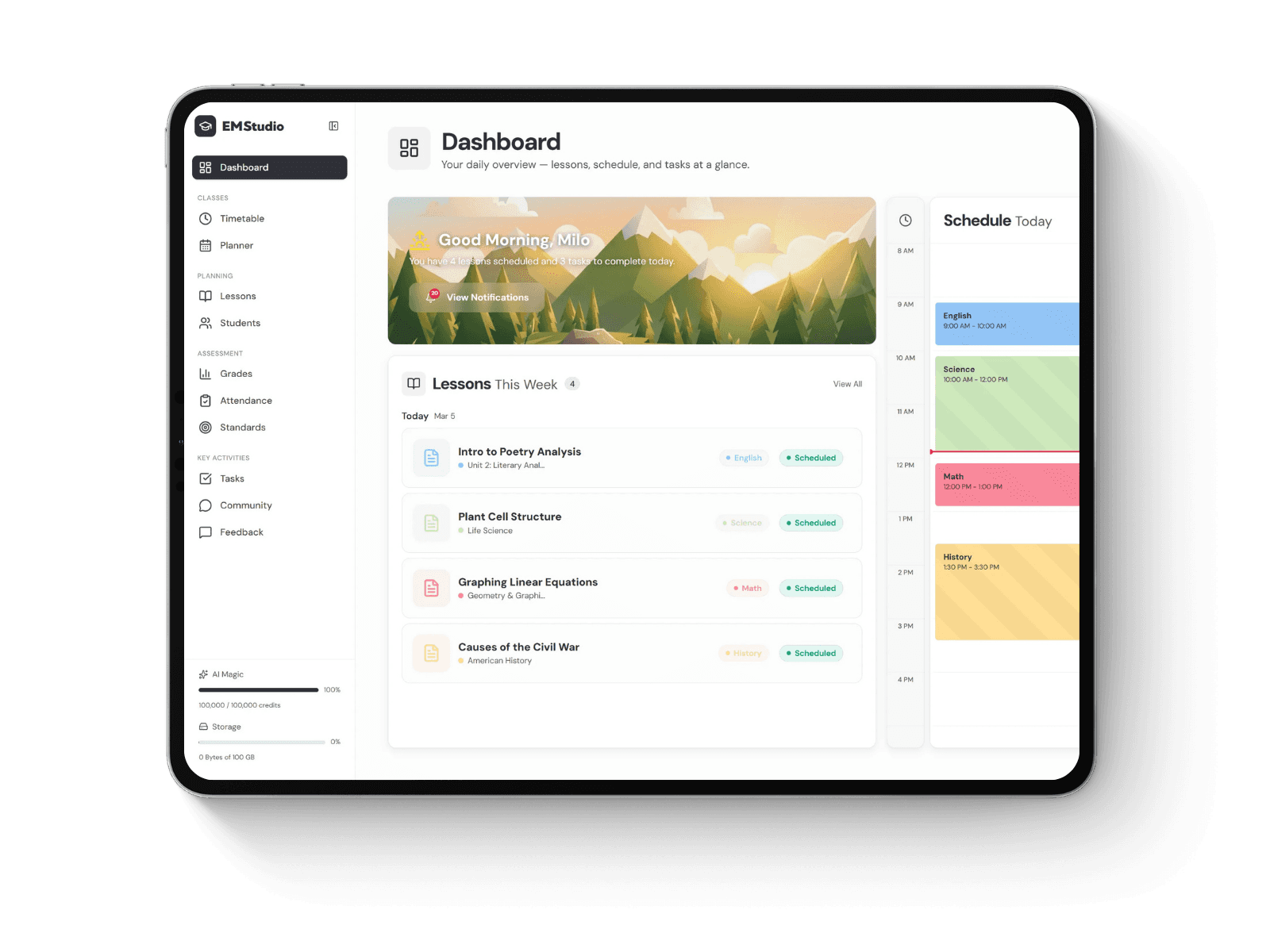
Still grading everything by hand?
EMStudio is a free teaching management app — manage your classes, students, lessons, and more!
Learn More
Table of Contents
What Is a Teacher in Modern Education?
A teacher is a state-certified professional who facilitates learning across instructional, managerial, and socio-emotional domains for 25-32 students daily. Modern teaching extends beyond content delivery to include data analysis, IEP management, and trauma-informed practices, requiring 6-12 hours of continuing education annually and involving 5-7 hours of invisible grading work weekly.
Being a teacher today means juggling three jobs simultaneously. You are instructor, manager, and counselor for two dozen kids who need completely different things at the same moment. It is nothing like the lecture-and-test model from twenty years ago.
The old "sage on the stage" model died when smartphones entered pockets and attention spans fragmented. You cannot simply deliver content and expect absorption. Modern pedagogy needs facilitation—guiding students through discovery while managing behaviors, trauma responses, and individualized learning paths simultaneously. You are the architect of experience, not just the keeper of knowledge. Content is free online. Your value is in shaping how students interact with it.
Instructionally, you operate as a data analyst before you ever teach a lesson. You dig into NWEA MAP or Illuminate reports Sunday evenings to form small groups. You track growth percentiles and adjust curriculum design based on real numbers. Student assessment drives every decision. You are teaching multiplication while simultaneously diagnosing why four specific students missed the benchmark. The platform spits out red and green dots. You translate those dots into human intervention.
Managerially, classroom management looks like air traffic control during a thunderstorm. You orchestrate 25-32 students through stations, transitions, and collaborative projects. Your peripheral vision catches a pencil flying left while you explain thesis statements right. You manage materials, time, space, and hormones simultaneously. You remember who has a peanut allergy, who cannot sit next to whom, and who needs to visit the nurse at 10:15. The logistics alone would break a retail manager.
Socio-emotionally, you practice trauma-informed care without a psychology degree or therapy license. You recognize triggers, provide sensory breaks, and regulate nervous systems before any algebra happens. Being a teacher now requires spotting ACEs and responding with strategies that keep kids learning through crisis. You de-escalate a panic attack at 9:00 AM and deliver a standardized test prompt at 9:15 AM. You are often the most stable adult in their daily orbit.
The physical toll matches the cognitive load. You are on your feet for six hours, vocalizing above thirty children, and suppressing your own biological needs. You get maybe twenty minutes of sitting time during a six-hour student day. By 3:00 PM, your voice is raw and your feet are swollen.
The barriers to entry are substantial and expensive. You pass Praxis Core exams in math, reading, and writing—often multiple attempts. You survive the edTPA portfolio gauntlet—hours of video evidence, reflective commentary, and lesson analysis that costs hundreds to submit. Then you secure state licensure. Most states mandate 6-12 hours of professional development annually, with license renewal cycles hitting every 3-5 years depending on your location. You pay for many of these requirements yourself.
Teacher work expands far beyond contract hours in ways that never appear on job descriptions or evaluation rubrics.
You spend 5-7 hours weekly on grading and feedback that students barely glance at before tossing in backpacks.
If you carry a special education caseload of 15-25 students, add 3-4 hours of IEP documentation, progress monitoring, and parent communication weekly.
Then there are the 2-3 hours of unpaid supervisory duties—hall monitoring, lunch coverage, morning arrival—that nobody mentions in education school.
This invisible labor totals 10-14 hours of unpaid time weekly. You perform it in evenings and weekends while earning a salary based on seven-hour days. The profession runs on this donated labor.
The Bureau of Labor Statistics shows elementary teachers earned a median $61,690 in 2022, while secondary teachers made $61,820. This requires a bachelor's degree plus certification, often plus master's credits for permanent licensure. You perform curriculum design, student assessment, and crisis intervention for roughly thirty dollars an hour when you calculate actual time worked. Compare this to other professions requiring similar education levels. The math does not favor the worker.
You are now a digital conductor managing an orchestra of glitchy instruments. Your typical Tuesday involves navigating Google Classroom or Canvas LMS, troubleshooting Clever single sign-on failures, and documenting behaviors in SWIS simultaneously. You teach while managing seven browser tabs and a smartboard that inevitably freezes during administrator observations. Technology was supposed to save time. It mostly creates new failure points to manage while students stare at loading screens.
Success in this chaos requires specific wiring that cannot be taught in credential programs. The essential traits and characteristics of a good teacher include adaptability, emotional stamina, and a high tolerance for ambiguity. You either develop these quickly or exit the profession within five years. The job filters out the faint of heart through sheer volume of demands.
Differentiated instruction is not a buzzword here. It is Tuesday morning reality. You modify the same lesson three ways while making sure rigor remains constant for diverse learners. You track who gets the modified text, who needs the Spanish translation, and who requires the extension project involving independent research. You manage these tiers simultaneously while circulating the room. This is standard teacher work, not exceptional practice.
Why Does the Role of a Teacher Matter to Society?
Teachers serve as the single strongest school-controlled influence on student achievement, with research indicating high-quality instruction significantly increases lifetime earnings and social mobility. One highly effective teacher impacts approximately 3,000 students over a 30-year career, driving civic engagement and economic outcomes that extend across generations.
John Hattie's Visible Learning meta-analysis puts teacher expertise into perspective. When he crunched the numbers on millions of students, pedagogy and teacher quality showed an effect size of 0.49 to 0.60 on student achievement. That beats class size, funding formulas, or building renovations. Nothing within school walls moves the needle like the adult standing at the front of the room.
An effect size of 0.50 is one year of growth in half a year. When you nail your pedagogy, students learn twice as fast. This isn't about working harder. It's about working smarter through intentional curriculum design. The research confirms what master teachers know.
Raj Chetty and his CEPR team tracked students from kindergarten through adulthood. Kids assigned to high-value-added teachers didn't just score better on tests. They earned significantly more over their lifetimes and attended college at higher rates. The data followed them for decades, showing that a single year with an exceptional teacher translated into measurable economic advantage.
College attendance spikes weren't limited to elite universities. Students with high-value-added teachers enrolled in community colleges at higher rates. They completed degrees. The impact wasn't test prep. It was about building academic persistence and the belief that higher education belonged to them.
Think about the math. If you teach 100 students per year across multiple sections, you touch 3,000 lives over a 30-year career. That's 3,000 individuals who carry your classroom management strategies, your feedback on their writing, your encouragement to try again. Each student becomes a parent, a voter, a colleague. The ripple extends across generations.
Consider the parent who helps their child with math using your strategies from twenty years ago. That child enters kindergarten ahead of peers. Your influence skipped a generation. This is how teaching creates social mobility that outlasts any single policy cycle.
Research links quality instruction to outcomes we rarely measure on Friday quizzes. Students who had strong early teachers show higher civic engagement decades later. They vote more frequently. They volunteer in their communities. Some studies even correlate excellent teaching with reduced incarceration rates. Your curriculum design today shapes society's fabric tomorrow.
Studies tracking students into adulthood found that access to effective teachers correlated with lower incarceration rates. For every twenty students assigned to high-quality teachers for three years, researchers saw one fewer prison admission later. That return beats any prison construction program.
In Title I schools serving 40-50% low-income populations, effective teaching isn't just nice to have. It's the primary intervention for breaking poverty cycles. While you can't fix a student's housing situation or food insecurity from your classroom, your differentiated instruction and high expectations provide the most reliable pathway to economic mobility available inside the school building.
Breaking poverty cycles requires relationships, not just information. When a Title I student experiences consistent classroom management and high expectations from a teacher who knows their story, they internalize that their future isn't predetermined by zip code. That psychological shift drives economic mobility.
The civic return on our teachers shows up years later in surprising places. Studies tracking early childhood instruction find that students who received quality teaching in kindergarten and first grade participate in elections at higher rates decades afterward. They join community boards. They run for local office. Classroom conversations about fairness and democracy translate into active citizenship.
Researchers followed students from the 1980s into the 2010s. Those with strong early teachers were more likely to serve on juries and attend town halls. The effect persisted when controlling for income. Quality instruction creates citizens, not just workers.
None of this happens by accident. It requires intentional professional development, deliberate student assessment practices, and the willingness to refine your craft year after year. When we discuss the profound importance of teaching in society, we are really talking about these daily decisions. The micro-interactions that compound into macro-change.
I saw this play out with Marcus, a 7th grader who hated writing. We worked on thesis statements every morning for three weeks. Last month, fifteen years later, he emailed me from law school. He mentioned that those early mornings taught him he could organize his thoughts. That is the importance of teaching.
Marcus now tutors first-generation college students. Three have entered teaching. The multiplier continues. When we discuss student assessment, we focus on immediate data. But the real metric is whether our students distribute the knowledge we gave them to others.
Hattie's numbers mean something specific in your room. It means that your expertise matters more than the fancy software your district just purchased. It means that when you choose to reteach a concept using a different strategy instead of moving to the next unit, you are leveraging the strongest tool available for learning outcomes.
Districts spend millions on initiatives with effect sizes of 0.10. Meanwhile, your professional development in differentiated instruction yields three times the impact. We should invest heavily in retaining expert teachers, not chasing the next educational technology platform.
Chetty's research quantified what many of us suspected. Replacing an average teacher with a high-value-added teacher for just one year increased students' lifetime earnings by thousands of dollars. Multiply that by 30 students per class. Then multiply by 30 years. The economic impact of a single career in education rivals major infrastructure investments.
Replacing the bottom five percent of teachers with average ones for five years would grow a regional economy by millions. The tax revenue from increased lifetime earnings would fund entire districts. The return makes teacher quality the highest-yield public policy lever available.
This matters for retention. When we understand that the teacher in the next classroom over will influence 3,000 future citizens, we treat the profession differently. We prioritize mentorship, collaboration on curriculum design, and sustainable working conditions. We recognize that burning out excellent educators isn't just a personal loss. It's a societal one.
Protecting teacher effectiveness means protecting planning time for student assessment analysis. It means class sizes small enough to allow differentiation. When districts ignore these conditions, they degrade the single strongest variable for student success that Hattie's research identified.
In buildings where half the kids qualify for free lunch, your classroom management isn't about compliance. It's about creating stability. Your student assessment isn't about sorting kids into tracks. It's about identifying exactly which skills will unlock economic opportunity. The stakes are higher, but so is the potential return.
In high-poverty schools, your pedagogy must be precise. Vague instructions waste minutes. Your curriculum design needs built-in scaffolds because home support varies. Every choice matters more because students have less margin for error. These teachers create the largest lifetime earnings gains for their students.
Voter participation doesn't start at age eighteen. It starts when a third-grade teacher asks students to debate a classroom issue using evidence. It grows when a high school history teacher connects past movements to present community organizing. These pedagogical choices build the habits of democracy that persist for decades.
When you let students debate controversial issues using evidence, you build civic muscle. When you teach respectful disagreement, you prevent polarization. These skills transfer to town halls and voting booths. The classroom becomes a laboratory for the democracy they inherit.
You are not just preparing students for next year's class. You are the variable that Hattie proved matters most. The data is clear, the economics are real, and the civic impact spans generations. That is why the role of a teacher remains the most consequential job in our communities.

How Teachers Navigate the Complexity of Daily Work
You know the myth. Teachers work 8:00 to 3:00 with built-in prep periods and long summers off. The bells ring, you lecture from a textbook, you grade papers at your tidy desk. The reality looks nothing like that. Your day starts in the dark and ends in traffic. You are a teacher navigating complexity no training manual covers.
Traditional Schedule | Actual Teacher Schedule |
8:00 AM arrival with 45-minute planning block | 5:30 AM alarm, 7:30 AM arrival, copier line |
Duty-free lunch | 22-minute lunch duty while eating standing up |
3:00 PM dismissal, work ends | 3:30 PM dismissal, then 2-hour IEP meetings or grading until 4:30 PM |
7-hour workday | 11-hour day with invisible cognitive labor |
Your alarm hits at 5:30 AM. You arrive by 7:30 AM to beat the copier line. Your lunch lasts twenty-two minutes, spent supervising a cafeteria table while eating. The bell rings at 3:30 PM for dismissal, but you stay for two-hour IEP meetings or grading until 4:30 PM.
Research estimates you make over 1,500 decisions daily. That puts teachers in the same cognitive load bracket as air traffic controllers. Every micro-choice about classroom management, curriculum design, and student assessment chips away at your mental battery. The quality of your decisions degrades by afternoon.
Should Maria work alone or in pairs? Do you reteach fractions today or push forward? You make these calls before 9:00 AM. You cannot white-knuckle through this cognitive load. You need systems, not willpower, to survive the day. This is where practical classroom hacks to save time become essential infrastructure.
Picture a 7th-grade ELA classroom. You've got kids reading at 4th-grade level sitting next to kids at 9th-grade level, all in one 50-minute period. You run station rotation with 8-minute intervals.
Group one works on phonics fluency with decodables. Group two tackles grade-level text analysis. Group three writes advanced literary essays. You circulate with a timer in your hand, adjusting differentiated instruction on the fly. This is the reality from your professional development session, but messier, louder, and happening in real-time.
Your phone buzzes constantly. You field forty to sixty parent emails weekly through ClassDojo or Remind, often after 10:00 PM when parents finally have time. You handle fifteen to twenty administrative messages daily on Teams or Slack, many marked urgent. Each ping requires an immediate decision about priority.
Then there's the teachers and social media puzzle. Parents friend you on Facebook. Students find your Instagram. You learn to set hard boundaries: locked accounts, no students followed, school email only for contact. Protecting your mental space is now part of pedagogy. You cannot serve students from an empty cup.
You juggle four separate systems before 8:00 AM. Each requires different logins, different workflows, different troubleshooting when the WiFi drops during your observation. You navigate the LMS for curriculum design updates. You check the SIS for new IEP modifications. You monitor behavior trackers for yesterday's incident reports. The context switching alone burns cognitive fuel you need for teaching.
LMS like Canvas or Google Classroom for assignments and resources
Engagement tools like Kahoot or Blooket for quick checks
SIS like PowerSchool for grades and attendance
Behavior trackers like SWIS or PBIS Rewards for classroom management data
This is the hidden architecture of teachers and teaching. The teachers experiences that nobody sees during the school day. You manage complexity that would break most corporate workflows. You balance pedagogy with data entry, relationships with compliance, and curriculum design with crisis response. You do it while actually teaching kids who need you present. And you return tomorrow to do it again.

The Challenges Teachers Face Inside and Outside the Classroom
Your contract says 37.5 hours. Your actual week runs 50 to 60 hours when you factor in Sunday afternoon lesson prep and responding to parent emails at 9:00 PM. The math doesn't work, yet you keep showing up because the kids need you there tomorrow morning ready to teach. The specific pressures teachers face break down like this:
Administrative burden consumes 45 to 55 percent of your contracted time. You spend mornings managing compliance spreadsheets and afternoons documenting behavior incidents while your pedagogy and planning for differentiated instruction get pushed to 8:00 PM.
The compensation gap persists. Economic Policy Institute research shows teachers earn 23.5 percent less than comparable college graduates in other professional fields, a gap that widens each year you stay in the classroom.
Your wallet takes the hit. NEA data shows you spend $750 to $1,000 annually out of pocket for basic supplies, classroom libraries, and student needs that district budgets consistently fail to cover.
Behavioral escalations require CPI certification for a reason. You handle three to five severe incidents monthly involving students in crisis, de-escalating physical threats while maintaining safety for the other twenty-nine kids in the room.
Vicarious trauma accumulates silently. Supporting students with high ACEs scores means hearing detailed accounts of abuse, neglect, and household chaos that your brain processes during your commute home or at 2:00 AM.
Policy whiplash disrupts your flow. Districts mandate curriculum changes every two to three years, invalidating your previous professional development and forcing you to rebuild curriculum design skills for programs that will disappear before you master them.
Parental hostility found new channels. Digital communication platforms allow angry messages to hit your phone at 10:00 PM on Saturday nights, erasing boundaries between your work and your personal life with every notification ping.
The hour mismatch creates chronic exhaustion. You work 50 to 60 hour weeks on a 37.5 hour contract, turning Sunday evenings into anxiety spirals and Monday mornings into survival mode.
Standard classroom management approaches fail in specific contexts that veteran teachers recognize immediately. Trauma-informed practices collapse without administrative backup when a student throws a chair across the room during a meltdown. Restorative circles fail when immediate safety threats demand physical removal, not conversation. Knowing when to abandon your training for crisis intervention protocol separates teachers who survive from those who burn out by October. These failure modes exhaust you because they force you to choose between your ideals and your safety.
Then there is the surveillance state of modern teaching. One viral TikTok filmed without context can end your career by Monday morning. You teach knowing that any lesson on current events, any awkward phrase during student assessment feedback, or any classroom management decision might appear on social media stripped of context and amplified by outrage. This loss of professional privacy means you perform your job under constant potential scrutiny, changing how you approach controversial topics or honest discussions about difficult history. You hesitate to teach the hard truths because the camera might be rolling.
Research indicates 44 percent of new teachers leave within five years. This retention crisis stems directly from the gap between actual teacher needs and institutional support systems. When pedagogy becomes secondary to survival, when differentiated instruction takes a backseat to crisis management, the profession loses its best practitioners to industries that respect their time and compensate their expertise appropriately. The classroom becomes a revolving door of inexperienced educators who lack the mentorship to develop sustainable practices.
You need strategies for maintaining a healthy work-life balance because the system will not provide them. Protecting your evenings and weekends is not lazy. It is the only mechanism that allows you to survive long enough to become the veteran teacher your students will remember thirty years from now. The challenges teachers face are structural, but your response determines whether you last.

How Can Schools Meet the Needs of Our Teachers?
Schools can support teachers by auditing invisible workloads to reclaim 5-10 hours weekly. Implement non-evaluative instructional coaching cycles every 2-3 weeks. Establish strict communication boundaries and provide competitive compensation benchmarks that address the 23.5% wage penalty through targeted certification stipends.
Stop guessing what your staff needs. Ask them to track their time for one week using Toggl or RescueTime. You will find them spending hours on redundant data entry and unsupervised hallway duty that drains energy from actual pedagogy.
Most schools bleed teacher time through invisible work. A teacher spends forty minutes daily logging behavioral incidents in three different systems. Another loses prep periods covering hallways without coverage pay. These drains kill morale faster than any difficult parent conference.
Run a workload audit first. Have every teacher install Toggl or RescueTime for five school days. Do not judge the results. Simply categorize where the hours go. You will likely discover five to ten weekly hours spent on tasks that serve compliance but not kids. Cut those first.
Look specifically for these time traps:
Redundant data entry across multiple platforms.
Unsupervised hallway duty during planning periods.
Weekly staff meetings that could be emails.
District-mandated paperwork with no classroom impact.
When you find those five to ten hours, give them back immediately. Cancel the redundant report. Hire a paraprofessional to cover hallway supervision. That reclaimed time goes directly into curriculum design and student assessment planning. Teachers notice when you protect their minutes.
Next, fix your professional development model. Ditch the sit-and-get workshops that ignore classroom management realities. Instead, implement Jim Knight's Impact Cycle every two to three weeks. This means a non-evaluative coach observes a specific strategy you requested, then partners with you to refine it. No paperwork for your file. Just growth.
The Impact Cycle includes four distinct phases. First, you identify your specific challenge with classroom management or student engagement. Second, the coach observes that exact moment in your room. Third, you co-create a strategy based on what actually happened. Fourth, you implement while the coach supports. This cycle repeats every two to three weeks, creating momentum without overwhelm.
This approach respects teacher autonomy. When educators drive their own pedagogy improvements, they stay longer. It also builds the trust necessary for building effective peer support networks that sustain staff through tough October weeks.
Create autonomy zones in curriculum design. Let teachers choose between three pathways for specific units: project-based, traditional testing, or portfolio assessment. This addresses diverse teacher needs while maintaining standards. One teacher might excel at student assessment through exhibitions. Another needs the structure of traditional metrics. Both can succeed.
Differentiated instruction applies to adults too. Forcing every teacher into identical delivery methods ignores their strengths. Some dominate at classroom management through strict routines. Others build community through restorative circles. Mandating one approach crushes innovation.
Establish hard communication boundaries. Write policy that forbids emails after 6 PM or before 7 AM. Restrict parent contact to school hours except emergencies. Protect weekends completely. When a teacher checks email Sunday evening, they lose mental recovery time needed for Monday's lessons.
Enforce these boundaries seriously. When a parent emails Friday at 8 PM, the auto-reply should state clearly that responses arrive during business hours. Train your office staff to screen calls during instruction time. Your staff needs psychological safety more than they need instant availability.
Consider celebrating teacher appreciation week with actual time off rather than doughnuts. A day without meetings beats a gift card every time.
Address the compensation gap directly. Benchmark salaries against districts within a fifty-mile radius. Survey what nearby systems pay for similar experience levels. If a teacher with ten years and a master's degree earns significantly less than a project manager with similar credentials, your stipends must close that gap.
Offer targeted certification stipends: twenty-five hundred dollars for ESL endorsement, three thousand for National Board Certification. These incentives acknowledge the twenty-three point five percent wage penalty teachers face compared to similarly educated professionals. They also incentivize the specialized skills your students need most.
Money talks, but so does mental health infrastructure. Provide six to eight annual EAP sessions per teacher without stigma. Add two to three mandatory mental health days beyond sick leave. When a teacher takes a mental health day, cover their class with a qualified sub. Do not make them write lesson plans while resting.
Mental health days should require no documentation. When a teacher requests one, your only response should be "Hope you feel better tomorrow." Do not ask for doctor's notes or detailed explanations. Trust your professionals to know when they need rest.
Advertise these EAP benefits explicitly. Many teachers do not know they can access free counseling for burnout, anxiety, or secondary trauma. Put the phone number on every bathroom stall and in every lounge. Normalize seeking help.
Finally, connect these supports to professional growth programs for educators that offer clear advancement pathways. Our teachers deserve systems that treat them as skilled professionals rather than interchangeable widgets.

Should You Try Teacher?
If you love watching kids get that "aha" moment and don't mind grading papers on Sunday nights, yes. Teaching isn't easy, but it's the only job where you see 30 humans grow in real time. Just know you'll earn every summer break.
The daily grind involves way more than cute bulletin boards and holiday breaks. You'll juggle classroom management while racing through curriculum design during your lone prep period. Solid pedagogy matters, but so does showing up with genuine energy when you're running on four hours of sleep. Professional development helps, yet most survival skills come from messy trial and error in the trenches with real kids.
Schools desperately need people who can handle the daily chaos with grace and still remember exactly why they walked through that door last August. If that sounds like your kind of challenge, the classroom is already waiting for you. What story will you tell five years from now when a former student asks what really made you choose this life?
What Is a Teacher in Modern Education?
A teacher is a state-certified professional who facilitates learning across instructional, managerial, and socio-emotional domains for 25-32 students daily. Modern teaching extends beyond content delivery to include data analysis, IEP management, and trauma-informed practices, requiring 6-12 hours of continuing education annually and involving 5-7 hours of invisible grading work weekly.
Being a teacher today means juggling three jobs simultaneously. You are instructor, manager, and counselor for two dozen kids who need completely different things at the same moment. It is nothing like the lecture-and-test model from twenty years ago.
The old "sage on the stage" model died when smartphones entered pockets and attention spans fragmented. You cannot simply deliver content and expect absorption. Modern pedagogy needs facilitation—guiding students through discovery while managing behaviors, trauma responses, and individualized learning paths simultaneously. You are the architect of experience, not just the keeper of knowledge. Content is free online. Your value is in shaping how students interact with it.
Instructionally, you operate as a data analyst before you ever teach a lesson. You dig into NWEA MAP or Illuminate reports Sunday evenings to form small groups. You track growth percentiles and adjust curriculum design based on real numbers. Student assessment drives every decision. You are teaching multiplication while simultaneously diagnosing why four specific students missed the benchmark. The platform spits out red and green dots. You translate those dots into human intervention.
Managerially, classroom management looks like air traffic control during a thunderstorm. You orchestrate 25-32 students through stations, transitions, and collaborative projects. Your peripheral vision catches a pencil flying left while you explain thesis statements right. You manage materials, time, space, and hormones simultaneously. You remember who has a peanut allergy, who cannot sit next to whom, and who needs to visit the nurse at 10:15. The logistics alone would break a retail manager.
Socio-emotionally, you practice trauma-informed care without a psychology degree or therapy license. You recognize triggers, provide sensory breaks, and regulate nervous systems before any algebra happens. Being a teacher now requires spotting ACEs and responding with strategies that keep kids learning through crisis. You de-escalate a panic attack at 9:00 AM and deliver a standardized test prompt at 9:15 AM. You are often the most stable adult in their daily orbit.
The physical toll matches the cognitive load. You are on your feet for six hours, vocalizing above thirty children, and suppressing your own biological needs. You get maybe twenty minutes of sitting time during a six-hour student day. By 3:00 PM, your voice is raw and your feet are swollen.
The barriers to entry are substantial and expensive. You pass Praxis Core exams in math, reading, and writing—often multiple attempts. You survive the edTPA portfolio gauntlet—hours of video evidence, reflective commentary, and lesson analysis that costs hundreds to submit. Then you secure state licensure. Most states mandate 6-12 hours of professional development annually, with license renewal cycles hitting every 3-5 years depending on your location. You pay for many of these requirements yourself.
Teacher work expands far beyond contract hours in ways that never appear on job descriptions or evaluation rubrics.
You spend 5-7 hours weekly on grading and feedback that students barely glance at before tossing in backpacks.
If you carry a special education caseload of 15-25 students, add 3-4 hours of IEP documentation, progress monitoring, and parent communication weekly.
Then there are the 2-3 hours of unpaid supervisory duties—hall monitoring, lunch coverage, morning arrival—that nobody mentions in education school.
This invisible labor totals 10-14 hours of unpaid time weekly. You perform it in evenings and weekends while earning a salary based on seven-hour days. The profession runs on this donated labor.
The Bureau of Labor Statistics shows elementary teachers earned a median $61,690 in 2022, while secondary teachers made $61,820. This requires a bachelor's degree plus certification, often plus master's credits for permanent licensure. You perform curriculum design, student assessment, and crisis intervention for roughly thirty dollars an hour when you calculate actual time worked. Compare this to other professions requiring similar education levels. The math does not favor the worker.
You are now a digital conductor managing an orchestra of glitchy instruments. Your typical Tuesday involves navigating Google Classroom or Canvas LMS, troubleshooting Clever single sign-on failures, and documenting behaviors in SWIS simultaneously. You teach while managing seven browser tabs and a smartboard that inevitably freezes during administrator observations. Technology was supposed to save time. It mostly creates new failure points to manage while students stare at loading screens.
Success in this chaos requires specific wiring that cannot be taught in credential programs. The essential traits and characteristics of a good teacher include adaptability, emotional stamina, and a high tolerance for ambiguity. You either develop these quickly or exit the profession within five years. The job filters out the faint of heart through sheer volume of demands.
Differentiated instruction is not a buzzword here. It is Tuesday morning reality. You modify the same lesson three ways while making sure rigor remains constant for diverse learners. You track who gets the modified text, who needs the Spanish translation, and who requires the extension project involving independent research. You manage these tiers simultaneously while circulating the room. This is standard teacher work, not exceptional practice.
Why Does the Role of a Teacher Matter to Society?
Teachers serve as the single strongest school-controlled influence on student achievement, with research indicating high-quality instruction significantly increases lifetime earnings and social mobility. One highly effective teacher impacts approximately 3,000 students over a 30-year career, driving civic engagement and economic outcomes that extend across generations.
John Hattie's Visible Learning meta-analysis puts teacher expertise into perspective. When he crunched the numbers on millions of students, pedagogy and teacher quality showed an effect size of 0.49 to 0.60 on student achievement. That beats class size, funding formulas, or building renovations. Nothing within school walls moves the needle like the adult standing at the front of the room.
An effect size of 0.50 is one year of growth in half a year. When you nail your pedagogy, students learn twice as fast. This isn't about working harder. It's about working smarter through intentional curriculum design. The research confirms what master teachers know.
Raj Chetty and his CEPR team tracked students from kindergarten through adulthood. Kids assigned to high-value-added teachers didn't just score better on tests. They earned significantly more over their lifetimes and attended college at higher rates. The data followed them for decades, showing that a single year with an exceptional teacher translated into measurable economic advantage.
College attendance spikes weren't limited to elite universities. Students with high-value-added teachers enrolled in community colleges at higher rates. They completed degrees. The impact wasn't test prep. It was about building academic persistence and the belief that higher education belonged to them.
Think about the math. If you teach 100 students per year across multiple sections, you touch 3,000 lives over a 30-year career. That's 3,000 individuals who carry your classroom management strategies, your feedback on their writing, your encouragement to try again. Each student becomes a parent, a voter, a colleague. The ripple extends across generations.
Consider the parent who helps their child with math using your strategies from twenty years ago. That child enters kindergarten ahead of peers. Your influence skipped a generation. This is how teaching creates social mobility that outlasts any single policy cycle.
Research links quality instruction to outcomes we rarely measure on Friday quizzes. Students who had strong early teachers show higher civic engagement decades later. They vote more frequently. They volunteer in their communities. Some studies even correlate excellent teaching with reduced incarceration rates. Your curriculum design today shapes society's fabric tomorrow.
Studies tracking students into adulthood found that access to effective teachers correlated with lower incarceration rates. For every twenty students assigned to high-quality teachers for three years, researchers saw one fewer prison admission later. That return beats any prison construction program.
In Title I schools serving 40-50% low-income populations, effective teaching isn't just nice to have. It's the primary intervention for breaking poverty cycles. While you can't fix a student's housing situation or food insecurity from your classroom, your differentiated instruction and high expectations provide the most reliable pathway to economic mobility available inside the school building.
Breaking poverty cycles requires relationships, not just information. When a Title I student experiences consistent classroom management and high expectations from a teacher who knows their story, they internalize that their future isn't predetermined by zip code. That psychological shift drives economic mobility.
The civic return on our teachers shows up years later in surprising places. Studies tracking early childhood instruction find that students who received quality teaching in kindergarten and first grade participate in elections at higher rates decades afterward. They join community boards. They run for local office. Classroom conversations about fairness and democracy translate into active citizenship.
Researchers followed students from the 1980s into the 2010s. Those with strong early teachers were more likely to serve on juries and attend town halls. The effect persisted when controlling for income. Quality instruction creates citizens, not just workers.
None of this happens by accident. It requires intentional professional development, deliberate student assessment practices, and the willingness to refine your craft year after year. When we discuss the profound importance of teaching in society, we are really talking about these daily decisions. The micro-interactions that compound into macro-change.
I saw this play out with Marcus, a 7th grader who hated writing. We worked on thesis statements every morning for three weeks. Last month, fifteen years later, he emailed me from law school. He mentioned that those early mornings taught him he could organize his thoughts. That is the importance of teaching.
Marcus now tutors first-generation college students. Three have entered teaching. The multiplier continues. When we discuss student assessment, we focus on immediate data. But the real metric is whether our students distribute the knowledge we gave them to others.
Hattie's numbers mean something specific in your room. It means that your expertise matters more than the fancy software your district just purchased. It means that when you choose to reteach a concept using a different strategy instead of moving to the next unit, you are leveraging the strongest tool available for learning outcomes.
Districts spend millions on initiatives with effect sizes of 0.10. Meanwhile, your professional development in differentiated instruction yields three times the impact. We should invest heavily in retaining expert teachers, not chasing the next educational technology platform.
Chetty's research quantified what many of us suspected. Replacing an average teacher with a high-value-added teacher for just one year increased students' lifetime earnings by thousands of dollars. Multiply that by 30 students per class. Then multiply by 30 years. The economic impact of a single career in education rivals major infrastructure investments.
Replacing the bottom five percent of teachers with average ones for five years would grow a regional economy by millions. The tax revenue from increased lifetime earnings would fund entire districts. The return makes teacher quality the highest-yield public policy lever available.
This matters for retention. When we understand that the teacher in the next classroom over will influence 3,000 future citizens, we treat the profession differently. We prioritize mentorship, collaboration on curriculum design, and sustainable working conditions. We recognize that burning out excellent educators isn't just a personal loss. It's a societal one.
Protecting teacher effectiveness means protecting planning time for student assessment analysis. It means class sizes small enough to allow differentiation. When districts ignore these conditions, they degrade the single strongest variable for student success that Hattie's research identified.
In buildings where half the kids qualify for free lunch, your classroom management isn't about compliance. It's about creating stability. Your student assessment isn't about sorting kids into tracks. It's about identifying exactly which skills will unlock economic opportunity. The stakes are higher, but so is the potential return.
In high-poverty schools, your pedagogy must be precise. Vague instructions waste minutes. Your curriculum design needs built-in scaffolds because home support varies. Every choice matters more because students have less margin for error. These teachers create the largest lifetime earnings gains for their students.
Voter participation doesn't start at age eighteen. It starts when a third-grade teacher asks students to debate a classroom issue using evidence. It grows when a high school history teacher connects past movements to present community organizing. These pedagogical choices build the habits of democracy that persist for decades.
When you let students debate controversial issues using evidence, you build civic muscle. When you teach respectful disagreement, you prevent polarization. These skills transfer to town halls and voting booths. The classroom becomes a laboratory for the democracy they inherit.
You are not just preparing students for next year's class. You are the variable that Hattie proved matters most. The data is clear, the economics are real, and the civic impact spans generations. That is why the role of a teacher remains the most consequential job in our communities.
How Teachers Navigate the Complexity of Daily Work
You know the myth. Teachers work 8:00 to 3:00 with built-in prep periods and long summers off. The bells ring, you lecture from a textbook, you grade papers at your tidy desk. The reality looks nothing like that. Your day starts in the dark and ends in traffic. You are a teacher navigating complexity no training manual covers.
Traditional Schedule | Actual Teacher Schedule |
8:00 AM arrival with 45-minute planning block | 5:30 AM alarm, 7:30 AM arrival, copier line |
Duty-free lunch | 22-minute lunch duty while eating standing up |
3:00 PM dismissal, work ends | 3:30 PM dismissal, then 2-hour IEP meetings or grading until 4:30 PM |
7-hour workday | 11-hour day with invisible cognitive labor |
Your alarm hits at 5:30 AM. You arrive by 7:30 AM to beat the copier line. Your lunch lasts twenty-two minutes, spent supervising a cafeteria table while eating. The bell rings at 3:30 PM for dismissal, but you stay for two-hour IEP meetings or grading until 4:30 PM.
Research estimates you make over 1,500 decisions daily. That puts teachers in the same cognitive load bracket as air traffic controllers. Every micro-choice about classroom management, curriculum design, and student assessment chips away at your mental battery. The quality of your decisions degrades by afternoon.
Should Maria work alone or in pairs? Do you reteach fractions today or push forward? You make these calls before 9:00 AM. You cannot white-knuckle through this cognitive load. You need systems, not willpower, to survive the day. This is where practical classroom hacks to save time become essential infrastructure.
Picture a 7th-grade ELA classroom. You've got kids reading at 4th-grade level sitting next to kids at 9th-grade level, all in one 50-minute period. You run station rotation with 8-minute intervals.
Group one works on phonics fluency with decodables. Group two tackles grade-level text analysis. Group three writes advanced literary essays. You circulate with a timer in your hand, adjusting differentiated instruction on the fly. This is the reality from your professional development session, but messier, louder, and happening in real-time.
Your phone buzzes constantly. You field forty to sixty parent emails weekly through ClassDojo or Remind, often after 10:00 PM when parents finally have time. You handle fifteen to twenty administrative messages daily on Teams or Slack, many marked urgent. Each ping requires an immediate decision about priority.
Then there's the teachers and social media puzzle. Parents friend you on Facebook. Students find your Instagram. You learn to set hard boundaries: locked accounts, no students followed, school email only for contact. Protecting your mental space is now part of pedagogy. You cannot serve students from an empty cup.
You juggle four separate systems before 8:00 AM. Each requires different logins, different workflows, different troubleshooting when the WiFi drops during your observation. You navigate the LMS for curriculum design updates. You check the SIS for new IEP modifications. You monitor behavior trackers for yesterday's incident reports. The context switching alone burns cognitive fuel you need for teaching.
LMS like Canvas or Google Classroom for assignments and resources
Engagement tools like Kahoot or Blooket for quick checks
SIS like PowerSchool for grades and attendance
Behavior trackers like SWIS or PBIS Rewards for classroom management data
This is the hidden architecture of teachers and teaching. The teachers experiences that nobody sees during the school day. You manage complexity that would break most corporate workflows. You balance pedagogy with data entry, relationships with compliance, and curriculum design with crisis response. You do it while actually teaching kids who need you present. And you return tomorrow to do it again.
The Challenges Teachers Face Inside and Outside the Classroom
Your contract says 37.5 hours. Your actual week runs 50 to 60 hours when you factor in Sunday afternoon lesson prep and responding to parent emails at 9:00 PM. The math doesn't work, yet you keep showing up because the kids need you there tomorrow morning ready to teach. The specific pressures teachers face break down like this:
Administrative burden consumes 45 to 55 percent of your contracted time. You spend mornings managing compliance spreadsheets and afternoons documenting behavior incidents while your pedagogy and planning for differentiated instruction get pushed to 8:00 PM.
The compensation gap persists. Economic Policy Institute research shows teachers earn 23.5 percent less than comparable college graduates in other professional fields, a gap that widens each year you stay in the classroom.
Your wallet takes the hit. NEA data shows you spend $750 to $1,000 annually out of pocket for basic supplies, classroom libraries, and student needs that district budgets consistently fail to cover.
Behavioral escalations require CPI certification for a reason. You handle three to five severe incidents monthly involving students in crisis, de-escalating physical threats while maintaining safety for the other twenty-nine kids in the room.
Vicarious trauma accumulates silently. Supporting students with high ACEs scores means hearing detailed accounts of abuse, neglect, and household chaos that your brain processes during your commute home or at 2:00 AM.
Policy whiplash disrupts your flow. Districts mandate curriculum changes every two to three years, invalidating your previous professional development and forcing you to rebuild curriculum design skills for programs that will disappear before you master them.
Parental hostility found new channels. Digital communication platforms allow angry messages to hit your phone at 10:00 PM on Saturday nights, erasing boundaries between your work and your personal life with every notification ping.
The hour mismatch creates chronic exhaustion. You work 50 to 60 hour weeks on a 37.5 hour contract, turning Sunday evenings into anxiety spirals and Monday mornings into survival mode.
Standard classroom management approaches fail in specific contexts that veteran teachers recognize immediately. Trauma-informed practices collapse without administrative backup when a student throws a chair across the room during a meltdown. Restorative circles fail when immediate safety threats demand physical removal, not conversation. Knowing when to abandon your training for crisis intervention protocol separates teachers who survive from those who burn out by October. These failure modes exhaust you because they force you to choose between your ideals and your safety.
Then there is the surveillance state of modern teaching. One viral TikTok filmed without context can end your career by Monday morning. You teach knowing that any lesson on current events, any awkward phrase during student assessment feedback, or any classroom management decision might appear on social media stripped of context and amplified by outrage. This loss of professional privacy means you perform your job under constant potential scrutiny, changing how you approach controversial topics or honest discussions about difficult history. You hesitate to teach the hard truths because the camera might be rolling.
Research indicates 44 percent of new teachers leave within five years. This retention crisis stems directly from the gap between actual teacher needs and institutional support systems. When pedagogy becomes secondary to survival, when differentiated instruction takes a backseat to crisis management, the profession loses its best practitioners to industries that respect their time and compensate their expertise appropriately. The classroom becomes a revolving door of inexperienced educators who lack the mentorship to develop sustainable practices.
You need strategies for maintaining a healthy work-life balance because the system will not provide them. Protecting your evenings and weekends is not lazy. It is the only mechanism that allows you to survive long enough to become the veteran teacher your students will remember thirty years from now. The challenges teachers face are structural, but your response determines whether you last.
How Can Schools Meet the Needs of Our Teachers?
Schools can support teachers by auditing invisible workloads to reclaim 5-10 hours weekly. Implement non-evaluative instructional coaching cycles every 2-3 weeks. Establish strict communication boundaries and provide competitive compensation benchmarks that address the 23.5% wage penalty through targeted certification stipends.
Stop guessing what your staff needs. Ask them to track their time for one week using Toggl or RescueTime. You will find them spending hours on redundant data entry and unsupervised hallway duty that drains energy from actual pedagogy.
Most schools bleed teacher time through invisible work. A teacher spends forty minutes daily logging behavioral incidents in three different systems. Another loses prep periods covering hallways without coverage pay. These drains kill morale faster than any difficult parent conference.
Run a workload audit first. Have every teacher install Toggl or RescueTime for five school days. Do not judge the results. Simply categorize where the hours go. You will likely discover five to ten weekly hours spent on tasks that serve compliance but not kids. Cut those first.
Look specifically for these time traps:
Redundant data entry across multiple platforms.
Unsupervised hallway duty during planning periods.
Weekly staff meetings that could be emails.
District-mandated paperwork with no classroom impact.
When you find those five to ten hours, give them back immediately. Cancel the redundant report. Hire a paraprofessional to cover hallway supervision. That reclaimed time goes directly into curriculum design and student assessment planning. Teachers notice when you protect their minutes.
Next, fix your professional development model. Ditch the sit-and-get workshops that ignore classroom management realities. Instead, implement Jim Knight's Impact Cycle every two to three weeks. This means a non-evaluative coach observes a specific strategy you requested, then partners with you to refine it. No paperwork for your file. Just growth.
The Impact Cycle includes four distinct phases. First, you identify your specific challenge with classroom management or student engagement. Second, the coach observes that exact moment in your room. Third, you co-create a strategy based on what actually happened. Fourth, you implement while the coach supports. This cycle repeats every two to three weeks, creating momentum without overwhelm.
This approach respects teacher autonomy. When educators drive their own pedagogy improvements, they stay longer. It also builds the trust necessary for building effective peer support networks that sustain staff through tough October weeks.
Create autonomy zones in curriculum design. Let teachers choose between three pathways for specific units: project-based, traditional testing, or portfolio assessment. This addresses diverse teacher needs while maintaining standards. One teacher might excel at student assessment through exhibitions. Another needs the structure of traditional metrics. Both can succeed.
Differentiated instruction applies to adults too. Forcing every teacher into identical delivery methods ignores their strengths. Some dominate at classroom management through strict routines. Others build community through restorative circles. Mandating one approach crushes innovation.
Establish hard communication boundaries. Write policy that forbids emails after 6 PM or before 7 AM. Restrict parent contact to school hours except emergencies. Protect weekends completely. When a teacher checks email Sunday evening, they lose mental recovery time needed for Monday's lessons.
Enforce these boundaries seriously. When a parent emails Friday at 8 PM, the auto-reply should state clearly that responses arrive during business hours. Train your office staff to screen calls during instruction time. Your staff needs psychological safety more than they need instant availability.
Consider celebrating teacher appreciation week with actual time off rather than doughnuts. A day without meetings beats a gift card every time.
Address the compensation gap directly. Benchmark salaries against districts within a fifty-mile radius. Survey what nearby systems pay for similar experience levels. If a teacher with ten years and a master's degree earns significantly less than a project manager with similar credentials, your stipends must close that gap.
Offer targeted certification stipends: twenty-five hundred dollars for ESL endorsement, three thousand for National Board Certification. These incentives acknowledge the twenty-three point five percent wage penalty teachers face compared to similarly educated professionals. They also incentivize the specialized skills your students need most.
Money talks, but so does mental health infrastructure. Provide six to eight annual EAP sessions per teacher without stigma. Add two to three mandatory mental health days beyond sick leave. When a teacher takes a mental health day, cover their class with a qualified sub. Do not make them write lesson plans while resting.
Mental health days should require no documentation. When a teacher requests one, your only response should be "Hope you feel better tomorrow." Do not ask for doctor's notes or detailed explanations. Trust your professionals to know when they need rest.
Advertise these EAP benefits explicitly. Many teachers do not know they can access free counseling for burnout, anxiety, or secondary trauma. Put the phone number on every bathroom stall and in every lounge. Normalize seeking help.
Finally, connect these supports to professional growth programs for educators that offer clear advancement pathways. Our teachers deserve systems that treat them as skilled professionals rather than interchangeable widgets.
Should You Try Teacher?
If you love watching kids get that "aha" moment and don't mind grading papers on Sunday nights, yes. Teaching isn't easy, but it's the only job where you see 30 humans grow in real time. Just know you'll earn every summer break.
The daily grind involves way more than cute bulletin boards and holiday breaks. You'll juggle classroom management while racing through curriculum design during your lone prep period. Solid pedagogy matters, but so does showing up with genuine energy when you're running on four hours of sleep. Professional development helps, yet most survival skills come from messy trial and error in the trenches with real kids.
Schools desperately need people who can handle the daily chaos with grace and still remember exactly why they walked through that door last August. If that sounds like your kind of challenge, the classroom is already waiting for you. What story will you tell five years from now when a former student asks what really made you choose this life?
Still grading everything by hand?
EMStudio is a free teaching management app — manage your classes, students, lessons, and more!
Learn More
Still grading everything by hand?
EMStudio is a free teaching management app — manage your classes, students, lessons, and more!
Learn More



Notion4Teachers
Notion templates to simplify administrative tasks and enhance your teaching experience.



2026 Notion4Teachers. All Rights Reserved.
Notion4Teachers
Notion templates to simplify administrative tasks and enhance your teaching experience.
2026 Notion4Teachers. All Rights Reserved.
Notion4Teachers
Notion templates to simplify administrative tasks and enhance your teaching experience.
2026 Notion4Teachers. All Rights Reserved.