

Teacher Incentive Allotment: How It Works and Who Qualifies

Ever clipped a coupon, only to find out at checkout that it doesn't work at your store? That's a lot like the Teacher Incentive Allotment (TIA), a Texas state program that can boost teacher pay.
It only reaches teachers in districts that participate, so the first question is always whether yours does.
Here, we'll walk you through how the program works, from designations and funding math to spending rules, timelines, and where to get help. Then you'll see how to check your district and what it could mean for your own pay.
Still grading everything by hand?
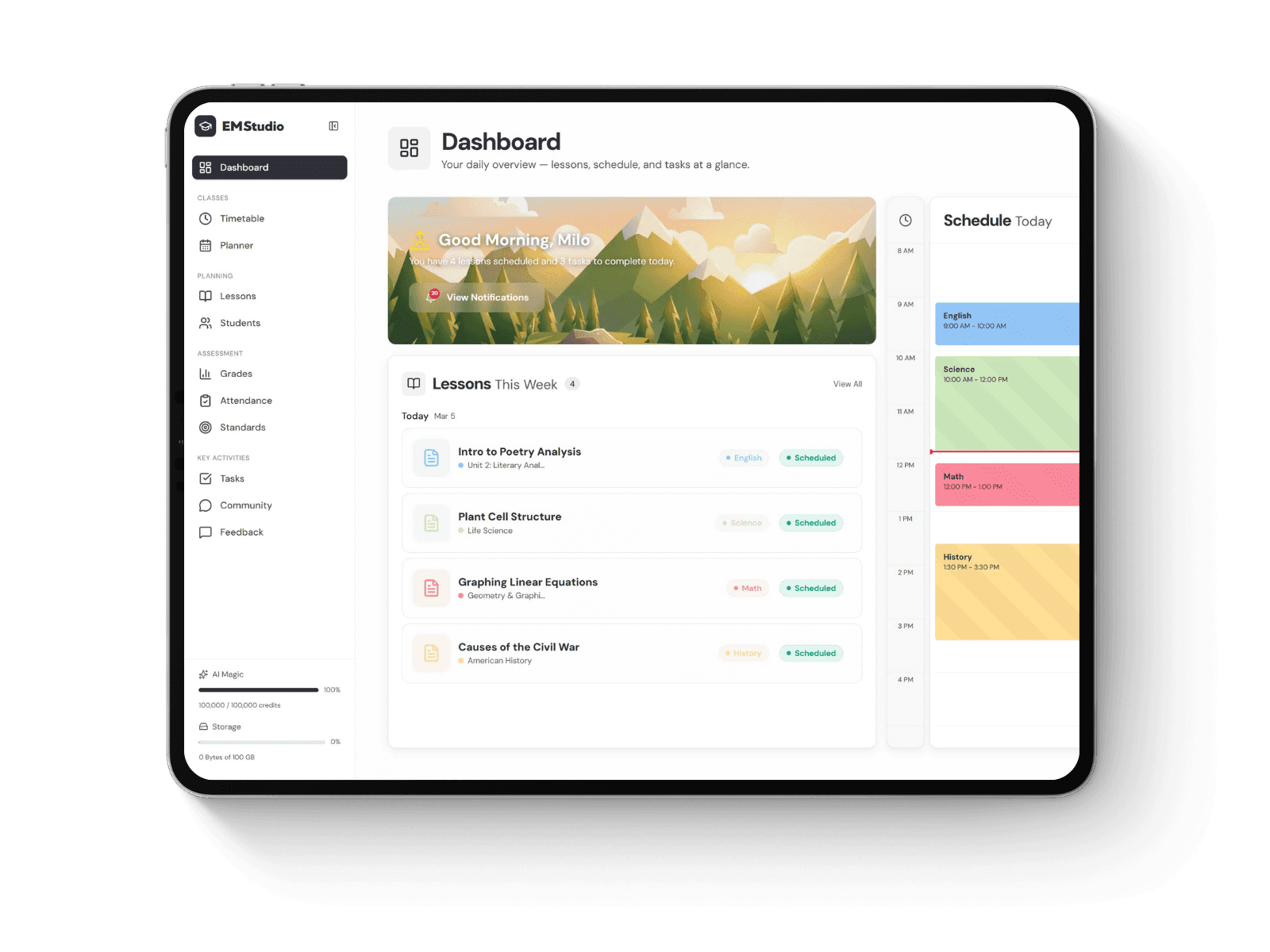
EMStudio is a free teaching management app — manage your classes, students, lessons, and more!
How the Teacher Incentive Allotment Works
Ever wondered how Texas could reward its strongest teachers for their impact? The Teacher Incentive Allotment (TIA) is one way it does that.
How it rewards and retains effective teachers
The aim is to recognize effective teachers, reward them, and keep them in the classroom. This is less about how long you've taught and more about how well your students are growing.
Each district develops its own designation system, so the criteria reflect local choices.
Consider a middle school science teacher whose students show strong growth. Her district's designation system could recognize that work and open a path to significantly higher pay. Recognition that pays.
Participation is optional for districts and charters, so ask your campus or district office whether yours takes part.
The program is meant to improve instruction and student outcomes. According to Governor Greg Abbott's office, TIA "was built to keep Texas’ most effective educators in the classroom and expand access to strong instruction."
How House Bill 3 set up its funding
House Bill 3 from the 86th Legislature set up TIA's funding. The money is tied to Tier 1 of the Foundation School Program, the state's base funding formula.
The result is a sustainable stream, not a one-time grant, so it can keep supporting designated teachers over time.
Steps for a district to get started
A district that wants in works through a few steps:
Get Texas Education Agency (TEA) approval. The agency must approve the district's participation.
Appoint a TIA lead and planning committee. The lead guides the work while the committee shapes the plan.
Collect teacher performance and growth data. That data is the raw material for the designation system.

What Each Teacher Designation Means
Designations unlock the extra pay, so here's what each level means.
How can teachers earn an extra $1000 a month?
The Texas Education Agency recognizes three levels:
Recognized
Exemplary
Master
Funding amounts vary by level. Teachers who hold one may receive extra pay, according to research on teacher retention.
Whether you reach $1,000 a month depends on your level, whether your campus is rural or high-needs (those campuses get higher pay), and whether your district participates.
Take a rural middle school math teacher who earns Exemplary: her higher rural pay makes her check bigger than it would elsewhere. Earning the designation is one step, but where you teach decides how much it pays.
Routes to earning a designation
Designations come through your district's local designation system, which looks at student growth and observation criteria.
National Board certification is a shortcut: National Board Certified Teachers (NBCTs) automatically earn Recognized. That's a head start.
Ask your district:
Does your district participate in the Teacher Incentive Allotment?
What student growth and observation criteria does it use?
When a designation lasts or gets revoked
Your designation is valid for five years, but that doesn't make it untouchable. It can be revoked for a few reasons:
Certificate sanctions: a sanction on your certificate can end it.
Do Not Hire registry: placement on the registry can end it too.
Improper issuance: a designation issued in error can be revoked.
System revoked: if the local system is revoked, its designations can be too.
Designations are publicly searchable, and you can display your certificate. Protect your record.
Funding Amounts and Who Qualifies
Two things decide your payment: how much your campus receives, and whether you're one of the people it counts.
What sets the size of each payment
Designation level. It sets the starting figure.
Campus socioeconomic status. It adjusts that figure.
Campus rural status. Rural status adjusts it further.
Last Friday in February snapshot. The amount is locked to that single day.
Multi-campus and central staff averaging. Split-campus and central office staff get an averaged figure.
Take Maria, a fourth-grade teacher at a rural campus who splits her week between two schools. Start with her campus's designation, then apply the socioeconomic and rural adjustments.
Her share is averaged across both campuses, and her name has to be on the snapshot to count.

Who qualifies for the funds
Four things have to line up:
Reported as 087 teacher. Your district must report you as an 087 teacher.
Creditable year of service. Your record must show one.
Class Roster Winter Submission. You need to be on the winter roster your district submits.
Must remain in classroom. You have to stay in a classroom role.
When teachers move or change roles
Designation stays active. A campus's designation doesn't reset when one teacher leaves.
Timing versus snapshot date. What matters is where you are on snapshot day, not where you were.
Non-teaching roles generate no funds. Moving into one stops your share.
Optional forwarding of funds. You may pass your share along, but you don't have to.
Check timing before changing campuses. Look at the snapshot dates before you transfer.
Consider Dana, a math teacher eyeing an administrative job in January. That job generates no funds, so she checks the dates before she accepts. Timing matters.
How the Money Has to Be Spent
The rules are less about how much a campus receives and more about where the money lands and when it has to be spent. Here's what to plan for.
Build a local plan for teacher pay
Districts must spend at least 90% of the allotment on teacher compensation. According to the Teacher Incentive Allotment FAQ, that money has to go to the campus where the designated teacher works.
The rest, up to 10%, can go to system support, the costs of administering the program at the district level.
Picture a designated teacher whose campus receives an allotment. The money must be spent on her campus, but how much of the direct teacher share reaches her own paycheck is a local decision. That's the question to bring to your district. Ask it early.

Yearly dates and how to verify funds
Mark these on your calendar:
April: Districts are notified of their allotments.
Verify in SCOMS: Check the figures in SCOMS, the online system where allotment amounts are tracked.
Spend by August 31: The money must be spent by August 31 each school year.
First year: Expect a single lump-sum reimbursement in September.
Summary of Finances: Review the Summary of Finances report to see where the money went.
A designated teacher who checks SCOMS in April knows her campus's number months before the money must be spent. That gives her time to ask how her share will work. August 31 is the date that matters.
Where to Get Help Setting It Up
Your district handles most of the setup, but a few sources can carry much of the load. Here's where to turn.
Get help from your regional service center
Your district can call on its regional education service center for:
Application development and review. A second set of eyes before anything is submitted.
Renewal and system expansion. Help keeping the plan current and expanding it.
Data validation and submission. Data errors caught before filing.
Calibration and student growth measures. Consistent evaluations and fair growth tracking.
Spending plan and compensation design. Deciding how funds are spent and how pay is structured.
Picture a middle school math teacher whose principal is drafting the application. A service center review catches the mistakes first. Asking early gets you prevention rather than repair. Start early.
Important dates and district training
Dates slip easily, so keep these in view:
Data submission and fee dates. Know both, since each has its own deadline.
Application due date. The deadline your district must meet to take part.
Collaborative meetings and summits. Chances to learn from other districts' approaches.
TEA training for districts. Sessions from the Texas Education Agency (TEA) that walk staff through the rules.
A high school teacher who hears the deadline at a district summit adds it to her own calendar. When her principal asks for input in the final week, she's ready. Mark the dates now.
Guides and calculators you can use
These show the mechanics, and you can read them on your own time.
Guidebook and data capture guide. The guidebook explains the rules, and the data capture guide shows what to record.
Allotment model calculator. Estimate what the allotment could mean for your pay, using your district's figures, not a generic example.
Business office spending guidance. Your business office can explain what the money can and can't cover.
SCOMS user guides. Step-by-step help for SCOMS, the online system where districts handle program data.

What Perks Can Teachers Get?
A key perk for Texas teachers is the Teacher Incentive Allotment (TIA), which adds pay for teachers who earn a designation. Your district's other perks and benefits round out the picture, so it's worth reviewing the full package.
Helps hire, keep and fairly pay teachers
Attract top teaching talent. Participating districts can use the allotment to recruit strong candidates.
Designated teachers more likely to stay. A new report on how charter schools reward and retain great teachers found that teachers with TIA designations are nine percentage points more likely to stay in their districts than non-designated peers.
More resources for high-need schools. The allotment aims to direct extra support to schools where keeping strong teachers is hardest.
Pay equity and transparency. Because designations follow a shared process, it's easier to see why one teacher earns more than another.
Consistency for students. Think of a middle school math teacher who knows exactly where her students struggle. When extra pay keeps her in that building, her students get the teacher who already knows them instead of starting over each fall.

Many teachers don't feel fairly paid
Education Week reports that 45 percent of public school teachers are satisfied with their teaching salary, while 55 percent are not.
Those figures come from the 2015-16 National Teacher and Principal Survey, a nationally representative sample survey of teachers and principals. That's a real gap.
The allotment aims to tie pay more closely to impact, rewarding what teachers do rather than only how long they've taught. It has limits, though. Teachers who want to strengthen what they do in the classroom can explore professional growth programs.
It only reaches teachers in participating districts, so if yours doesn't take part, you won't see that benefit. It also can't close the pay gap on its own.
Other HR Steps That Support Retention
The allotment works best alongside the everyday human resources (HR) decisions that shape whether teachers stay. Here's what else to watch.
HR practices beyond the allotment
Teachers weigh the whole package. Five practices matter most:
Competitive benefits. Health coverage, retirement options, and leave policies shape whether teachers see a future here.
Compliance and payroll accuracy. Clean records and on-time pay build trust fast.
Onboarding and professional development. A clear start and a path for growth give new teachers a reason to stay.
Salary benchmarking. Compare your pay scales against neighboring districts so gaps surface before teachers start job hunting.
Total rewards evaluation. Look at pay, benefits, development, and workload together, because teachers experience them as one package.
Consider a third-year math teacher whose stipend posts late after a paperwork mix-up. One accurate, on-time check keeps her focused on students instead of her inbox.
Retention is less about one big raise and more about many everyday reasons to stay. Small fixes add up.
Partnering with a PEO for HR help
A professional employer organization (PEO) handles a share of an employer's HR and payroll work. For a district without a deep HR bench, that's a practical way to get support.
Outsourced HR expertise. A PEO brings specialists in benefits, compliance, and payroll, so your district doesn't have to master every area.
Simplifies administrative tasks. Routine paperwork moves off busy staff desks, freeing them for the people they serve.
ExtensisHR SchoolCloud. If you're comparing providers, put ExtensisHR SchoolCloud on your shortlist and ask how it fits your district's size and needs.
The Teacher Incentive Allotment is easiest to understand as a set of connected pieces: designations, funding, spending rules, and timelines.
Once you see how they fit together, you'll know which questions to ask your district and what the program could mean for you.
Ready to keep growing in your career? Check out our post, Teacher Life & Wellbeing, to find more ways to build the skills that matter most to you.
References
Governor Abbott Announces $750 Million In Teacher Incentive Allotment Awards | Office of the Texas Governor — gov.texas.gov (2026)
Improving Teacher Retention with Focused Professional Development on the Texas Teacher Evaluation and Support System — hdl.handle.net (2023)
Teacher Incentive Allotment Designations — tea.texas.gov
When will I get my TIA check? — tiatexas.org (2026)
New report shows how charter schools reward, retain great teachers — publiccharters.org
Nearly Half of Public School Teachers Are Satisfied With Their Salaries, Data Show — edweek.org
Still grading everything by hand?
EMStudio is a free teaching management app — manage your classes, students, lessons, and more!