
A Student's Notion System for Never Missing an Assignment Deadline
A Student's Notion System for Never Missing an Assignment Deadline

Article by
Milo
ESL Content Coordinator & Educator
ESL Content Coordinator & Educator
All Posts
GUEST POST FOR notion4teachers.com
Outgoing link: Assignment Help Center — https://assignmenthelpcenter.com/ (anchor: assignment help)
Placement: One contextual link in the “when to ask for help” section. Please keep dofollow.
Word count: ~1,560 | Includes: hero image, chart, 2 tables, step diagram, worked example, FAQs.
Note: The submission-rate chart is illustrative; work statistics are from the US BLS (Oct 2024). Please verify any stats you keep.
Images: a hero banner and a chart are embedded. Optional extra photo:

Notion has quietly become one of the most popular tools students use to run their academic lives, and for good reason: it can hold your classes, notes, readings, and to-dos in one flexible workspace. But here is the catch most people discover the hard way.
A beautiful template does not keep you on top of deadlines; a system does. Plenty of students set up an elegant Notion dashboard, admire it for a week, then drift back to scribbling due dates on their hand. This guide fixes that.
It walks through a simple, repeatable Notion system, built on habits rather than willpower, that turns a scattered semester into a calm weekly rhythm where no assignment ever ambushes you.
Still grading everything by hand?
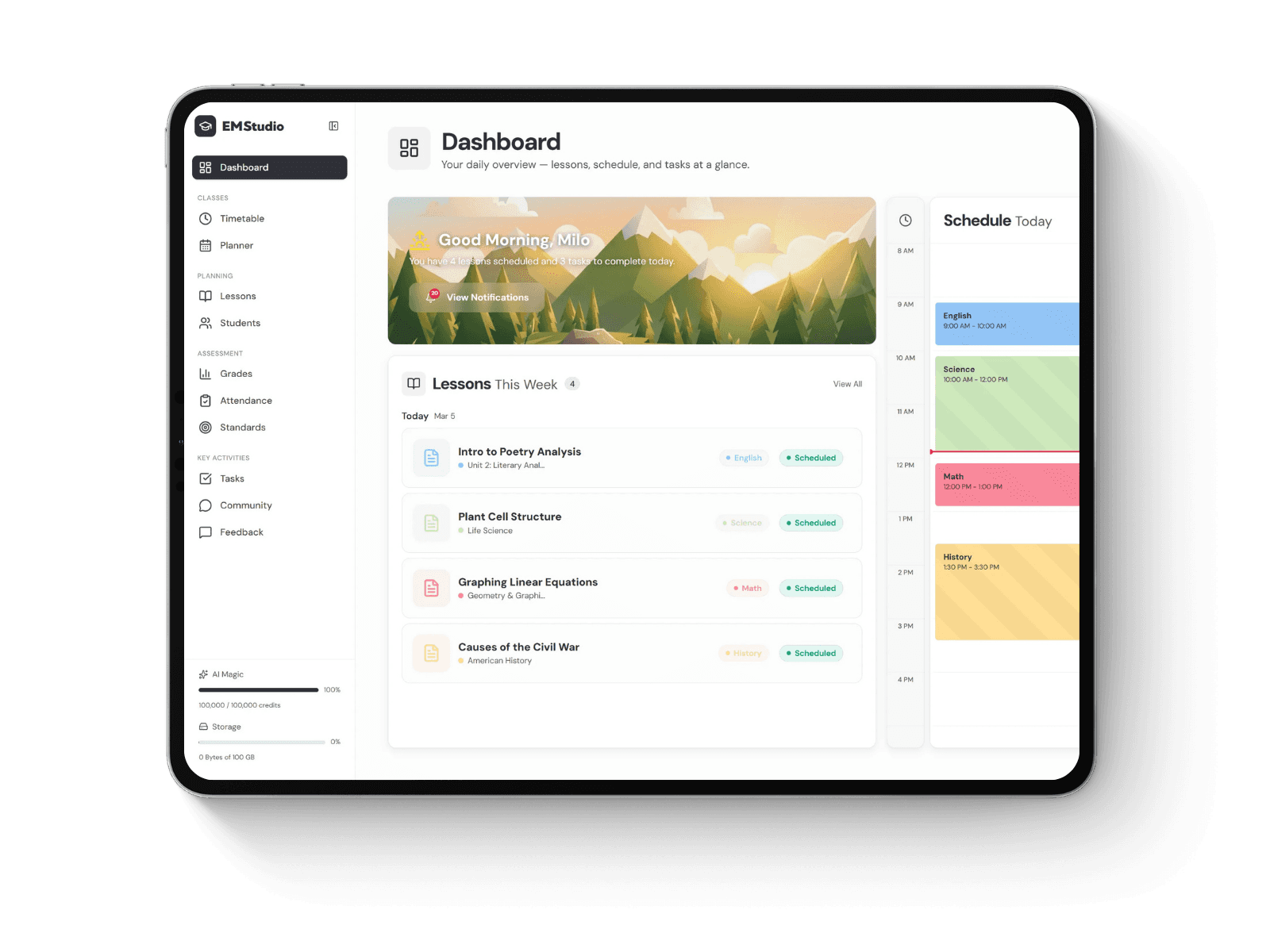
EMStudio is a free teaching management app — manage your classes, students, lessons, and more!
Learn More
Still grading everything by hand?
EMStudio is a free teaching management app — manage your classes, students, lessons, and more!
Learn More
Table of Contents
A student planning coursework in a Notion dashboard on a laptop. Search: “student laptop planner”.
Why Deadlines Slip, Even When You're Organised
Missed and rushed deadlines are rarely a motivation problem. They are a system problem. Most students keep deadlines in a mix of places, a syllabus PDF, a group chat, a vague memory, and rely on remembering to check them at the right moment.
Motivation makes this worse, not better, because it shows up when a task is new and disappears exactly when you need it, the week everything is due.
This matters even more now that most students work while they study: in October 2024, 44.6% of full-time and 81.6% of part-time US college students were in the labour force (BLS, 2025). With a job in the mix, you cannot afford to run your coursework on memory.
A single trusted system, checked on a schedule, is what keeps everything from slipping.

Figure 1: A consistent, tracked system protects your deadlines far better than last-minute effort (illustrative).
Build Your Notion Command Centre
The foundation of the whole system is one Notion database, an Assignments table, that becomes the single source of truth for everything you owe.
Rather than scattered pages, you create one database and give each assignment a row with a few key properties: the course, the due date, a status, a priority, and a rough estimate of how long it will take. The power comes from the views.
The same data can appear as a calendar so you see the month at a glance, a board grouped by status so you can drag tasks from “To do” to “In progress” to “Done,” and a filtered list showing only what is due this week.
One database, several lenses, zero things falling through the cracks.
The Weekly Deadline System
A database only works if you feed it. Run this five-step loop every week and the system stays alive instead of becoming another abandoned template.
STEP 1 Capture every deadline in your Notion database the moment you learn it |
↓
STEP 2 Break each assignment into small, dated subtasks |
↓
STEP 3 Time-block those subtasks onto your calendar view |
↓
STEP 4 Work from the “due this week” view, not the whole list |
↓
STEP 5 Run a 15-minute review every Sunday and roll over anything unfinished |
Figure 2: A five-step weekly loop that keeps your Notion workspace, and your deadlines, under control.
Step two is where the magic happens. “Essay due in two weeks” is intimidating and easy to avoid; the same essay entered as “pick a question, gather five sources, outline, draft, edit,” each with its own date, becomes a series of one-hour tasks you can actually start. Deadlines do not cause stress. Undefined, unscheduled work does, and breaking tasks down in Notion removes exactly that.
Your Notion Dashboard: What to Track
You do not need forty properties. A handful, used consistently, does the job.
Property | Why it earns its place | Example |
Course | Lets you filter and balance work across modules | BIOL 210 |
Due date | Powers the calendar view and “due this week” filter | Oct 18 |
Status | Drives the board so progress is visible at a glance | In progress |
Priority | Separates the urgent-and-important from busywork | High |
Est. time | Helps you time-block realistically, not hopefully | 3 hrs |
Table 1: Five simple properties turn a list into a working command centre.
A Sample Week in Notion
Here is the system in motion for a student taking four modules with a part-time job. On Sunday evening they open the database, filter to the next two weeks, and see an essay due Friday and a problem set due the following Monday. They break the essay into subtasks, drag them onto the calendar around classes and shifts, and set the problem set as next week's focus. Monday to Thursday, each day has one protected study block pulled straight from the “today” view, and a two-minute evening check to tick off what is done and adjust tomorrow.
The result is not a heroic all-nighter. It is steady, almost boring progress: the essay due Friday is largely written by Wednesday because the subtasks were scheduled, not left to chance. The student is not working more hours than their cramming classmates, they are working earlier and in smaller pieces, guided by a system that tells them exactly what to do next.
When to Ask for Help
A good system prevents most crises, but not all of them. Some weeks genuinely contain more work than hours, a placement clashes with three deadlines, illness strikes, or a topic simply will not click in time. Recognising overload early, and acting on it, is itself a skill, and it beats sliding silently toward a missed deadline.
When several major assignments collide, it helps to know your options before you are in the panic zone. Some students lean on campus writing centres or study groups; others use professional assignment help to manage the research and structure of one piece so they can stay on top of everything else. Used sensibly, as support in a genuine crunch rather than a substitute for learning, and in line with your institution's rules, that kind of backup is the difference between a controlled week and a crisis one. Build the awareness into your Notion system, a simple “if overloaded” note in your review, so that when a real crunch hits you reach for a plan instead of an all-nighter.
Common Mistakes to Avoid
Keeping deadlines outside Notion. If it isn't in your database, it doesn't exist; capture everything immediately.
Over-designing the template. A pretty dashboard you don't update is worse than a plain one you do.
Tracking without time-blocking. A due date isn't a plan until the work has a slot on your calendar.
Skipping the weekly review. Without it, you can't see what's slipping until it's already late.
Protect Your Energy
A system is only useful if you can keep running it, so build it to be sustainable rather than heroic. Set an end time for study each day, take real breaks between focus blocks, and use Notion's small wins, ticking a subtask to “Done,” as genuine motivation. Consistency, not intensity, is what quietly separates the students who always seem on top of their deadlines from those who are perpetually behind. A calm routine you can run all term will always beat a burst of effort that burns out by week three.
Frequently Asked Questions
Do I need a paid Notion plan for this?
No. The free plan is more than enough for a personal assignment database with calendar, board, and filtered views. Paid plans mainly add collaboration features you don't need for solo study.
How far ahead should I start an assignment?
Capture it the moment it's set, and schedule its first small subtask within a day or two. A two-week assignment shouldn't have its first task starting in week two, that's how last-minute scrambles happen.
What if I keep ignoring my Notion dashboard?
Make checking it a trigger-based habit, tie it to something you already do, like opening your laptop for class. And simplify: an overloaded dashboard is easy to avoid, while a clean “due this week” view is easy to act on. If it still isn't sticking, shrink the system further, sometimes a single filtered view you check each morning does more real work than an elaborate dashboard you never open.
Is it okay to get outside help with assignments?
Used the right way, yes, tutoring, writing centres, or professional assignment help can keep you on track during genuine crunch periods. The key is to treat it as a way to learn and manage workload, within your institution's rules, not as a shortcut around understanding the material.
The Bottom Line
Notion won't save your deadlines on its own, but a simple system built inside it will. Capture every assignment in one database, break each into dated subtasks, time-block them, work from a “this week” view, and review every Sunday. Add the judgement to ask for help when a week is genuinely overloaded, protect your energy, and “assignment due Friday” stops being a source of dread and becomes just another line on a plan you're already ahead of.
A student planning coursework in a Notion dashboard on a laptop. Search: “student laptop planner”.
Why Deadlines Slip, Even When You're Organised
Missed and rushed deadlines are rarely a motivation problem. They are a system problem. Most students keep deadlines in a mix of places, a syllabus PDF, a group chat, a vague memory, and rely on remembering to check them at the right moment.
Motivation makes this worse, not better, because it shows up when a task is new and disappears exactly when you need it, the week everything is due.
This matters even more now that most students work while they study: in October 2024, 44.6% of full-time and 81.6% of part-time US college students were in the labour force (BLS, 2025). With a job in the mix, you cannot afford to run your coursework on memory.
A single trusted system, checked on a schedule, is what keeps everything from slipping.
Figure 1: A consistent, tracked system protects your deadlines far better than last-minute effort (illustrative).
Build Your Notion Command Centre
The foundation of the whole system is one Notion database, an Assignments table, that becomes the single source of truth for everything you owe.
Rather than scattered pages, you create one database and give each assignment a row with a few key properties: the course, the due date, a status, a priority, and a rough estimate of how long it will take. The power comes from the views.
The same data can appear as a calendar so you see the month at a glance, a board grouped by status so you can drag tasks from “To do” to “In progress” to “Done,” and a filtered list showing only what is due this week.
One database, several lenses, zero things falling through the cracks.
The Weekly Deadline System
A database only works if you feed it. Run this five-step loop every week and the system stays alive instead of becoming another abandoned template.
STEP 1 Capture every deadline in your Notion database the moment you learn it |
↓
STEP 2 Break each assignment into small, dated subtasks |
↓
STEP 3 Time-block those subtasks onto your calendar view |
↓
STEP 4 Work from the “due this week” view, not the whole list |
↓
STEP 5 Run a 15-minute review every Sunday and roll over anything unfinished |
Figure 2: A five-step weekly loop that keeps your Notion workspace, and your deadlines, under control.
Step two is where the magic happens. “Essay due in two weeks” is intimidating and easy to avoid; the same essay entered as “pick a question, gather five sources, outline, draft, edit,” each with its own date, becomes a series of one-hour tasks you can actually start. Deadlines do not cause stress. Undefined, unscheduled work does, and breaking tasks down in Notion removes exactly that.
Your Notion Dashboard: What to Track
You do not need forty properties. A handful, used consistently, does the job.
Property | Why it earns its place | Example |
Course | Lets you filter and balance work across modules | BIOL 210 |
Due date | Powers the calendar view and “due this week” filter | Oct 18 |
Status | Drives the board so progress is visible at a glance | In progress |
Priority | Separates the urgent-and-important from busywork | High |
Est. time | Helps you time-block realistically, not hopefully | 3 hrs |
Table 1: Five simple properties turn a list into a working command centre.
A Sample Week in Notion
Here is the system in motion for a student taking four modules with a part-time job. On Sunday evening they open the database, filter to the next two weeks, and see an essay due Friday and a problem set due the following Monday. They break the essay into subtasks, drag them onto the calendar around classes and shifts, and set the problem set as next week's focus. Monday to Thursday, each day has one protected study block pulled straight from the “today” view, and a two-minute evening check to tick off what is done and adjust tomorrow.
The result is not a heroic all-nighter. It is steady, almost boring progress: the essay due Friday is largely written by Wednesday because the subtasks were scheduled, not left to chance. The student is not working more hours than their cramming classmates, they are working earlier and in smaller pieces, guided by a system that tells them exactly what to do next.
When to Ask for Help
A good system prevents most crises, but not all of them. Some weeks genuinely contain more work than hours, a placement clashes with three deadlines, illness strikes, or a topic simply will not click in time. Recognising overload early, and acting on it, is itself a skill, and it beats sliding silently toward a missed deadline.
When several major assignments collide, it helps to know your options before you are in the panic zone. Some students lean on campus writing centres or study groups; others use professional assignment help to manage the research and structure of one piece so they can stay on top of everything else. Used sensibly, as support in a genuine crunch rather than a substitute for learning, and in line with your institution's rules, that kind of backup is the difference between a controlled week and a crisis one. Build the awareness into your Notion system, a simple “if overloaded” note in your review, so that when a real crunch hits you reach for a plan instead of an all-nighter.
Common Mistakes to Avoid
Keeping deadlines outside Notion. If it isn't in your database, it doesn't exist; capture everything immediately.
Over-designing the template. A pretty dashboard you don't update is worse than a plain one you do.
Tracking without time-blocking. A due date isn't a plan until the work has a slot on your calendar.
Skipping the weekly review. Without it, you can't see what's slipping until it's already late.
Protect Your Energy
A system is only useful if you can keep running it, so build it to be sustainable rather than heroic. Set an end time for study each day, take real breaks between focus blocks, and use Notion's small wins, ticking a subtask to “Done,” as genuine motivation. Consistency, not intensity, is what quietly separates the students who always seem on top of their deadlines from those who are perpetually behind. A calm routine you can run all term will always beat a burst of effort that burns out by week three.
Frequently Asked Questions
Do I need a paid Notion plan for this?
No. The free plan is more than enough for a personal assignment database with calendar, board, and filtered views. Paid plans mainly add collaboration features you don't need for solo study.
How far ahead should I start an assignment?
Capture it the moment it's set, and schedule its first small subtask within a day or two. A two-week assignment shouldn't have its first task starting in week two, that's how last-minute scrambles happen.
What if I keep ignoring my Notion dashboard?
Make checking it a trigger-based habit, tie it to something you already do, like opening your laptop for class. And simplify: an overloaded dashboard is easy to avoid, while a clean “due this week” view is easy to act on. If it still isn't sticking, shrink the system further, sometimes a single filtered view you check each morning does more real work than an elaborate dashboard you never open.
Is it okay to get outside help with assignments?
Used the right way, yes, tutoring, writing centres, or professional assignment help can keep you on track during genuine crunch periods. The key is to treat it as a way to learn and manage workload, within your institution's rules, not as a shortcut around understanding the material.
The Bottom Line
Notion won't save your deadlines on its own, but a simple system built inside it will. Capture every assignment in one database, break each into dated subtasks, time-block them, work from a “this week” view, and review every Sunday. Add the judgement to ask for help when a week is genuinely overloaded, protect your energy, and “assignment due Friday” stops being a source of dread and becomes just another line on a plan you're already ahead of.
Still grading everything by hand?
EMStudio is a free teaching management app — manage your classes, students, lessons, and more!
Learn More
Still grading everything by hand?
EMStudio is a free teaching management app — manage your classes, students, lessons, and more!
Learn More



Notion4Teachers
Notion templates to simplify administrative tasks and enhance your teaching experience.



2026 Notion4Teachers. All Rights Reserved.
Notion4Teachers
Notion templates to simplify administrative tasks and enhance your teaching experience.
2026 Notion4Teachers. All Rights Reserved.
Notion4Teachers
Notion templates to simplify administrative tasks and enhance your teaching experience.
2026 Notion4Teachers. All Rights Reserved.