How Students Can Use Notion to Manage a Research Project or Dissertation
How Students Can Use Notion to Manage a Research Project or Dissertation

Article by
Milo
ESL Content Coordinator & Educator
ESL Content Coordinator & Educator
All Posts
GUEST POST FOR notion4teachers.com
Outgoing link: Buy Assignment Online — https://buyassignmentonline.com/resources/academic-research/what-is-empirical-research/ (anchor: empirical research)
Placement: One contextual link in the “strengthen your evidence” section. Please keep dofollow.
Word count: ~1,560 | Includes: hero image, chart, 2 tables, step diagram, worked example, FAQs.
Note: The mark-deduction chart is illustrative. Please verify any statistics you keep before publishing.
Images: a hero banner and a chart are embedded. Optional extra photo:
A dissertation or major research project is as much an organisational challenge as an intellectual one.
Over months you gather dozens of sources, hundreds of notes, and a moving list of tasks, and if any of it lives only in scattered files or your memory, you lose time you cannot spare and, worse, you lose citations you needed.
Notion is a natural home for all of it: a single workspace to store sources, capture notes, track tasks, and see the whole project at a glance. But organisation is only half the job. A tidy Notion hub built on weak evidence still earns weak marks.
This guide covers both: how to structure your research in Notion, and how to make sure the research itself is sound, because the two together are what separate a project that merely looks organised from one that actually earns the grade.
Still grading everything by hand?
EMStudio is a free teaching management app — manage your classes, students, lessons, and more!
Learn More

Still grading everything by hand?
EMStudio is a free teaching management app — manage your classes, students, lessons, and more!
Learn More
Table of Contents
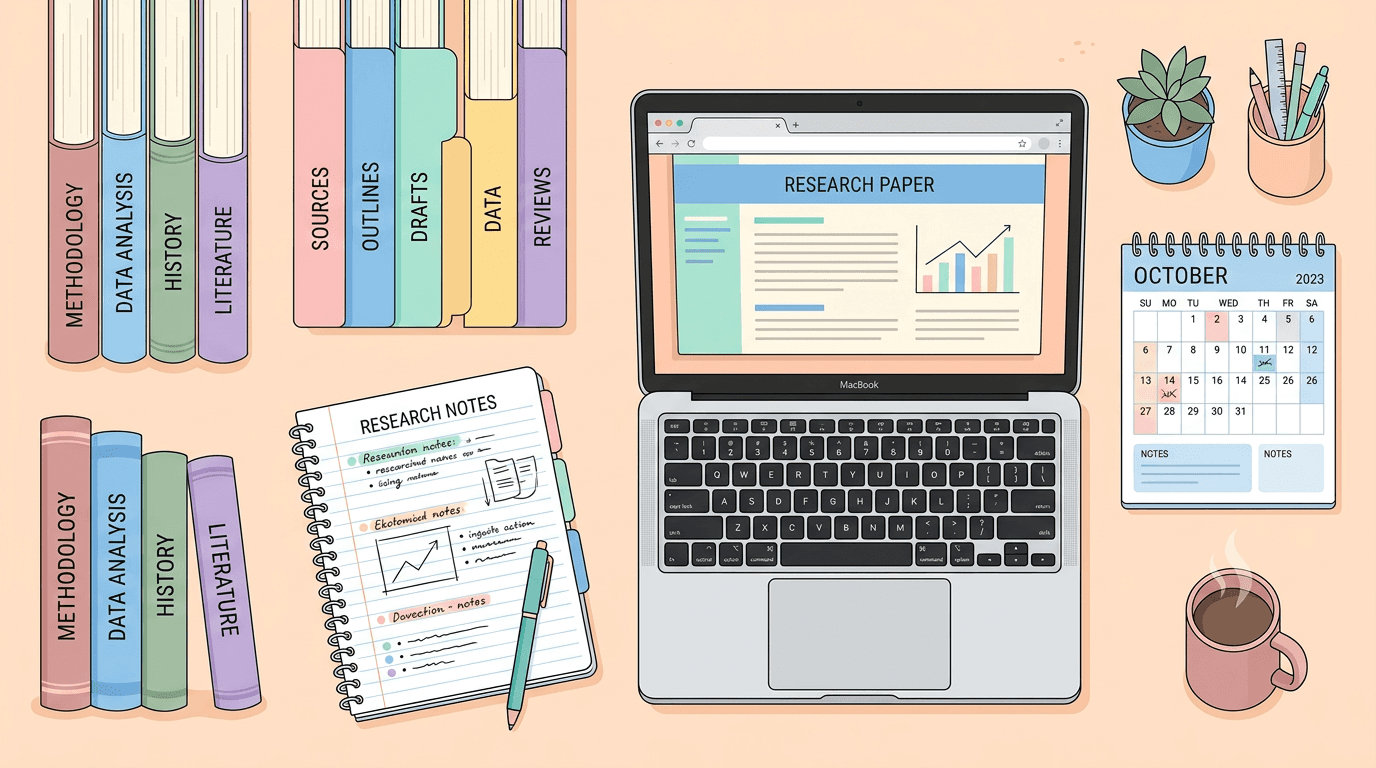
A student organising research sources in Notion on a laptop. Search: “research notes laptop”.
Why Organised Research Wins (and Weak Evidence Loses)
The students who struggle with big projects rarely lack ideas; they lose control of their material. A quote they can no longer find, a source they forgot to record, a method they cannot quite justify, these are the small failures that drain marks. And the single biggest one is evidence.
When examiners deduct marks, the most common reason is not a typo or a late submission; it is claims that are not properly supported by sound research and analysis. A Notion research hub solves the organisation half by keeping every source, note, and task in one linked, searchable place.
The rest of this guide makes sure the evidence inside it is strong enough to carry the argument.

Figure 1: Weak evidence and analysis is the most common way research projects lose marks (illustrative).
The Research Process, Step by Step
Good research follows a sequence, and building that sequence into Notion keeps you from skipping steps under deadline pressure.
STEP 1 Define a clear, answerable research question |
↓
STEP 2 Run a literature review to see what's already known |
↓
STEP 3 Choose a method that actually answers the question |
↓
STEP 4 Collect your data or evidence systematically |
↓
STEP 5 Analyse the results honestly, including what surprises you |
↓
STEP 6 Write up and cite every claim back to its source |
Figure 2: The research loop, each stage a Notion database or page so nothing gets skipped or lost.
The order matters. A question that is too broad makes every later step harder; a method chosen before the question is fully clear often answers the wrong thing. Mapping these stages as linked Notion pages means you always know where you are, and what still has to happen before you can write with confidence.
Build a Notion Research Hub
Three linked databases do most of the work. Keep them simple and connect them with relations so a note always points back to its source.
Database | What it does | Key fields |
Sources | Your reference library, so nothing is ever lost | Author, year, type, link, citation |
Notes / evidence | Quotes and findings, each linked to a source | Note, theme, source (relation) |
Tasks | The project broken into dated, trackable steps | Task, stage, due date, status |
Table 1: A three-database hub that keeps sources, evidence, and tasks connected and searchable.
Know Your Evidence: Qualitative vs Quantitative
Strong research starts with matching the right kind of evidence to your question. A quick orientation:
Approach | Best for questions about… | Typical evidence |
Quantitative | How much, how many, how often, relationships | Surveys, measurements, statistics |
Qualitative | Why and how, meaning, experience | Interviews, case studies, texts |
Mixed methods | Both the scale and the story behind it | A combination of the above |
Table 2: Match the approach to the question before you gather a single data point.
A Worked Example
Say your question is whether flexible study schedules improve outcomes for working students.
In Notion, you'd log every source in the Sources database as you read, drop key findings into the Notes database linked to each source, and tag them by theme, “flexibility,” “stress,” “grades.” When you sit down to write the results, you filter the Notes database by theme and your evidence is already grouped and cited.
Because each note points back to a source, there is no frantic hunt for “who said that?” at 2am, and no accidental uncited claim slipping into the final draft. The organisation directly protects the mark.
It also makes analysis easier: once your evidence is grouped by theme, patterns and contradictions across sources become visible instead of staying buried in a folder of PDFs, and spotting those patterns is where the strongest marks are won.
Strengthen Your Evidence Before You Submit
Once the hub is built, the deciding factor is the quality of what's inside it. Before you write a conclusion, check that every claim traces back to solid empirical research, evidence grounded in real observation and data rather than assumption or a single unverified source. Ask of each key point: what is this based on, is the source credible and recent, and does the evidence actually support the claim, or just sit near it? Weak or thin evidence is the fastest way to lose marks, so treat this pass as seriously as proofreading. If you're unsure whether a section is properly supported, that's exactly the moment to revisit your sources, or seek guidance, rather than hope an examiner won't notice.
Common Research Mistakes to Avoid
Collecting before questioning. Gathering sources without a sharp question wastes weeks; define the question first.
Losing your citations. Log every source the moment you use it; back-filling references is where errors creep in.
Cherry-picking evidence. Report what challenges your argument too; ignoring it weakens the whole project.
Confusing description with analysis. Marks come from interpreting evidence, not just summarising it.
Referencing and Integrity
A well-organised hub makes referencing almost automatic, which protects both your marks and your integrity. Keep full citation details in the Sources database from the first day, so your bibliography assembles itself rather than becoming a last-minute scramble.
Follow your required style exactly, whether APA, Harvard, or another, and make sure every quotation and paraphrase is attributed. Good referencing is not bureaucracy; it is the visible proof that your argument rests on real evidence, which is precisely what strong research is.
It is also your best protection against accidental plagiarism, since a source logged the moment you use it can never quietly become an uncredited claim in the final draft.
From Hub to First Draft
The final advantage of a Notion research hub is how smoothly it turns into a draft.
Because your evidence is already grouped by theme and linked to its sources, each section of the write-up practically outlines itself: filter the Notes database to a theme and you have the material, and the citations, for that part of the argument in one place.
Write in short, focused sessions, one theme or sub-question at a time, and update each section's status in your Tasks database as you go.
This keeps a long dissertation from feeling like one impossible block and turns it into a sequence of manageable, evidence-backed sections you can actually finish, which is exactly how big projects get done without a last-minute collapse.
Frequently Asked Questions
Is Notion good enough for a whole dissertation?
For organising sources, notes, tasks, and drafts, yes, it's excellent, and the linked databases keep everything connected. Many students pair it with a dedicated reference manager for citation formatting, but Notion can hold the whole project's structure.
When should I start my literature review?
Early, right after you've drafted your question. Logging sources from day one in your Sources database means you're never reconstructing your reading list under deadline pressure, and you spot gaps in the evidence while there's still time to fill them.
How do I know if my evidence is strong enough?
Check each key claim against three tests: is the source credible, is it current, and does it directly support the point? If a claim rests on one weak or outdated source, strengthen it before you rely on it in your argument. A useful habit is to tag shaky claims in your Notes database as “needs support” so you can see, at a glance, exactly where your evidence still has gaps to close before submission.
Qualitative or quantitative, which is better?
Neither, in the abstract. The right approach is the one that answers your question. Questions of scale and frequency suit quantitative methods; questions of meaning and experience suit qualitative ones, and many projects sensibly use both.
The Bottom Line
A research project is won on two fronts: organisation and evidence. Use Notion to build a simple hub, sources, notes, and tasks in linked databases, so nothing is ever lost and referencing looks after itself. Then do the harder, more important work of making sure every claim rests on sound, well-analysed research. Get both right and the dissertation stops feeling like chaos and starts reading like what it is: a clear argument built on solid ground.
A student organising research sources in Notion on a laptop. Search: “research notes laptop”.
Why Organised Research Wins (and Weak Evidence Loses)
The students who struggle with big projects rarely lack ideas; they lose control of their material. A quote they can no longer find, a source they forgot to record, a method they cannot quite justify, these are the small failures that drain marks. And the single biggest one is evidence.
When examiners deduct marks, the most common reason is not a typo or a late submission; it is claims that are not properly supported by sound research and analysis. A Notion research hub solves the organisation half by keeping every source, note, and task in one linked, searchable place.
The rest of this guide makes sure the evidence inside it is strong enough to carry the argument.
Figure 1: Weak evidence and analysis is the most common way research projects lose marks (illustrative).
The Research Process, Step by Step
Good research follows a sequence, and building that sequence into Notion keeps you from skipping steps under deadline pressure.
STEP 1 Define a clear, answerable research question |
↓
STEP 2 Run a literature review to see what's already known |
↓
STEP 3 Choose a method that actually answers the question |
↓
STEP 4 Collect your data or evidence systematically |
↓
STEP 5 Analyse the results honestly, including what surprises you |
↓
STEP 6 Write up and cite every claim back to its source |
Figure 2: The research loop, each stage a Notion database or page so nothing gets skipped or lost.
The order matters. A question that is too broad makes every later step harder; a method chosen before the question is fully clear often answers the wrong thing. Mapping these stages as linked Notion pages means you always know where you are, and what still has to happen before you can write with confidence.
Build a Notion Research Hub
Three linked databases do most of the work. Keep them simple and connect them with relations so a note always points back to its source.
Database | What it does | Key fields |
Sources | Your reference library, so nothing is ever lost | Author, year, type, link, citation |
Notes / evidence | Quotes and findings, each linked to a source | Note, theme, source (relation) |
Tasks | The project broken into dated, trackable steps | Task, stage, due date, status |
Table 1: A three-database hub that keeps sources, evidence, and tasks connected and searchable.
Know Your Evidence: Qualitative vs Quantitative
Strong research starts with matching the right kind of evidence to your question. A quick orientation:
Approach | Best for questions about… | Typical evidence |
Quantitative | How much, how many, how often, relationships | Surveys, measurements, statistics |
Qualitative | Why and how, meaning, experience | Interviews, case studies, texts |
Mixed methods | Both the scale and the story behind it | A combination of the above |
Table 2: Match the approach to the question before you gather a single data point.
A Worked Example
Say your question is whether flexible study schedules improve outcomes for working students.
In Notion, you'd log every source in the Sources database as you read, drop key findings into the Notes database linked to each source, and tag them by theme, “flexibility,” “stress,” “grades.” When you sit down to write the results, you filter the Notes database by theme and your evidence is already grouped and cited.
Because each note points back to a source, there is no frantic hunt for “who said that?” at 2am, and no accidental uncited claim slipping into the final draft. The organisation directly protects the mark.
It also makes analysis easier: once your evidence is grouped by theme, patterns and contradictions across sources become visible instead of staying buried in a folder of PDFs, and spotting those patterns is where the strongest marks are won.
Strengthen Your Evidence Before You Submit
Once the hub is built, the deciding factor is the quality of what's inside it. Before you write a conclusion, check that every claim traces back to solid empirical research, evidence grounded in real observation and data rather than assumption or a single unverified source. Ask of each key point: what is this based on, is the source credible and recent, and does the evidence actually support the claim, or just sit near it? Weak or thin evidence is the fastest way to lose marks, so treat this pass as seriously as proofreading. If you're unsure whether a section is properly supported, that's exactly the moment to revisit your sources, or seek guidance, rather than hope an examiner won't notice.
Common Research Mistakes to Avoid
Collecting before questioning. Gathering sources without a sharp question wastes weeks; define the question first.
Losing your citations. Log every source the moment you use it; back-filling references is where errors creep in.
Cherry-picking evidence. Report what challenges your argument too; ignoring it weakens the whole project.
Confusing description with analysis. Marks come from interpreting evidence, not just summarising it.
Referencing and Integrity
A well-organised hub makes referencing almost automatic, which protects both your marks and your integrity. Keep full citation details in the Sources database from the first day, so your bibliography assembles itself rather than becoming a last-minute scramble.
Follow your required style exactly, whether APA, Harvard, or another, and make sure every quotation and paraphrase is attributed. Good referencing is not bureaucracy; it is the visible proof that your argument rests on real evidence, which is precisely what strong research is.
It is also your best protection against accidental plagiarism, since a source logged the moment you use it can never quietly become an uncredited claim in the final draft.
From Hub to First Draft
The final advantage of a Notion research hub is how smoothly it turns into a draft.
Because your evidence is already grouped by theme and linked to its sources, each section of the write-up practically outlines itself: filter the Notes database to a theme and you have the material, and the citations, for that part of the argument in one place.
Write in short, focused sessions, one theme or sub-question at a time, and update each section's status in your Tasks database as you go.
This keeps a long dissertation from feeling like one impossible block and turns it into a sequence of manageable, evidence-backed sections you can actually finish, which is exactly how big projects get done without a last-minute collapse.
Frequently Asked Questions
Is Notion good enough for a whole dissertation?
For organising sources, notes, tasks, and drafts, yes, it's excellent, and the linked databases keep everything connected. Many students pair it with a dedicated reference manager for citation formatting, but Notion can hold the whole project's structure.
When should I start my literature review?
Early, right after you've drafted your question. Logging sources from day one in your Sources database means you're never reconstructing your reading list under deadline pressure, and you spot gaps in the evidence while there's still time to fill them.
How do I know if my evidence is strong enough?
Check each key claim against three tests: is the source credible, is it current, and does it directly support the point? If a claim rests on one weak or outdated source, strengthen it before you rely on it in your argument. A useful habit is to tag shaky claims in your Notes database as “needs support” so you can see, at a glance, exactly where your evidence still has gaps to close before submission.
Qualitative or quantitative, which is better?
Neither, in the abstract. The right approach is the one that answers your question. Questions of scale and frequency suit quantitative methods; questions of meaning and experience suit qualitative ones, and many projects sensibly use both.
The Bottom Line
A research project is won on two fronts: organisation and evidence. Use Notion to build a simple hub, sources, notes, and tasks in linked databases, so nothing is ever lost and referencing looks after itself. Then do the harder, more important work of making sure every claim rests on sound, well-analysed research. Get both right and the dissertation stops feeling like chaos and starts reading like what it is: a clear argument built on solid ground.
Still grading everything by hand?
EMStudio is a free teaching management app — manage your classes, students, lessons, and more!
Learn More
Still grading everything by hand?
EMStudio is a free teaching management app — manage your classes, students, lessons, and more!
Learn More




Notion4Teachers
Notion templates to simplify administrative tasks and enhance your teaching experience.



2026 Notion4Teachers. All Rights Reserved.
Notion4Teachers
Notion templates to simplify administrative tasks and enhance your teaching experience.
2026 Notion4Teachers. All Rights Reserved.
Notion4Teachers
Notion templates to simplify administrative tasks and enhance your teaching experience.
2026 Notion4Teachers. All Rights Reserved.