
SAT Grammar Practice That Actually Moves Scores
SAT Grammar Practice That Actually Moves Scores

Article by
Milo
ESL Content Coordinator & Educator
ESL Content Coordinator & Educator
All Posts
Table of Contents
Most SAT grammar practice fails because it treats grammar like vocabulary, memorize the rule, circle the right choice, move on. That worked better on the old paper section, but the digital SAT now hides grammar inside short, adaptive Reading and Writing passages, so the student who “knows the rule” can still miss a boundary question, a meaning change, or a rushed agreement decision. The core task is not rule recall. It's error diagnosis under adaptive-test conditions.
That shift matters because the Reading and Writing section is now 54 questions over 64 minutes, split into two adaptive modules, and Standard English Conventions still makes up about 26% of the section, or roughly 11 to 15 questions depending on the form, according to College Board specifications (digital SAT test overview). Grammar is not a side issue. It's one of the largest score levers on the section.
The better question is not “Which rules should a student memorize?” It's “Why does a student miss questions they can explain after the fact?” The answer usually sits in the gap between rule knowledge and live decision-making. Timing, passage context, distractor design, and the first adaptive module all shape outcomes.

Why Most SAT Grammar Practice Stalls Before It Starts
A lot of students spend weeks doing grammar drills and still miss the same questions. Effort is rarely the problem. The practice is built around rule recognition instead of decision quality in context. On the digital SAT, grammar questions do not show up as neat worksheets. They appear inside short passages where the wrong answer can sound fine but weaken meaning.
The format changed, the habit often did not
The old paper SAT had a separate Writing and Language section with 44 questions in 35 minutes, focused on grammar, usage, punctuation, and revision in longer passages. The digital SAT, introduced internationally in 2023 and adopted for U.S. administrations in 2024, replaced that with one adaptive Reading and Writing section containing 54 questions across two 27-question modules, with 32 minutes per module (SAT syllabus overview). That shift matters because students now edit inside shorter contexts, not longer paper-era passages.
The same rule can still appear, but the test environment is different. A student who can name the difference between a semicolon and a comma splice may still lose points if they choose an answer that keeps the grammar intact but changes the sentence's logic. Old materials still help with core rules, but they do not cover current timing and structure well enough on their own.
Practical rule: If practice feels like flashcards, it is probably missing the test conditions the digital SAT creates.
What actually costs points
The most common misses are not exotic. They are boundary decisions, agreement choices, pronouns, and edits that shift meaning. The Reading and Writing section's Standard English Conventions domain covers sentence boundaries, form, structure, and sense, and it remains a major part of the section. Grammar questions still carry real score value, but they are less forgiving in context.
A student can also lose ground by mishandling the first module. Because the test is adaptive, early accuracy affects later difficulty. That means rushing through a simple punctuation item can change the level of the next set. The student is not just answering one question. They are shaping the difficulty of what follows.
What to stop doing
Stop drilling isolated rules only. Rules matter, but they do not teach live sentence parsing.
Stop treating every miss as the same miss. A comma splice and a pronoun-reference error need different reteaching.
Stop timing practice loosely. If a student spends far longer per item than the exam allows, the drill teaches comfort, not performance.
SAT grammar practice has to produce a diagnosis, not just a score. A Notion-backed feedback loop turns missed questions into targeted reteaching, which is the part that changes results.
The Seven Rules That Earn the Most Points
The digital SAT grammar section isn't random. It keeps returning to a small set of structures, and students usually gain the most by mastering the ones that show up constantly in passage-based editing. The point isn't to memorize every rule in the English language. It's to spot the patterns that the test keeps recycling.
Punctuation and sentence boundaries
Commas separate removable information, items in a list, and certain introductory elements. They do not join two complete sentences by themselves. If both sides have a subject and finite verb, the student needs a semicolon, a period, or a comma plus a coordinating conjunction.
Semicolons join two complete clauses. Colons introduce an explanation, list, or example after a complete clause. Dashes can set off nonessential information, but they must be used consistently when the interrupting phrase sits in the middle of the sentence.
A quick test helps: if removing the punctuation leaves two full sentences, the punctuation probably needs upgrading. If the second part explains the first, a colon may fit. If the two parts are independent but closely linked, semicolon territory is likely.
Verb tense and agreement
Verb questions on the SAT are usually about timeline and subject number, not style. The student should ask what happened first, what is happening now, and whether the subject is singular or plural. A long prepositional phrase can hide the true subject, so the trick is to strip away decorative language and find the noun doing the work.
Agreement errors often look obvious once the sentence is simplified. The issue is that the test hides them inside long noun phrases. The best habit is to locate the subject before reading the answer choices.
Pronouns
Pronouns need a clear antecedent and the right number. If a sentence says “this,” “it,” “they,” or “them,” the student should check whether the reference is obvious and grammatically matched. The digital SAT likes pronouns that sound smooth but point vaguely, or number-shift in a way that feels invisible on a quick read.
Modifiers
Modifiers must sit next to the noun they describe. If an opening phrase describes the wrong noun, the sentence becomes illogical even if the words are grammatically correct. That's why modifier questions reward careful sentence mapping more than vocabulary knowledge.
Parallelism and concision
Lists need matching grammatical form. If the first two items are gerunds, the third should be a gerund too. If a sentence says the same thing twice, the cleaner version usually wins. SAT grammar practice should train students to remove repetition without deleting meaning.
Apostrophes and possessives
Apostrophes still trip students up because they look small but carry a lot of meaning. Its is possessive, it's means “it is.” Singular ownership takes apostrophe plus s, plural ownership usually takes just the apostrophe. That distinction keeps appearing because it's easy to miss under time pressure.
A student who can name the rule but cannot identify the clause still does not control the question.
The practical order is clear. Drill punctuation and boundaries first, then verb form and agreement, then pronouns and modifiers, then parallelism and concision. That sequence matches the rules the test repeats most aggressively and the errors students usually make first.
A Decision Tree for Passage Editing
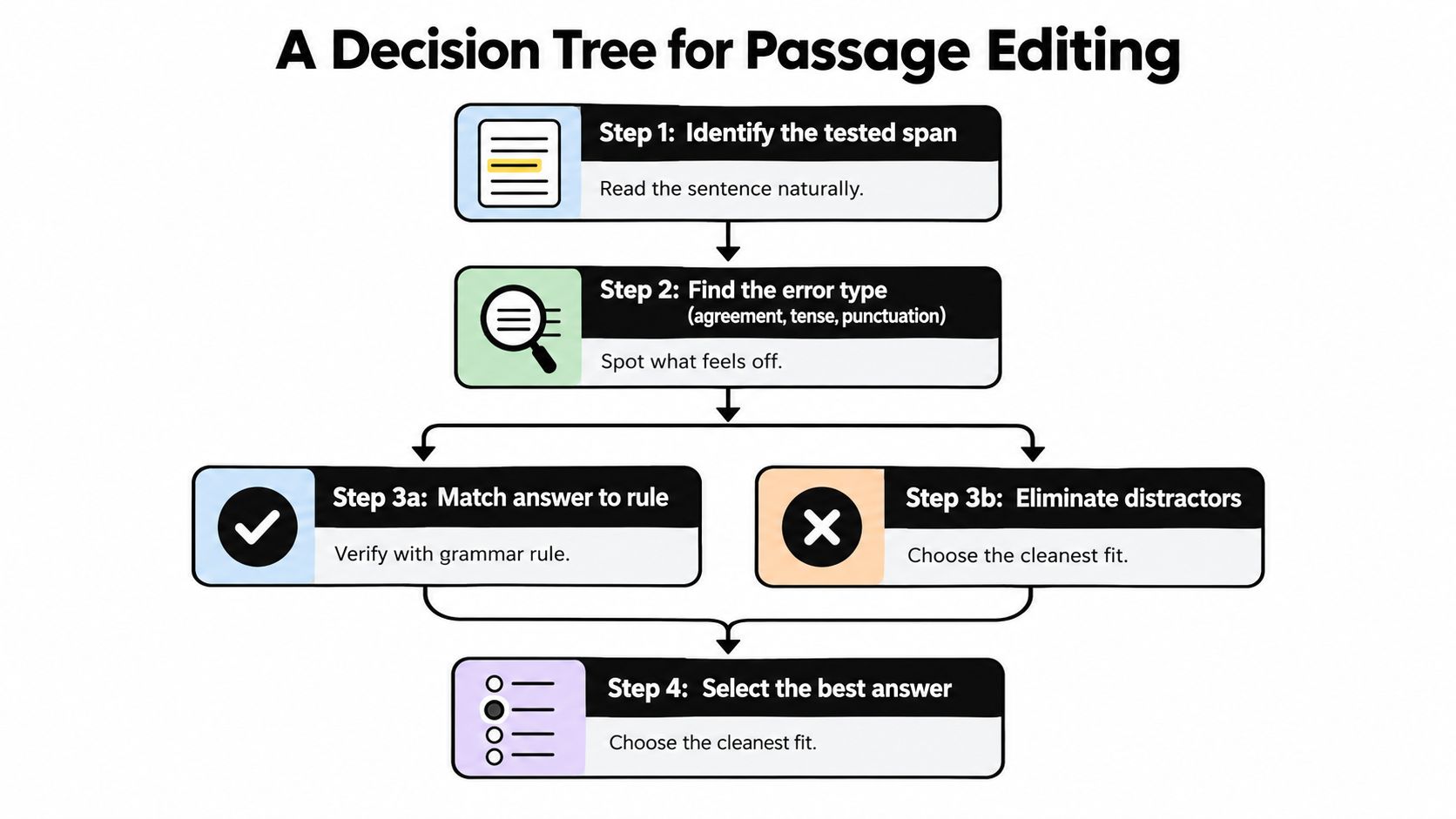
Grammar questions on the digital SAT get easier when students stop reading them like grammar questions. The move is to read them like editing tasks. That means identifying the tested span, finding the clause structure, and checking whether the best answer preserves both grammar and meaning.
The four-step read
Start with the exact words under test. Then find the subject and finite verb on each side of the blank. Then decide whether each side is independent or dependent. Only after that should the student test punctuation, agreement, or sentence structure.
A workable sequence looks like this:
Identify the tested span. Read the sentence naturally and mark the blank or underlined phrase.
Find the clause skeleton. Locate the subject and main verb on both sides.
Classify the structure. Independent clause, dependent clause, modifier, list, or interruption.
Test meaning last. Keep the option that preserves logic, concision, and rhetorical fit.
The most common trap is choosing an answer that is grammatical but changes the relationship between ideas. The second trap is treating a comma as if it can connect two full clauses. The third is rushing past the first clause before the sentence structure is even clear.
A worked example
Take a sentence like this: “The researcher finished the trial, however, the data still looked inconsistent.” The phrase however signals a contrast, but the two parts are both complete clauses. A comma alone is not enough. The student should test whether a semicolon before however and a comma after it makes the whole sentence legal and keeps the contrast intact.
If an answer choice changes the meaning to cause-and-effect, that choice is wrong even if the punctuation is clean. If another answer choice is grammatical but awkward, the student should still compare it against the clearest version. SAT grammar rewards the option that is both correct and clean.
The four habits that quietly erase points
Grammatically fine, meaning wrong. The sentence still parses, but the logic changes.
Ignoring the surrounding sentence. The blank often depends on what came before it.
Treating commas as connectors. A comma doesn't magically join independent clauses.
Rushing the first clause. If the subject and verb are unclear, the rest of the question is guesswork.
Use the decision tree until it becomes automatic. That's how a student stops hunting for familiar-looking answer choices and starts checking the structure that matters.
How Makon AI Can Help
For students who need more than a static worksheet, Makon AI is a reasonable fit because it combines an adaptive study planner, a practice library, mock tests, analytics, and an AI tutor in one place. It's built for SAT, ACT, and AP prep, so it works best when grammar practice has to sit inside a broader test-prep routine rather than live as a separate activity.
The biggest advantage is feedback. A student who keeps missing boundary or agreement questions can use targeted drills, saved questions, and review tools to turn misses into a repeatable correction loop. The platform's SAT grammar practice guide is especially useful when a learner needs a compact reference for the rules themselves.

When it makes sense
Makon AI makes the most sense for students who need structure, not just content. If a learner is drifting between random drills, forgetting what they missed last week, or practicing without a clear review cycle, an adaptive system can help keep the work organized. Teachers and tutors also get more value from a tool like this when they need progress visibility across multiple students.
The platform's strength is less about “more questions” and more about keeping practice connected to diagnosis. That matters in SAT grammar because the section rewards repeat recognition of a few high-frequency patterns, not broad exposure to endless exercises.
When it is not the first choice
It's not automatically the right move for a student who already has a clean error log and only needs a few focused drills. In that case, the bottleneck isn't access to practice, it's the quality of review. A student in that position may be better served by a simpler routine built around a notebook, a spreadsheet, or Notion.
Still, for learners who need a single workspace with planning, drills, and analytics in one place, Makon AI is worth considering. It's most useful when the student needs to stop guessing at what went wrong and start training the exact subskill that broke.
The Six-Step Feedback Loop That Makes Practice Stick
A missed grammar question should never just be “wrong.” It should become a labeled event with a reason, a fix, and a retest date. That's the difference between practice that accumulates and practice that evaporates.
The loop below is what keeps SAT grammar practice from turning into repetitive busywork.
1. Diagnose the subskill
Every miss gets a label: comma splice, semicolon, subject-verb agreement, pronoun reference, modifier placement, parallelism, or concision. If a student missed a punctuation item, the next question is not “Why did you miss punctuation?” It's “What kind of punctuation decision broke down?”
A weak diagnosis says “grammar.” A strong diagnosis says “independent clauses were joined with a comma.”
2. Rewrite the sentence
The student rewrites the sentence in plain English and explains why each answer choice is grammatical or ungrammatical. This forces the student to slow down and prove the rule, not just recognize the right letter.
A correct answer with a weak explanation should still count as unstable. The student may have guessed correctly or matched a pattern by sight. If the rule can't be defended, the mastery isn't real yet.
3. Log the mistake
A simple error log should record the rule, the trigger, the confidence level, and the explanation quality. A Notion database works well because it can keep every miss tied to the same labels and later show whether the same error keeps returning.
For spaced review frameworks, the logic pairs well with a classroom system like this Notion-based spaced repetition guide.
4. Drill the exact subskill
The next practice set should be short, usually 8 to 12 items of one type. A student who missed semicolons doesn't need a mixed bag of random items immediately. The first job is to stabilize the rule in a narrow context.
5. Retest after a delay
The student revisits the same subskill after 48 to 72 hours. That delay matters because immediate repetition can make accuracy look better than it is. If the student can't reproduce the correct reasoning two days later, the skill hasn't stuck.
6. Mix the questions again
Once the subskill reaches reliable accuracy, the student moves back to mixed sets. That transfer step matters because the digital SAT doesn't isolate grammar into tidy bins. A student has to recognize the rule inside a short passage with competing signals.
Best habit: the explanation has to survive a retest, not just the first correction.
The loop only works when accuracy and explanation are tracked separately. Students can answer right for the wrong reason, and that false comfort is one of the main reasons grammar scores stall.
A Six-Week Practice Schedule for the Digital SAT
A useful schedule doesn't try to fix everything at once. It starts with diagnosis, isolates the biggest leak, then rebuilds performance in mixed conditions. That rhythm fits the digital SAT better than a loose pile of worksheets.
Week 1 and 2
Week 1 should be a baseline diagnostic with at least 20 grammar-centered items. The deliverable is a labeled error log, not a score boast. Week 2 should drill the highest-yield subskill until accuracy is stable in short sets.
If a student falls behind, the adjustment rule is simple, stop adding new material and repeat the same subskill in smaller sets.
Week 3 and 4
Week 3 should move into mixed-domain timed sets so grammar practice starts competing with other Reading and Writing question types. Week 4 should add passage-level editing under realistic pacing, with the student checking whether timing pressure changes the error pattern.
At this stage, a useful internal link for planning comes from digital practice tests and learning efficiency. The point is not more volume. It's better transfer.
Week 5 and 6
Week 5 should include one full adaptive Reading and Writing practice test, then a structured review of every miss. Week 6 should focus on recovery, retesting, and test-day habits, especially the first-module questions that shape later difficulty.
A student who's still shaky at the end of Week 6 should not add more content. The fix is a tighter review cycle, slower pacing, and another round of targeted retests.
A simple weekly deliverable set
Diagnostic output: one error log with labels and confidence ratings.
Drill output: one narrow subskill set with at least 90% mixed-set accuracy before moving on.
Transfer output: one timed passage set with corrected explanations.
Review output: one retest showing whether the error returned.
Teachers can compress the six weeks into four by combining Weeks 3 and 4, or stretch it to eight by repeating the retest cycle. The schedule matters less than the sequence. Diagnosis first, drill second, transfer third.
Building the Notion Workflow for Tracking Progress
A Notion workspace works because it stores the whole process in one place and makes every missed grammar question traceable. A student should be able to move from the original item to the retest outcome without hunting through scattered notes. That trail matters more than polished visuals.

The five databases that matter
Questions: store the item, source, subskill, and passage context.
Errors: store the miss, the rule label, confidence, explanation quality, and recurrence flag.
Drills: store short remedial sets by subskill.
Practice Tests: store dates, section results, and adaptive-module notes.
Weekly Reviews: store reflections, trends, and next-step decisions.
For teachers running a full roster, linked databases and filtered views by student keep the system usable. For a tutor or homeschool educator working with one learner, a simpler setup is enough, one error log, one drill log, one review page. Skip the fancy dashboards unless roster-level reporting is part of the job.
Error-log properties that matter
Each error entry should include the rule, the subskill, confidence, explanation quality, retest date, and outcome. Add a recurrence flag for any error that returns after a retest. That flag often tells you more than raw correctness because it shows whether the student is changing habits.
A single error log beats scattered Google Docs because it lets the teacher search for patterns across weeks. If a student keeps missing the same clause-boundary question, the database should make that visible in seconds. For a ready-made labeling system, see this Notion CEFR grammar tracker for ESL teachers and adapt its tag structure to your error log.
The setup checklist
Create one canonical label set. Keep rule names consistent across all student entries.
Use a retest date field. If there's no delay, there's no memory check.
Separate correctness from explanation. A lucky guess doesn't count as mastery.
Build a weekly review view. That view should show the last seven days, nothing more.
The most common mistakes are overbuilding the workspace, using vague tags like “grammar issue,” and forgetting to mark whether an error came back. Stronger scorers sort, retest, and close the loop until the same miss stops reappearing.
Habits That Separate 700 Plus Scorers From the Rest
Three habits usually decide whether SAT grammar practice pays off. First, strong scorers label every miss by subskill instead of calling it “a grammar mistake.” Second, they retest after a delay, not right away. Third, they keep mixed review in the schedule after the narrow drill is done.
Two traps keep showing up. One is overworking easy questions because they feel productive. The other is trusting a correct answer without checking the explanation. Both habits create the illusion of progress while the underlying error stays untouched.
Highest-return habit: every wrong answer gets a rule label, a rewrite, and a retest date.
A weekly review ritual should be essential. The student or teacher should open the error log, identify the two most common recurring subskills, and decide what gets drilled next. That one meeting is often the difference between random improvement and real movement.
The blunt truth is that practice that does not diagnose mistakes is entertainment, not preparation, and the digital SAT punishes the difference. For teachers and students who want a cleaner tracking system, Notion4Teachers is worth a look as a source of classroom-ready Notion workflows and planning ideas, especially if the goal is to turn missed grammar questions into a disciplined review cycle.
Most SAT grammar practice fails because it treats grammar like vocabulary, memorize the rule, circle the right choice, move on. That worked better on the old paper section, but the digital SAT now hides grammar inside short, adaptive Reading and Writing passages, so the student who “knows the rule” can still miss a boundary question, a meaning change, or a rushed agreement decision. The core task is not rule recall. It's error diagnosis under adaptive-test conditions.
That shift matters because the Reading and Writing section is now 54 questions over 64 minutes, split into two adaptive modules, and Standard English Conventions still makes up about 26% of the section, or roughly 11 to 15 questions depending on the form, according to College Board specifications (digital SAT test overview). Grammar is not a side issue. It's one of the largest score levers on the section.
The better question is not “Which rules should a student memorize?” It's “Why does a student miss questions they can explain after the fact?” The answer usually sits in the gap between rule knowledge and live decision-making. Timing, passage context, distractor design, and the first adaptive module all shape outcomes.
Why Most SAT Grammar Practice Stalls Before It Starts
A lot of students spend weeks doing grammar drills and still miss the same questions. Effort is rarely the problem. The practice is built around rule recognition instead of decision quality in context. On the digital SAT, grammar questions do not show up as neat worksheets. They appear inside short passages where the wrong answer can sound fine but weaken meaning.
The format changed, the habit often did not
The old paper SAT had a separate Writing and Language section with 44 questions in 35 minutes, focused on grammar, usage, punctuation, and revision in longer passages. The digital SAT, introduced internationally in 2023 and adopted for U.S. administrations in 2024, replaced that with one adaptive Reading and Writing section containing 54 questions across two 27-question modules, with 32 minutes per module (SAT syllabus overview). That shift matters because students now edit inside shorter contexts, not longer paper-era passages.
The same rule can still appear, but the test environment is different. A student who can name the difference between a semicolon and a comma splice may still lose points if they choose an answer that keeps the grammar intact but changes the sentence's logic. Old materials still help with core rules, but they do not cover current timing and structure well enough on their own.
Practical rule: If practice feels like flashcards, it is probably missing the test conditions the digital SAT creates.
What actually costs points
The most common misses are not exotic. They are boundary decisions, agreement choices, pronouns, and edits that shift meaning. The Reading and Writing section's Standard English Conventions domain covers sentence boundaries, form, structure, and sense, and it remains a major part of the section. Grammar questions still carry real score value, but they are less forgiving in context.
A student can also lose ground by mishandling the first module. Because the test is adaptive, early accuracy affects later difficulty. That means rushing through a simple punctuation item can change the level of the next set. The student is not just answering one question. They are shaping the difficulty of what follows.
What to stop doing
Stop drilling isolated rules only. Rules matter, but they do not teach live sentence parsing.
Stop treating every miss as the same miss. A comma splice and a pronoun-reference error need different reteaching.
Stop timing practice loosely. If a student spends far longer per item than the exam allows, the drill teaches comfort, not performance.
SAT grammar practice has to produce a diagnosis, not just a score. A Notion-backed feedback loop turns missed questions into targeted reteaching, which is the part that changes results.
The Seven Rules That Earn the Most Points
The digital SAT grammar section isn't random. It keeps returning to a small set of structures, and students usually gain the most by mastering the ones that show up constantly in passage-based editing. The point isn't to memorize every rule in the English language. It's to spot the patterns that the test keeps recycling.
Punctuation and sentence boundaries
Commas separate removable information, items in a list, and certain introductory elements. They do not join two complete sentences by themselves. If both sides have a subject and finite verb, the student needs a semicolon, a period, or a comma plus a coordinating conjunction.
Semicolons join two complete clauses. Colons introduce an explanation, list, or example after a complete clause. Dashes can set off nonessential information, but they must be used consistently when the interrupting phrase sits in the middle of the sentence.
A quick test helps: if removing the punctuation leaves two full sentences, the punctuation probably needs upgrading. If the second part explains the first, a colon may fit. If the two parts are independent but closely linked, semicolon territory is likely.
Verb tense and agreement
Verb questions on the SAT are usually about timeline and subject number, not style. The student should ask what happened first, what is happening now, and whether the subject is singular or plural. A long prepositional phrase can hide the true subject, so the trick is to strip away decorative language and find the noun doing the work.
Agreement errors often look obvious once the sentence is simplified. The issue is that the test hides them inside long noun phrases. The best habit is to locate the subject before reading the answer choices.
Pronouns
Pronouns need a clear antecedent and the right number. If a sentence says “this,” “it,” “they,” or “them,” the student should check whether the reference is obvious and grammatically matched. The digital SAT likes pronouns that sound smooth but point vaguely, or number-shift in a way that feels invisible on a quick read.
Modifiers
Modifiers must sit next to the noun they describe. If an opening phrase describes the wrong noun, the sentence becomes illogical even if the words are grammatically correct. That's why modifier questions reward careful sentence mapping more than vocabulary knowledge.
Parallelism and concision
Lists need matching grammatical form. If the first two items are gerunds, the third should be a gerund too. If a sentence says the same thing twice, the cleaner version usually wins. SAT grammar practice should train students to remove repetition without deleting meaning.
Apostrophes and possessives
Apostrophes still trip students up because they look small but carry a lot of meaning. Its is possessive, it's means “it is.” Singular ownership takes apostrophe plus s, plural ownership usually takes just the apostrophe. That distinction keeps appearing because it's easy to miss under time pressure.
A student who can name the rule but cannot identify the clause still does not control the question.
The practical order is clear. Drill punctuation and boundaries first, then verb form and agreement, then pronouns and modifiers, then parallelism and concision. That sequence matches the rules the test repeats most aggressively and the errors students usually make first.
A Decision Tree for Passage Editing
Grammar questions on the digital SAT get easier when students stop reading them like grammar questions. The move is to read them like editing tasks. That means identifying the tested span, finding the clause structure, and checking whether the best answer preserves both grammar and meaning.
The four-step read
Start with the exact words under test. Then find the subject and finite verb on each side of the blank. Then decide whether each side is independent or dependent. Only after that should the student test punctuation, agreement, or sentence structure.
A workable sequence looks like this:
Identify the tested span. Read the sentence naturally and mark the blank or underlined phrase.
Find the clause skeleton. Locate the subject and main verb on both sides.
Classify the structure. Independent clause, dependent clause, modifier, list, or interruption.
Test meaning last. Keep the option that preserves logic, concision, and rhetorical fit.
The most common trap is choosing an answer that is grammatical but changes the relationship between ideas. The second trap is treating a comma as if it can connect two full clauses. The third is rushing past the first clause before the sentence structure is even clear.
A worked example
Take a sentence like this: “The researcher finished the trial, however, the data still looked inconsistent.” The phrase however signals a contrast, but the two parts are both complete clauses. A comma alone is not enough. The student should test whether a semicolon before however and a comma after it makes the whole sentence legal and keeps the contrast intact.
If an answer choice changes the meaning to cause-and-effect, that choice is wrong even if the punctuation is clean. If another answer choice is grammatical but awkward, the student should still compare it against the clearest version. SAT grammar rewards the option that is both correct and clean.
The four habits that quietly erase points
Grammatically fine, meaning wrong. The sentence still parses, but the logic changes.
Ignoring the surrounding sentence. The blank often depends on what came before it.
Treating commas as connectors. A comma doesn't magically join independent clauses.
Rushing the first clause. If the subject and verb are unclear, the rest of the question is guesswork.
Use the decision tree until it becomes automatic. That's how a student stops hunting for familiar-looking answer choices and starts checking the structure that matters.
How Makon AI Can Help
For students who need more than a static worksheet, Makon AI is a reasonable fit because it combines an adaptive study planner, a practice library, mock tests, analytics, and an AI tutor in one place. It's built for SAT, ACT, and AP prep, so it works best when grammar practice has to sit inside a broader test-prep routine rather than live as a separate activity.
The biggest advantage is feedback. A student who keeps missing boundary or agreement questions can use targeted drills, saved questions, and review tools to turn misses into a repeatable correction loop. The platform's SAT grammar practice guide is especially useful when a learner needs a compact reference for the rules themselves.
When it makes sense
Makon AI makes the most sense for students who need structure, not just content. If a learner is drifting between random drills, forgetting what they missed last week, or practicing without a clear review cycle, an adaptive system can help keep the work organized. Teachers and tutors also get more value from a tool like this when they need progress visibility across multiple students.
The platform's strength is less about “more questions” and more about keeping practice connected to diagnosis. That matters in SAT grammar because the section rewards repeat recognition of a few high-frequency patterns, not broad exposure to endless exercises.
When it is not the first choice
It's not automatically the right move for a student who already has a clean error log and only needs a few focused drills. In that case, the bottleneck isn't access to practice, it's the quality of review. A student in that position may be better served by a simpler routine built around a notebook, a spreadsheet, or Notion.
Still, for learners who need a single workspace with planning, drills, and analytics in one place, Makon AI is worth considering. It's most useful when the student needs to stop guessing at what went wrong and start training the exact subskill that broke.
The Six-Step Feedback Loop That Makes Practice Stick
A missed grammar question should never just be “wrong.” It should become a labeled event with a reason, a fix, and a retest date. That's the difference between practice that accumulates and practice that evaporates.
The loop below is what keeps SAT grammar practice from turning into repetitive busywork.
1. Diagnose the subskill
Every miss gets a label: comma splice, semicolon, subject-verb agreement, pronoun reference, modifier placement, parallelism, or concision. If a student missed a punctuation item, the next question is not “Why did you miss punctuation?” It's “What kind of punctuation decision broke down?”
A weak diagnosis says “grammar.” A strong diagnosis says “independent clauses were joined with a comma.”
2. Rewrite the sentence
The student rewrites the sentence in plain English and explains why each answer choice is grammatical or ungrammatical. This forces the student to slow down and prove the rule, not just recognize the right letter.
A correct answer with a weak explanation should still count as unstable. The student may have guessed correctly or matched a pattern by sight. If the rule can't be defended, the mastery isn't real yet.
3. Log the mistake
A simple error log should record the rule, the trigger, the confidence level, and the explanation quality. A Notion database works well because it can keep every miss tied to the same labels and later show whether the same error keeps returning.
For spaced review frameworks, the logic pairs well with a classroom system like this Notion-based spaced repetition guide.
4. Drill the exact subskill
The next practice set should be short, usually 8 to 12 items of one type. A student who missed semicolons doesn't need a mixed bag of random items immediately. The first job is to stabilize the rule in a narrow context.
5. Retest after a delay
The student revisits the same subskill after 48 to 72 hours. That delay matters because immediate repetition can make accuracy look better than it is. If the student can't reproduce the correct reasoning two days later, the skill hasn't stuck.
6. Mix the questions again
Once the subskill reaches reliable accuracy, the student moves back to mixed sets. That transfer step matters because the digital SAT doesn't isolate grammar into tidy bins. A student has to recognize the rule inside a short passage with competing signals.
Best habit: the explanation has to survive a retest, not just the first correction.
The loop only works when accuracy and explanation are tracked separately. Students can answer right for the wrong reason, and that false comfort is one of the main reasons grammar scores stall.
A Six-Week Practice Schedule for the Digital SAT
A useful schedule doesn't try to fix everything at once. It starts with diagnosis, isolates the biggest leak, then rebuilds performance in mixed conditions. That rhythm fits the digital SAT better than a loose pile of worksheets.
Week 1 and 2
Week 1 should be a baseline diagnostic with at least 20 grammar-centered items. The deliverable is a labeled error log, not a score boast. Week 2 should drill the highest-yield subskill until accuracy is stable in short sets.
If a student falls behind, the adjustment rule is simple, stop adding new material and repeat the same subskill in smaller sets.
Week 3 and 4
Week 3 should move into mixed-domain timed sets so grammar practice starts competing with other Reading and Writing question types. Week 4 should add passage-level editing under realistic pacing, with the student checking whether timing pressure changes the error pattern.
At this stage, a useful internal link for planning comes from digital practice tests and learning efficiency. The point is not more volume. It's better transfer.
Week 5 and 6
Week 5 should include one full adaptive Reading and Writing practice test, then a structured review of every miss. Week 6 should focus on recovery, retesting, and test-day habits, especially the first-module questions that shape later difficulty.
A student who's still shaky at the end of Week 6 should not add more content. The fix is a tighter review cycle, slower pacing, and another round of targeted retests.
A simple weekly deliverable set
Diagnostic output: one error log with labels and confidence ratings.
Drill output: one narrow subskill set with at least 90% mixed-set accuracy before moving on.
Transfer output: one timed passage set with corrected explanations.
Review output: one retest showing whether the error returned.
Teachers can compress the six weeks into four by combining Weeks 3 and 4, or stretch it to eight by repeating the retest cycle. The schedule matters less than the sequence. Diagnosis first, drill second, transfer third.
Building the Notion Workflow for Tracking Progress
A Notion workspace works because it stores the whole process in one place and makes every missed grammar question traceable. A student should be able to move from the original item to the retest outcome without hunting through scattered notes. That trail matters more than polished visuals.
The five databases that matter
Questions: store the item, source, subskill, and passage context.
Errors: store the miss, the rule label, confidence, explanation quality, and recurrence flag.
Drills: store short remedial sets by subskill.
Practice Tests: store dates, section results, and adaptive-module notes.
Weekly Reviews: store reflections, trends, and next-step decisions.
For teachers running a full roster, linked databases and filtered views by student keep the system usable. For a tutor or homeschool educator working with one learner, a simpler setup is enough, one error log, one drill log, one review page. Skip the fancy dashboards unless roster-level reporting is part of the job.
Error-log properties that matter
Each error entry should include the rule, the subskill, confidence, explanation quality, retest date, and outcome. Add a recurrence flag for any error that returns after a retest. That flag often tells you more than raw correctness because it shows whether the student is changing habits.
A single error log beats scattered Google Docs because it lets the teacher search for patterns across weeks. If a student keeps missing the same clause-boundary question, the database should make that visible in seconds. For a ready-made labeling system, see this Notion CEFR grammar tracker for ESL teachers and adapt its tag structure to your error log.
The setup checklist
Create one canonical label set. Keep rule names consistent across all student entries.
Use a retest date field. If there's no delay, there's no memory check.
Separate correctness from explanation. A lucky guess doesn't count as mastery.
Build a weekly review view. That view should show the last seven days, nothing more.
The most common mistakes are overbuilding the workspace, using vague tags like “grammar issue,” and forgetting to mark whether an error came back. Stronger scorers sort, retest, and close the loop until the same miss stops reappearing.
Habits That Separate 700 Plus Scorers From the Rest
Three habits usually decide whether SAT grammar practice pays off. First, strong scorers label every miss by subskill instead of calling it “a grammar mistake.” Second, they retest after a delay, not right away. Third, they keep mixed review in the schedule after the narrow drill is done.
Two traps keep showing up. One is overworking easy questions because they feel productive. The other is trusting a correct answer without checking the explanation. Both habits create the illusion of progress while the underlying error stays untouched.
Highest-return habit: every wrong answer gets a rule label, a rewrite, and a retest date.
A weekly review ritual should be essential. The student or teacher should open the error log, identify the two most common recurring subskills, and decide what gets drilled next. That one meeting is often the difference between random improvement and real movement.
The blunt truth is that practice that does not diagnose mistakes is entertainment, not preparation, and the digital SAT punishes the difference. For teachers and students who want a cleaner tracking system, Notion4Teachers is worth a look as a source of classroom-ready Notion workflows and planning ideas, especially if the goal is to turn missed grammar questions into a disciplined review cycle.
Table of Contents



Notion4Teachers
Notion templates to simplify administrative tasks and enhance your teaching experience.



2026 Notion4Teachers. All Rights Reserved.
Notion4Teachers
Notion templates to simplify administrative tasks and enhance your teaching experience.
2026 Notion4Teachers. All Rights Reserved.
Notion4Teachers
Notion templates to simplify administrative tasks and enhance your teaching experience.
2026 Notion4Teachers. All Rights Reserved.