NAPLAN 2026 English Results: Where Australian Students Need the Most Support, and How to Prepare for 2027
NAPLAN 2026 English Results: Where Australian Students Need the Most Support, and How to Prepare for 2027

Article by
Milo
ESL Content Coordinator & Educator
ESL Content Coordinator & Educator
All Posts
The 2026 NAPLAN results from the Australian Curriculum, Assessment and Reporting Authority (ACARA) show that grammar and punctuation is the area where Australian students need the most support in English. Around 44% of Year 3 and Year 9 students are working below the Strong proficiency level. Spelling is the strongest area, reading dips in Year 9, and girls outperform boys in writing at every year level. NAPLAN 2027 will be held from Wednesday 10 March to Monday 22 March 2027, early in Term 1, so the school holidays are a valuable time to build literacy skills at home.
Still grading everything by hand?
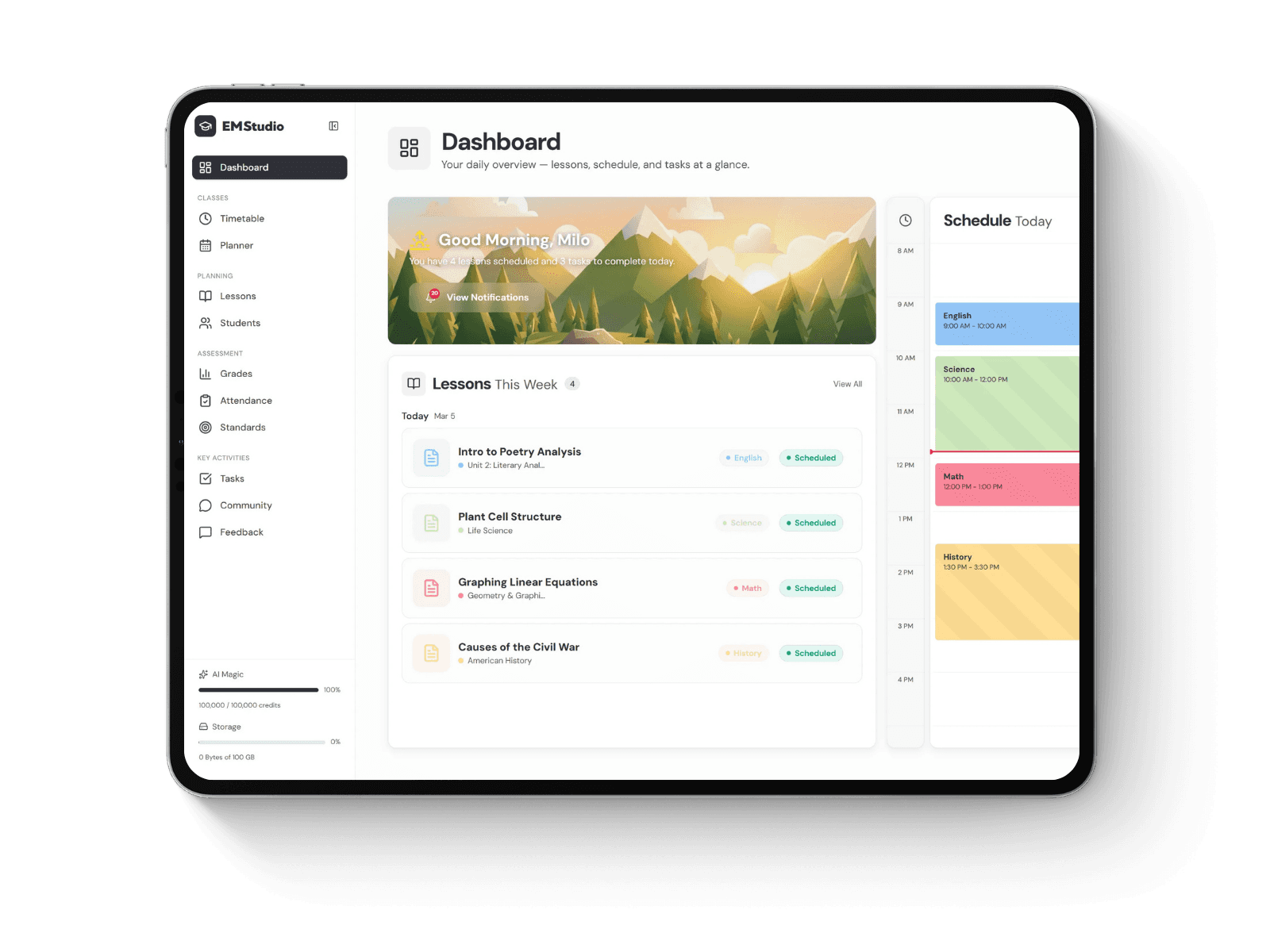
EMStudio is a free teaching management app — manage your classes, students, lessons, and more!
Learn More
Still grading everything by hand?
EMStudio is a free teaching management app — manage your classes, students, lessons, and more!
Learn More
Table of Contents
How NAPLAN reports English skills
NAPLAN tests literacy in four areas: reading, writing, spelling, and grammar and punctuation. The last two are grouped together as conventions of language. Each student's result is reported in one of four proficiency levels:
Exceeding: above what is expected at the time of testing.
Strong: meeting challenging but reasonable expectations for the year level.
Developing: working towards the expected level.
Needs additional support: not yet achieving the expected level, and likely to need extra help.
Because NAPLAN's scale was reset in 2023, results can be compared from 2023 onwards.
The 2026 English results at a glance
The table below shows the share of Australian students in the Developing or Needs additional support levels, meaning below the Strong level, in each English domain.
Below Strong, 2026 | Year 3 | Year 5 | Year 7 | Year 9 |
Reading | 32.3% | 27.2% | 31.6% | 36.2% |
Writing* | 24.0% | 32.6% | 35.9% | 38.4% |
Spelling | 36.2% | 28.3% | 25.8% | 26.9% |
Grammar and punctuation | 44.0% | 35.2% | 38.2% | 44.2% |
Source: ACARA, NAPLAN National Results 2026. *ACARA advises caution when interpreting 2026 writing results (see below).
ACARA's commentary notes that differences in average scores since 2023 were negligible across all domains and year levels. In other words, these gaps have been fairly stable over the past four years. They aren't closing on their own.
Grammar and punctuation is the biggest gap
Across every year level, grammar and punctuation has the highest share of students below the Strong level. In Year 9, 44.2% of students are in the Developing or Needs additional support levels, the highest share of any domain at any year level. In Year 3 it's 44.0%, and 16.3% of Year 3 students are in the Needs additional support level alone.
There's one figure worth watching. The share of Year 7 students in Needs additional support for grammar and punctuation rose from 10.6% in 2023 to 15.4% in 2026. ACARA considers national changes since 2023 negligible overall, but it's a reminder that this area needs attention.
Grammar and punctuation matter well beyond the test. They affect how clearly children can express ideas in every subject, from science reports to history essays. They also become more important in high school, when written assessments carry more weight. The good news is that they're skills that respond well to short, regular practice.
One guide to grammar practice games points to research showing that sentence-combining activities do more for writing quality than isolated grammar drills, which rarely carry over into students’ own writing.
Reading dips in the high school years
Reading is relatively strong in primary school. In Year 5, 70.9% of students are at the Strong level or above. By Year 9, that falls to 62.0%, with 36.2% of students below the Strong level.
That pattern makes sense. High school texts are longer and more complex, and they ask students to infer meaning, compare viewpoints and analyse how language is used, not just understand what happened. Students who were confident readers in primary school can find that shift challenging. Many children also read less for pleasure as they get older, which reduces the practice that builds comprehension.
Spelling is the strongest area
From Year 5 onwards, spelling is one of the strongest literacy domains, with around 70% or more of students at the Strong level or above. In Year 7, 72.5% of students are at Strong or above, and 24.1% are in the Exceeding level.
Year 3 is the exception. 36.2% of Year 3 students are below the Strong level in spelling, which reflects how much early readers are still developing their phonics and word knowledge.
Girls outperform boys in writing, and the gap widens
One of the clearest patterns in the 2026 results is the gender gap in writing. The share of students in the Exceeding level was higher for girls than boys at every year level:
Year 3: 9.6% of girls compared with 6.5% of boys
Year 5: 13.6% compared with 9.9%
Year 7: 21.6% compared with 13.6%
Year 9: 27.5% compared with 16.1%
In Year 9, girls' average writing score was 591.4, compared with 553.3 for boys. Girls also had a higher share of students at the Developing level or above in all four literacy domains, by 7.5 percentage points on average in Year 9.
For parents of boys in particular, this is a useful prompt. Writing confidence often depends on having something to say and a clear structure for saying it, and both can be built with practice.
A note on the 2026 writing results. ACARA has flagged that a technical issue with the assessment platform affected many Year 5, 7 and 9 students who sat the writing test on 11 March 2026. ACARA's analysis found national results were minimally affected and can be reported, but it advises caution when interpreting them.
Why NAPLAN 2027's timing matters
NAPLAN runs early in the school year. In 2027, the test window is Wednesday 10 March to Monday 22 March, about six weeks after most students return to school. With new teachers, new routines and a busy first term, there's little time to revisit last year's work before the tests.
NAPLAN isn't something children should cram for. It measures skills built over time. The best preparation is steady, low-pressure practice, and the summer holidays are an ideal time for it.
Holiday literacy ideas by year level
Short and regular works best, around 15 to 20 minutes a few times a week.
Heading into Year 3: Read aloud together every day and let your child read to you. Practise sounding out unfamiliar words, and look at how sentences start with capital letters and end with full stops or question marks. Year 3 writing is still done on paper, so some handwriting practice helps too.
Heading into Year 5: Encourage a mix of reading, such as novels, non-fiction and news written for kids. Practise commas in lists, apostrophes for contractions and ownership, and organising writing into paragraphs.
Heading into Year 7: Build persuasive and narrative writing skills with a clear structure: an introduction, well-developed body paragraphs and a conclusion. Talk about what your child reads by asking why the author made certain choices, not just what happened.
Heading into Year 9: Focus on persuasive writing, using evidence and varied sentence structures. Practise more advanced punctuation such as colons and semicolons. Reading longer and more challenging texts builds the stamina and inference skills that Year 9 reading requires.
For every year level: Students don't know in advance whether the NAPLAN writing task will be persuasive or narrative, so practising both is worthwhile. And keep reading enjoyable. The children who read most tend to build vocabulary, grammar and comprehension almost without noticing.
Where online English tutoring fits
For families who want more structure than home practice alone, online English tutoring can help. It's worth choosing an option that tailors learning to your child's actual level rather than their year level, and that includes real feedback on writing, not just automated quizzes.
Kinetic Education is an Australian online tutoring company founded in 1993, which has supported more than 100,000 Australian families. Itsonline English tutoring covers Foundation to Year 12, aligned to the Australian Curriculum.
Kinetic Education identifies each child's English skills and tailors their personalised weekly learning plan to their level. Children then work through short, interactive lessons at home, using pictures, animations, text and audio.
Each family is assigned a real Australian tutor who holds a current Working with Children Check. The tutor oversees your child's learning plan and progress. English tutors can also set extra writing tasks and give feedback on planning, structure, grammar, punctuation and clarity, which are exactly the areas where the 2026 NAPLAN results show students need the most support.
Kinetic Education is the #1 ranked provider in Tutoring & Kids Programs on ProductReview.com.au. Tutoring starts from $29 a week for the family, and new families can start with two weeks free.
How NAPLAN reports English skills
NAPLAN tests literacy in four areas: reading, writing, spelling, and grammar and punctuation. The last two are grouped together as conventions of language. Each student's result is reported in one of four proficiency levels:
Exceeding: above what is expected at the time of testing.
Strong: meeting challenging but reasonable expectations for the year level.
Developing: working towards the expected level.
Needs additional support: not yet achieving the expected level, and likely to need extra help.
Because NAPLAN's scale was reset in 2023, results can be compared from 2023 onwards.
The 2026 English results at a glance
The table below shows the share of Australian students in the Developing or Needs additional support levels, meaning below the Strong level, in each English domain.
Below Strong, 2026 | Year 3 | Year 5 | Year 7 | Year 9 |
Reading | 32.3% | 27.2% | 31.6% | 36.2% |
Writing* | 24.0% | 32.6% | 35.9% | 38.4% |
Spelling | 36.2% | 28.3% | 25.8% | 26.9% |
Grammar and punctuation | 44.0% | 35.2% | 38.2% | 44.2% |
Source: ACARA, NAPLAN National Results 2026. *ACARA advises caution when interpreting 2026 writing results (see below).
ACARA's commentary notes that differences in average scores since 2023 were negligible across all domains and year levels. In other words, these gaps have been fairly stable over the past four years. They aren't closing on their own.
Grammar and punctuation is the biggest gap
Across every year level, grammar and punctuation has the highest share of students below the Strong level. In Year 9, 44.2% of students are in the Developing or Needs additional support levels, the highest share of any domain at any year level. In Year 3 it's 44.0%, and 16.3% of Year 3 students are in the Needs additional support level alone.
There's one figure worth watching. The share of Year 7 students in Needs additional support for grammar and punctuation rose from 10.6% in 2023 to 15.4% in 2026. ACARA considers national changes since 2023 negligible overall, but it's a reminder that this area needs attention.
Grammar and punctuation matter well beyond the test. They affect how clearly children can express ideas in every subject, from science reports to history essays. They also become more important in high school, when written assessments carry more weight. The good news is that they're skills that respond well to short, regular practice.
One guide to grammar practice games points to research showing that sentence-combining activities do more for writing quality than isolated grammar drills, which rarely carry over into students’ own writing.
Reading dips in the high school years
Reading is relatively strong in primary school. In Year 5, 70.9% of students are at the Strong level or above. By Year 9, that falls to 62.0%, with 36.2% of students below the Strong level.
That pattern makes sense. High school texts are longer and more complex, and they ask students to infer meaning, compare viewpoints and analyse how language is used, not just understand what happened. Students who were confident readers in primary school can find that shift challenging. Many children also read less for pleasure as they get older, which reduces the practice that builds comprehension.
Spelling is the strongest area
From Year 5 onwards, spelling is one of the strongest literacy domains, with around 70% or more of students at the Strong level or above. In Year 7, 72.5% of students are at Strong or above, and 24.1% are in the Exceeding level.
Year 3 is the exception. 36.2% of Year 3 students are below the Strong level in spelling, which reflects how much early readers are still developing their phonics and word knowledge.
Girls outperform boys in writing, and the gap widens
One of the clearest patterns in the 2026 results is the gender gap in writing. The share of students in the Exceeding level was higher for girls than boys at every year level:
Year 3: 9.6% of girls compared with 6.5% of boys
Year 5: 13.6% compared with 9.9%
Year 7: 21.6% compared with 13.6%
Year 9: 27.5% compared with 16.1%
In Year 9, girls' average writing score was 591.4, compared with 553.3 for boys. Girls also had a higher share of students at the Developing level or above in all four literacy domains, by 7.5 percentage points on average in Year 9.
For parents of boys in particular, this is a useful prompt. Writing confidence often depends on having something to say and a clear structure for saying it, and both can be built with practice.
A note on the 2026 writing results. ACARA has flagged that a technical issue with the assessment platform affected many Year 5, 7 and 9 students who sat the writing test on 11 March 2026. ACARA's analysis found national results were minimally affected and can be reported, but it advises caution when interpreting them.
Why NAPLAN 2027's timing matters
NAPLAN runs early in the school year. In 2027, the test window is Wednesday 10 March to Monday 22 March, about six weeks after most students return to school. With new teachers, new routines and a busy first term, there's little time to revisit last year's work before the tests.
NAPLAN isn't something children should cram for. It measures skills built over time. The best preparation is steady, low-pressure practice, and the summer holidays are an ideal time for it.
Holiday literacy ideas by year level
Short and regular works best, around 15 to 20 minutes a few times a week.
Heading into Year 3: Read aloud together every day and let your child read to you. Practise sounding out unfamiliar words, and look at how sentences start with capital letters and end with full stops or question marks. Year 3 writing is still done on paper, so some handwriting practice helps too.
Heading into Year 5: Encourage a mix of reading, such as novels, non-fiction and news written for kids. Practise commas in lists, apostrophes for contractions and ownership, and organising writing into paragraphs.
Heading into Year 7: Build persuasive and narrative writing skills with a clear structure: an introduction, well-developed body paragraphs and a conclusion. Talk about what your child reads by asking why the author made certain choices, not just what happened.
Heading into Year 9: Focus on persuasive writing, using evidence and varied sentence structures. Practise more advanced punctuation such as colons and semicolons. Reading longer and more challenging texts builds the stamina and inference skills that Year 9 reading requires.
For every year level: Students don't know in advance whether the NAPLAN writing task will be persuasive or narrative, so practising both is worthwhile. And keep reading enjoyable. The children who read most tend to build vocabulary, grammar and comprehension almost without noticing.
Where online English tutoring fits
For families who want more structure than home practice alone, online English tutoring can help. It's worth choosing an option that tailors learning to your child's actual level rather than their year level, and that includes real feedback on writing, not just automated quizzes.
Kinetic Education is an Australian online tutoring company founded in 1993, which has supported more than 100,000 Australian families. Itsonline English tutoring covers Foundation to Year 12, aligned to the Australian Curriculum.
Kinetic Education identifies each child's English skills and tailors their personalised weekly learning plan to their level. Children then work through short, interactive lessons at home, using pictures, animations, text and audio.
Each family is assigned a real Australian tutor who holds a current Working with Children Check. The tutor oversees your child's learning plan and progress. English tutors can also set extra writing tasks and give feedback on planning, structure, grammar, punctuation and clarity, which are exactly the areas where the 2026 NAPLAN results show students need the most support.
Kinetic Education is the #1 ranked provider in Tutoring & Kids Programs on ProductReview.com.au. Tutoring starts from $29 a week for the family, and new families can start with two weeks free.
Still grading everything by hand?
EMStudio is a free teaching management app — manage your classes, students, lessons, and more!
Learn More
Still grading everything by hand?
EMStudio is a free teaching management app — manage your classes, students, lessons, and more!
Learn More


Notion4Teachers
Notion templates to simplify administrative tasks and enhance your teaching experience.



2026 Notion4Teachers. All Rights Reserved.
Notion4Teachers
Notion templates to simplify administrative tasks and enhance your teaching experience.
2026 Notion4Teachers. All Rights Reserved.
Notion4Teachers
Notion templates to simplify administrative tasks and enhance your teaching experience.
2026 Notion4Teachers. All Rights Reserved.